REVIEW 2 major objections 1 minor 47 references
A technical report on the surface-energy and morphology-based screening for electrode/electrolyte interface compatibility in SOFC/ReSOC materials
T0 review · 2 major / 1 minor · reviewed 2026-07-01 · grok-4.3
Pith's one-line read Surface energy and roughness metrics screen electrode-electrolyte pairs for solid oxide cells
desk verdict This is a methods proposal for pre-screening SOFC interfaces via contact angles and roughness, but it contains no data, no populated matrix, and no validation against performance metrics. read the letter →
The pith
A machine-rendered reading of the paper's core claim, the machinery that carries it, and where it could break.
The reading
What carries the argument
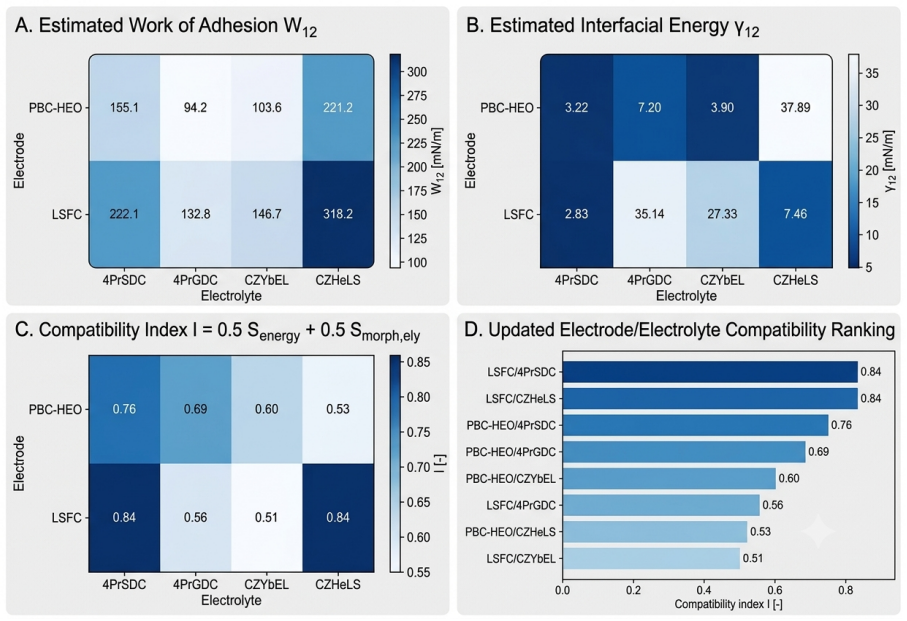
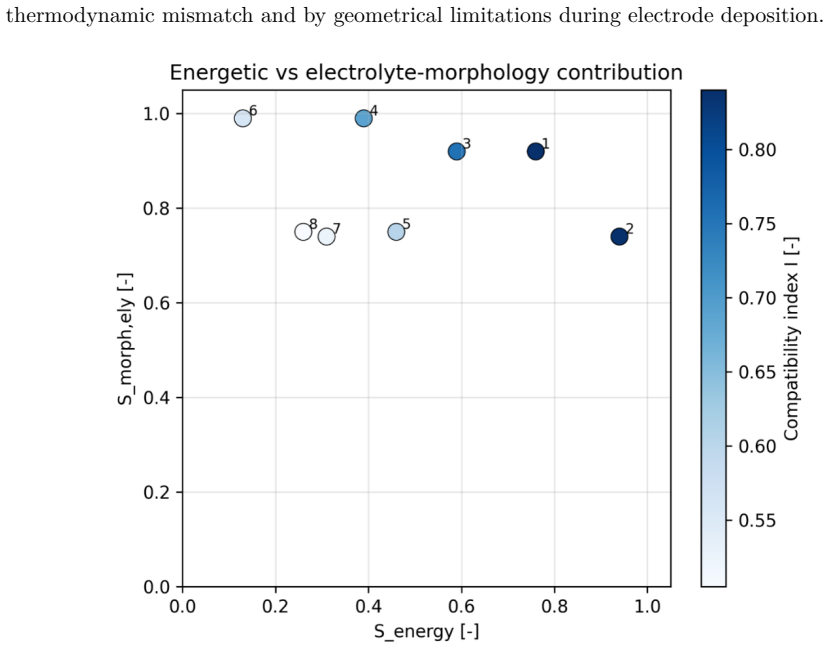
A compatibility matrix that combines energetic affinity (from surface free energy components) with morphological suitability (from roughness parameters) focused on the electrolyte as deposition substrate.
What would settle it
Rank several electrode-electrolyte pairs with the matrix, then run electrochemical impedance spectroscopy, area-specific resistance and durability tests on the top and bottom pairs to check whether measured performance follows the predicted ranking.
Extended reading notes
Core claim
The most promising interfaces are not necessarily those with the highest surface free energy, but those combining high adhesion work, low interfacial energy and a substrate morphology suitable for continuous electrode deposition.
Load-bearing premise
Surface free energy components from contact angles with two liquids plus standard roughness parameters are enough to predict long-term interface compatibility and electrode deposition quality.
Editorial extensions
If this is right
- The matrix can prioritize material pairs for full electrochemical validation and thereby reduce the number of expensive tests required.
- Surface chemistry and topography become connected inputs in a single framework for interface formation.
- The method supplies a rational filter that can be applied early in the development of new solid oxide cell materials.
Reading between the lines
- The same surface descriptors could be fed into atomistic simulations to screen additional pairings computationally before any experiments.
- Adding temperature dependence to the surface energy terms would test whether the screening remains valid under operating conditions.
- The approach might transfer to other solid-state ion-conducting devices where electrode deposition quality limits performance.
Signed reviews
Editorial analysis
A structured set of objections, weighed in public.
Referee Report
Summary. The manuscript proposes a surface-based screening methodology for electrode/electrolyte interface compatibility in SOFC/ReSOC materials. Contact-angle data with water and glycerol are processed via the Owens-Wendt-Rabel-Kaelble method to obtain dispersive and polar surface-energy components; confocal topography supplies ISO 25178 roughness parameters. These are combined into a compatibility matrix that ranks pairs by work of adhesion, interfacial energy, and morphological suitability for continuous electrode deposition on the electrolyte substrate. The central claim is that the most promising interfaces are those satisfying the combined criteria rather than those with the highest total surface free energy alone; the matrix is positioned as a pre-electrochemical prioritization tool.
Significance. If the surface descriptors were shown to correlate with measured adhesion, contact resistance, or durability, the approach could offer a low-cost, physically motivated filter to reduce the number of pairs requiring full electrochemical testing. No such correlation is reported, so the practical significance remains prospective.
major comments (2)
- [Abstract] Abstract: the assertion that 'the most promising interfaces are not necessarily those with the highest surface free energy, but those combining high adhesion work, low interfacial energy and a substrate morphology suitable for continuous electrode deposition' is presented as a result of the study, yet the manuscript supplies neither the numerical rankings nor any comparison of those rankings against independent performance metrics (adhesion strength, ASR, electrical contact resistance, or long-term stability).
- [Abstract] Abstract and methods description: the compatibility matrix is described only at the level of 'combining energetic affinity and morphological suitability'; no explicit weighting, normalization, or decision rule is given, so it is impossible to determine whether the claimed superiority over simple surface-energy ranking follows from the chosen parameters or from an untested modeling assumption.
minor comments (1)
- [Abstract] The abstract states that the method 'does not replace electrochemical characterization' but then claims to identify 'most promising' interfaces; this tension should be resolved by explicit qualification of the predictive scope.
Simulated Author's Rebuttal
We thank the referee for the constructive comments on our technical report. The work proposes a surface-based screening methodology as a pre-electrochemical prioritization tool rather than a validated predictor of device performance. We address each major comment below and will revise the manuscript accordingly.
read point-by-point responses
-
Referee: [Abstract] Abstract: the assertion that 'the most promising interfaces are not necessarily those with the highest surface free energy, but those combining high adhesion work, low interfacial energy and a substrate morphology suitable for continuous electrode deposition' is presented as a result of the study, yet the manuscript supplies neither the numerical rankings nor any comparison of those rankings against independent performance metrics (adhesion strength, ASR, electrical contact resistance, or long-term stability).
Authors: We agree that the abstract presents the conclusion without sufficient qualification. The numerical surface-energy components, work-of-adhesion values, interfacial energies, and ISO 25178 parameters are reported in the results section and used to identify the ranked pairs; however, the manuscript does not contain any direct comparison against independent metrics such as adhesion strength or ASR. This absence is consistent with the stated scope of the work as a low-cost, physically motivated filter to reduce the number of pairs requiring full electrochemical testing. We will revise the abstract to state explicitly that the indicated ranking derives solely from the computed OWRK and topography descriptors and to note the lack of electrochemical validation in the present study. revision: yes
-
Referee: [Abstract] Abstract and methods description: the compatibility matrix is described only at the level of 'combining energetic affinity and morphological suitability'; no explicit weighting, normalization, or decision rule is given, so it is impossible to determine whether the claimed superiority over simple surface-energy ranking follows from the chosen parameters or from an untested modeling assumption.
Authors: We acknowledge that the current description of the compatibility matrix is high-level. The full manuscript applies the matrix by ranking pairs according to thresholds on work of adhesion, interfacial energy, and selected ISO 25178 parameters (e.g., skewness and slope for deposition continuity), but does not detail the normalization procedure, relative weights, or composite-score cutoff. To resolve the ambiguity, we will add an explicit subsection in the methods that specifies min-max normalization of each component, equal weighting between the energetic and morphological scores, and the decision rule used to designate a pair as 'promising'. This addition will allow readers to reproduce the ranking and evaluate whether the reported ordering arises from the surface parameters themselves. revision: yes
Circularity Check
No significant circularity; experimental screening procedure with direct computation from measurements
full rationale
The paper presents an experimental methodology using contact-angle data processed via the established OWRK method and ISO 25178 roughness parameters to construct a compatibility matrix. No equations, fitted parameters, or self-citations are shown that reduce the output rankings or 'most promising' designation to the inputs by construction. The central claim is a direct consequence of applying standard surface-energy formulas and morphological metrics to measured data, without any predictive step that loops back to the same quantities. This is a standard empirical screening workflow and does not match any of the enumerated circularity patterns.
Assumptions & free parameters
assumptions (1)
- domain assumption The Owens-Wendt-Rabel-Kaelble method correctly decomposes total surface free energy into dispersive and polar components from contact angles with water and glycerol.
Cite this review
Pith. "Pith review of A technical report on the surface-energy and morphology-based screening for electrode/electrolyte interface compatibility in SOFC/ReSOC materials." pith.science (2026). https://pith.science/paper/EJGMP6BU
@misc{pith2026260631828,
  author       = {Pith},
  title        = {Pith review of: A technical report on the surface-energy and morphology-based screening for electrode/electrolyte interface compatibility in SOFC/ReSOC materials},
  year         = {2026},
  howpublished = {\url{https://pith.science/paper/EJGMP6BU}},
  note         = {Machine review of arXiv:2606.31828}
}
read the original abstract
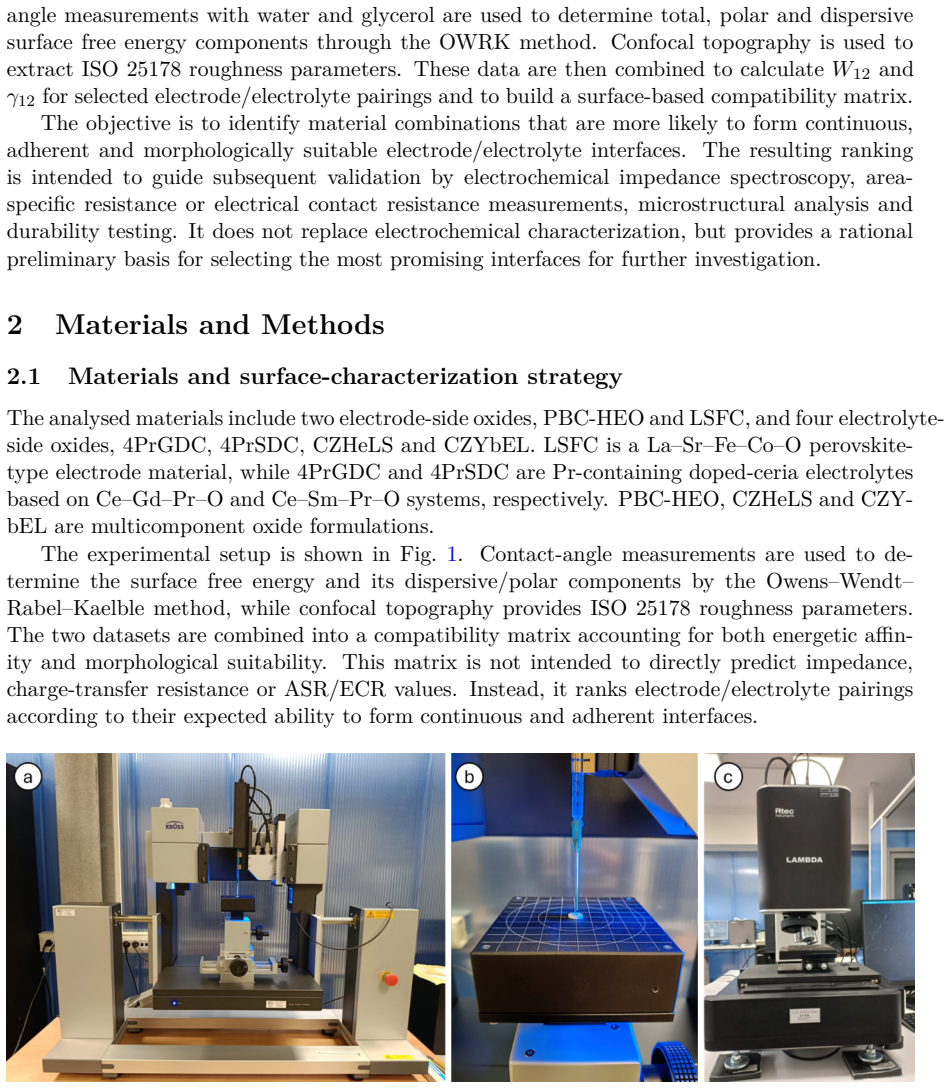
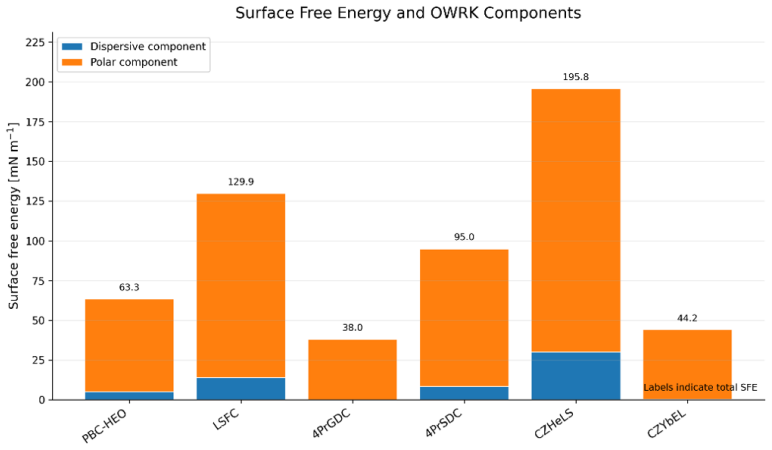
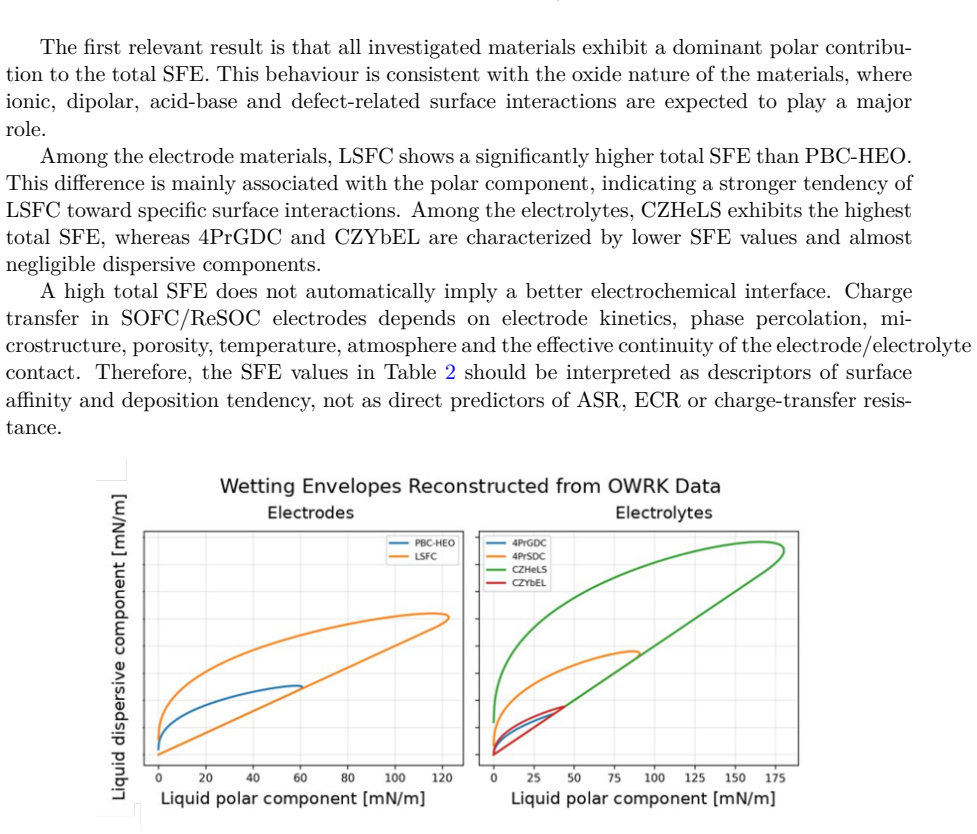
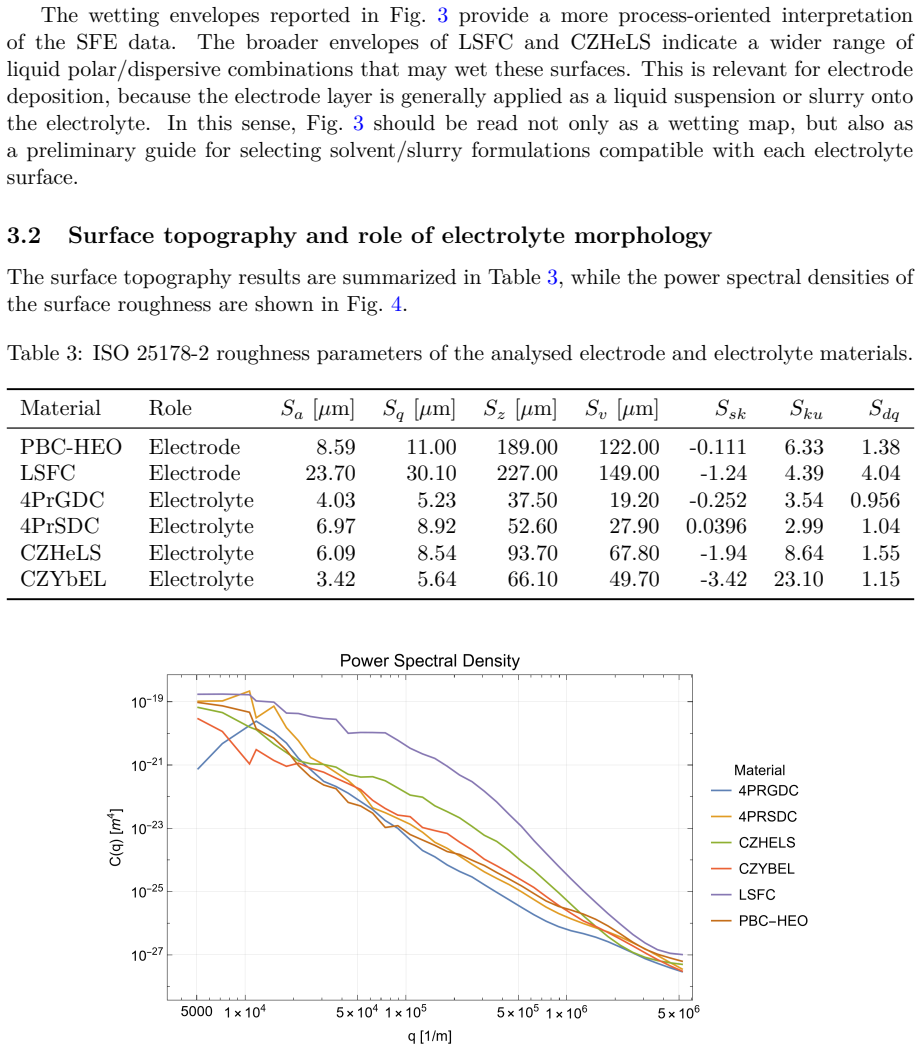
The performance and durability of solid oxide fuel cells and reversible solid oxide cells are strongly affected by the electrode-electrolyte interface, where charge transfer, ionic transport, adhesion, morphology and thermomechanical stability interact. Early-stage compatibility screening is usually based on electrochemical or compositional criteria, whereas surface-related descriptors are rarely included in a unified framework. This work proposes a surface-based methodology to assess the expected compatibility of candidate electrode-electrolyte pairings. Contact-angle measurements with water and glycerol are used to determine total, dispersive and polar surface free energy components through the Owens-Wendt-Rabel-Kaelble method. Confocal topography is used to extract ISO 25178 roughness parameters, including average roughness, peak-to-valley height, valley depth, skewness, kurtosis and surface slope. A compatibility matrix is constructed by combining energetic affinity and morphological suitability, with emphasis on the electrolyte surface, since the electrode is deposited directly onto the electrolyte substrate. The results indicate that the most promising interfaces are not necessarily those with the highest surface free energy, but those combining high adhesion work, low interfacial energy and a substrate morphology suitable for continuous electrode deposition. The proposed approach provides a rational pre-electrochemical screening tool to prioritize electrode-electrolyte combinations for subsequent validation by electrochemical impedance spectroscopy, area specific resistance, electrical contact resistance, microstructural analysis and durability testing. Although it does not replace electrochemical characterization, it offers a physically grounded way to connect surface chemistry, topography and interface formation in solid oxide cell materials.
Figures
Figures from the paper (3 more)
Reference graph
Works this paper leans on
-
[1]
N. Q. Minh, “Ceramic fuel cells,”Journal of the American Ceramic Society, 76, 563–588, 1993
work page 1993
-
[2]
Materials for fuel-cell technologies,
B. C. H. Steele and A. Heinzel, “Materials for fuel-cell technologies,”Nature, 414, 345–352, 2001
work page 2001
-
[3]
Advances in solid oxide fuel cell technology,
S. C. Singhal, “Advances in solid oxide fuel cell technology,”Solid State Ionics, 135, 305– 313, 2000
work page 2000
-
[4]
A. B. Stambouli and E. Traversa, “Solid oxide fuel cells (SOFCs): a review of an environ- mentally clean and efficient source of energy,”Renewable and Sustainable Energy Reviews, 6, 433–455, 2002
work page 2002
-
[5]
A review of numerical modeling of solid oxide fuel cells,
S. Kakaç, A. Pramuanjaroenkij and X. Y. Zhou, “A review of numerical modeling of solid oxide fuel cells,”International Journal of Hydrogen Energy, 32, 761–786, 2007
work page 2007
-
[6]
Math- ematical modeling of solid oxide fuel cells: a review,
S. A. Hajimolana, M. A. Hussain, W. M. A. W. Daud, M. Soroush and A. Shamiri, “Math- ematical modeling of solid oxide fuel cells: a review,”Renewable and Sustainable Energy Reviews, 15, 1893–1917, 2011
work page 1917
-
[7]
A review on solid oxide fuel cell dura- bility: latest progress, mechanisms, and study tools,
S. Zarabi Golkhatmi, M. I. Asghar and P. D. Lund, “A review on solid oxide fuel cell dura- bility: latest progress, mechanisms, and study tools,”Renewable and Sustainable Energy Reviews, 161, 112339, 2022
work page 2022
-
[8]
Review: failuremechanismsofsolidoxidefuelcells,
K.ChenandS.P.Jiang, “Review: failuremechanismsofsolidoxidefuelcells,”International Journal of Hydrogen Energy, 36, 10541–10549, 2011
work page 2011
Show all 47 references
-
[9]
Recent advances in high temperature electrolysis using solid oxide fuel cells: a review,
M. A. Laguna-Bercero, “Recent advances in high temperature electrolysis using solid oxide fuel cells: a review,”Journal of Power Sources, 203, 4–16, 2012
2012
-
[10]
High temperature electrolysis in alkaline cells, solid proton conducting cells, and solid oxide cells,
S. D. Ebbesen, S. H. Jensen, A. Hauch and M. B. Mogensen, “High temperature electrolysis in alkaline cells, solid proton conducting cells, and solid oxide cells,”Chemical Reviews, 114, 10697–10734, 2014
2014
-
[11]
Advanced anodes for high-temperature fuel cells,
A. Atkinson et al., “Advanced anodes for high-temperature fuel cells,”Nature Materials, 3, 17–27, 2004
2004
-
[12]
Nickel coarsening in annealed Ni/8YSZ anode sub- strates for solid oxide fuel cells,
D. Simwonis, F. Tietz and D. Stöver, “Nickel coarsening in annealed Ni/8YSZ anode sub- strates for solid oxide fuel cells,”Solid State Ionics, 132, 241–251, 2000
2000
-
[13]
Solid oxide electrolysis cells: microstructure and degradation of the Ni/YSZ electrode,
A. Hauch, S. D. Ebbesen, S. H. Jensen and M. Mogensen, “Solid oxide electrolysis cells: microstructure and degradation of the Ni/YSZ electrode,”Journal of The Electrochemical Society, 155, B1184–B1193, 2008
2008
-
[14]
Development of lanthanum strontium manganite perovskite cathode materials of solid oxide fuel cells: a review,
S. P. Jiang, “Development of lanthanum strontium manganite perovskite cathode materials of solid oxide fuel cells: a review,”Journal of Materials Science, 43, 6799–6833, 2008
2008
-
[15]
A high-performance cathode for the next generation of solid-oxide fuel cells,
Z. Shao and S. M. Haile, “A high-performance cathode for the next generation of solid-oxide fuel cells,”Nature, 431, 170–173, 2004. 12
2004
-
[16]
Factors governing oxygen reduction in solid oxide fuel cell cathodes,
S. B. Adler, “Factors governing oxygen reduction in solid oxide fuel cell cathodes,”Chemical Reviews, 104, 4791–4843, 2004
2004
-
[17]
Fundamental mechanisms limiting solid oxide fuel cell durability,
H. Yokokawa, H. Tu, B. Iwanschitz and A. Mai, “Fundamental mechanisms limiting solid oxide fuel cell durability,”Journal of Power Sources, 182, 400–412, 2008
2008
-
[18]
Micro-modelling of solid oxide fuel cell elec- trodes,
P. Costamagna, P. Costa and V. Antonucci, “Micro-modelling of solid oxide fuel cell elec- trodes,”Electrochimica Acta, 43, 375–394, 1998
1998
-
[19]
The role of electrode microstructure on activation and concentration polarizations in solid oxide fuel cells,
A. V. Virkar, J. Chen, C. W. Tanner and J.-W. Kim, “The role of electrode microstructure on activation and concentration polarizations in solid oxide fuel cells,”Solid State Ionics, 131, 189–198, 2000
2000
-
[20]
Three-dimensional reconstruction of a solid-oxide fuel-cell anode,
J. R. Wilson et al., “Three-dimensional reconstruction of a solid-oxide fuel-cell anode,” Nature Materials, 5, 541–544, 2006
2006
-
[21]
High accuracy interface characterization of three phase material systems in three dimensions,
P. S. Jørgensen, K. V. Hansen, R. Larsen and J. R. Bowen, “High accuracy interface characterization of three phase material systems in three dimensions,”Journal of Power Sources, 195, 8168–8176, 2010
2010
-
[22]
Heterogeneous electrocatalysis in porous cathodes of solid oxide fuel cells,
Y. Fu et al., “Heterogeneous electrocatalysis in porous cathodes of solid oxide fuel cells,” Journal of The Electrochemical Society, 162, F613–F621, 2015
2015
-
[23]
Engineering porous materials for fuel cell applications,
N. P. Brandon and D. J. L. Brett, “Engineering porous materials for fuel cell applications,” Philosophical Transactions of the Royal Society A, 364, 147–159, 2006
2006
-
[24]
Quantitative evaluation of transport properties of solid oxide fuel cell porous anodes based on focused ion beam and scanning electron microscope reconstruction,
M. Kishimoto, H. Iwai, M. Saito and H. Yoshida, “Quantitative evaluation of transport properties of solid oxide fuel cell porous anodes based on focused ion beam and scanning electron microscope reconstruction,”Journal of Power Sources, 196, 4555–4563, 2011
2011
-
[25]
Ni coarsening in the three-phase solid oxide fuel cell anode: a phase-field simulation study,
H.-Y. Chen et al., “Ni coarsening in the three-phase solid oxide fuel cell anode: a phase-field simulation study,”Journal of Power Sources, 196, 1333–1337, 2011
2011
-
[26]
Crack formation in ceramic films used in solid oxide fuel cells,
X. Wang, Z. Chen and A. Atkinson, “Crack formation in ceramic films used in solid oxide fuel cells,”Journal of the European Ceramic Society, 35, 391–397, 2015
2015
-
[27]
Electrochemical performance of LSCF based thin film cathodes prepared by spray pyrolysis,
D. Beckel et al., “Electrochemical performance of LSCF based thin film cathodes prepared by spray pyrolysis,”Solid State Ionics, 178, 407–415, 2007
2007
-
[28]
The influence of electrodes on the strength of planar zirconia solid oxide fuel cells,
A. Selçuk, G. Merere and A. Atkinson, “The influence of electrodes on the strength of planar zirconia solid oxide fuel cells,”Journal of Materials Science, 36, 1173–1182, 2001
2001
-
[29]
A linear Kronig–Kramers transform test for immittance data validation,
B. A. Boukamp, “A linear Kronig–Kramers transform test for immittance data validation,” Journal of The Electrochemical Society, 142, 1885–1894, 1995
1995
-
[30]
Reversible solid oxide cells,
M. Mogensen et al., “Reversible solid oxide cells,”Clean Energy, 3, 175–201, 2019
2019
-
[31]
Degradation studies of ceria-based solid oxide fuel cells at intermediate temperature under various load conditions,
Y.-D. Kim et al., “Degradation studies of ceria-based solid oxide fuel cells at intermediate temperature under various load conditions,”Journal of Power Sources, 452, 227758, 2020
2020
-
[32]
A review of redox cycling of solid oxide fuel cells anode,
A. Faes, A. Hessler-Wyser, A. Zryd and J. Van Herle, “A review of redox cycling of solid oxide fuel cells anode,”Membranes, 2, 585–664, 2012
2012
-
[33]
The phenomena of rupture and flow in solids,
A. A. Griffith, “The phenomena of rupture and flow in solids,”Philosophical Transactions of the Royal Society A, 221, 163–198, 1921
1921
-
[34]
Analysis of stresses and strains near the end of a crack traversing a plate,
G. R. Irwin, “Analysis of stresses and strains near the end of a crack traversing a plate,” Journal of Applied Mechanics, 24, 361–364, 1957. 13
1957
-
[35]
Porous LSCF/dense 3YSZ interface fracture toughness measured by single cantilever beam wedge test,
X. Wang, F. He, Z. Chen and A. Atkinson, “Porous LSCF/dense 3YSZ interface fracture toughness measured by single cantilever beam wedge test,” preprint/article version, 2015
2015
-
[36]
An essay on the cohesion of fluids,
T. Young, “An essay on the cohesion of fluids,”Philosophical Transactions of the Royal Society of London, 95, 65–87, 1805
-
[37]
Attractive forces at interfaces,
F. M. Fowkes, “Attractive forces at interfaces,”Industrial & Engineering Chemistry, 56, 40–52, 1964
1964
-
[38]
Estimation of the surface free energy of polymers,
D. K. Owens and R. C. Wendt, “Estimation of the surface free energy of polymers,”Journal of Applied Polymer Science, 13, 1741–1747, 1969
1969
-
[39]
Dispersion-polar surface tension properties of organic solids,
D. H. Kaelble, “Dispersion-polar surface tension properties of organic solids,”Journal of Adhesion, 2, 66–81, 1970
1970
-
[40]
Einige Aspekte der Benetzungstheorie und ihre Anwendung auf die Unter- suchung und Veränderung der Oberflächeneigenschaften von Polymeren,
W. Rabel, “Einige Aspekte der Benetzungstheorie und ihre Anwendung auf die Unter- suchung und Veränderung der Oberflächeneigenschaften von Polymeren,”Farbe und Lack, 77, 997–1005, 1971
1971
-
[41]
Wetting: statics and dynamics,
P. G. de Gennes, “Wetting: statics and dynamics,”Reviews of Modern Physics, 57, 827–863, 1985
1985
-
[42]
Resistance of solid surfaces to wetting by water,
R. N. Wenzel, “Resistance of solid surfaces to wetting by water,”Industrial & Engineering Chemistry, 28, 988–994, 1936
1936
-
[43]
Wettability of porous surfaces,
A. B. D. Cassie and S. Baxter, “Wettability of porous surfaces,”Transactions of the Faraday Society, 40, 546–551, 1944
1944
-
[44]
Wetting and roughness,
D. Quéré, “Wetting and roughness,”Annual Review of Materials Research, 38, 71–99, 2008
2008
-
[45]
Tailoring the surface energy and area surface resistance of solid-electrolyte polymer membrane for dendrite-free, high-performance, and safe solid-state Li-batteries,
B. P. Dubey, A. Sahoo and Y. Sharma, “Tailoring the surface energy and area surface resistance of solid-electrolyte polymer membrane for dendrite-free, high-performance, and safe solid-state Li-batteries,”Journal of Power Sources, 541, 231690, 2022
2022
-
[46]
Interfaces and interphases in all- solid-state batteries with inorganic solid electrolytes,
A. Banerjee, X. Wang, C. Fang, E. A. Wu and Y. S. Meng, “Interfaces and interphases in all- solid-state batteries with inorganic solid electrolytes,”Chemical Reviews, 120, 6878–6933, 2020
2020
-
[47]
Overcoming the interfacial limitations imposed by the solid–solid interface in solid-state batteries using ionic liquid-based interlayers,
S. A. Pervez et al., “Overcoming the interfacial limitations imposed by the solid–solid interface in solid-state batteries using ionic liquid-based interlayers,”Small, 16, 2000279, 2020. 14
2020
Reviewed July 1, 2026 · model on record in the stance chip above.
Discussion (0). Continue with ORCID to comment.