Automatic quantum function parallelization and memory management in Qrisp
Pith reviewed 2026-07-01 05:14 UTC · model grok-4.3
The pith
The permeability DAG representation captures commutation relations to enable automatic parallelization and memory management in quantum programs.
A machine-rendered reading of the paper's core claim, the machinery that carries it, and where it could break.
Core claim
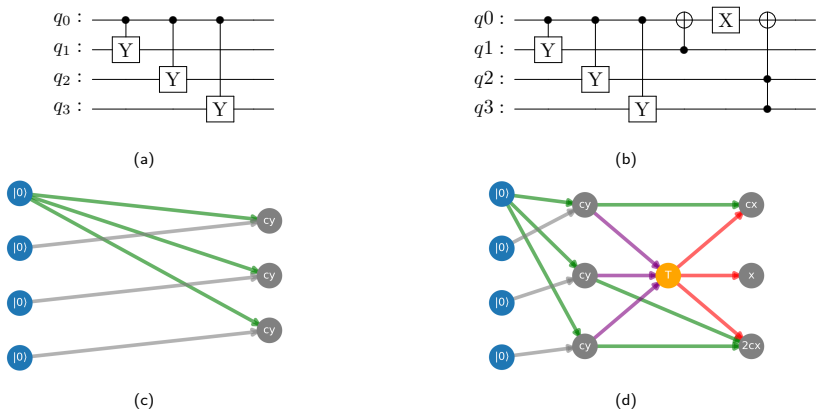
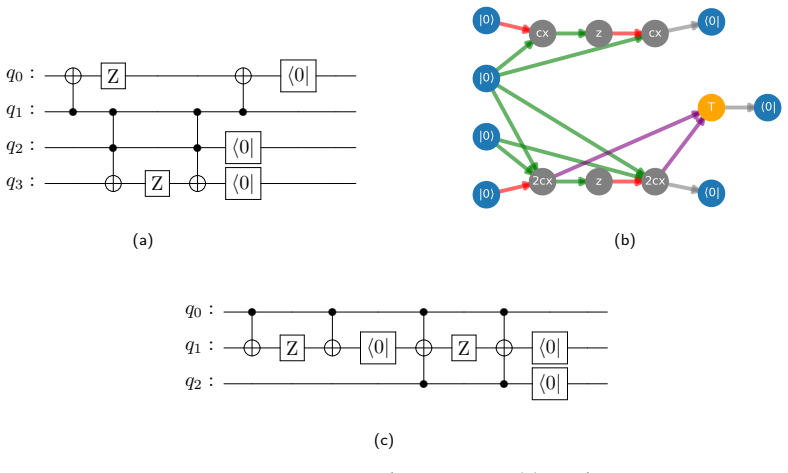
The permeability DAG is introduced as a novel data-structure for representing quantum programs. It captures several useful properties across multiple levels of abstraction by abstracting away a class of non-trivial commutation relations that stem from permeability. Operating on this representation facilitates automatic parallelization, memory management, and synthesis of uncomputation. Memory management and parallelization can both be made sensitive to the execution speed details of each particular quantum gate, so the compilation methods are retargetable between NISQ and fault-tolerant regimes and even for individual device instances.
What carries the argument
The permeability DAG, a data structure that abstracts non-trivial commutation relations stemming from the permeability feature to enable program transformations across abstraction levels.
If this is right
- Quantum functions can be parallelized automatically without manual scheduling.
- Memory allocation and deallocation in quantum programs can be handled by the compiler.
- Uncomputation steps can be synthesized rather than written by hand.
- The same compilation pipeline works for both NISQ and fault-tolerant targets and for device-specific gate timings.
Where Pith is reading between the lines
- The DAG representation may support additional transformations such as resource estimation or error mitigation not detailed in the work.
- Adoption could reduce the expertise barrier for writing efficient quantum code by shifting optimization work to the compiler.
- Similar permeability-style abstractions might apply to classical reversible computing or hybrid quantum-classical workflows.
Load-bearing premise
The permeability property accurately abstracts all relevant non-trivial commutation relations across abstraction levels without introducing errors in the resulting transformations.
What would settle it
Take a quantum program with known correct output statistics, apply the automatic parallelization and memory-management transformations, and check whether the resulting circuit produces identical statistics or whether commutation errors appear.
Figures
read the original abstract
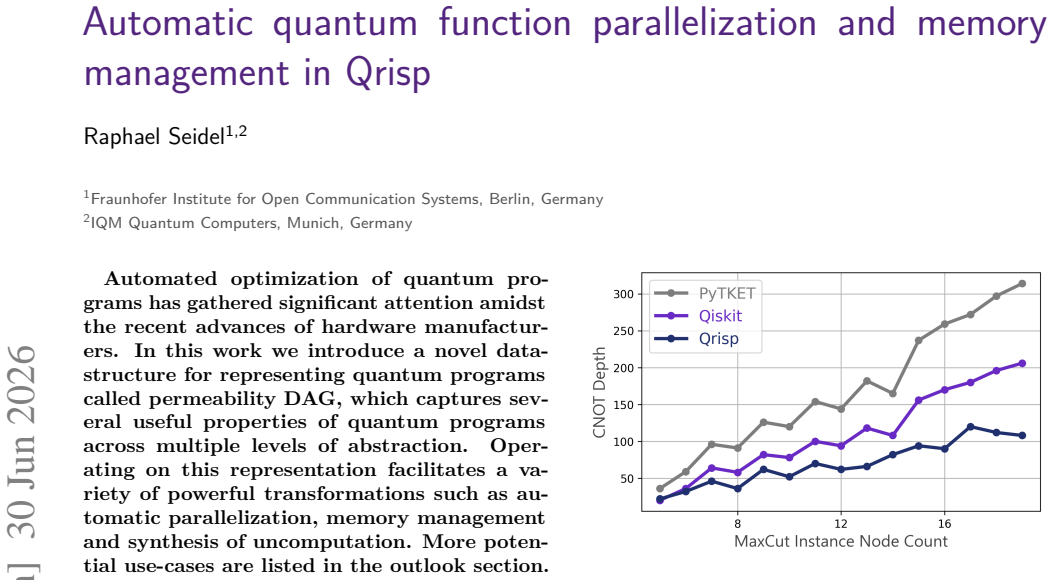
Automated optimization of quantum programs has gathered significant attention amidst the recent advances of hardware manufacturers. In this work we introduce a novel data-structure for representing quantum programs called permeability DAG, which captures several useful properties of quantum programs across multiple levels of abstraction. Operating on this representation facilitates a variety of powerful transformations such as automatic parallelization, memory management and synthesis of uncomputation. More potential use-cases are listed in the outlook section. At the core, our representation abstracts away a class of non-trivial commutation relations, which stem from a feature called permeability. Both memory management and parallelization can be made sensitive to execution speed details of each particular quantum gate, implying our compilation methods are not only retargetable between NISQ/FT but even for individual device instances.
Editorial analysis
A structured set of objections, weighed in public.
Referee Report
Summary. The paper introduces a permeability DAG data structure for representing quantum programs in the Qrisp framework. This representation abstracts non-trivial commutation relations arising from a permeability feature across multiple abstraction levels. The authors claim that operating on this DAG enables automatic parallelization, memory management, and synthesis of uncomputation, with the methods being sensitive to individual gate execution speeds for retargetability across NISQ/FT regimes and even specific devices.
Significance. If the permeability DAG is shown to correctly capture the relevant commutation relations and the transformations are proven semantics-preserving, the work could provide a unified, retargetable approach to quantum program optimization that reduces manual effort in compilation. The device-instance sensitivity and multi-level abstraction are potentially valuable strengths if supported by concrete implementations and examples.
major comments (2)
- Abstract: The central claim that the permeability DAG facilitates automatic parallelization, memory management, and uncomputation synthesis rests on the assertion that it accurately abstracts commutation relations, but no formal definition of permeability, construction of the DAG, or proof of semantic preservation is provided, preventing verification of the weakest assumption that the abstraction introduces no errors.
- Abstract (outlook section reference): No concrete examples, benchmarks, or correctness arguments are supplied to demonstrate that the claimed transformations are load-bearing or achieve the stated benefits over existing quantum compilation techniques.
minor comments (2)
- Abstract: The term 'permeability' is introduced without an inline definition or reference to its prior use in the quantum computing literature, which would aid readability.
- Abstract: Claims of retargetability 'even for individual device instances' would benefit from a brief illustration of how gate speed details are incorporated into the DAG.
Simulated Author's Rebuttal
We thank the referee for their review and the opportunity to address the concerns regarding the permeability DAG representation. We respond to each major comment below.
read point-by-point responses
-
Referee: Abstract: The central claim that the permeability DAG facilitates automatic parallelization, memory management, and uncomputation synthesis rests on the assertion that it accurately abstracts commutation relations, but no formal definition of permeability, construction of the DAG, or proof of semantic preservation is provided, preventing verification of the weakest assumption that the abstraction introduces no errors.
Authors: We acknowledge that the current manuscript introduces the permeability DAG primarily via its operational properties and examples rather than a standalone formal treatment. A formal definition of permeability (building on its prior introduction in the Qrisp framework), the precise DAG construction algorithm, and a semantic-preservation argument will be added in a dedicated section of the revised manuscript to enable independent verification. revision: yes
-
Referee: Abstract (outlook section reference): No concrete examples, benchmarks, or correctness arguments are supplied to demonstrate that the claimed transformations are load-bearing or achieve the stated benefits over existing quantum compilation techniques.
Authors: The main text already contains illustrative examples of the DAG enabling parallelization and memory management, and the outlook lists further directions. We agree, however, that quantitative benchmarks, direct comparisons to existing compilers, and explicit correctness arguments for the transformations are currently limited. The revision will expand the examples, add a correctness argument, and include preliminary benchmark results. revision: partial
Circularity Check
No significant circularity; novel representation introduced without self-referential derivation
full rationale
The paper introduces a permeability DAG as a novel data structure that abstracts commutation relations stemming from permeability. The transformations (automatic parallelization, memory management, uncomputation synthesis) are described as facilitated by operating on this representation, with no equations, fitted parameters, or self-citations presented as load-bearing. No derivation chain reduces a claimed result to its own inputs by construction; the work is self-contained as the definition and application of a new abstraction layer. This matches the default case of an honest non-finding.
Axiom & Free-Parameter Ledger
invented entities (1)
-
permeability DAG
no independent evidence
Reference graph
Works this paper leans on
-
[1]
Logical quantum proces- sor based on reconfigurable atom arrays
Dolev Bluvstein, Simon J. Evered, and Alexan- dra A. et al. Geim. “Logical quantum proces- sor based on reconfigurable atom arrays”. Nature 626, 58–65 (2023)
2023
-
[2]
Demonstration of logical qubits and repeated error correction with better-than-physical error rates
M. P. da Silva, C. Ryan-Anderson, and J. M. Bello-Rivas et al. “Demonstration of logical qubits and repeated error correction with better-than-physical error rates” (2024). arXiv:2404.02280
work page internal anchor Pith review Pith/arXiv arXiv 2024
-
[3]
Scalable, high-fidelity all- electronic control of trapped-ion qubits
C. M. Löschnauer, J. Mosca Toba, and A. C. Hugheset et al. “Scalable, high-fidelity all- electronic control of trapped-ion qubits” (2024). arXiv:2407.07694
-
[4]
Qrisp: A framework for compilable high-level programming of gate-based quantum computers
Raphael Seidel, Sebastian Bock, and René Zan- der et al. “Qrisp: A framework for compilable high-level programming of gate-based quantum computers” (2024). arXiv:2406.14792
-
[5]
A Quantum Approximate Optimization Algorithm
Edward Farhi, Jeffrey Goldstone, and Sam Gut- mann. “A quantum approximate optimization al- gorithm” (2014). arXiv:1411.4028
work page internal anchor Pith review Pith/arXiv arXiv 2014
-
[6]
Random Graphs
E. N. Gilbert. “Random Graphs”. The Annals of Mathematical Statistics30, 1141 – 1144 (1959)
1959
-
[7]
Unqomp: synthesizing uncom- putation in quantum circuits
Anouk Paradis, Benjamin Bichsel, and Samuel et al. Steffen. “Unqomp: synthesizing uncom- putation in quantum circuits”. In Proceedings of the 42nd ACM SIGPLAN International Con- ference on Programming Language Design and Implementation. Page 222–236. PLDI 2021New York, NY, USA (2021). Association for Comput- ing Machinery
2021
-
[8]
Uncomputation in the Qrisp high-level quantum programming frame- work
Raphael Seidel, Nikolay Tcholtchev, and Se- bastian et al. Bock. “Uncomputation in the Qrisp high-level quantum programming frame- work”. Page 150–165. Springer Nature Switzer- land. (2023)
2023
-
[9]
Phase gadget synthesis for shallow circuits
Alexander Cowtan, Silas Dilkes, and Ross et al. Duncan. “Phase gadget synthesis for shallow circuits”. Electronic Proceedings in Theoretical Computer Science318, 213–228 (2020)
2020
-
[10]
Useofglobal interactions in efficient quantum circuit construc- tions
DmitriMaslovandYunseongNam. “Useofglobal interactions in efficient quantum circuit construc- tions”. New Journal of Physics20, 033018 (2018)
2018
-
[11]
Quan- tum dynamics of trapped ions in a dynamic field gradient using dressed states
Sabine Wölk and Christof Wunderlich. “Quan- tum dynamics of trapped ions in a dynamic field gradient using dressed states”. New Journal of Physics19, 083021 (2017)
2017
-
[12]
On the controlled-not complexity of controlled-not–phase circuits
Matthew Amy, Parsiad Azimzadeh, and Michele Mosca. “On the controlled-not complexity of controlled-not–phase circuits”. Quantum Science and Technology4, 015002 (2018)
2018
-
[13]
TDAG: Tree-based directed acyclic graph partitioning for quantum circuits
Joseph Clark, Travis Humble, and Himanshu Thapliyal. “TDAG: Tree-based directed acyclic graph partitioning for quantum circuits”. In Pro- ceedings of the Great Lakes Symposium on VLSI
-
[14]
GLSVLSI ’23New York, NY, USA (2023)
Page 587–592. GLSVLSI ’23New York, NY, USA (2023). Association for Computing Machin- ery
2023
-
[15]
Compiler for distributed quantum computing: a reinforcement learning approach
Panagiotis Promponas, Akrit Mudvari, and Luca Della Chiesa et al. “Compiler for distributed quantum computing: a reinforcement learning approach” (2024). arXiv:2404.17077. 9
-
[16]
Xor-and-inverter graphs for quantum compilation
Giulia Meuli, Mathias Soeken, and Giovanni Micheli. “Xor-and-inverter graphs for quantum compilation”. npj Quantum Information8 (2022)
2022
-
[17]
Interacting quantum observables: categorical algebra and diagrammatics
Bob Coecke and Ross Duncan. “Interacting quantum observables: categorical algebra and diagrammatics”. New Journal of Physics 13, 043016 (2011)
2011
-
[18]
Addition on a Quantum Computer
ThomasG.Draper. “Additiononaquantumcom- puter” (2000). arXiv:quant-ph/0008033
work page internal anchor Pith review Pith/arXiv arXiv 2000
-
[19]
Topological sorting of large net- works
A. B. Kahn. “Topological sorting of large net- works”. Commun. ACM5, 558–562 (1962)
1962
-
[20]
Numba: a LLVM-based python JIT com- piler
SiuKwanLam, AntoinePitrou, andStanleySeib- ert. “Numba: a LLVM-based python JIT com- piler”. In Proceedings of the Second Workshop on the LLVM Compiler Infrastructure in HPC. LLVM ’15New York, NY, USA (2015). Associa- tion for Computing Machinery
2015
-
[21]
Introduction to algo- rithms, third edition
Thomas H. Cormen, Charles E. Leiserson, and Ronald L. et al. Rivest. “Introduction to algo- rithms, third edition”. The MIT Press. (2009). 3rd edition
2009
-
[22]
MQTBench: Benchmarkingsoftwareand design automation tools for quantum computing
Nils Quetschlich, Lukas Burgholzer, and Robert Wille. “MQTBench: Benchmarkingsoftwareand design automation tools for quantum computing”. Quantum (2023)
2023
-
[23]
Analyzing multi-trillion edge graphs on large gpu clusters: A case study with pagerank
Seunghwa Kang, Joseph Nke, and Brad Rees. “Analyzing multi-trillion edge graphs on large gpu clusters: A case study with pagerank”. In 2022 IEEE High Performance Extreme Comput- ing Conference (HPEC). Pages 1–7. (2022)
2022
-
[24]
Compiling machine learning programs via high- level tracing
Roy Frostig, Matthew Johnson, and Chris Leary. “Compiling machine learning programs via high- level tracing”. In SYSML’18, Stanford, CA USA. (2018). url:https://mlsys.org/Conferences/ doc/2018/146.pdf. Appendix A Proof of Theorem 1 This appendix contains the proofs for Theorem 1 from Section 2. In order to prove Theorem 1, we first need the following theo...
2018
discussion (0)
Sign in with ORCID, Apple, or X to comment. Anyone can read and Pith papers without signing in.