Belief Contraction in Dynamic Epistemic Logic
Pith reviewed 2026-07-01 02:25 UTC · model grok-4.3
The pith
Belief contraction is modeled by a direct transformation on standard Kripke models without accessibility constraints.
A machine-rendered reading of the paper's core claim, the machinery that carries it, and where it could break.
Core claim
We introduce a mechanism for belief contraction defined directly on standard Kripke models, without any constraints on the doxastic accessibility relation. This mechanism satisfies some of the standard properties of belief contraction but not others. We study the conditions under which contraction may be unsuccessful and provide a sound and complete axiomatization of the logic via reduction axioms. We also define a more general dynamic logic that is an extension of standard DEL and accommodates belief contractions due to events such as private or semi-private announcements, and provide a complete and sound axiomatization of the general logic.
What carries the argument
The contraction mechanism that directly transforms the doxastic accessibility relation on standard Kripke models to effect belief contraction.
Load-bearing premise
That the limitations of plausibility-enriched models are real and that contraction dynamics can be captured accurately by a transformation on unconstrained Kripke models.
What would settle it
Finding a specific Kripke model and hedged announcement where the defined contraction does not produce the expected belief change, or discovering a valid formula not derivable from the given reduction axioms.
Figures
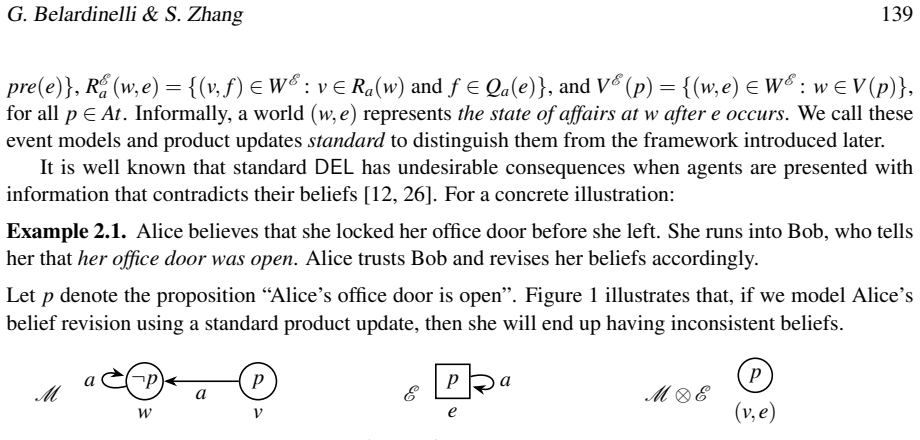
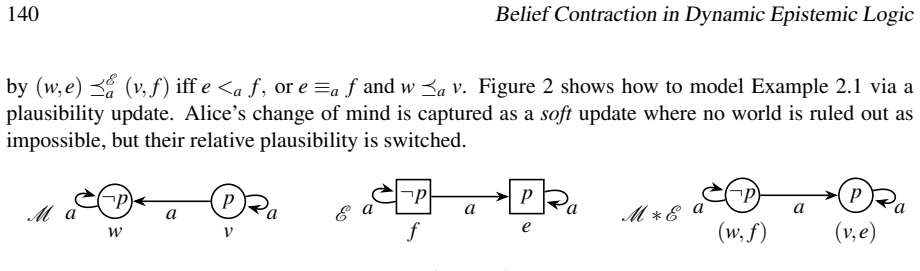
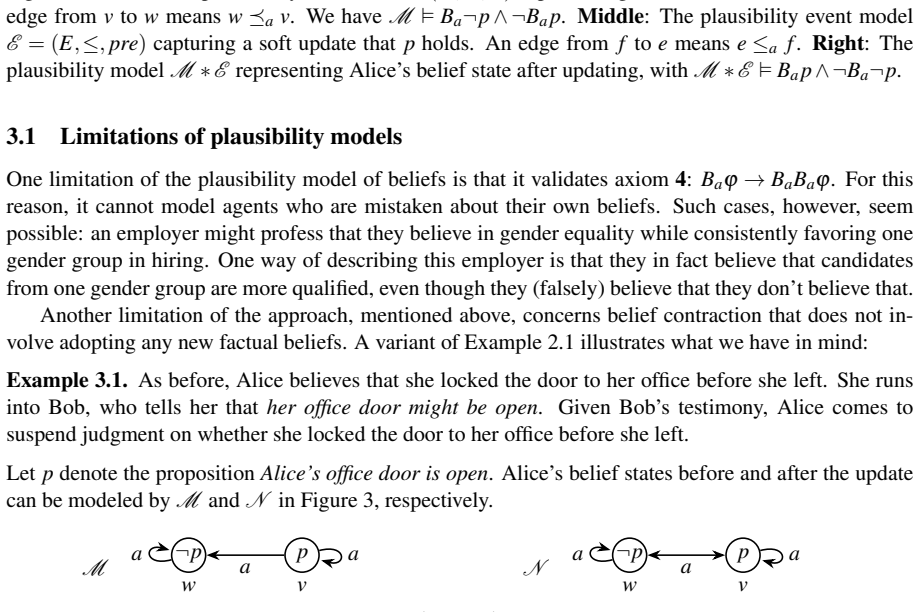
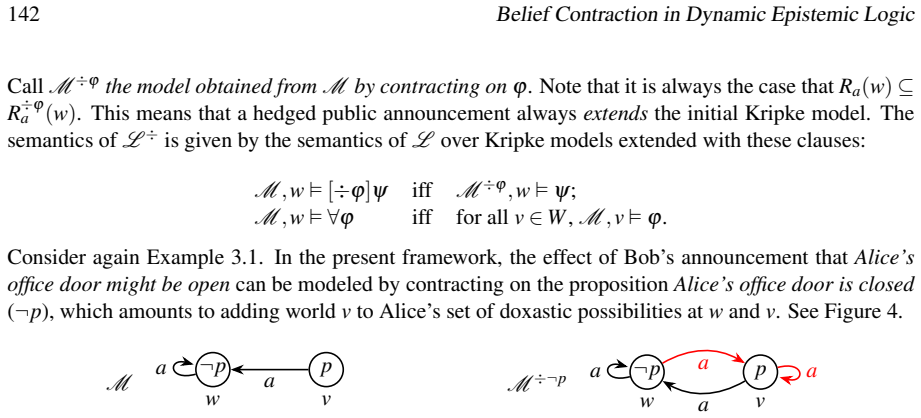
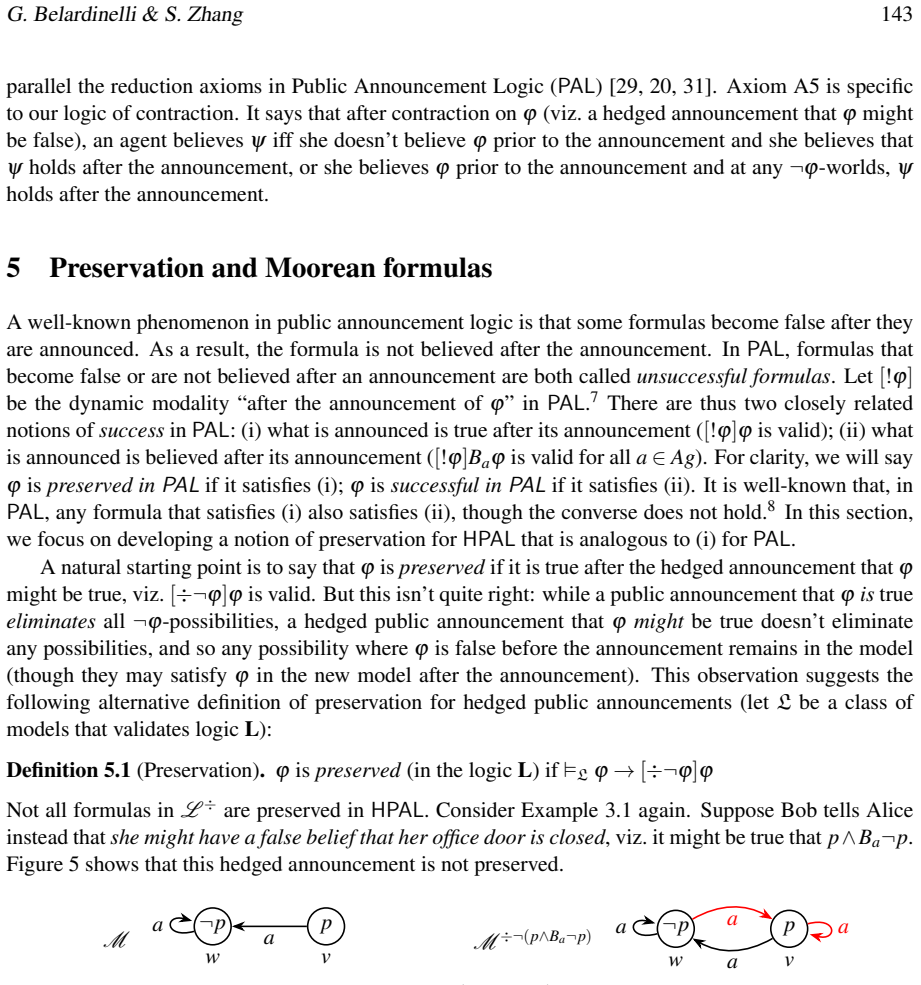
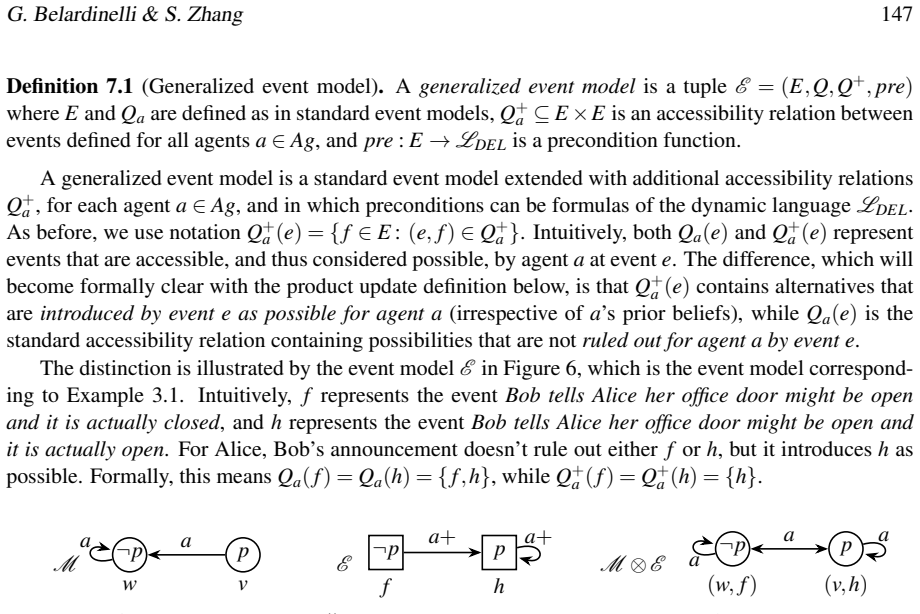
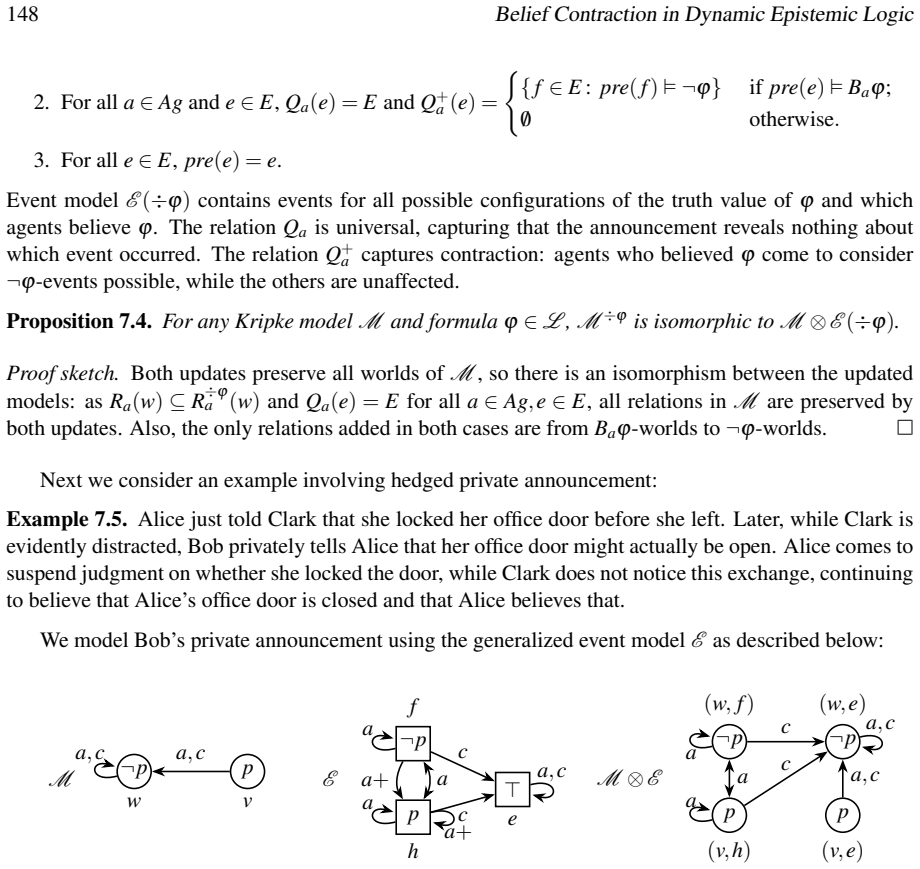
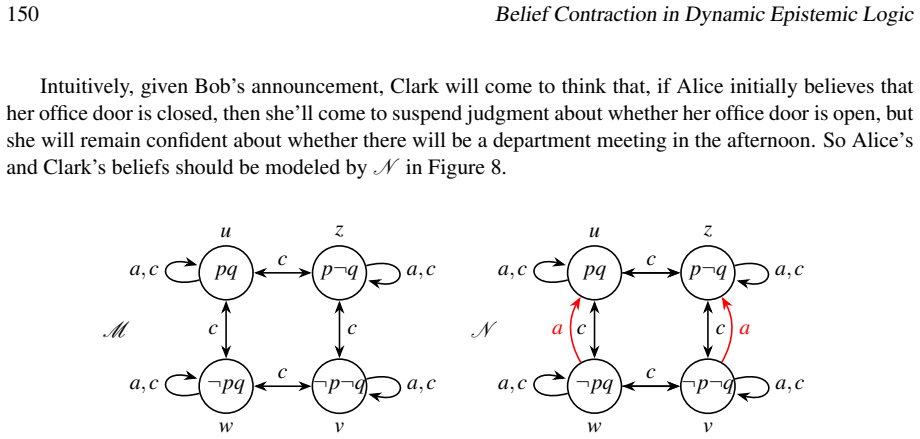
read the original abstract
Dynamic epistemic logic represents belief change via model transformations induced by epistemic events. Its standard formulation (Baltag, Moss, Solecki, 1998) provides a natural account of belief expansion through the elimination of possibilities, but it cannot model belief contraction about factual propositions. A classic response enriches Kripke models with plausibility orderings, representing contraction as an update that promotes certain possibilities over others. We show that this approach has expressive limitations. In particular, the approach cannot model belief that violates positive introspection and contraction dynamics in response to a hedged public announcement that phi might be false. Motivated by these considerations, we introduce a mechanism for belief contraction defined directly on standard Kripke models, without any constraints on the doxastic accessibility relation. We show that it satisfies some of the standard properties of belief contraction but not others, study the conditions under which contraction may be unsuccessful, and provide a sound and complete axiomatization of the logic via reduction axioms. We also define a more general dynamic logic that is an extension of standard DEL and accommodates belief contractions due to events such as private or semi-private announcements, and provide a complete and sound axiomatization of the general logic.
Editorial analysis
A structured set of objections, weighed in public.
Referee Report
Summary. The paper claims that plausibility-enriched models have expressive limitations for representing belief contraction in dynamic epistemic logic, specifically failing to capture beliefs that violate positive introspection or the effects of hedged public announcements. It introduces a contraction operator defined directly on standard Kripke models with no constraints on the doxastic accessibility relation, shows that the operator satisfies some but not all standard contraction properties, identifies conditions under which contraction is unsuccessful, and supplies sound and complete axiomatizations via reduction axioms both for the core logic and for a generalized dynamic logic extending DEL to handle private and semi-private contractions.
Significance. If the central claims hold, the work is significant for dynamic epistemic logic because it offers a framework for contraction that avoids additional plausibility structure while still delivering reduction axioms. The explicit treatment of unsuccessful contraction and the extension to private announcements are useful contributions, and the provision of complete axiomatizations via reduction axioms is a clear technical strength that supports syntactic reasoning about the dynamics.
major comments (2)
- [§3] §3, definition of the contraction operator on the accessibility relation: the transformation must be shown not to implicitly enforce seriality or other frame properties on arbitrary input relations; otherwise the claimed advantage over plausibility models (which already impose orderings) is lost and the soundness of the reduction axioms for the base language becomes fragile.
- [§5] §5, soundness argument for the general dynamic logic: the reduction axioms for semi-private announcements are stated to be complete, but it is unclear whether they continue to hold when the contraction operator is applied to models that lack positive introspection; a concrete counter-model or preservation lemma is needed to support the claim that the general logic remains a conservative extension of standard DEL.
minor comments (2)
- Notation for the updated accessibility relation after contraction should be introduced once and used consistently; occasional reuse of R for both original and updated relations reduces readability.
- The discussion of unsuccessful contraction would benefit from an explicit example showing a concrete Kripke model in which the operator returns the original model.
Simulated Author's Rebuttal
We thank the referee for the thoughtful and detailed report. The comments raise important technical points about frame properties and the scope of the soundness results. We address each major comment point by point below.
read point-by-point responses
-
Referee: [§3] §3, definition of the contraction operator on the accessibility relation: the transformation must be shown not to implicitly enforce seriality or other frame properties on arbitrary input relations; otherwise the claimed advantage over plausibility models (which already impose orderings) is lost and the soundness of the reduction axioms for the base language becomes fragile.
Authors: The contraction operator is defined to act on arbitrary accessibility relations without imposing additional constraints. Specifically, the transformation removes certain worlds from the set of accessible worlds but does not add accessibility links or enforce properties like seriality (which would require at least one accessible world). We will add an explicit lemma in the revised §3 proving that the operator preserves the absence of seriality, transitivity, and other properties from the input model. This maintains the claimed advantage over plausibility-enriched models and ensures the soundness of the reduction axioms holds for the unrestricted class of models. revision: yes
-
Referee: [§5] §5, soundness argument for the general dynamic logic: the reduction axioms for semi-private announcements are stated to be complete, but it is unclear whether they continue to hold when the contraction operator is applied to models that lack positive introspection; a concrete counter-model or preservation lemma is needed to support the claim that the general logic remains a conservative extension of standard DEL.
Authors: We agree that a preservation result is necessary to confirm the reduction axioms apply even to models without positive introspection. Since our framework explicitly allows arbitrary accessibility relations (which may violate positive introspection), we will include a preservation lemma in the revised §5 showing that the semantics of the contraction operator and the reduction axioms for semi-private announcements are preserved under such models. This lemma will also establish that the general logic is a conservative extension of standard DEL. If the referee prefers, we can instead exhibit a counter-model, but our preliminary verification indicates the axioms hold. revision: yes
Circularity Check
No circularity: new contraction operator defined directly on Kripke models with independent reduction-axiom axiomatization.
full rationale
The paper defines a belief contraction mechanism directly on unconstrained Kripke models, demonstrates selected AGM-like properties via explicit model transformation, identifies failure conditions, and supplies reduction axioms whose soundness and completeness are established relative to the base DEL semantics. No step reduces a claimed prediction or uniqueness result to a fitted parameter, self-citation chain, or definitional renaming; the cited Baltag-Moss-Solecki framework is external and the new operator is introduced by explicit construction rather than by re-labeling prior results. The derivation therefore remains self-contained against the standard DEL semantics.
Axiom & Free-Parameter Ledger
axioms (2)
- standard math Kripke models with accessibility relations represent epistemic states
- standard math Reduction axioms characterize dynamic operators
Reference graph
Works this paper leans on
-
[1]
Carlos E. Alchourrón, Peter Gärdenfors & David Makinson (1985): On the Logic of Theory Change: Partial Meet Contraction and Revision Functions. The Journal of Symbolic Logic 50(2), pp. 510–530, doi:10.2307/2274239
-
[2]
In: Australasian Joint Conference on Artificial Intelligence, Springer, pp
Mikkel Birkegaard Andersen, Thomas Bolander, Hans van Ditmarsch & Martin Holm Jensen (2013): Bisimulation for single-agent plausibility models . In: Australasian Joint Conference on Artificial Intelligence, Springer, pp. 277–288, doi:10.1007/978-3-319-03680-9_30. 156 Belief Contraction in Dynamic Epistemic Logic
-
[3]
Mikkel Birkegaard Andersen, Thomas Bolander, Hans van Ditmarsch & Martin Holm Jensen (2017): Bisimulation and expressivity for conditional belief, degrees of belief, and safe belief. Syn- these 194(7), pp. 2447–2487, doi:10.1007/s11229-016-1060-x
-
[4]
Journal of philosophical logic 27(3), pp
Hajnal Andréka, István Németi & Johan Van Benthem (1998): Modal languages and bounded fragments of predicate logic . Journal of philosophical logic 27(3), pp. 217–274, doi:10.1023/A:1004275029985
-
[5]
Electronic Notes in Theoretical Computer Science 231, pp
Guillaume Aucher, Philippe Balbiani, Luis Fariñas del Cerro & Andreas Herzig (2009): Global and Local Graph Modifiers. Electronic Notes in Theoretical Computer Science 231, pp. 293–307, doi:10.1016/j.entcs.2009.02.042. Proceedings of the 5th Workshop on Methods for Modalities (M4M5 2007)
-
[6]
Moss & Slawomir Solecki (1998): The Logic of Public Announce- ments and Common Knowledge and Private Suspicions
Alexandru Baltag, Lawrence S. Moss & Slawomir Solecki (1998): The Logic of Public Announce- ments and Common Knowledge and Private Suspicions . In Itzhak Gilboa, editor: Proceedings of the 7th Conference on Theoretical Aspects of Rationality and Knowledge (TARK-98) , Morgan Kaufmann, pp. 43–56
1998
-
[7]
In Edward N
Alexandru Baltag & Bryan Renne (2016): Dynamic Epistemic Logic. In Edward N. Zalta, editor: The Stanford Encyclopedia of Philosophy, Winter 2016 edition, Metaphysics Research Lab, Stan- ford University. Available at https://plato.stanford.edu/archives/win2016/entries/ dynamic-epistemic/
2016
-
[8]
Alexandru Baltag & Sonja Smets (2008): A Qualitative Theory of Dynamic Interactive Belief Re- vision. In Giacomo Bonanno, Wiebe van der Hoek & Michael Wooldridge, editors: Logic and the Foundations of Game and Decision Theory (LOFT7) , Texts in Logic and Games 3, Amsterdam University Press, pp. 13–60. Available at https://www.jstor.org/stable/j.ctt46mz4h.4
2008
-
[10]
Logic Journal of the IGPL 31(6), pp
Johan van Benthem (2023): The Logic of Conditionals on Outback Trails . Logic Journal of the IGPL 31(6), pp. 1135–1152, doi:10.1093/jigpal/jzac064
-
[11]
Velázquez-Quesada (2010): The dynamics of awareness
Johan van Benthem & Fernando R. Velázquez-Quesada (2010): The dynamics of awareness. Syn- these 177, pp. 5–27, doi:10.1007/s11229-010-9764-9
-
[12]
Journal of Applied Non- Classical Logics 17(2), pp
Johan van Benthem and (2007): Dynamic logic for belief revision . Journal of Applied Non- Classical Logics 17(2), pp. 129–155, doi:10.3166/jancl.17.129-155
-
[13]
Benton & Peter Van Elswyk (2020): Hedged Assertion
Matthew A. Benton & Peter Van Elswyk (2020): Hedged Assertion . In Sanford Gold- berg, editor: The Oxford Handbook of Assertion , Oxford University Press, pp. 245–263, doi:10.1093/oxfordhb/9780190675233.013.11
-
[14]
Cambridge University Press, 2001
Patrick Blackburn, Maarten de Rijke & Yde Venema (2001): Modal Logic . Cambridge Tracts in Theoretical Computer Science 53, Cambridge University Press, Cambridge, UK, doi:10.1017/CBO9781107050884
-
[15]
Information and Computation 239, pp
Laura Bozzelli, Hans van Ditmarsch, Tim French, James Hales & Sophie Pinchinat (2014): Refine- ment modal logic. Information and Computation 239, pp. 303–339, doi:10.1016/j.ic.2014.07.013
-
[16]
Journal of Applied Non-Classical Logics 21(3-4), pp
Lorenz Demey (2011): Some remarks on the model theory of epistemic plausibility models. Journal of Applied Non-Classical Logics 21(3-4), pp. 375–395, doi:10.3166/jancl.21.375-395. G. Belardinelli & S. Zhang 157
-
[17]
Hans van Ditmarsch & Tim French (2009): Awareness and forgetting of facts and agents . In: 2009 IEEE/WIC/ACM International Joint Conference on Web Intelligence and Intelligent Agent Technology, 3, IEEE, pp. 478–483, doi:10.1109/WI-IAT.2009.330
-
[18]
Kuijer (2025): Modal Logic for Simulation, Refinement, and Mutual Ignorance
Hans van Ditmarsch, Tim French, Rustam Galimullin & Louwe B. Kuijer (2025): Modal Logic for Simulation, Refinement, and Mutual Ignorance . Electronic Proceedings in Theoretical Computer Science 437, p. 379–398, doi:10.4204/eptcs.437.30
-
[19]
Hans van Ditmarsch, Andreas Herzig, Jérôme Lang & Pierre Marquis (2009): Introspective forget- ting. Synthese 169(2), pp. 405–423, doi:10.1007/s11229-009-9554-4
-
[20]
Springer, 2007.doi:10.1007/978-1-4020-5839-4
Hans van Ditmarsch, Wiebe van der Hoek & Barteld Kooi (2008): Dynamic epistemic logic . Springer, doi:10.1007/978-1-4020-5839-4
-
[21]
In Giacomo Bonanno, Wiebe van der Hoek & Michael Wooldridge, editors:Logic and the Foundation of Game and Decision Theory (LOFT 7) , pp
Hans van Ditmarsch & Barteld Kooi (2008): Semantic Results for Ontic and Epistemic Change. In Giacomo Bonanno, Wiebe van der Hoek & Michael Wooldridge, editors:Logic and the Foundation of Game and Decision Theory (LOFT 7) , pp. 87–117. Available at https://www.jstor.org/ stable/j.ctt46mz4h.6
2008
-
[22]
Velázquez–Quesada (2015):Forgetting complex propositions
David Fernández–Duque, Ángel Nepomuceno–Fernández, Enrique Sarrión–Morrillo, Fernando Soler–Toscano & Fernando R. Velázquez–Quesada (2015):Forgetting complex propositions. Logic Journal of the IGPL 23(6), pp. 942–965, doi:10.1093/jigpal/jzv049
-
[23]
Virginie Fiutek (2013): Playing with Knowledge and Belief. Ph.D. thesis, University of Amsterdam, Institute for Logic, Language, and Computation. Available at https://eprints.illc.uva.nl/ id/eprint/2120
2013
-
[24]
Oxford Uni- versity Press, United States, 2017.doi:10.1093/oso/9780198701347.001.0001
Patrick Girard, Jeremy Seligman & Fenrong Liu (2012): General Dynamic Dynamic Logic . In Thomas Bolander, Torben Braüner, Silvio Ghilardi & Lawrence Moss, editors:Advances in Modal Logic 9, College Publications, pp. 239–260, doi:10.1093/oso/9780198538592.003.0004
-
[25]
In Edward N
Sven Ove Hansson (2022): Logic of Belief Revision . In Edward N. Zalta, editor: The Stanford Encyclopedia of Philosophy , Spring 2022 edition, Metaphysics Research Lab, Stan- ford University. Available at https://plato.stanford.edu/archives/spr2022/entries/ logic-belief-revision/
2022
-
[26]
Journal of Applied Non-Classical Logics 27(3-4), pp
Andreas Herzig (2017): Dynamic Epistemic Logics: Promises, Problems, Shortcom- ings, and Perspectives . Journal of Applied Non-Classical Logics 27(3-4), pp. 328–341, doi:10.1080/11663081.2017.1416036
-
[27]
Indicative Conditionals and Dynamic Epistemic Logic
Wesley H. Holliday & Thomas F. Icard III (2017): Indicative conditionals and dynamic epistemic logic. arXiv preprint arXiv:1707.08752, doi:10.48550/arXiv.1707.08752
work page internal anchor Pith review Pith/arXiv arXiv doi:10.48550/arxiv.1707.08752 2017
-
[28]
167–190, doi:10.1007/s11229-006-9143-8
Hannes Leitgeb & Krister Segerberg (2007): Dynamic doxastic logic: why, how, and where to? Synthese 155(2), pp. 167–190, doi:10.1007/s11229-006-9143-8
-
[29]
Logics of public communications.Synthese, 158(2):165–179, September 2007
Jan Plaza (2007): Logics of public communications . Synthese 158(2), pp. 165–179, doi:10.1007/s11229-007-9168-7
-
[30]
Krister Segerberg (1999): Two Traditions in the Logic of Belief: Bringing them Together, pp. 135–
1999
-
[31]
Springer Netherlands, Dordrecht, doi:10.1007/978-94-011-4574-9_8
-
[32]
Yanjing Wang & Qinxiang Cao (2013): On axiomatizations of public announcement logic . Syn- these 190(Suppl 1), pp. 103–134, doi:10.1007/s11229-012-0233-5
-
[33]
Seth Yalcin (2007): Epistemic modals. Mind 116(464), pp. 983–1026, doi:10.1093/mind/fzm983
discussion (0)
Sign in with ORCID, Apple, or X to comment. Anyone can read and Pith papers without signing in.