Sequential RC-TGAN: Generating Relational Time Series with Spectral Envelope Loss
Pith reviewed 2026-07-01 06:32 UTC · model grok-4.3
The pith
A spectral envelope loss lets temporal GANs preserve cyclic patterns and seasonality in relational time series.
A machine-rendered reading of the paper's core claim, the machinery that carries it, and where it could break.
Core claim
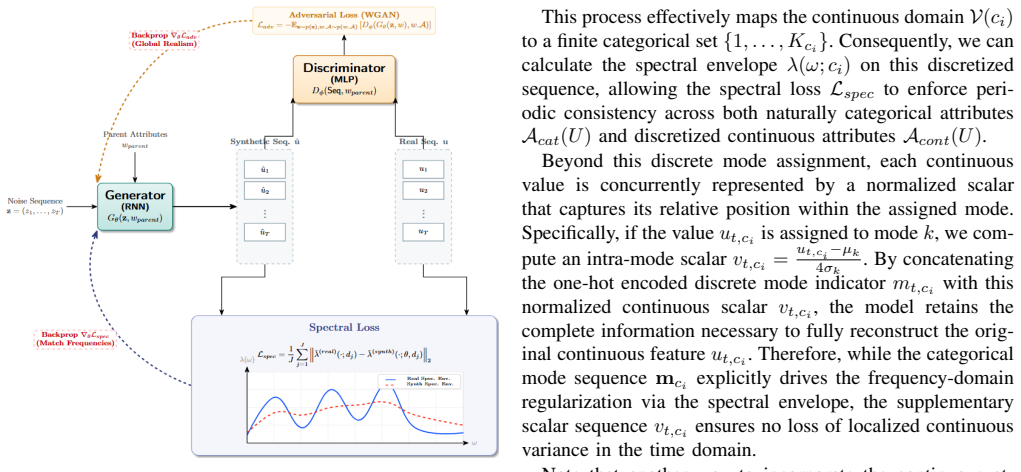
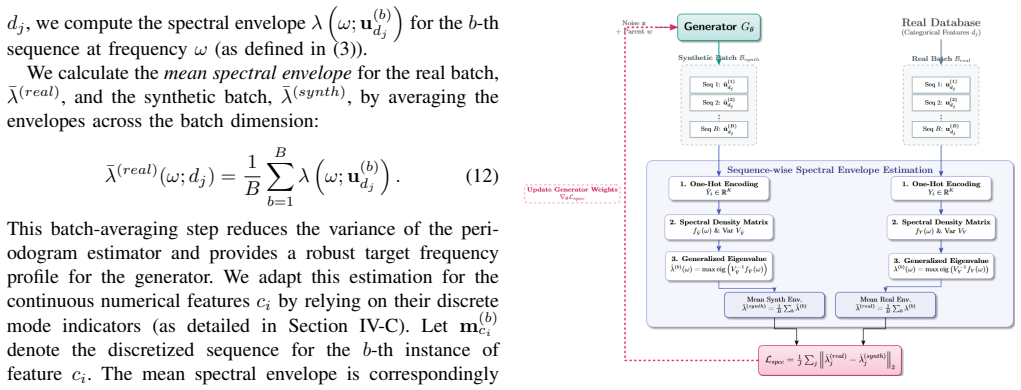
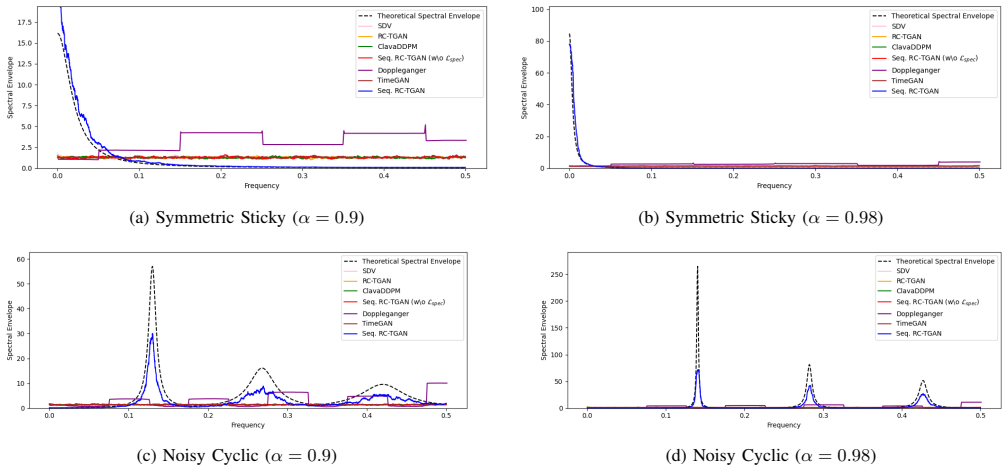
Sequential RC-TGAN equips a temporal extension of the RC-TGAN framework with an integrated spectral envelope loss that the generator optimizes via backpropagation, thereby preserving latent periodic structures. Spectral envelope theory is applied directly to categorical sequences while continuous series are first discretized by a variational Gaussian mixture model; simulated categorical sequences governed by parameter alpha supply known theoretical envelopes as ground truth. Together with the proposed Spectral Density Divergence and Spectral Envelope Divergence metrics, the end-to-end approach reproduces cyclic patterns and long-term seasonality more accurately than state-of-the-art systems
What carries the argument
The Spectral Envelope Loss, a differentiable regularization term derived from spectral envelope theory that penalizes mismatch between the generator's output and target frequency-domain periodic structures.
If this is right
- The generator can optimize preservation of latent periodic structures directly through backpropagation rather than relying on post-hoc encoding fixes.
- Frequency-domain fidelity of generated relational time series can be measured rigorously with the new Spectral Density Divergence and Spectral Envelope Divergence metrics.
- The same framework applies to both categorical sequences and continuous features after VGM discretization.
- Simulated benchmarks controlled by parameter alpha supply an objective ground-truth standard for evaluating cyclic and seasonal fidelity.
Where Pith is reading between the lines
- If the discretization step succeeds without artifacts, frequency-based losses derived from categorical theory could be tested on other mixed-type sequential generation tasks.
- Better reproduction of seasonality in synthetic data might improve the training of downstream models that rely on long-range temporal correlations.
- The construction of parameter-controlled simulated benchmarks offers a template for creating objective frequency-domain test suites in other generative modeling settings.
Load-bearing premise
Extending spectral envelope theory to continuous series via VGM discretization preserves the frequency-domain properties without introducing artifacts that invalidate the ground-truth comparison on simulated data governed by parameter alpha.
What would settle it
On the alpha-parameterized simulated benchmarks, compute the spectral envelopes of the sequences produced by Seq. RC-TGAN and observe whether they match the known theoretical envelopes within the tolerance shown by the new divergence metrics; substantial mismatch would falsify effective preservation.
Figures
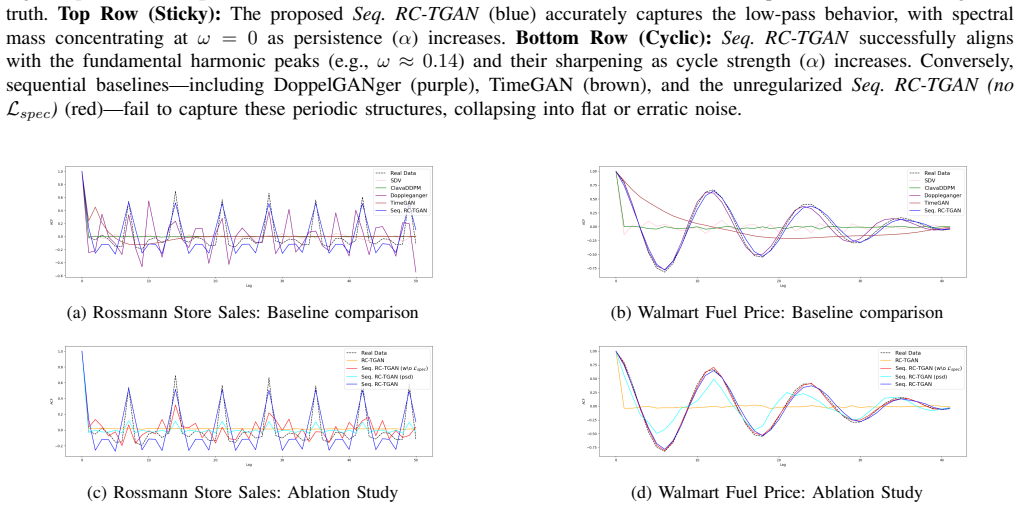
read the original abstract
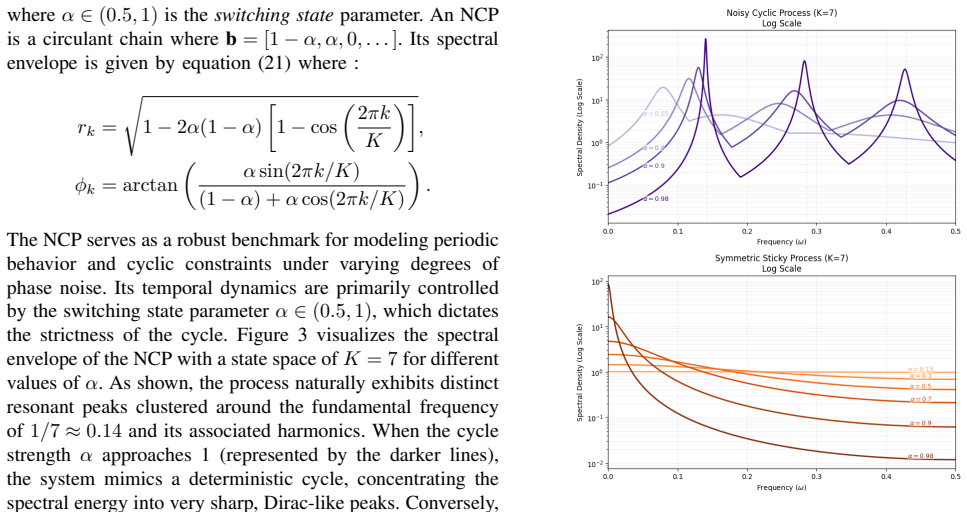
The generation of synthetic relational databases often involves modeling complex temporal dynamics, such as transaction logs or event sequences. A significant challenge in this domain is the handling of categorical time series (e.g., status codes), where standard encoding methods like one-hot encoding fail to capture intrinsic frequency-domain features such as seasonality and cyclicity. In this paper, we introduce Sequential RC-TGAN (Seq. RC-TGAN), a temporal extension of the RC-TGAN framework, equipped with a novel integrated loss function based on the \textit{Spectral Envelope Theory}. This differentiable loss allows the generator to directly optimize the preservation of latent periodic structures via backpropagation. While spectral envelope theory is inherently designed for categorical sequences, we extend this frequency-domain regularization to continuous time series by employing a Variational Gaussian Mixture Model (VGM) discretization strategy. To establish a mathematically rigorous evaluation standard, we simulate categorical time series governed by a parameter $\alpha$, with exactly known theoretical spectral envelopes. Integrating these dynamic sequences into the child tables of a relational database yields a robust ground-truth benchmark for evaluating the frequency-domain fidelity of our generative framework. Furthermore, we address the lack of robust evaluation standards for relational time series by proposing two new metrics: Spectral Density Divergence and Spectral Envelope Divergence. Experimental results on real-world datasets, as well as our simulated benchmarks, demonstrate that our end-to-end approach significantly outperforms state-of-the-art systems in reproducing cyclic patterns and long-term seasonality across both categorical and continuous features.
Editorial analysis
A structured set of objections, weighed in public.
Referee Report
Summary. The paper introduces Sequential RC-TGAN as a temporal extension of RC-TGAN that incorporates a differentiable Spectral Envelope Loss based on spectral envelope theory to directly optimize preservation of cyclic and seasonal patterns in categorical relational time series. It extends the loss to continuous features via VGM discretization, simulates categorical time series with exactly known spectral envelopes governed by parameter α to create ground-truth benchmarks, proposes Spectral Density Divergence and Spectral Envelope Divergence metrics, and claims that the end-to-end model significantly outperforms state-of-the-art systems on both real-world datasets and the simulated benchmarks for reproducing cyclic patterns and long-term seasonality across categorical and continuous features.
Significance. If the VGM discretization step is shown to preserve the relevant frequency content without introducing artifacts, the introduction of a backpropagatable spectral loss together with simulated benchmarks that have theoretical ground truth and two new divergence metrics would represent a meaningful advance in evaluation standards and modeling fidelity for synthetic relational time series generation.
major comments (1)
- [Abstract] Abstract (paragraph on extension to continuous time series and on simulated benchmarks): the central claim of significant outperformance on continuous features rests on the unverified assumption that VGM discretization preserves the frequency-domain properties (seasonality, cyclicity) of the original continuous series. The simulated benchmarks are described as using only categorical processes governed by α and therefore provide no test of this invariance; any mixture-induced smoothing or binning could attenuate or shift the periodic components the loss is intended to enforce. This assumption is load-bearing for the cross-feature-type claim.
minor comments (1)
- [Abstract] Abstract: the statement that the method 'significantly outperforms state-of-the-art systems' is presented without reference to any table, figure, or quantitative margin, making it difficult to evaluate the practical magnitude of the reported gains.
Simulated Author's Rebuttal
We thank the referee for highlighting this important assumption in our abstract. We address the point directly below and will revise the manuscript accordingly.
read point-by-point responses
-
Referee: [Abstract] Abstract (paragraph on extension to continuous time series and on simulated benchmarks): the central claim of significant outperformance on continuous features rests on the unverified assumption that VGM discretization preserves the frequency-domain properties (seasonality, cyclicity) of the original continuous series. The simulated benchmarks are described as using only categorical processes governed by α and therefore provide no test of this invariance; any mixture-induced smoothing or binning could attenuate or shift the periodic components the loss is intended to enforce. This assumption is load-bearing for the cross-feature-type claim.
Authors: We agree that the simulated benchmarks use only categorical processes governed by α and therefore do not test invariance under VGM discretization. The central claim of outperformance on continuous features does rely on the assumption that VGM discretization preserves relevant frequency content. We will revise the abstract to clarify the scope of the simulated benchmarks and add an appendix with explicit verification: we will generate continuous series with known periodic components, apply VGM discretization, and compare spectral envelopes and densities before and after discretization to quantify any attenuation or shift. If the verification shows material distortion, we will restrict the cross-feature-type claims to real-world results only. This addresses the load-bearing assumption directly. revision: yes
Circularity Check
No circularity identified in derivation or evaluation chain
full rationale
The paper grounds its claims in experimental comparisons against real-world data and a simulated categorical benchmark whose spectral envelopes are defined externally by the known parameter α. The VGM discretization is introduced as an applied strategy to extend the loss, without any equation or claim reducing the frequency preservation to a fitted input or self-definition. No self-citations, uniqueness theorems, or ansatzes from prior author work are load-bearing. The new divergence metrics are proposed additions rather than renamings of existing results. The strongest claim of outperformance therefore rests on independent benchmarks rather than any definitional equivalence.
Axiom & Free-Parameter Ledger
free parameters (1)
- alpha
axioms (2)
- domain assumption Spectral envelope theory applies directly to categorical sequences and can be made differentiable for backpropagation.
- ad hoc to paper VGM discretization preserves the frequency-domain features of continuous series sufficiently for the loss to remain meaningful.
Reference graph
Works this paper leans on
-
[1]
Modeling Tabular data using Conditional GAN,
L. Xu, M. Skoularidou, A. Cuesta-Infante, and K. Veeramachaneni, “Modeling Tabular data using Conditional GAN,”arXiv:1907.00503 [cs, stat], Oct. 2019, arXiv: 1907.00503. [Online]. Available: http://arxiv.org/abs/1907.00503
-
[2]
TabD- DPM: Modelling Tabular Data with Diffusion Models,
A. Kotelnikov, D. Baranchuk, I. Rubachev, and A. Babenko, “TabD- DPM: Modelling Tabular Data with Diffusion Models,” Oct. 2024, arXiv:2209.15421. [Online]. Available: http://arxiv.org/abs/2209.15421
-
[3]
A Comprehen- sive Survey of Synthetic Tabular Data Generation,
R. Shi, Y . Wang, M. Du, X. Shen, and X. Wang, “A Comprehen- sive Survey of Synthetic Tabular Data Generation,”arXiv preprint arXiv:2504.16506, 2025
-
[4]
Tabular transformers for modeling multivariate time series,
I. Padhi, Y . Schiff, I. Melnyk, M. Rigotti, Y . Mroueh, P. Dognin, J. Ross, R. Nair, and E. Altman, “Tabular transformers for modeling multivariate time series,” inICASSP 2021-2021 IEEE International Conference on Acoustics, Speech and Signal Processing (ICASSP). IEEE, 2021, pp. 3565–3569
2021
-
[5]
Tabular transformer genera- tive adversarial network for heterogeneous distribution in healthcare,
H. Y . J. Kang, M. Ko, and K. S. Ryu, “Tabular transformer genera- tive adversarial network for heterogeneous distribution in healthcare,” Scientific Reports, vol. 15, no. 1, p. 10254, 2025
2025
-
[6]
The Synthetic Data Vault,
N. Patki, R. Wedge, and K. Veeramachaneni, “The Synthetic Data Vault,”2016 IEEE International Conference on Data Science and Advanced Analytics (DSAA), vol. 2016, pp. 399–410, Oct. 2016
2016
-
[7]
Row conditional-TGAN for generating synthetic relational databases,
M. Gueye, Y . Attabi, and M. Dumas, “Row conditional-TGAN for generating synthetic relational databases,” inICASSP 2023-2023 IEEE International Conference on Acoustics, Speech and Signal Processing (ICASSP). IEEE, 2023, pp. 1–5
2023
-
[8]
Realtabformer: Generating real- istic relational and tabular data using transformers,
A. V . Solatorio and O. Dupriez, “REaLTabFormer: Generating Realistic Relational and Tabular Data using Transformers,” Feb. 2023, arXiv:2302.02041. [Online]. Available: http://arxiv.org/abs/2302.02041
-
[9]
ClavaDDPM: Multi-relational Data Synthesis with Cluster-guided Diffusion Models,
W. Pang, M. Shafieinejad, L. Liu, S. Hazlewood, and X. He, “ClavaDDPM: Multi-relational Data Synthesis with Cluster-guided Diffusion Models,” Nov. 2024, arXiv:2405.17724. [Online]. Available: http://arxiv.org/abs/2405.17724
-
[10]
V . Hudovernik, M. Xu, J. Shi, L. Šubelj, S. Ermon, E. Štrumbelj, and J. Leskovec, “Reldiff: Relational data generative modeling with graph- based diffusion models,”arXiv preprint arXiv:2506.00710, 2025
-
[11]
Time-series generative adversarial networks,
J. Yoon, D. Jarrett, and M. Van der Schaar, “Time-series generative adversarial networks,”Advances in neural information processing systems, vol. 32, 2019
2019
-
[12]
Using gans for sharing networked time series data: Challenges, initial promise, and open questions,
Z. Lin, A. Jain, C. Wang, G. Fanti, and V . Sekar, “Using gans for sharing networked time series data: Challenges, initial promise, and open questions,” inProceedings of the ACM internet measurement conference, 2020, pp. 464–483
2020
-
[13]
Spectral analysis for categorical time series: Scaling and the spectral envelope,
D. S. Stoffer, D. E. Tyler, and A. J. McDougall, “Spectral analysis for categorical time series: Scaling and the spectral envelope,”Biometrika, vol. 80, no. 3, pp. 611–622, 1993
1993
-
[14]
The spectral envelope and its applications,
D. S. Stoffer, D. E. Tyler, and D. A. Wendt, “The spectral envelope and its applications,”Statistical Science, pp. 224–253, 2000
2000
-
[15]
R. H. Shumway and D. S. Stoffer,Time series analysis and its applications: with R examples. Springer, 2006
2006
-
[16]
Dynamic community detection using class preserving time series generation with fourier markov diffusion,
Y . Ma, D. Qu, and Y . Wang, “Dynamic community detection using class preserving time series generation with fourier markov diffusion,” Scientific Reports, 2026
2026
-
[17]
Frequency decom- position and enhancement for time series generation using diffusion models
Z. Zhang, Q. Ouyang, Z. Yu, D. Pei, and T. Xiao, “Frequency decom- position and enhancement for time series generation using diffusion models.”
-
[18]
X. Piao, Z. Chen, L. Zhu, Y . Dong, Y . Matsubara, and Y . Sakurai, “Tifo: Time-invariant frequency operator for stationarity-aware representation learning in time series,”arXiv preprint arXiv:2602.17122, 2026
-
[19]
Probabilistic relational models,
D. Koller, “Probabilistic relational models,” inInternational Confer- ence on Inductive Logic Programming. Springer, 1999, pp. 3–13
1999
-
[20]
Recurrent neural networks,
L. R. Medsker, L. Jainet al., “Recurrent neural networks,”Design and applications, vol. 5, no. 64-67, p. 2, 2001
2001
-
[21]
On circulant matrices,
I. Kra and S. R. Simanca, “On circulant matrices,”Notices of the AMS, vol. 59, no. 3, pp. 368–377, 2012
2012
-
[22]
Rossmann Store Sales
“Rossmann Store Sales.” [Online]. Available: https://www.kaggle.com/c/rossmann-store-sales
-
[23]
Walmart
T. Wilczek, “Walmart.” [Online]. Available: https://data.world/tommywilczek/walmart APPENDIX PROOF OFLEMMA1 By assumption, the spectral density matrix of the one- hot encoded process,f Y (ω), is continuous. Because the categories are mutually exclusive and exhaustive, the co- variance matrixVhas rankK−1. We can apply any K×(K−1)-dim projection matrixQto o...
discussion (0)
Sign in with ORCID, Apple, or X to comment. Anyone can read and Pith papers without signing in.