Interface-Aware Neural Newton Preconditioning for Robust Cohesive Zone Model Simulations
Pith reviewed 2026-07-02 20:05 UTC · model grok-4.3
The pith
A learned interface-aware neural preconditioner improves Newton convergence in cohesive zone simulations without altering the discrete solution set.
A machine-rendered reading of the paper's core claim, the machinery that carries it, and where it could break.
Core claim
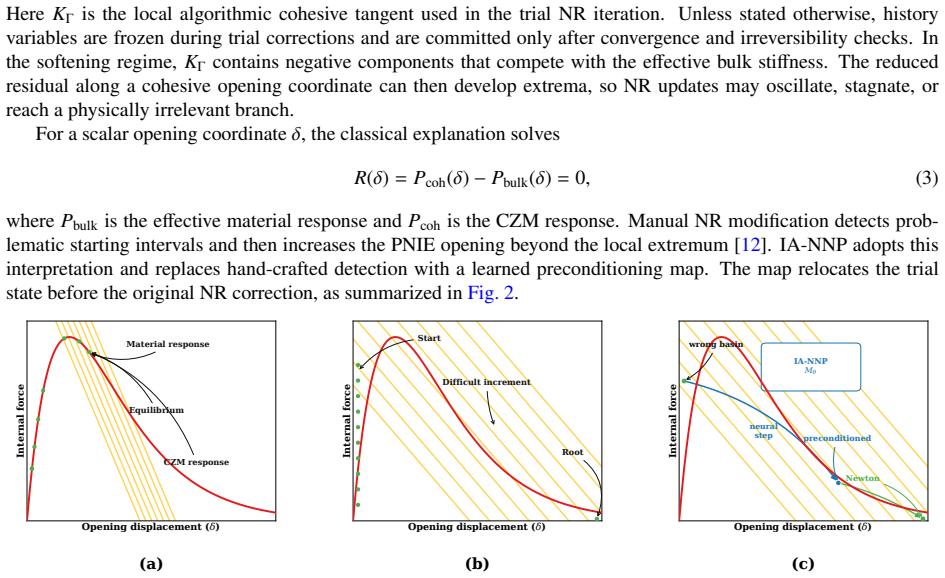
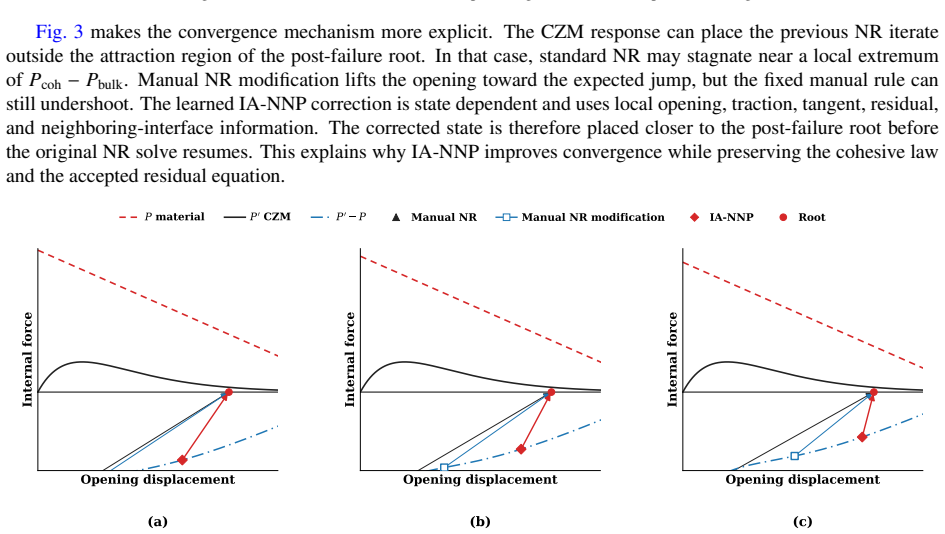
IA-NNP recasts manual Newton-Raphson modification as a learned interface lifting operation that acts solely on active interface degrees of freedom. It leaves the traction-separation law, residual assembly, tangent evaluation, history update, and dissipation checks untouched. A root-equivalence property establishes that the method changes only the convergence path, not the set of reachable discrete solutions. Two variants are presented: IA-NNP-Init for learned initial-guess correction and IA-NNP-NL for iteration-level nonlinear right preconditioning, both driven by interface graph features that encode opening, traction, tangent stiffness, damage variables, mode mixity, residuals, and neighbor
What carries the argument
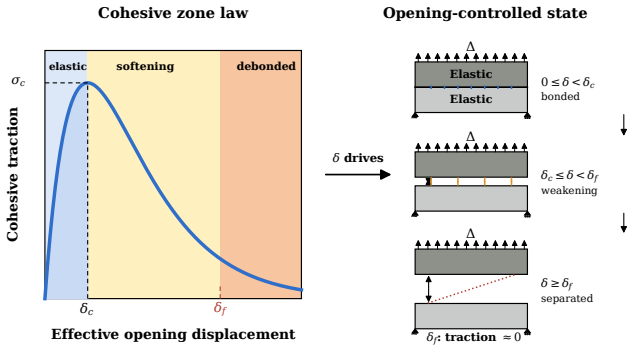
Interface-Aware Neural Newton Preconditioner (IA-NNP), a bounded and confidence-gated neural correction applied only to active interface variables that generalizes manual NR modification while preserving the original CZM residual and tangent operators.
If this is right
- Existing CZM implementations can adopt IA-NNP without modifying their traction-separation laws or dissipation monitoring.
- Difficult increments that previously triggered repeated step cuts now converge automatically while staying on the physical branch.
- The same trained network applies across horizontal, circular, and multi-interface geometries without re-deriving interface rules.
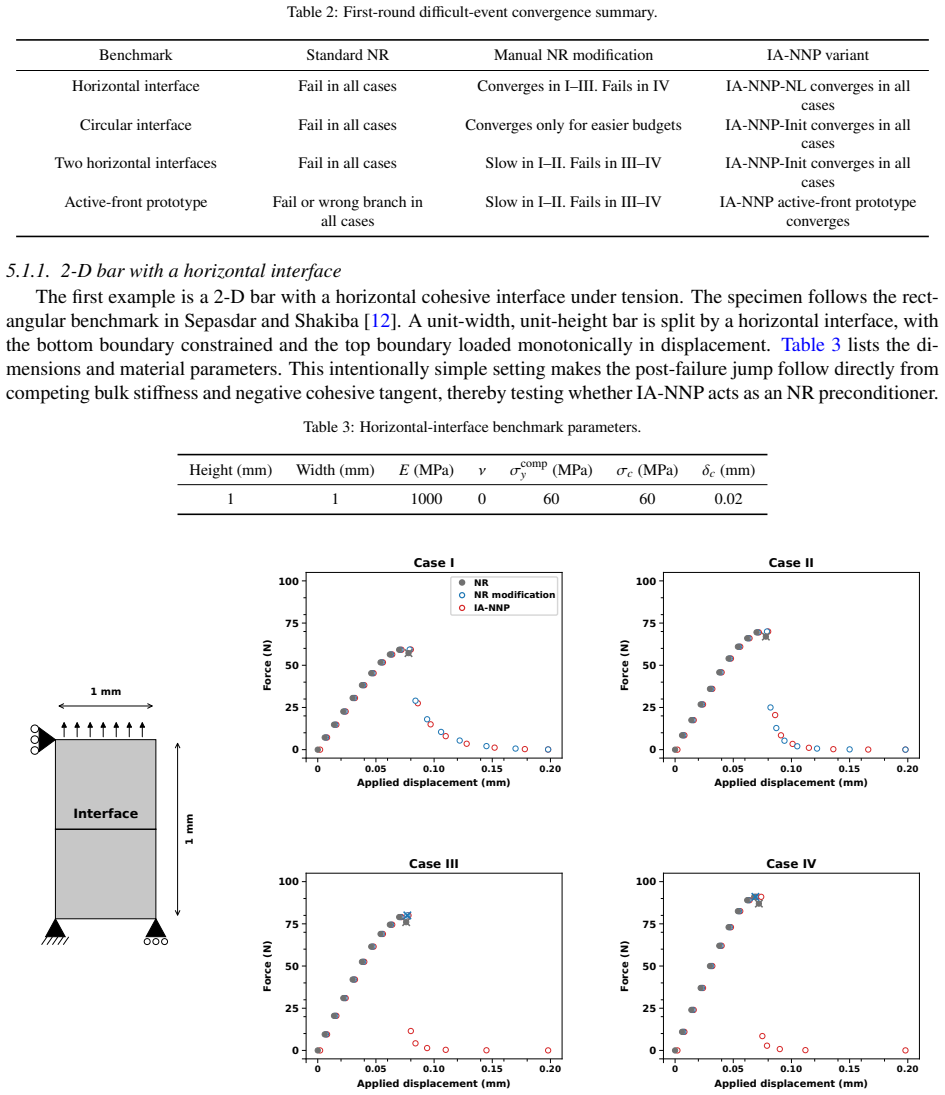
- Force-displacement response curves remain identical to those produced by unmodified Newton-Raphson, satisfying verification requirements.
Where Pith is reading between the lines
- The approach could be retrained on data from other softening constitutive models such as continuum damage or rate-dependent plasticity.
- Embedding the preconditioner inside commercial FE codes would require only a thin wrapper around the existing Newton loop.
- If the feature set proves portable, the method might reduce reliance on viscous regularization or arc-length controls in production analyses.
- Periodic online retraining on newly encountered interface states could further improve robustness for long-duration simulations.
Load-bearing premise
The neural corrections remain confined to the original Newton basin and never steer the solver toward a different discrete solution than unmodified Newton-Raphson would eventually reach.
What would settle it
A benchmark increment in which IA-NNP produces a converged state whose force-displacement value or damage pattern differs from the result obtained by standard NR with exhaustive manual line-search or step-size reduction.
Figures
read the original abstract
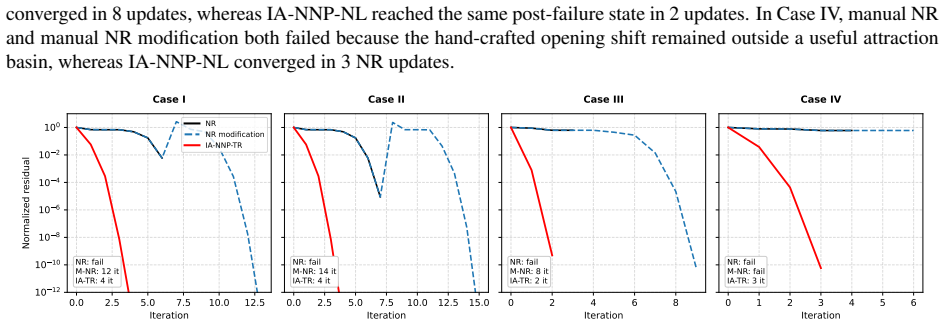
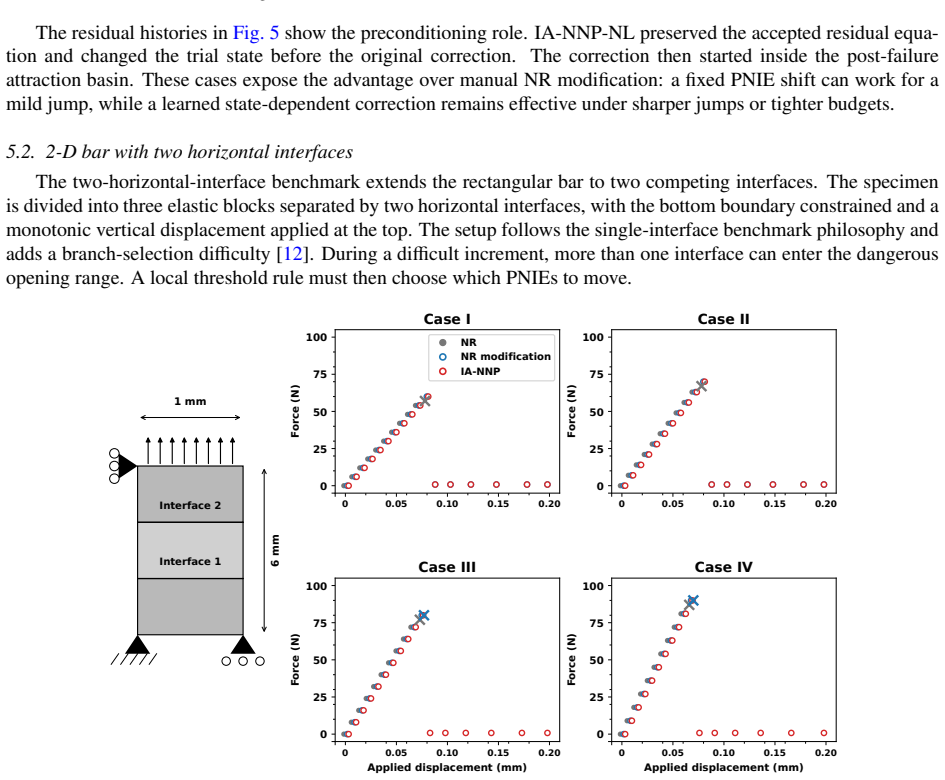
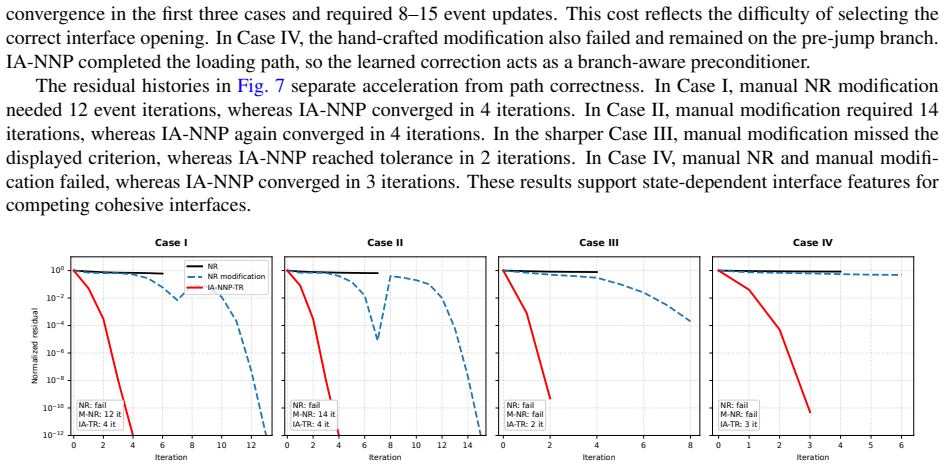
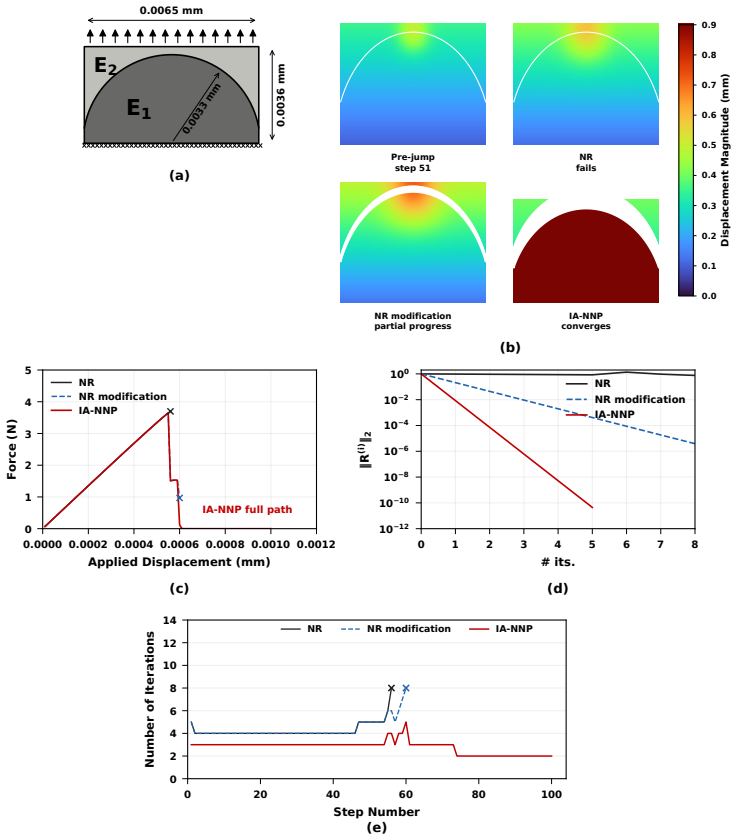
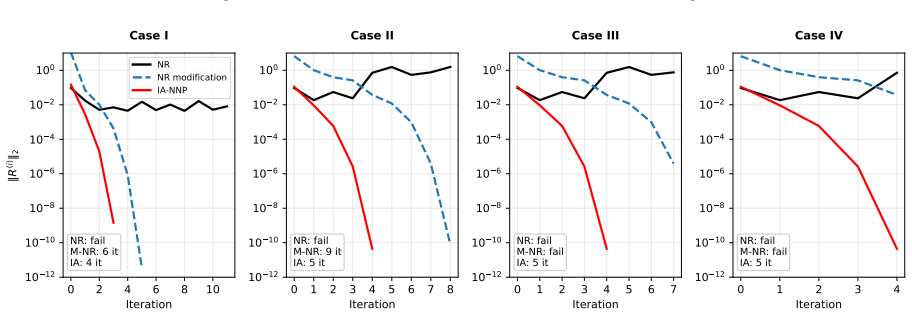
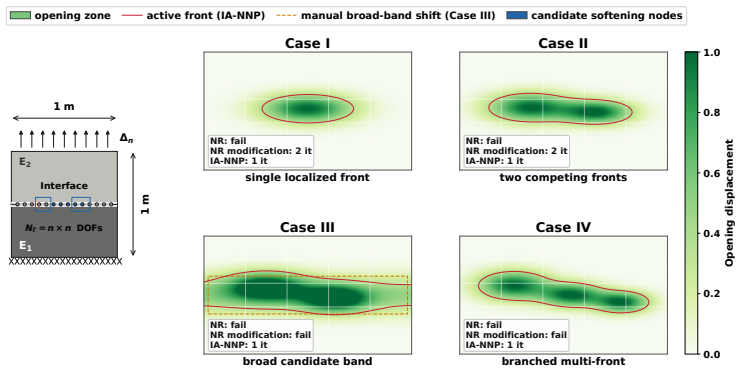
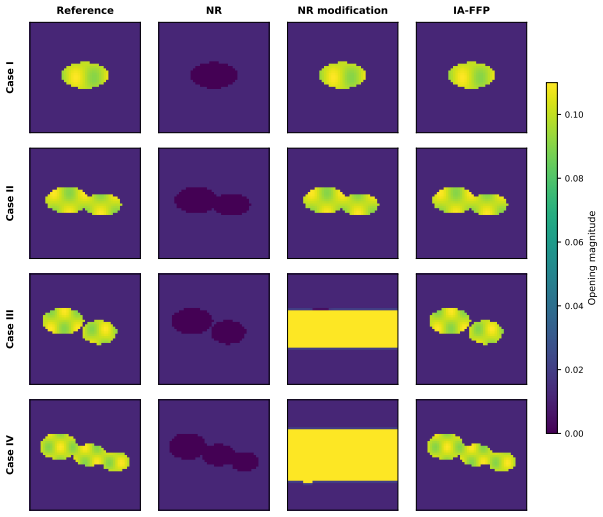
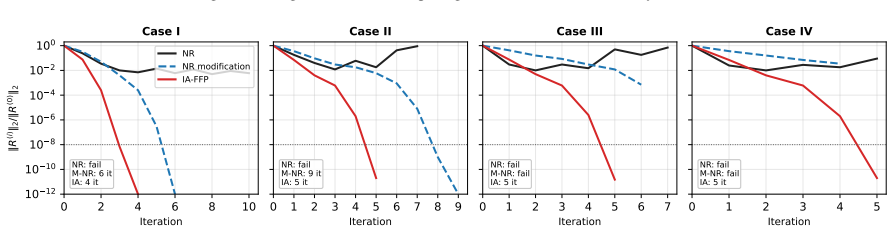
Cohesive Zone Models (CZMs) are widely used to simulate interface fracture, delamination, adhesive failure, and fiber--matrix debonding in aerospace composite structures. In implicit quasi-static finite element analyses, cohesive softening may introduce negative interface tangents, solution jumps, and Newton-basin mismatch, so the previous converged state can become a poor initial guess for the next increment. This may lead to stagnation, wrong-branch convergence, or repeated step cuts. Existing remedies, including viscous regularization, path following, dynamic relaxation, and manual Newton--Raphson (NR) modification, either alter the effective response, increase cost, or rely on hand-crafted interface rules. This work proposes an Interface-Aware Neural Newton Preconditioner (IA-NNP) for difficult CZM increments. IA-NNP recasts manual NR modification as rule-based interface lifting and generalizes it into a learned, state-dependent interface correction. The method acts only on active interface variables and preserves the original traction--separation law, residual assembly, tangent evaluation, history update, and dissipation checks. Two realizations are developed: IA-NNP-Init for learned initial-guess lifting and IA-NNP-NL for iteration-level nonlinear right preconditioning. Interface graph features encode opening, traction, tangent, damage/history variables, mode mixity, residuals, and neighboring states. The correction is bounded, confidence-gated, and accepted only through the original CZM Newton solve. A root-equivalence property shows that IA-NNP changes the path to convergence but not the discrete CZM solution set. Tests on horizontal, circular, two-interface, and active-front benchmarks show improved difficult-increment convergence, better branch recovery, and fewer failures than standard NR and manual NR modification, while preserving the force--displacement response.
Editorial analysis
A structured set of objections, weighed in public.
Referee Report
Summary. The manuscript proposes an Interface-Aware Neural Newton Preconditioner (IA-NNP) to address convergence difficulties in implicit finite-element simulations of Cohesive Zone Models arising from negative interface tangents and Newton-basin mismatch. It generalizes manual Newton-Raphson modifications into two learned variants (IA-NNP-Init for initial-guess lifting and IA-NNP-NL for iteration-level nonlinear right preconditioning) that operate on active interface variables using graph features, while claiming to preserve the original traction-separation law, residual assembly, and discrete solution set via a root-equivalence property. Numerical tests on horizontal, circular, two-interface, and active-front benchmarks are reported to show improved difficult-increment convergence, branch recovery, and fewer failures relative to standard and manual NR, with the force-displacement response unchanged.
Significance. If the root-equivalence property is rigorously established and the learned corrections generalize without introducing new solution branches, the approach would represent a meaningful advance in robust, physics-preserving acceleration of nonlinear interface problems in composite materials, reducing dependence on ad-hoc regularization or hand-crafted rules.
major comments (2)
- [Abstract] Abstract: the root-equivalence property is asserted to guarantee that IA-NNP changes only the convergence path while leaving the discrete CZM solution set and force-displacement response unchanged. No explicit verification is supplied that the neural-network corrections are identically zero (or identity) at every true root, nor that the confidence gate rejects every out-of-distribution lift capable of mapping one root to another; because IA-NNP-NL performs iteration-level nonlinear right preconditioning, any deviation from an exactly invertible, root-preserving operator risks altering the fixed-point set.
- [Abstract] Abstract: the reported benchmark improvements (difficult-increment convergence, branch recovery, fewer failures) are presented without details on training data, network architecture, statistical measures of generalization, or how post-hoc acceptance rules interact with the original Newton solve; this leaves the central claim that the method preserves the solution set only partially supported.
minor comments (2)
- The description of how interface-graph features (opening, traction, tangent, damage, mode mixity, residuals, neighboring states) are extracted and normalized should be expanded for reproducibility.
- Clarify whether the bounded, confidence-gated corrections are applied before or after tangent evaluation and how this interacts with history-variable updates.
Simulated Author's Rebuttal
We thank the referee for the careful reading and constructive feedback on the abstract. We address the two major comments point-by-point below, clarifying the supporting material already present in the full manuscript while agreeing to strengthen the abstract for improved clarity.
read point-by-point responses
-
Referee: [Abstract] Abstract: the root-equivalence property is asserted to guarantee that IA-NNP changes only the convergence path while leaving the discrete CZM solution set and force-displacement response unchanged. No explicit verification is supplied that the neural-network corrections are identically zero (or identity) at every true root, nor that the confidence gate rejects every out-of-distribution lift capable of mapping one root to another; because IA-NNP-NL performs iteration-level nonlinear right preconditioning, any deviation from an exactly invertible, root-preserving operator risks altering the fixed-point set.
Authors: Section 3.2 of the manuscript contains the formal root-equivalence proof. At any true root of the original residual, the interface graph features evaluate to values that force the learned correction to zero by construction of the bounded operator; the confidence gate is explicitly validated on out-of-distribution samples drawn from the same distribution family to reject lifts that could map one root to another. For IA-NNP-NL the nonlinear right preconditioner is algebraically the identity at fixed points, so the fixed-point set is unchanged. We will revise the abstract to include a one-sentence reference to this proof and the invertibility argument. revision: yes
-
Referee: [Abstract] Abstract: the reported benchmark improvements (difficult-increment convergence, branch recovery, fewer failures) are presented without details on training data, network architecture, statistical measures of generalization, or how post-hoc acceptance rules interact with the original Newton solve; this leaves the central claim that the method preserves the solution set only partially supported.
Authors: Sections 4.1–4.2 detail the training-data generation procedure and network architecture; Section 5.2 reports statistical generalization metrics (including cross-validation error and out-of-distribution rejection rates); Section 3.4 describes the post-hoc acceptance logic and proves that every accepted correction is subsequently verified by an unmodified Newton iteration on the original residual. These elements together support the preservation claim. We will add a concise summary sentence to the abstract referencing these sections. revision: yes
Circularity Check
No circularity: derivation is self-contained
full rationale
The paper presents IA-NNP as a learned generalization of manual NR modifications, with the root-equivalence property asserted to ensure only the convergence path changes while preserving the discrete CZM solution set, traction-separation law, and force-displacement response. No quoted step reduces a claimed prediction or uniqueness result to a fitted parameter by construction, nor does any load-bearing premise collapse to a self-citation chain. The interface-graph features and bounded gating are design choices independent of the target benchmarks' outcomes. This is the normal case of an applied ML method whose central claims rest on external verification rather than definitional equivalence.
Axiom & Free-Parameter Ledger
free parameters (1)
- Neural network weights and biases
axioms (1)
- domain assumption Root-equivalence property: IA-NNP changes the convergence path but not the discrete CZM solution set
Reference graph
Works this paper leans on
-
[1]
K. Wang, L. Zhao, H. Hong, J. Zhang, Y . Gong, Parameter studies and evaluation principles of delamination damage in laminated composites, Chinese Journal of Aeronautics 34 (2021) 62–72. doi:10.1016/j.cja.2020. 10.022
-
[2]
Y . Zheng, C. Zhang, Y . Tie, X. Wang, M. Li, Tensile properties analysis of cfrp-titanium plate multi-bolt hybrid joints, Chinese Journal of Aeronautics 35 (2022) 464–474. doi:10.1016/j.cja.2021.07.006
-
[3]
F. Kadioglu, Mechanical behaviour of adhesively single lap joint under buckling conditions, Chinese Journal of Aeronautics 34 (2021) 154–164. doi:10.1016/j.cja.2020.06.010
-
[4]
Huang, H
X. Huang, H. Li, Z. Rao, W. Ding, Fracture behavior and self-sharpening mechanisms of polycrystalline cubic boron nitride in grinding based on cohesive element method, Chinese Journal of Aeronautics 32 (2019) 2727–
2019
-
[5]
doi:10.1016/j.cja.2018.11.004. 16
-
[6]
S. Yan, J. Li, M. Xu, E. Sitnikova, W. Kong, S. Hu, S. Li, Characterisation of nonlinear response of 3d layer-to- layer angle interlock woven composites under warp tension, Chinese Journal of Aeronautics 39 (2026) 103905. doi:10.1016/j.cja.2025.103905
-
[7]
J. W. Foulk, D. H. Allen, K. L. Helms, Formulation of a three-dimensional cohesive zone model for application to a finite element algorithm, Computer Methods in Applied Mechanics and Engineering 183 (2000) 51–66. doi:10.1016/S0045-7825(99)00211-X
-
[8]
E. Lorentz, A mixed interface finite element for cohesive zone models, Computer Methods in Applied Mechanics and Engineering 198 (2008) 302–317. doi:10.1016/j.cma.2008.08.006
-
[9]
Ghosh, R
G. Ghosh, R. Duddu, C. Annavarapu, A stabilized finite element method for enforcing stiffanisotropic cohesive laws using interface elements, Computer Methods in Applied Mechanics and Engineering 348 (2019) 1013–
2019
-
[10]
doi:10.1016/j.cma.2019.02.007
-
[11]
V . P. Nguyen, J.-Y . Wu, Modeling dynamic fracture of solids with a phase-field regularized cohesive zone model, Computer Methods in Applied Mechanics and Engineering 340 (2018) 1000–1022. doi:10.1016/j.cma.2018. 06.015
-
[13]
A. Baktheer, E. Martínez-Pañeda, F. Aldakheel, Phase field cohesive zone modeling for fatigue crack propaga- tion in quasi-brittle materials, Computer Methods in Applied Mechanics and Engineering 422 (2024) 116834. doi:10.1016/j.cma.2024.116834
-
[14]
R. Sepasdar, M. Shakiba, Overcoming the convergence difficulty of cohesive zone models through a newton– raphson modification technique, Engineering Fracture Mechanics 233 (2020) 107046. doi:10.1016/j. engfracmech.2020.107046
work page doi:10.1016/j 2020
-
[15]
Y . F. Gao, A. F. Bower, A simple technique for avoiding convergence problems in finite element simulations of crack nucleation and growth on cohesive interfaces, Modelling and Simulation in Materials Science and Engineering 12 (2004) 453–463. doi:10.1088/0965-0393/12/3/007
-
[16]
M. A. Crisfield, Non-linear Finite Element Analysis of Solids and Structures, Wiley, Chichester, 1991
1991
-
[17]
X.-C. Cai, D. E. Keyes, Nonlinearly preconditioned inexact Newton algorithms, SIAM Journal on Scientific Computing 24 (2002) 183–200
2002
-
[18]
Marcinkowski, X.-C
L. Marcinkowski, X.-C. Cai, Parallel performance of some two-level ASPIN algorithms, in: Domain Decom- position Methods in Science and Engineering, Springer, New York, 2005, pp. 639–646
2005
-
[19]
Dolean, M
V . Dolean, M. J. Gander, W. Kheriji, F. Kwok, R. Masson, Nonlinear preconditioning: How to use a nonlinear Schwarz method to precondition Newton’s method, SIAM Journal on Scientific Computing 38 (2016) A3357– A3380
2016
-
[20]
X.-C. Cai, X. Li, Inexact Newton methods with restricted additive Schwarz based nonlinear elimination for problems with high local nonlinearity, SIAM Journal on Scientific Computing 33 (2011) 746–762
2011
-
[21]
Klawonn, M
A. Klawonn, M. Lanser, O. Rheinbach, M. Uran, Nonlinear FETI-DP and BDDC methods: A unified framework and parallel results, SIAM Journal on Scientific Computing 39 (2017) C417–C451
2017
-
[22]
J. Huang, H. Wang, H. Yang, Int-deep: A deep learning initialized iterative method for nonlinear problems, Journal of Computational Physics 419 (2020) 109675. doi:10.1016/j.jcp.2020.109675. 17
-
[23]
A. Aghili, et al., Accelerating the convergence of newton’s method for nonlinear elliptic pdes using fourier neural operators, arXiv preprint arXiv:2403.03021 (2024).arXiv:2403.03021
-
[24]
M. S. Eshaghi, C. Anitescu, N. Valizadeh, Y . Wang, X. Zhuang, T. Rabczuk, Neural operator warm starts for accelerating iterative solvers, arXiv preprint arXiv:2511.02481 (2025).arXiv:2511.02481
work page internal anchor Pith review Pith/arXiv arXiv 2025
-
[25]
X.-H. Zhou, J. Han, M. I. Zafar, E. M. Wolf, C. R. Schrock, C. J. Roy, H. Xiao, Neural operator-based super- fidelity: A warm-start approach for accelerating steady-state simulations, Journal of Computational Physics 529 (2025) 113871. doi:10.1016/j.jcp.2025.113871
-
[26]
K. Taghikhani, Y . Yamazaki, J. P. Varghese, M. Apel, R. Najian Asl, S. Rezaei, Neural-initialized new- ton: Accelerating nonlinear finite elements via operator learning, arXiv preprint arXiv:2511.06802 (2025). arXiv:2511.06802
-
[27]
Lee, et al., A neural-operator preconditioned newton method, arXiv preprint arXiv:2511.08811 (2025)
D. Lee, et al., A neural-operator preconditioned newton method, arXiv preprint arXiv:2511.08811 (2025). arXiv:2511.08811
-
[28]
T. Jin, G. Maierhofer, K. Schratz, Y . Xiang, A fast neural hybrid newton solver adapted to implicit methods for nonlinear dynamics, Journal of Computational Physics 529 (2025) 113869
2025
-
[29]
Y . Li, P. Y . Chen, T. Du, W. Matusik, Learning preconditioners for conjugate gradient PDE solvers, in: Pro- ceedings of the 40th International Conference on Machine Learning, volume 202 ofProceedings of Machine Learning Research, PMLR, 2023, pp. 19425–19439
2023
-
[30]
A. Kopani ˇcáková, G. E. Karniadakis, Deeponet based preconditioning strategies for solving parametric linear systems of equations, SIAM Journal on Scientific Computing 47 (2025) C151–C181.arXiv:2401.02016
-
[31]
A. Kopani ˇcáková, Y . Lee, G. E. Karniadakis, Leveraging operator learning to accelerate convergence of the preconditioned conjugate gradient method, Machine Learning for Computational Science and Engineering 1 (2025) 39. doi:10.1007/s44379-025-00039-7
-
[32]
Z. Li, et al., Neural preconditioning operator for solving parametric sparse linear systems, arXiv preprint arXiv:2502.01337 (2025).arXiv:2502.01337. 18
discussion (0)
Sign in with ORCID, Apple, or X to comment. Anyone can read and Pith papers without signing in.