Decoding the Early-Time Light Curves of Type Ia Supernovae. II. Population Parameters of One Thousand ZTF Supernovae
Pith reviewed 2026-07-02 17:53 UTC · model grok-4.3
The pith
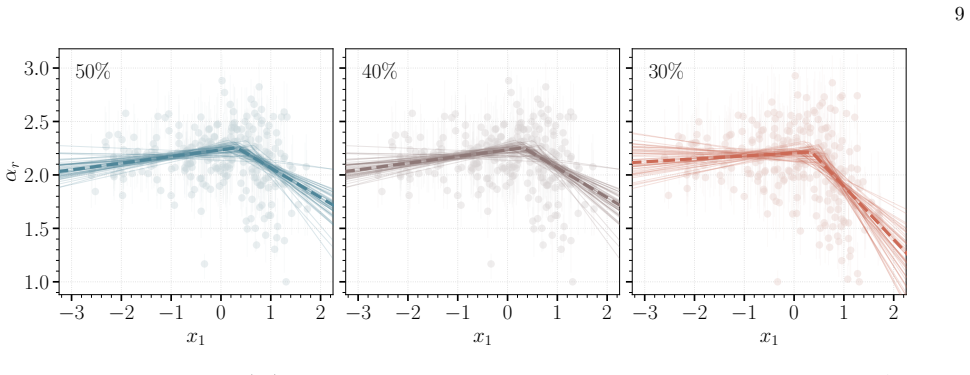
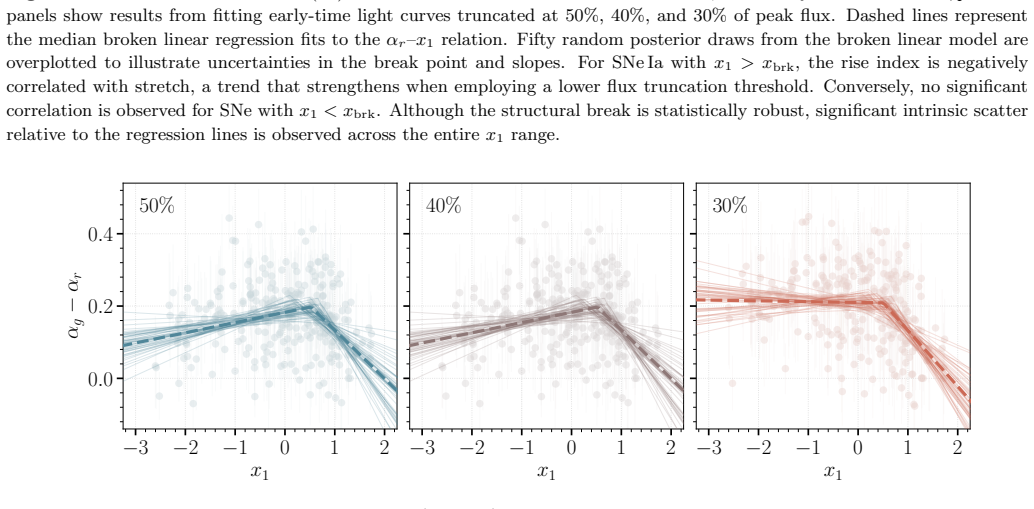
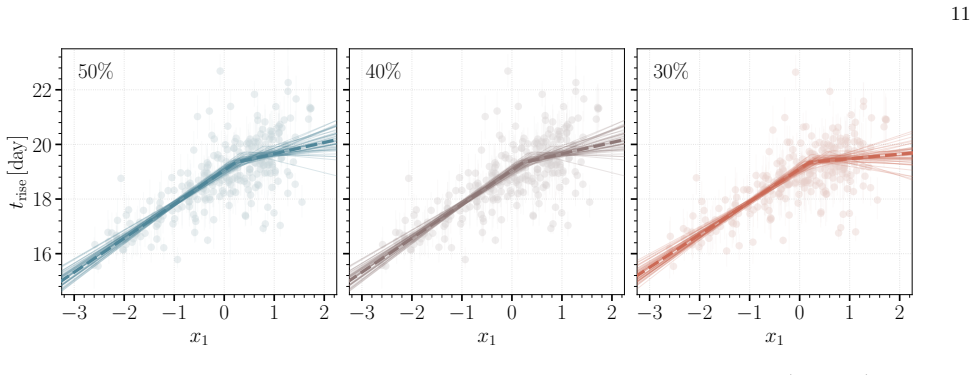
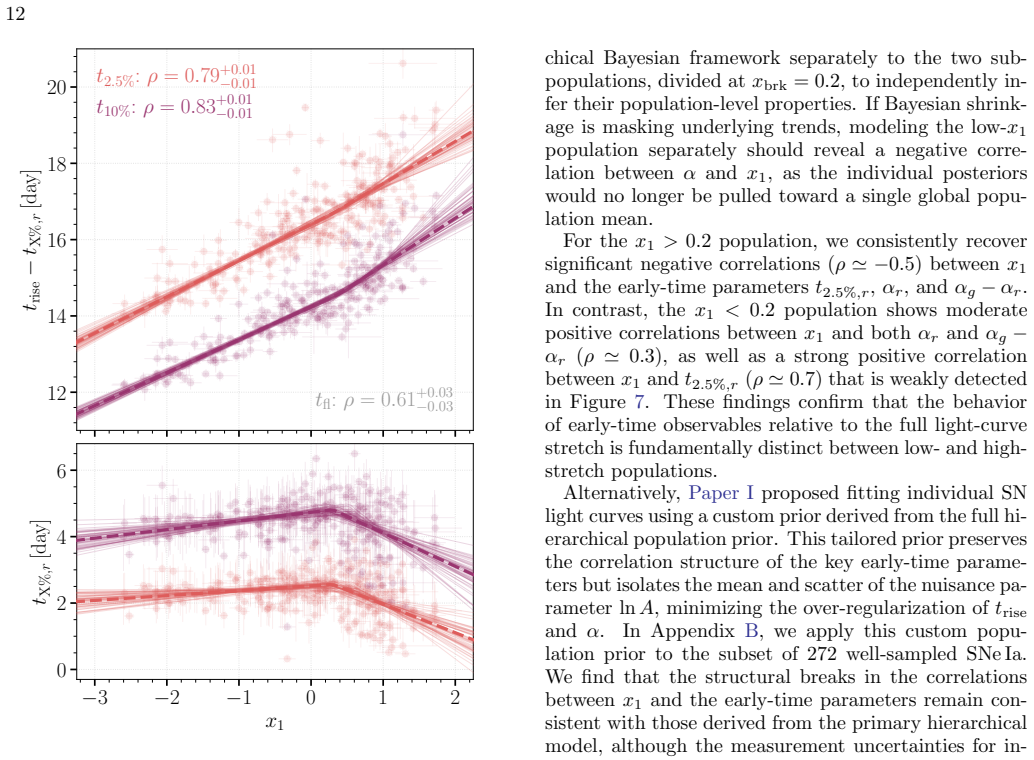
Type Ia supernovae exhibit a bifurcated rise morphology versus stretch relation, with high-stretch events showing shallower rises and persistent early blue colors.
A machine-rendered reading of the paper's core claim, the machinery that carries it, and where it could break.
Core claim
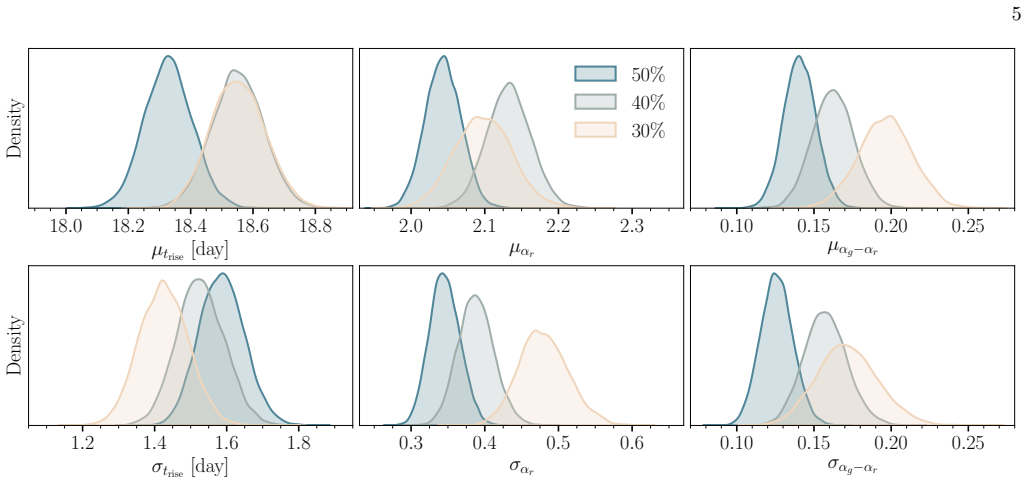
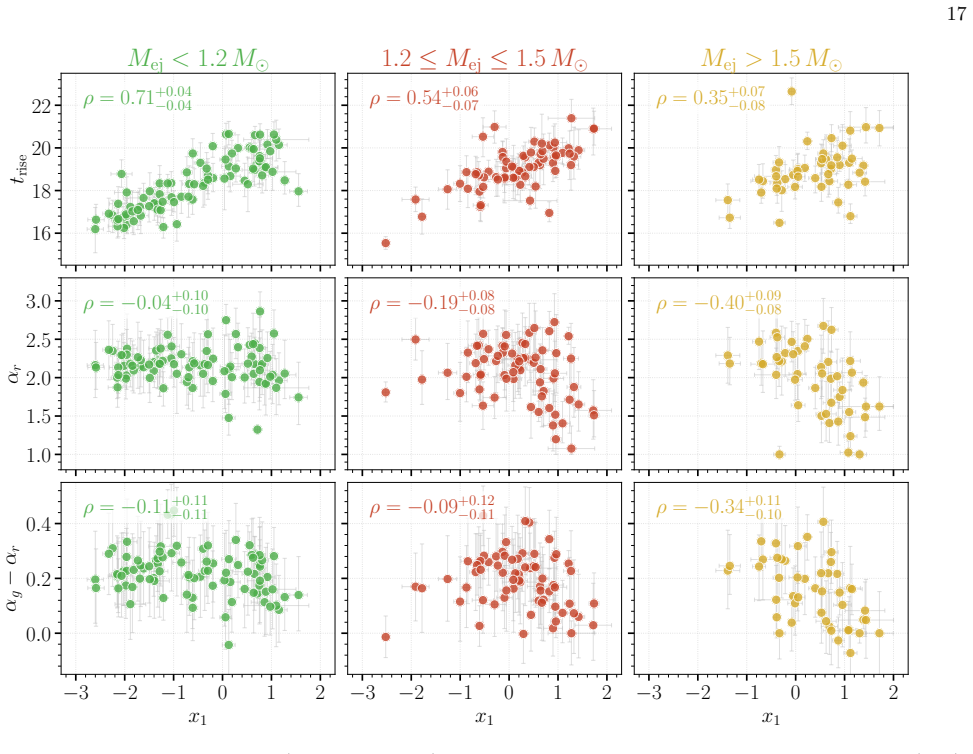
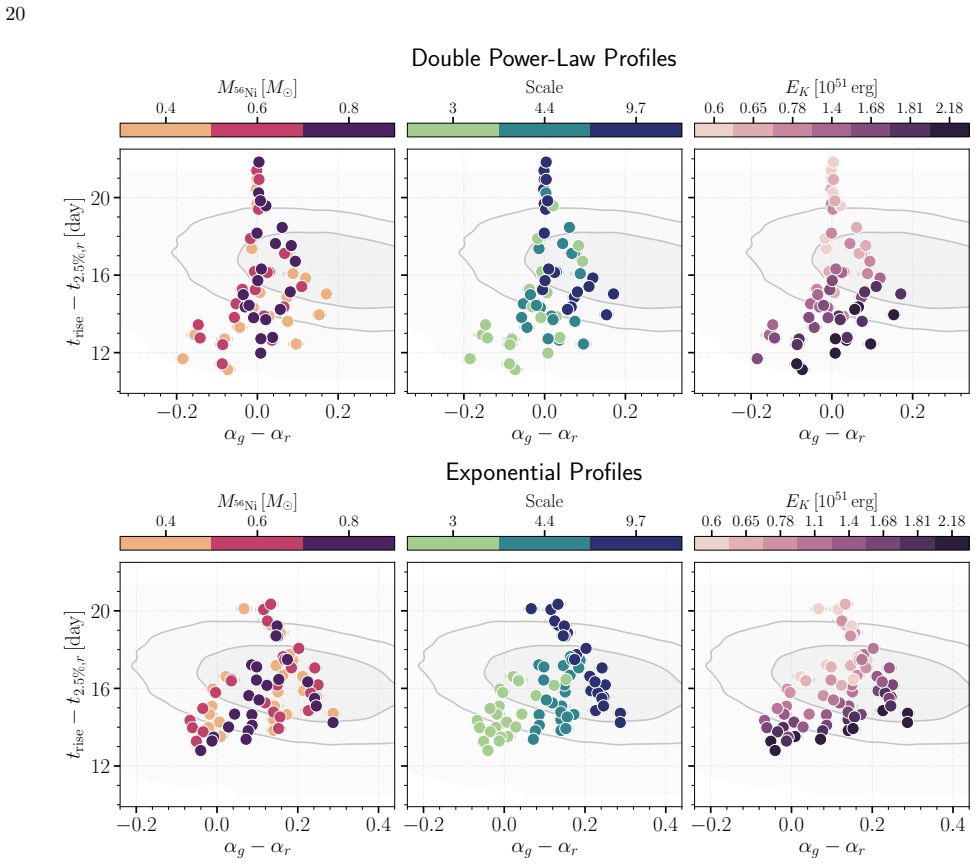
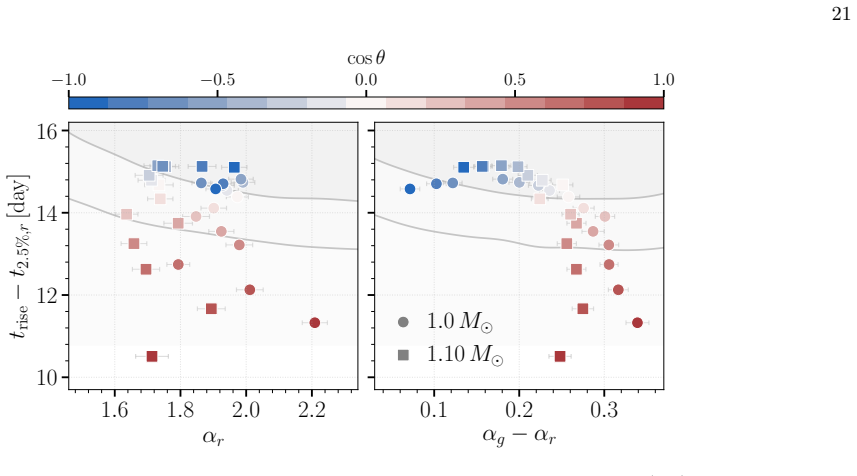
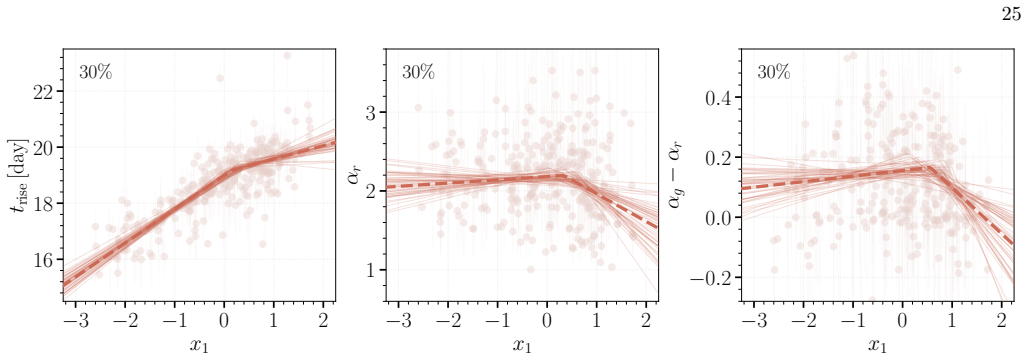
Power-law modeling of early light curves for 972 ZTF SNe Ia yields population parameters t_rise of 18.55 plus or minus 0.08 days with sigma 1.42 days, alpha of 2.10 plus or minus 0.04 with sigma 0.48 in ZTF r, and alpha_g minus alpha_r of 0.20 plus or minus 0.02 with sigma 0.17. The relation between rise morphology and SALT2 x1 stretch bifurcates into two regimes where high-stretch events correlate higher x1 with shallower rises and more persistent blue colors while low-stretch events lack these trends; long-duration flux excesses around 5 days are common in the high-stretch population and tied to those features, indicating widespread outward 56Ni mixing.
What carries the argument
Hierarchical Bayesian power-law fits applied to light curves truncated at 30 percent of peak flux across a volume-complete sample of 972 events.
If this is right
- High-stretch SNe Ia commonly display long-duration flux excesses linked to shallow rises and early blue colors.
- The dichotomy between high- and low-stretch populations in rise morphology must be reproduced by multi-dimensional explosion models that include realistic progenitor setups.
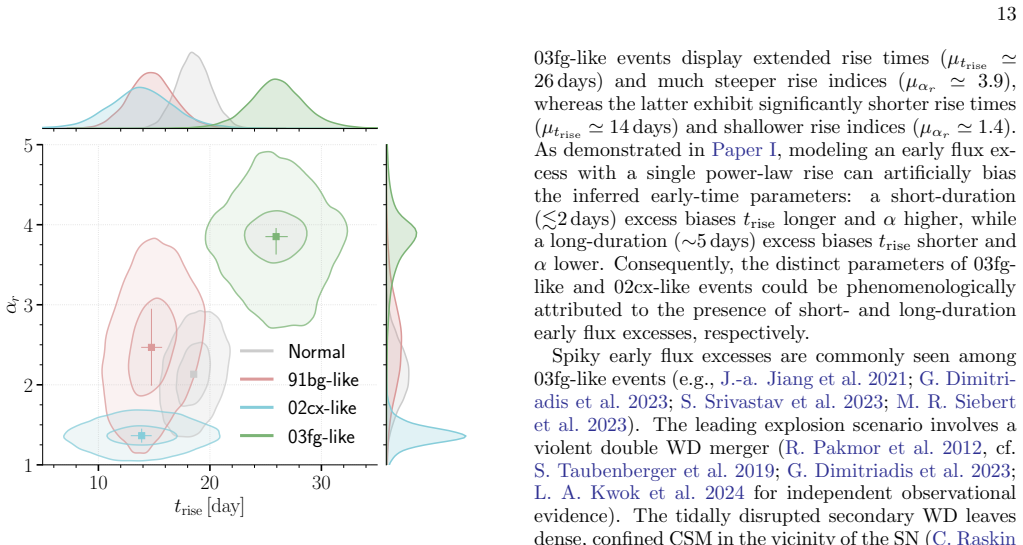
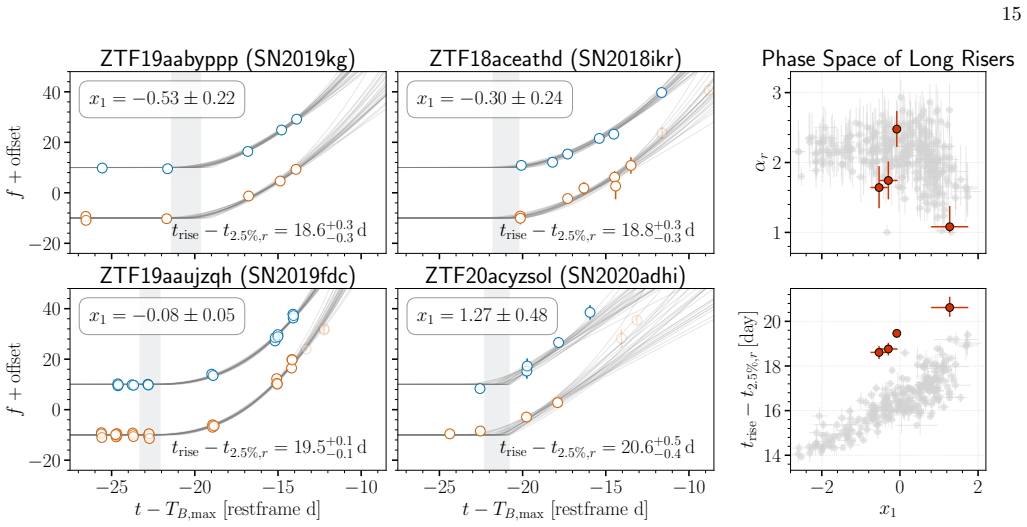
- Several normal SNe Ia display unusually long rise times that may include short-duration flux excesses over a smooth rise.
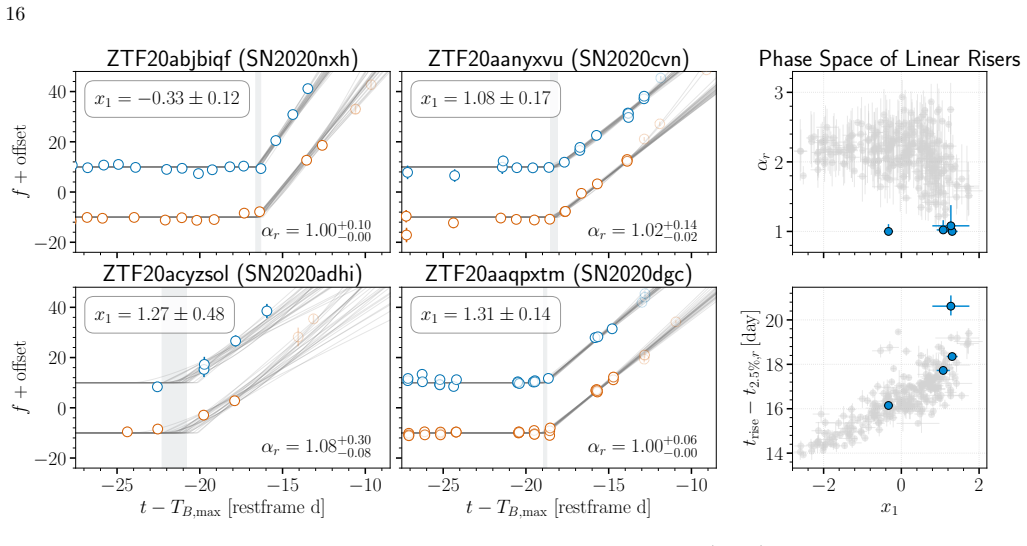
- Rise times correlate positively with x1 overall, but this relation flattens within the high-stretch population.
Where Pith is reading between the lines
- The two-regime behavior could serve as an observable to separate different progenitor channels for Type Ia supernovae.
- Early-time photometry from future wide-field surveys could be used to assign individual events to one regime or the other before peak.
- If the regimes also differ in peak luminosity or color at maximum, the bifurcation would affect how these events are standardized for cosmology.
Load-bearing premise
The power-law model remains an adequate description of the light curves when the fit is restricted to data up to 30 percent of peak flux.
What would settle it
Re-fitting the same 972 events with data included up to 40 percent of peak flux and obtaining substantially different population means or scatters for rise time or index would show the truncation choice biases the results.
Figures
read the original abstract
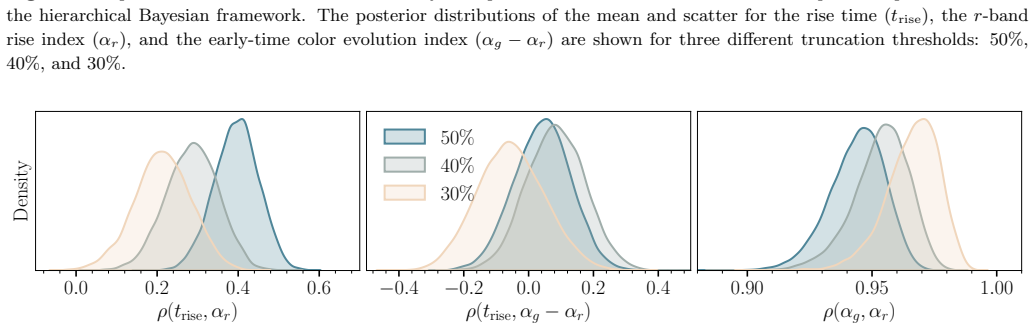
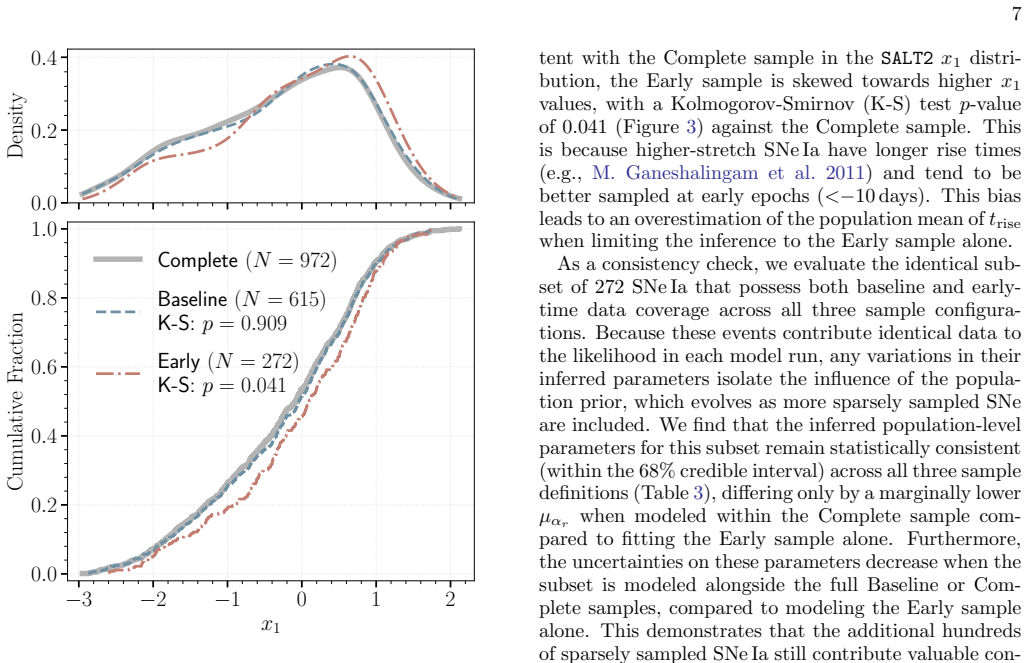
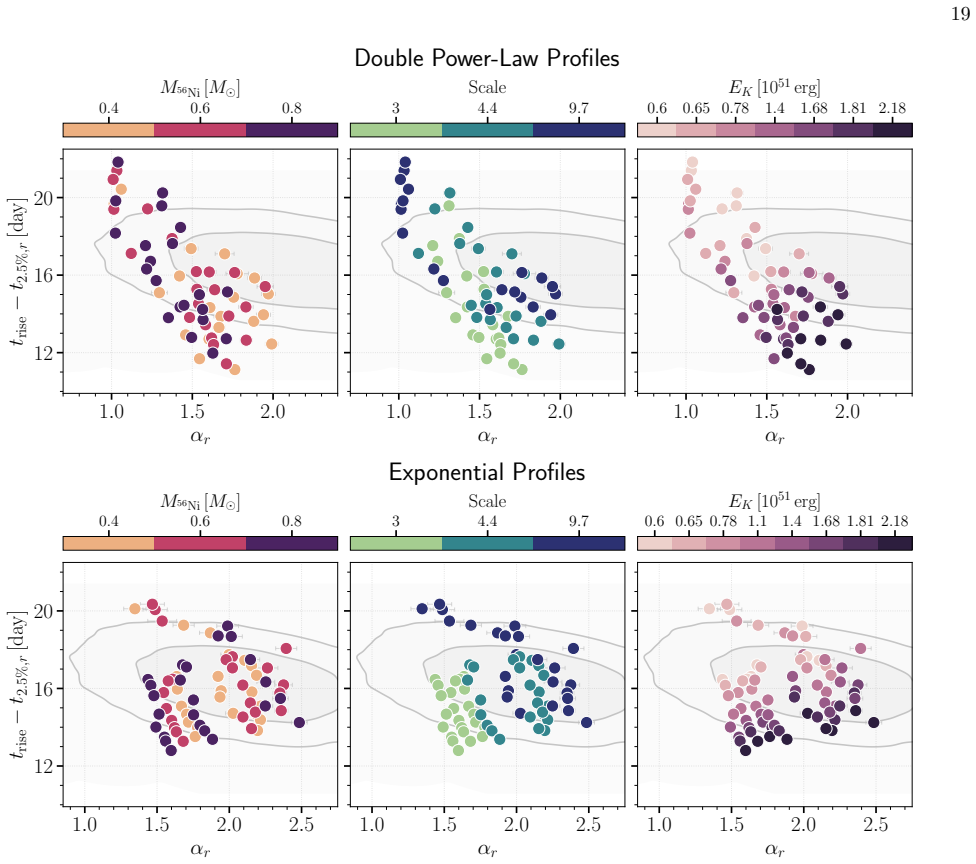
Early-time light curves of Type Ia Supernovae (SNe Ia) encode critical information about their progenitor systems. We characterize the rise of normal SNe Ia using a volume-complete sample of 972 events from the Zwicky Transient Facility Data Release 2, an order of magnitude larger than any previous dataset for similar analyses. Fitting light curves up to $30\%$ of peak flux with a power-law model under a hierarchical Bayesian framework, we provide robust population-level constraints on the rise time ($t_\mathrm{rise}$; $\mu=18.55\pm0.08$ days, $\sigma=1.42\pm0.07$ days), rise index ($\alpha$; $\mu=2.10\pm0.04$, $\sigma=0.48\pm0.03$ in ZTF $r$), and $g-r$ color evolution ($\alpha_g - \alpha_r$; $\mu=0.20\pm0.02$, $\sigma=0.17\pm0.02$). These power-law fits are sensitive to the chosen truncation epoch if data beyond $\sim$$40\%$ of peak flux are included, but generally converge when restricted to earlier epochs. The relation between rise morphology and light-curve width ($\texttt{SALT2}$ $x_1$ stretch) bifurcates into two distinct regimes: high-stretch SNe Ia show clear trends where a higher $x_1$ correlates with shallower rises and more persistent blue colors, whereas low-stretch SNe Ia lack such trends. While rise times correlate positively with $x_1$ overall, this relation flattens significantly within the high-stretch population. Searching for anomalies, we identify several normal SNe Ia with unusually long rise times, which potentially exhibit short-duration ($\lesssim$2 days) flux excesses over a smooth rise. Long-duration ($\sim$5 days) flux excesses appear common within the high-stretch population and are tied to the shallow rises and early blue colors, pointing to widespread outward $^{56}$Ni mixing. Multi-dimensional explosion models with more realistic progenitor setups are needed to fully reproduce the observed dichotomy in rise morphology and stretch.
Editorial analysis
A structured set of objections, weighed in public.
Referee Report
Summary. The paper claims to derive robust population parameters for the early rise of 972 Type Ia supernovae using power-law fits to ZTF light curves truncated at 30% of peak flux within a hierarchical Bayesian model. Key results include t_rise with mean 18.55 days and dispersion 1.42 days, rise index α mean 2.10 and dispersion 0.48 in r-band, color evolution difference mean 0.20, and a bifurcation in the rise morphology versus SALT2 x1 relation, with implications for 56Ni mixing in high-stretch events.
Significance. The study benefits from an order-of-magnitude larger sample than previous work and employs a hierarchical framework that properly accounts for uncertainties, providing empirical benchmarks for SN Ia models. The identification of distinct regimes in rise behavior and potential flux excesses offers testable predictions for explosion physics. However, the significance is tempered by the need to confirm that the truncation choice does not introduce systematic biases in the reported means and dispersions.
major comments (2)
- [Abstract] The claim of robust constraints on t_rise, α, and the x1 bifurcation depends on the power-law model being adequate at the 30% peak flux truncation. The abstract acknowledges sensitivity when including data beyond ~40% but does not quantify whether the population hyperparameters (μ, σ) shift significantly when the cutoff is varied between 20-35%, which is necessary to support the 'robust' qualifier.
- [Results on bifurcation] The reported bifurcation where high-stretch SNe show trends with x1 but low-stretch do not is central to the interpretation of widespread outward 56Ni mixing. Without an explicit test of how this split behaves under different truncation epochs or alternative early-time models, it is unclear if the dichotomy is physical or influenced by the modeling cutoff.
minor comments (2)
- [Notation] The rise index is denoted α in r-band and the color difference as α_g - α_r; a clear definition early in the text would aid readability.
- [Sample description] Clarify how the 972 events were selected from the one thousand ZTF supernovae mentioned in the title to ensure reproducibility.
Simulated Author's Rebuttal
We thank the referee for their careful reading and constructive comments, which identify key areas where additional quantification would strengthen the manuscript's claims of robustness. We address each major comment below and will revise the paper to incorporate the suggested tests.
read point-by-point responses
-
Referee: [Abstract] The claim of robust constraints on t_rise, α, and the x1 bifurcation depends on the power-law model being adequate at the 30% peak flux truncation. The abstract acknowledges sensitivity when including data beyond ~40% but does not quantify whether the population hyperparameters (μ, σ) shift significantly when the cutoff is varied between 20-35%, which is necessary to support the 'robust' qualifier.
Authors: We agree that the abstract's use of 'robust' would be better supported by an explicit demonstration that the population hyperparameters remain stable when the truncation epoch is varied between 20% and 35% of peak flux. The manuscript notes general convergence for earlier epochs but does not report the specific shifts in μ and σ across this range. In the revised version we will add a supplementary analysis (or figure) repeating the hierarchical fits at 20%, 25%, 30%, and 35% truncations and tabulating the resulting changes in the reported means and dispersions for t_rise, α, and color evolution. This will either confirm stability or allow us to qualify the robustness statement appropriately. revision: yes
-
Referee: [Results on bifurcation] The reported bifurcation where high-stretch SNe show trends with x1 but low-stretch do not is central to the interpretation of widespread outward 56Ni mixing. Without an explicit test of how this split behaves under different truncation epochs or alternative early-time models, it is unclear if the dichotomy is physical or influenced by the modeling cutoff.
Authors: We acknowledge that the bifurcation result is central to the physical interpretation and that its stability under changes in truncation has not been explicitly demonstrated. While the manuscript already flags sensitivity beyond ~40%, we have not tested the high- versus low-stretch split at other cutoffs within 20-35%. In revision we will repeat the bifurcation analysis at 25% and 35% truncations and report whether the two-regime behavior persists. We note that a full exploration of alternative early-time models (e.g., broken power laws or physically motivated templates) lies beyond the scope of the present power-law study but will be flagged as important future work; the truncation tests alone will clarify whether the reported dichotomy is robust to the specific modeling cutoff chosen. revision: yes
Circularity Check
No circularity: empirical population parameters are direct outputs of hierarchical Bayesian fit to observed data.
full rationale
The paper performs a hierarchical Bayesian fit of a power-law model to early-time ZTF light-curve data truncated at 30% of peak flux, directly yielding posterior means and dispersions for t_rise, alpha, and color evolution as reported quantities. No step claims a 'prediction' that reduces to a fitted input by the paper's own equations, no uniqueness theorem is imported via self-citation, and no ansatz is smuggled in; the truncation sensitivity is noted but does not create a definitional loop. The derivation chain is self-contained against external data.
Axiom & Free-Parameter Ledger
free parameters (2)
- population hyperparameters (mu and sigma for t_rise, alpha, color difference)
- truncation epoch (30% of peak flux)
axioms (2)
- domain assumption Early-time supernova flux follows a power-law form
- domain assumption The 972-event sample is volume-complete and representative of normal Type Ia supernovae
Reference graph
Works this paper leans on
-
[1]
2026, A&A, 707, A91, doi: 10.1051/0004-6361/202555976
Alburai, A., Galbany, L., Burgaz, U., et al. 2026, A&A, 707, A91, doi: 10.1051/0004-6361/202555976
-
[2]
2025, A&A, 694, A3, doi: 10.1051/0004-6361/202452134
Amenouche, M., Rosnet, P., Smith, M., et al. 2025, A&A, 694, A3, doi: 10.1051/0004-6361/202452134
-
[3]
Arnett, W. D. 1982, ApJ, 253, 785, doi: 10.1086/159681
-
[4]
Ashall, C., Lu, J., Shappee, B. J., et al. 2022, ApJ, 932, L2, doi: 10.3847/2041-8213/ac7235
-
[5]
Barna, B., Szalai, T., Jha, S. W., et al. 2021, MNRAS, 501, 1078, doi: 10.1093/mnras/staa3543
-
[6]
Bellm, E. C., Kulkarni, S. R., Graham, M. J., et al. 2018, PASP, 131, 018002, doi: 10.1088/1538-3873/aaecbe
-
[7]
P., Jankowiak, M., et al
Bingham, E., Chen, J. P., Jankowiak, M., et al. 2019, JMLR, 20, 1
2019
-
[8]
Boos, S. J., Dessart, L., Townsley, D. M., & Shen, K. J. 2025, ApJ, 987, 54, doi: 10.3847/1538-4357/add400
-
[9]
Miles, B. J. 2021, ApJ, 919, 126, doi: 10.3847/1538-4357/ac07a2
-
[10]
2018, JAX: Composable Transformations of Python+NumPy
Bradbury, J., Frostig, R., Hawkins, P., et al. 2018, JAX: Composable Transformations of Python+NumPy
2018
-
[11]
Bulla, M., Miller, A. A., Yao, Y., et al. 2020, ApJ, 902, 48, doi: 10.3847/1538-4357/abb13c
-
[12]
Burke, J., Andrews, M., Howell, D. A., et al. 2025, ApJ, 994, 87, doi: 10.3847/1538-4357/ae058b
-
[13]
Conley, A., Howell, D. A., Howes, A., et al. 2006, AJ, 132, 1707, doi: 10.1086/507788
-
[14]
Deckers, M., Maguire, K., Magee, M. R., et al. 2022, MNRAS, 512, 1317, doi: 10.1093/mnras/stac558
-
[15]
Dekany, R., Smith, R. M., Riddle, R., et al. 2020, PASP, 132, 038001, doi: 10.1088/1538-3873/ab4ca2 DES Collaboration, Abbott, T. M. C., Acevedo, M., et al. 2024, ApJ, 973, L14, doi: 10.3847/2041-8213/ad6f9f
-
[16]
Dimitriadis, G., Foley, R. J., Rest, A., et al. 2018, ApJ, 870, L1, doi: 10.3847/2041-8213/aaedb0
-
[17]
Dimitriadis, G., Maguire, K., Karambelkar, V. R., et al. 2023, MNRAS, 521, 1162, doi: 10.1093/mnras/stad536
-
[18]
2025, A&A, 694, A10, doi: 10.1051/0004-6361/202451852
Dimitriadis, G., Burgaz, U., Deckers, M., et al. 2025, A&A, 694, A10, doi: 10.1051/0004-6361/202451852
-
[19]
Fausnaugh, M. M., Vallely, P. J., Tucker, M. A., et al. 2023, ApJ, 956, 108, doi: 10.3847/1538-4357/aceaef
-
[20]
Filippenko, A. V., Richmond, M. W., Matheson, T., et al. 1992a, ApJ, 384, L15, doi: 10.1086/186252
-
[21]
Filippenko, A. V., Richmond, M. W., Branch, D., et al. 1992b, AJ, 104, 1543, doi: 10.1086/116339
-
[22]
Fink, M., R¨ opke, F. K., Hillebrandt, W., et al. 2010, A&A, 514, A53, doi: 10.1051/0004-6361/200913892
-
[23]
Fink, M., Kromer, M., Seitenzahl, I. R., et al. 2014, MNRAS, 438, 1762, doi: 10.1093/mnras/stt2315
-
[24]
E., Sullivan, M., Gal-Yam, A., et al
Firth, R. E., Sullivan, M., Gal-Yam, A., et al. 2015, MNRAS, 446, 3895, doi: 10.1093/mnras/stu2314
-
[25]
Ganeshalingam, M., Li, W., & Filippenko, A. V. 2011, MNRAS, 416, 2607, doi: 10.1111/j.1365-2966.2011.19213.x
-
[26]
2025, A&A, 695, A140, doi: 10.1051/0004-6361/202450378
Ginolin, M., Rigault, M., Smith, M., et al. 2025, A&A, 695, A140, doi: 10.1051/0004-6361/202450378
-
[27]
Goldhaber, G., Groom, D. E., Kim, A., et al. 2001, ApJ, 558, 359, doi: 10.1086/322460 26 Gonz´ alez-Gait´ an, S., Conley, A., Bianco, F. B., et al. 2011, ApJ, 745, 44, doi: 10.1088/0004-637X/745/1/44
-
[28]
2014, ApJ, 784, L12, doi: 10.1088/2041-8205/784/1/L12
Goobar, A., Johansson, J., Amanullah, R., et al. 2014, ApJ, 784, L12, doi: 10.1088/2041-8205/784/1/L12
-
[29]
Graham, M. J., Kulkarni, S. R., Bellm, E. C., et al. 2019, PASP, 131, 078001, doi: 10.1088/1538-3873/ab006c
-
[30]
Gronow, S., Collins, C., Ohlmann, S. T., et al. 2020, A&A, 635, A169, doi: 10.1051/0004-6361/201936494
-
[31]
Gronow, S., Collins, C. E., Sim, S. A., & R¨ opke, F. K. 2021, A&A, 649, A155, doi: 10.1051/0004-6361/202039954
-
[32]
2007, A&A, 466, 11, doi: 10.1051/0004-6361:20066930
Guy, J., Astier, P., Baumont, S., et al. 2007, A&A, 466, 11, doi: 10.1051/0004-6361:20066930
-
[33]
Hayden, B. T., Garnavich, P. M., Kasen, D., et al. 2010a, ApJ, 722, 1691, doi: 10.1088/0004-637X/722/2/1691
-
[34]
Hayden, B. T., Garnavich, P. M., Kessler, R., et al. 2010b, ApJ, 712, 350, doi: 10.1088/0004-637X/712/1/350
-
[35]
Hicken, M., Garnavich, P. M., Prieto, J. L., et al. 2007, ApJ, 669, L17, doi: 10.1086/523301
-
[36]
Hoffman, M. D., & Gelman, A. 2014, doi: 10.5555/2627435.2638586
-
[37]
Hoogendam, W. B., Ashall, C., Jones, D. O., et al. 2025, ApJ, 988, 209, doi: 10.3847/1538-4357/ade787
-
[38]
Hosseinzadeh, G., Sand, D. J., Valenti, S., et al. 2017, ApJ, 845, L11, doi: 10.3847/2041-8213/aa8402
-
[39]
Howell, D. A., Sullivan, M., Nugent, P. E., et al. 2006, Nature, 443, 308, doi: 10.1038/nature05103
-
[40]
2025, ApJ, 984, 160, doi: 10.3847/1538-4357/adb3a4
Iskandar, A., Wang, X., Esamdin, A., et al. 2025, ApJ, 984, 160, doi: 10.3847/1538-4357/adb3a4 Ivezi´ c,ˇZ., Kahn, S. M., Tyson, J. A., et al. 2019, ApJ, 873, 111, doi: 10.3847/1538-4357/ab042c
-
[41]
2018, ApJ, 865, 149, doi: 10.3847/1538-4357/aadb9a
Jiang, J.-a., Doi, M., Maeda, K., & Shigeyama, T. 2018, ApJ, 865, 149, doi: 10.3847/1538-4357/aadb9a
-
[42]
2020, ApJ, 892, 25, doi: 10.3847/1538-4357/ab76cb
Jiang, J.-a., Yasuda, N., Maeda, K., et al. 2020, ApJ, 892, 25, doi: 10.3847/1538-4357/ab76cb
-
[43]
2021, ApJ, 923, L8, doi: 10.3847/2041-8213/ac375f
Jiang, J.-a., Maeda, K., Kawabata, M., et al. 2021, ApJ, 923, L8, doi: 10.3847/2041-8213/ac375f
-
[44]
2010, ApJ, 708, 1025, doi: 10.1088/0004-637X/708/2/1025
Kasen, D. 2010, ApJ, 708, 1025, doi: 10.1088/0004-637X/708/2/1025
-
[45]
Kasen, D., Thomas, R. C., & Nugent, P. 2006, ApJ, 651, 366, doi: 10.1086/506190
-
[46]
Khatami, D. K., & Kasen, D. N. 2019, ApJ, 878, 56, doi: 10.3847/1538-4357/ab1f09
-
[47]
Kromer, M., Sim, S. A., Fink, M., et al. 2010, ApJ, 719, 1067, doi: 10.1088/0004-637X/719/2/1067
-
[48]
2013, MNRAS, 429, 2287, doi: 10.1093/mnras/sts498
Kromer, M., Fink, M., Stanishev, V., et al. 2013, MNRAS, 429, 2287, doi: 10.1093/mnras/sts498
-
[49]
Kwok, L. A., Siebert, M. R., Johansson, J., et al. 2024, ApJ, 966, 135, doi: 10.3847/1538-4357/ad2c0d
-
[50]
Larison, C., Jha, S. W., Kwok, L. A., & Camacho-Neves, Y. 2024, ApJ, 961, 185, doi: 10.3847/1538-4357/ad0e0f
-
[51]
Li, W., Filippenko, A. V., Chornock, R., et al. 2003, PASP, 115, 453, doi: 10.1086/374200
-
[52]
2018, ApJ, 870, 12, doi: 10.3847/1538-4357/aaec74
Li, W., Wang, X., Vink´ o, J., et al. 2018, ApJ, 870, 12, doi: 10.3847/1538-4357/aaec74
-
[53]
Liu, C., & Miller, A. A. 2026, Submitted to ApJ
2026
-
[54]
Liu, C., Miller, A. A., Boos, S. J., et al. 2023, ApJ, 958, 178, doi: 10.3847/1538-4357/acffc9
-
[55]
Liu, Z.-W., R¨ opke, F. K., & Han, Z. 2023, RAA, 23, 082001, doi: 10.1088/1674-4527/acd89e
-
[56]
R., Maguire, K., Kotak, R., et al
Magee, M. R., Maguire, K., Kotak, R., et al. 2020, A&A, 634, A37, doi: 10.1051/0004-6361/201936684
-
[57]
Magee, M. R., Sim, S. A., Kotak, R., & Kerzendorf, W. E. 2018, A&A, 614, A115, doi: 10.1051/0004-6361/201832675
-
[58]
Magee, M. R., Kotak, R., Sim, S. A., et al. 2016, A&A, 589, A89, doi: 10.1051/0004-6361/201528036
-
[59]
R., Cuddy, C., Maguire, K., et al
Magee, M. R., Cuddy, C., Maguire, K., et al. 2022, MNRAS, 513, 3035, doi: 10.1093/mnras/stac1045
-
[60]
Magee, M. R., Killestein, T. L., Pursiainen, M., et al. 2025, MNRAS, 543, 3731, doi: 10.1093/mnras/staf1675
-
[61]
Maguire, K., Magee, M. R., Leloudas, G., et al. 2023, MNRAS, 525, 1210, doi: 10.1093/mnras/stad2316
-
[62]
Marion, G. H., Brown, P. J., Vink´ o, J., et al. 2016, ApJ, 820, 92, doi: 10.3847/0004-637X/820/2/92
-
[63]
A., Abril-Pla, O., Deklerk, J., et al
Martin, O. A., Abril-Pla, O., Deklerk, J., et al. 2026, J. Open Source Softw., 11, 9889, doi: 10.21105/joss.09889
-
[64]
Masci, F. J., Laher, R. R., Rusholme, B., et al. 2018, PASP, 131, 018003, doi: 10.1088/1538-3873/aae8ac
work page internal anchor Pith review doi:10.1088/1538-3873/aae8ac 2018
-
[65]
Miller, A. A., Cao, Y., Piro, A. L., et al. 2018, ApJ, 852, 100, doi: 10.3847/1538-4357/aaa01f
-
[66]
Miller, A. A., Yao, Y., Bulla, M., et al. 2020, ApJ, 902, 47, doi: 10.3847/1538-4357/abb13b
-
[67]
Miller, A. A., Abrams, N. S., Aldering, G., et al. 2025, PASP, 137, 094204, doi: 10.1088/1538-3873/ae02c5 M¨ uller-Bravo, T. E., Maguire, K., Alburai, A., et al. 2026, Submitted to A&A
-
[68]
Ni, Y. Q., Moon, D.-S., Drout, M. R., et al. 2025, ApJ, 983, 3, doi: 10.3847/1538-4357/adbbb7
-
[69]
2021, A&A, 649, A74, doi: 10.1051/0004-6361/202038447
Nicolas, N., Rigault, M., Copin, Y., et al. 2021, A&A, 649, A74, doi: 10.1051/0004-6361/202038447
-
[70]
M., Kromer, M., Taubenberger, S., et al
Noebauer, U. M., Kromer, M., Taubenberger, S., et al. 2017, MNRAS, 472, 2787, doi: 10.1093/mnras/stx2093
-
[71]
M., Taubenberger, S., Blinnikov, S., Sorokina, E., & Hillebrandt, W
Noebauer, U. M., Taubenberger, S., Blinnikov, S., Sorokina, E., & Hillebrandt, W. 2016, MNRAS, 463, 2972, doi: 10.1093/mnras/stw2197 O’Brien, J. T., Kerzendorf, W. E., Fullard, A., et al. 2024, ApJ, 964, 137, doi: 10.3847/1538-4357/ad2358
-
[72]
Olling, R. P., Mushotzky, R., Shaya, E. J., et al. 2015, Nature, 521, 332, doi: 10.1038/nature14455 27
-
[73]
2012, The Astrophysical Journal Letters, 747, L10, 10.1088/2041-8205/747/1/L10
Pakmor, R., Kromer, M., Taubenberger, S., et al. 2012, ApJ, 747, L10, doi: 10.1088/2041-8205/747/1/L10
-
[74]
Pereira, R., Thomas, R. C., Aldering, G., et al. 2013, A&A, 554, A27, doi: 10.1051/0004-6361/201221008
-
[75]
Measurements of Omega and Lambda from 42 High-Redshift Supernovae
Perlmutter, S., Aldering, G., Goldhaber, G., et al. 1999, ApJ, 517, 565, doi: 10.1086/307221
work page internal anchor Pith review doi:10.1086/307221 1999
-
[76]
Composable Effects for Flexible and Accelerated Probabilistic Programming in NumPyro
Phan, D., Pradhan, N., & Jankowiak, M. 2019, Composable Effects for Flexible and Accelerated Probabilistic Programming in NumPyro, arXiv, doi: 10.48550/arXiv.1912.11554
work page internal anchor Pith review Pith/arXiv arXiv doi:10.48550/arxiv.1912.11554 2019
-
[77]
Piro, A. L. 2015, ApJ, 808, L51, doi: 10.1088/2041-8205/808/2/L51
-
[78]
Piro, A. L., & Morozova, V. S. 2016, ApJ, 826, 96, doi: 10.3847/0004-637X/826/1/96
-
[79]
Piro, A. L., & Nakar, E. 2013, ApJ, 769, 67, doi: 10.1088/0004-637X/769/1/67
-
[80]
Piro, A. L., & Nakar, E. 2014, ApJ, 784, 85, doi: 10.1088/0004-637X/784/1/85
discussion (0)
Sign in with ORCID, Apple, or X to comment. Anyone can read and Pith papers without signing in.