Little Red Dots at z~2 in EIGER reveal a gentle decline with respect to their peak number density at z~5
Pith reviewed 2026-07-02 18:23 UTC · model grok-4.3
The pith
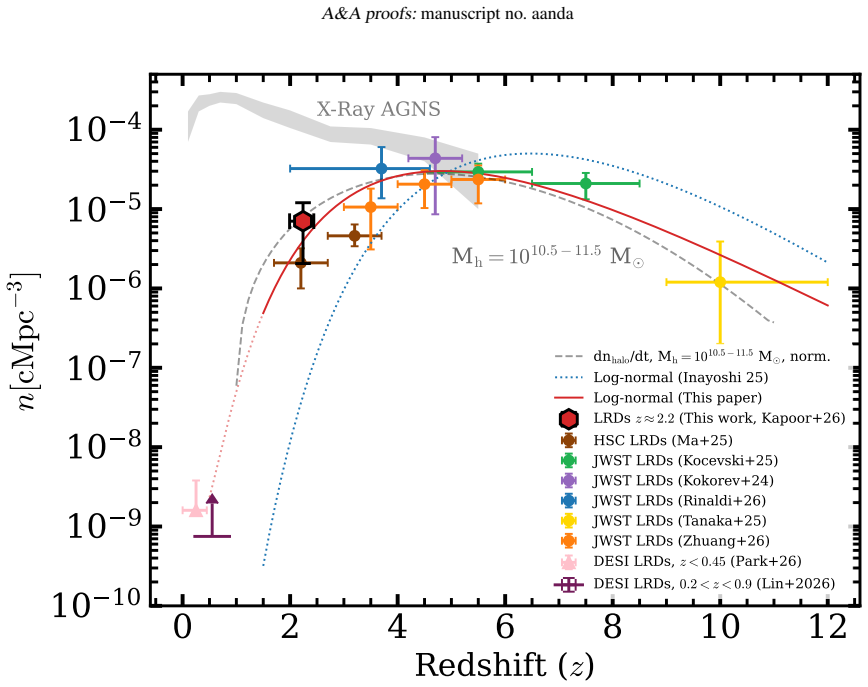
Little red dots at z≈2 exhibit a gentler decline in number density from their z≈5 peak than photometric surveys indicated.
A machine-rendered reading of the paper's core claim, the machinery that carries it, and where it could break.
Core claim
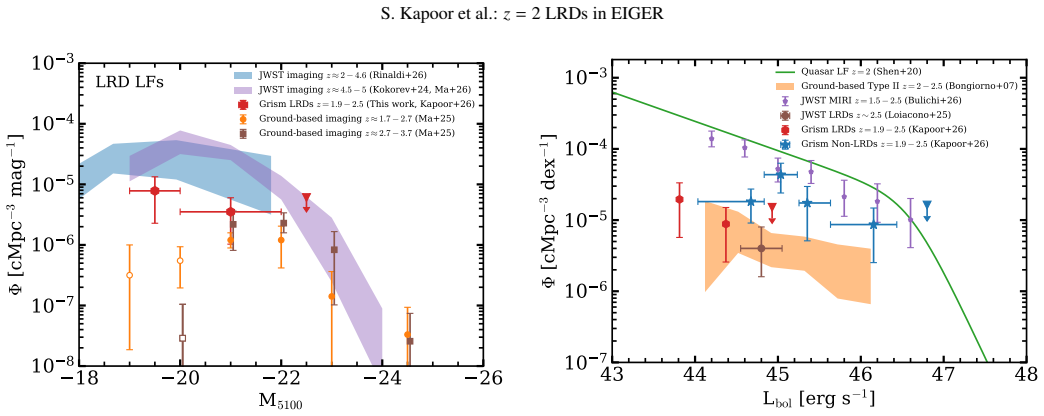
Our LRD sample at z≈2 spans a similar optical luminosity range as higher-redshift counterparts and yields a number density of ≈7×10^{-6} cMpc^{-3} at z=1.9-2.5, confirming a decline relative to z≈5 while indicating that decline is more gentle than photometric surveys had emphasized.
What carries the argument
Spectro-photometric classification of broad-line emitters into LRDs versus classical AGNs, followed by volume-limited number-density measurement over the 140 arcmin² EIGER survey area.
If this is right
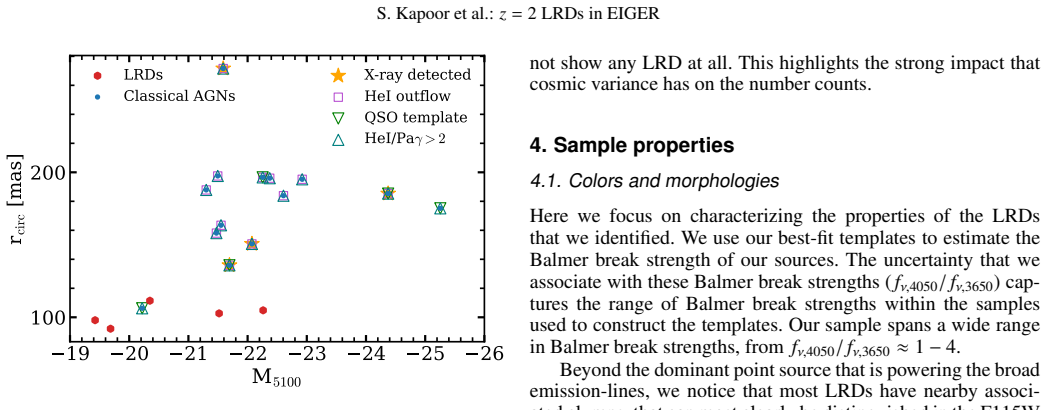
- Classical AGNs dominate the counts above M_{5100} < -22.5 while the LRD fraction among broad-line sources reaches 100 percent near M_{5100} ≈ -20.
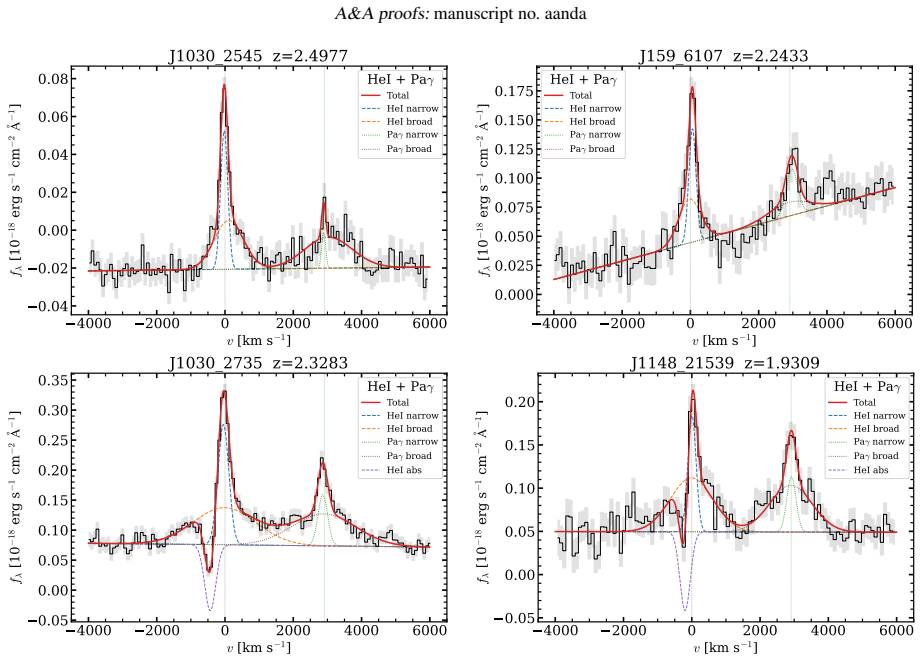
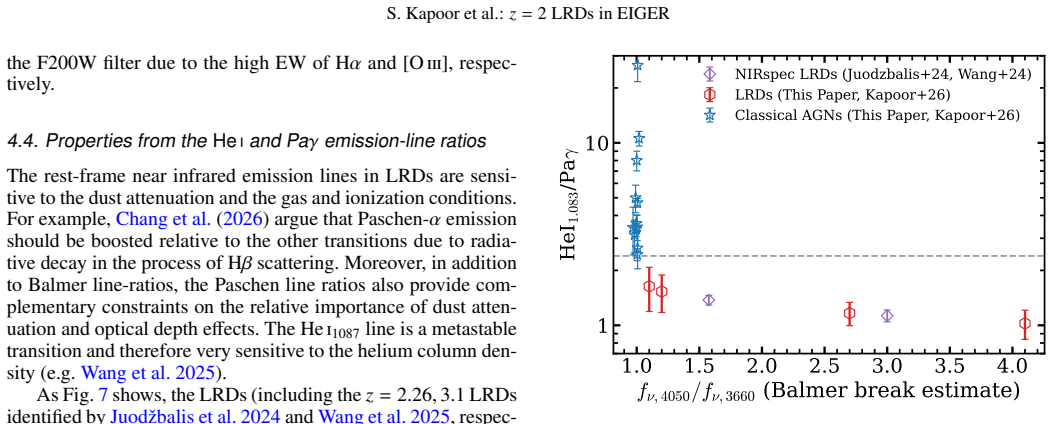
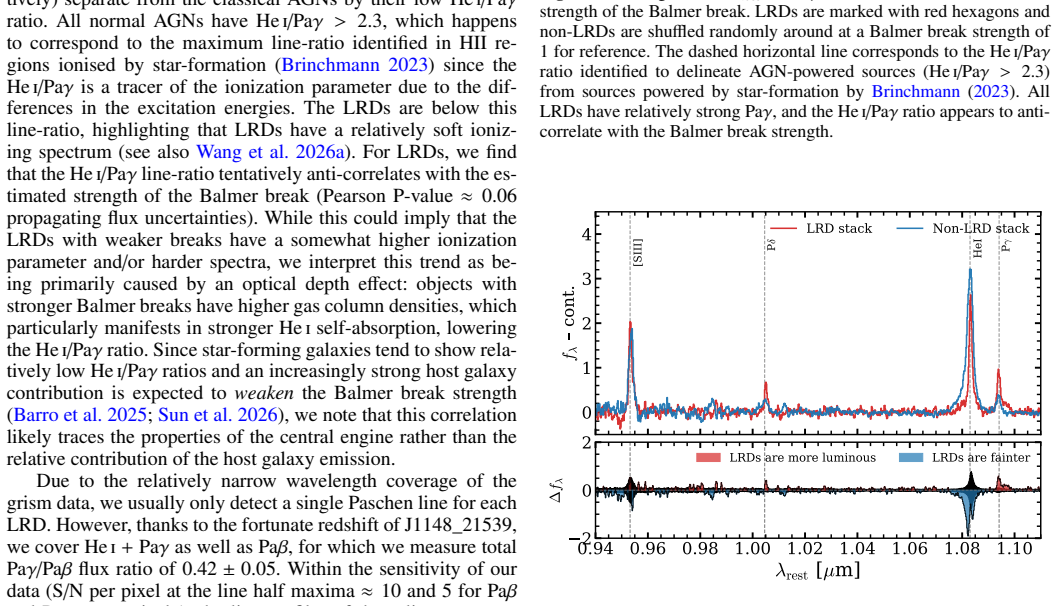
- The HeI/Paγ ratio cleanly separates LRDs from classical AGNs and appears to anti-correlate with Balmer break strength, tracing higher gas column densities via self-absorption.
- Blue-shifted HeI absorption is present in the two reddest LRDs.
- The LRDs correspond to black-hole masses of ~10^6 M_⊙ at the Eddington limit, matching the luminosity range of their high-redshift counterparts.
Where Pith is reading between the lines
- A milder density decline would imply that the physical conditions producing LRDs persist over a wider redshift interval than models with a sharp cutoff would predict.
- Deeper spectroscopy targeting fainter luminosities at z~2 could test whether the LRD fraction continues to rise below the current detection threshold.
- The observed link between line ratios and Balmer breaks offers a potential observable for testing dust and gas geometry in low-luminosity accreting systems.
Load-bearing premise
The spectro-photometric criteria used to classify five of the 19 broad-line sources as LRDs are both complete and free of significant contamination or selection bias within the EIGER survey volume and luminosity range.
What would settle it
A comparable or larger spectroscopic survey at z≈2 that measures an LRD number density below 10^{-6} cMpc^{-3} would indicate a steeper decline than reported here.
Figures
read the original abstract
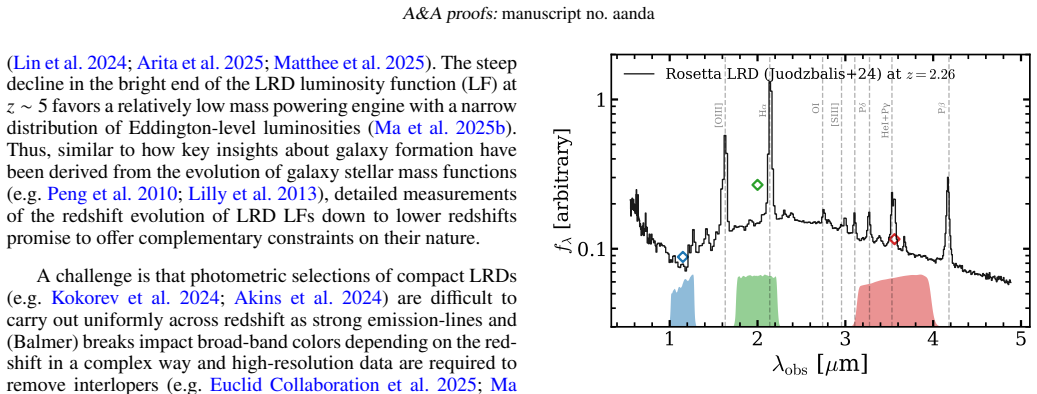
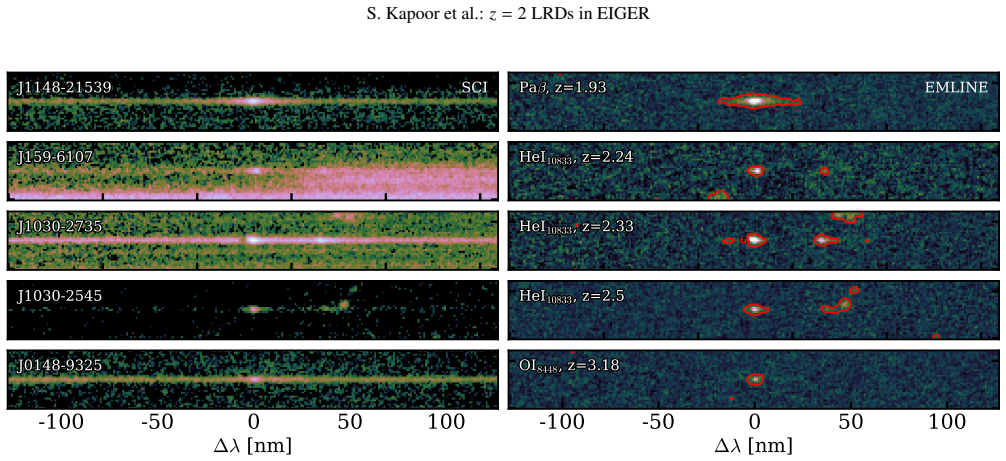
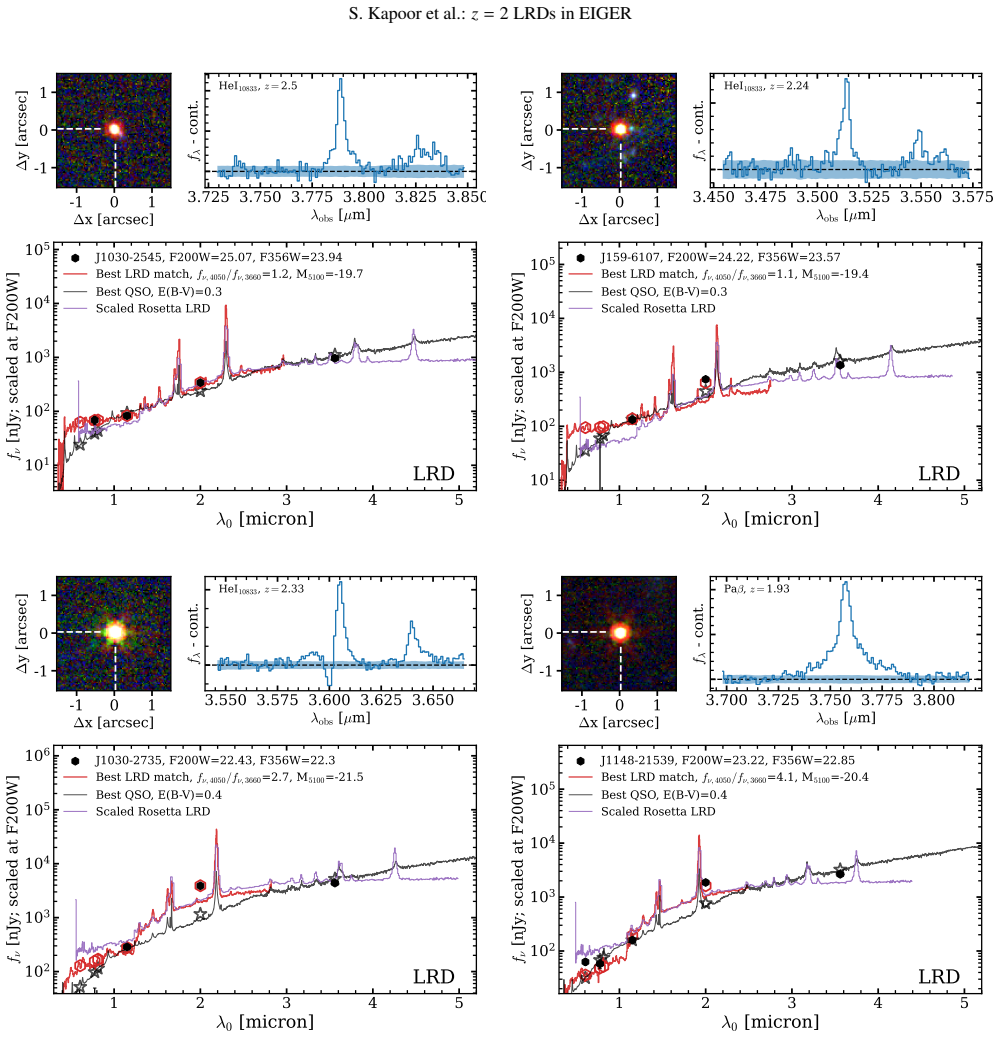
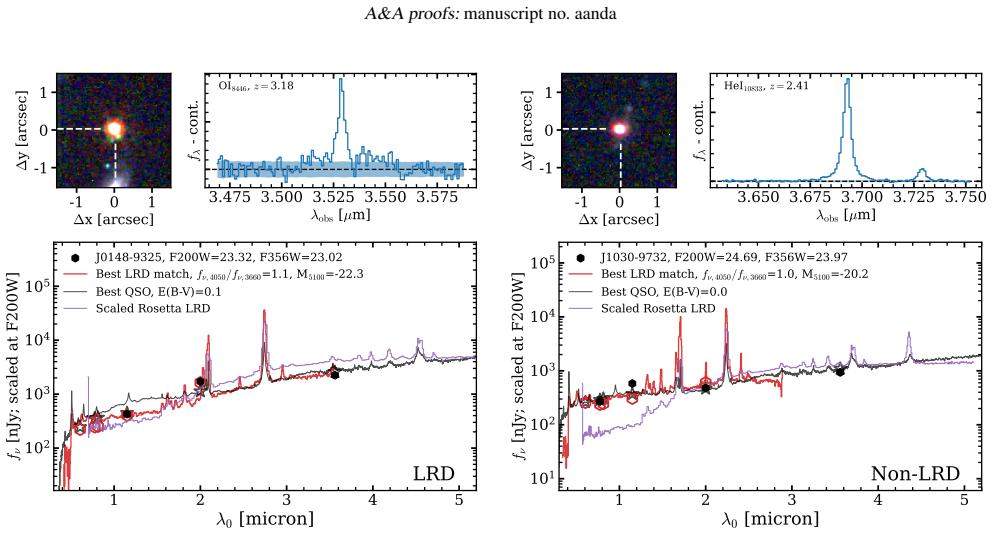
We report the discovery of a sample of little red dots (LRDs) at $z \approx 2$ identified from deep JWST/NIRCam imaging and wide-field slitless spectroscopy over $140$ arcmin$^2$ from the EIGER survey. With an improved blind broad-line identification algorithm, we select 19 sources at spectroscopic redshifts $z = 1.55-3.18$ identified via rest-frame near-infrared lines (Paschen-$\beta$, HeI+Pa$\gamma$ and OI). Based on a range of spectro-photometric criteria, we classify five of these sources as LRDs and the other 14 as classical active galactic nuclei (AGNs). This classification is corroborated by some X-ray detections among the AGNs. Classical AGNs dominate the number counts above optical luminosities M$_{5100}<-22.5$, whereas the LRD fraction among broad-line sources reaches 100 % at M$_{5100}\approx-20$. The LRDs span the range in Balmer break strengths seen in the higher redshift populations. Blue-shifted HeI absorption is detected in the two reddest sources. The HeI/Pa$\gamma$ ratio cleanly separates LRDs from classical AGNs and seems to anti-correlate with Balmer break strength, likely tracing HeI self-absorption at higher gas column densities. Our LRD sample has a similar optical luminosity range as their high-redshift counterparts, corresponding to black hole masses of $\sim10^{6}$ M$_{\odot}$ at the Eddington luminosity. We measure LRD number densities of $\approx 7\times10^{-6}$ cMpc$^{-3}$ at $z = 1.9-2.5$, which indicates that LRDs represent $\lesssim 3$ % of the AGN population at these epochs. Our results confirm the previously reported decline in the LRD number density with respect to $z \approx 5$ based on photometric surveys, although we find the decline to be more gentle than earlier emphasized.
Editorial analysis
A structured set of objections, weighed in public.
Referee Report
Summary. The paper reports the discovery of five little red dots (LRDs) at z≈2 from the EIGER JWST survey over 140 arcmin², selected among 19 spectroscopically confirmed broad-line sources (z=1.55-3.18) via Paschen-β, HeI+Paγ and OI lines. Using spectro-photometric criteria (Balmer break strength, HeI/Paγ ratio, blue-shifted absorption), five sources are classified as LRDs and 14 as classical AGNs, with the classification partly corroborated by X-ray detections. The LRDs have similar luminosities to higher-z counterparts (M5100 ≈ –20 to –22.5, implying ~10^6 M⊙ black holes at Eddington), and the measured number density is ≈7×10^{-6} cMpc^{-3} at z=1.9-2.5, implying LRDs are ≲3% of the AGN population and confirming a decline from z≈5 but gentler than previously reported.
Significance. If robust, the result supplies the first spectroscopic sample of LRDs at z~2, bridging photometric high-z samples and lower-z AGN demographics. The direct spectroscopic redshifts, X-ray corroboration for some AGNs, and the reported anti-correlation between HeI/Paγ and Balmer break strength are concrete strengths that allow testable follow-up on gas column densities and accretion properties.
major comments (3)
- [Abstract, §3] Abstract and §3 (classification section): the central number density of ≈7×10^{-6} cMpc^{-3} at z=1.9-2.5 is obtained by counting five sources classified as LRDs out of 19 broad-line objects, but no completeness simulation, purity estimate, or mock-catalog test of the spectro-photometric criteria (Balmer-break range, HeI/Paγ ratio, blue-shifted absorption) is provided for the survey luminosity range M5100 ~ –20 to –22.5. This directly affects whether the measured density and the claimed gentler decline relative to z≈5 are reliable.
- [Abstract] Abstract: the reported density carries no error budget (Poisson uncertainties, cosmic variance, or volume calculation details for the 140 arcmin² field in the z=1.9-2.5 bin). With N=5, even modest contamination or incompleteness at the 20% level would shift the density enough to remove the distinction from a steeper decline.
- [Abstract] Abstract: the statement that “the HeI/Paγ ratio cleanly separates LRDs from classical AGNs” is presented without a quantitative demonstration (e.g., separation statistic, boundary definition, or robustness test against measurement errors) in the luminosity and redshift slice of the sample.
minor comments (2)
- Provide an explicit table or subsection listing the 19 sources with measured line ratios, Balmer-break strengths, and X-ray properties to allow independent assessment of the classification boundary.
- Clarify how the comoving volume for the density calculation is derived from the 140 arcmin² area and the precise redshift interval.
Simulated Author's Rebuttal
We thank the referee for their careful and constructive review. The comments highlight important areas where the manuscript can be strengthened with additional quantitative analysis. We address each major comment below and will incorporate the suggested revisions in the next version of the paper.
read point-by-point responses
-
Referee: [Abstract, §3] Abstract and §3 (classification section): the central number density of ≈7×10^{-6} cMpc^{-3} at z=1.9-2.5 is obtained by counting five sources classified as LRDs out of 19 broad-line objects, but no completeness simulation, purity estimate, or mock-catalog test of the spectro-photometric criteria (Balmer-break range, HeI/Paγ ratio, blue-shifted absorption) is provided for the survey luminosity range M5100 ~ –20 to –22.5. This directly affects whether the measured density and the claimed gentler decline relative to z≈5 are reliable.
Authors: We agree that formal completeness and purity estimates via mock catalogs are needed to robustly support the number density and the comparison to z≈5. In the revised manuscript we will add mock-catalog simulations that inject sources with the observed range of Balmer-break strengths, HeI/Paγ ratios, and absorption features into the EIGER data, then re-apply our classification criteria to quantify completeness and purity in the M5100 ≈ –20 to –22.5 range. This will allow us to place a more reliable uncertainty on the reported density and on the claimed gentler decline. revision: yes
-
Referee: [Abstract] Abstract: the reported density carries no error budget (Poisson uncertainties, cosmic variance, or volume calculation details for the 140 arcmin² field in the z=1.9-2.5 bin). With N=5, even modest contamination or incompleteness at the 20% level would shift the density enough to remove the distinction from a steeper decline.
Authors: We acknowledge that the current version omits a quantitative error budget. The revised abstract and §4 will explicitly report Poisson uncertainties on the density, an estimate of cosmic variance appropriate for the 140 arcmin² EIGER footprint, and the precise comoving volume for the z=1.9–2.5 bin. We will also add a short sensitivity analysis showing how 20 % contamination or incompleteness would affect the comparison with the steeper decline reported at higher redshift, thereby clarifying the robustness of our conclusion. revision: yes
-
Referee: [Abstract] Abstract: the statement that “the HeI/Paγ ratio cleanly separates LRDs from classical AGNs” is presented without a quantitative demonstration (e.g., separation statistic, boundary definition, or robustness test against measurement errors) in the luminosity and redshift slice of the sample.
Authors: The separation is visually evident in our sample of 19 sources, but we agree that a quantitative demonstration is required. In the revision we will define an explicit boundary value for the HeI/Paγ ratio, report a statistical measure of separation (e.g., the significance of the difference between the two populations), and test the robustness of the classification against the measurement uncertainties on the line ratios within the M5100 and redshift range of the sample. revision: yes
Circularity Check
Number density derived by direct counting; no reduction to fitted inputs or self-citations
full rationale
The paper's central result is the LRD number density at z=1.9-2.5 obtained by counting five sources that meet a set of spectro-photometric criteria among 19 broad-line emitters identified via Paschen and HeI lines. This count is converted to a comoving density using the survey volume; the value is not obtained by fitting any parameter to a subset of the data and then predicting the same quantity. The comparison to the z≈5 peak is made against external photometric surveys rather than prior work by the same authors. No equation, ansatz, or uniqueness theorem is invoked that reduces the reported density to the classification criteria by construction, and the classification itself is presented as an empirical separation corroborated by X-ray detections rather than a self-referential definition.
Axiom & Free-Parameter Ledger
axioms (2)
- domain assumption The improved blind broad-line identification algorithm recovers all relevant Paschen-beta, HeI+Pa-gamma, and OI emitters without significant incompleteness or false positives in the EIGER data.
- domain assumption The range of spectro-photometric criteria used to label five sources as LRDs versus 14 as classical AGNs is both necessary and sufficient and does not introduce post-hoc bias.
Reference graph
Works this paper leans on
-
[1]
Shedding Light on the Galaxy Luminosity Function
Shedding light on the galaxy luminosity function. , keywords =. doi:10.1007/s00159-011-0041-9 , archivePrefix =. 1106.2039 , primaryClass =
work page internal anchor Pith review Pith/arXiv arXiv doi:10.1007/s00159-011-0041-9 2039
-
[2]
, year = 1968, month = feb, volume =
Space Distribution and Luminosity Functions of Quasi-Stellar Radio Sources. , year = 1968, month = feb, volume =. doi:10.1086/149446 , adsurl =
-
[3]
doi:10.48550/arXiv.2412.04557 , keywords =
arXiv e-prints , pages =. doi:10.48550/arXiv.2412.04557 , keywords =
-
[4]
, keywords =
The massive wind of S Dor. , keywords =
-
[5]
A quasi-star is born: formation and evolution of accreting quasi-stars as a metallicity-independent pathway to Little Red Dots. arXiv e-prints , keywords =. doi:10.48550/arXiv.2603.21714 , archivePrefix =. 2603.21714 , primaryClass =
-
[6]
Pulsational mass loss from supermassive stars creates the compact shells of Little Red Dots
Pulsational mass loss from supermassive stars creates the compact shells of Little Red Dots. arXiv e-prints , keywords =. doi:10.48550/arXiv.2604.19988 , archivePrefix =. 2604.19988 , primaryClass =
work page internal anchor Pith review Pith/arXiv arXiv doi:10.48550/arxiv.2604.19988
-
[7]
Non-LTE atmosphere models of very luminous sources and their applicability to Little Red Dots, quasi-stars, and similar objects. arXiv e-prints , keywords =. doi:10.48550/arXiv.2605.12141 , archivePrefix =. 2605.12141 , primaryClass =
work page internal anchor Pith review Pith/arXiv arXiv doi:10.48550/arxiv.2605.12141
-
[8]
Evidence of violation of Case B recombination in Little Red Dots
Evidence of violation of Case B recombination in Little Red Dots. arXiv e-prints , keywords =. doi:10.48550/arXiv.2510.06362 , archivePrefix =. 2510.06362 , primaryClass =
work page internal anchor Pith review Pith/arXiv arXiv doi:10.48550/arxiv.2510.06362
-
[9]
The Engine and its Flows: Little Red Dot spectra are shaped by the column densities of their gas envelopes. arXiv e-prints , keywords =. doi:10.48550/arXiv.2603.17667 , archivePrefix =. 2603.17667 , primaryClass =
-
[10]
How I Wonder What You Are -- JWST's Little Red Dots do not TWINKLE
How I Wonder What You Are -- JWST's Little Red Dots do not TWINKLE. arXiv e-prints , keywords =. doi:10.48550/arXiv.2604.13000 , archivePrefix =. 2604.13000 , primaryClass =
work page internal anchor Pith review Pith/arXiv arXiv doi:10.48550/arxiv.2604.13000
-
[11]
Not Just a Dot: The Complex UV Morphology and Underlying Properties of Little Red Dots. , keywords =. doi:10.3847/1538-4357/adfa10 , archivePrefix =. 2411.14383 , primaryClass =
-
[12]
EIGER. VII. The Evolving Relationship between Galaxies and the Intergalactic Medium in the Final Stages of Reionization. , keywords =. doi:10.3847/1538-4357/ae2799 , archivePrefix =. 2506.03121 , primaryClass =
-
[13]
, year = 2026, month = apr, doi =
The evolution of the galaxy stellar mass function and star formation rates in the COLIBRE simulations from redshift 17 to 0. , year = 2026, month = apr, doi =
2026
-
[14]
A New Census of the 0.2 < z < 3.0 Universe. I. The Stellar Mass Function. , keywords =. doi:10.3847/1538-4357/ab7e27 , archivePrefix =. 1910.04168 , primaryClass =
-
[15]
arXiv e-prints , keywords =
A new sample of Little Red Dots at z<0.45 in DESI DR1: Broad Balmer lines, low ionization spectrum and no variability. arXiv e-prints , keywords =
-
[16]
Theoretical Modeling of Star-Forming Galaxies. I. Emission-Line Diagnostic Grids for Local and Low-Metallicity Galaxies. , keywords =. doi:10.1088/0004-6256/139/2/712 , archivePrefix =. 0908.0460 , primaryClass =
work page internal anchor Pith review Pith/arXiv arXiv doi:10.1088/0004-6256/139/2/712
-
[17]
High-z galaxies with JWST and local analogues - it is not only star formation. , keywords =. doi:10.1093/mnras/stad1704 , archivePrefix =. 2208.07467 , primaryClass =
-
[18]
JADES: Probing interstellar medium conditions at z 5.5-9.5 with ultra-deep JWST/NIRSpec spectroscopy. , keywords =. doi:10.1051/0004-6361/202346107 , archivePrefix =. 2302.04298 , primaryClass =
-
[19]
Challenging the Active Galactic Nucleus Scenario for JWST/NIRSpec Little Red Dot and Non─Little Red Dot Broad H Emitters in Light of Nondetection of NIRCam Photometric Variability and X-Ray. , keywords =. doi:10.3847/1538-4357/ae119e , archivePrefix =. 2407.04777 , primaryClass =
-
[20]
Lack of Rest-frame Ultraviolet Variability in Little Red Dots Based on HST and JWST Observations. , keywords =. doi:10.3847/2041-8213/adc5e3 , archivePrefix =. 2412.05242 , primaryClass =
-
[21]
Investigating photometric and spectroscopic variability in the multiply imaged little red dot A2744-QSO1. , keywords =. doi:10.1051/0004-6361/202554110 , archivePrefix =. 2502.07875 , primaryClass =
-
[22]
Little Red Dots as self-gravitating discs accreting on supermassive stars: Spectral appearance and formation pathway of the progenitors to direct collapse black holes. arXiv e-prints , keywords =. doi:10.48550/arXiv.2507.22014 , archivePrefix =. 2507.22014 , primaryClass =
-
[23]
The Emergence of Little Red Dots from Binary Massive Black Holes
The Emergence of Little Red Dots from Binary Massive Black Holes. arXiv e-prints , keywords =. doi:10.48550/arXiv.2505.05322 , archivePrefix =. 2505.05322 , primaryClass =
work page internal anchor Pith review Pith/arXiv arXiv doi:10.48550/arxiv.2505.05322
-
[24]
A Black-Hole Envelope Interpretation for Cosmological Demographics of Little Red Dots. arXiv e-prints , keywords =. doi:10.48550/arXiv.2512.04208 , archivePrefix =. 2512.04208 , primaryClass =
-
[25]
Spectral Appearance of Self-gravitating AGN Disks Powered by Stellar Objects: Universal Effective Temperature in the Optical Continuum and Application to Little Red Dots. arXiv e-prints , keywords =. doi:10.48550/arXiv.2602.06954 , archivePrefix =. 2602.06954 , primaryClass =
work page internal anchor Pith review Pith/arXiv arXiv doi:10.48550/arxiv.2602.06954
-
[26]
The Balmer Break and Optical Continuum of Little Red Dots from Super-Eddington Accretion. , keywords =. doi:10.3847/1538-4357/ae0c19 , archivePrefix =. 2507.07190 , primaryClass =
-
[27]
No Luminous Little Red Dots: A Sharp Cutoff in Their Luminosity Function. arXiv e-prints , keywords =. doi:10.48550/arXiv.2509.02662 , archivePrefix =. 2509.02662 , primaryClass =
-
[28]
Physics of Active Galactic Nuclei at all Scales , year = 2006, editor =
The Broad-Line Region in Active Galactic Nuclei. Physics of Active Galactic Nuclei at all Scales , year = 2006, editor =. doi:10.1007/3-540-34621-X_3 , adsurl =
-
[29]
The Origin of Fe II Emission in AGN
The Origin of Fe II Emission in Active Galactic Nuclei. , keywords =. doi:10.1086/424683 , archivePrefix =. astro-ph/0407404 , primaryClass =
work page internal anchor Pith review Pith/arXiv arXiv doi:10.1086/424683
-
[30]
Three Dimensional Radiation Hydrodynamic Simulations of Massive Star Envelopes
Outbursts of luminous blue variable stars from variations in the helium opacity. , keywords =. doi:10.1038/s41586-018-0525-0 , archivePrefix =. 1809.10187 , primaryClass =
work page internal anchor Pith review Pith/arXiv arXiv doi:10.1038/s41586-018-0525-0
-
[31]
Sub-surface convection zones in hot massive stars and their observable consequences
Sub-surface convection zones in hot massive stars and their observable consequences. , keywords =. doi:10.1051/0004-6361/200911643 , archivePrefix =. 0903.2049 , primaryClass =
work page internal anchor Pith review Pith/arXiv arXiv doi:10.1051/0004-6361/200911643 2049
-
[32]
Counting Little Red Dots at z<4 with Ground-based Surveys and Spectroscopic Follow-up. arXiv e-prints , keywords =. doi:10.48550/arXiv.2504.08032 , archivePrefix =. 2504.08032 , primaryClass =
-
[33]
, year = 1965, month = jan, volume =
The Optical Spectrum of 3c 273. , year = 1965, month = jan, volume =. doi:10.1086/148086 , adsurl =
-
[34]
, year = 1970, month = dec, volume =
Electron Scattering in Seyfert Galaxies. , year = 1970, month = dec, volume =. doi:10.1086/150707 , adsurl =
-
[35]
Little Red Dot - Host Galaxy = Black Hole Star: A Gas-Enshrouded Heart at the Center of Every Little Red Dot. arXiv e-prints , keywords =. doi:10.48550/arXiv.2601.20929 , archivePrefix =. 2601.20929 , primaryClass =
work page internal anchor Pith review Pith/arXiv arXiv doi:10.48550/arxiv.2601.20929
-
[36]
Accounting for selection effects in the BH-bulge relations: No evidence for cosmological evolution
Accounting for selection effects in the BH-bulge relations: no evidence for cosmological evolution. , keywords =. doi:10.1093/mnras/stt2457 , archivePrefix =. 1312.5610 , primaryClass =
work page internal anchor Pith review Pith/arXiv arXiv doi:10.1093/mnras/stt2457
-
[37]
Selection Bias in Observing the Cosmological Evolution of the M _ - and M _ -L Relationships. , keywords =. doi:10.1086/522083 , archivePrefix =. 0705.4103 , primaryClass =
-
[38]
Environmental Evidence for Overly Massive Black Holes in Low-mass Galaxies and a Black Hole Halo Mass Relation at z 5. , keywords =. doi:10.3847/1538-4357/ade886 , archivePrefix =. 2412.02846 , primaryClass =
-
[39]
Too many or too massive? Investigating the high-z demography of active SMBHs from JWST. , keywords =. doi:10.1093/mnras/stag223 , archivePrefix =. 2601.23250 , primaryClass =
-
[40]
The implications of overmassive black holes at z > 5 for quasar and black hole growth. , keywords =. doi:10.1088/1475-7516/2025/10/094 , archivePrefix =. 2508.14164 , primaryClass =
-
[41]
No [C II] or dust detection in two Little Red Dots at z _ spec > 7. , keywords =. doi:10.1051/0004-6361/202554361 , archivePrefix =. 2503.01945 , primaryClass =
-
[42]
The Demographics of Broad-line Quasars in the Mass-Luminosity Plane. I. Testing FWHM-based Virial Black Hole Masses. , keywords =. doi:10.1088/0004-637X/746/2/169 , archivePrefix =. 1107.4372 , primaryClass =
work page internal anchor Pith review Pith/arXiv arXiv doi:10.1088/0004-637x/746/2/169
-
[43]
The cosmic growth of the active black hole population at 1<z<2 in zCOSMOS, VVDS and SDSS
The cosmic growth of the active black hole population at 1 <z <2 in zCOSMOS, VVDS and SDSS. , keywords =. doi:10.1093/mnras/stu2549 , archivePrefix =. 1412.0754 , primaryClass =
work page internal anchor Pith review Pith/arXiv arXiv doi:10.1093/mnras/stu2549
-
[44]
Constraining the supermassive black holes evolution through the continuity equation
Constraining supermassive black hole evolution through the continuity equation. , keywords =. doi:10.1051/0004-6361/201628419 , archivePrefix =. 1603.00823 , primaryClass =
work page internal anchor Pith review Pith/arXiv arXiv doi:10.1051/0004-6361/201628419
-
[45]
The Extreme Rarity and Physical Properties of Low-redshift AGNs with Balmer Absorption
The Extreme Rarity and Physical Properties of Low-redshift AGNs with Balmer Absorption. arXiv e-prints , keywords =. doi:10.48550/arXiv.2606.04712 , archivePrefix =. 2606.04712 , primaryClass =
work page internal anchor Pith review Pith/arXiv arXiv doi:10.48550/arxiv.2606.04712
-
[46]
The AURORA Survey: Multiple Balmer and Paschen Emission Lines for Individual Star-forming Galaxies at z = 1.5─4.4. I. A Diversity of Nebular Attenuation Curves and Evidence for Non-unity Dust Covering Fractions. , keywords =. doi:10.3847/1538-4357/ae38da , archivePrefix =. 2506.17396 , primaryClass =
work page internal anchor Pith review Pith/arXiv arXiv doi:10.3847/1538-4357/ae38da
-
[47]
Toward the Standard Population Synthesis Model of the X-Ray Background: Evolution of X-Ray Luminosity and Absorption Functions of Active Galactic Nuclei Including Compton-thick Populations. , keywords =. doi:10.1088/0004-637X/786/2/104 , archivePrefix =. 1402.1836 , primaryClass =
work page internal anchor Pith review Pith/arXiv arXiv doi:10.1088/0004-637x/786/2/104
-
[48]
Contemporary Physics , keywords =
JWST provides a new view of cosmic dawn: latest developments in studies of early galaxies. Contemporary Physics , keywords =. doi:10.1080/00107514.2025.2586370 , archivePrefix =. 2511.04843 , primaryClass =
-
[49]
RUBIES: A spectroscopic census of little red dots: All point sources with v-shaped continua have broad lines. , keywords =. doi:10.1051/0004-6361/202555816 , archivePrefix =. 2506.05459 , primaryClass =
-
[50]
A big red dot at cosmic noon. , keywords =. doi:10.1051/0004-6361/202555946 , archivePrefix =. 2506.12141 , primaryClass =
-
[51]
, year = 1997, month = jan, volume =
Eta Carinae and Its Environment. , year = 1997, month = jan, volume =. doi:10.1146/annurev.astro.35.1.1 , adsurl =
-
[52]
Quasar Spectral Energy Distributions in the Rest-frame Extreme Ultraviolet: Hubble-COS Spectra of Two Ultraluminous Quasars. , keywords =. doi:10.3847/1538-4357/adfb5f , archivePrefix =. 2508.10097 , primaryClass =
-
[53]
BlackTHUNDER: Evidence of three massive black holes in a z~5 galaxy
BlackTHUNDER: evidence for three massive black holes in a z -0.5ex 5 galaxy. arXiv e-prints , keywords =. doi:10.48550/arXiv.2509.21575 , archivePrefix =. 2509.21575 , primaryClass =
work page internal anchor Pith review Pith/arXiv arXiv doi:10.48550/arxiv.2509.21575
-
[54]
Decade-long time-monitoring of candidate luminous blue variable stars in the two very metal-deficient star-forming galaxies DDO 68 and PHL 293B. , keywords =. doi:10.1093/mnras/stac820 , archivePrefix =. 2203.11630 , primaryClass =
-
[55]
H alpha as a Tracer of Mass Loss from OB Stars. , keywords =. doi:10.1086/166097 , adsurl =
-
[56]
The nature of low-luminosity AGNs discovered by JWST based on clustering analysis: progenitors of low-z quasars?. , keywords =. doi:10.1093/mnras/stae2765 , archivePrefix =. 2410.08707 , primaryClass =
-
[57]
Bridging Quasars and Little Red Dots: Insights into Broad-Line AGNs at z=5-8 from the First JWST COSMOS-3D Dataset. arXiv e-prints , keywords =. doi:10.48550/arXiv.2504.08039 , archivePrefix =. 2504.08039 , primaryClass =
-
[58]
JADES: A large population of obscured, narrow-line active galactic nuclei at high redshift. , keywords =. doi:10.1051/0004-6361/202348804 , archivePrefix =. 2311.18731 , primaryClass =
-
[59]
CAPERS-LRD-z9: A Gas Enshrouded Little Red Dot Hosting a Broad-line AGN at z=9.288. arXiv e-prints , keywords =. doi:10.48550/arXiv.2505.04609 , archivePrefix =. 2505.04609 , primaryClass =
-
[60]
The MUSE Hubble Ultra Deep Field Survey. I. Survey description, data reduction, and source detection. , keywords =. doi:10.1051/0004-6361/201730833 , archivePrefix =. 1710.03002 , primaryClass =
work page internal anchor Pith review Pith/arXiv arXiv doi:10.1051/0004-6361/201730833
-
[61]
A confirmed deficit of hot and cold dust emission in the most luminous Little Red Dots. arXiv e-prints , keywords =. doi:10.48550/arXiv.2503.02059 , archivePrefix =. 2503.02059 , primaryClass =
-
[62]
doi:10.1051/0004-6361/202347640 , keywords =
, volume = 691, pages =. doi:10.1051/0004-6361/202347640 , keywords =
-
[63]
, volume = 959, number = 1, pages = 39, doi =
-
[64]
A catalog of rich clusters of galaxies. , keywords =. doi:10.1086/191333 , adsurl =
-
[65]
The UNCOVER Survey: First Release of Ultradeep JWST/NIRSpec PRISM Spectra for 700 Galaxies from z 0.3 13 in A2744. , keywords =. doi:10.3847/1538-4357/adaec1 , archivePrefix =. 2408.03920 , primaryClass =
-
[66]
EIGER. VI. The Correlation Function, Host Halo Mass, and Duty Cycle of Luminous Quasars at z 6. , keywords =. doi:10.3847/1538-4357/ad778b , archivePrefix =. 2403.07986 , primaryClass =
-
[67]
A Near-Infrared Spectral Template for Quasars
A Near-Infrared Spectral Template for Quasars. , keywords =. doi:10.1086/500098 , archivePrefix =. astro-ph/0511640 , primaryClass =
work page internal anchor Pith review Pith/arXiv arXiv doi:10.1086/500098
-
[68]
Completion of a Survey and Detailed Study of Double-Peaked Emission Lines in Radio-Loud AGNs
Completion of a Survey and Detailed Study of Double-peaked Emission Lines in Radio-loud Active Galactic Nuclei. , keywords =. doi:10.1086/379540 , archivePrefix =. astro-ph/0309149 , primaryClass =
work page internal anchor Pith review Pith/arXiv arXiv doi:10.1086/379540
-
[69]
Excitation and Ionization Properties of Star-forming Galaxies at z = 2.0-9.3 with JWST/NIRSpec. , keywords =. doi:10.3847/1538-4357/acedad , archivePrefix =. 2301.06696 , primaryClass =
-
[70]
A New Infrared Criterion for Selecting Active Galactic Nuclei to Lower Luminosities. , keywords =. doi:10.3847/1538-3881/ac5e33 , archivePrefix =. 2203.11217 , primaryClass =
-
[71]
Environmental dependence of high-redshift galaxy evolution
First Light And Reionization Epoch Simulations (FLARES) - I. Environmental dependence of high-redshift galaxy evolution. , keywords =. doi:10.1093/mnras/staa3360 , archivePrefix =. 2004.07283 , primaryClass =
-
[72]
JWST, ALMA, and Keck Spectroscopic Constraints on the UV Luminosity Functions at z 7 14: Clumpiness and Compactness of the Brightest Galaxies in the Early Universe. , keywords =. doi:10.3847/1538-4357/ad9b2c , archivePrefix =. 2406.18352 , primaryClass =
-
[73]
RUBIES: A complete census of the bright and red distant Universe with JWST/NIRSpec. , keywords =. doi:10.1051/0004-6361/202452186 , archivePrefix =. 2409.05948 , primaryClass =
-
[74]
UNCOVER: The Growth of the First Massive Black Holes from JWST/NIRSpec-Spectroscopic Redshift Confirmation of an X-Ray Luminous AGN at z = 10.1. , keywords =. doi:10.3847/2041-8213/acf7c5 , archivePrefix =. 2308.02750 , primaryClass =
-
[75]
First Detection of an Overmassive Black Hole Galaxy UHZ1: Evidence for Heavy Black Hole Seed Formation from Direct Collapse. , keywords =. doi:10.3847/2041-8213/ad0e76 , archivePrefix =. 2308.02654 , primaryClass =
-
[76]
The Rise of Faint, Red AGN at z>4 : A Sample of Little Red Dots in the JWST Extragalactic Legacy Fields. arXiv e-prints , keywords =. doi:10.48550/arXiv.2404.03576 , archivePrefix =. 2404.03576 , primaryClass =
-
[77]
The JWST UNCOVER Treasury Survey: Ultradeep NIRSpec and NIRCam Observations before the Epoch of Reionization. , keywords =. doi:10.3847/1538-4357/ad66cf , archivePrefix =. 2212.04026 , primaryClass =
-
[78]
Medium Bands, Mega Science: A JWST/NIRCam Medium-band Imaging Survey of A2744. , keywords =. doi:10.3847/1538-4357/ad75fe , archivePrefix =. 2404.13132 , primaryClass =
-
[79]
TRINITY II: The luminosity-dependent bias of the supermassive black hole mass-galaxy mass relation for bright quasars at z = 6. , keywords =. doi:10.1093/mnrasl/slad060 , archivePrefix =. 2303.08150 , primaryClass =
-
[80]
JWST CEERS and JADES Active Galaxies at z = 4-7 Violate the Local M _ -M _ Relation at >3 : Implications for Low-mass Black Holes and Seeding Models. , keywords =. doi:10.3847/2041-8213/ad0158 , archivePrefix =. 2308.12331 , primaryClass =
discussion (0)
Sign in with ORCID, Apple, or X to comment. Anyone can read and Pith papers without signing in.