Recognition: no theorem link
Spectral Appearance of Self-gravitating Disks Powered by Stellar Objects: Universal Effective Temperature in the Optical Continuum and Application to Little Red Dots
Pith reviewed 2026-05-16 06:17 UTC · model grok-4.3
The pith
Self-gravitating accretion disks around compact objects reach a fixed outer effective temperature of 4000-4500 K independent of accretion rate, mass, or viscosity.
A machine-rendered reading of the paper's core claim, the machinery that carries it, and where it could break.
Core claim
All optically thick solutions for extended self-gravitating disks possess a universal outer effective temperature of T_eff ~ 4000-4500 K. This disk Hayashi limit fixes the dominant optical continuum temperature of the disk spectrum independent of accretion rate, central mass, and disk viscosity when the extended disk is heated by stellar sources.
What carries the argument
The disk Hayashi limit: the fixed outer effective temperature that emerges in optically thick, self-gravitating disks under stellar heating and dust-poor opacities.
If this is right
- LRD-like spectra appear naturally once the ratio of accretion rate to viscosity exceeds roughly 0.1 solar masses per year, a threshold independent of central mass.
- Stellar formation and accretion inside the disk hollow out the inner regions, removing the variable UV/X-ray signature of a standard quasar.
- At lower accretion rates the system transitions into a classical AGN disk, accompanied by rising metallicity, dust production, and far-infrared emission.
- The outer stellar population supplies a separate, non-variable UV component on nuclear to galactic scales.
Where Pith is reading between the lines
- The same temperature-locking mechanism could operate in other compact high-redshift sources that show red continua without strong variability.
- Predictions for line ratios or lack of short-term variability could distinguish these stellar-powered disks from standard thin-disk AGN models in future observations.
- If the transition to dustier AGN disks occurs, the far-infrared luminosity should increase at the same time the optical continuum remains stable.
Load-bearing premise
The extended disk is heated primarily by embedded stellar sources rather than by viscous heating alone, together with the assumption of dust-poor opacities throughout the outer disk.
What would settle it
A measurement showing that the optical continuum temperature of Little Red Dots varies systematically with accretion rate, black-hole mass, or luminosity instead of remaining fixed near 4000-4500 K.
Figures


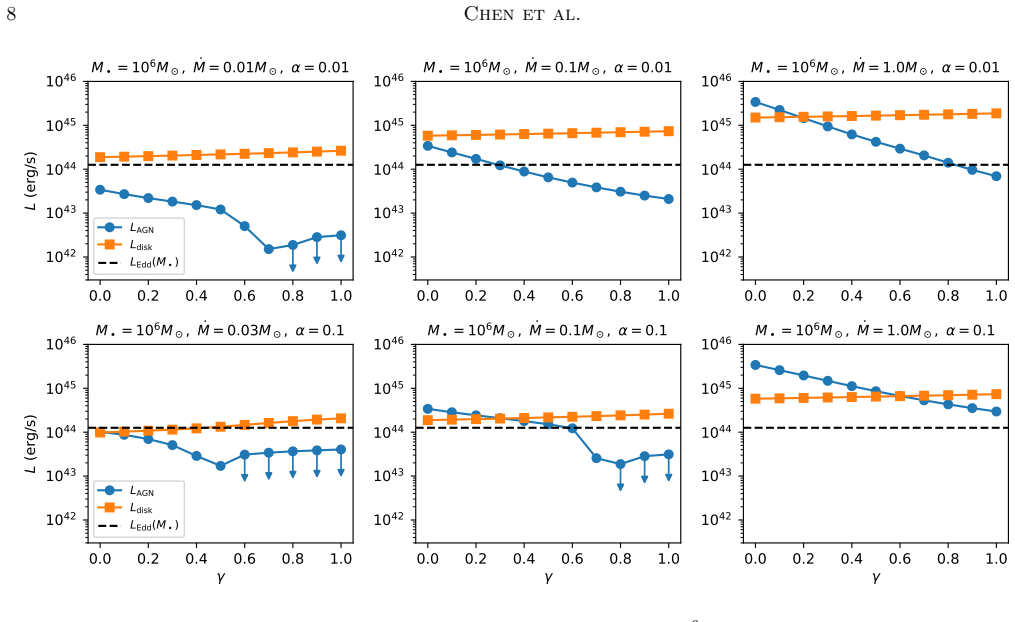


read the original abstract
We revisit the spectral appearance of extended self-gravitating accretion disks surrounding compact central objects such as supermassive black holes. Using dust-poor opacities, we show that all optically thick disk solutions possess a universal outer effective temperature of $T_{\rm eff}\sim 4000-4500$K, closely resembling compact, high-redshift sources known as Little Red Dots (LRDs). Assuming the extended disk is primarily heated by stellar sources, this ``disk Hayashi limit" fixes the dominant optical continuum temperature of the disk spectrum independent of accretion rate $\dot{M}$, central mass $M_\bullet$, and disk viscosity $\alpha$, and removes the parameter-tuning required in previous disk interpretations of LRDs. The formation and accretion of embedded stellar objects can both power the emission of the outer disk and hollow out the inner disk, suppressing variable UV/X-ray associated with a standard quasar. The resulting disk emission is dominated by a luminous optical continuum while a separate, non-variable UV component arises from stellar populations on the nuclear to galaxy scale. We map the optimal region of parameter space for such systems and show that LRD-like appearances naturally emerge for $\dot{M}/\alpha \gtrsim 0.1 M_\odot /{\rm yr}$, a threshold insensitive to $M_\bullet$, below which the system may transition into classical non-self-gravitating AGN disks, potentially a later evolution stage. We expect this transition to be accompanied by the enhancement of metallicity and production of dust, giving rise to far infrared emission. This picture offers a physically motivated and quantitative framework connecting LRDs with AGNs and their associated nuclear stellar population.
Editorial analysis
A structured set of objections, weighed in public.
Referee Report
Summary. The manuscript argues that extended self-gravitating accretion disks around compact objects such as supermassive black holes, when primarily heated by embedded stellar sources and adopting dust-poor opacities, converge to a universal outer effective temperature T_eff ∼ 4000-4500 K (the 'disk Hayashi limit'). This temperature pins the dominant optical continuum independent of accretion rate Ṁ, central mass M_•, and viscosity α. LRD-like spectra emerge for Ṁ/α ≳ 0.1 M_⊙ yr^{-1}, with a transition to classical AGN disks at lower rates accompanied by metallicity enhancement and dust production.
Significance. If the central derivation holds, the result supplies a physically motivated, largely parameter-free framework connecting LRDs to AGN evolutionary stages and nuclear stellar populations. It eliminates the need for fine-tuning in prior disk models of LRDs and yields falsifiable predictions for spectral transitions and far-infrared emission.
major comments (1)
- [Abstract] Abstract and the section deriving the threshold: the specific cutoff Ṁ/α ≳ 0.1 M_⊙ yr^{-1} for LRD appearance is presented without explicit derivation steps, error analysis, or demonstration that it follows directly from the universal T_eff rather than numerical calibration. This weakens the claim that the threshold is insensitive to M_• and must be shown in detail to support the independence result.
minor comments (1)
- The analogy to the stellar Hayashi track is invoked for the 'disk Hayashi limit'; a short paragraph comparing the opacity-driven temperature pinning in disks versus stars would strengthen the nomenclature.
Simulated Author's Rebuttal
We thank the referee for their positive summary, recognition of the physical motivation, and recommendation for minor revision. We address the single major comment below and will revise the manuscript accordingly.
read point-by-point responses
-
Referee: [Abstract] Abstract and the section deriving the threshold: the specific cutoff Ṁ/α ≳ 0.1 M_⊙ yr^{-1} for LRD appearance is presented without explicit derivation steps, error analysis, or demonstration that it follows directly from the universal T_eff rather than numerical calibration. This weakens the claim that the threshold is insensitive to M_• and must be shown in detail to support the independence result.
Authors: We appreciate the referee drawing attention to the presentation of the threshold. The cutoff Ṁ/α ≳ 0.1 M_⊙ yr^{-1} follows directly from combining the universal outer T_eff (set by the Hayashi-limit balance between stellar heating and radiative cooling at dust-poor opacities) with the Toomre Q ≈ 1 self-gravity condition and the requirement of optical thickness. Because the outer radius scales with central mass while T_eff remains fixed by opacity, the resulting critical Ṁ/α is independent of M_•; this is shown via the analytic scaling in the parameter-space mapping. We agree, however, that the steps, including propagation of opacity and heating-efficiency uncertainties, are not laid out with sufficient explicitness. In the revised manuscript we will add a dedicated subsection (or appendix) that derives the threshold analytically from the T_eff equation and Q = 1 criterion, includes a brief error analysis, and demonstrates the M_• independence directly from the resulting expression rather than solely from the numerical grid. The abstract will be updated to reference this derivation. revision: yes
Circularity Check
Derivation self-contained under stated assumptions
full rationale
The central claim of a universal outer T_eff (disk Hayashi limit) is derived from the disk structure equations under the explicit conditions of dust-poor opacities and stellar heating of the extended disk. This fixes T_eff by the opacity structure, rendering it independent of Ṁ, M_• and α by construction of the model. The subsequent Ṁ/α ≳ 0.1 threshold for LRD-like spectra follows directly as a model consequence rather than an input fit or self-definition. No load-bearing step reduces to a self-citation chain, fitted input renamed as prediction, or ansatz smuggled via prior work. The derivation remains self-contained against external benchmarks.
Axiom & Free-Parameter Ledger
free parameters (1)
- Ṁ/α threshold of 0.1 M_⊙ yr⁻¹
axioms (2)
- domain assumption dust-poor opacities
- domain assumption extended disk primarily heated by stellar sources
Forward citations
Cited by 1 Pith paper
-
Smoluchowski Coagulation Equation and the Evolution of Primordial Black Hole Clusters
Monte Carlo solutions to the Smoluchowski coagulation equation yield runaway timescales and mass evolution for primordial black hole clusters at different redshifts based on cluster properties.
Reference graph
Works this paper leans on
-
[1]
Akins, H. B., Casey, C. M., Lambrides, E., et al. 2025, ApJ, 991, 37, doi: 10.3847/1538-4357/ade984
-
[2]
Ali-Dib, M., & Lin, D. N. C. 2023, MNRAS, doi: 10.1093/mnras/stad2774 16Chen et al
-
[3]
2018, The Astrophysical Journal, 866, 84, doi: 10.3847/1538-4357/aadc11
Aoyama, Y., Ikoma, M., & Tanigawa, T. 2018, The Astrophysical Journal, 866, 84, doi: 10.3847/1538-4357/aadc11
-
[4]
Asada, Y., Inayoshi, K., Fei, Q., Fujimoto, S., & Willott, C. 2026, arXiv e-prints, arXiv:2601.10573, doi: 10.48550/arXiv.2601.10573
work page internal anchor Pith review Pith/arXiv arXiv doi:10.48550/arxiv.2601.10573 2026
-
[5]
Baggen, J. F. W., van Dokkum, P., Labb´ e, I., & Brammer, G. 2025, arXiv e-prints, arXiv:2512.03239, doi: 10.48550/arXiv.2512.03239
-
[6]
Begelman, M. C., & Dexter, J. 2025, arXiv e-prints, arXiv:2507.09085, doi: 10.48550/arXiv.2507.09085
-
[7]
, archivePrefix = "arXiv", eprint =
Bernardi, M., Meert, A., Sheth, R. K., et al. 2013, MNRAS, 436, 697, doi: 10.1093/mnras/stt1607
-
[8]
, archivePrefix = "arXiv", eprint =
Bernardi, M., Shankar, F., Hyde, J. B., et al. 2010, MNRAS, 404, 2087, doi: 10.1111/j.1365-2966.2010.16425.x
-
[9]
2025, MNRAS, 544, L167, doi: 10.1093/mnrasl/slaf116
Brazzini, M., D’Eugenio, F., Maiolino, R., et al. 2025, MNRAS, 544, L167, doi: 10.1093/mnrasl/slaf116
-
[10]
J., Stone, Z., Shen, Y., & Jiang, Y.-F
Burke, C. J., Stone, Z., Shen, Y., & Jiang, Y.-F. 2025, arXiv e-prints, arXiv:2511.16082, doi: 10.48550/arXiv.2511.16082
-
[11]
Cantiello, M., Jermyn, A. S., & Lin, D. N. C. 2021, ApJ, 910, 94, doi: 10.3847/1538-4357/abdf4f
-
[12]
Casey, C. M., Akins, H. B., Finkelstein, S. L., et al. 2025, ApJL, 990, L61, doi: 10.3847/2041-8213/adfa91
-
[13]
2025, MNRAS, doi: 10.1093/mnras/staf2131
Chang, S.-J., Gronke, M., Matthee, J., & Mason, C. 2025, MNRAS, doi: 10.1093/mnras/staf2131
-
[14]
Chen, C.-H., Ho, L. C., Li, R., & Inayoshi, K. 2025a, ApJL, 989, L12, doi: 10.3847/2041-8213/adee0a
-
[15]
Chen, C.-H., Ho, L. C., Li, R., & Zhuang, M.-Y. 2025b, ApJ, 983, 60, doi: 10.3847/1538-4357/ada93a
-
[16]
2023a, ApJ, 948, 136, doi: 10.3847/1538-4357/acc45f
Chen, K., Ren, J., & Dai, Z.-G. 2023a, ApJ, 948, 136, doi: 10.3847/1538-4357/acc45f
-
[17]
2025c, ApJ, 987, 188, doi: 10.3847/1538-4357/addd0a
Chen, Y.-X., Jiang, Y.-F., & Goodman, J. 2025c, ApJ, 987, 188, doi: 10.3847/1538-4357/addd0a
-
[18]
Chen, Y.-X., Jiang, Y.-F., Goodman, J., & Lin, D. N. C. 2024, ApJ, 974, 106, doi: 10.3847/1538-4357/ad6dd4
-
[19]
Chen, Y.-X., Jiang, Y.-F., Goodman, J., & Ostriker, E. C. 2023b, ApJ, 948, 120, doi: 10.3847/1538-4357/acc023
-
[20]
Chen, Y.-X., & Lin, D. N. C. 2024, ApJ, 967, 88, doi: 10.3847/1538-4357/ad3c3a de Graaff, A., Hviding, R. E., Naidu, R. P., et al. 2025a, arXiv e-prints, arXiv:2511.21820, doi: 10.48550/arXiv.2511.21820 de Graaff, A., Rix, Hans-Walter, Naidu, Rohan P., et al. 2025b, A&A, 701, A168, doi: 10.1051/0004-6361/202554681
-
[21]
J., Cantiello, M., & Jermyn, A
Dittmann, A. J., Cantiello, M., & Jermyn, A. S. 2021, ApJ, 916, 48, doi: 10.3847/1538-4357/ac042c
-
[22]
2025, MNRAS, 537, 3396, doi: 10.1093/mnras/staf237
Epstein-Martin, M., Tagawa, H., Haiman, Z., & Perna, R. 2025, MNRAS, 537, 3396, doi: 10.1093/mnras/staf237
-
[23]
2024, ApJ, 966, 222, doi: 10.3847/1538-4357/ad395d
Fan, X., Wu, Q., Wu, J., et al. 2024, ApJ, 966, 222, doi: 10.3847/1538-4357/ad395d
-
[24]
Ferguson, J. W., Alexander, D. R., Allard, F., et al. 2005, ApJ, 623, 585, doi: 10.1086/428642
-
[25]
2025, arXiv e-prints, arXiv:2512.02096, doi: 10.48550/arXiv.2512.02096
Fu, S., Zhang, Z., Jiang, D., et al. 2025, arXiv e-prints, arXiv:2512.02096, doi: 10.48550/arXiv.2512.02096
-
[26]
Furtak, L. J., Secunda, A. R., Greene, J. E., et al. 2025, A&A, 698, A227, doi: 10.1051/0004-6361/202554110
-
[27]
Gilbaum, S., & Stone, N. C. 2022, ApJ, 928, 191, doi: 10.3847/1538-4357/ac4ded
-
[28]
Goodman, J. 2003, MNRAS, 339, 937, doi: 10.1046/j.1365-8711.2003.06241.x
-
[29]
Goodman, J., & Rafikov, R. R. 2001, ApJ, 552, 793, doi: 10.1086/320572
-
[30]
Goodman, J., & Tan, J. C. 2004, ApJ, 608, 108, doi: 10.1086/386360
-
[31]
Graham, M. J., McKernan, B., Ford, K. E. S., et al. 2025, Nature Astronomy, doi: 10.1038/s41550-025-02699-0
-
[32]
Greene, J. E., Labbe, I., Goulding, A. D., et al. 2024, ApJ, 964, 39, doi: 10.3847/1538-4357/ad1e5f
-
[33]
Greene, J. E., Setton, D. J., Furtak, L. J., et al. 2025, arXiv e-prints, arXiv:2509.05434, doi: 10.48550/arXiv.2509.05434
-
[34]
Hinkle, J. T., Shappee, B. J., Auchettl, K., et al. 2025, Science Advances, 11, eadt0074, doi: 10.1126/sciadv.adt0074
-
[35]
, archivePrefix = "arXiv", eprint =
Hopkins, P. F., & Quataert, E. 2010, MNRAS, 407, 1529, doi: 10.1111/j.1365-2966.2010.17064.x
-
[36]
Hviding, R. E., de Graaff, A., Miller, T. B., et al. 2025, A&A, 702, A57, doi: 10.1051/0004-6361/202555816
-
[37]
Iglesias, C. A., & Rogers, F. J. 1993, ApJ, 412, 752, doi: 10.1086/172958 —. 1996, ApJ, 464, 943, doi: 10.1086/177381
-
[38]
2025, ApJL, 988, L22, doi: 10.3847/2041-8213/adea66
Inayoshi, K. 2025, ApJL, 988, L22, doi: 10.3847/2041-8213/adea66
-
[39]
2025, ApJL, 980, L27, doi: 10.3847/2041-8213/adaebd
Inayoshi, K., & Maiolino, R. 2025, ApJL, 980, L27, doi: 10.3847/2041-8213/adaebd
-
[40]
The Emergence of Little Red Dots from Binary Massive Black Holes
Haiman, Z. 2025, arXiv e-prints, arXiv:2505.05322, doi: 10.48550/arXiv.2505.05322
work page internal anchor Pith review Pith/arXiv arXiv doi:10.48550/arxiv.2505.05322 2025
-
[41]
Jermyn, A. S., Dittmann, A. J., McKernan, B., Ford, K. E. S., & Cantiello, M. 2022, ApJ, 929, 133, doi: 10.3847/1538-4357/ac5d40
-
[42]
2025, MNRAS, doi: 10.1093/mnras/staf1867 Juodˇ zbalis, I., Maiolino, R., Baker, W
Ji, X., Maiolino, R., ¨Ubler, H., et al. 2025, MNRAS, 544, 3900, doi: 10.1093/mnras/staf1867
-
[43]
2011, ApJ, 730, 45, doi: 10.1088/0004-637X/730/1/45
Jiang, Y.-F., & Goodman, J. 2011, ApJ, 730, 45, doi: 10.1088/0004-637X/730/1/45
-
[44]
2022, A&A, 662, A19, doi: 10.1051/0004-6361/202243480 Juodˇ zbalis, I., Ji, X., Maiolino, R., et al
Johansen, A., & Dorn, C. 2022, A&A, 662, A19, doi: 10.1051/0004-6361/202243480 Juodˇ zbalis, I., Ji, X., Maiolino, R., et al. 2024, MNRAS, 535, 853, doi: 10.1093/mnras/stae2367
-
[45]
Kido, D., Ioka, K., Hotokezaka, K., Inayoshi, K., & Irwin, C. M. 2025, MNRAS, 544, 3407, doi: 10.1093/mnras/staf1898
-
[46]
Kim, C.-G., & Ostriker, E. C. 2017, ApJ, 846, 133, doi: 10.3847/1538-4357/aa8599
-
[47]
Kocevski, D. D., Finkelstein, S. L., Barro, G., et al. 2024, arXiv e-prints, arXiv:2404.03576, doi: 10.48550/arXiv.2404.03576
-
[48]
Kokorev, V., Caputi, K. I., Greene, J. E., et al. 2024, ApJ, 968, 38, doi: 10.3847/1538-4357/ad4265
-
[49]
Kurosawa, R., Harries, T. J., & Symington, N. H. 2006, Monthly Notices of the Royal Astronomical Society, 370, 580596, doi: 10.1111/j.1365-2966.2006.10527.x Labb´ e, I., van Dokkum, P., Nelson, E., et al. 2023, Nature, 616, 266, doi: 10.1038/s41586-023-05786-2
-
[50]
Labbe, I., Greene, J. E., Matthee, J., et al. 2024, arXiv e-prints, arXiv:2412.04557, doi: 10.48550/arXiv.2412.04557
-
[51]
The case for super-Eddington accretion in JWST broad-line AGN during the first billion years
Lambrides, E., Garofali, K., Larson, R., et al. 2024, arXiv e-prints, arXiv:2409.13047, doi: 10.48550/arXiv.2409.13047
work page internal anchor Pith review Pith/arXiv arXiv doi:10.48550/arxiv.2409.13047 2024
-
[52]
Lee, E. J., Chiang, E., & Ormel, C. W. 2014, ApJ, 797, 95, doi: 10.1088/0004-637X/797/2/95
-
[53]
Li, R., Ho, L. C., & Chen, C.-H. 2025, arXiv e-prints, arXiv:2505.12867, doi: 10.48550/arXiv.2505.12867
-
[54]
Liepold, E. R., & Ma, C.-P. 2024, ApJL, 971, L29, doi: 10.3847/2041-8213/ad66b8
-
[55]
2024, ApJ, 974, 147, doi: 10.3847/1538-4357/ad6565
Lin, X., Wang, F., Fan, X., et al. 2024, ApJ, 974, 147, doi: 10.3847/1538-4357/ad6565
-
[56]
2025, arXiv e-prints, arXiv:2507.10659, doi: 10.48550/arXiv.2507.10659
Lin, X., Fan, X., Cai, Z., et al. 2025, arXiv e-prints, arXiv:2507.10659, doi: 10.48550/arXiv.2507.10659
-
[57]
Liu, H., Jiang, Y.-F., Quataert, E., Greene, J. E., & Ma, Y. 2025, ApJ, 994, 113, doi: 10.3847/1538-4357/ae0c19
-
[58]
2024, ApJ, 969, 37, doi: 10.3847/1538-4357/ad463a
Liu, J.-R., Wang, Y.-L., & Wang, J.-M. 2024, ApJ, 969, 37, doi: 10.3847/1538-4357/ad463a
-
[59]
Lynden-Bell, D., & Pringle, J. E. 1974, MNRAS, 168, 603, doi: 10.1093/mnras/168.3.603
-
[60]
Ma, Y., Greene, J. E., Setton, D. J., et al. 2025a, ApJ, 981, 191, doi: 10.3847/1538-4357/ada613 —. 2025b, arXiv e-prints, arXiv:2504.08032, doi: 10.48550/arXiv.2504.08032
-
[61]
2025, MNRAS, 538, 1921, doi: 10.1093/mnras/staf359
Maiolino, R., Risaliti, G., Signorini, M., et al. 2025, MNRAS, 538, 1921, doi: 10.1093/mnras/staf359
-
[62]
Matthee, J., Naidu, R. P., Brammer, G., et al. 2024, ApJ, 963, 129, doi: 10.3847/1538-4357/ad2345
-
[63]
A "Black Hole Star" Reveals the Remarkable Gas-Enshrouded Hearts of the Little Red Dots
Naidu, R. P., Matthee, J., Katz, H., et al. 2025, arXiv e-prints, arXiv:2503.16596, doi: 10.48550/arXiv.2503.16596
work page internal anchor Pith review doi:10.48550/arxiv.2503.16596 2025
-
[64]
2025, arXiv e-prints, arXiv:2507.12618, doi: 10.48550/arXiv.2507.12618
Nandal, D., & Loeb, A. 2025, arXiv e-prints, arXiv:2507.12618, doi: 10.48550/arXiv.2507.12618
-
[65]
Paxton, B. 2024, Modules for Experiments in Stellar Astrophysics (MESA), r24.08.1, Zenodo, doi: 10.5281/zenodo.13353788 R´ emy-Ruyer, A., Madden, S. C., Galliano, F., et al. 2014, A&A, 563, A31, doi: 10.1051/0004-6361/201322803
-
[66]
Rozyczka, M., Bodenheimer, P., & Lin, D. N. C. 1995, MNRAS, 276, 597, doi: 10.1093/mnras/276.2.597
-
[67]
Rusakov, V., Watson, D., Nikopoulos, G. P., et al. 2025, arXiv e-prints, arXiv:2503.16595, doi: 10.48550/arXiv.2503.16595
-
[68]
Setton, D. J., Greene, J. E., Spilker, J. S., et al. 2025, ApJL, 991, L10, doi: 10.3847/2041-8213/ade78b
- [69]
-
[70]
Sirko, E., & Goodman, J. 2003, MNRAS, 341, 501, doi: 10.1046/j.1365-8711.2003.06431.x
-
[71]
Sneppen, A., Watson, D., Matthews, J. H., et al. 2026, arXiv e-prints, arXiv:2601.18864, doi: 10.48550/arXiv.2601.18864
-
[72]
1982, MNRAS, 200, 115, doi: 10.1093/mnras/200.1.115
Soltan, A. 1982, MNRAS, 200, 115, doi: 10.1093/mnras/200.1.115
-
[73]
Sun, W. Q., Naidu, R. P., Matthee, J., et al. 2026, arXiv e-prints, arXiv:2601.20929. https://arxiv.org/abs/2601.20929
-
[74]
2020, ApJ, 898, 25, doi: 10.3847/1538-4357/ab9b8c
Tagawa, H., Haiman, Z., & Kocsis, B. 2020, ApJ, 898, 25, doi: 10.3847/1538-4357/ab9b8c
-
[75]
Thompson, T. A., Quataert, E., & Murray, N. 2005, ApJ, 630, 167, doi: 10.1086/431923
-
[76]
2025, arXiv e-prints, arXiv:2510.00103, doi: 10.48550/arXiv.2510.00103
Torralba, A., Matthee, J., Pezzulli, G., et al. 2025, arXiv e-prints, arXiv:2510.00103, doi: 10.48550/arXiv.2510.00103
-
[77]
2025, arXiv e-prints, arXiv:2512.04208, doi: 10.48550/arXiv.2512.04208
Umeda, H., Inayoshi, K., Harikane, Y., & Murase, K. 2025, arXiv e-prints, arXiv:2512.04208, doi: 10.48550/arXiv.2512.04208
-
[78]
2024, ApJL, 969, L13, doi: 10.3847/2041-8213/ad55f7
Wang, B., Leja, J., de Graaff, A., et al. 2024, ApJL, 969, L13, doi: 10.3847/2041-8213/ad55f7
-
[79]
Wang, B., de Graaff, A., Davies, R. L., et al. 2025a, ApJ, 984, 121, doi: 10.3847/1538-4357/adc1ca
-
[80]
The Missing Hard Photons of Little Red Dots: Their Incident Ionizing Spectra Resemble Massive Stars
Wang, B., Leja, J., Katz, H., et al. 2025b, arXiv e-prints, arXiv:2508.18358, doi: 10.48550/arXiv.2508.18358
work page internal anchor Pith review Pith/arXiv arXiv doi:10.48550/arxiv.2508.18358
discussion (0)
Sign in with ORCID, Apple, or X to comment. Anyone can read and Pith papers without signing in.