How can we finally see the first light? Status and perspective in the search for Population III stars
Pith reviewed 2026-07-02 17:55 UTC · model grok-4.3
The pith
Multiple search methods are narrowing the allowed properties of the first stars and preparing for their detection.
A machine-rendered reading of the paper's core claim, the machinery that carries it, and where it could break.
Core claim
The review states that the combination of JWST spectroscopy, time-domain searches, lensing surveys, stellar archaeology, absorption-line studies, and improved simulations is yielding a growing number of observational candidates and narrowing the allowed parameter space for the first stars, setting the stage for a golden era of Pop III searches.
What carries the argument
The coordinated use of JWST spectroscopy with lensing surveys, time-domain monitoring, stellar archaeology, and absorption-line studies to detect peculiar spectral features or extremely metal-poor systems.
If this is right
- Near-field cosmology can place tighter limits on the initial mass function and formation sites of the first stars.
- Hard-ionizing spectral signatures at intermediate and high redshifts can be used to constrain the timing of the transition to metal-enriched star formation.
- Absorption-line studies along lines of sight to distant quasars can map the topology of early metal enrichment.
- Time-domain and lensing surveys will identify rare, magnified systems where Pop III activity may be detectable up to Cosmic Dawn.
Where Pith is reading between the lines
- Confirmed Pop III candidates would allow direct tests of whether the first stars formed in isolation or in small clusters.
- The narrowing of parameter space could guide which specific wavelength ranges or line ratios future instruments should prioritize.
- If no signatures appear, the field may shift emphasis toward indirect constraints from the reionization history and metal-poor halo stars.
Load-bearing premise
The peculiar spectral features or other signatures of Population III stars can still be observed despite their short lifetimes and low brightness.
What would settle it
Deep JWST and lensing surveys that return no convincing Pop III candidates or hard-ionizing signatures after several years of targeted observations would indicate that the direct-search strategies are not viable.
Figures

read the original abstract
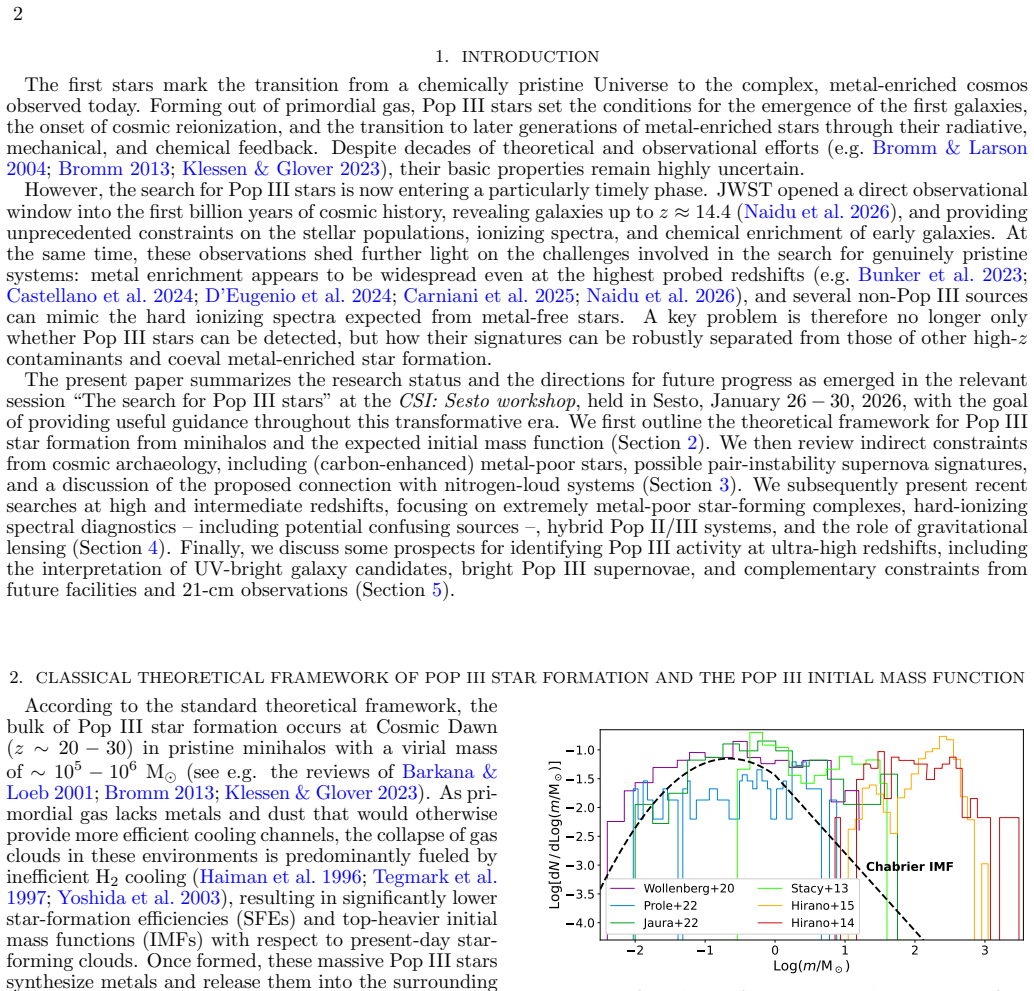
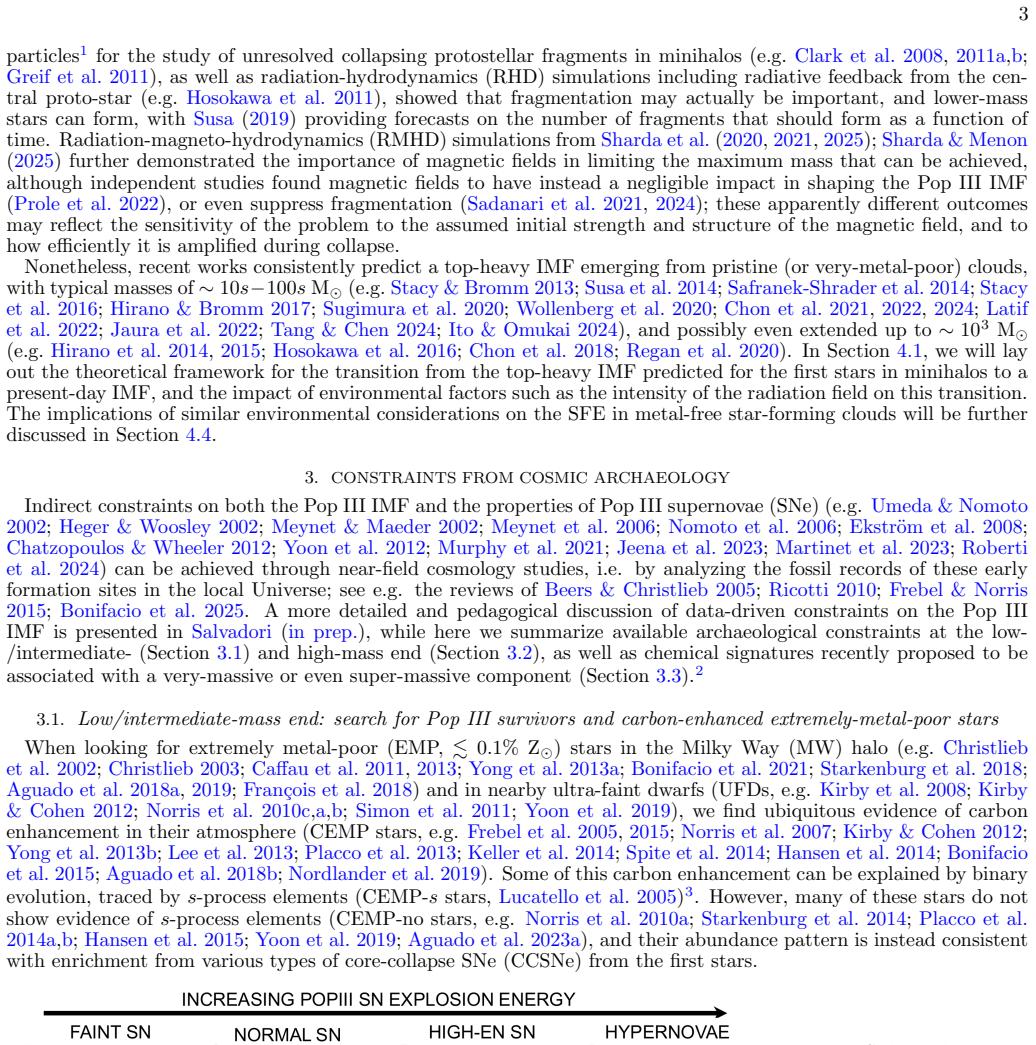
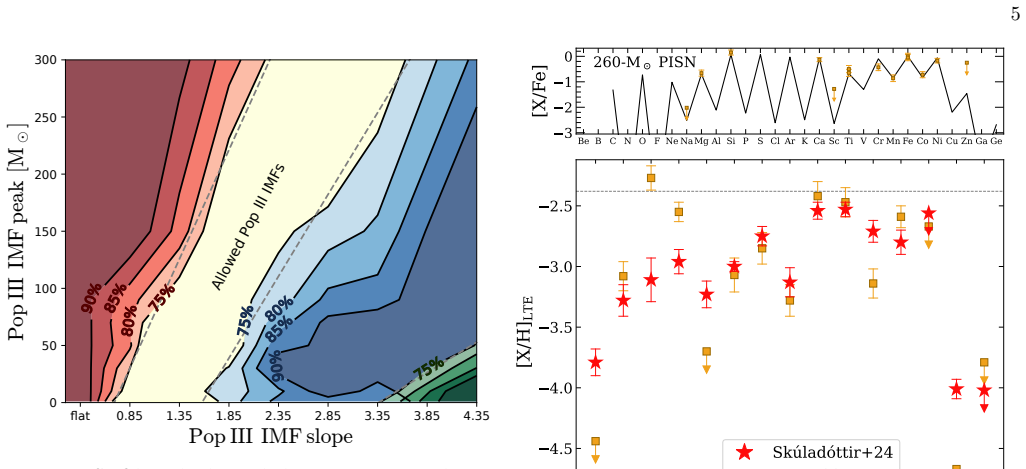
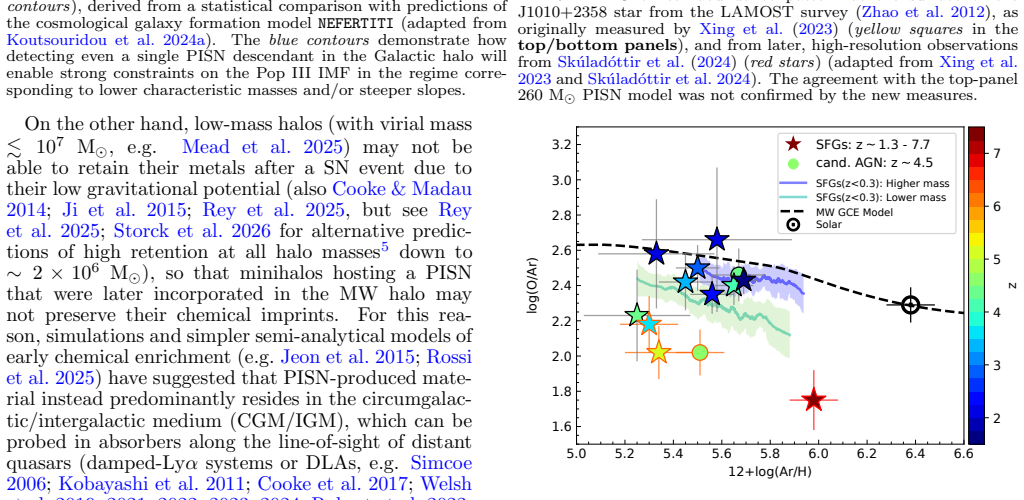
Finding the first (Population III or Pop III) stars is one of the fundamental quests of astronomy, aiming to deliver the missing link in how stars form at early cosmic times. Yet their initial mass function, formation sites and feedback remain highly uncertain, as well as the timing and topology of the transition to metal-enriched star formation. The observability of their peculiar spectral features is also debated, due to their short lifetime and faintness. This review summarizes current theoretical expectations for Pop III star formation, and the main observational strategies that have been adopted to constrain their properties across cosmic time, including near-field cosmology studies, direct searches for extremely metal-poor star-forming complexes and/or hard-ionizing spectral signatures at high and intermediate redshifts, and prospects for identifying Pop III activity up to Cosmic Dawn. The combination of JWST spectroscopy, time-domain searches, lensing surveys, stellar archaeology, absorption-line studies, as well as improved simulations, is yielding a growing number of observational candidates and narrowing the allowed parameter space for the first stars, setting the stage for a ``golden era'' of Pop III searches.
Editorial analysis
A structured set of objections, weighed in public.
Referee Report
Summary. This review summarizes theoretical expectations for Population III star formation, including uncertainties in the IMF, formation sites, feedback, and the transition to metal-enriched star formation. It reviews observational strategies such as near-field cosmology, direct searches for extremely metal-poor complexes and hard-ionizing signatures at high and intermediate redshifts, JWST spectroscopy, time-domain searches, lensing surveys, stellar archaeology, and absorption-line studies, concluding that their combination is yielding observational candidates and narrowing the allowed parameter space for the first stars.
Significance. If the synthesis holds, the review provides a balanced, up-to-date overview of converging multi-method efforts in early-universe astrophysics. It explicitly notes the ongoing debate on observability due to short lifetimes and faintness, which strengthens its utility for guiding future observations and simulations toward Cosmic Dawn.
minor comments (1)
- [Abstract] Abstract: the statement that the listed methods are 'yielding a growing number of observational candidates' is central to the review's forward-looking claim; adding one or two concrete, referenced examples from the main text would make this assertion more traceable for readers.
Simulated Author's Rebuttal
We thank the referee for their positive assessment of the manuscript, including the recognition that it provides a balanced, up-to-date overview of converging efforts in early-universe astrophysics and notes the ongoing debate on observability. We appreciate the recommendation for minor revision.
Circularity Check
Review paper with no derivations, predictions or self-referential claims
full rationale
This is a literature review summarizing theoretical expectations, observational strategies, and existing candidates from JWST and other facilities. No equations, fitted parameters, uniqueness theorems, or quantitative predictions appear that could reduce to the paper's own inputs by construction. The central statement that multiple methods are 'narrowing the allowed parameter space' is presented as a synthesis of external results rather than a derived claim internal to the paper. No load-bearing self-citations or ansatzes are invoked to justify the review's own conclusions.
Axiom & Free-Parameter Ledger
Reference graph
Works this paper leans on
-
[1]
Abdurro’uf, Larson, R. L., Coe, D., et al. 2024, ApJ, 973, 47, doi:10.3847/1538-4357/ad6001
-
[2]
2002, Ap&SS, 281, 471, doi:10.1023/A:1019509211972
Abel, T. 2002, Ap&SS, 281, 471, doi:10.1023/A:1019509211972
-
[3]
Abel, T., Bryan, G. L., & Norman, M. L. 2002, Science, 295, 93, doi:10.1126/science.1063991
-
[4]
Agarwal, B., Johnson, J. L., Zackrisson, E., et al. 2016, MNRAS, 460, 4003, doi:10.1093/mnras/stw1173
-
[5]
2018a, ApJ, 854, L34, doi:10.3847/2041-8213/aaadb8
Rebolo, R. 2018a, ApJ, 854, L34, doi:10.3847/2041-8213/aaadb8
-
[6]
2018b, ApJ, 852, L20, doi:10.3847/2041-8213/aaa23a —
Rebolo, R. 2018b, ApJ, 852, L20, doi:10.3847/2041-8213/aaa23a —. 2019, ApJ, 874, L21, doi:10.3847/2041-8213/ab1076 21
-
[7]
S., Caffau, E., Molaro, P., et al
Aguado, D. S., Caffau, E., Molaro, P., et al. 2023a, A&A, 669, L4, doi:10.1051/0004-6361/202245392
-
[8]
S., Salvadori, S., Sk´ ulad´ ottir,´A., et al
Aguado, D. S., Salvadori, S., Sk´ ulad´ ottir,´A., et al. 2023b, MNRAS, 520, 866, doi:10.1093/mnras/stad164 ´Alvarez-M´ arquez, J., Colina, L., Crespo-Gomez, A., et al. 2026, arXiv e-prints, arXiv:2602.02323, doi:10.48550/arXiv.2602.02323
-
[9]
Aoki, W., Tominaga, N., Beers, T. C., Honda, S., & Lee, Y. S. 2014, Science, 345, 912, doi:10.1126/science.1252633 Arellano-C´ ordova, K. Z., Berg, D. A., Mingozzi, M., et al. 2025, MNRAS, 544, 1588, doi:10.1093/mnras/staf1723 Arellano-C´ ordova, K. Z., M´ endez-Delgado, J. E., Flury, S. R., et al. 2026, MNRAS, 547, stag380, doi:10.1093/mnras/stag380
-
[10]
2026, arXiv e-prints, arXiv:2601.20045, doi:10.48550/arXiv.2601.20045
Asada, Y., Fujimoto, S., Chisholm, J., et al. 2026, arXiv e-prints, arXiv:2601.20045, doi:10.48550/arXiv.2601.20045
-
[11]
2025, arXiv e-prints, arXiv:2511.07542, doi:10.48550/arXiv.2511.07542
Atek, H., Chisholm, J., Kokorev, V., et al. 2025, arXiv e-prints, arXiv:2511.07542, doi:10.48550/arXiv.2511.07542
-
[12]
Barkana, R., & Loeb, A. 2001, Phys. Rep., 349, 125, doi:10.1016/S0370-1573(01)00019-9
-
[13]
2018, ARA&A, 56, 83, doi:10.1146/annurev-astro-081817-051839
Bastian, N., & Lardo, C. 2018, ARA&A, 56, 83, doi:10.1146/annurev-astro-081817-051839
-
[14]
Bate, M. R., Bonnell, I. A., & Price, N. M. 1995, MNRAS, 277, 362, doi:10.1093/mnras/277.2.362
-
[15]
Beers, T. C., & Christlieb, N. 2005, ARA&A, 43, 531, doi:10.1146/annurev.astro.42.053102.134057
-
[16]
2023, MNRAS, 526, L26, doi:10.1093/mnrasl/slad108
Bekki, K., & Tsujimoto, T. 2023, MNRAS, 526, L26, doi:10.1093/mnrasl/slad108
-
[17]
Bennett, J. S., & Sijacki, D. 2020, MNRAS, 499, 597, doi:10.1093/mnras/staa2835
-
[18]
Berg, D. A., Naidu, R. P., Chisholm, J., et al. 2026a, ApJ, 1003, 112, doi:10.3847/1538-4357/ae5e4c —. 2026b, ApJ, 1003, 112, doi:10.3847/1538-4357/ae5e4c
-
[19]
Bernal, J. L., & Kovetz, E. D. 2022, Astron. Astrophys. Rev., 30, 5, doi:10.1007/s00159-022-00143-0
-
[20]
Bezanson, R., Labbe, I., Whitaker, K. E., et al. 2024, ApJ, 974, 92, doi:10.3847/1538-4357/ad66cf
-
[21]
2025a, ApJ, 983, L30, doi:10.3847/2041-8213/adc735
Saha, K. 2025a, ApJ, 983, L30, doi:10.3847/2041-8213/adc735
-
[22]
Saha, K. 2025b, arXiv e-prints, arXiv:2505.01896, doi:10.48550/arXiv.2505.01896
work page internal anchor Pith review Pith/arXiv arXiv doi:10.48550/arxiv.2505.01896
-
[23]
A Cosmic Archipelago of lensed metal-poor galaxies at $z\sim6$
Bolamperti, A., Messa, M., Zanella, A., et al. 2026, arXiv e-prints, arXiv:2606.02720, doi:10.48550/arXiv.2606.02720
work page internal anchor Pith review Pith/arXiv arXiv doi:10.48550/arxiv.2606.02720 2026
-
[24]
2025, A&A Rev., 33, 2, doi:10.1007/s00159-025-00159-2
Bonifacio, P., Caffau, E., Fran¸ cois, P., & Spite, M. 2025, A&A Rev., 33, 2, doi:10.1007/s00159-025-00159-2
-
[25]
2015, A&A, 579, A28, doi:10.1051/0004-6361/201425266
Bonifacio, P., Caffau, E., Spite, M., et al. 2015, A&A, 579, A28, doi:10.1051/0004-6361/201425266
-
[26]
2021, A&A, 651, A79, doi:10.1051/0004-6361/202140816
Bonifacio, P., Monaco, L., Salvadori, S., et al. 2021, A&A, 651, A79, doi:10.1051/0004-6361/202140816
-
[27]
Bouwens, R. J., Illingworth, G. D., Oesch, P. A., et al. 2010, ApJ, 708, L69, doi:10.1088/2041-8205/708/2/L69
-
[28]
Bowler, R. A. A., McLure, R. J., Dunlop, J. S., et al. 2017, MNRAS, 469, 448, doi:10.1093/mnras/stx839 Bradaˇ c, M., Willott, C., Asada, Y., et al. 2026, arXiv e-prints, arXiv:2604.23668, doi:10.48550/arXiv.2604.23668
work page internal anchor Pith review Pith/arXiv arXiv doi:10.1093/mnras/stx839 2017
-
[29]
Bray, J. C., Stanway, E. R., & Eldridge, J. J. 2025, MNRAS, 542, 2087, doi:10.1093/mnras/staf1348
-
[30]
2013, Reports on Progress in Physics, 76, 112901, doi:10.1088/0034-4885/76/11/112901
Bromm, V. 2013, Reports on Progress in Physics, 76, 112901, doi:10.1088/0034-4885/76/11/112901
-
[31]
Bromm, V., Coppi, P. S., & Larson, R. B. 2002, ApJ, 564, 23, doi:10.1086/323947
-
[32]
Bromm, V., Ferrara, A., Coppi, P. S., & Larson, R. B. 2001a, MNRAS, 328, 969, doi:10.1046/j.1365-8711.2001.04915.x
-
[33]
Bromm, V., Kudritzki, R. P., & Loeb, A. 2001b, ApJ, 552, 464, doi:10.1086/320549
-
[34]
Bromm, V., & Larson, R. B. 2004, ARA&A, 42, 79, doi:10.1146/annurev.astro.42.053102.134034
-
[35]
2003, Nature, 425, 812, doi:10.1038/nature02071
Bromm, V., & Loeb, A. 2003, Nature, 425, 812, doi:10.1038/nature02071
-
[36]
Bromm, V., Yoshida, N., Hernquist, L., & McKee, C. F. 2009, Nature, 459, 49, doi:10.1038/nature07990
-
[37]
Bunker, A. J., Saxena, A., Cameron, A. J., et al. 2023, A&A, 677, A88, doi:10.1051/0004-6361/202346159
-
[38]
Busso, M., Gallino, R., & Wasserburg, G. J. 1999, ARA&A, 37, 239, doi:10.1146/annurev.astro.37.1.239
-
[39]
2011, Nature, 477, 67, doi:10.1038/nature10377 —
Caffau, E., Bonifacio, P., Fran¸ cois, P., et al. 2011, Nature, 477, 67, doi:10.1038/nature10377 —. 2013, A&A, 560, A15, doi:10.1051/0004-6361/201322213
-
[40]
2025, ApJ, 993, L52, doi:10.3847/2041-8213/ae1608
Cai, S., Li, M., Cai, Z., et al. 2025, ApJ, 993, L52, doi:10.3847/2041-8213/ae1608
-
[41]
Cameron, A. J., Katz, H., & Rey, M. P. 2023a, MNRAS, 522, L89, doi:10.1093/mnrasl/slad046
-
[42]
Cameron, A. J., Katz, H., Rey, M. P., & Saxena, A. 2023b, MNRAS, 523, 3516, doi:10.1093/mnras/stad1579
-
[43]
J., Katz, H., Witten, C., et al
Cameron, A. J., Katz, H., Witten, C., et al. 2024, MNRAS, 534, 523, doi:10.1093/mnras/stae1547
-
[44]
Cappelluti, N., Kashlinsky, A., Arendt, R. G., et al. 2013, ApJ, 769, 68, doi:10.1088/0004-637X/769/1/68
-
[45]
2025, A&A, 696, A87, doi:10.1051/0004-6361/202452451
Carniani, S., D’Eugenio, F., Ji, X., et al. 2025, A&A, 696, A87, doi:10.1051/0004-6361/202452451
-
[46]
2013, A&A, 556, A68, doi:10.1051/0004-6361/201220969
Cassata, P., Le F` evre, O., Charlot, S., et al. 2013, A&A, 556, A68, doi:10.1051/0004-6361/201220969
-
[47]
1993, ApJS, 88, 509, doi:10.1086/191831
Cassisi, S., & Castellani, V. 1993, ApJS, 88, 509, doi:10.1086/191831
-
[48]
2024, ApJ, 972, 143, doi:10.3847/1538-4357/ad5f88
Castellano, M., Napolitano, L., Fontana, A., et al. 2024, ApJ, 972, 143, doi:10.3847/1538-4357/ad5f88
-
[49]
2026, The Open Journal of Astrophysics, 9, 60281, doi:10.33232/001c.160281
Castellano, M., Napolitano, L., Moreschini, B., et al. 2026, The Open Journal of Astrophysics, 9, 60281, doi:10.33232/001c.160281
-
[50]
Tracing nitrogen enrichment across cosmic time with JWST
Cataldi, E., Belfiore, F., Curti, M., et al. 2025, arXiv e-prints, arXiv:2512.07955, doi:10.48550/arXiv.2512.07955
work page internal anchor Pith review Pith/arXiv arXiv doi:10.48550/arxiv.2512.07955 2025
-
[51]
Chabrier, G. 2003, PASP, 115, 763, doi:10.1086/376392
work page internal anchor Pith review doi:10.1086/376392 2003
-
[52]
2025, ApJ, 985, 24, doi:10.3847/1538-4357/adc7b5
Chakraborty, P., Sarkar, A., Smith, R., et al. 2025, ApJ, 985, 24, doi:10.3847/1538-4357/adc7b5
-
[53]
2023, A&A, 673, L7, doi:10.1051/0004-6361/202346410
Charbonnel, C., Schaerer, D., Prantzos, N., et al. 2023, A&A, 673, L7, doi:10.1051/0004-6361/202346410
-
[54]
Chatzopoulos, E., & Wheeler, J. C. 2012, ApJ, 748, 42, doi:10.1088/0004-637X/748/1/42
-
[55]
2024, ApJ, 976, L15, doi:10.3847/2041-8213/ad8dc9
Chemerynska, I., Atek, H., Dayal, P., et al. 2024, ApJ, 976, L15, doi:10.3847/2041-8213/ad8dc9
-
[56]
2025, arXiv e-prints, arXiv:2504.17506, doi:10.48550/arXiv.2504.17506
Chiaki, G., Nozawa, T., Kobayashi, C., & Tominaga, N. 2025, arXiv e-prints, arXiv:2504.17506, doi:10.48550/arXiv.2504.17506
-
[57]
2013, ApJ, 765, L3, doi:10.1088/2041-8205/765/1/L3
Chiaki, G., Nozawa, T., & Yoshida, N. 2013, ApJ, 765, L3, doi:10.1088/2041-8205/765/1/L3
-
[58]
Chiaki, G., & Wise, J. H. 2019, MNRAS, 482, 3933, doi:10.1093/mnras/sty2984
-
[59]
Chiaki, G., Wise, J. H., Marassi, S., et al. 2020, MNRAS, 497, 3149, doi:10.1093/mnras/staa2144
-
[60]
2022, MNRAS, 510, 5199, doi:10.1093/mnras/stab2799
Chiaki, G., & Yoshida, N. 2022, MNRAS, 510, 5199, doi:10.1093/mnras/stab2799
-
[61]
2016, MNRAS, 463, 2781, doi:10.1093/mnras/stw2120
Chiaki, G., Yoshida, N., & Hirano, S. 2016, MNRAS, 463, 2781, doi:10.1093/mnras/stw2120
-
[62]
Chisholm, J., Berg, D. A., Boylan-Kolchin, M., et al. 2026, ApJ, 1004, L4, doi:10.3847/2041-8213/ae6dae
-
[63]
2024, MNRAS, 530, 2453, doi:10.1093/mnras/stae1027
Chon, S., Hosokawa, T., Omukai, K., & Schneider, R. 2024, MNRAS, 530, 2453, doi:10.1093/mnras/stae1027
-
[64]
2018, MNRAS, 475, 4104, doi:10.1093/mnras/sty086
Chon, S., Hosokawa, T., & Yoshida, N. 2018, MNRAS, 475, 4104, doi:10.1093/mnras/sty086
-
[65]
2025, MNRAS, 539, 2561, doi:10.1093/mnras/staf598
Chon, S., & Omukai, K. 2025, MNRAS, 539, 2561, doi:10.1093/mnras/staf598
-
[66]
2021, MNRAS, 508, 4175, doi:10.1093/mnras/stab2497
Chon, S., Omukai, K., & Schneider, R. 2021, MNRAS, 508, 4175, doi:10.1093/mnras/stab2497
-
[67]
2022, MNRAS, 514, 4639, doi:10.1093/mnras/stac1549
Chon, S., Ono, H., Omukai, K., & Schneider, R. 2022, MNRAS, 514, 4639, doi:10.1093/mnras/stac1549
-
[68]
2023, A&A, 680, A82, doi:10.1051/0004-6361/202347943
Christensen, L., Jakobsen, P., Willott, C., et al. 2023, A&A, 680, A82, doi:10.1051/0004-6361/202347943
-
[69]
2003, Reviews in Modern Astronomy, 16, 191, doi:10.1002/9783527617647.ch8
Christlieb, N. 2003, Reviews in Modern Astronomy, 16, 191, doi:10.1002/9783527617647.ch8
-
[70]
Christlieb, N., Bessell, M. S., Beers, T. C., et al. 2002, Nature, 419, 904, doi:10.1038/nature01142
-
[71]
2022, A&A, 666, A78, doi:10.1051/0004-6361/202142320
Claeyssens, A., Richard, J., Blaizot, J., et al. 2022, A&A, 666, A78, doi:10.1051/0004-6361/202142320
-
[72]
Clark, P. C., Glover, S. C. O., & Klessen, R. S. 2008, ApJ, 672, 757, doi:10.1086/524187
-
[73]
Clark, P. C., Glover, S. C. O., Klessen, R. S., & Bromm, V. 2011a, ApJ, 727, 110, doi:10.1088/0004-637X/727/2/110
-
[74]
Clark, P. C., Glover, S. C. O., Smith, R. J., et al. 2011b, Science, 331, 1040, doi:10.1126/science.1198027
-
[75]
Cleri, N. J., Olivier, G. M., Hutchison, T. A., et al. 2023, ApJ, 953, 10, doi:10.3847/1538-4357/acde55 22
-
[76]
2012, Nature, 491, 228, doi:10.1038/nature11521
Cooke, J., Sullivan, M., Gal-Yam, A., et al. 2012, Nature, 491, 228, doi:10.1038/nature11521
-
[77]
Cooke, R. J., & Madau, P. 2014, ApJ, 791, 116, doi:10.1088/0004-637X/791/2/116
-
[78]
Cooke, R. J., Pettini, M., & Steidel, C. C. 2017, MNRAS, 467, 802, doi:10.1093/mnras/stx037 Correa Magnus, L., Smith, B. D., Khochfar, S., et al. 2024, MNRAS, 527, 307, doi:10.1093/mnras/stad3167
-
[79]
Cruz, H. A. G., Mu˜ noz, J. B., Sabti, N., & Kamionkowski, M. 2025, Phys. Rev. D, 111, 083503, doi:10.1103/PhysRevD.111.083503
-
[80]
R., Hutter, A., Dayal, P., et al
Cueto, E. R., Hutter, A., Dayal, P., et al. 2024, A&A, 686, A138, doi:10.1051/0004-6361/202349017
discussion (0)
Sign in with ORCID, Apple, or X to comment. Anyone can read and Pith papers without signing in.