Dominant-pair free energies predict phase selection in high-entropy alloys
Pith reviewed 2026-07-02 18:31 UTC · model grok-4.3
The pith
A dominant-pair mechanism reduces multicomponent B2 ordering in alloys to an effective pseudo-binary system whose Bragg-Williams free energy predicts the stable phase versus composition and temperature.
A machine-rendered reading of the paper's core claim, the machinery that carries it, and where it could break.
Core claim
Phase selection arises from competition between configurational entropy and ordering enthalpy; when the dominant-pair mechanism is invoked, the multicomponent B2-ordering enthalpy collapses to an analytically solvable pseudo-binary Bragg-Williams free energy whose minimum, evaluated at each composition and temperature, directly identifies the lowest-energy phase.
What carries the argument
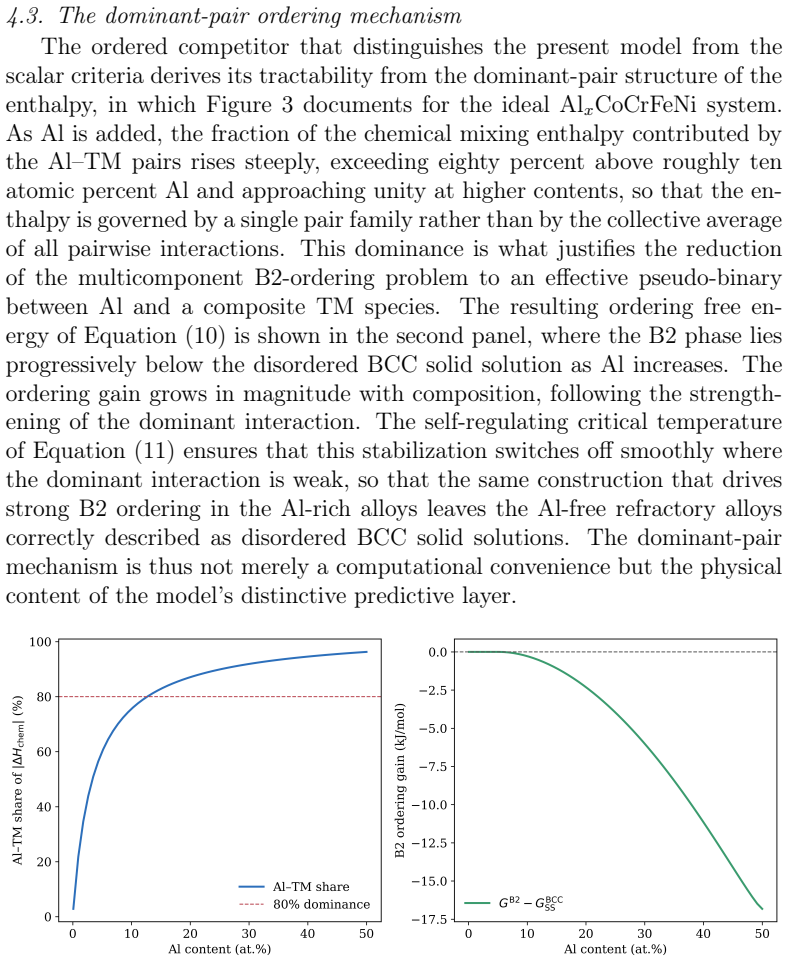
The dominant-pair mechanism, which isolates the Al-transition-metal interaction family to reduce the multicomponent B2-ordering problem to an effective pseudo-binary system evaluated with an analytic Bragg-Williams free energy.
If this is right
- Continuous phase-stability maps are generated directly as functions of composition and temperature.
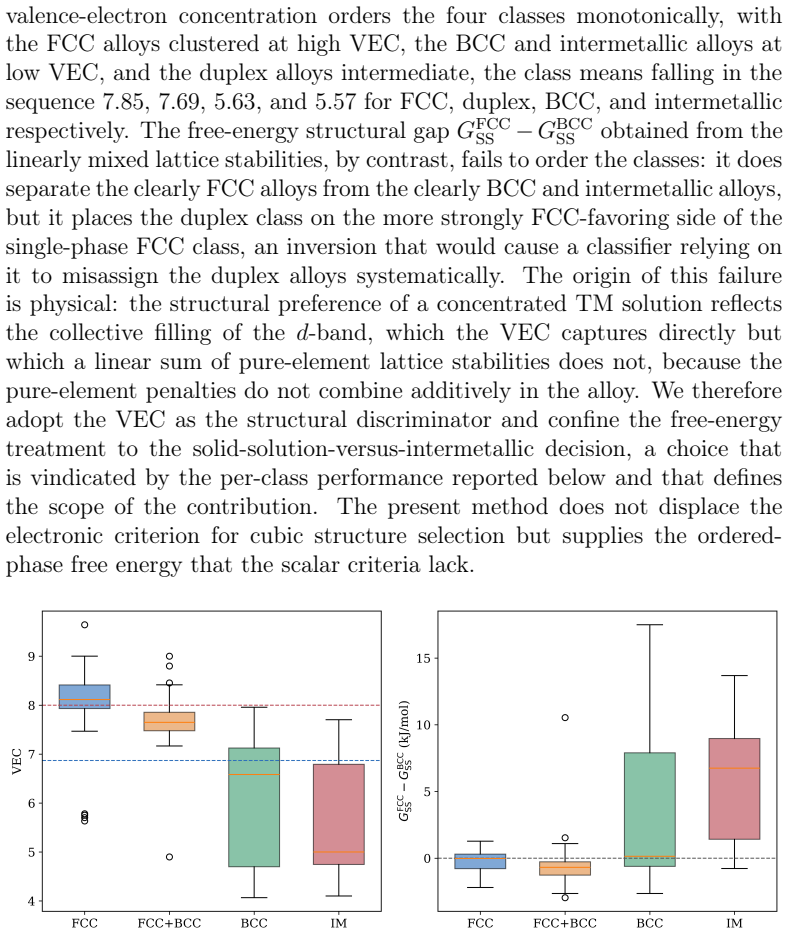
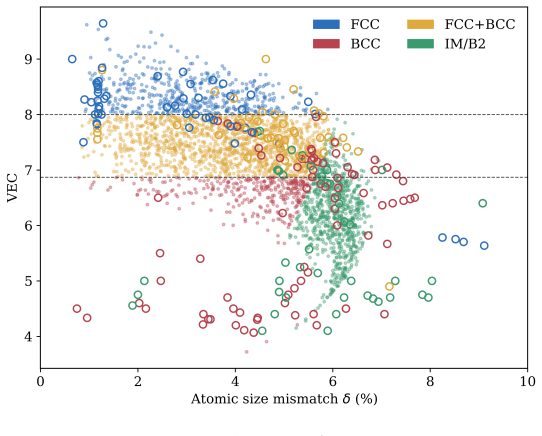
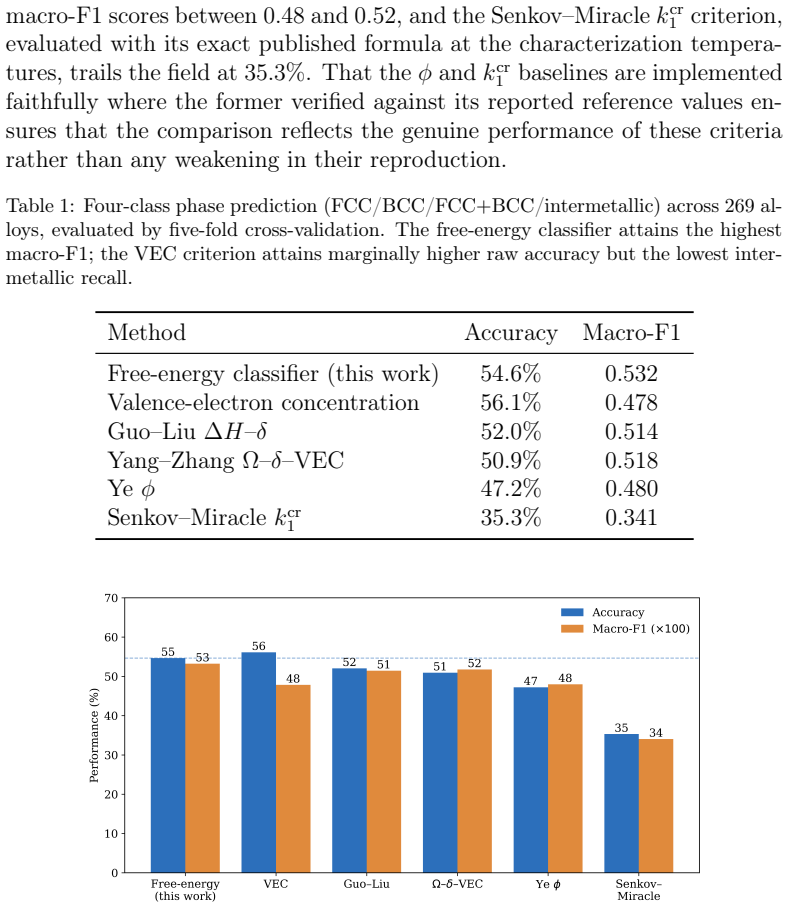
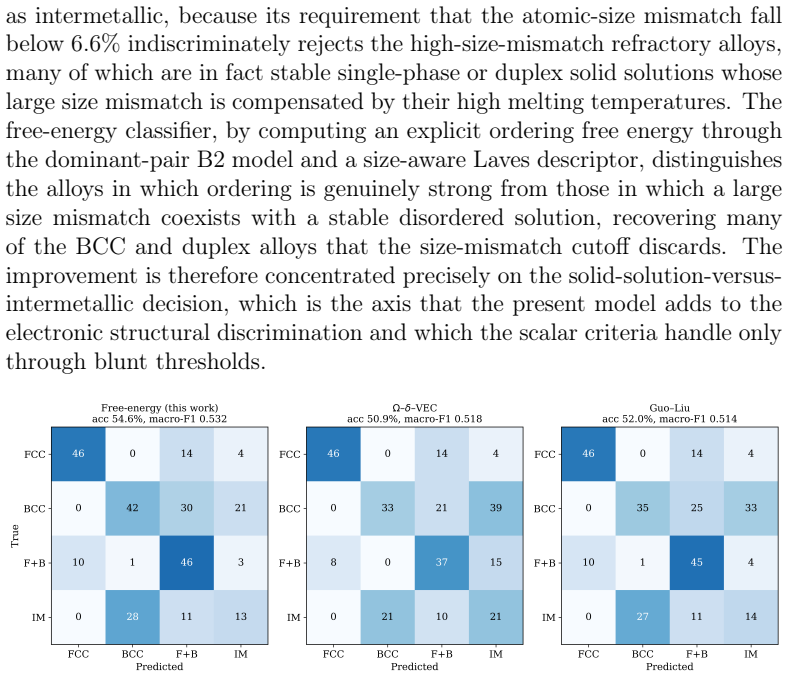
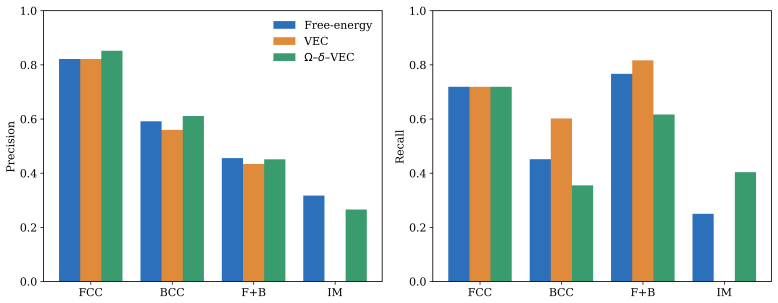
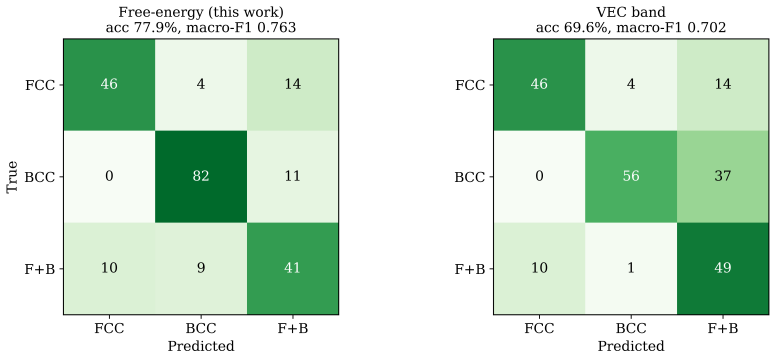
- The three-class classification accuracy reaches 77.9 percent on 269 experimental samples and exceeds the valence-electron-concentration criterion.
- The same construction applies without modification to any multicomponent alloy whose ordering is governed by a single dominant pair interaction.
- Computation remains fast enough to scan broad composition-temperature space without iterative numerical solution of the full multicomponent problem.
Where Pith is reading between the lines
- The same reduction could be tested on ordering types other than B2 if an analogous dominant pair can be identified.
- Integration with existing CALPHAD databases would allow the free-energy surfaces to be used as starting points for more detailed kinetic modeling.
- If the dominant-pair premise holds more generally, similar simplifications may shorten the search for stable phases in other chemically complex materials.
Load-bearing premise
The assumption that the Al-transition-metal interaction family supplies the dominant contribution to the ordering enthalpy across the alloys considered.
What would settle it
An experimental high-entropy alloy composition and temperature at which the phase predicted by the minimum-free-energy classifier is not the observed lowest-energy phase.
Figures
read the original abstract
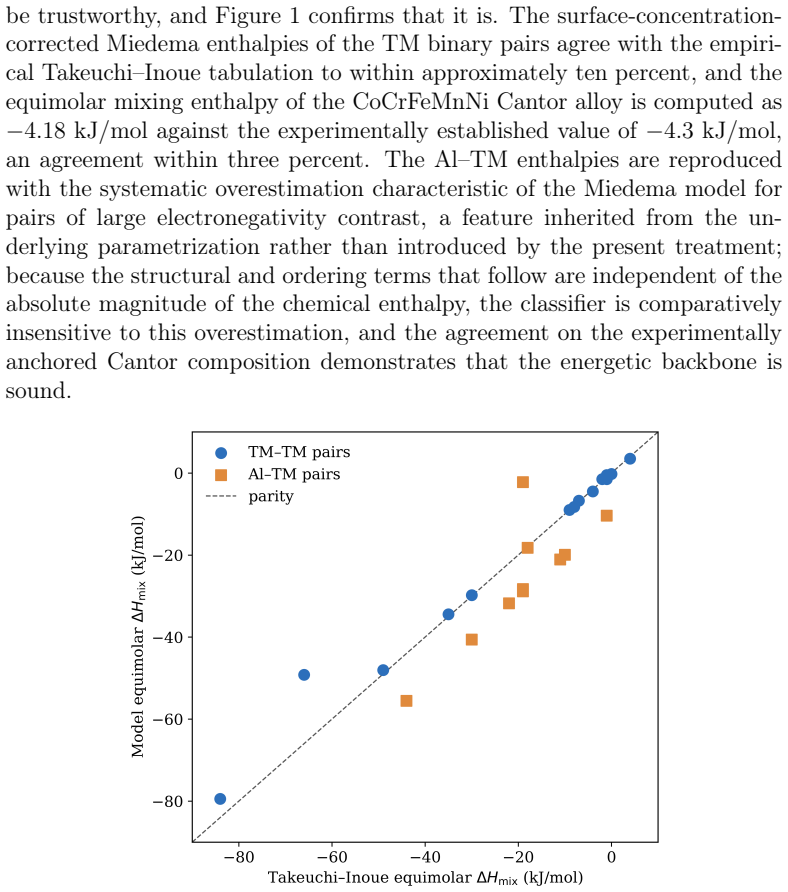
Phase selection in multicomponent alloys is governed by the competition between entropic stabilization of disordered solutions and enthalpic driving forces for chemical ordering. However, widely used parametric criteria reduce it to a single scalar, carrying no explicit free energy for any competing ordered phase. Herein, we develop a thermodynamic framework based on the semi-empirical macroscopic atom model and the Dinsdale lattice stability database to fill this gap. We show that a dominant-pair mechanism, in which the Al-transition-metal interaction family dominates the ordering enthalpy, enables the complex multicomponent B2-ordering problem to be reduced to an effective pseudo-binary system with an analytically evaluated Bragg-Williams free energy. Combined with a minimum-free-energy classifier, the framework predicts the lowest-energy phase as a function of composition and temperature. This provides continuous phase stability maps rather than the single-value predictions of conventional descriptors. Demonstrated on high-entropy alloys using a dataset of 269 experimentally characterized samples, the model outperforms widely used phase-selection criteria in the class-balanced macro-F1 metric and achieves 77.9% on the well-posed three-class task, outperforming the valence electron concentration criterion. The model is general by construction and computationally efficient for predicting phase stability in multicomponent alloys over a broad range of compositions and temperatures.
Editorial analysis
A structured set of objections, weighed in public.
Referee Report
Summary. The manuscript develops a thermodynamic framework using the semi-empirical macroscopic atom model and Dinsdale database to predict phase selection in high-entropy alloys. It introduces a dominant-pair mechanism in which the Al-transition-metal interaction family is assumed to dominate ordering enthalpy, reducing the multicomponent B2-ordering problem to an effective pseudo-binary system whose free energy is evaluated analytically via the Bragg-Williams approximation. Combined with a minimum-free-energy classifier, the model generates continuous composition-temperature phase stability maps and is reported to achieve 77.9% accuracy on a three-class task using 269 experimentally characterized samples, outperforming the valence electron concentration criterion in class-balanced macro-F1.
Significance. If the dominant-pair reduction is shown to hold across the dataset, the framework supplies an explicit, temperature-dependent free-energy surface rather than a single scalar descriptor, enabling continuous stability maps that are computationally efficient and general by construction. The use of an established semi-empirical model with analytic evaluation is a strength when the central assumption is validated.
major comments (2)
- [Abstract] Abstract and the description of the dominant-pair mechanism: the claim that the Al-transition-metal interaction family dominates the ordering enthalpy (enabling the pseudo-binary reduction) is load-bearing for the minimum-free-energy classifier and continuous maps, yet the manuscript supplies no explicit validation such as a ranking of all pair-interaction enthalpies from the macroscopic atom model for the experimentally labeled B2 samples to confirm the chosen pair is maximal in magnitude.
- [Abstract] Abstract: the reported 77.9% accuracy on the 269-sample set is presented without information on data splits, cross-validation procedure, error bars, or whether any samples overlap with those used to fit the underlying pair-interaction enthalpies; this information is required to assess whether the performance claim is independent of the semi-empirical parameters.
minor comments (1)
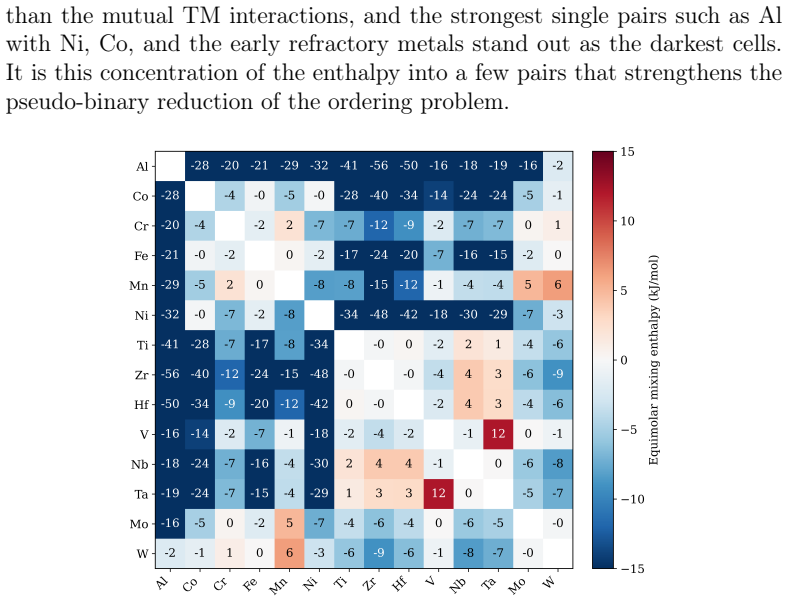
- The manuscript would benefit from a table or figure explicitly comparing the magnitudes of the dominant Al-TM pair enthalpy against other TM-TM and Al-Al pairs for representative compositions in the dataset.
Simulated Author's Rebuttal
We thank the referee for the constructive comments, which help clarify the presentation of our thermodynamic framework. We address each major comment below and indicate the revisions we will make to strengthen the manuscript.
read point-by-point responses
-
Referee: [Abstract] Abstract and the description of the dominant-pair mechanism: the claim that the Al-transition-metal interaction family dominates the ordering enthalpy (enabling the pseudo-binary reduction) is load-bearing for the minimum-free-energy classifier and continuous maps, yet the manuscript supplies no explicit validation such as a ranking of all pair-interaction enthalpies from the macroscopic atom model for the experimentally labeled B2 samples to confirm the chosen pair is maximal in magnitude.
Authors: We agree that an explicit ranking of pair-interaction enthalpies for the B2 samples would provide direct support for the dominant-pair assumption. The assumption is motivated by the well-documented strength of Al-TM interactions in the macroscopic atom model, but we acknowledge the manuscript does not include a dataset-specific validation. In the revised manuscript we will add a supplementary table (or figure) that ranks the relevant pair enthalpies computed from the model for the experimentally labeled B2 samples, confirming that the Al-TM family is maximal. This addition will be referenced in the abstract and methods. revision: yes
-
Referee: [Abstract] Abstract: the reported 77.9% accuracy on the 269-sample set is presented without information on data splits, cross-validation procedure, error bars, or whether any samples overlap with those used to fit the underlying pair-interaction enthalpies; this information is required to assess whether the performance claim is independent of the semi-empirical parameters.
Authors: The 77.9% figure is the direct accuracy of the analytic thermodynamic model evaluated on the full set of 269 experimental samples; no machine-learning training or parameter fitting to this dataset occurs. The pair-interaction enthalpies are taken unchanged from the established macroscopic atom model and Dinsdale database. We will revise the abstract, methods, and results sections to state explicitly that (i) there is no overlap with any fitting procedure, (ii) data splits and cross-validation are not applicable because the model is deterministic and physics-based rather than statistical, and (iii) the reported class-balanced macro-F1 already provides a robustness metric. Error bars in the statistical sense are not generated by the model, but we can note the consistency across the three-class task. revision: yes
Circularity Check
No significant circularity detected
full rationale
The derivation uses an external semi-empirical macroscopic atom model plus Dinsdale database to obtain pair enthalpies, applies the stated dominant-pair reduction to form a pseudo-binary, evaluates an analytic Bragg-Williams free energy, and feeds the result into a minimum-free-energy classifier. Phase predictions are then tested against an independent experimental dataset of 269 samples (77.9 % accuracy on the three-class task). No equation or step in the provided text reduces the output to the input quantities by construction, and no self-citation chain is invoked to justify the central premise. The framework therefore remains self-contained against external benchmarks.
Axiom & Free-Parameter Ledger
free parameters (1)
- pair-interaction enthalpies
axioms (2)
- domain assumption Bragg-Williams mean-field approximation is adequate for the effective pseudo-binary free energy
- ad hoc to paper Al-transition-metal pair dominates ordering enthalpy in the alloys considered
Reference graph
Works this paper leans on
-
[1]
J.-W. Yeh, S.-K. Chen, S.-J. Lin, J.-Y. Gan, T.-S. Chin, T.-T. Shun, C.-H. Tsau, S.- Y. Chang, Nanostructured high-entropy alloys with multiple principal elements: novel al- loy design concepts and outcomes, Advanced engineering materials 6 (5) (2004) 299–303. doi:https://doi.org/10.1002/adem.200300567
-
[2]
B. Cantor, I. Chang, P. Knight, A. Vincent, Microstructural development in equiatomic multicomponent alloys, Materials Science and Engineering: A 375 (2004) 213–218. doi:https://doi.org/10.1016/j.msea.2003.10.257
-
[3]
Gludovatz, A
B. Gludovatz, A. Hohenwarter, D. Catoor, E. H. Chang, E. P. George, R. O. Ritchie, A fracture- resistant high-entropy alloy for cryogenic applications, Science 345 (6201) (2014) 1153–1158
2014
-
[4]
O. N. Senkov, G. Wilks, D. Miracle, C. Chuang, P. Liaw, Refractory high-entropy alloys, Inter- metallics 18 (9) (2010) 1758–1765
2010
-
[5]
O. N. Senkov, G. B. Wilks, J. M. Scott, D. B. Miracle, Mechanical properties of nb25mo25ta25w25 and v20nb20mo20ta20w20 refractory high entropy alloys, Intermetallics 19 (5) (2011) 698–706
2011
-
[6]
F. Otto, Y. Yang, H. Bei, E. P. George, Relative effects of enthalpy and entropy on the phase stability of equiatomic high-entropy alloys, Acta Materialia 61 (7) (2013) 2628–2638
2013
-
[7]
Sheng, C
G. Sheng, C. T. Liu, Phase stability in high entropy alloys: Formation of solid-solution phase or amorphous phase, Progress in Natural Science: Materials International 21 (6) (2011) 433–446
2011
-
[8]
J. He, H. Wang, H. Huang, X. Xu, M. Chen, Y. Wu, X. Liu, T. Nieh, K. An, Z. Lu, A precipitation- hardened high-entropy alloy with outstanding tensile properties, Acta Materialia 102 (2016) 187–196
2016
-
[9]
Wang, W.-L
W.-R. Wang, W.-L. Wang, S.-C. Wang, Y.-C. Tsai, C.-H. Lai, J.-W. Yeh, Effects of al addition on the microstructure and mechanical property of alxcocrfeni high-entropy alloys, Intermetallics 26 (2012) 44–51
2012
-
[10]
Kumar, N
J. Kumar, N. Kumar, S. Das, N. Gurao, K. Biswas, Effect of al addition on the microstructural evolution of equiatomic cocrfemnni alloy, Transactions of the Indian Institute of Metals 71 (11) (2018) 2749–2758
2018
-
[11]
Hsu, C.-L
Y.-C. Hsu, C.-L. Li, C.-H. Hsueh, Effects of al addition on microstructures and mechanical properties of cocrfemnnial x high entropy alloy films, Entropy 22 (1) (2019) 2
2019
-
[12]
Zhang, Y
Y. Zhang, Y. J. Zhou, J. P. Lin, G. L. Chen, P. K. Liaw, Solid-solution phase formation rules for multi-component alloys, Advanced engineering materials 10 (6) (2008) 534–538
2008
-
[13]
X. Yang, Y. Zhang, Prediction of high-entropy stabilized solid-solution in multi-component alloys, Materials Chemistry and Physics 132 (2-3) (2012) 233–238. 26
2012
-
[14]
S. Guo, C. Ng, J. Lu, C. Liu, Effect of valence electron concentration on stability of fcc or bcc phase in high entropy alloys, Journal of applied physics 109 (10) (2011)
2011
-
[15]
Senkov, D
O. Senkov, D. Miracle, A new thermodynamic parameter to predict formation of solid solution or intermetallic phases in high entropy alloys, Journal of Alloys and Compounds 658 (2016) 603–607
2016
-
[16]
Y. Ye, Q. Wang, J.-t. Lu, C. Liu, Y. Yang, Design of high entropy alloys: A single-parameter thermodynamic rule, Scripta Materialia 104 (2015) 53–55
2015
-
[17]
Mansoori, N
G. Mansoori, N. F. Carnahan, K. Starling, T. Leland Jr, Equilibrium thermodynamic properties of the mixture of hard spheres, The Journal of Chemical Physics 54 (4) (1971) 1523–1525
1971
-
[18]
M. C. Troparevsky, J. R. Morris, P. R. Kent, A. R. Lupini, G. M. Stocks, Criteria for predicting the formation of single-phase high-entropy alloys, Physical Review X 5 (1) (2015) 011041
2015
-
[19]
Miedema, P
A. Miedema, P. De Chatel, F. De Boer, Cohesion in alloys—fundamentals of a semi-empirical model, Physica B+ c 100 (1) (1980) 1–28
1980
-
[20]
F. R. Boer, Cohesion in metals: transition metal alloys, Vol. 1, North Holland, 1988
1988
-
[21]
Takeuchi, A
A. Takeuchi, A. Inoue, Classification of bulk metallic glasses by atomic size difference, heat of mix- ing and period of constituent elements and its application to characterization of the main alloying element, Materials transactions 46 (12) (2005) 2817–2829
2005
-
[22]
A. T. Dinsdale, Sgte data for pure elements, Calphad 15 (4) (1991) 317–425
1991
-
[23]
Schneeweiss, M
O. Schneeweiss, M. Friák, M. Dudová, D. Holec, M. Šob, D. Kriegner, V. Hol` y, P. Beran, E. P. George, J. Neugebauer, et al., Magnetic properties of the crmnfeconi high-entropy alloy, Physical Review B 96 (1) (2017) 014437
2017
-
[24]
Lin, C.-C
C.-M. Lin, C.-C. Juan, C.-H. Chang, C.-W. Tsai, J.-W. Yeh, Effect of al addition on mechanical properties and microstructure of refractory alxhfnbtatizr alloys, Journal of Alloys and Compounds 624 (2015) 100–107
2015
-
[25]
Z.Zhou, X.Peng, W.Lü, S.Yang, H.Li, H.Guo, J.Wang, Ultra-hightemperatureoxidationresistant refractory high entropy alloys fabricated by laser melting deposition: Al concentration regulation and oxidation mechanism, Corrosion Science 224 (2023) 111537
2023
-
[26]
Senkov, J
O. Senkov, J. Miller, D. Miracle, C. Woodward, Accelerated exploration of multi-principal element alloys with solid solution phases, Nature communications 6 (1) (2015) 6529
2015
-
[27]
Whitfield, N
T. Whitfield, N. Church, H. Stone, N. Jones, On the rate of microstructural degradation of al-ta-ti-zr refractory metal high entropy superalloys, Journal of Alloys and Compounds 939 (2023) 168369
2023
-
[28]
J. Wen, X. Chu, Y. Cao, N. Li, Effects of al on precipitation behavior of ti-nb-ta-zr refractory high entropy alloys, Metals 11 (3) (2021) 514
2021
-
[29]
N. Y. Yurchenko, N. D. Stepanov, S. V. Zherebtsov, M. A. Tikhonovsky, G. A. Salishchev, Structure and mechanical properties of B2 ordered refractory AlNbTiVZrx (x= 0–1.5) high-entropy alloys, Materials Science and Engineering: A 704 (2017) 82–90. doi:10.1016/j.msea.2017.08.019
-
[30]
F. Körmann, T. Kostiuchenko, A. Shapeev, J. Neugebauer, B2 ordering in body-centered- cubic AlNbTiV refractory high-entropy alloys, Physical Review Materials 5 (5) (2021) 053803. doi:10.1103/PhysRevMaterials.5.053803
-
[31]
C. D. Woodgate, H. J. Naguszewski, D. Redka, J. Minár, D. Quigley, J. B. Staunton, Emergent B2 chemical orderings in the AlTiVNb and AlTiCrMo refractory high-entropy superalloys studied via first-principles theory and atomistic modelling, Journal of Physics: Materials 8 (4) (2025) 045002. doi:10.1088/2515-7639/adf468
-
[32]
T. B. Massalski (Ed.), Binary Alloy Phase Diagrams, 2nd Edition, ASM International, Materials Park, OH, 1990. doi:https://doi.org/10.1002/adma.19910031215. 27
discussion (0)
Sign in with ORCID, Apple, or X to comment. Anyone can read and Pith papers without signing in.