Constraining leptonic and hadronic gamma-ray emission from HESS J1825-137 and its environment
Pith reviewed 2026-07-02 17:07 UTC · model grok-4.3
The pith
Baseline GeV-TeV data favor a purely leptonic model for HESS J1825-137 while simulated CTAO or LHAASO ultra-high-energy points shift preference to models with a hadronic component.
A machine-rendered reading of the paper's core claim, the machinery that carries it, and where it could break.
Core claim
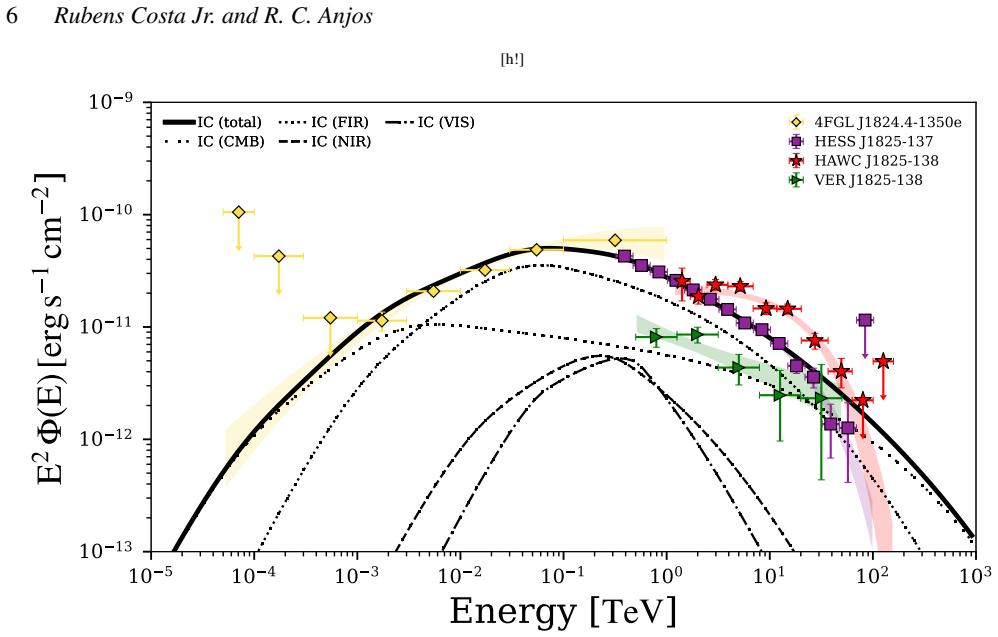
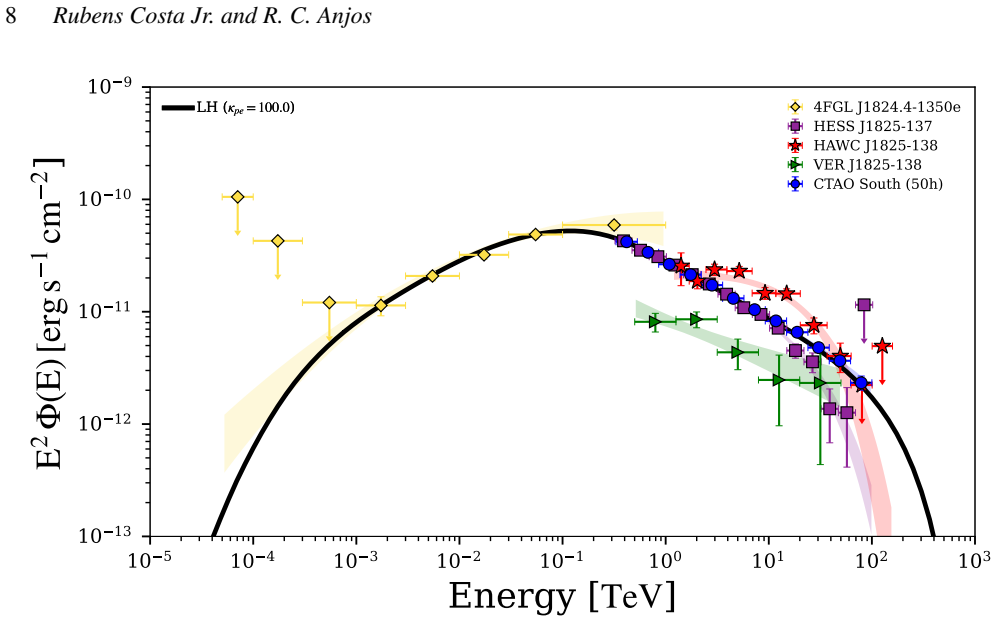
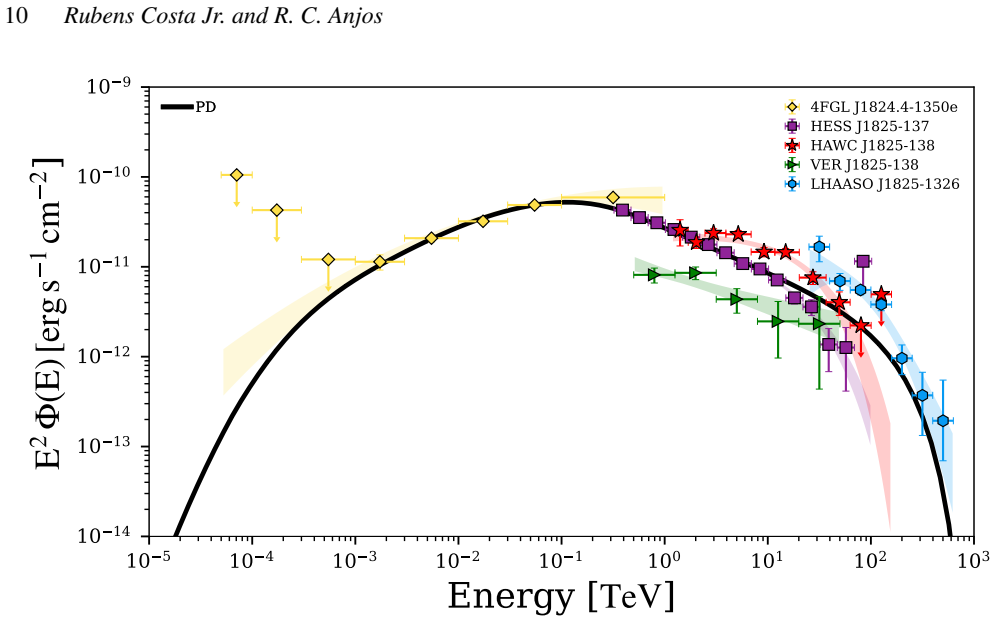
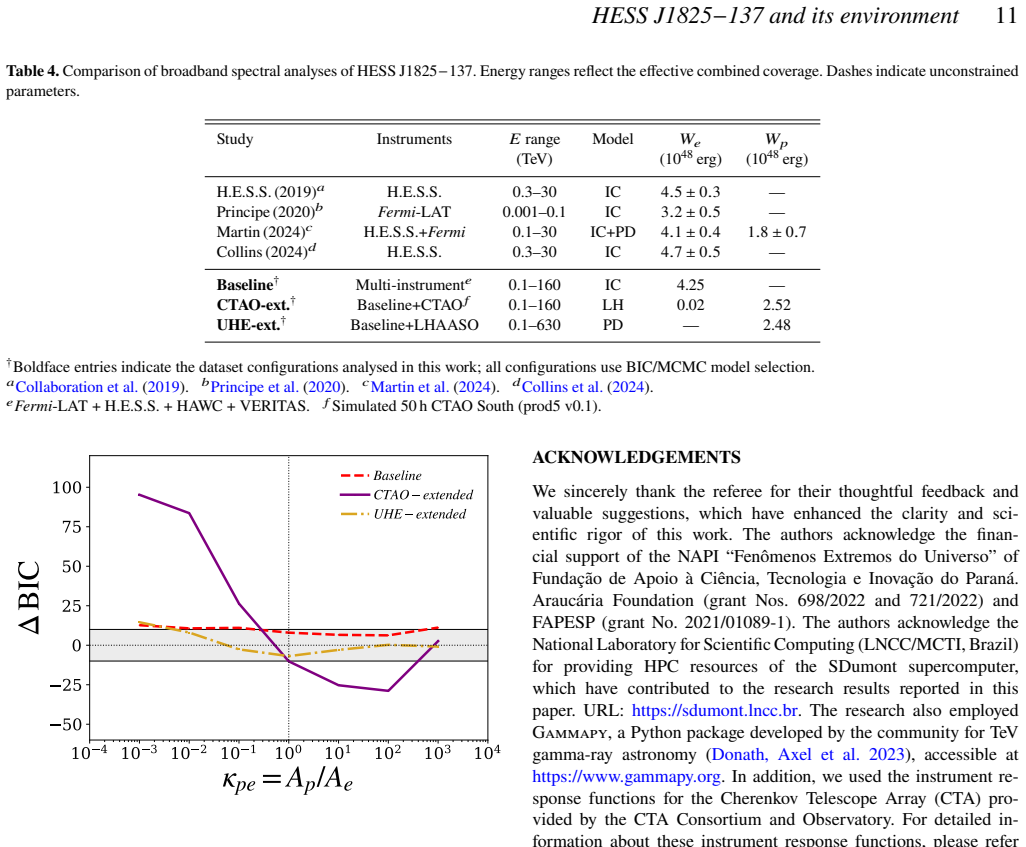
The spectral energy distribution of HESS J1825-137 is best described by a purely leptonic model for the baseline GeV-TeV dataset, while inclusion of simulated CTAO observations or LHAASO ultra-high-energy measurements yields ΔBIC values of -28.87 and -7.89 that favor lepto-hadronic scenarios. The electron energy budget is 4.25 × 10^48 erg, consistent with prior estimates, and the proton energy budget of approximately 2.5 × 10^48 erg is energetically compatible with pp interactions in the dense molecular environment adjacent to the nebula. Precise spectral measurements above 10 TeV are essential to establish the dominant emission mechanism.
What carries the argument
The Naima radiative modeling framework with Markov Chain Monte Carlo parameter estimation and Bayesian Information Criterion comparison applied to leptonic, hadronic, and lepto-hadronic scenarios for the pulsar wind nebula emission.
If this is right
- The electron energy budget of 4.25 × 10^48 erg matches previous literature estimates for this source.
- The proton energy budget of approximately 2.5 × 10^48 erg is compatible with pp interactions in the adjacent dense molecular environment.
- Precise spectral measurements above approximately 10 TeV are essential to establish the dominant emission mechanism.
- Simulated CTAO or LHAASO data points produce clear shifts in model preference quantified by ΔBIC.
Where Pith is reading between the lines
- Confirmation of a hadronic component would imply that protons are being accelerated within or near the nebula and interacting with surrounding molecular gas.
- The same modeling approach could be applied to other pulsar wind nebulae to test whether ultra-high-energy data routinely reveal hidden hadronic contributions.
- Once real CTAO or LHAASO observations become available they can replace the simulated points and directly test the current model rankings.
Load-bearing premise
The shift toward hadronic models depends on the accuracy of the simulated CTAO and LHAASO data points together with the specific choices for gas density, target photon fields, and other environmental parameters inside the model.
What would settle it
Actual ultra-high-energy spectrum measurements from LHAASO or CTAO above 100 TeV that lack the excess predicted by the hadronic component would remove the statistical preference for models that include protons.
Figures
read the original abstract
We present a broadband spectral analysis of the $\gamma$-ray emission from the pulsar wind nebula HESS~J1825$-$137, combining observations from Fermi Large Area Telescope (\textit{Fermi}-LAT), High Energy Stereoscopic System (H.E.S.S.), High-Altitude Water Cherenkov Observatory (HAWC), and Very Energetic Radiation Imaging Telescope Array System (VERITAS) across the $\sim 0.1$~GeV--$160$~TeV energy range. The spectral energy distribution is modelled under purely leptonic, purely hadronic, and lepto-hadronic scenarios using the \textsc{Naima} radiative modeling framework with Markov Chain Monte Carlo parameter estimation. Model comparison via the Bayesian Information Criterion reveals that the baseline GeV--TeV data favour a purely leptonic interpretation, while the inclusion of simulated Cherenkov Telescope Array Observatory (CTAO) observations or Large High Altitude Air Shower Observatory (LHAASO) ultra-high-energy (UHE; $E_{\gamma} \ge 100\,\mathrm{TeV}$) measurements shifts the preference toward models incorporating a hadronic component ($\Delta\mathrm{BIC} = -28.87$ and $-7.89$, respectively). The inferred electron energy budget for the baseline GeV--TeV dataset, $W_e = 4.25 \times 10^{48}$~erg, is consistent with previous estimates reported in the literature. The proton energy budget, $W_p \approx 2.5 \times 10^{48}$~erg, is energetically compatible with $pp$ interactions in the dense molecular environment adjacent to the nebula. These results demonstrate that precise spectral measurements above $\sim 10$~TeV, where Klein--Nishina suppression of inverse Compton emission creates a window for hadronic processes, are essential to establish the dominant emission mechanism in this source.
Editorial analysis
A structured set of objections, weighed in public.
Referee Report
Summary. The manuscript performs a broadband SED analysis of the PWN HESS J1825-137 using Fermi-LAT, H.E.S.S., HAWC and VERITAS data (0.1 GeV–160 TeV). It fits purely leptonic, purely hadronic and lepto-hadronic models inside the Naima radiative code via MCMC sampling, then compares models with the Bayesian Information Criterion. The baseline GeV–TeV dataset is reported to favour the leptonic scenario, while the addition of simulated CTAO or LHAASO UHE points produces ΔBIC = −28.87 and −7.89, respectively, shifting preference toward models that include a hadronic component. Derived electron and proton energy budgets (We = 4.25 × 10^48 erg, Wp ≈ 2.5 × 10^48 erg) are stated to be consistent with prior literature and with the local molecular environment.
Significance. If the simulated CTAO/LHAASO points are generated without reference to the baseline leptonic posterior, the result would usefully illustrate the diagnostic value of UHE observations for PWNe once Klein–Nishina suppression opens a window for hadronic emission. The work employs standard, publicly available tools (Naima + MCMC + BIC) and reports energy budgets that can be directly compared with existing estimates, which strengthens its utility for the community.
major comments (2)
- [description of simulated CTAO/LHAASO observations] The generation of the simulated CTAO and LHAASO data points that produce the reported ΔBIC shifts is not described quantitatively (no statement of the input spectrum, target photon fields, gas density n_H, cutoff energies, or error model used inside Naima). Because these points are the sole driver of the novel claim that future UHE data favour hadronic or lepto-hadronic scenarios, the absence of this pipeline prevents assessment of circularity. This is load-bearing for the central result stated in the abstract.
- [model comparison and BIC results] The BIC values and ΔBIC shifts are presented without the underlying log-likelihood surfaces or the number of free parameters per model (electron vs. proton spectral indices, cutoffs, We, Wp). Without these, it is impossible to verify that the reported preference changes are not driven by differences in model complexity or prior volume.
minor comments (1)
- [abstract and §2] Notation for the energy budgets (We, Wp) should be defined at first use and kept consistent with the Naima documentation.
Simulated Author's Rebuttal
We are grateful to the referee for their insightful comments, which have helped us improve the clarity and completeness of our manuscript. Below we respond point-by-point to the major comments.
read point-by-point responses
-
Referee: [description of simulated CTAO/LHAASO observations] The generation of the simulated CTAO and LHAASO data points that produce the reported ΔBIC shifts is not described quantitatively (no statement of the input spectrum, target photon fields, gas density n_H, cutoff energies, or error model used inside Naima). Because these points are the sole driver of the novel claim that future UHE data favour hadronic or lepto-hadronic scenarios, the absence of this pipeline prevents assessment of circularity. This is load-bearing for the central result stated in the abstract.
Authors: We recognize that the lack of a quantitative description of the simulated CTAO and LHAASO data points limits the ability to evaluate the robustness of our conclusions regarding the preference for lepto-hadronic models with future data. In the revised manuscript, we will add a detailed description of the simulation procedure, including the input spectrum used, target photon fields, gas density n_H, cutoff energies, and the error model within Naima. This will permit a full assessment of whether the simulation is circular with respect to the baseline leptonic posterior. The points were generated to demonstrate the diagnostic capability of UHE observations in the regime where Klein-Nishina suppression allows hadronic emission to become prominent. revision: yes
-
Referee: [model comparison and BIC results] The BIC values and ΔBIC shifts are presented without the underlying log-likelihood surfaces or the number of free parameters per model (electron vs. proton spectral indices, cutoffs, We, Wp). Without these, it is impossible to verify that the reported preference changes are not driven by differences in model complexity or prior volume.
Authors: We agree that additional information on the model parameters and likelihoods is important for verifying the BIC results. The BIC penalizes for the number of free parameters, but we will include in the revised manuscript a table that reports the maximum log-likelihood, the number of free parameters for each model (leptonic, hadronic, and lepto-hadronic), and the BIC values for the different datasets. This will allow independent verification that the reported ΔBIC values reflect genuine improvements in fit quality rather than variations in model complexity. revision: yes
Circularity Check
No significant circularity; central results are direct fits to observed data
full rationale
The paper's core analysis consists of direct MCMC fits to existing Fermi-LAT, H.E.S.S., HAWC and VERITAS spectra inside the Naima framework, followed by BIC model comparison among leptonic, hadronic and lepto-hadronic scenarios. The reported preference shifts arise only when externally generated simulated CTAO or LHAASO points are added; these are forward tests, not quantities that reduce by the paper's own equations to any fitted parameter. No self-definitional relations, fitted-input-called-prediction steps, or load-bearing self-citations appear. The derivation chain is therefore self-contained against external benchmarks.
Axiom & Free-Parameter Ledger
free parameters (4)
- electron spectral parameters
- proton spectral parameters
- We
- Wp
axioms (1)
- domain assumption Standard assumptions inside the Naima code for inverse-Compton and pp-interaction emissivities, including target photon fields and ambient gas density.
Reference graph
Works this paper leans on
-
[1]
The Astrophysical Journal , volume =
Sironi, Lorenzo and Spitkovsky, Anatoly , title =. The Astrophysical Journal , volume =. 2011 , doi =
2011
-
[2]
Kirk, J. G. and Skj. Dissipation in Poynting-flux-dominated flows: The sigma-problem of the Crab pulsar wind , journal =. 2003 , doi =
2003
-
[3]
Robert E. Kass and Adrian E. Raftery , title =. Journal of the American Statistical Association , volume =. 1995 , publisher =. doi:10.1080/01621459.1995.10476572 , URL =
-
[4]
H. E.S.S. Collaboration and H. Abdalla and F. Aharonian and F. Ait Benkhali and E. O. Angüner and M. Arakawa and C. Arcaro and C. Armand and M. Arrieta and M. Backes and M. Barnard and Y. Becherini and J. Becker Tjus and D. Berge and K. Bernlöhr and R. Blackwell and M. Böttcher and C. Boisson and J. Bolmont and S. Bonnefoy and P. Bordas and J. Bregeon and...
-
[6]
Extended gamma-ray emission from particle escape in pulsar wind nebulae: Application to HESS J1809 193 and HESS J1825 137. , keywords =. doi:10.1051/0004-6361/202450254 , archivePrefix =. 2407.07583 , primaryClass =
-
[7]
IEEE Transactions on Information Theory , title =
David MacKay , doi =. IEEE Transactions on Information Theory , title =
-
[8]
J. P. Yuan and N. Wang and R. N. Manchester and Z. Y. Liu , doi =. 29 glitches detected at Urumqi Observatory , volume =. Monthly Notices of the Royal Astronomical Society , keywords =
-
[9]
J. M. Yao and R. N. Manchester and N. Wang , title =. The Astrophysical Journal , abstract =. 2017 , month =. doi:10.3847/1538-4357/835/1/29 , url =
-
[10]
T. R. Clifton and A. G. Lyne , doi =. Nature , title =
-
[11]
3.9 day orbital modulation in the TeV γ-ray flux and spectrum from the X-ray binary LS 5039 , DOI= "10.1051/0004-6361:20065940", url= "https://doi.org/10.1051/0004-6361:20065940", journal =
-
[13]
R. N. Manchester and G. B. Hobbs and A. Teoh and M. Hobbs , doi =. The Australia Telescope National Facility Pulsar Catalogue , volume =. The Astronomical Journal , month =
-
[14]
Hogg and Dustin Lang and Jonathan Goodman , doi =
Daniel Foreman-Mackey and David W. Hogg and Dustin Lang and Jonathan Goodman , doi =. emcee : The MCMC Hammer , volume =. Publications of the Astronomical Society of the Pacific , month =
-
[16]
Particle acceleration at astrophysical shocks: A theory of cosmic ray origin , journal =
Roger Blandford and David Eichler , abstract =. Particle acceleration at astrophysical shocks: A theory of cosmic ray origin , journal =. 1987 , issn =. doi:https://doi.org/10.1016/0370-1573(87)90134-7 , url =
-
[17]
A. Albert and R. Alfaro and C. Alvarez and J. R. Angeles Camacho and J. C. Arteaga-Velázquez and K. P. Arunbabu and D. Avila Rojas and H. A. Ayala Solares and V. Baghmanyan and E. Belmont-Moreno and S. Y. BenZvi and C. Brisbois and K. S. Caballero-Mora and T. Capistrán and A. Carramiñana and S. Casanova and U. Cotti and J. Cotzomi and S. Coutiño de León a...
-
[18]
Stefano Gabici and Felix A. Aharonian , title =. The Astrophysical Journal , abstract =. 2007 , month =. doi:10.1086/521047 , url =
-
[19]
Detection of TeV -ray emission from the shell-type supernova remnant RX J0852.0-4622 with HESS , DOI= "10.1051/0004-6361:200500130", url= "https://doi.org/10.1051/0004-6361:200500130", journal =
-
[20]
Bykov, A. M. and Brandenburg, A. and Malkov, M. A. and Osipov, S. M. , title =. Space Science Reviews , volume =. 2013 , doi =
2013
-
[21]
and Barbarino, G
Adriani, O. and Barbarino, G. C. and Bazilevskaya, G. A. and et al. (Pamela collaboration) , title =. Science , volume =. 2011 , doi =
2011
-
[22]
Probes of Multimessenger Astrophysics
Maurizio Spurio. Probes of Multimessenger Astrophysics. doi:https://doi.org/10.1007/978-3-319-96854-4
-
[24]
The MAGIC gamma-ray observatory , journal =
Daniel Ferenc , abstract =. The MAGIC gamma-ray observatory , journal =. 2005 , note =. doi:https://doi.org/10.1016/j.nima.2005.08.085 , url =
-
[25]
Advances in Space Research , year = 2014, month =
HAWC: A next-generation all-sky gamma-ray telescope. Advances in Space Research , year = 2014, month =. doi:10.1016/j.asr.2013.03.016 , adsurl =
-
[26]
Abdollahi and F
S. Abdollahi and F. Acero and L. Baldini and J. Ballet and D. Bastieri and R. Bellazzini and B. Berenji and A. Berretta and E. Bissaldi and R. D. Blandford and E. Bloom and R. Bonino and A. Brill and R. J. Britto and P. Bruel and T. H. Burnett and S. Buson and R. A. Cameron and R. Caputo and P. A. Caraveo and D. Castro and S. Chaty and C. C. Cheung and G....
-
[27]
Acero and M
F. Acero and M. Ackermann and M. Ajello and A. Albert and W. B. Atwood and M. Axelsson and L. Baldini and J. Ballet and G. Barbiellini and D. Bastieri and A. Belfiore and R. Bellazzini and E. Bissaldi and R. D. Blandford and E. D. Bloom and J. R. Bogart and R. Bonino and E. Bottacini and J. Bregeon and R. J. Britto and P. Bruel and R. Buehler and T. H. Bu...
-
[28]
Ackermann and M
M. Ackermann and M. Ajello and W. B. Atwood and L. Baldini and J. Ballet and G. Barbiellini and D. Bastieri and J. Becerra Gonzalez and R. Bellazzini and E. Bissaldi and R. D. Blandford and E. D. Bloom and R. Bonino and E. Bottacini and T. J. Brandt and J. Bregeon and P. Bruel and R. Buehler and S. Buson and G. A. Caliandro and R. A. Cameron and R. Caputo...
-
[29]
Ajello and W
M. Ajello and W. B. Atwood and L. Baldini and J. Ballet and G. Barbiellini and D. Bastieri and R. Bellazzini and E. Bissaldi and R. D. Blandford and E. D. Bloom and R. Bonino and J. Bregeon and R. J. Britto and P. Bruel and R. Buehler and S. Buson and R. A. Cameron and R. Caputo and M. Caragiulo and P. A. Caraveo and E. Cavazzuti and C. Cecchi and E. Char...
-
[31]
Phase Separation in Ultramassive White Dwarfs. , keywords =. doi:10.3847/1538-4357/ac1513 , archivePrefix =. 2107.07094 , primaryClass =
-
[33]
The H.E.S.S. survey of the Inner Galaxy in very high-energy gamma-rays
The H.E.S.S. Survey of the Inner Galaxy in Very High Energy Gamma Rays. , keywords =. doi:10.1086/498013 , archivePrefix =. astro-ph/0510397 , primaryClass =
work page internal anchor Pith review Pith/arXiv arXiv doi:10.1086/498013
-
[34]
Chandra and H.E.S.S. observations of the Supernova Remnant CTB 37B
Chandra and HESS observations of the supernova remnant CTB 37B. , keywords =. doi:10.1051/0004-6361:200809655 , archivePrefix =. 0803.0682 , primaryClass =
work page internal anchor Pith review Pith/arXiv arXiv doi:10.1051/0004-6361:200809655
-
[35]
3FHL: The Third Catalog of Hard Fermi-LAT Sources
3FHL: The Third Catalog of Hard Fermi-LAT Sources. , keywords =. doi:10.3847/1538-4365/aa8221 , archivePrefix =. 1702.00664 , primaryClass =
work page internal anchor Pith review Pith/arXiv arXiv doi:10.3847/1538-4365/aa8221
-
[36]
2FHL: The Second Catalog of Hard Fermi-LAT Sources
2FHL: The Second Catalog of Hard Fermi-LAT Sources. , keywords =. doi:10.3847/0067-0049/222/1/5 , archivePrefix =. 1508.04449 , primaryClass =
work page internal anchor Pith review Pith/arXiv arXiv doi:10.3847/0067-0049/222/1/5
-
[37]
Incremental Fermi Large Area Telescope Fourth Source Catalog. , keywords =. doi:10.3847/1538-4365/ac6751 , archivePrefix =. 2201.11184 , primaryClass =
-
[38]
Fermi Large Area Telescope Fourth Source Catalog Data Release 4 (4FGL-DR4)
Fermi Large Area Telescope Fourth Source Catalog Data Release 4 (4FGL-DR4). arXiv e-prints , keywords =. doi:10.48550/arXiv.2307.12546 , archivePrefix =. 2307.12546 , primaryClass =
work page internal anchor Pith review Pith/arXiv arXiv doi:10.48550/arxiv.2307.12546
-
[39]
Fermi Large Area Telescope Third Source Catalog
Fermi Large Area Telescope Third Source Catalog. , keywords =. doi:10.1088/0067-0049/218/2/23 , archivePrefix =. 1501.02003 , primaryClass =
work page internal anchor Pith review Pith/arXiv arXiv doi:10.1088/0067-0049/218/2/23
-
[40]
Extended VHE gamma-ray emission towards SGR1806-20, LBV1806-20, and stellar cluster Cl*1806-20
Extended VHE -ray emission towards SGR1806-20, LBV 1806-20, and stellar cluster Cl* 1806-20. , keywords =. doi:10.1051/0004-6361/201628695 , archivePrefix =. 1606.05404 , primaryClass =
work page internal anchor Pith review Pith/arXiv arXiv doi:10.1051/0004-6361/201628695
-
[41]
The H.E.S.S. Galactic plane survey
The H.E.S.S. Galactic plane survey. , keywords =. doi:10.1051/0004-6361/201732098 , archivePrefix =. 1804.02432 , primaryClass =
work page internal anchor Pith review Pith/arXiv arXiv doi:10.1051/0004-6361/201732098
-
[42]
IEEE Transactions on Automatic Control , keywords =
A New Look at the Statistical Model Identification. IEEE Transactions on Automatic Control , keywords =
-
[43]
37th International Cosmic Ray Conference , year = 2022, month = mar, eid =
Detection methods for the Cherenkov Telescope Array at very-short exposure times. 37th International Cosmic Ray Conference , year = 2022, month = mar, eid =. doi:10.22323/1.395.0694 , archivePrefix =. 2108.04504 , primaryClass =
-
[44]
Background Modelling in Very-High-Energy gamma-ray Astronomy
Background modelling in very-high-energy -ray astronomy. , keywords =. doi:10.1051/0004-6361:20066674 , archivePrefix =. astro-ph/0610959 , primaryClass =
work page internal anchor Pith review Pith/arXiv arXiv doi:10.1051/0004-6361:20066674
-
[45]
Analysis methods for results in gamma-ray astronomy. , keywords =. doi:10.1086/161295 , adsurl =
-
[46]
doi:10.5281/zenodo.5499840 , url =
-
[47]
Nuovo Cimento C Geophysics Space Physics C , year = 2017, month = may, volume =
GRBs as multimessenger sources. Nuovo Cimento C Geophysics Space Physics C , year = 2017, month = may, volume =. doi:10.1393/ncc/i2017-17126-2 , adsurl =
-
[48]
Frontiers in Astronomy and Space Sciences , keywords =
Multimessenger Search for the Sources of Cosmic Rays using Cosmic Neutrinos. Frontiers in Astronomy and Space Sciences , keywords =. doi:10.3389/fspas.2019.00032 , adsurl =
-
[49]
Cosmic rays from pulsars and magnetars. , keywords =. doi:10.1111/j.1745-3933.2010.00874.x , archivePrefix =. 1005.1003 , primaryClass =
-
[50]
arXiv , author =:2305.17030 , journal =
The First LHAASO Catalog of Gamma-Ray Sources. , keywords =. doi:10.3847/1538-4365/acfd29 , archivePrefix =. 2305.17030 , primaryClass =
-
[51]
A Catalog of the Highest-energy Cosmic Rays Recorded during Phase I of Operation of the Pierre Auger Observatory. , keywords =. doi:10.3847/1538-4365/aca537 , adsurl =
-
[52]
Constraining models for the origin of ultra-high-energy cosmic rays with a novel combined analysis of arrival directions, spectrum, and composition data measured at the Pierre Auger Observatory. , keywords =. doi:10.1088/1475-7516/2024/01/022 , archivePrefix =. 2305.16693 , primaryClass =
-
[53]
Massive Stars as Major Factories of Galactic Cosmic Rays
Massive stars as major factories of Galactic cosmic rays. Nature Astronomy , keywords =. doi:10.1038/s41550-019-0724-0 , archivePrefix =. 1804.02331 , primaryClass =
work page internal anchor Pith review Pith/arXiv arXiv doi:10.1038/s41550-019-0724-0
-
[54]
Massive star cluster origin for the galactic cosmic ray population at very-high energies. , keywords =. doi:10.1093/mnras/stac3469 , archivePrefix =. 2211.11625 , primaryClass =
-
[56]
Magnetars as powering sources of gamma-ray burst associated supernovae, and unsupervized clustering of cosmic explosions. , keywords =. doi:10.1093/mnras/stae901 , archivePrefix =. 2403.18076 , primaryClass =
-
[57]
European Physical Journal Web of Conferences , year = 2023, series =
UHECR results of combined analyses of TA and Auger experiments. European Physical Journal Web of Conferences , year = 2023, series =. doi:10.1051/epjconf/202328004001 , adsurl =
-
[58]
Annual Review of Nuclear and Particle Science , keywords =
Ultra-High-Energy Gamma-Ray Astronomy. Annual Review of Nuclear and Particle Science , keywords =. doi:10.1146/annurev-nucl-112822-025357 , archivePrefix =. 2310.01744 , primaryClass =
-
[59]
Formation of Very Strongly Magnetized Neutron Stars: Implications for Gamma-Ray Bursts. , keywords =. doi:10.1086/186413 , adsurl =
-
[60]
Radiative mechanism for outbursts
The soft gamma repeaters as very strongly magnetized neutron stars - I. Radiative mechanism for outbursts. , keywords =. doi:10.1093/mnras/275.2.255 , adsurl =
-
[61]
Binary Coalescences as Sources of Ultrahigh-Energy Cosmic Rays. , keywords =. doi:10.1103/PhysRevLett.132.091401 , archivePrefix =. 2307.06200 , primaryClass =
-
[62]
Science with the Cherenkov Telescope Array. doi:10.1142/10986 , adsurl =
-
[63]
W. B. Atwood and A. A. Abdo and M. Ackermann and W. Althouse and B. Anderson and M. Axelsson and L. Baldini and J. Ballet and D. L. Band and G. Barbiellini and J. Bartelt and D. Bastieri and B. M. Baughman and K. Bechtol and D. Bédérède and F. Bellardi and R. Bellazzini and B. Berenji and G. F. Bignami and D. Bisello and E. Bissaldi and R. D. Blandford an...
-
[64]
Identification of CXOU J171405.7-381031 as a New Magnetar with XMM-Newton
Identification of CXOU J171405.7-381031 as a New Magnetar with XMM-Newton. Publications of the Astronomical Society of Japan , keywords =. doi:10.1093/pasj/62.5.L33 , archivePrefix =. 1008.0234 , primaryClass =
work page internal anchor Pith review Pith/arXiv arXiv doi:10.1093/pasj/62.5.l33
-
[65]
Two Magnetar Candidates in HESS Supernova Remnants
Two Magnetar Candidates in HESS Supernova Remnants. The Astrophysical Journal , keywords =. doi:10.1088/0004-637X/710/2/941 , archivePrefix =. 0912.4985 , primaryClass =
work page internal anchor Pith review Pith/arXiv arXiv doi:10.1088/0004-637x/710/2/941
-
[66]
Discovery of a VHE gamma-ray source coincident with the supernova remnant CTB 37A
Discovery of a VHE gamma-ray source coincident with the supernova remnant CTB 37A. Astronomy and Astrophysics , keywords =. doi:10.1051/0004-6361:200809722 , archivePrefix =. 0803.0702 , primaryClass =
work page internal anchor Pith review Pith/arXiv arXiv doi:10.1051/0004-6361:200809722
-
[67]
An Energetic Magnetar in HESS J1713-381/CTB 37B
An Energetic Magnetar in HESS J1713-381/CTB 37B. The Astrophysical Journal , keywords =. doi:10.1088/0004-637X/725/1/1384 , archivePrefix =. 1008.2558 , primaryClass =
work page internal anchor Pith review Pith/arXiv arXiv doi:10.1088/0004-637x/725/1/1384
-
[68]
X-ray Observations of a New Unusual Magnetar Swift J1834.9-0846
X-Ray Observations of the New Unusual Magnetar Swift J1834.9-0846. The Astrophysical Journal , keywords =. doi:10.1088/0004-637X/748/1/26 , archivePrefix =. 1201.1894 , primaryClass =
work page internal anchor Pith review Pith/arXiv arXiv doi:10.1088/0004-637x/748/1/26
-
[69]
Learning About the Magnetar Swift J1834.9-0846 from its Wind Nebula
Learning about the magnetar Swift J1834.9-0846 from its wind nebula. Monthly Notices of the Royal Astronomical Society , keywords =. doi:10.1093/mnras/stw2554 , archivePrefix =. 1608.06994 , primaryClass =
work page internal anchor Pith review Pith/arXiv arXiv doi:10.1093/mnras/stw2554
-
[70]
The Distances of SNR W41 and overlapping HII regions
The Distances of SNR W41 and Overlapping H II Regions. The Astronomical Journal , keywords =. doi:10.1088/0004-6256/135/1/167 , archivePrefix =. 0708.3377 , primaryClass =
work page internal anchor Pith review Pith/arXiv arXiv doi:10.1088/0004-6256/135/1/167
-
[71]
On the Origin of TeV Gamma-ray Emission from HESS J1834-087
On the Origin of TeV Gamma-Ray Emission from HESS J1834-087. The Astrophysical Journal , keywords =. doi:10.1088/0004-637X/691/2/1707 , archivePrefix =. 0810.1605 , primaryClass =
work page internal anchor Pith review Pith/arXiv arXiv doi:10.1088/0004-637x/691/2/1707
-
[72]
VLA and XMM-Newton observations of the SNR W41/TeV Gamma-ray source HESS J1834-087
VLA and XMM-Newton Observations of the SNR W41/TeV Gamma-Ray Source HESS J1834-087. The Astrophysical Journal Letters , keywords =. doi:10.1086/512544 , archivePrefix =. astro-ph/0612296 , primaryClass =
work page internal anchor Pith review Pith/arXiv arXiv doi:10.1086/512544
-
[73]
The Prelude to and Aftermath of the Giant Flare of 2004 December 27: Persistent and Pulsed X-Ray Properties of SGR 1806-20 from 1993 to 2005. The Astrophysical Journal , keywords =. doi:10.1086/507459 , archivePrefix =. astro-ph/0602402 , primaryClass =
work page internal anchor Pith review Pith/arXiv arXiv doi:10.1086/507459 2004
-
[74]
A downward revision to the distance of the 1806-20 cluster and associated magnetar from Gemini Near-Infrared Spectroscopy. Monthly Notices of the Royal Astronomical Society , keywords =. doi:10.1111/j.1745-3933.2008.00453.x , archivePrefix =. 0802.0815 , primaryClass =
-
[75]
Rita C. dos Anjos and Jaziel G. Coelho and Jonas P. Pereira and Fernando Catalani , title =. Journal of Cosmology and Astroparticle Physics , abstract =. 2021 , month =. doi:10.1088/1475-7516/2021/10/023 , url =
-
[76]
Jaziel G. Coelho and Luana N. Padilha and Rita C. dos Anjos and Cynthia V. Ventura and Geanderson A. Carvalho , title =. 2022 , month =. doi:10.1088/1475-7516/2022/10/041 , url =
-
[77]
A GeV source in the direction of Supernova Remnant CTB 37B
A GeV Source in the Direction of Supernova Remnant CTB 37B. , keywords =. doi:10.3847/0004-637X/817/1/64 , archivePrefix =. 1509.08548 , primaryClass =
work page internal anchor Pith review Pith/arXiv arXiv doi:10.3847/0004-637x/817/1/64
-
[78]
Suzaku Observations of SGR 1900+14 and SGR 1806-20
Suzaku Observations of SGR1900+14 and SGR1806-20. , keywords =. doi:10.1093/pasj/61.sp1.S387 , archivePrefix =. 0808.3846 , primaryClass =
work page internal anchor Pith review Pith/arXiv arXiv doi:10.1093/pasj/61.sp1.s387
-
[79]
The McGill Magnetar Catalog. , keywords =. doi:10.1088/0067-0049/212/1/6 , archivePrefix =. 1309.4167 , primaryClass =
work page internal anchor Pith review Pith/arXiv arXiv doi:10.1088/0067-0049/212/1/6
-
[80]
Physics of Strongly Magnetized Neutron Stars
Physics of strongly magnetized neutron stars. Reports on Progress in Physics , keywords =. doi:10.1088/0034-4885/69/9/R03 , archivePrefix =. astro-ph/0606674 , primaryClass =
work page internal anchor Pith review Pith/arXiv arXiv doi:10.1088/0034-4885/69/9/r03
-
[81]
Advances in Space Research , year = 2011, month = apr, volume =
The multi-wavelength properties of Anomalous X-ray Pulsars and Soft Gamma-ray Repeaters. Advances in Space Research , year = 2011, month = apr, volume =. doi:10.1016/j.asr.2010.08.031 , adsurl =
-
[82]
Proper Motions and Origins of SGR 1806-20 and SGR 1900+14
Proper Motions and Origins of SGR 1806-20 and SGR 1900+14. , keywords =. doi:10.1088/0004-637X/761/1/76 , archivePrefix =. 1210.8151 , primaryClass =
work page internal anchor Pith review Pith/arXiv arXiv doi:10.1088/0004-637x/761/1/76 1900
-
[83]
An exceptionally bright flare from SGR1806-20 and the origins of short-duration gamma-ray bursts
An exceptionally bright flare from SGR 1806-20 and the origins of short-duration -ray bursts. , keywords =. doi:10.1038/nature03519 , archivePrefix =. astro-ph/0502329 , primaryClass =
work page internal anchor Pith review Pith/arXiv arXiv doi:10.1038/nature03519
-
[84]
The Nature of a Cosmic-Ray Accelerator, CTB37 B, Observed with Suzaku and Chandra
The Nature of a Cosmic-Ray Accelerator, CTB37B, Observed with Suzaku and Chandra. , keywords =. doi:10.1093/pasj/61.sp1.S197 , archivePrefix =. 0808.2339 , primaryClass =
work page internal anchor Pith review Pith/arXiv arXiv doi:10.1093/pasj/61.sp1.s197
-
[85]
GRB Coordinates Network , year = 2011, month = jan, volume =
GRB 110807A: Swift detection of a burst or a posible new Sgr. GRB Coordinates Network , year = 2011, month = jan, volume =
2011
-
[86]
A new population of very high energy gamma-ray sources in the Milky Way
A New Population of Very High Energy Gamma-Ray Sources in the Milky Way. Science , keywords =. doi:10.1126/science.1108643 , archivePrefix =. astro-ph/0504380 , primaryClass =
work page internal anchor Pith review Pith/arXiv arXiv doi:10.1126/science.1108643
-
[87]
and others , title =
Ackermann, M. and others , title =. Journal of Physics B: Atomic, Molecular and Optical Physics , volume =. 2017 , doi =
2017
discussion (0)
Sign in with ORCID, Apple, or X to comment. Anyone can read and Pith papers without signing in.