Heavy element dust explains the late-time spectra of kilonovae
Pith reviewed 2026-07-02 08:03 UTC · model grok-4.3
The pith
R-process dust grains form in kilonova ejecta and explain the observed late-time infrared emission.
A machine-rendered reading of the paper's core claim, the machinery that carries it, and where it could break.
Core claim
Kilonova ejecta favor the formation of dust grains composed of refractory r-process elements. Kinetic formation calculations with tungsten reaction rates as proxy show efficient grain production, particularly in slow ejecta. Radiative transfer simulations that incorporate this dust reproduce the late-time infrared emission observed in kilonovae.
What carries the argument
Kinetic dust formation model that uses tungsten reaction rate coefficients as proxy for other refractory r-process elements, together with radiative transfer calculations that include the resulting dust opacity and thermal emission.
If this is right
- Infrared observations at late times can constrain the total mass and velocity distribution of r-process ejecta.
- Different ejecta components will produce different dust yields, offering a way to separate fast and slow material.
- The sensitivity to composition means the same observations can test which heavy elements are actually present in the ejecta.
Where Pith is reading between the lines
- If dust formation proves common, models of kilonova light curves will need to include an additional opacity source that turns on after the atomic lines fade.
- Better laboratory rates for other r-process elements would tighten the link between observed infrared flux and specific elemental yields.
Load-bearing premise
That reaction rates measured for tungsten can stand in for the condensation kinetics of zirconium, osmium, and other refractory r-process elements, and that slow ejecta always supply the right conditions for rapid grain growth.
What would settle it
A future kilonova whose late-time infrared spectrum shows no evidence of continuum emission or extinction features expected from r-process dust grains, or direct spectroscopic limits on grain abundances that fall well below the predicted levels.
Figures
read the original abstract
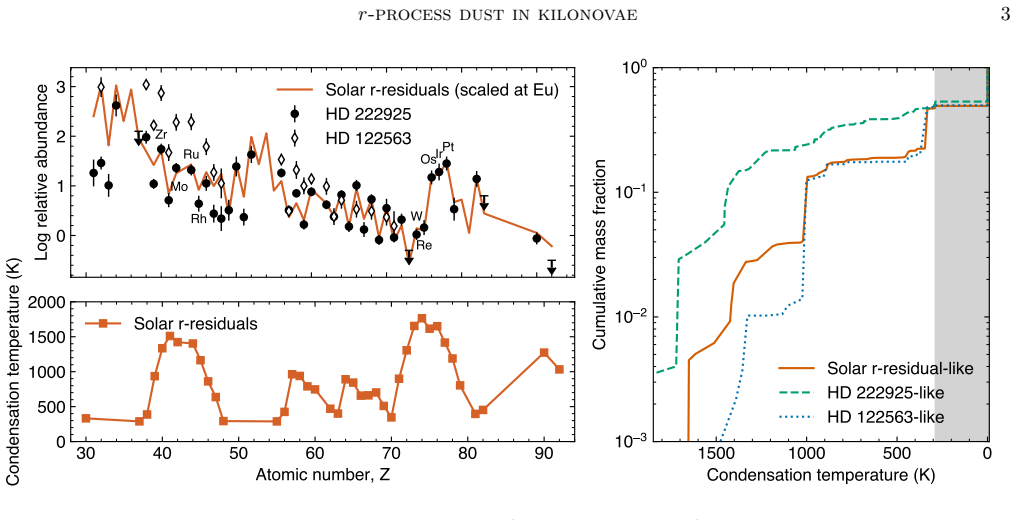
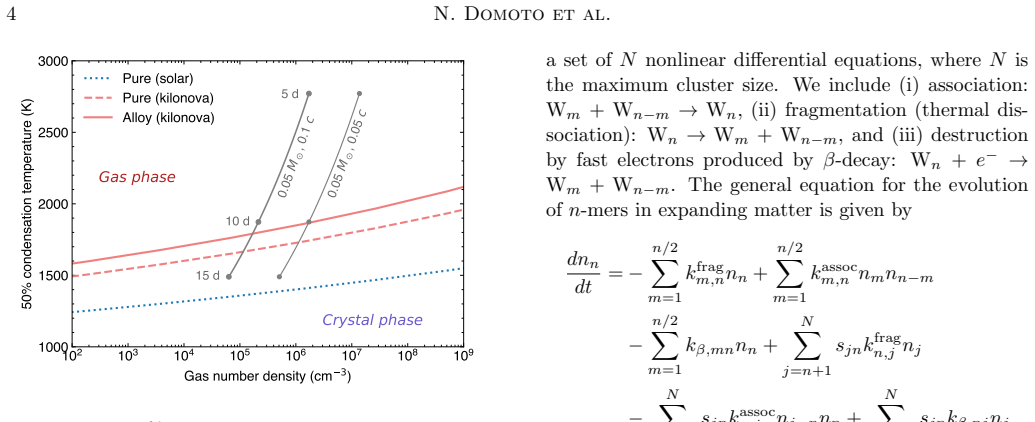
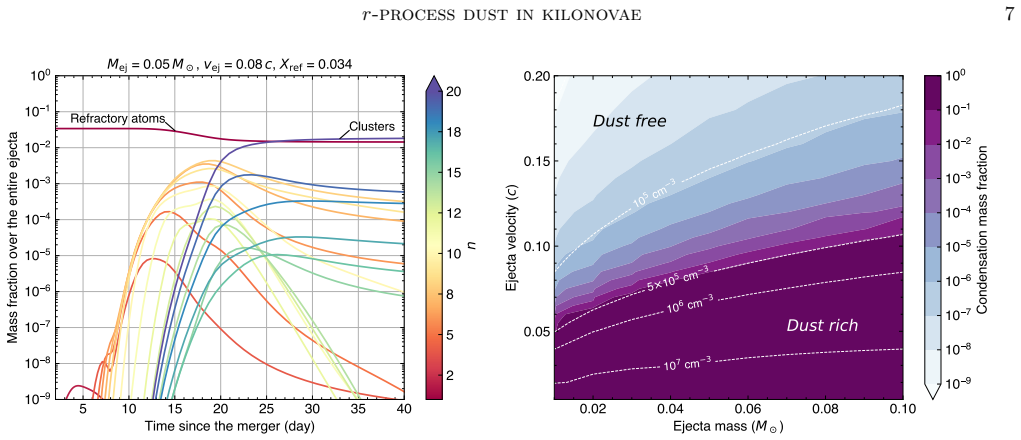
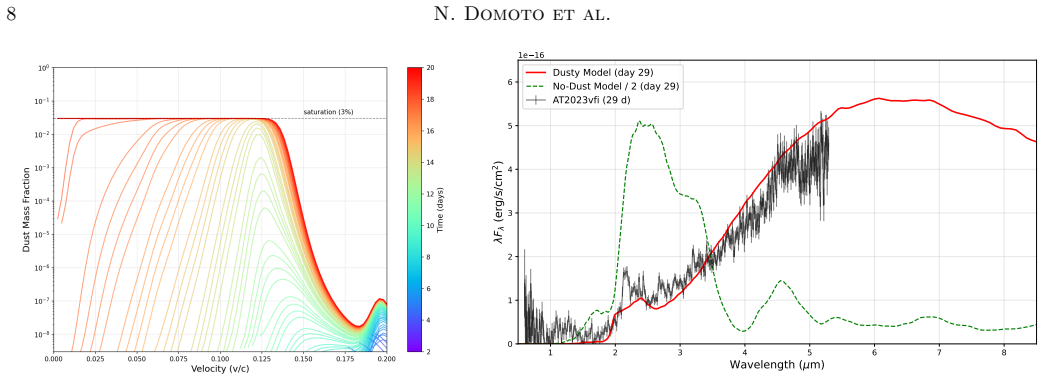
Neutron star mergers are a leading site of $r$-process, producing radioactively powered optical and infrared transients known as kilonovae. Observations of the kilonovae AT2017gfo, associated with the gravitational-wave event GW170817, and AT2023vfi, associated with GRB 230307A, have enabled measurements of the mass of ejected $r$-process material and the identification of heavy elements in the ejecta. However, late-time observations reveal strong infrared emission with temperature below 1000 K, which is difficult to explain by atomic absorption and emission processes alone. In this paper, we show that kilonova ejecta provide conditions favorable for the formation of dust grains composed of refractory $r$-process elements including Zr, W, and Os. We calculate the kinetic formation of dust grains using reaction rate coefficients of W as a proxy, finding that dust forms efficiently, particularly in slow ejecta. This stands in contrast to a previous study that relied on a classical nucleation framework. By performing radiative transfer simulations that incorporate dust formation, we demonstrate that $r$-process dust naturally explains the observed late-time infrared emission. The formation and abundance of $r$-process dust are highly sensitive to the ejecta mass, composition, and expansion velocity. Infrared emission from $r$-process dust can therefore serve a new probe of heavy-element production in neutron star mergers.
Editorial analysis
A structured set of objections, weighed in public.
Referee Report
Summary. The paper claims that kilonova ejecta from neutron star mergers provide conditions for efficient formation of dust grains from refractory r-process elements (Zr, W, Os), calculated via a kinetic model using W reaction rates as proxy; radiative transfer simulations then show this dust accounts for the observed late-time IR emission below 1000 K in events like AT2017gfo and AT2023vfi, in contrast to prior classical nucleation results, with dust abundance sensitive to ejecta mass, composition, and velocity.
Significance. If substantiated, the result supplies a physical mechanism for late-time kilonova spectra that atomic processes alone struggle to explain and introduces IR dust emission as a potential new diagnostic of r-process yields. The approach of coupling kinetic dust formation (with physical rates) to radiative transfer is a methodological strength over purely parametric fits.
major comments (3)
- [Section 3] Section 3 (kinetic model): adoption of W reaction rate coefficients as proxy for Zr/Os chemistry lacks any sensitivity tests or independent rates; if the true rates are lower by even a factor of a few, the grain nucleation timescale lengthens and the resulting dust mass falls below the threshold needed to reproduce the observed <1000 K continuum.
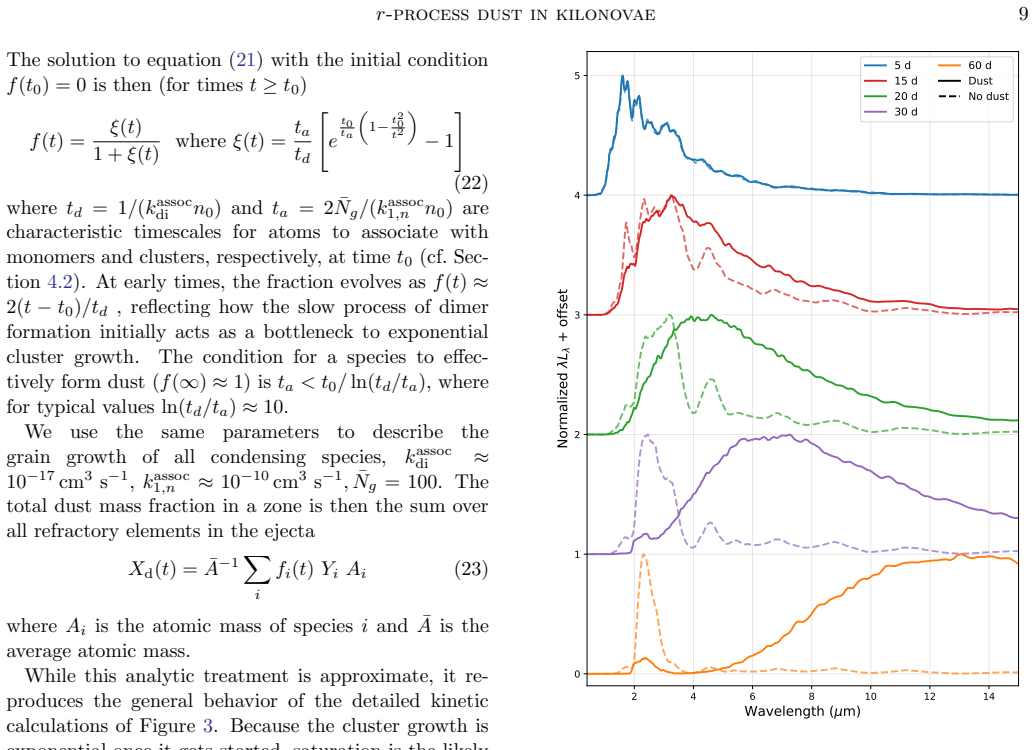
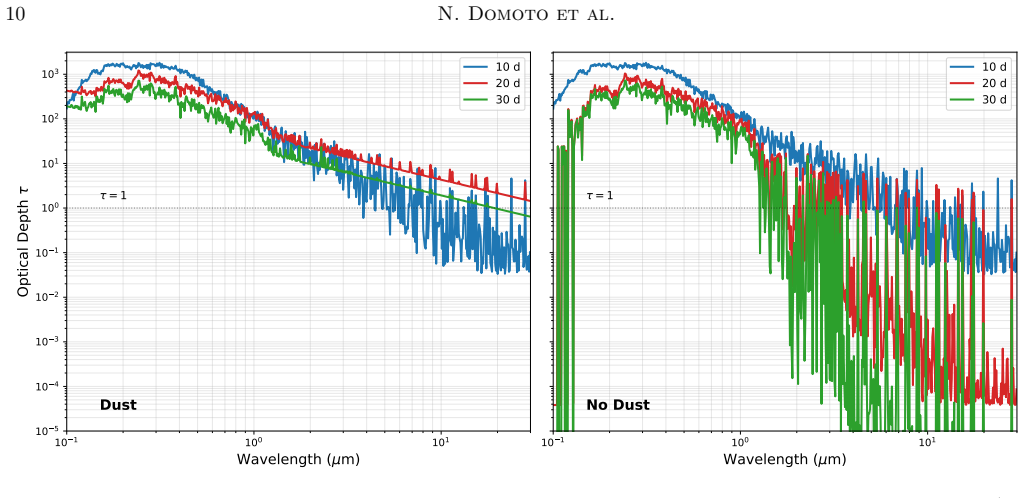
- [Radiative transfer simulations] Radiative transfer section: the manuscript states that simulations 'demonstrate' the dust explains the IR emission, yet supplies no quantitative spectra, flux comparisons, error bars, or validation against the specific late-time data of AT2017gfo or AT2023vfi, leaving the central claim without demonstrated support.
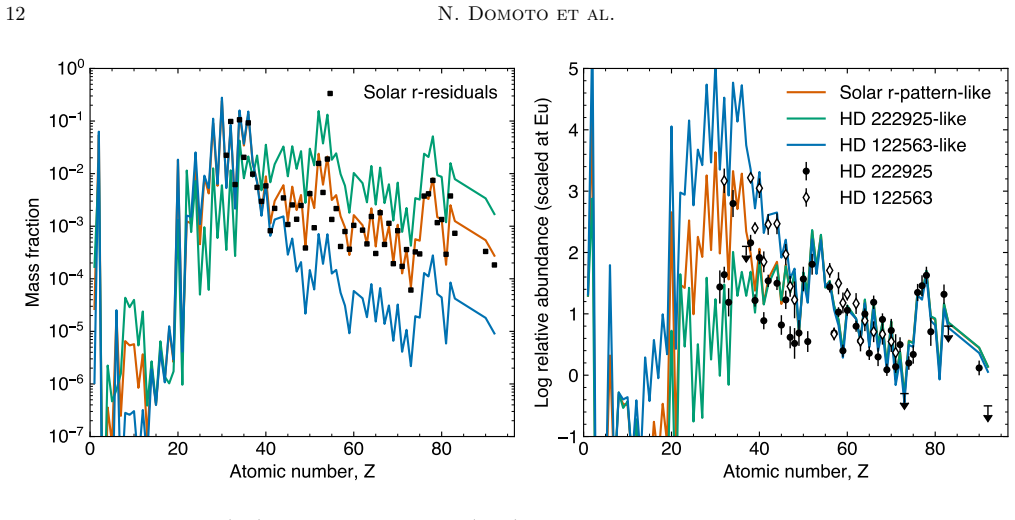
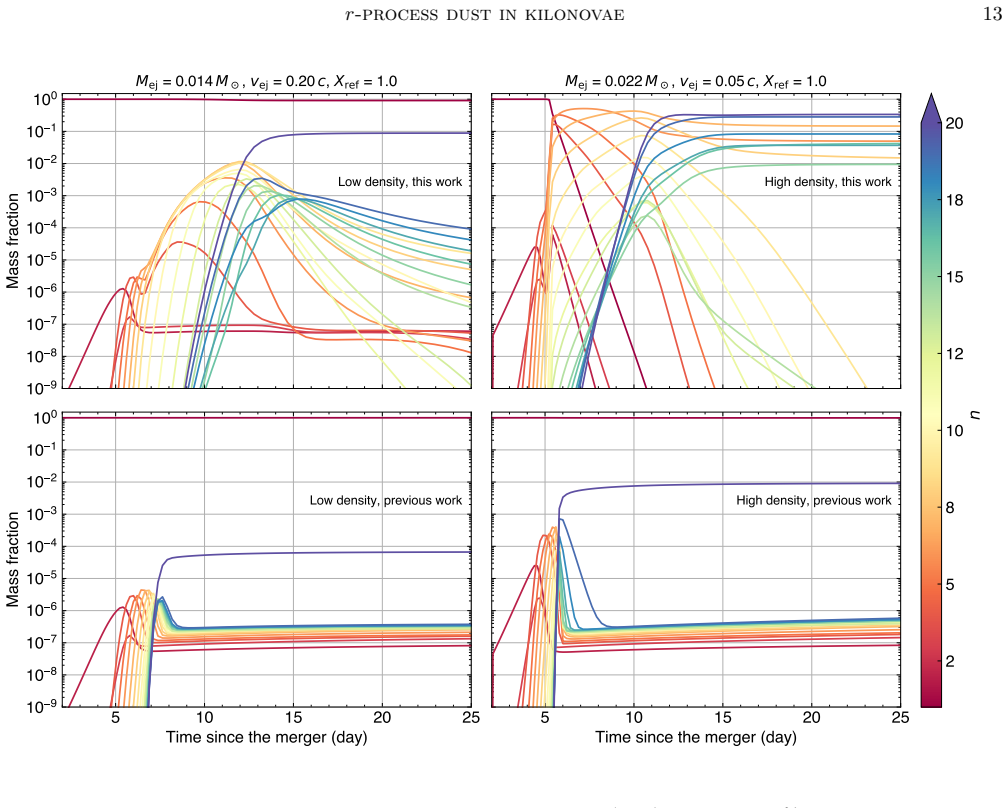
- [Parameter dependence discussion] Parameter study: while the abstract notes high sensitivity to ejecta mass, composition, and expansion velocity, no concrete examples or figures quantify how variations in these free parameters (listed in the axiom ledger) alter dust mass and resulting spectra, weakening the assertion that slow ejecta are particularly favorable.
minor comments (1)
- The abstract and described text outline calculations but do not reference specific figures or tables showing dust mass fractions or temperature evolution; adding these would improve clarity.
Simulated Author's Rebuttal
We thank the referee for their detailed and constructive comments on our manuscript. We address each of the major comments below and outline the revisions we will make to strengthen the paper.
read point-by-point responses
-
Referee: [Section 3] Section 3 (kinetic model): adoption of W reaction rate coefficients as proxy for Zr/Os chemistry lacks any sensitivity tests or independent rates; if the true rates are lower by even a factor of a few, the grain nucleation timescale lengthens and the resulting dust mass falls below the threshold needed to reproduce the observed <1000 K continuum.
Authors: We acknowledge that performing sensitivity tests on the reaction rates would enhance the robustness of our results. In the revised version, we will add a subsection in Section 3 with sensitivity analyses varying the rate coefficients by factors of 0.1 to 10, showing the impact on dust mass and nucleation timescale. We maintain that using W rates as a proxy is justified due to the similar refractory nature and lack of specific rates for Zr and Os, but we agree additional tests are warranted. revision: yes
-
Referee: [Radiative transfer simulations] Radiative transfer section: the manuscript states that simulations 'demonstrate' the dust explains the IR emission, yet supplies no quantitative spectra, flux comparisons, error bars, or validation against the specific late-time data of AT2017gfo or AT2023vfi, leaving the central claim without demonstrated support.
Authors: The current manuscript presents radiative transfer results that support the claim, but we agree that more explicit quantitative comparisons are needed. We will revise the radiative transfer section to include direct comparisons of the simulated spectra with the observed late-time data for both AT2017gfo and AT2023vfi, incorporating flux values, temperature fits, and error considerations where available. revision: yes
-
Referee: [Parameter dependence discussion] Parameter study: while the abstract notes high sensitivity to ejecta mass, composition, and expansion velocity, no concrete examples or figures quantify how variations in these free parameters (listed in the axiom ledger) alter dust mass and resulting spectra, weakening the assertion that slow ejecta are particularly favorable.
Authors: We will expand the discussion of parameter dependence by adding specific numerical examples and new figures that illustrate the effects of varying ejecta mass, composition, and velocity on dust formation and the resulting spectra. This will provide concrete quantification supporting the preference for slow ejecta. revision: yes
Circularity Check
No circularity: forward model from proxy rates and ejecta parameters to spectra
full rationale
The derivation proceeds from external inputs (W proxy reaction rates for dust nucleation, assumed ejecta mass/velocity/composition) through kinetic dust formation and radiative transfer to a demonstration that dust can produce the observed late-time IR continuum. No step equates a claimed prediction to a fit of the target spectra, renames a known result, or reduces the central claim to a self-citation chain. The proxy-rate assumption and lack of sensitivity tests are validity concerns, not circularity by construction. The paper is self-contained against external benchmarks.
Axiom & Free-Parameter Ledger
free parameters (1)
- ejecta mass, composition, and expansion velocity
axioms (1)
- domain assumption Kilonova ejecta provide conditions favorable for formation of dust grains from refractory r-process elements
Reference graph
Works this paper leans on
-
[1]
Abbott, B. P., Abbott, R., Abbott, T. D., et al. 2017a, PhRvL, 119, 161101, doi: 10.1103/PhysRevLett.119.161101
-
[2]
Abbott, B. P., Abbott, R., Abbott, T. D., et al. 2017b, ApJL, 848, L12, doi: 10.3847/2041-8213/aa91c9 r-process dust in kilonovae13 10 9 10 8 10 7 10 6 10 5 10 4 10 3 10 2 10 1 100 Mass fraction Low density, this work Mej = 0.014 M , vej = 0.20 c, Xref = 1.0 High density, this work Mej = 0.022 M , vej = 0.05 c, Xref = 1.0 5 10 15 20 25 Time since the merg...
-
[3]
Alcock, C. B., Itkin, V. P., & Horrigan, M. K. 1984, Canadian Metallurgical Quarterly, 23, 309, doi: 10.1179/cmq.1984.23.3.309
-
[4]
Aleksandrov, N. L., Kindysheva, S. V., & Kochetov, I. V. 2014, Plasma Sources Science Technology, 23, 015017, doi: 10.1088/0963-0252/23/1/015017
-
[5]
Arcavi, I., Hosseinzadeh, G., Howell, D. A., et al. 2017, Nature, 551, 64, doi: 10.1038/nature24291
-
[6]
Arunachalam, P., Macias, P., & Foley, R. J. 2025, arXiv e-prints, arXiv:2510.16121, doi: 10.48550/arXiv.2510.16121
-
[7]
Babb, J. F., Smyth, R. T., & McLaughlin, B. M. 2019, ApJ, 884, 155, doi: 10.3847/1538-4357/ab43cb
-
[8]
2016, ApJ, 829, 110, doi: 10.3847/0004-637X/829/2/110
Barnes, J., Kasen, D., Wu, M.-R., & Mart´ ınez-Pinedo, G. 2016, ApJ, 829, 110, doi: 10.3847/0004-637X/829/2/110
-
[9]
2025, ApJ, 984, 197, doi: 10.3847/1538-4357/adc300
Batziou, E., Glas, R., Janka, H.-T., et al. 2025, ApJ, 984, 197, doi: 10.3847/1538-4357/adc300
-
[10]
2025, arXiv e-prints, arXiv:2508.18364, doi: 10.48550/arXiv.2508.18364
Brethauer, D., Kasen, D., Margutti, R., & Chornock, R. 2025, arXiv e-prints, arXiv:2508.18364, doi: 10.48550/arXiv.2508.18364
-
[11]
Chase, M. W., J. 1998, NIST-JANAF Thermochemical Tables, 4th Edition (American Institute of Physics, -1)
1998
-
[12]
2009, ApJ, 703, 642, doi: 10.1088/0004-637X/703/1/642
Cherchneff, I., & Dwek, E. 2009, ApJ, 703, 642, doi: 10.1088/0004-637X/703/1/642
-
[14]
2010b, ApJ, 713, 1, doi: 10.1088/0004-637X/713/1/1
Cherchneff, I., & Dwek, E. 2010b, ApJ, 713, 1, doi: 10.1088/0004-637X/713/1/1
-
[15]
2008, ApJL, 683, L123, doi: 10.1086/591906 14N
Cherchneff, I., & Lilly, S. 2008, ApJL, 683, L123, doi: 10.1086/591906 14N. Domoto et al
-
[16]
Clayton, D. D., Deneault, E. A. N., & Meyer, B. S. 2001, ApJ, 562, 480, doi: 10.1086/323467
-
[17]
Clayton, D. D., Liu, W., & Dalgarno, A. 1999, Science, 283, 1290, doi: 10.1126/science.283.5406.1290
-
[18]
Coulter, D. A., Foley, R. J., Kilpatrick, C. D., et al. 2017, Science, 358, 1556, doi: 10.1126/science.aap9811
-
[19]
Cowan, J. J., Sneden, C., Beers, T. C., et al. 2005, ApJ, 627, 238, doi: 10.1086/429952
-
[20]
2022, ApJ, 939, 8, doi: 10.3847/1538-4357/ac8c36
Domoto, N., Tanaka, M., Kato, D., et al. 2022, ApJ, 939, 8, doi: 10.3847/1538-4357/ac8c36
-
[21]
2021, ApJ, 913, 26, doi: 10.3847/1538-4357/abf358
Domoto, N., Tanaka, M., Wanajo, S., & Kawaguchi, K. 2021, ApJ, 913, 26, doi: 10.3847/1538-4357/abf358
-
[22]
Draine, B. T. 1979, Ap&SS, 65, 313, doi: 10.1007/BF00648499
-
[23]
Eichler, D., Livio, M., Piran, T., & Schramm, D. N. 1989, Nature, 340, 126, doi: 10.1038/340126a0
-
[24]
Evans, P. A., Cenko, S. B., Kennea, J. A., et al. 2017, Science, 358, 1565, doi: 10.1126/science.aap9580 Fl¨ ors, A., da Silva, R. F., Marques, J. P., Sampaio, J. M., & Mart´ ınez-Pinedo, G. 2026, PhRvD, 113, 063041, doi: 10.1103/jxqw-7ynk
-
[25]
Fontes, C. J., Fryer, C. L., Hungerford, A. L., Wollaeger, R. T., & Korobkin, O. 2020, MNRAS, 493, 4143, doi: 10.1093/mnras/staa485
-
[26]
Freiburghaus, C., Rosswog, S., & Thielemann, F. K. 1999, ApJL, 525, L121, doi: 10.1086/312343
-
[27]
Gall, C., Hjorth, J., Rosswog, S., Tanvir, N. R., & Levan, A. J. 2017, ApJL, 849, L19, doi: 10.3847/2041-8213/aa93f9
-
[28]
Gillanders, J. H., & Smartt, S. J. 2025, MNRAS, 538, 1663, doi: 10.1093/mnras/staf287
-
[29]
2011, ApJL, 738, L32, doi: 10.1088/2041-8205/738/2/L32
Goriely, S., Bauswein, A., & Janka, H.-T. 2011, ApJL, 738, L32, doi: 10.1088/2041-8205/738/2/L32
-
[30]
Baluja, K. L. 2022a, European Physical Journal D, 76, 97, doi: 10.1140/epjd/s10053-022-00425-3
-
[31]
Goswami, K., Luthra, M., Bharadvaja, A., & Baluja, K. L. 2022b, Atoms, 10, 101, doi: 10.3390/atoms10040101
-
[32]
Goumans, T. P. M., & Bromley, S. T. 2012, MNRAS, 420, 3344, doi: 10.1111/j.1365-2966.2011.20255.x
-
[33]
2024, MNRAS, 533, 994, doi: 10.1093/mnras/stae1795
Guttman, O., Shenhar, B., Sarkar, A., & Waxman, E. 2024, MNRAS, 533, 994, doi: 10.1093/mnras/stae1795
-
[34]
Honda, S., Aoki, W., Ishimaru, Y., Wanajo, S., & Ryan, S. G. 2006, ApJ, 643, 1180, doi: 10.1086/503195
-
[35]
2020, ApJ, 891, 152, doi: 10.3847/1538-4357/ab6a98
Hotokezaka, K., & Nakar, E. 2020, ApJ, 891, 152, doi: 10.3847/1538-4357/ab6a98
-
[36]
2021, MNRAS, 506, 5863, doi: 10.1093/mnras/stab1975
Hotokezaka, K., Tanaka, M., Kato, D., & Gaigalas, G. 2021, MNRAS, 506, 5863, doi: 10.1093/mnras/stab1975
-
[37]
2023, MNRAS, 526, L155, doi: 10.1093/mnrasl/slad128
Hotokezaka, K., Tanaka, M., Kato, D., & Gaigalas, G. 2023, MNRAS, 526, L155, doi: 10.1093/mnrasl/slad128
-
[38]
2016, MNRAS, 459, 35, doi: 10.1093/mnras/stw404
Hotokezaka, K., Wanajo, S., Tanaka, M., et al. 2016, MNRAS, 459, 35, doi: 10.1093/mnras/stw404
-
[39]
2023, A&A, 672, A25, doi: 10.1051/0004-6361/202245326
Hou, Z., Qin, Z., & Liu, L. 2023, A&A, 672, A25, doi: 10.1051/0004-6361/202245326
-
[40]
E., Mauracher, A., S¨ uß, D., et al
Huber, S. E., Mauracher, A., S¨ uß, D., et al. 2019, The Journal of Chemical Physics, 150, doi: 10.1063/1.5063767 Jacobson-Gal´ an, W. V., Dessart, L., Kilpatrick, C. D., et al. 2025, ApJL, 994, L14, doi: 10.3847/2041-8213/ae157a
-
[41]
2025, arXiv e-prints, arXiv:2510.12410, doi: 10.48550/arXiv.2510.12410
Jerkstrand, A., Pognan, Q., Banerjee, S., et al. 2025, arXiv e-prints, arXiv:2510.12410, doi: 10.48550/arXiv.2510.12410
-
[42]
2022, Annual Review of Physical Chemistry, 73, 453, doi: 10.1146/annurev-physchem-082720-100947
Jun, Y.-S., Zhu, Y., Wang, Y., et al. 2022, Annual Review of Physical Chemistry, 73, 453, doi: 10.1146/annurev-physchem-082720-100947
-
[43]
2022, MNRAS, 509, 1377, doi: 10.1093/mnras/stab2861
Bauswein, A. 2022, MNRAS, 509, 1377, doi: 10.1093/mnras/stab2861
-
[44]
Kasen, D., Badnell, N. R., & Barnes, J. 2013, ApJ, 774, 25, doi: 10.1088/0004-637X/774/1/25
-
[45]
2017, , 551, 80, 10.1038/nature24453
Ramirez-Ruiz, E. 2017, Nature, 551, 80, doi: 10.1038/nature24453
-
[46]
Kasen, D., Thomas, R. C., & Nugent, P. 2006, ApJ, 651, 366, doi: 10.1086/506190
-
[47]
Kasliwal, M. M., Nakar, E., Singer, L. P., et al. 2017, Science, 358, 1559, doi: 10.1126/science.aap9455
-
[48]
Kasliwal, M. M., Kasen, D., Lau, R. M., et al. 2022, MNRAS, 510, L7, doi: 10.1093/mnrasl/slz007
-
[49]
2018, ApJL, 865, L21, doi: 10.3847/2041-8213/aade02
Kawaguchi, K., Shibata, M., & Tanaka, M. 2018, ApJL, 865, L21, doi: 10.3847/2041-8213/aade02
-
[50]
2012, , 427, 127, 10.1111/j.1365-2966.2012.21948.x
Korobkin, O., Rosswog, S., Arcones, A., & Winteler, C. 2012, MNRAS, 426, 1940, doi: 10.1111/j.1365-2966.2012.21859.x
-
[51]
Kotak, R., Meikle, W. P. S., Farrah, D., et al. 2009, ApJ, 704, 306, doi: 10.1088/0004-637X/704/1/306
-
[52]
Lattimer, J. M., & Schramm, D. N. 1974, ApJL, 192, L145, doi: 10.1086/181612
-
[53]
2016, ApJ, 817, 134, doi: 10.3847/0004-637X/817/2/134
Lazzati, D., & Heger, A. 2016, ApJ, 817, 134, doi: 10.3847/0004-637X/817/2/134
-
[54]
Levan, A. J., Gompertz, B. P., Salafia, O. S., et al. 2024, Nature, 626, 737, doi: 10.1038/s41586-023-06759-1
-
[55]
1998, ApJL, 507, L59, doi: 10.1086/311680
Li, L.-X., & Paczy´ nski, B. 1998, ApJL, 507, L59, doi: 10.1086/311680
-
[56]
Li, Z. H., & Truhlar, D. G. 2008, Journal of Physical Chemistry C, 112, 11109, doi: 10.1021/jp711349v
-
[57]
2003, ApJ, 591, 1220, doi: 10.1086/375492
Lodders, K. 2003, ApJ, 591, 1220, doi: 10.1086/375492
-
[58]
Lodders, K., Palme, H., & Gail, H. P. 2009, Landolt B¨ ornstein, 4B, 712, doi: 10.1007/978-3-540-88055-434
-
[59]
Lu, W., & Quataert, E. 2023, MNRAS, 522, 5848, doi: 10.1093/mnras/stad1336 r-process dust in kilonovae15 Mat´ uˇ ska, J., Sukuba, I., & Urban, J. 2019, Journal of Molecular Modeling, 25, doi: 10.1007/s00894-019-4072-x
-
[60]
2025, ApJ, 993, 191, doi: 10.3847/1538-4357/ae0736
Medler, K., Ashall, C., Hoeflich, P., et al. 2025, ApJ, 993, 191, doi: 10.3847/1538-4357/ae0736
-
[61]
Meikle, W. P. S., Kotak, R., Farrah, D., et al. 2011, ApJ, 732, 109, doi: 10.1088/0004-637X/732/2/109
-
[62]
The base models and a new line index system
Metzger, B. D., Mart´ ınez-Pinedo, G., Darbha, S., et al. 2010, MNRAS, 406, 2650, doi: 10.1111/j.1365-2966.2010.16864.x
-
[63]
Meyer, B. S. 1989, ApJ, 343, 254, doi: 10.1086/167702
-
[64]
Miller, J. M., Sprouse, T. M., Fryer, C. L., et al. 2020, ApJ, 902, 66, doi: 10.3847/1538-4357/abb4e3 M¨ osta, P., Roberts, L. F., Halevi, G., et al. 2018, ApJ, 864, 171, doi: 10.3847/1538-4357/aad6ec
-
[65]
Sneppen, A., & Sim, S. A. 2026, MNRAS, 546, stag237, doi: 10.1093/mnras/stag237
-
[66]
2017, ApJL, 836, L21, doi: 10.3847/2041-8213/aa5dee
Thielemann, F.-K. 2017, ApJL, 836, L21, doi: 10.3847/2041-8213/aa5dee
-
[67]
2003, ApJ, 598, 785, doi: 10.1086/379011
Nozawa, T., Kozasa, T., Umeda, H., Maeda, K., & Nomoto, K. 2003, ApJ, 598, 785, doi: 10.1086/379011
-
[68]
1976, Earth and Planetary Science Letters, 33, 45, doi: 10.1016/0012-821X(76)90156-4
Palme, H., & Wlotzka, F. 1976, Earth and Planetary Science Letters, 33, 45, doi: 10.1016/0012-821X(76)90156-4
-
[69]
2017, ApJL, 850, L37, doi: 10.3847/2041-8213/aa9ab9
Perego, A., Radice, D., & Bernuzzi, S. 2017, ApJL, 850, L37, doi: 10.3847/2041-8213/aa9ab9
-
[70]
2017, Nature, 551, 67, doi: 10.1038/nature24298
Pian, E., D’Avanzo, P., Benetti, S., et al. 2017, Nature, 551, 67, doi: 10.1038/nature24298
-
[71]
Collapse of Magnetized White Dwarfs as site of Heavy Element Formation and Kilonova Signal
Pitik, T., Radice, D., Kasen, D., et al. 2026, arXiv e-prints, arXiv:2602.21291, doi: 10.48550/arXiv.2602.21291
work page internal anchor Pith review Pith/arXiv arXiv doi:10.48550/arxiv.2602.21291 2026
-
[72]
2022, MNRAS, 510, 3806, doi: 10.1093/mnras/stab3674
Pognan, Q., Jerkstrand, A., & Grumer, J. 2022, MNRAS, 510, 3806, doi: 10.1093/mnras/stab3674
-
[73]
2026, MNRAS, 547, stag441, doi: 10.1093/mnras/stag441
Pognan, Q., Kawaguchi, K., Wanajo, S., et al. 2026, MNRAS, 547, stag441, doi: 10.1093/mnras/stag441
-
[74]
2020, , 491, 1832, 10.1093/mnras/stz3154
Prantzos, N., Abia, C., Cristallo, S., Limongi, M., & Chieffi, A. 2020, MNRAS, 491, 1832, doi: 10.1093/mnras/stz3154
-
[75]
Reichert, M., Obergaulinger, M., Eichler, M., Aloy, M. ´A., & Arcones, A. 2021, MNRAS, 501, 5733, doi: 10.1093/mnras/stab029
-
[76]
Roberts, L. F., Kasen, D., Lee, W. H., & Ramirez-Ruiz, E. 2011, ApJL, 736, L21, doi: 10.1088/2041-8205/736/1/L21
-
[77]
Roederer, I. U., Lawler, J. E., Sobeck, J. S., et al. 2012, ApJS, 203, 27, doi: 10.1088/0067-0049/203/2/27
-
[78]
Roederer, I. U., Lawler, J. E., Den Hartog, E. A., et al. 2022, ApJS, 260, 27, doi: 10.3847/1538-4365/ac5cbc
-
[79]
2018, A&A, 615, A132, doi: 10.1051/0004-6361/201732117
Rosswog, S., Sollerman, J., Feindt, U., et al. 2018, A&A, 615, A132, doi: 10.1051/0004-6361/201732117
-
[80]
2013, ApJ, 776, 107, doi: 10.1088/0004-637X/776/2/107
Sarangi, A., & Cherchneff, I. 2013, ApJ, 776, 107, doi: 10.1088/0004-637X/776/2/107
-
[81]
2017, PhRvD, 96, 123012, doi: 10.1103/PhysRevD.96.123012
Shibata, M., Fujibayashi, S., Hotokezaka, K., et al. 2017, PhRvD, 96, 123012, doi: 10.1103/PhysRevD.96.123012
discussion (0)
Sign in with ORCID, Apple, or X to comment. Anyone can read and Pith papers without signing in.