Synthesizing Compound Pulse Gadgets for Hamiltonian Simulation on Trapped-Ion Platforms
Pith reviewed 2026-07-02 12:15 UTC · model grok-4.3
The pith
Holistic GRAPE synthesis creates compound pulse gadgets that compress QSVT schedules for H2 Hamiltonian simulation on trapped ions.
A machine-rendered reading of the paper's core claim, the machinery that carries it, and where it could break.
Core claim
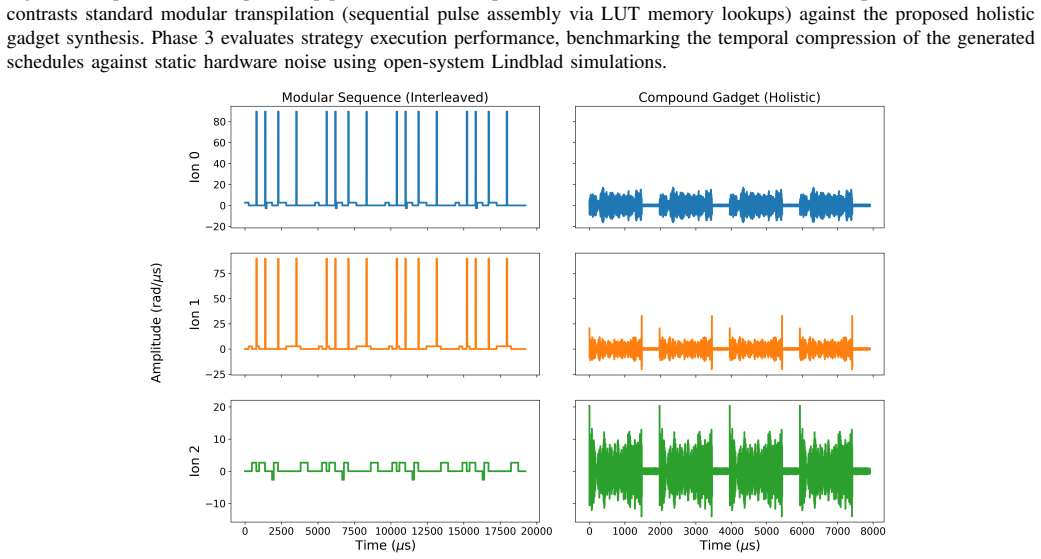
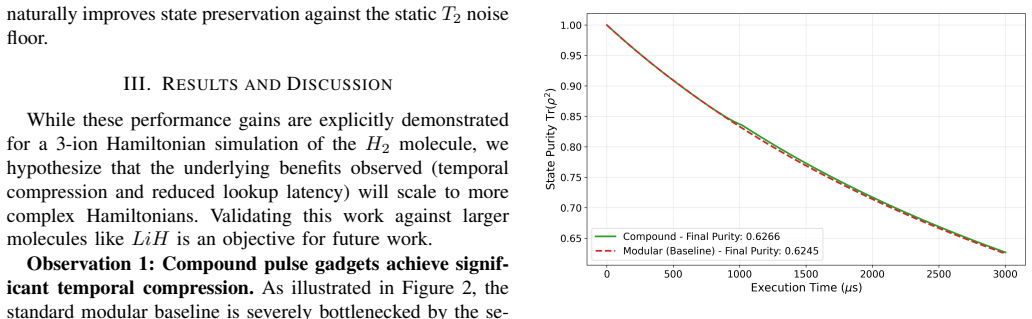
By compiling the full QSVT circuit for approximating U = e^{-i H t} directly into GRAPE-optimized compound pulse gadgets rather than stitching discrete gates, the total pulse schedule duration is reduced and control-layer latency from pulse lookup is eliminated, as observed in noisy master-equation simulations of the three-ion H2 simulation.
What carries the argument
Compound pulse gadgets: continuous laser-pulse sequences generated by the GRAPE algorithm that implement entire algorithmic blocks without intermediate gate decompositions or discrete pulse lookups.
If this is right
- Total pulse schedule duration drops compared with standard compilers that use discrete gate stitching.
- Control-layer latency from discrete pulse lookup tables is removed.
- Operations finish faster, allowing greater circuit depth before T2 decoherence sets in.
- The same holistic synthesis applies to other high-precision algorithms such as QSVT on near-term ion traps.
Where Pith is reading between the lines
- Pulse-level compilation may become preferable to gate-level transpilation once hardware calibration supports it.
- The method could extend to other trapped-ion algorithms that currently suffer from pulse fragmentation.
- Real-device validation would need to include additional error sources such as laser intensity fluctuations not captured in the master equation.
- Combining these gadgets with dynamical decoupling sequences might further extend effective coherence.
Load-bearing premise
GRAPE-optimized compound gadgets will maintain the target fidelity on real hardware when tested only in Lindblad simulations that omit unmodeled control errors and calibration drifts.
What would settle it
Execute the synthesized compound gadgets on physical trapped-ion hardware, measure achieved fidelity and total runtime, and compare both quantities against the Lindblad predictions and against standard gate-based compilation of the same circuit.
Figures

read the original abstract
Standard gate-level transpilation introduces significant physical noise and overhead for high-precision quantum algorithms, such as the Quantum Singular Value Transformation (QSVT), on near-term trapped-ion hardware. Current compilers treat quantum operations as discrete units, forcing the physical control layer to execute highly fragmented laser pulses. To address this hardware-software disconnect, this work introduces a holistic pulse synthesis strategy that bypasses discrete gate-stitching to compile algorithms directly into continuous compound pulse gadgets. As a proof-of-concept, we target Hamiltonian simulation of the $H_2$ molecule, block-encoding the problem into a QSVT circuit to approximate the time-evolution operator $U = e^{-i H t}$ across 3 computational ions (2 system, 1 ancilla). We utilize the Gradient Ascent Pulse Engineering (GRAPE) algorithm to generate these compound gadgets and evaluate our methodology using noisy Lindblad master equation simulations. Preliminary observations indicate that the proposed strategy achieves significant temporal compression, reducing the total pulse schedule duration compared to standard compilers. Furthermore, synthesizing operations holistically eliminates the control-layer latency associated with discrete pulse lookup overhead. By streamlining the physical control schedule, this methodology offers a promising pathway to execute operations faster, highlighting the potential for compound gadgets to increase the computational depth achievable within fundamental $T_2$ decoherence limits.
Editorial analysis
A structured set of objections, weighed in public.
Referee Report
Summary. The manuscript proposes a holistic pulse synthesis strategy using the GRAPE algorithm to generate compound pulse gadgets that compile QSVT block-encodings of H2 Hamiltonian simulation directly into continuous waveforms on a 3-ion trapped-ion platform (2 system + 1 ancilla), bypassing discrete gate-stitching. It claims this yields significant temporal compression of the total pulse schedule relative to standard compilers while preserving the target unitary, with evaluation performed via noisy Lindblad master-equation simulations; the approach is also said to eliminate control-layer latency from discrete pulse lookup overhead.
Significance. If the claimed duration reductions can be shown quantitatively while maintaining high fidelity, the method would address a genuine hardware-software mismatch in trapped-ion control and could increase achievable circuit depth within T2 limits. The use of GRAPE for end-to-end gadget synthesis is a conceptually coherent strength, but the absence of supporting numerical results currently limits the demonstrated impact.
major comments (2)
- [Abstract] Abstract: the central claim that the strategy 'achieves significant temporal compression, reducing the total pulse schedule duration compared to standard compilers' is unsupported by any quantitative data (durations, ratios, fidelity values, or error bars) from the Lindblad simulations; this absence is load-bearing for the primary contribution.
- [Abstract] Abstract and evaluation description: no baseline pulse schedules from standard compilers, no comparison metrics, and no details on the Lindblad noise model parameters or simulation settings are provided, preventing verification that the GRAPE gadgets outperform gate-stitching while preserving the intended unitary.
minor comments (1)
- [Abstract] Abstract: the phrase 'preliminary observations' should be replaced or supplemented by explicit statements of what was observed once quantitative results are added.
Simulated Author's Rebuttal
We thank the referee for the detailed review and constructive feedback on our manuscript. The comments highlight the need for quantitative support of our claims, which we address below by committing to specific additions in the revised version. We believe these changes will strengthen the presentation of our GRAPE-based holistic synthesis approach for QSVT Hamiltonian simulation on trapped ions.
read point-by-point responses
-
Referee: [Abstract] Abstract: the central claim that the strategy 'achieves significant temporal compression, reducing the total pulse schedule duration compared to standard compilers' is unsupported by any quantitative data (durations, ratios, fidelity values, or error bars) from the Lindblad simulations; this absence is load-bearing for the primary contribution.
Authors: We agree that the abstract's claim requires quantitative backing from the simulations to be substantiated. In the revised manuscript, we will expand the abstract (and main text) to report specific metrics from the Lindblad master-equation simulations, including pulse schedule durations for the GRAPE gadgets versus gate-based baselines, compression ratios, achieved fidelities, and associated error bars or statistical details. This will directly support the temporal compression result while preserving the target unitary. revision: yes
-
Referee: [Abstract] Abstract and evaluation description: no baseline pulse schedules from standard compilers, no comparison metrics, and no details on the Lindblad noise model parameters or simulation settings are provided, preventing verification that the GRAPE gadgets outperform gate-stitching while preserving the intended unitary.
Authors: The referee correctly identifies that the current manuscript lacks explicit baselines, metrics, and simulation parameters. We will revise the evaluation section and abstract to include: (i) explicit baseline pulse schedules generated by standard compilers, (ii) direct comparison metrics (e.g., total duration, fidelity to the ideal QSVT unitary), and (iii) full specification of the Lindblad noise model (decoherence rates, Lindblad operators) along with simulation settings (time-stepping, integration method, initial states). These additions will enable independent verification that the compound gadgets outperform gate-stitching. revision: yes
Circularity Check
No circularity; method uses independent GRAPE optimization and Lindblad simulation
full rationale
The paper's core workflow applies the standard GRAPE algorithm to synthesize compound pulses for a QSVT block-encoding of H2 evolution and evaluates the resulting schedule duration via Lindblad master-equation simulations. Neither step is defined in terms of the claimed temporal compression, nor does any result reduce by construction to a fitted parameter or self-citation. The abstract and described methodology contain no load-bearing self-citations, uniqueness theorems, or ansatzes imported from prior author work. The reported observations are therefore outputs of externally defined numerical procedures rather than tautological restatements of the inputs.
Axiom & Free-Parameter Ledger
Reference graph
Works this paper leans on
-
[1]
A. Gily ´en, Y . Su, G. H. Low, and N. Wiebe, “Quantum singular value transformation and beyond: Exponential im- provements for quantum matrix arithmetics,” inProceedings of the 51st Annual ACM SIGACT Symposium on Theory of Computing, ser. STOC 2019, New York, NY , USA: Associa- tion for Computing Machinery, Jun. 2019, pp. 193–204.DOI: 10.1145/3313276.3316366
-
[2]
Grand Unification of Quantum Algorithms,
J. M. Martyn, Z. M. Rossi, A. K. Tan, and I. L. Chuang, “Grand Unification of Quantum Algorithms,”PRX Quan- tum, vol. 2, no. 4, p. 040 203, Dec. 2021.DOI: 10 . 1103 / PRXQuantum.2.040203
work page 2021
-
[3]
Optimal Hamiltonian Simulation by Quantum Signal Processing,
G. H. Low and I. L. Chuang, “Optimal Hamiltonian Simulation by Quantum Signal Processing,”Physical Review Letters, vol. 118, no. 1, p. 010 501, Jan. 2017.DOI: 10 . 1103 / PhysRevLett.118.010501
work page 2017
-
[4]
K. J. Joven, E. R. Das, J. Bierman, A. Majumdar, M. H. Heris, and Y . Liu, “Scalable quantum computational science: A perspective from block-encodings and polynomial transforma- tions,”APL Computational Physics, vol. 2, no. 1, p. 010 901, Mar. 2026.DOI: 10.1063/5.0312254
-
[5]
K. Toyoizumi, N. Yamamoto, and K. Hoshino, “Hamilto- nian simulation using the quantum singular-value transforma- tion: Complexity analysis and application to the linearized Vlasov-Poisson equation,”Physical Review A, vol. 109, no. 1, p. 012 430, Jan. 2024.DOI: 10.1103/PhysRevA.109.012430
-
[6]
Generalized Quantum Signal Processing,
D. Motlagh and N. Wiebe, “Generalized Quantum Signal Processing,”PRX Quantum, vol. 5, no. 2, p. 020 368, Jun. 2024.DOI: 10.1103/PRXQuantum.5.020368
-
[7]
E. Younis, C. C. Iancu, W. Lavrijsen, M. Davis, and E. Smith, Berkeley quantum synthesis toolkit (bqskit) v1, [Computer Software] https : / / doi . org / 10 . 11578 / dc . 20210603 . 2, Apr. 2021.DOI: 10.11578/dc.20210603.2
-
[8]
Batch optimization of frequency-modulated pulses for robust two- qubit gates in ion chains,
M. Kang, Q. Qiao, Y . Wang, C. Noel, and K. R. Brown, “Batch optimization of frequency-modulated pulses for robust two- qubit gates in ion chains,”Physical Review Applied, vol. 16, no. 2, p. 024 039, 2021.DOI: 10.1103/PhysRevApplied.16. 024039
-
[9]
A. S. Dalvi, L. Riesebos, J. Whitlow, and K. R. Brown,Graph- Based Pulse Representation for Diverse Quantum Control Hardware, Sep. 2024.DOI: 10.48550/arXiv.2409.08407
-
[10]
N. Khaneja, T. Reiss, C. Kehlet, T. Schulte-Herbr ¨uggen, and S. J. Glaser, “Optimal control of coupled spin dynamics: De- sign of NMR pulse sequences by gradient ascent algorithms,” Journal of Magnetic Resonance, vol. 172, no. 2, pp. 296–305, Feb. 2005.DOI: 10.1016/j.jmr.2004.11.004
-
[11]
Recent developments in the pyscf program package,
Q. Sun et al., “Recent developments in the pyscf program package,”The Journal of Chemical Physics, vol. 153, no. 2, p. 024 109, 2020.DOI: 10.1063/5.0006074
-
[12]
A. Javadi-Abhari et al.,Quantum computing with Qiskit, 2024. DOI: 10.48550/arXiv.2405.08810
work page internal anchor Pith review Pith/arXiv arXiv doi:10.48550/arxiv.2405.08810 2024
-
[13]
Duke Quantum Center,[Pulse Design and Simulation - MS Gate], Private repository, unpublished software, 2025
work page 2025
-
[14]
A graph-based recovery and decomposition of Swanson’ s hypothesis using semantic predications
N. Lambert et al., “Qutip 5: The quantum toolbox in Python,” Physics Reports, vol. 1153, pp. 1–62, 2026.DOI: 10.1016/j. physrep.2025.10.001
work page doi:10.1016/j 2026
-
[15]
Pulse-level noisy quantum circuits with QuTiP,
B. Li et al., “Pulse-level noisy quantum circuits with QuTiP,” Quantum, vol. 6, p. 630, Jan. 2022.DOI: 10.22331/q-2022- 01-24-630
discussion (0)
Sign in with ORCID, Apple, or X to comment. Anyone can read and Pith papers without signing in.