Horizon-scale intensity and polarization images of rotating Konoplya-Zhidenko black holes with thick accretion flows
Pith reviewed 2026-07-02 08:23 UTC · model grok-4.3
The pith
Thick accretion flows around rotating non-Kerr black holes produce distinct intensity and polarization image features.
A machine-rendered reading of the paper's core claim, the machinery that carries it, and where it could break.
Core claim
The thick disk model produces features in both intensity and polarization images that differ markedly from those in thin disk models. Within the framework used in this work, the observed intensity and polarization signatures can serve as effective probes of the underlying spacetime geometry and near horizon accretion dynamics.
What carries the argument
Analytical ballistic approximation accretion flow model for the Konoplya-Zhidenko rotating black hole spacetime with deformation parameter η.
If this is right
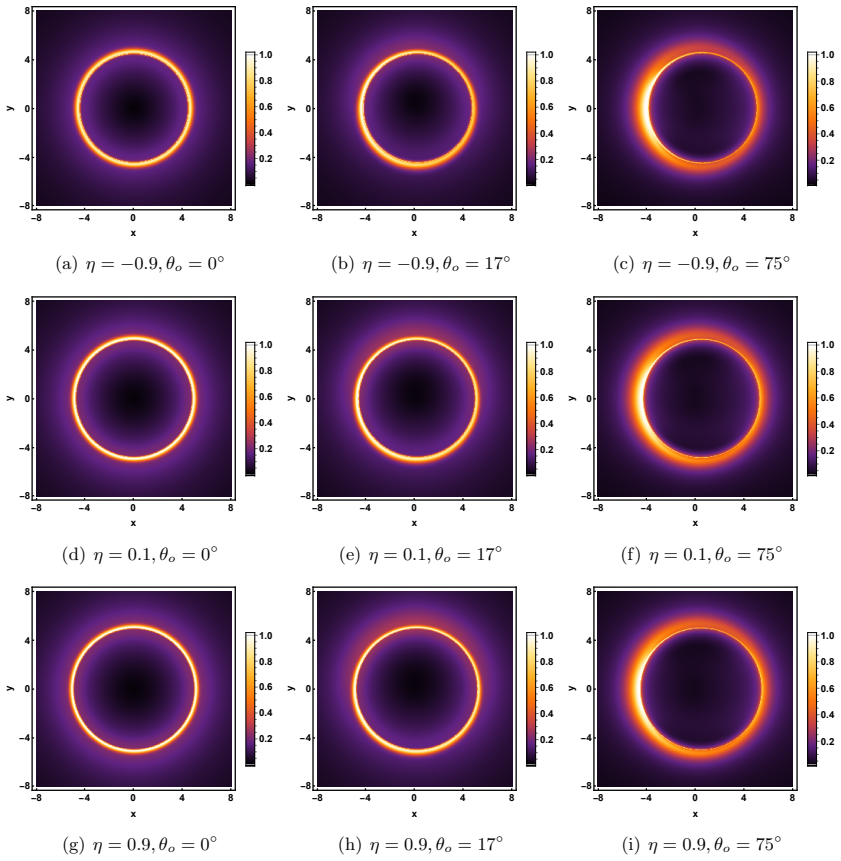
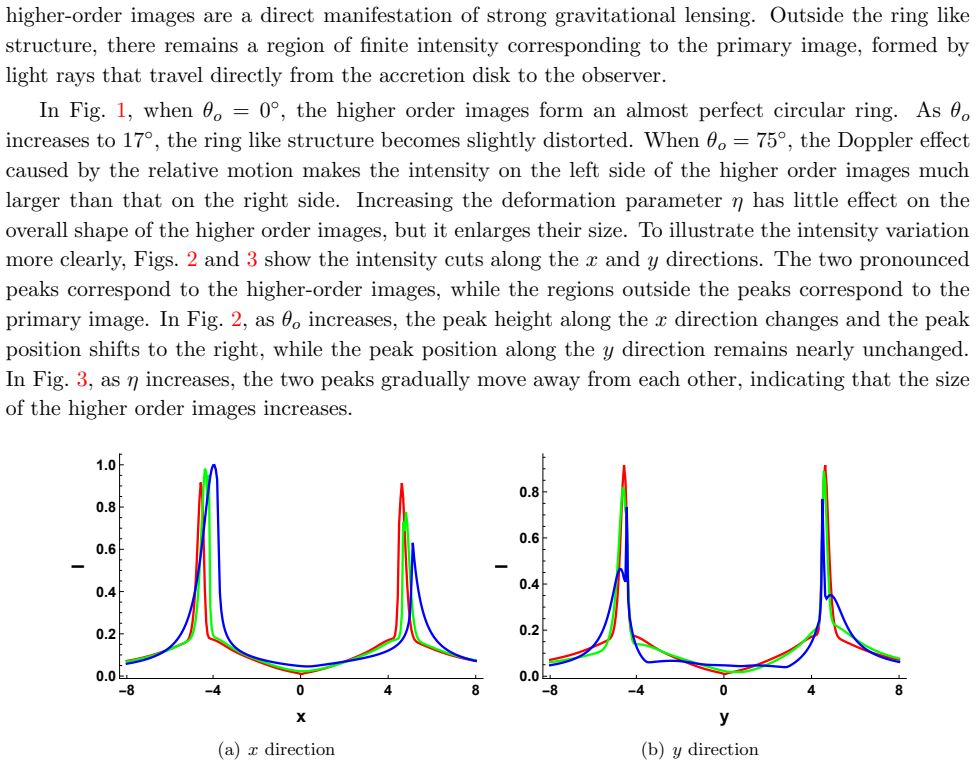
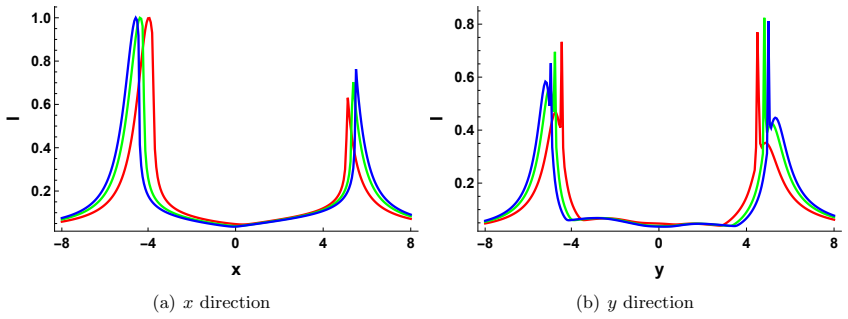
- Increasing the deformation parameter η enlarges the size of higher order images without significantly changing their shape.
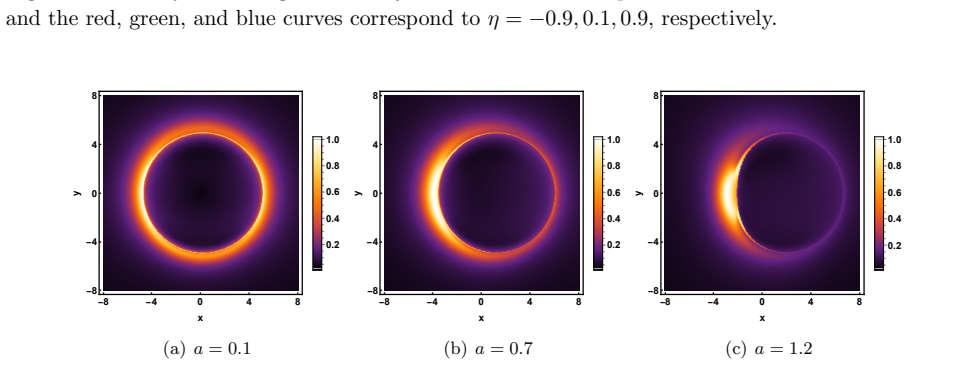
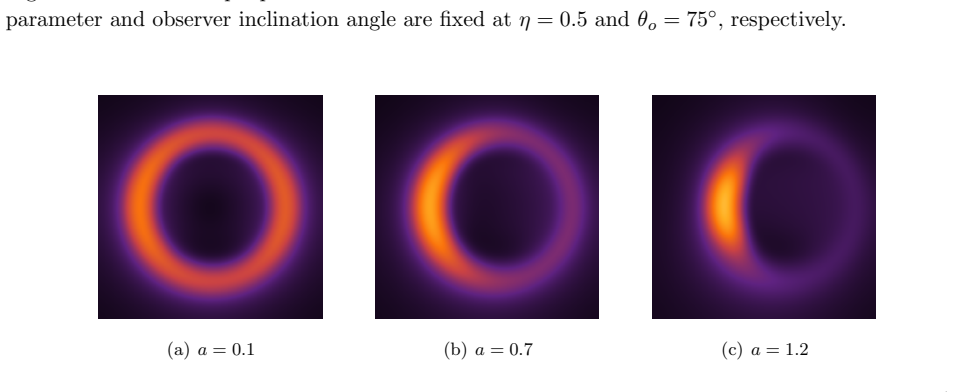
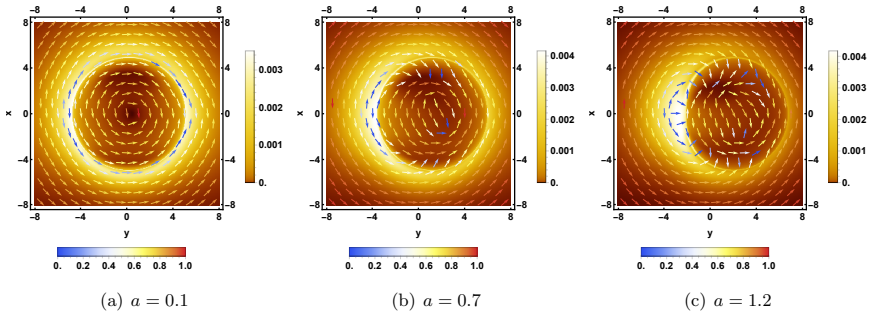
- Increasing the spin parameter a and observer inclination angle θ_o enhances asymmetry of the higher order images with much larger intensity on the left side.
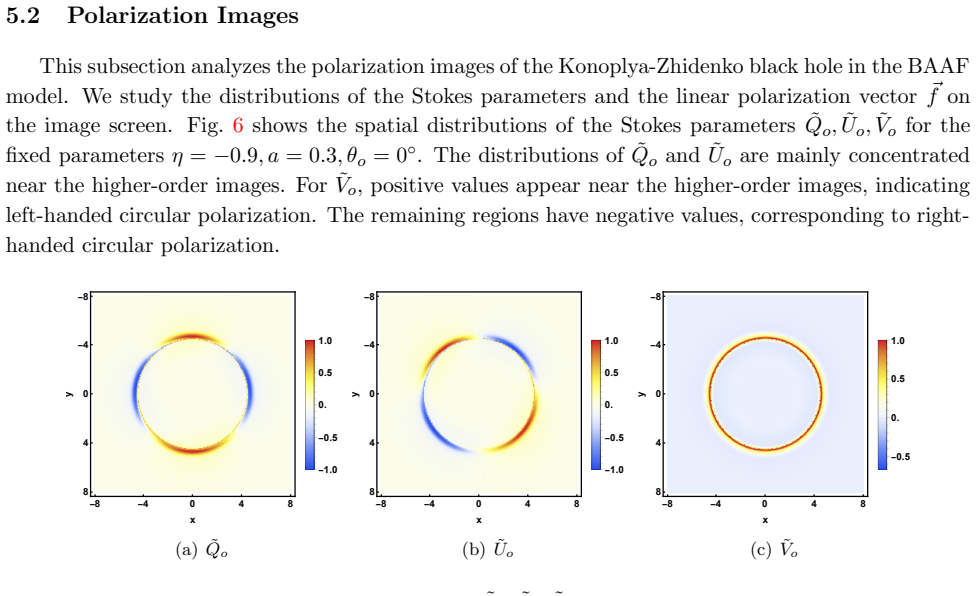
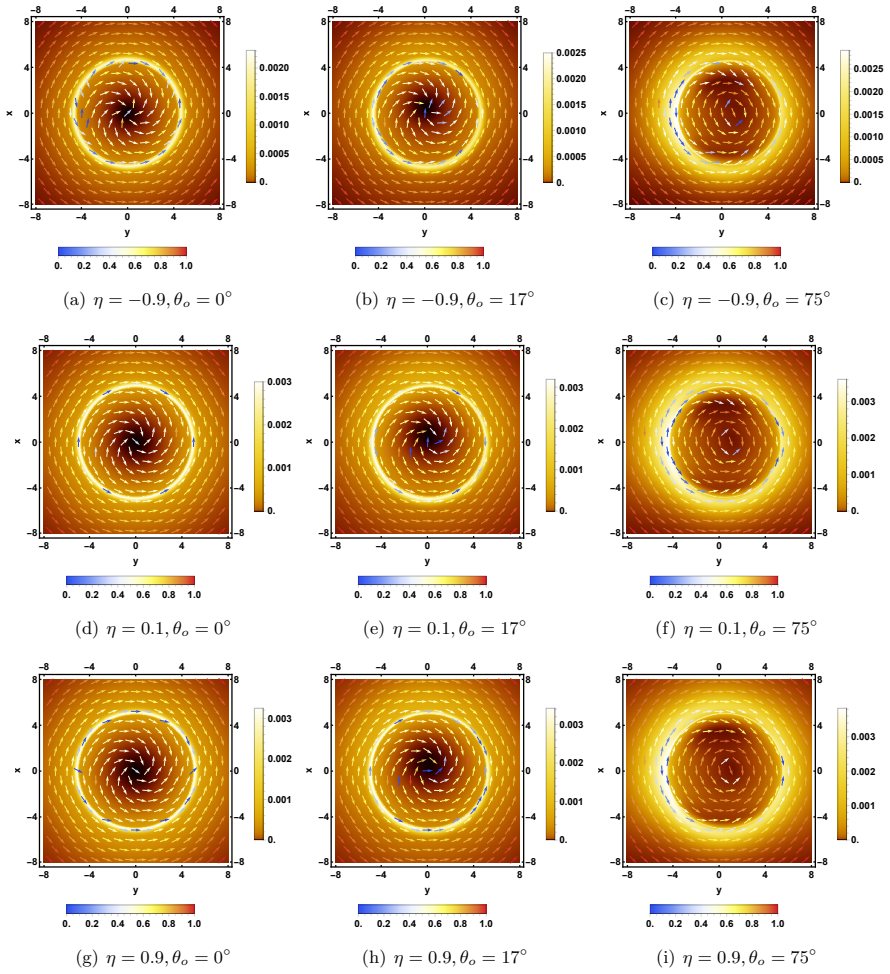
- The degree of linear polarization is much smaller in the higher-order image region than in other regions.
- Polarization vectors extend over the whole image plane.
Where Pith is reading between the lines
- These image differences could allow future very-long-baseline interferometry to constrain the deformation parameter for observed black hole candidates.
- The modeling approach could be extended to other non-Kerr metrics to identify whether each produces unique polarization signatures.
- Validation against full magnetohydrodynamic simulations would be needed to confirm whether the ballistic flow approximation captures the actual near-horizon gas behavior.
Load-bearing premise
The accretion flow around the black hole is described by an analytical ballistic approximation model.
What would settle it
Observation of black hole images showing polarization degrees and patterns matching thin disk models rather than the reduced polarization in higher-order regions predicted for thick flows would falsify the claim.
Figures
read the original abstract
We investigate the shadow and polarization images of a Konoplya-Zhidenko rotating non-Kerr black hole surrounded by a geometrically thick and optically thin accretion flow. The accretion flow is described by an analytical ballistic approximation accretion flow model. The numerical results show that the shadow image exhibits two main features, an outer bright ring and an inner dark region. The former corresponds to higher order images, while the latter is produced by the black hole event horizon. Increasing the deformation parameter $\eta$ does not significantly change the overall shape of the higher order images, but it enlarges their size. Increasing the spin parameter $a$ and the observer inclination angle $\theta_o$ enhances the asymmetry of the higher order images and makes the intensity on the left side much larger than that on the right side. This behavior is associated with frame dragging and the relativistic Doppler effect. In the polarization images, the degree of linear polarization is much smaller in the higher-order image region than in other regions, and the polarization vectors extend over the whole image plane. These results indicate that the thick disk model produces features in both intensity and polarization images that differ markedly from those in thin disk models. Within the framework used in this work, the observed intensity and polarization signatures can serve as effective probes of the underlying spacetime geometry and near horizon accretion dynamics.
Editorial analysis
A structured set of objections, weighed in public.
Referee Report
Summary. The manuscript numerically investigates shadow and polarization images of rotating Konoplya-Zhidenko black holes with a geometrically thick, optically thin accretion flow modeled via an analytical ballistic approximation. It reports an outer bright ring (higher-order images) and inner dark region (event horizon) in intensity maps, with left-right asymmetry increasing with spin a and inclination θ_o due to frame-dragging and Doppler boosting. Polarization maps show reduced linear polarization degree in higher-order regions and vectors spanning the image plane. The authors conclude that these features differ markedly from thin-disk cases and can probe the underlying spacetime geometry and near-horizon dynamics within the adopted framework.
Significance. If the reported trends hold, the work contributes to the literature on non-Kerr metrics and thick-disk imaging by extending ray-tracing calculations to the Konoplya-Zhidenko spacetime and highlighting polarization signatures. The parameter study of deformation η, spin a, and observer angle provides concrete trends that could inform EHT-like observations. No machine-checked proofs or fully reproducible code are mentioned, but the forward simulations of intensity and polarization constitute a clear, falsifiable set of predictions within the model.
major comments (2)
- [Abstract] Abstract: The central claim that 'the thick disk model produces features in both intensity and polarization images that differ markedly from those in thin disk models' is load-bearing for the paper's significance, yet no direct side-by-side comparison, quantitative difference metric, or reference to equivalent thin-disk ray-tracing runs (same metric, same code) is supplied; without this the magnitude and robustness of the distinction cannot be assessed.
- [Abstract] Abstract: All image features and their reported dependence on a, θ_o, and η rest on the specific analytical ballistic approximation for the flow (velocity, density, and emissivity profiles), but the manuscript supplies neither the explicit functional forms, the choice of free parameters in the approximation, nor any sensitivity tests or comparison to MHD simulations; this assumption is load-bearing for the interpretation that the signatures probe spacetime geometry.
minor comments (1)
- The abstract would be clearer if it stated the specific ranges or fiducial values explored for the deformation parameter η, spin a, and inclination θ_o.
Simulated Author's Rebuttal
We thank the referee for the constructive feedback on our manuscript. We address each major comment below and will incorporate revisions to strengthen the presentation of our results.
read point-by-point responses
-
Referee: [Abstract] Abstract: The central claim that 'the thick disk model produces features in both intensity and polarization images that differ markedly from those in thin disk models' is load-bearing for the paper's significance, yet no direct side-by-side comparison, quantitative difference metric, or reference to equivalent thin-disk ray-tracing runs (same metric, same code) is supplied; without this the magnitude and robustness of the distinction cannot be assessed.
Authors: We agree that a direct comparison would better substantiate the central claim. In the revised manuscript we will add a new figure (or appendix) showing side-by-side intensity and polarization images computed with the identical ray-tracing code for both the thick ballistic flow and a standard thin-disk model in the same Konoplya-Zhidenko spacetime. We will also report quantitative metrics, such as the fractional difference in bright-ring radius and mean linear polarization fraction, to allow readers to assess the magnitude of the reported distinctions. revision: yes
-
Referee: [Abstract] Abstract: All image features and their reported dependence on a, θ_o, and η rest on the specific analytical ballistic approximation for the flow (velocity, density, and emissivity profiles), but the manuscript supplies neither the explicit functional forms, the choice of free parameters in the approximation, nor any sensitivity tests or comparison to MHD simulations; this assumption is load-bearing for the interpretation that the signatures probe spacetime geometry.
Authors: The explicit functional forms of the velocity, density and emissivity profiles together with the chosen parameter values are already stated in Section II (Eqs. 5–8). To address the referee’s concern we will expand that section with the complete expressions, tabulate the adopted free-parameter values, and add a short sensitivity study showing how modest variations in those parameters affect the reported image features. A full MHD comparison lies outside the scope of the present analytical-model study; we will nevertheless add a paragraph discussing the model’s limitations and citing relevant MHD literature. revision: partial
Circularity Check
No circularity; forward simulations from specified flow model
full rationale
The paper computes shadow and polarization images via numerical ray-tracing on a Konoplya-Zhidenko metric with an analytical ballistic accretion flow. Reported features (outer bright ring, left-right asymmetry, low polarization degree in higher-order images) are direct numerical outputs of this setup. No equation reduces a claimed prediction to a fitted parameter or self-defined quantity by construction, and no load-bearing step relies on a self-citation chain that itself assumes the target result. The ballistic model is an input assumption whose validity is external to the derivation.
Axiom & Free-Parameter Ledger
axioms (2)
- domain assumption Konoplya-Zhidenko metric correctly describes the spacetime of a rotating non-Kerr black hole
- domain assumption Analytical ballistic approximation adequately models the geometrically thick, optically thin accretion flow
Reference graph
Works this paper leans on
-
[1]
Properties of the binary black hole merger gw150914,
B. P. Abbott, R. Abbott, T. Abbott, M. Abernathy, F. Acernese, K. Ackley, C. Adams, T. Adams, P. Addesso, R. Adhikari,et al., “Properties of the binary black hole merger gw150914,”Physical review letters116no. 24, (2016) 241102
2016
-
[2]
Observation of gravitational waves from a binary black hole merger,
B. P. Abbott, R. Abbott, T. D. Abbott, M. R. Abernathy, F. Acernese, K. Ackley, C. Adams, T. Adams, P. Addesso, R. X. Adhikari,et al., “Observation of gravitational waves from a binary black hole merger,”Physical review letters116no. 6, (2016) 061102
2016
-
[3]
First m87 event horizon telescope results. ii. array and instrumentation,
E. H. T. Collaboration, K. Akiyama, A. Alberdi, W. Alef, K. Asada, R. Azulay, A.-K. Baczko, D. Ball, M. Balokovi´ c, J. Barrett,et al., “First m87 event horizon telescope results. ii. array and instrumentation,”The Astrophysical Journal Letters875no. 1, (2019) L2
2019
-
[4]
First m87 event horizon telescope results. iii. data processing and calibration,
K. Akiyama, A. Alberdi, W. Alef, K. Asada, R. Azulay, A.-K. Baczko, D. Ball, M. Balokovi´ c, J. Barrett, D. Bintley,et al., “First m87 event horizon telescope results. iii. data processing and calibration,”The Astrophysical Journal Letters875no. 1, (2019) L3
2019
-
[5]
First m87 event horizon telescope results. iv. imaging the central supermassive black hole,
K. Akiyama, A. Alberdi, W. Alef, K. Asada, R. Azulay, A.-K. Baczko, D. Ball, M. Balokovi´ c, J. Barrett, D. Bintley,et al., “First m87 event horizon telescope results. iv. imaging the central supermassive black hole,”The Astrophysical Journal Letters875no. 1, (2019) L4
2019
-
[6]
First sagittarius a* event horizon telescope results. i. the shadow of the supermassive black hole in the center of the milky way,
E. H. T. Collaboration, K. Akiyama, A. Alberdi, W. Alef, J. C. Algaba, R. Anantua, K. Asada, R. Azulay, U. Bach, A.-K. Baczko,et al., “First sagittarius a* event horizon telescope results. i. the shadow of the supermassive black hole in the center of the milky way,”The Astrophysical Journal Letters930no. 2, (2022) L12
2022
-
[7]
First sagittarius a* event horizon telescope results. iii. imaging of the galactic center supermassive black hole,
K. Akiyama, A. Alberdi, W. Alef, J. C. Algaba, R. Anantua, K. Asada, R. Azulay, U. Bach, A.-K. Baczko, D. Ball,et al., “First sagittarius a* event horizon telescope results. iii. imaging of the galactic center supermassive black hole,”The Astrophysical Journal Letters930no. 2, (2022) L14
2022
-
[8]
Schwarzschild black hole lensing,
K. S. Virbhadra and G. F. Ellis, “Schwarzschild black hole lensing,”Physical Review D62 no. 8, (2000) 084003
2000
-
[9]
The geometry of photon surfaces,
C.-M. Claudel, K. S. Virbhadra, and G. F. Ellis, “The geometry of photon surfaces,”Journal of Mathematical Physics42no. 2, (2001) 818–838
2001
-
[10]
Viewing the shadow of the black hole at the galactic center,
H. Falcke, F. Melia, and E. Agol, “Viewing the shadow of the black hole at the galactic center,” The Astrophysical Journal Letters528no. 1, (2000) L13–L16
2000
-
[11]
Calculating black hole shadows: Review of analytical studies,
V. Perlick and O. Y. Tsupko, “Calculating black hole shadows: Review of analytical studies,” Physics Reports947(2022) 1–39
2022
-
[12]
Black hole shadow as a standard ruler in cosmology,
O. Y. Tsupko, Z. Fan, and G. S. Bisnovatyi-Kogan, “Black hole shadow as a standard ruler in cosmology,”Classical and Quantum Gravity37no. 6, (2020) 065016. 17
2020
-
[13]
Superradiant evolution of the shadow and photon ring of sgr a*,
Y. Chen, R. Roy, S. Vagnozzi, and L. Visinelli, “Superradiant evolution of the shadow and photon ring of sgr a*,”Physical Review D106no. 4, (2022) 043021
2022
-
[14]
The shadows and observational appearance of a noncommutative black hole surrounded by various profiles of accretions,
X.-X. Zeng, G.-P. Li, and K.-J. He, “The shadows and observational appearance of a noncommutative black hole surrounded by various profiles of accretions,”Nuclear Physics B 974(2022) 115639
2022
-
[15]
Shadows and observational appearance of a new family of ay´ on-beato-garc´ ıa black holes,
P.-H. Mou, Y.-X. Chen, K.-J. He, and G.-P. Li, “Shadows and observational appearance of a new family of ay´ on-beato-garc´ ıa black holes,”Communications in Theoretical Physics74no. 12, (2022) 125401
2022
-
[16]
Viewing the holographic image of the bardeen-ads black hole,
K.-J. He, Y.-W. Han, and G.-P. Li, “Viewing the holographic image of the bardeen-ads black hole,”Nuclear Physics B1010(2025) 116768
2025
-
[17]
Shadow and polarization images of rotating black holes in kalb–ramond gravity illuminated by several thick accretion disks,
C.-Y. Yang, H. Ye, and X.-X. Zeng, “Shadow and polarization images of rotating black holes in kalb–ramond gravity illuminated by several thick accretion disks,”The European Physical Journal C86no. 4, (2026) 370
2026
-
[18]
Measuring the kerr spin parameter of regular black holes from their shadow,
Z. Li and C. Bambi, “Measuring the kerr spin parameter of regular black holes from their shadow,”Journal of Cosmology and Astroparticle Physics2014no. 01, (2014) 041–041
2014
-
[19]
Intrinsic curvature and topology of shadows in kerr spacetime,
S.-W. Wei, Y.-X. Liu, and R. B. Mann, “Intrinsic curvature and topology of shadows in kerr spacetime,”Physical Review D99no. 4, (2019) 041303
2019
-
[20]
Measurement of the kerr spin parameter by observation of a compact object’s shadow,
K. Hioki and K.-i. Maeda, “Measurement of the kerr spin parameter by observation of a compact object’s shadow,”Physical Review D—Particles, Fields, Gravitation, and Cosmology 80no. 2, (2009) 024042
2009
-
[21]
Shadow and deflection angle of rotating black holes in perfect fluid dark matter with a cosmological constant,
S. Haroon, M. Jamil, K. Jusufi, K. Lin, and R. B. Mann, “Shadow and deflection angle of rotating black holes in perfect fluid dark matter with a cosmological constant,”Physical Review D99no. 4, (2019) 044015
2019
-
[22]
Shadow of a black hole surrounded by dark matter,
R. Konoplya, “Shadow of a black hole surrounded by dark matter,”Physics Letters B795 (2019) 1–6
2019
-
[23]
Black hole shadow of sgr a* in dark matter halo,
X. Hou, Z. Xu, M. Zhou, and J. Wang, “Black hole shadow of sgr a* in dark matter halo,” Journal of Cosmology and Astroparticle Physics2018no. 07, (2018) 015–015
2018
-
[24]
Image of a spherical black hole with thin accretion disk,
J.-P. Luminet, “Image of a spherical black hole with thin accretion disk,”Astronomy and Astrophysics, vol. 75, no. 1-2, May 1979, p. 228-235.75(1979) 228–235
1979
-
[25]
Black hole shadows, photon rings, and lensing rings,
S. E. Gralla, D. E. Holz, and R. M. Wald, “Black hole shadows, photon rings, and lensing rings,”Physical Review D100no. 2, (2019) 024018
2019
-
[26]
Influence of quintessence dark energy on the shadow of black hole,
X.-X. Zeng and H.-Q. Zhang, “Influence of quintessence dark energy on the shadow of black hole,”The European Physical Journal C80no. 11, (2020) 1058
2020
-
[27]
Influence of quantum correction on black hole shadows, photon rings, and lensing rings,
J. Peng, M. Guo, and X.-H. Feng, “Influence of quantum correction on black hole shadows, photon rings, and lensing rings,”Chinese Physics C45no. 8, (2021) 085103
2021
-
[28]
Influence of torsion charge on shadow and observation signature of black hole surrounded by various profiles of accretions,
K.-J. He, S.-C. Tan, and G.-P. Li, “Influence of torsion charge on shadow and observation signature of black hole surrounded by various profiles of accretions,”The European Physical Journal C82no. 1, (2022) 81. 18
2022
-
[29]
Observational appearances of af (r) global monopole black hole illuminated by various accretions,
G.-P. Li and K.-J. He, “Observational appearances of af (r) global monopole black hole illuminated by various accretions,”The European Physical Journal C81no. 11, (2021) 1018
2021
-
[30]
Effects of dark matter on shadows and rings of brane-world black holes illuminated by various accretions,
X.-X. Zeng, K.-J. He, and G.-P. Li, “Effects of dark matter on shadows and rings of brane-world black holes illuminated by various accretions,”Science China Physics, Mechanics & Astronomy 65no. 9, (2022) 290411
2022
-
[31]
Image of a kerr-melvin black hole with a thin accretion disk,
Y. Hou, Z. Zhang, H. Yan, M. Guo, and B. Chen, “Image of a kerr-melvin black hole with a thin accretion disk,”Physical Review D106no. 6, (2022) 064058
2022
-
[32]
Observational features of the rotating bardeen black hole surrounded by perfect fluid dark matter,
K.-J. He, G.-P. Li, C.-Y. Yang, and X.-X. Zeng, “Observational features of the rotating bardeen black hole surrounded by perfect fluid dark matter,”The European Physical Journal C85no. 6, (2025) 662
2025
-
[33]
Shadow images of ghosh-kumar rotating black hole illuminated by spherical light sources and thin accretion disks,
C.-Y. Yang, M. I. Aslam, X.-X. Zeng, and R. Saleem, “Shadow images of ghosh-kumar rotating black hole illuminated by spherical light sources and thin accretion disks,”Journal of High Energy Astrophysics46(2025) 100345
2025
-
[34]
The shadow and observational images of the non-singular rotating black holes in loop quantum gravity,
G.-P. Li, H.-B. Zheng, K.-J. He, and Q.-Q. Jiang, “The shadow and observational images of the non-singular rotating black holes in loop quantum gravity,”The European Physical Journal C 85no. 3, (2025) 249
2025
-
[35]
Kerr-like black hole surrounded by cold dark matter halo: the shadow images and eht constraints,
X.-X. Zeng, C.-Y. Yang, M. Israr Aslam, R. Saleem, and S. Aslam, “Kerr-like black hole surrounded by cold dark matter halo: the shadow images and eht constraints,”Journal of Cosmology and Astroparticle Physics2025no. 08, (2025) 066
2025
-
[36]
First m87 event horizon telescope results. v. physical origin of the asymmetric ring,
K. Akiyama, A. Alberdi, W. Alef, K. Asada, R. Azulay, A.-K. Baczko, D. Ball, M. Balokovi´ c, J. Barrett, D. Bintley,et al., “First m87 event horizon telescope results. v. physical origin of the asymmetric ring,”The Astrophysical Journal Letters875no. 1, (2019) L5
2019
-
[37]
The spectral energy distributions of low-luminosity active galactic nuclei,
L. C. Ho, “The spectral energy distributions of low-luminosity active galactic nuclei,”The Astrophysical Journal516no. 2, (1999) 672
1999
-
[38]
Advection-Dominated Accretion: A Self-Similar Solution
R. Narayan and I. Yi, “Advection-dominated accretion: A self-similar solution,”arXiv preprint astro-ph/9403052(1994)
work page internal anchor Pith review Pith/arXiv arXiv 1994
-
[39]
Nonthermal electrons in radiatively inefficient accretion flow models of sagittarius a,
F. Yuan, E. Quataert, and R. Narayan, “Nonthermal electrons in radiatively inefficient accretion flow models of sagittarius a,”The Astrophysical Journal598no. 1, (2003) 301
2003
-
[40]
Frequency-dependent shift in the image centroid of the black hole at the galactic center as a test of general relativity,
A. E. Broderick and A. Loeb, “Frequency-dependent shift in the image centroid of the black hole at the galactic center as a test of general relativity,”The Astrophysical Journal636no. 2, (2005) L109
2005
-
[41]
Imaging the black hole silhouette of m87: implications for jet formation and black hole spin,
A. E. Broderick and A. Loeb, “Imaging the black hole silhouette of m87: implications for jet formation and black hole spin,”The Astrophysical Journal697no. 2, (2009) 1164
2009
-
[42]
M. Wielgus, A. Tursunov, A. P. Lobanov, R. Emami,et al., “Semi-analytic studies of accretion disk and magnetic field geometry in m87,”arXiv preprint arXiv:2508.11760(2025)
-
[43]
Shadows of loop quantum black holes: semi-analytical simulations of loop quantum gravity effects on sagittarius a* and m87,
H.-X. Jiang, C. Liu, I. K. Dihingia, Y. Mizuno, H. Xu, T. Zhu, and Q. Wu, “Shadows of loop quantum black holes: semi-analytical simulations of loop quantum gravity effects on sagittarius a* and m87,”Journal of Cosmology and Astroparticle Physics2024no. 01, (2024) 059. 19
2024
-
[44]
Hot accretion flows around black holes,
F. Yuan and R. Narayan, “Hot accretion flows around black holes,”Annual Review of Astronomy and Astrophysics52no. 1, (2014) 529–588
2014
-
[45]
Estimating the parameters of sagittarius a*’s accretion flow via millimeter vlbi,
A. E. Broderick, V. L. Fish, S. S. Doeleman, and A. Loeb, “Estimating the parameters of sagittarius a*’s accretion flow via millimeter vlbi,”The Astrophysical Journal697no. 1, (2009) 45
2009
-
[46]
Radiative models of sgr a* from grmhd simulations,
M. Mo´ scibrodzka, C. F. Gammie, J. C. Dolence, H. Shiokawa, and P. K. Leung, “Radiative models of sgr a* from grmhd simulations,”The Astrophysical Journal706no. 1, (2009) 497
2009
-
[47]
Distinguishing Black Holes and Neutron Stars via Optical Images Illuminated by Thick Accretion Disks
C.-Y. Yang and X.-X. Zeng, “Distinguishing black holes and neutron stars via optical images illuminated by thick accretion disks,”arXiv preprint arXiv:2604.00117(2026)
work page internal anchor Pith review Pith/arXiv arXiv 2026
-
[48]
A new analytical model of magnetofluids surrounding rotating black holes,
Y. Hou, Z. Zhang, M. Guo, and B. Chen, “A new analytical model of magnetofluids surrounding rotating black holes,”Journal of Cosmology and Astroparticle Physics2024no. 02, (2024) 030
2024
-
[49]
Imaging thick accretion disks and jets surrounding black holes,
Z. Zhang, Y. Hou, M. Guo, and B. Chen, “Imaging thick accretion disks and jets surrounding black holes,”Journal of Cosmology and Astroparticle Physics2024no. 05, (2024) 032
2024
-
[50]
Detection of gravitational waves from black holes: Is there a window for alternative theories?,
R. Konoplya and A. Zhidenko, “Detection of gravitational waves from black holes: Is there a window for alternative theories?,”Physics Letters B756(2016) 350–353
2016
-
[51]
Strong gravitational lensing by a konoplya-zhidenko rotating non-kerr compact object,
S. Wang, S. Chen, and J. Jing, “Strong gravitational lensing by a konoplya-zhidenko rotating non-kerr compact object,”Journal of Cosmology and Astroparticle Physics2016no. 11, (2016) 020–020
2016
-
[52]
General relativistic viscous accretion flow around konoplya-zhidenko black hole,
S. Patra, B. R. Majhi, and S. Das, “General relativistic viscous accretion flow around konoplya-zhidenko black hole,”Journal of High Energy Astrophysics44(2024) 371–380
2024
-
[53]
Energy extraction from a konoplya–zhidenko rotating non-kerr black hole,
F. Long, S. Chen, S. Wang, and J. Jing, “Energy extraction from a konoplya–zhidenko rotating non-kerr black hole,”Nuclear Physics B926(2018) 83–94
2018
-
[54]
Application of symmetric explicit symplectic integrators in non-rotating konoplya and zhidenko black hole spacetime,
G. He, G. Huang, and A. Hu, “Application of symmetric explicit symplectic integrators in non-rotating konoplya and zhidenko black hole spacetime,”Symmetry15no. 10, (2023) 1848
2023
-
[55]
Fundamental photon orbits: black hole shadows and spacetime instabilities,
P. V. Cunha, C. A. Herdeiro, and E. Radu, “Fundamental photon orbits: black hole shadows and spacetime instabilities,”Physical Review D96no. 2, (2017) 024039
2017
-
[56]
Repetitive penrose process in konoplya-zhidenko rotating non-kerr black holes,
X.-X. Zeng, D.-P. Su, and K. Wang, “Repetitive penrose process in konoplya-zhidenko rotating non-kerr black holes,”Science China Physics, Mechanics & Astronomy69no. 7, (2026) 270414
2026
-
[57]
Imaging and polarimetric signatures of konoplya-zhidenko black holes with various thick disk,
X. Wang, Y. Wang, and X.-X. Zeng, “Imaging and polarimetric signatures of konoplya-zhidenko black holes with various thick disk,”Journal of Cosmology and Astroparticle Physics2026 no. 04, (2026) 073
2026
-
[58]
Tests of general relativity with gw150914,
B. P. Abbott, R. Abbott, T. Abbott, M. Abernathy, F. Acernese, K. Ackley, C. Adams, T. Adams, P. Addesso, R. Adhikari,et al., “Tests of general relativity with gw150914,”Physical review letters116no. 22, (2016) 221101
2016
-
[59]
Shadow casted by a konoplya-zhidenko rotating non-kerr black hole,
M. Wang, S. Chen, and J. Jing, “Shadow casted by a konoplya-zhidenko rotating non-kerr black hole,”Journal of Cosmology and Astroparticle Physics2017no. 10, (2017) 051–051
2017
-
[60]
The ring-shaped shadow of a rotating naked singularity with a complete photon sphere,
M. Wang, G. Guo, P. Yan, S. Chen, and J. Jing, “The ring-shaped shadow of a rotating naked singularity with a complete photon sphere,”Chinese Physics C48no. 10, (2024) 105103. 20
2024
-
[61]
Distinguishing black holes and neutron stars through optical images,
C.-Y. Yang and X.-X. Zeng, “Distinguishing black holes and neutron stars through optical images,”Journal of Cosmology and Astroparticle Physics2026no. 04, (2026) 032
2026
-
[62]
Qed effect on a black hole shadow,
Z. Hu, Z. Zhong, P.-C. Li, M. Guo, and B. Chen, “Qed effect on a black hole shadow,”Physical Review D103no. 4, (2021) 044057
2021
-
[63]
Qed effects on kerr black hole shadows immersed in uniform magnetic fields,
Z. Zhong, Z. Hu, H. Yan, M. Guo, and B. Chen, “Qed effects on kerr black hole shadows immersed in uniform magnetic fields,”Physical Review D104no. 10, (2021) 104028
2021
-
[64]
Semianalytical study on polarized images of a black hole due to frame dragging,
X. Wang, S. Chen, M. Guo, and B. Chen, “Semianalytical study on polarized images of a black hole due to frame dragging,”Physical Review D113no. 2, (2026) 024033
2026
-
[65]
Shadow and accretion disk images of the rotation loop quantum black bounce,
K.-J. He, H. Ye, X.-X. Zeng, L.-F. Li, and P. Xu, “Shadow and accretion disk images of the rotation loop quantum black bounce,”Chinese Physics C49no. 12, (2025) 125103
2025
-
[66]
Observational features of the Bardeen-boson star with thin disk accretion,
C.-Y. Yang, H. Ye, and X.-X. Zeng, “Observational features of the bardeen-boson star with thin disk accretion,”arXiv preprint arXiv:2509.17535(2025)
-
[67]
Harmony in electrons: Cyclotron and synchrotron emission by thermal electrons in a magnetic field,
R. Mahadevan, R. Narayan, and I. Yi, “Harmony in electrons: Cyclotron and synchrotron emission by thermal electrons in a magnetic field,”The Astrophysical Journal465no. 1, (1996) 327–338
1996
-
[68]
The effects of accretion flow dynamics on the black hole shadow of sagittarius a,
H.-Y. Pu, K. Akiyama, and K. Asada, “The effects of accretion flow dynamics on the black hole shadow of sagittarius a,”The Astrophysical Journal831no. 1, (2016) 4
2016
-
[69]
Constraining the size of the dark region around the m87 black hole by space-vlbi observations,
R. Takahashi and S. Mineshige, “Constraining the size of the dark region around the m87 black hole by space-vlbi observations,”The Astrophysical Journal729no. 2, (2011) 86
2011
-
[70]
Images and photon ring signatures of thick disks around black holes,
F. H. Vincent, S. E. Gralla, A. Lupsasca, and M. Wielgus, “Images and photon ring signatures of thick disks around black holes,”Astronomy & Astrophysics667(2022) A170
2022
-
[71]
Relativistic magnetohydrodynamical effects of plasma accreting into a black hole,
R. Ruffini and J. R. Wilson, “Relativistic magnetohydrodynamical effects of plasma accreting into a black hole,”Physical Review D12no. 10, (1975) 2959
1975
-
[72]
General relativistic magnetohydrodynamic simulations of monopole magnetospheres of black holes,
S. Komissarov, “General relativistic magnetohydrodynamic simulations of monopole magnetospheres of black holes,”Monthly Notices of the Royal Astronomical Society350no. 4, (2004) 1431–1436
2004
-
[73]
Electrodynamics of black hole magnetospheres,
S. Komissarov, “Electrodynamics of black hole magnetospheres,”Monthly Notices of the Royal Astronomical Society350no. 2, (2004) 427–448
2004
-
[74]
A formalism for covariant polarized radiative transport by ray tracing,
C. F. Gammie and P. K. Leung, “A formalism for covariant polarized radiative transport by ray tracing,”The Astrophysical Journal752no. 2, (2012) 123
2012
-
[75]
Coport: a new public code for polarized radiative transfer in a covariant framework,
J. Huang, L. Zheng, M. Guo, and B. Chen, “Coport: a new public code for polarized radiative transfer in a covariant framework,”Journal of Cosmology and Astroparticle Physics2024 no. 11, (2024) 054
2024
-
[76]
Non-thermal Synchrotron Emission and Polarization Signatures during Black Hole Flux Eruptions
F. Zhou, J. Huang, Y. Li, Z. Zhang, Y. Hou, M. Guo, and B. Chen, “Non-thermal synchrotron emission and polarization signatures during black hole flux eruptions,”arXiv preprint arXiv:2512.06803(2025)
work page internal anchor Pith review Pith/arXiv arXiv 2025
-
[77]
Observing the inner shadow of a black hole: a direct view of the event horizon,
A. Chael, M. D. Johnson, and A. Lupsasca, “Observing the inner shadow of a black hole: a direct view of the event horizon,”The Astrophysical Journal918no. 1, (2021) 6. 21
2021
-
[78]
Observational signatures and polarized images of rotating charged black holes in kalb–ramond gravity,
C.-Y. Yang, K.-J. He, X.-X. Zeng, and L.-F. Li, “Observational signatures and polarized images of rotating charged black holes in kalb–ramond gravity,”The European Physical Journal C86 no. 5, (2026) 520. 22
2026
discussion (0)
Sign in with ORCID, Apple, or X to comment. Anyone can read and Pith papers without signing in.