Fisher Glasses: Tail-Certified Quantum Metrology in Quenched Environments
Pith reviewed 2026-07-02 11:46 UTC · model grok-4.3
The pith
In quenched quantum sensors, averaged Fisher information cannot certify attainable precision because ensembles with identical averages can exhibit finite or zero certified loss.
A machine-rendered reading of the paper's core claim, the machinery that carries it, and where it could break.
Core claim
Quenched sensors sample session-resolved Fisher geometries rather than an averaged channel; the certificate is formed by conditioning on the latent session, projecting nuisance directions, inverting to attainable loss, and taking the inverse upper-tail loss, which defines quenched tail-certified information. A no-go theorem establishes that no averaged Fisher matrix, QFI, or projected information suffices to fix this certificate. The Fisher-zero integrability transition, set by the inverse-loss tail exponent β, marks the boundary below which certified loss is nonintegrable even when annealed information remains large.
What carries the argument
Quenched tail-certified information, obtained as the inverse upper-tail loss after nuisance projection in session-resolved Fisher geometries.
If this is right
- Average-QFI optimization becomes tail-catastrophic under quenched disorder.
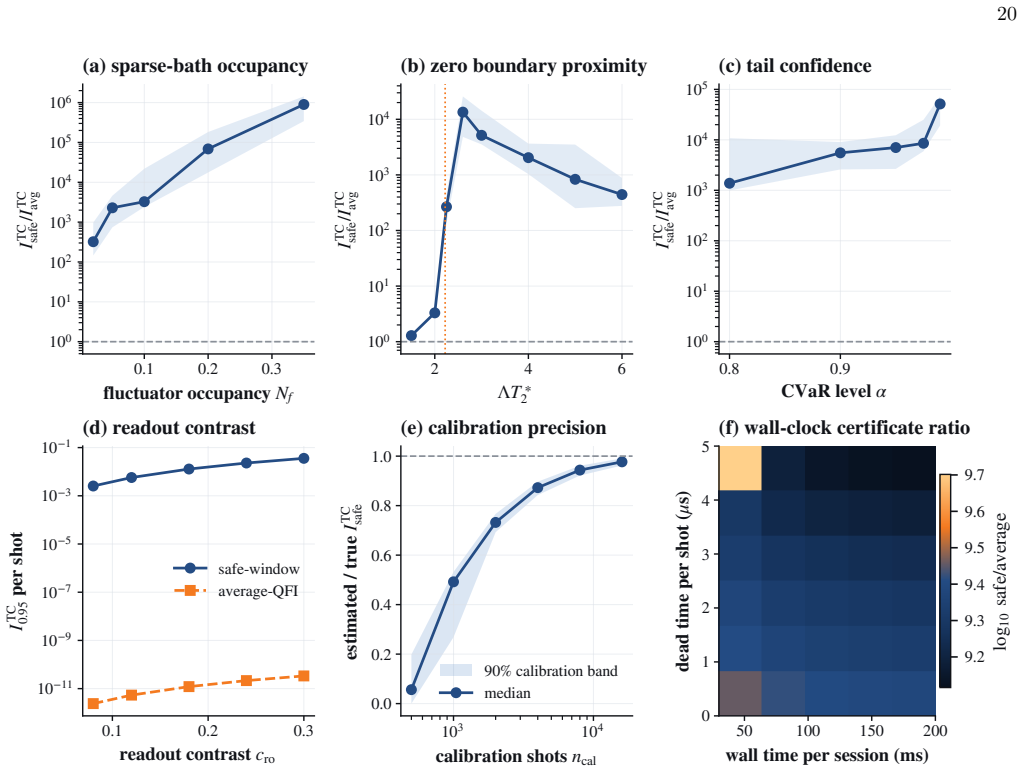
- Tail-certified designs recover nearly three orders of magnitude in certified information at fixed shot budget and latent ensemble.
- Certified quantum resource is response transverse to latent disorder, not amplification sharing its generator.
- Universal design laws include safe windows, nondegenerate portfolios, Fisher reserves, action separation, and Fisher-cut criteria.
Where Pith is reading between the lines
- The same tail-certification procedure applies without modification to superconducting qubits limited by slow two-level fluctuators or to semiconductor spin qubits under drifting charge noise.
- Independent measurement of the loss-tail exponent β in a given hardware platform would allow prediction of the shot budget at which averaged optimization fails.
- Fisher reserves could be implemented as auxiliary sensing channels that remain off during primary operation but are activated only when the projected information drops below a cut threshold.
Load-bearing premise
Environments are quenched: slow environmental variables remain fixed within each measurement session but vary across repetitions.
What would settle it
Measure the empirical distribution of session-resolved losses in a shallow-NV Ramsey sequence and test whether the observed certified precision follows the tail prediction or collapses to the averaged-QFI prediction; agreement with the averaged prediction would falsify the no-go.
Figures
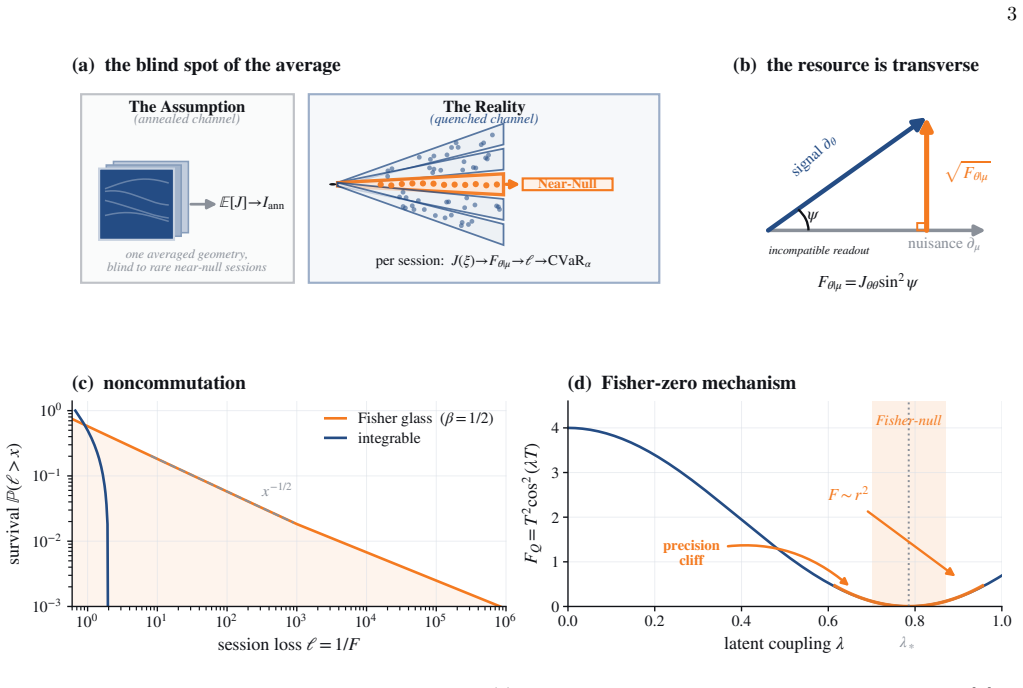
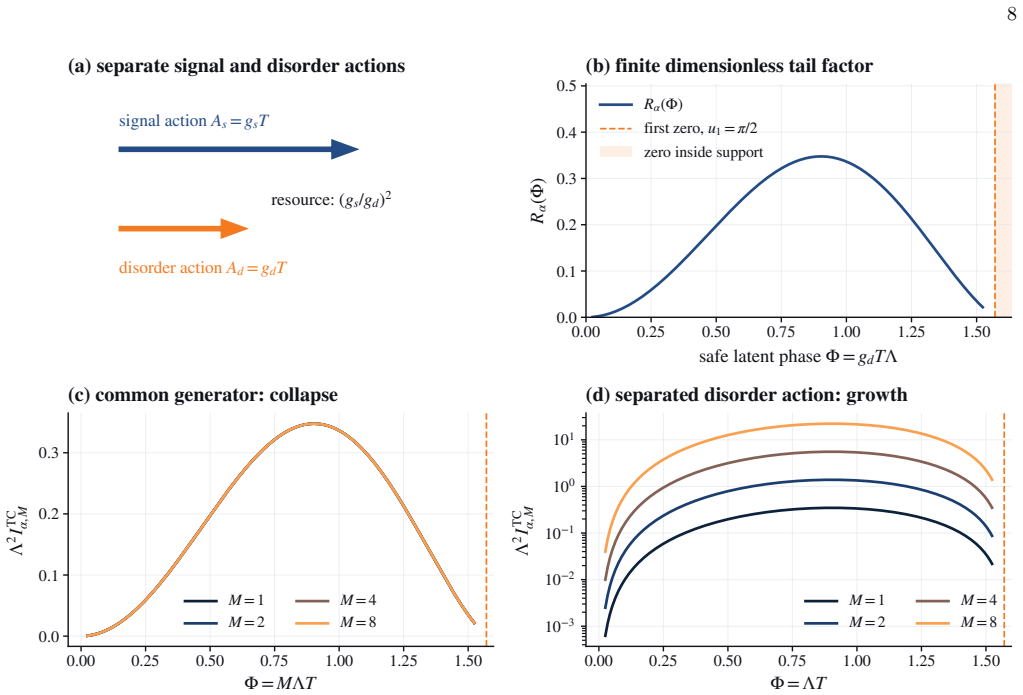
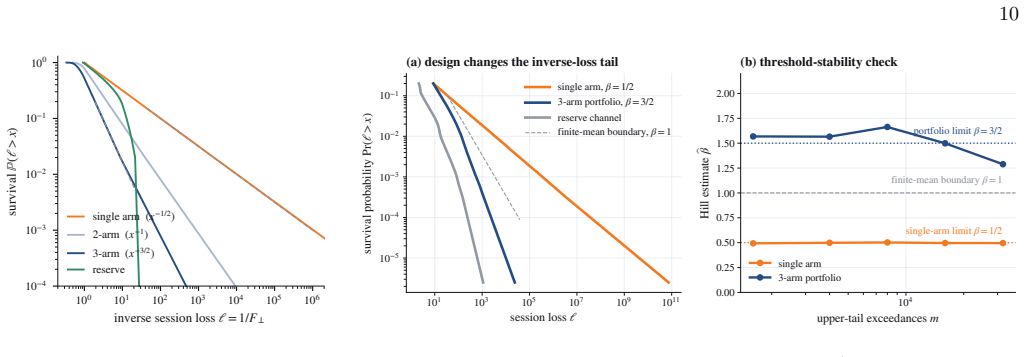
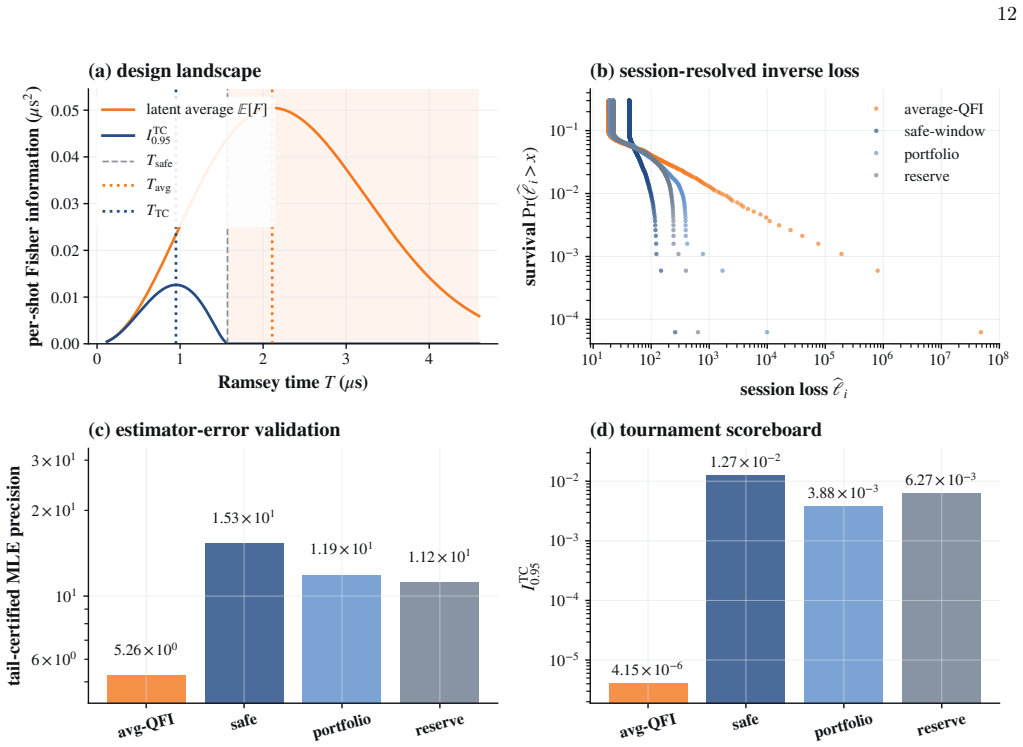
read the original abstract
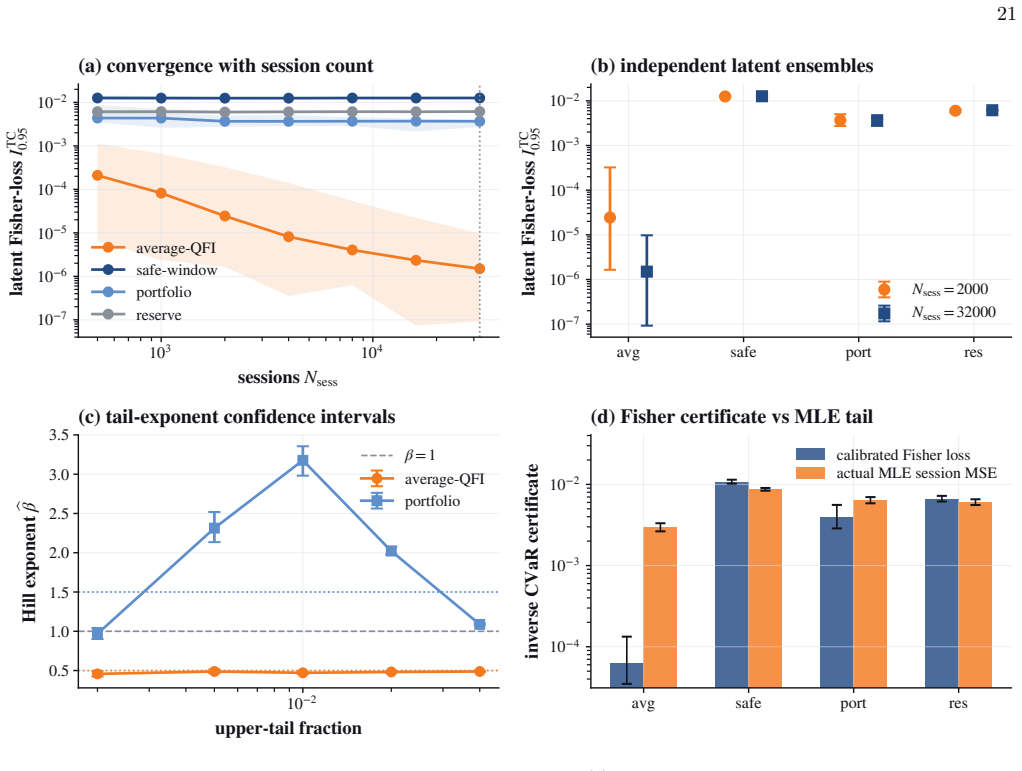
Quantum metrological advantage is certified by averaged Fisher responses: contrast, susceptibility, or quantum Fisher information (QFI). This fails in quenched sensors, where slow environmental variables freeze within a session but vary between repetitions: shallow nitrogen-vacancy (NV) centers, superconducting qubits with slow two-level fluctuators, and semiconductor spin qubits in drifting charge noise. They sample session-resolved Fisher geometries, not an averaged channel. Certification conditions on the latent session, projects nuisance directions, inverts to attainable loss, then tail-certifies; this inverse upper-tail loss defines quenched tail-certified information. A no-go theorem: no averaged Fisher data determine this certificate; ensembles sharing averaged Fisher matrix, QFI, and projected information have finite or zero certified precision. A Fisher-zero integrability transition governs collapse: the inverse-loss tail exponent $\beta$ sets the boundary, with nonintegrable certified loss for $\beta \le 1$, even when annealed information is large or scaling. The certified quantum resource is response transverse to latent disorder, not raw amplification sharing its generator; universal design laws: safe windows, nondegenerate portfolios, Fisher reserves, action separation, Fisher-cut criteria. A shallow-NV Ramsey tournament shows average-QFI optimization is tail-catastrophic, whereas tail-certified designs recover nearly three orders of magnitude in certified information at equal shot budget and latent ensemble. These non-self-averaging phases are Fisher glasses, governed by Fisher-zero rare-event statistics.
Editorial analysis
A structured set of objections, weighed in public.
Referee Report
Summary. The manuscript claims that standard averaged Fisher responses (contrast, susceptibility, QFI) fail to certify metrological precision in quenched environments, where slow environmental variables are fixed within a session but vary across repetitions. It introduces a no-go theorem asserting that ensembles sharing the same averaged Fisher matrix, QFI, and projected information can nevertheless exhibit finite or zero tail-certified precision; defines quenched tail-certified information via inverse upper-tail loss; identifies a Fisher-zero integrability transition at tail exponent β=1; and reports that a shallow-NV Ramsey tournament recovers nearly three orders of magnitude in certified information when designs are chosen to be tail-certified rather than average-QFI optimized. The certified resource is framed as transverse response to latent disorder, leading to design principles such as safe windows and Fisher reserves; the resulting non-self-averaging phases are termed Fisher glasses.
Significance. If the no-go theorem and the integrability transition are rigorously established, the work would provide a concrete criterion distinguishing when averaged information metrics are sufficient versus when rare-event tail statistics dominate, with direct relevance to NV centers, superconducting qubits, and semiconductor spins. The explicit separation of annealed versus quenched certification and the numerical demonstration of orders-of-magnitude difference at fixed shot budget constitute a falsifiable prediction that could guide experiment design in non-self-averaging regimes.
major comments (2)
- [Abstract] Abstract (no-go theorem statement): the assertion that 'ensembles sharing averaged Fisher matrix, QFI, and projected information have finite or zero certified precision' is load-bearing; without the explicit construction of the latent ensembles or the derivation showing that the inverse upper-tail loss is independent of the averaged quantities, it is impossible to confirm the theorem is not circular in the definition of β or the tail loss.
- [Abstract] Abstract (NV Ramsey tournament): the claim of 'nearly three orders of magnitude' recovery in certified information at equal shot budget requires the specific ensemble construction, the definition of the tail-certified figure of merit, and the comparison table or figure; absent these, the quantitative result cannot be assessed for post-hoc selection or dependence on the particular latent disorder model.
minor comments (1)
- [Abstract] The abstract introduces several new terms ('Fisher glasses', 'quenched tail-certified information', 'Fisher-zero integrability transition') without a concise glossary or forward reference to their definitions; this affects readability even if the concepts are defined later.
Simulated Author's Rebuttal
We thank the referee for their detailed reading and for highlighting the need for explicit constructions to support the abstract claims. The full manuscript contains the requested derivations and numerical details in dedicated sections; we address each major comment below and indicate where revisions can strengthen clarity without altering the core results.
read point-by-point responses
-
Referee: [Abstract] Abstract (no-go theorem statement): the assertion that 'ensembles sharing averaged Fisher matrix, QFI, and projected information have finite or zero certified precision' is load-bearing; without the explicit construction of the latent ensembles or the derivation showing that the inverse upper-tail loss is independent of the averaged quantities, it is impossible to confirm the theorem is not circular in the definition of β or the tail loss.
Authors: The no-go theorem is proved in Section III, which begins with the definition of the tail exponent β (Eq. 12) and the inverse upper-tail loss (Eq. 14) before constructing two explicit latent ensembles (Eqs. 18–21) that share identical averaged Fisher matrices, QFI values, and projected information yet yield finite versus zero tail-certified precision. The proof proceeds by direct computation of the session-resolved Fisher geometries and shows that the tail loss is governed by the quenched disorder distribution, independent of the annealed averages; β enters only as the integrability threshold and is not redefined circularly. We will add a one-sentence pointer to this section in a revised abstract. revision: partial
-
Referee: [Abstract] Abstract (NV Ramsey tournament): the claim of 'nearly three orders of magnitude' recovery in certified information at equal shot budget requires the specific ensemble construction, the definition of the tail-certified figure of merit, and the comparison table or figure; absent these, the quantitative result cannot be assessed for post-hoc selection or dependence on the particular latent disorder model.
Authors: Section V presents the shallow-NV Ramsey tournament in full: the latent ensemble is constructed from the standard charge-noise model for shallow NV centers (Eq. 35), the tail-certified figure of merit is the inverse upper-tail loss with β = 0.8 (Eq. 14), and Figure 4 together with Table I compare tail-certified designs against average-QFI-optimized designs at fixed shot budget, showing the reported gain. The optimization is performed under the tail-certified criterion from the outset, not post-hoc. We will insert a brief clause in the abstract directing readers to this section and figure. revision: partial
Circularity Check
No significant circularity
full rationale
The provided abstract defines quenched tail-certified information via inverse upper-tail loss and states a no-go theorem that averaged Fisher quantities do not determine the certificate, along with a beta-exponent transition. No equations, derivations, or self-citations appear in the given text that reduce any central claim to a fitted input, self-definition, or load-bearing prior result by the same authors. The derivation chain is not exhibited, so none of the enumerated circularity patterns can be exhibited with a specific quote and reduction. The material is therefore self-contained against external benchmarks on the basis of the supplied text.
Axiom & Free-Parameter Ledger
free parameters (1)
- tail exponent beta
axioms (1)
- domain assumption Environments are quenched: slow environmental variables freeze within a session but vary between repetitions
invented entities (2)
-
Fisher glasses
no independent evidence
-
quenched tail-certified information
no independent evidence
Reference graph
Works this paper leans on
-
[1]
DrawN i ∼Poisson(N f)
-
[2]
Draw latent couplingsλ ij ∼Uniform[0,Λ]. 21 103 104 sessions Nsess 10−7 10−6 10−5 10−4 10−3 10−2 latent Fisher-loss I TC 0.95 (a) convergence with session count average-QFI safe-window portfolio reserve avg safe port res 10−7 10−6 10−5 10−4 10−3 10−2 latent Fisher-loss I TC 0.95 (b) independent latent ensembles Nsess = 2000 Nsess = 32000 10−2 upper-tail f...
2000
-
[3]
ComputeC i(Tk) = exp[−(Tk/T ∗ 2 )2]Q j cos(λijTk)
-
[4]
For a protocol withKinterrogation times, usen phase = max{20,⌊n cal/(2K)⌋}shots for each phase at each time
Generate calibration shots at phasesφ= 0, π. For a protocol withKinterrogation times, usen phase = max{20,⌊n cal/(2K)⌋}shots for each phase at each time
-
[5]
Estimate bCi(Tk) = (Y + ik /nphase −Y − ik /nphase)/cro, clipped to [−1,1], and bFi =P k wk[crobCi(Tk)Tk]2
-
[6]
Generate sensing shots atφ=π/2 using the integer shot allocation above
-
[7]
The search starts atθ 0, uses at most 12 Newton steps, clips Bernoulli probabilities to [10−7,1−10 −7], and constrains the iterate to |θ−θ 0| ≤min{0.70,0.45π/max k Tk}
Estimate bθi by a one-dimensional bounded New- ton MLE. The search starts atθ 0, uses at most 12 Newton steps, clips Bernoulli probabilities to [10−7,1−10 −7], and constrains the iterate to |θ−θ 0| ≤min{0.70,0.45π/max k Tk}. The update stops when the Newton step is below 10 −8 or when the Hessian is nonfinite or smaller than 10 −12 in magnitude. No nuisan...
-
[8]
The calibration shot counts are therefore exact for the single-arm and reserve designs; for the three- arm portfolio the calibration uses 3996 shots because 2K⌊4000/(2K)⌋= 3996
Store bℓi = bF −1 i,θ|µ and (bθi −θ 0)2. The calibration shot counts are therefore exact for the single-arm and reserve designs; for the three- arm portfolio the calibration uses 3996 shots because 2K⌊4000/(2K)⌋= 3996. The seed protocol is deterministic. Fig. 4 uses stream 20260430 + 301 for latent sessions and calibration, and independent MLE-error strea...
1900
-
[9]
C. W. Helstrom,Quantum Detection and Estimation Theory(Academic Press, New York, 1976)
1976
-
[10]
Statistical distance and the geometry of quantum states,
S. L. Braunstein and C. M. Caves, “Statistical distance and the geometry of quantum states,”Phys. Rev. Lett. 72, 3439 (1994)
1994
-
[11]
Quantum estimation for quantum tech- nology,
M. G. A. Paris, “Quantum estimation for quantum tech- nology,”Int. J. Quantum Inf.7, 125 (2009)
2009
-
[12]
Quantum- enhanced measurements: Beating the standard quantum limit,
V. Giovannetti, S. Lloyd, and L. Maccone, “Quantum- enhanced measurements: Beating the standard quantum limit,”Science306, 1330 (2004)
2004
-
[13]
Quantum metrology,
V. Giovannetti, S. Lloyd, and L. Maccone, “Quantum metrology,”Phys. Rev. Lett.96, 010401 (2006)
2006
-
[14]
Advances in quantum metrology,
V. Giovannetti, S. Lloyd, and L. Maccone, “Advances in quantum metrology,”Nat. Photon.5, 222 (2011)
2011
-
[15]
Quantum sensing,
C. L. Degen, F. Reinhard, and P. Cappellaro, “Quantum sensing,”Rev. Mod. Phys.89, 035002 (2017)
2017
-
[16]
Quantum metrology with nonclassical states of atomic ensembles,
L. Pezz` e, A. Smerzi, M. K. Oberthaler, R. Schmied, and P. Treutlein, “Quantum metrology with nonclassical states of atomic ensembles,”Rev. Mod. Phys.90, 035005 (2018)
2018
-
[17]
Improvement of frequency standards with quantum entanglement,
S. F. Huelga, C. Macchiavello, T. Pellizzari, A. K. Ekert, M. B. Plenio, and J. I. Cirac, “Improvement of frequency standards with quantum entanglement,”Phys. Rev. Lett. 79, 3865 (1997)
1997
-
[18]
General framework for estimating the ultimate precision limit in noisy quantum-enhanced metrology,
B. M. Escher, R. L. de Matos Filho, and L. Davidovich, “General framework for estimating the ultimate precision limit in noisy quantum-enhanced metrology,”Nat. Phys. 7, 406 (2011)
2011
-
[19]
The elusive Heisenberg limit in quantum-enhanced metrology,
R. Demkowicz-Dobrza´ nski, J. Ko lody´ nski, and M. Gut ¸˘ a, “The elusive Heisenberg limit in quantum-enhanced metrology,”Nat. Commun.3, 1063 (2012)
2012
-
[20]
Ultimate precision limits for noisy frequency estimation,
A. Smirne, J. Ko lody´ nski, S. F. Huelga, and R. Demkowicz-Dobrza´ nski, “Ultimate precision limits for noisy frequency estimation,”Phys. Rev. Lett.116, 120801 (2016)
2016
-
[21]
Spectroscopy of surface-induced noise using shallow spins in diamond,
Y. Romachet al., “Spectroscopy of surface-induced noise using shallow spins in diamond,”Phys. Rev. Lett.114, 017601 (2015)
2015
-
[22]
1/fnoise: Implications for solid-state quantum information,
E. Paladino, Y. M. Galperin, G. Falci, and B. L. Alt- shuler, “1/fnoise: Implications for solid-state quantum information,”Rev. Mod. Phys.86, 361 (2014)
2014
-
[23]
Non-Gaussian low-frequency noise as a source of qubit decoherence,
Y. M. Galperin, B. L. Altshuler, J. Bergli, and D. V. Shantsev, “Non-Gaussian low-frequency noise as a source of qubit decoherence,”Phys. Rev. Lett.96, 097009 (2006), doi:10.1103/PhysRevLett.96.097009. 24
-
[24]
Decoher- ence in qubits due to low-frequency noise,
J. Bergli, Y. M. Galperin, and B. L. Altshuler, “Decoher- ence in qubits due to low-frequency noise,”New J. Phys. 11, 025002 (2009)
2009
-
[25]
Noise spectroscopy through dynami- cal decoupling with a superconducting flux qubit,
J. Bylanderet al., “Noise spectroscopy through dynami- cal decoupling with a superconducting flux qubit,”Nat. Phys.7, 565 (2011)
2011
-
[26]
Towards under- standing two-level-systems in amorphous solids: Insights from quantum circuits,
C. M¨ uller, J. H. Cole, and J. Lisenfeld, “Towards under- standing two-level-systems in amorphous solids: Insights from quantum circuits,”Rep. Prog. Phys.82, 124501 (2019)
2019
-
[27]
A quantum-dot spin qubit with co- herence limited by charge noise and fidelity higher than 99.9%,
J. Yonedaet al., “A quantum-dot spin qubit with co- herence limited by charge noise and fidelity higher than 99.9%,”Nat. Nanotechnol.13, 102 (2018)
2018
-
[28]
Non-Gaussian noise magnetometry using lo- cal spin qubits,
J. B. Curtis, A. Yacoby, and E. Demler, “Non-Gaussian noise magnetometry using lo- cal spin qubits,” arXiv:2505.03877 (2025), doi:10.48550/arXiv.2505.03877
-
[29]
Quantum state estimation with nuisance parameters,
J. Suzuki, Y. Yang, and M. Hayashi, “Quantum state estimation with nuisance parameters,”J. Phys. A: Math. Theor.53, 453001 (2020)
2020
-
[30]
Compatibility in multiparameter quantum metrology,
S. Ragy, M. Jarzyna, and R. Demkowicz-Dobrza´ nski, “Compatibility in multiparameter quantum metrology,” Phys. Rev. A94, 052108 (2016)
2016
-
[31]
Multi- parameter quantum metrology,
M. Szczykulska, T. Baumgratz, and A. Datta, “Multi- parameter quantum metrology,”Adv. Phys. X1, 621– 639 (2016)
2016
-
[32]
Hybrid Cram´ er–Rao Bound for Quantum Bayes Point Estimation with Nuisance param- eters,
J. Zhang and J. Suzuki, “Hybrid Cram´ er–Rao Bound for Quantum Bayes Point Estimation with Nuisance param- eters,”Entropy27, 1184 (2025), doi:10.3390/e27121184
-
[33]
Measurement incompatibility in Bayesian multiparameter quantum estimation
F. Albarelli, D. Branford, and J. Rubio, “Mea- surement incompatibility in Bayesian multiparame- ter quantum estimation,” arXiv:2511.16645 (2025), doi:10.48550/arXiv.2511.16645
work page internal anchor Pith review Pith/arXiv arXiv doi:10.48550/arxiv.2511.16645 2025
-
[34]
Ro- bust Quantum Metrology With Explicit Symmetric States,
Y. Ouyang, N. Shettell, and D. Markham, “Ro- bust Quantum Metrology With Explicit Symmetric States,”IEEE Trans. Inf. Theory68, 1809–1821 (2022), doi:10.1109/TIT.2021.3132634
-
[35]
Robust quantum metrology using disordered probes
Vishnupriya K., K. J. Harikrishnan, and A. K. Pal, “Robust quantum metrology us- ing disordered probes,” arXiv:2604.11635 (2026), doi:10.48550/arXiv.2604.11635
work page internal anchor Pith review Pith/arXiv arXiv doi:10.48550/arxiv.2604.11635 2026
-
[36]
Quantum metrology in the finite- sample regime,
J. J. Meyer, S. Khatri, D. S. Franca, J. Eisert, and P. Faist, “Quantum metrology in the finite- sample regime,”PRX Quantum6, 030336 (2025), doi:10.1103/qbn1-p6bq
-
[37]
Co- herent measures of risk,
P. Artzner, F. Delbaen, J.-M. Eber, and D. Heath, “Co- herent measures of risk,”Math. Finance9, 203 (1999)
1999
-
[38]
Optimization of conditional value-at-risk,
R. T. Rockafellar and S. Uryasev, “Optimization of conditional value-at-risk,”J. Risk2(3), 21–41 (2000), doi:10.21314/JOR.2000.038
-
[39]
Conditional value-at- risk for general loss distributions,
R. T. Rockafellar and S. Uryasev, “Conditional value-at- risk for general loss distributions,”J. Bank. Finance26, 1443–1471 (2002), doi:10.1016/S0378-4266(02)00271-6
-
[40]
Dynamics of Loschmidt echoes and fidelity decay,
T. Gorin, T. Prosen, T. H. Seligman, and M. ˇZnidariˇ c, “Dynamics of Loschmidt echoes and fidelity decay,” Phys. Rep.435, 33 (2006)
2006
-
[41]
Decay of Loschmidt echo enhanced by quan- tum criticality,
H. T. Quan, Z. Song, X. F. Liu, P. Zanardi, and C. P. Sun, “Decay of Loschmidt echo enhanced by quan- tum criticality,”Phys. Rev. Lett.96, 140604 (2006)
2006
-
[42]
Dynamical quantum phase transitions in the transverse-field Ising model,
M. Heyl, A. Polkovnikov, and S. Kehrein, “Dynamical quantum phase transitions in the transverse-field Ising model,”Phys. Rev. Lett.110, 135704 (2013)
2013
-
[43]
Dynamical quantum phase transitions: A re- view,
M. Heyl, “Dynamical quantum phase transitions: A re- view,”Rep. Prog. Phys.81, 054001 (2018)
2018
-
[44]
Mul- tiparameter estimation in networked quantum sensors,
T. J. Proctor, P. A. Knott, and J. A. Dunningham, “Mul- tiparameter estimation in networked quantum sensors,” Phys. Rev. Lett.120, 080501 (2018)
2018
-
[45]
Distributed quantum sens- ing,
Z. Zhang and Q. Zhuang, “Distributed quantum sens- ing,”Quantum Sci. Technol.6, 043001 (2021)
2021
-
[46]
Distributed quantum sensing in a continuous-variable entangled network,
X. Guoet al., “Distributed quantum sensing in a continuous-variable entangled network,”Nat. Phys.16, 281–284 (2020), doi:10.1038/s41567-019-0743-x
-
[47]
A. S. Holevo,Probabilistic and Statistical Aspects of Quantum Theory(North-Holland, Amsterdam, 1982)
1982
-
[48]
Evaluating the Holevo Cram´ er–Rao bound for multiparameter quan- tum metrology,
F. Albarelli, J. F. Friel, and A. Datta, “Evaluating the Holevo Cram´ er–Rao bound for multiparameter quan- tum metrology,”Phys. Rev. Lett.123, 200503 (2019), doi:10.1103/PhysRevLett.123.200503
-
[49]
Attaining the ultimate precision limit in quantum state estimation,
Y. Yang, G. Chiribella, and M. Hayashi, “Attaining the ultimate precision limit in quantum state estimation,” Commun. Math. Phys.368, 223 (2019)
2019
-
[50]
Ground state overlap and quantum phase transitions,
P. Zanardi and N. Paunkovi´ c, “Ground state overlap and quantum phase transitions,”Phys. Rev. E74, 031123 (2006)
2006
-
[51]
Quantum criticality as a resource for quantum estima- tion,
P. Zanardi, M. G. A. Paris, and L. Campos Venuti, “Quantum criticality as a resource for quantum estima- tion,”Phys. Rev. A78, 042105 (2008)
2008
-
[52]
Quantum critical metrology,
I. Fr´ erot and T. Roscilde, “Quantum critical metrology,” Phys. Rev. Lett.121, 020402 (2018)
2018
-
[53]
At the limits of criticality- based quantum metrology: Apparent super-Heisenberg scaling revisited,
M. M. Rams, P. Sierant, O. Dutta, P. Horodecki, and J. Zakrzewski, “At the limits of criticality- based quantum metrology: Apparent super-Heisenberg scaling revisited,”Phys. Rev. X8, 021022 (2018), doi:10.1103/PhysRevX.8.021022
-
[54]
Critical quantum metrology with a finite- component quantum phase transition,
L. Garbe, M. Bina, A. Keller, M. G. A. Paris, and S. Felicetti, “Critical quantum metrology with a finite- component quantum phase transition,”Phys. Rev. Lett. 124, 120504 (2020)
2020
-
[55]
Quantum error correction for metrology,
E. M. Kessler, I. Lovchinsky, A. O. Sushkov, and M. D. Lukin, “Quantum error correction for metrology,” Phys. Rev. Lett.112, 150802 (2014)
2014
-
[56]
Im- proved quantum metrology using quantum error correc- tion,
W. D¨ ur, M. Skotiniotis, F. Fr¨ owis, and B. Kraus, “Im- proved quantum metrology using quantum error correc- tion,”Phys. Rev. Lett.112, 080801 (2014)
2014
-
[57]
In- creasing sensing resolution with error correction,
G. Arrad, Y. Vinkler, D. Aharonov, and A. Retzker, “In- creasing sensing resolution with error correction,”Phys. Rev. Lett.112, 150801 (2014)
2014
-
[58]
Quantum metrology with full and fast quantum con- trol,
P. Sekatski, M. Skotiniotis, J. Ko lody´ nski, and W. D¨ ur, “Quantum metrology with full and fast quantum con- trol,”Quantum1, 27 (2017)
2017
-
[59]
Quantum fidelity in the thermodynamic limit,
M. M. Rams and B. Damski, “Quantum fidelity in the thermodynamic limit,”Phys. Rev. Lett.106, 055701 (2011)
2011
-
[60]
Effect of random defects on the critical behaviour of Ising models,
A. B. Harris, “Effect of random defects on the critical behaviour of Ising models,”J. Phys. C: Solid State Phys. 7, 1671 (1974)
1974
-
[61]
Spin echoes,
E. L. Hahn, “Spin echoes,”Phys. Rev.80, 580 (1950)
1950
-
[62]
Dynamical decoupling of open quantum systems,
L. Viola, E. Knill, and S. Lloyd, “Dynamical decoupling of open quantum systems,”Phys. Rev. Lett.82, 2417 (1999)
1999
-
[63]
Optimized dynamical decoupling in a model quantum memory,
M. J. Biercuket al., “Optimized dynamical decoupling in a model quantum memory,”Nature458, 996 (2009)
2009
-
[64]
Universal dynamical decoupling of a single solid-state spin from a spin bath,
G. de Lange, Z. H. Wang, D. Rist` e, V. V. Dobrovitski, and R. Hanson, “Universal dynamical decoupling of a single solid-state spin from a spin bath,”Science330, 60 (2010)
2010
-
[65]
High-sensitivity diamond magne- tometer with nanoscale resolution,
J. M. Tayloret al., “High-sensitivity diamond magne- tometer with nanoscale resolution,”Nat. Phys.4, 810 25 (2008)
2008
-
[66]
Nanoscale nuclear magnetic resonance with a nitrogen-vacancy spin sensor,
H. J. Mamin, M. Kim, M. H. Sherwood, C. T. Rettner, K. Ohno, D. D. Awschalom, and D. Rugar, “Nanoscale nuclear magnetic resonance with a nitrogen-vacancy spin sensor,”Science339, 557 (2013)
2013
-
[67]
Nuclear magnetic resonance spec- troscopy on a (5-nanometer) 3 sample volume,
T. Staudacheret al., “Nuclear magnetic resonance spec- troscopy on a (5-nanometer) 3 sample volume,”Science 339, 561 (2013)
2013
-
[68]
Probing condensed matter physics with magnetometry based on nitrogen-vacancy centres in diamond,
F. Casola, T. van der Sar, and A. Yacoby, “Probing condensed matter physics with magnetometry based on nitrogen-vacancy centres in diamond,”Nat. Rev. Mater. 3, 17088 (2018)
2018
-
[69]
Nanoscale diamond quantum sensors for many-body physics,
J. Rovny, S. Gopalakrishnan, A. C. Bleszynski Jayich, P. Maletinsky, E. Demler, and N. P. de Leon, “Nanoscale diamond quantum sensors for many-body physics,”Nat. Rev. Phys.6, 753–768 (2024), doi:10.1038/s42254-024- 00775-4
-
[70]
A simple general approach to inference about the tail of a distribution,
B. M. Hill, “A simple general approach to inference about the tail of a distribution,”Ann. Stat.3, 1163 (1975)
1975
-
[71]
Embrechts, C
P. Embrechts, C. Kl¨ uppelberg, and T. Mikosch,Mod- elling Extremal Events for Insurance and Finance (Springer, Berlin, 1997)
1997
-
[72]
de Haan and A
L. de Haan and A. Ferreira,Extreme Value Theory: An Introduction(Springer, New York, 2006)
2006
discussion (0)
Sign in with ORCID, Apple, or X to comment. Anyone can read and Pith papers without signing in.