Strange Luttinger liquids in a cavity-embedded one-dimensional electronic chain
Pith reviewed 2026-07-02 05:18 UTC · model grok-4.3
The pith
Coupling a one-dimensional electron chain to a cavity quantum field yields a strange Luttinger liquid that breaks conventional velocity relations.
A machine-rendered reading of the paper's core claim, the machinery that carries it, and where it could break.
Core claim
In the absence of electron-electron interactions, the low-energy effective description in the presence of light-matter coupling is a strange Luttinger liquid. Although it retains a formal resemblance to conventional Luttinger liquid theory, the coupling to the quantum field qualitatively modifies the low-energy sector and breaks the standard velocity relation underlying Luttinger universality. For finite electron-electron interactions a phase diagram emerges with several phases as a function of interaction strength and hopping amplitude, including a phase hosting Majorana-like zero modes whose properties are modified by the cavity field.
What carries the argument
The strange Luttinger liquid, the low-energy effective theory obtained when a homogeneous quantized vacuum field couples to the electronic chain.
If this is right
- The cavity field significantly shifts the phase boundaries obtained from exact diagonalization.
- Majorana-like zero modes are modified by the light-matter coupling.
- Observables computed via exact diagonalization characterize the cavity-shifted phase boundaries.
- The strange Luttinger liquid description may continue or break down once electron-electron interactions are turned on.
Where Pith is reading between the lines
- The same cavity-induced modification of velocity relations could appear in other one-dimensional systems coupled to a uniform photon mode.
- Tuning cavity parameters might offer an experimental knob to move phase boundaries without altering microscopic hopping or interaction strengths.
- If the strange Luttinger liquid persists at weak interactions, it would define a new universality class controlled by light-matter coupling strength.
Load-bearing premise
The derivation of the low-energy effective description assumes a homogeneous quantized vacuum field and neglects higher-order effects or specific boundary conditions in the cavity.
What would settle it
A measurement of the single-particle spectrum or density correlations in the non-interacting cavity-coupled chain that recovers equal charge and spin velocities would falsify the strange Luttinger liquid claim.
Figures
read the original abstract
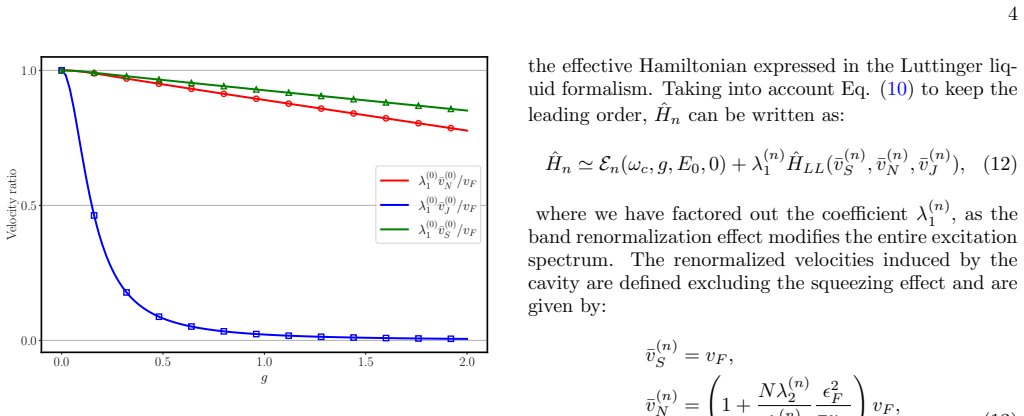
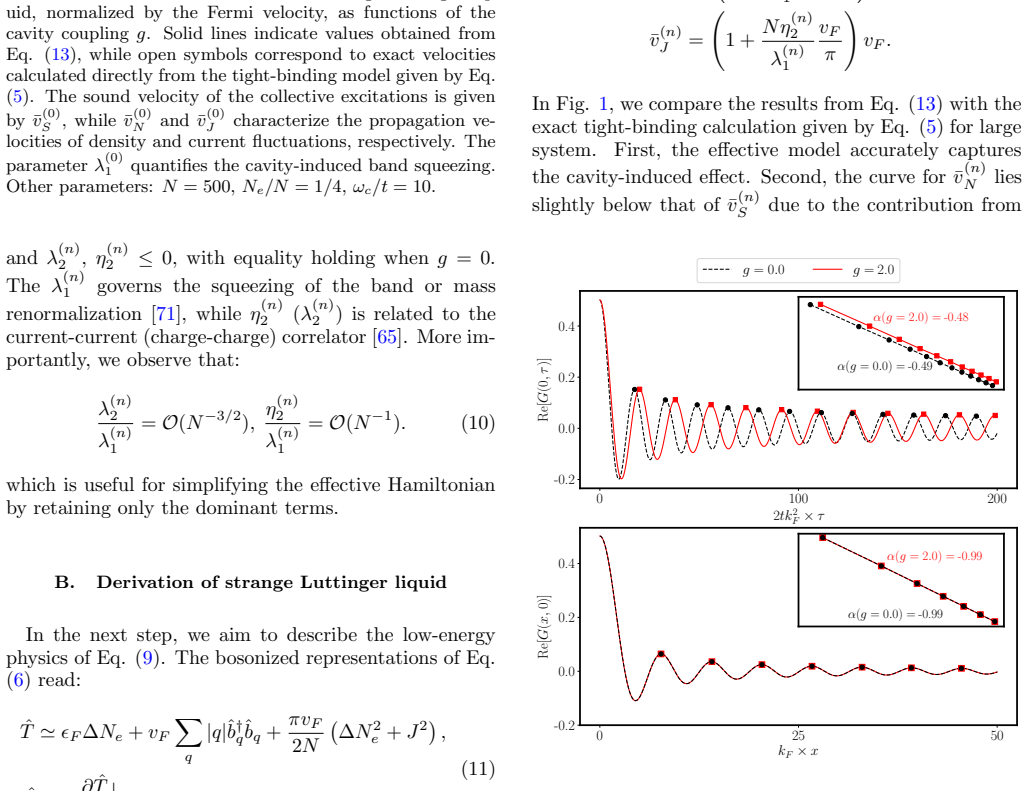
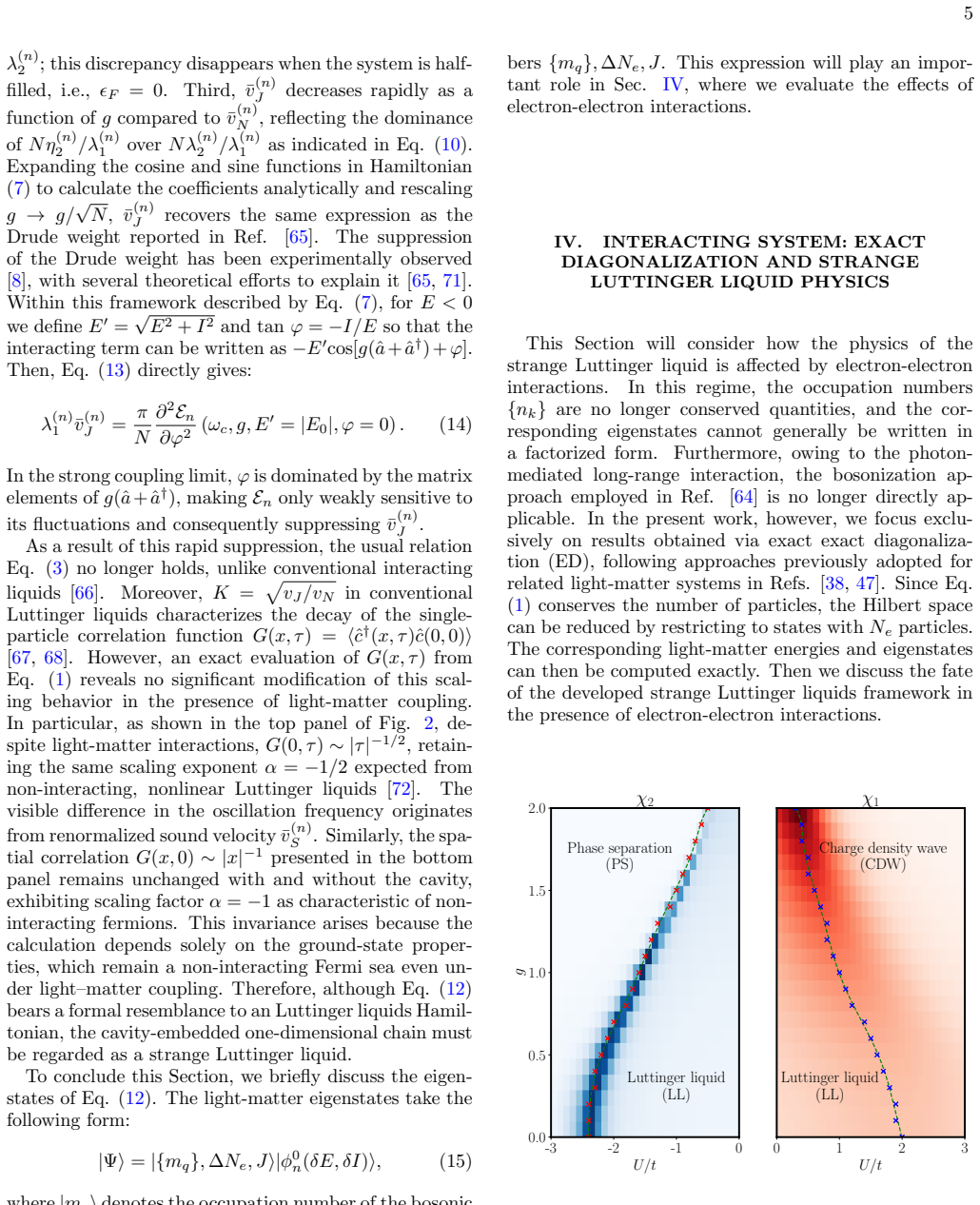
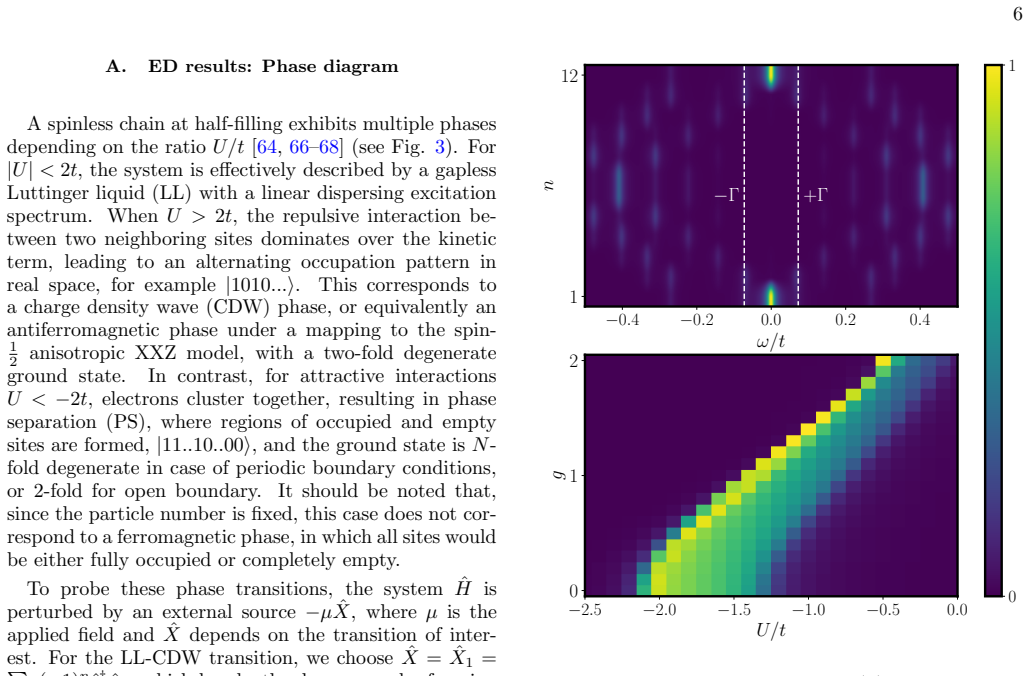
We study a one-dimensional electronic chain coupled to a homogeneous quantized vacuum field and electron-electron interactions. In the absence of the latter, we derive a low-energy effective description in the presence of light-matter coupling, which we identify as a strange Luttinger liquid. Although it retains a formal resemblance to conventional Luttinger liquid theory, the coupling to the quantum field qualitatively modifies the low-energy sector and breaks the standard velocity relation underlying Luttinger universality. For finite electron-electron interactions, we recover a phase diagram featuring several phases as a function of interaction strength and hopping amplitude, including a phase hosting Majorana-like zero modes. Using exact diagonalization, we compute observables that characterize the phase boundaries and show that the cavity field significantly shifts them. We also study the fate of Majorana-like states under the influence of the cavity field, highlighting their modification by light-matter coupling. Finally, we investigate whether the strange Luttinger liquid description identified in the noninteracting regime continues to hold when electron-electron interactions are introduced.
Editorial analysis
A structured set of objections, weighed in public.
Referee Report
Summary. The paper studies a one-dimensional electronic chain coupled to a homogeneous quantized vacuum field together with electron-electron interactions. In the non-interacting limit it derives a low-energy effective theory identified as a 'strange Luttinger liquid' whose bosonic velocities no longer obey the conventional relation v_ρ v_σ = v_F². With interactions it maps a phase diagram versus interaction strength and hopping that includes a phase with Majorana-like zero modes, uses exact diagonalization to extract observables and phase boundaries, and examines how the cavity field shifts those boundaries and modifies the zero modes. It also checks whether the strange-Luttinger-liquid description survives the addition of interactions.
Significance. If the central derivation is correct, the work identifies a cavity-induced modification of Luttinger-liquid universality that is qualitatively distinct from standard treatments. The exact-diagonalization survey of the interacting phase diagram supplies concrete, falsifiable signatures. The result would be of interest to the cavity-QED condensed-matter community provided the homogeneous-field assumption is shown to be robust.
major comments (1)
- [Derivation of the low-energy effective description (non-interacting regime)] The claim that the cavity coupling produces a strange Luttinger liquid whose velocities violate the standard product relation rests on the assumption that the vector potential is strictly homogeneous. The manuscript must demonstrate that wave-vector-dependent vertices arising from any spatial variation of the cavity mode (or from higher multipole terms) do not, after integration, restore v_ρ v_σ = v_F² at the infrared fixed point; otherwise the central distinction from conventional Luttinger theory is lost.
minor comments (1)
- The term 'Majorana-like zero modes' is used without an explicit definition of the diagnostic (e.g., zero-bias conductance peak, parity operator, or entanglement spectrum signature) employed in the exact-diagonalization analysis.
Simulated Author's Rebuttal
We thank the referee for their careful reading of the manuscript and for identifying the need to strengthen the discussion of the homogeneous-field assumption. We address the single major comment below and indicate the planned revision.
read point-by-point responses
-
Referee: [Derivation of the low-energy effective description (non-interacting regime)] The claim that the cavity coupling produces a strange Luttinger liquid whose velocities violate the standard product relation rests on the assumption that the vector potential is strictly homogeneous. The manuscript must demonstrate that wave-vector-dependent vertices arising from any spatial variation of the cavity mode (or from higher multipole terms) do not, after integration, restore v_ρ v_σ = v_F² at the infrared fixed point; otherwise the central distinction from conventional Luttinger theory is lost.
Authors: We agree that the central distinction of the strange Luttinger liquid relies on the strictly homogeneous vector potential used in the model definition. This approximation is standard when the cavity wavelength greatly exceeds the chain length. To address the referee's concern, the revised manuscript will include a new paragraph in the low-energy theory section. There we will perform a power-counting analysis in the bosonized description showing that the leading wave-vector-dependent corrections generate operators that are irrelevant under renormalization-group flow and therefore leave the infrared relation v_ρ v_σ ≠ v_F² intact. This addition will make explicit that the reported distinction survives weak spatial inhomogeneities of the type expected in realistic cavity geometries. revision: yes
Circularity Check
No circularity: derivations rest on explicit assumptions and exact diagonalization, not self-referential fits or citations
full rationale
The paper derives the strange Luttinger liquid description from the model Hamiltonian under the stated homogeneous-field assumption, then uses exact diagonalization for the interacting case to map phases and observables. No equation reduces to a fitted parameter renamed as prediction, no self-citation chain bears the central velocity-relation claim, and the low-energy identification follows from standard bosonization steps applied to the light-matter term. The derivation chain is self-contained and externally falsifiable via the stated numerics and comparison to conventional Luttinger universality.
Axiom & Free-Parameter Ledger
Reference graph
Works this paper leans on
-
[1]
F. J. Garcia-Vidal, C. Ciuti, and T. W. Ebbesen, Ma- nipulating matter by strong coupling to vacuum fields, Science373(2021)
2021
-
[2]
Schlawin, D
F. Schlawin, D. M. Kennes, and M. A. Sentef, Cavity quantum materials, Applied Physics Reviews9(2022)
2022
-
[3]
Bloch, A
J. Bloch, A. Cavalleri, V. Galitski, M. Hafezi, and A. Ru- bio, Strongly correlated electron–photon systems, Nature 606, 41–48 (2022)
2022
-
[4]
I.-T. Lu, D. Shin, M. Kamper Svendsen, S. Latini, H. H¨ ubener, M. Ruggenthaler, and A. Rubio, Cavity en- gineering of solid-state materials without external driv- ing, Advances in Optics and Photonics17, 441 (2025)
2025
-
[5]
D. Basov, A. Asenjo-Garcia, P. J. Schuck, X. Zhu, A. Rubio, A. Cavalleri, M. Delor, M. M. Fogler, and M. Liu, Polaritonic quantum matter, Nanophotonics 10.1515/nanoph-2025-0001 (2025)
-
[6]
Scalari, C
G. Scalari, C. Maissen, D. Turcinkova, D. Hagen- muller, S. D. Liberato, C. Ciuti, C. Reichl, D. Schuh, W. Wegscheider, M. Beck, and J. Faist, Ultrastrong Cou- pling of the Cyclotron Transition of a 2D Electron Gas 10 to a THz Metamaterial, Science335, 1323 (2012)
2012
-
[7]
Keller, G
J. Keller, G. Scalari, S. Cibella, C. Maissen, F. Ap- pugliese, E. Giovine, R. Leoni, M. Beck, and J. Faist, Few-Electron Ultrastrong Light-Matter Coupling at 300 GHz with Nanogap Hybrid LC Microcavities, Nano Let- ters17, 7410 (2017)
2017
-
[8]
G. L. Paravicini-Bagliani, F. Appugliese, E. Richter, F. Valmorra, J. Keller, M. Beck, N. Bartolo, C. R¨ ossler, T. Ihn, K. Ensslin, C. Ciuti, G. Scalari, and J. Faist, Magneto-transport controlled by Landau polariton states, Nature Physics15, 186–190 (2018)
2018
-
[9]
Enkner, L
J. Enkner, L. Graziotto, D. Bori¸ ci, F. Appugliese, C. Re- ichl, G. Scalari, N. Regnault, W. Wegscheider, C. Ciuti, and J. Faist, Tunable vacuum-field control of fractional and integer quantum Hall phases, Nature641, 884–889 (2025)
2025
-
[10]
Ashida, A
Y. Ashida, A. ˙Imamo˘ glu, and E. Demler, Cavity Quan- tum Electrodynamics with Hyperbolic van der Waals Materials, Physical Review Letters130(2023)
2023
-
[11]
Appugliese, J
F. Appugliese, J. Enkner, G. L. Paravicini-Bagliani, M. Beck, C. Reichl, W. Wegscheider, G. Scalari, C. Ciuti, and J. Faist, Breakdown of topological protection by cav- ity vacuum fields in the integer quantum Hall effect, Sci- ence375, 1030 (2022)
2022
-
[12]
Kuroyama, J
K. Kuroyama, J. Kwoen, Y. Arakawa, and K. Hirakawa, Electrical Detection of Ultrastrong Coherent Interaction between Terahertz Fields and Electrons Using Quantum Point Contacts, Nano Letters23, 11402–11408 (2023)
2023
-
[13]
Kuroyama, J
K. Kuroyama, J. Kwoen, Y. Arakawa, and K. Hirakawa, Coherent Interaction of a Few-Electron Quantum Dot with a Terahertz Optical Resonator, Physical Review Letters132(2024)
2024
-
[14]
H. Xue, H.-C. Chan, Z. Lin, D. Bori¸ ci, S. Zhou, Y. Wang, K. Watanabe, T. Taniguchi, C. Ciuti, W. Yao, D.-K. Ki, and S. Zhang, Observation of Cavity-Mediated Nonlin- ear Landau Fan and Modified Landau Level Degener- acy in Graphene Quantum Transport, arXiv:2506.21409 (2025)
-
[15]
G. Jarc, S. Y. Mathengattil, A. Montanaro, F. Giusti, E. M. Rigoni, R. Sergo, F. Fassioli, S. Winnerl, S. Dal Zilio, D. Mihailovic, P. Prelovˇ sek, M. Eckstein, and D. Fausti, Cavity-mediated thermal control of metal- to-insulator transition in 1T-TaS 2, Nature622, 487–492 (2023)
2023
-
[16]
M. A. Sentef, M. Ruggenthaler, and A. Rubio, Cav- ity quantum-electrodynamical polaritonically enhanced electron-phonon coupling and its influence on supercon- ductivity, Science Advances4(2018)
2018
-
[17]
J. B. Curtis, Z. M. Raines, A. A. Allocca, M. Hafezi, and V. M. Galitski, Cavity Quantum Eliashberg Enhance- ment of Superconductivity, Physical Review Letters122 (2019)
2019
-
[18]
Schlawin, A
F. Schlawin, A. Cavalleri, and D. Jaksch, Cavity- Mediated Electron-Photon Superconductivity, Physical Review Letters122(2019)
2019
-
[20]
G´ omez-Le´ on, M
´A. G´ omez-Le´ on, M. Schir` o, and O. Dmytruk, Majorana bound states from cavity embedding in an interacting two-site Kitaev chain, Physical Review B111(2025)
2025
-
[21]
Hagenm¨ uller, J
D. Hagenm¨ uller, J. Schachenmayer, S. Sch¨ utz, C. Genes, and G. Pupillo, Cavity-Enhanced Transport of Charge, Physical Review Letters119(2017)
2017
-
[22]
Hagenm¨ uller, S
D. Hagenm¨ uller, S. Sch¨ utz, J. Schachenmayer, C. Genes, and G. Pupillo, Cavity-assisted mesoscopic transport of fermions: Coherent and dissipative dynamics, Physical Review B97(2018)
2018
-
[23]
Arwas and C
G. Arwas and C. Ciuti, Quantum electron transport con- trolled by cavity vacuum fields, Physical Review B107 (2023)
2023
-
[24]
Rokaj, J
V. Rokaj, J. Wang, J. Sous, M. Penz, M. Ruggenthaler, and A. Rubio, Weakened Topological Protection of the Quantum Hall Effect in a Cavity, Physical Review Letters 131(2023)
2023
-
[25]
Winter and O
L. Winter and O. Zilberberg, Fractional quantum Hall edge polaritons, Physical Review B112(2025)
2025
- [26]
-
[27]
Bori¸ ci, G
D. Bori¸ ci, G. Arwas, and C. Ciuti, Cavity-modified quan- tum electron transport in multiterminal devices and in- terferometers, Physical Review B112(2025)
2025
-
[28]
Dmytruk and M
O. Dmytruk and M. Schir` o, Controlling topological phases of matter with quantum light, Communications Physics5(2022)
2022
-
[29]
J. Li, L. Schamriß, and M. Eckstein, Effective theory of lattice electrons strongly coupled to quantum electromag- netic fields, Physical Review B105(2022)
2022
-
[30]
Shaffer, M
D. Shaffer, M. Claassen, A. Srivastava, and L. H. San- tos, Entanglement and topology in Su-Schrieffer-Heeger cavity quantum electrodynamics, Physical Review B109 (2024)
2024
-
[31]
Z. Lin, C. Xiao, D.-P. Nguyen, G. Arwas, C. Ciuti, and W. Yao, Remote gate control of topological transitions in moir´ e superlattices via cavity vacuum fields, Proceedings of the National Academy of Sciences120(2023)
2023
-
[32]
Dmytruk and M
O. Dmytruk and M. Schir` o, Hybrid light-matter states in topological superconductors coupled to cavity photons, Physical Review B110(2024)
2024
-
[33]
C. B. Dag and V. Rokaj, Engineering topology in graphene with chiral cavities, Physical Review B110 (2024)
2024
-
[34]
P´ erez-Gonz´ alez, G
B. P´ erez-Gonz´ alez, G. Platero, and ´A. G´ omez-Le´ on, Light-matter correlations in Quantum Floquet engineer- ing of cavity quantum materials, Quantum9, 1633 (2025)
2025
-
[35]
F. P. M. M´ endez-C´ ordoba, J. J. Mendoza-Arenas, F. J. G´ omez-Ruiz, F. J. Rodr´ ıguez, C. Tejedor, and L. Quiroga, R´ enyi entropy singularities as signatures of topological criticality in coupled photon-fermion systems, Physical Review Research2(2020)
2020
-
[36]
F. P. M. M´ endez-C´ ordoba, F. J. Rodr´ ıguez, C. Tejedor, and L. Quiroga, From edge to bulk: Cavity-induced dis- placement of topological nonlocal qubits, Physical Re- view B107(2023)
2023
-
[37]
Yang and Q.-D
L. Yang and Q.-D. Jiang, Emergent Haldane model and photon-valley locking in chiral cavities, Communications Physics8(2025)
2025
-
[38]
Fernandez Becerra and O
V. Fernandez Becerra and O. Dmytruk, Fermion parity switching in a short kitaev chain coupled to a photonic cavity, Physical Review B113(2026)
2026
-
[39]
Poor man's Majorana bound states in quantum dot based Kitaev chain coupled to a photonic cavity
F. Buonemani, ´A. G´ omez-Le´ on, M. Schir` o, and O. Dmytruk, Poor man’s Majorana bound states in quan- tum dot based Kitaev chain coupled to a photonic cavity, 11 arXiv:2604.15036 (2026)
work page internal anchor Pith review Pith/arXiv arXiv 2026
-
[40]
Topological markers for a one-dimensional fermionic chain coupled to a single-mode cavity
A. Ritz-Zwilling and O. Dmytruk, Topological markers for a one-dimensional fermionic chain coupled to a single- mode cavity, arXiv:2604.13936 (2026)
work page internal anchor Pith review Pith/arXiv arXiv 2026
-
[41]
L. H. Santos, Logarithmic Entanglement and Emergent Dipole Symmetry from a Strongly Coupled Light-Matter Quantum Circuit, arXiv:2604.18670 (2026)
work page internal anchor Pith review Pith/arXiv arXiv 2026
-
[42]
Shin, I.-T
D. Shin, I.-T. Lu, B. Fan, E. V. Bostr¨ om, H. Liu, M. K. Svendsen, S. Latini, P. Tang, and A. Rubio, Multiple pho- ton field–induced topological states in bulk HgTe, Science Advances12(2026)
2026
-
[43]
L. Yang, G. Cardoso, T. H. Hansson, and Q.-D. Jiang, Quantum Hall effect in a chiral cavity, Physical Review B113(2026)
2026
-
[44]
Bacciconi, H
Z. Bacciconi, H. B. Xavier, I. Carusotto, T. Chanda, and M. Dalmonte, Theory of Fractional Quantum Hall Liq- uids Coupled to Quantum Light and Emergent Graviton- Polaritons, Physical Review X15(2025)
2025
-
[45]
H. B. Xavier, Z. Bacciconi, T. Chanda, D. T. Son, and M. Dalmonte, Chiral Graviton Modes on the Lattice, Physical Review Letters135(2025)
2025
-
[46]
Nguyen, G
D.-P. Nguyen, G. Arwas, Z. Lin, W. Yao, and C. Ciuti, Electron-Photon Chern Number in Cavity-Embedded 2D Moir´ e Materials, Physical Review Letters131(2023)
2023
-
[47]
Nguyen, G
D.-P. Nguyen, G. Arwas, and C. Ciuti, Electron conduc- tance and many-body marker of a cavity-embedded topo- logical one-dimensional chain, Physical Review B110 (2024)
2024
-
[48]
Bacciconi, G
Z. Bacciconi, G. M. Andolina, and C. Mora, Topological protection of Majorana polaritons in a cavity, Physical Review B109(2024)
2024
- [49]
-
[50]
Ac´ ın, I
A. Ac´ ın, I. Bloch, H. Buhrman, T. Calarco, C. Eichler, J. Eisert, D. Esteve, N. Gisin, S. J. Glaser, F. Jelezko, S. Kuhr, M. Lewenstein, M. F. Riedel, P. O. Schmidt, R. Thew, A. Wallraff, I. Walmsley, and F. K. Wilhelm, The quantum technologies roadmap: a European com- munity view, New Journal of Physics20, 080201 (2018)
2018
-
[51]
Proctor, K
T. Proctor, K. Young, A. D. Baczewski, and R. Blume- Kohout, Benchmarking quantum computers, Nature Re- views Physics7, 105–118 (2025)
2025
-
[52]
A. Y. Kitaev, Unpaired Majorana fermions in quantum wires, Physics-Uspekhi44, 131–136 (2001)
2001
-
[53]
Alicea, New directions in the pursuit of Majorana fermions in solid state systems, Reports on Progress in Physics75, 076501 (2012)
J. Alicea, New directions in the pursuit of Majorana fermions in solid state systems, Reports on Progress in Physics75, 076501 (2012)
2012
-
[54]
Beenakker, Search for Majorana Fermions in Super- conductors, Annual Review of Condensed Matter Physics 4, 113–136 (2013)
C. Beenakker, Search for Majorana Fermions in Super- conductors, Annual Review of Condensed Matter Physics 4, 113–136 (2013)
2013
-
[55]
Prada, P
E. Prada, P. San-Jose, M. W. A. de Moor, A. Geresdi, E. J. H. Lee, J. Klinovaja, D. Loss, J. Nyg˚ ard, R. Aguado, and L. P. Kouwenhoven, From Andreev to Majorana bound states in hybrid superconductor–semiconductor nanowires, Nature Reviews Physics2, 575–594 (2020)
2020
-
[56]
S. D. Sarma, M. Freedman, and C. Nayak, Majorana zero modes and topological quantum computation, npj Quantum Information1(2015)
2015
-
[57]
Schirmer, C.-X
J. Schirmer, C.-X. Liu, and J. K. Jain, Phase diagram of superconductivity in the integer quantum Hall regime, Proceedings of the National Academy of Sciences119 (2022)
2022
-
[58]
V. K. Kozin, E. Thingstad, D. Loss, and J. Klinovaja, Cavity-enhanced superconductivity via band engineer- ing, Physical Review B111(2025)
2025
-
[59]
A. J. Leggett,Quantum Liquids: Bose condensation and Cooper pairing in condensed-matter systems(Oxford University PressOxford, 2006)
2006
-
[60]
Lin and A
Y. Lin and A. J. Leggett, Some questions concerning Ma- jorana fermions in 2D (p + ip) Fermi superfluids, Quan- tum Frontiers1(2022)
2022
-
[61]
C. V. Kraus, M. Dalmonte, M. A. Baranov, A. M. L¨ auchli, and P. Zoller, Majorana Edge States in Atomic Wires Coupled by Pair Hopping, Physical Review Letters 111(2013)
2013
-
[62]
C. Chen, W. Yan, C. S. Ting, Y. Chen, and F. J. Burnell, Flux-stabilized Majorana zero modes in coupled one- dimensional Fermi wires, Physical Review B98(2018)
2018
-
[63]
Iemini, D
F. Iemini, D. Rossini, R. Fazio, S. Diehl, and L. Mazza, Dissipative topological superconductors in number- conserving systems, Physical Review B93(2016)
2016
-
[64]
Vadimov, T
V. Vadimov, T. Hyart, J. L. Lado, M. M¨ ott¨ onen, and T. Ala-Nissila, Many-body Majorana-like zero modes without gauge symmetry breaking, Physical Review Re- search3(2021)
2021
-
[65]
C. J. Eckhardt, G. Passetti, M. Othman, C. Karrasch, F. Cavaliere, M. A. Sentef, and D. M. Kennes, Quan- tum Floquet engineering with an exactly solvable tight- binding chain in a cavity, Communications Physics5 (2022)
2022
-
[66]
F. D. M. Haldane, General Relation of Correlation Expo- nents and Spectral Properties of One-Dimensional Fermi Systems: Application to the AnisotropicS= 1 2 Heisen- berg Chain, Physical Review Letters45, 1358–1362 (1980)
1980
-
[67]
Giamarchi,Quantum Physics in One Dimension(Ox- ford University Press, 2003)
T. Giamarchi,Quantum Physics in One Dimension(Ox- ford University Press, 2003)
2003
-
[68]
Sutherland,Beautiful Models: 70 Years of Exactly Solved Quantum Many-Body Problems(WORLD SCI- ENTIFIC, 2004)
B. Sutherland,Beautiful Models: 70 Years of Exactly Solved Quantum Many-Body Problems(WORLD SCI- ENTIFIC, 2004)
2004
-
[69]
F. D. M. Haldane, ‘Luttinger liquid theory’ of one- dimensional quantum fluids. I. Properties of the Lut- tinger model and their extension to the general 1D in- teracting spinless Fermi gas, Journal of Physics C: Solid State Physics14, 2585–2609 (1981)
1981
-
[70]
Bouchoule, R
I. Bouchoule, R. Citro, T. Duty, T. Giamarchi, R. G. Hulet, M. Klanjˇ sek, E. Orignac, and B. We- ber, Platforms for the realization and characterization of Tomonaga–Luttinger liquids, Nature Reviews Physics 7, 565–580 (2025)
2025
-
[71]
Rokaj, M
V. Rokaj, M. Ruggenthaler, F. G. Eich, and A. Ru- bio, Free electron gas in cavity quantum electrodynamics, Physical Review Research4(2022)
2022
-
[72]
R. G. Pereira, LONG TIME CORRELATIONS OF NONLINEAR LUTTINGER LIQUIDS, International Journal of Modern Physics B26, 1244008 (2012)
2012
discussion (0)
Sign in with ORCID, Apple, or X to comment. Anyone can read and Pith papers without signing in.