The fingerprint of primordial mass segregation on the tidal tails of star clusters
Pith reviewed 2026-07-03 19:39 UTC · model grok-4.3
The pith
Primordial mass segregation produces denser, unified, and longer tidal tails in star clusters early in their evolution.
A machine-rendered reading of the paper's core claim, the machinery that carries it, and where it could break.
Core claim
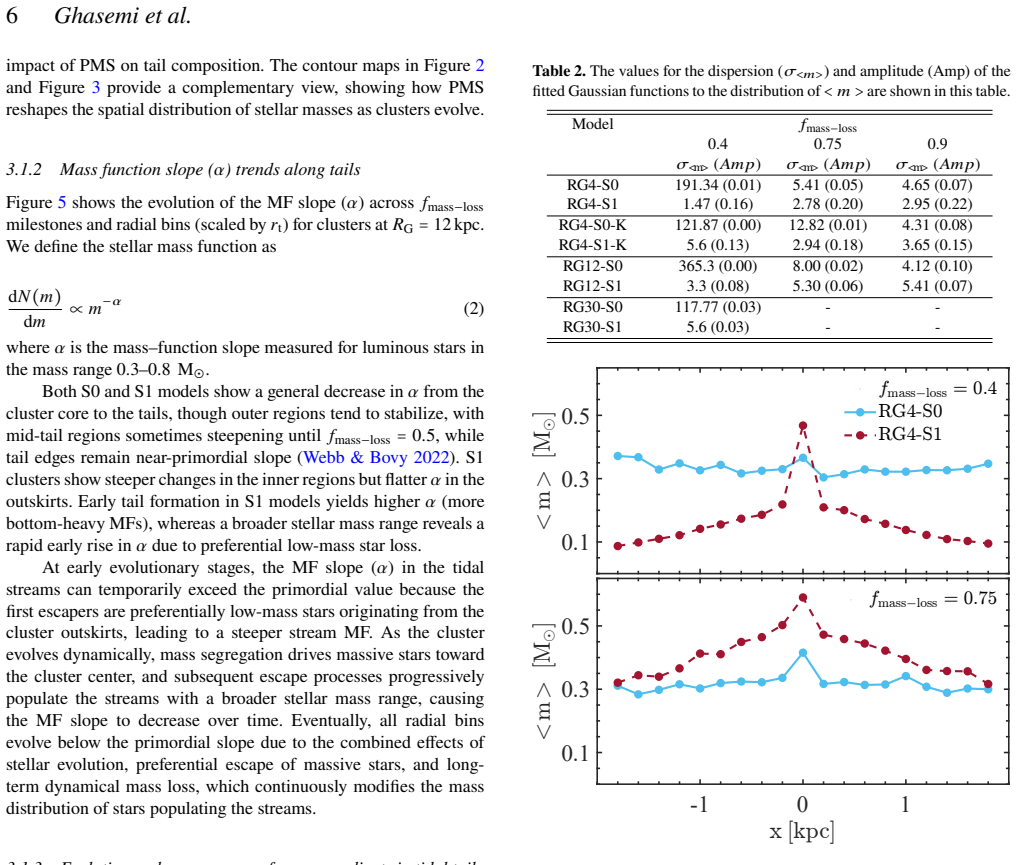
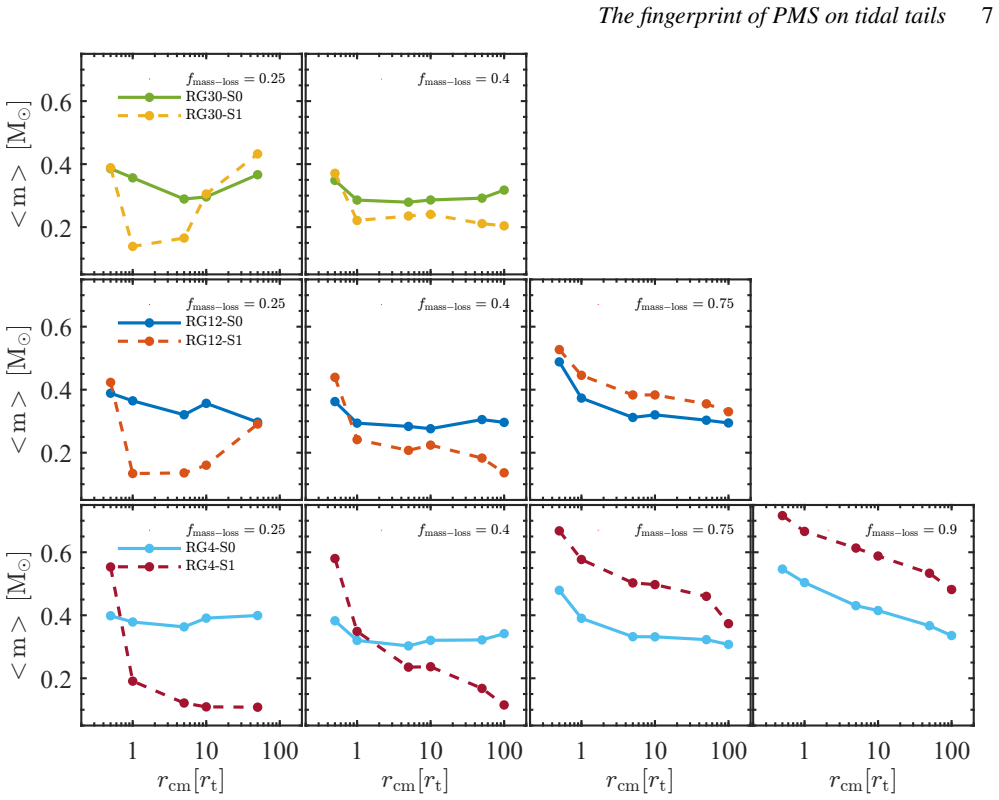
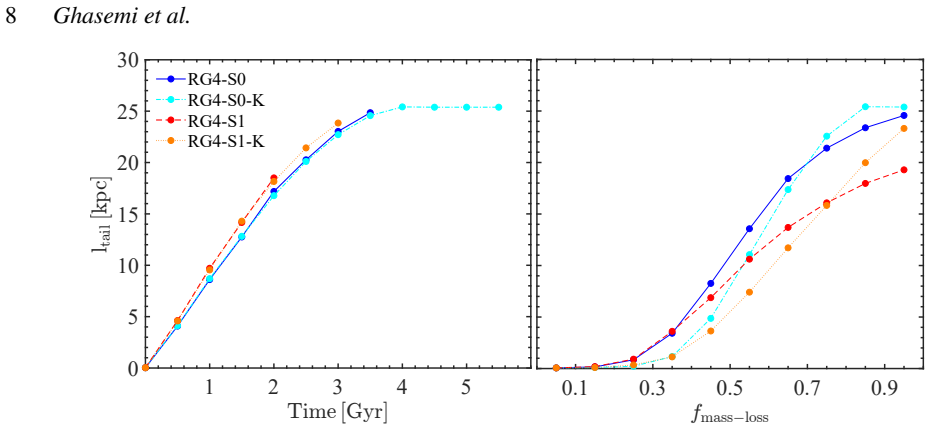
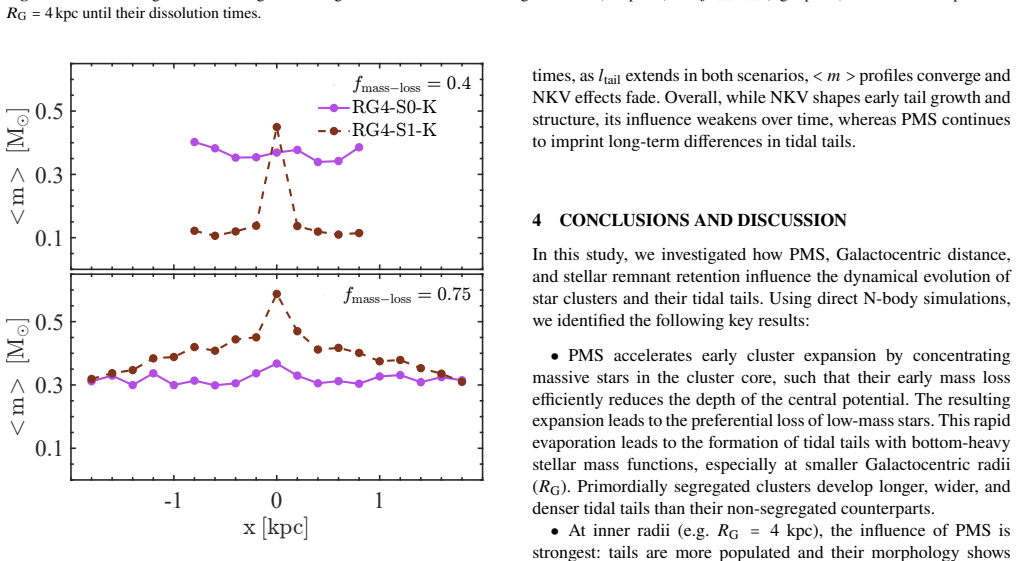
N-body simulations of clusters with different degrees of primordial mass segregation at various Galactocentric distances show that primordially segregated clusters form denser, unified, and longer tidal tail structures with a bottom-heavy stellar mass function compared to non-segregated clusters. The effect is stronger at smaller R_G but weakens over time, with mean stellar mass distributions along the tails converging at later stages. Stellar remnant retention has only a weak effect on the mass distribution and tail morphology.
What carries the argument
N-body simulations that compare primordially mass-segregated and non-segregated clusters to measure tidal tail density, length, unity, and the stellar mass function along the tails.
If this is right
- Mean stellar mass along the tails follows distinct patterns for segregated versus non-segregated clusters that converge at later times.
- The rate of change in mean mass along the tails for segregated clusters eventually matches that of non-segregated clusters.
- Black hole retention has only a weak effect on mean mass distribution and tail morphology.
- Tail structure differences are more pronounced at smaller Galactocentric distances.
- The overall influence of primordial mass segregation on tail properties fades during cluster evolution.
Where Pith is reading between the lines
- Observations of mass functions in the tails of young clusters could indicate whether they began with primordial mass segregation.
- Late-time observations of old clusters may not retain clear signatures of initial mass segregation.
- Comparing clusters at a range of galactic distances could test how strongly the galactic potential modulates the PMS signal in tails.
- Simulations with a wider range of initial cluster masses or orbital parameters would show whether the reported tail differences hold more generally.
Load-bearing premise
The two chosen degrees of primordial mass segregation together with the specific galactic potential and black hole retention fractions match the range present in real star clusters.
What would settle it
Finding young star clusters whose tidal tails show no measurable difference in density, length, or low-mass star fraction between clusters expected to have had high versus low primordial mass segregation.
Figures
read the original abstract
We investigate the effect of primordial mass segregation (PMS) in shaping the tidal tail structures of star clusters, searching for any trace of PMS on the tails at both early and late evolutionary stages. Through N-body simulations, we analyze clusters with two different degrees of PMS at various Galactocentric distances (R_G), considering two black hole retention scenarios. Our findings reveal that PMS influences early cluster expansion and the formation of tidal tails with a bottom-heavy stellar mass function, this being more pronounced at smaller R_G but diminishes over time. Primordially segregated clusters exhibit denser, unified, and longer tail structures compared to non-segregated clusters. The mean stellar mass distribution along the tails shows distinct patterns for primordially segregated and non-segregated clusters, converging at later evolutionary stages. The retention of stellar remnants has a weak impact on the mean mass distribution along the tails and on its morphology. We find that although mean mass differences persist along the tidal tails, the rate of change in primordially mass-segregated clusters eventually converges with that of non-segregated clusters, suggesting that the influence of primordial mass segregation on the tidal tails gradually diminishes over the course of cluster evolution.
Editorial analysis
A structured set of objections, weighed in public.
Referee Report
Summary. The manuscript reports N-body simulations comparing star clusters with two discrete levels of primordial mass segregation (PMS) at multiple Galactocentric distances (R_G) and two black-hole retention fractions. It finds that PMS drives earlier cluster expansion and produces tidal tails with bottom-heavy stellar mass functions (stronger at small R_G), with segregated clusters forming denser, unified, and longer tails. Mean stellar mass distributions along the tails differ initially but converge at later times; black-hole retention has only weak effects, and the overall PMS imprint diminishes over cluster evolution.
Significance. If the reported trends are robust, the work demonstrates that initial mass segregation can leave observable morphological and mass-function signatures in tidal tails, offering a potential diagnostic for the early dynamical state of clusters. The parameter survey across R_G and retention fractions is a positive feature, as is the explicit tracking of time evolution showing convergence of the PMS effect.
major comments (2)
- [Methods] Methods section (simulation setup and post-processing): the abstract and results describe consistent trends across runs but report no quantitative error bars, no convergence tests with respect to particle number or integration accuracy, and no explicit description of how tail membership is assigned in post-processing. These omissions are load-bearing because the central claims rest on differences in tail density, length, and mass-function gradients.
- [Results] Results on tail morphology and mass functions: the statements that PMS produces 'denser, unified, and longer' tails and distinct mean-mass patterns are presented without statistical significance measures or sensitivity tests to the two chosen PMS degrees. This weakens the ability to judge whether the reported differences are robust or could be altered by modest changes in the free parameters (PMS level, R_G, retention fraction).
Simulated Author's Rebuttal
We thank the referee for the constructive and detailed report. We address each major comment point by point below, agreeing where clarifications and additions are warranted, and will revise the manuscript accordingly.
read point-by-point responses
-
Referee: [Methods] Methods section (simulation setup and post-processing): the abstract and results describe consistent trends across runs but report no quantitative error bars, no convergence tests with respect to particle number or integration accuracy, and no explicit description of how tail membership is assigned in post-processing. These omissions are load-bearing because the central claims rest on differences in tail density, length, and mass-function gradients.
Authors: We agree these details should be explicit. In the revised manuscript we will add: (i) a precise description of the post-processing algorithm used to assign tail membership (based on stars lying beyond a multiple of the instantaneous tidal radius with velocities exceeding the local escape speed and aligned with the orbital direction); (ii) quantitative error bars on all reported tail properties, computed as the standard deviation across the ensemble of runs at each R_G and retention fraction; and (iii) a short convergence subsection noting the adopted particle number (N = 10^5) and timestep accuracy, together with a reference to prior validation of the integrator for similar cluster problems. These additions will be placed in the Methods section. revision: yes
-
Referee: [Results] Results on tail morphology and mass functions: the statements that PMS produces 'denser, unified, and longer' tails and distinct mean-mass patterns are presented without statistical significance measures or sensitivity tests to the two chosen PMS degrees. This weakens the ability to judge whether the reported differences are robust or could be altered by modest changes in the free parameters (PMS level, R_G, retention fraction).
Authors: The two PMS levels were selected to represent moderate and strong segregation, and the reported trends hold uniformly across the surveyed R_G and retention values. To strengthen the presentation we will insert statistical significance measures (standard errors on mean-mass profiles and, where appropriate, two-sample KS-test p-values for mass-function differences) directly into the figures and text. We will also add a short paragraph discussing sensitivity to the precise PMS parameter values, noting that the morphological and mass-function contrasts scale monotonically with the degree of segregation. Because the existing runs already span a range of R_G and retention fractions, these additions can be made from the current data set. revision: partial
Circularity Check
No significant circularity; simulation results are independent of inputs
full rationale
The paper performs direct N-body simulations of star clusters with two discrete levels of primordial mass segregation, varying Galactocentric radius and black-hole retention, then reports morphological and mass-function differences in the resulting tidal tails. No analytic derivation, fitted parameter, or self-citation chain is invoked to obtain the reported trends; the outcomes are generated by the numerical integration itself under the stated initial conditions. The comparison between segregated and non-segregated runs is therefore not reducible to a redefinition or renaming of the input assumptions.
Axiom & Free-Parameter Ledger
free parameters (3)
- degree of primordial mass segregation
- Galactocentric distance R_G
- black-hole retention fraction
axioms (2)
- standard math Newtonian gravity and standard stellar evolution prescriptions govern the N-body evolution
- domain assumption The chosen initial conditions for PMS are physically plausible
Reference graph
Works this paper leans on
-
[1]
J., 1999, @doi [ ] 10.1086/316455 , https://ui.adsabs.harvard.edu/abs/1999PASP..111.1333A 111, 1333
Aarseth S. J., 1999, @doi [ ] 10.1086/316455 , https://ui.adsabs.harvard.edu/abs/1999PASP..111.1333A 111, 1333
-
[2]
J., 2003, Gravitational N-body simulations: tools and algorithms
Aarseth S. J., 2003, Gravitational N-body simulations: tools and algorithms. Cambridge University Press
2003
-
[3]
Allison R. J., Goodwin S. P., Parker R. J., de Grijs R., Portegies Zwart S. F., Kouwenhoven M. B. N., 2009, @doi [ ] 10.1088/0004-637X/700/2/L99 , https://ui.adsabs.harvard.edu/abs/2009ApJ...700L..99A 700, L99
-
[4]
Baumgardt H., Makino J., 2003, @doi [ ] 10.1046/j.1365-8711.2003.06286.x , https://ui.adsabs.harvard.edu/abs/2003MNRAS.340..227B 340, 227
-
[5]
Belokurov V., Evans N. W., Irwin M. J., Hewett P. C., Wilkinson M. I., 2006, @doi [ ] 10.1086/500362 , https://ui.adsabs.harvard.edu/abs/2006ApJ...637L..29B 637, L29
-
[6]
Bernard E. J., et al., 2014, @doi [ ] 10.1093/mnrasl/slu089 , https://ui.adsabs.harvard.edu/abs/2014MNRAS.443L..84B 443, L84
-
[7]
Boffin H. M. J., Jerabkova T., Beccari G., Wang L., 2022, @doi [ ] 10.1093/mnras/stac1567 , https://ui.adsabs.harvard.edu/abs/2022MNRAS.514.3579B 514, 3579
-
[8]
J., 1934, Harvard College Observatory Circular, https://ui.adsabs.harvard.edu/abs/1934HarCi.384....1B 384, 1
Bok B. J., 1934, Harvard College Observatory Circular, https://ui.adsabs.harvard.edu/abs/1934HarCi.384....1B 384, 1
1934
-
[9]
Bonaca A., Geha M., K \"u pper A. H. W., Diemand J., Johnston K. V., Hogg D. W., 2014, @doi [ ] 10.1088/0004-637X/795/1/94 , https://ui.adsabs.harvard.edu/abs/2014ApJ...795...94B 795, 94
-
[10]
Bonnell I. A., Bate M. R., 2002, @doi [ ] 10.1046/j.1365-8711.2002.05794.x , https://ui.adsabs.harvard.edu/abs/2002MNRAS.336..659B 336, 659
-
[11]
Bonnell I. A., Davies M. B., 1998, @doi [ ] 10.1046/j.1365-8711.1998.01372.x , https://ui.adsabs.harvard.edu/abs/1998MNRAS.295..691B 295, 691
-
[12]
Capuzzo Dolcetta R., Di Matteo P., Miocchi P., 2005, @doi [ ] 10.1086/426006 , https://ui.adsabs.harvard.edu/abs/2005AJ....129.1906C 129, 1906
-
[13]
Chumak Y. O., Platais I., McLaughlin D. E., Rastorguev A. S., Chumak O. V., 2010, @doi [ ] 10.1111/j.1365-2966.2009.16021.x , https://ui.adsabs.harvard.edu/abs/2010MNRAS.402.1841C 402, 1841
-
[14]
Fischer P., Pryor C., Murray S., Mateo M., Richtler T., 1998, @doi [ ] 10.1086/300212 , https://ui.adsabs.harvard.edu/abs/1998AJ....115..592F 115, 592
-
[15]
Frank M. J., Hilker M., Baumgardt H., C \^o t \'e P., Grebel E. K., Haghi H., K \"u pper A. H. W., Djorgovski S. G., 2012, @doi [ ] 10.1111/j.1365-2966.2012.21105.x , https://ui.adsabs.harvard.edu/abs/2012MNRAS.423.2917F 423, 2917
-
[16]
Frank M. J., Grebel E. K., K \"u pper A. H. W., 2014, @doi [ ] 10.1093/mnras/stu1197 , https://ui.adsabs.harvard.edu/abs/2014MNRAS.443..815F 443, 815
-
[17]
M., Rostami-Shirazi A., Khalaj P., Zonoozi A
Ghasemi S. M., Rostami-Shirazi A., Khalaj P., Zonoozi A. H., Haghi H., 2024, @doi [ ] 10.1093/mnras/stae2212 , https://ui.adsabs.harvard.edu/abs/2024MNRAS.535.1475G 535, 1475
-
[18]
Gieles M., Erkal D., Antonini F., Balbinot E., Pe \ n arrubia J., 2021, @doi [Nature Astronomy] 10.1038/s41550-021-01392-2 , https://ui.adsabs.harvard.edu/abs/2021NatAs...5..957G 5, 957
-
[19]
Gnedin O. Y., Ostriker J. P., 1997, @doi [ ] 10.1086/303441 , https://ui.adsabs.harvard.edu/abs/1997ApJ...474..223G 474, 223
-
[20]
Gouliermis D., Keller S. C., Kontizas M., Kontizas E., Bellas-Velidis I., 2004, @doi [ ] 10.1051/0004-6361:20031702 , https://ui.adsabs.harvard.edu/abs/2004A&A...416..137G 416, 137
-
[21]
Gouliermis D. A., de Grijs R., Xin Y., 2009, @doi [ ] 10.1088/0004-637X/692/2/1678 , https://ui.adsabs.harvard.edu/abs/2009ApJ...692.1678G 692, 1678
-
[22]
Grillmair C. J., 2009, @doi [ ] 10.1088/0004-637X/693/2/1118 , https://ui.adsabs.harvard.edu/abs/2009ApJ...693.1118G 693, 1118
-
[23]
Grillmair C. J., Freeman K. C., Irwin M., Quinn P. J., 1995, @doi [ ] 10.1086/117470 , https://ui.adsabs.harvard.edu/abs/1995AJ....109.2553G 109, 2553
-
[24]
Grillmair C. J., Cutri R., Masci F. J., Conrow T., Sesar B., Eisenhardt P. R. M., Wright E. L., 2013, @doi [ ] 10.1088/2041-8205/769/2/L23 , https://ui.adsabs.harvard.edu/abs/2013ApJ...769L..23G 769, L23
-
[25]
Haghi H., Hoseini-Rad S. M., Zonoozi A. H., K \"u pper A. H. W., 2014, @doi [ ] 10.1093/mnras/stu1714 , https://ui.adsabs.harvard.edu/abs/2014MNRAS.444.3699H 444, 3699
-
[26]
Haghi H., Zonoozi A. H., Kroupa P., Banerjee S., Baumgardt H., 2015, @doi [ ] 10.1093/mnras/stv2207 , https://ui.adsabs.harvard.edu/abs/2015MNRAS.454.3872H 454, 3872
-
[27]
Heggie D., Hut P., 2003, The Gravitational Million-Body Problem: A Multidisciplinary Approach to Star Cluster Dynamics
2003
-
[28]
A., 1997, @doi [ ] 10.1086/118389 , https://ui.adsabs.harvard.edu/abs/1997AJ....113.1733H 113, 1733
Hillenbrand L. A., 1997, @doi [ ] 10.1086/118389 , https://ui.adsabs.harvard.edu/abs/1997AJ....113.1733H 113, 1733
-
[29]
Hurley J. R., Pols O. R., Tout C. A., 2000, @doi [ ] 10.1046/j.1365-8711.2000.03426.x , https://ui.adsabs.harvard.edu/abs/2000MNRAS.315..543H 315, 543
-
[30]
Hurley J. R., Tout C. A., Pols O. R., 2002, @doi [ ] 10.1046/j.1365-8711.2002.05038.x , https://ui.adsabs.harvard.edu/abs/2002MNRAS.329..897H 329, 897
-
[31]
Ibata R. A., Malhan K., Martin N. F., 2019, @doi [ ] 10.3847/1538-4357/ab0080 , https://ui.adsabs.harvard.edu/abs/2019ApJ...872..152I 872, 152
-
[32]
Jadhav V. V., Risbud D., Kroupa P., Wu W., 2025, @doi [ ] 10.1051/0004-6361/202555858 , https://ui.adsabs.harvard.edu/abs/2025A&A...704A..50J 704, A50
-
[33]
Jerabkova T., Boffin H. M. J., Beccari G., de Marchi G., de Bruijne J. H. J., Prusti T., 2021, @doi [ ] 10.1051/0004-6361/202039949 , https://ui.adsabs.harvard.edu/abs/2021A&A...647A.137J 647, A137
-
[34]
Jordi K., et al., 2009, @doi [ ] 10.1088/0004-6256/137/6/4586 , https://ui.adsabs.harvard.edu/abs/2009AJ....137.4586J 137, 4586
-
[35]
Just A., Berczik P., Petrov M. I., Ernst A., 2009, @doi [ ] 10.1111/j.1365-2966.2008.14099.x , https://ui.adsabs.harvard.edu/abs/2009MNRAS.392..969J 392, 969
-
[36]
Kaderali S., Hunt J. A. S., Webb J. J., Price-Jones N., Carlberg R., 2019, @doi [ ] 10.1093/mnrasl/slz015 , https://ui.adsabs.harvard.edu/abs/2019MNRAS.484L.114K 484, L114
-
[37]
Keller S. C., Da Costa G. S., Prior S. L., 2009, @doi [ ] 10.1111/j.1365-2966.2009.14393.x , https://ui.adsabs.harvard.edu/abs/2009MNRAS.394.1045K 394, 1045
-
[38]
Koposov S. E., Belokurov V., Zucker D. B., Lewis G. F., Ibata R. A., Olszewski E. W., L \'o pez-S \'a nchez \'A . R., Hyde E. A., 2015, @doi [ ] 10.1093/mnras/stu2263 , https://ui.adsabs.harvard.edu/abs/2015MNRAS.446.3110K 446, 3110
-
[39]
Kos J., 2024, @doi [arXiv e-prints] 10.48550/arXiv.2406.18767 , https://ui.adsabs.harvard.edu/abs/2024arXiv240618767K p. arXiv:2406.18767
-
[40]
Kroupa P., 2001, @doi [ ] 10.1046/j.1365-8711.2001.04022.x , https://ui.adsabs.harvard.edu/abs/2001MNRAS.322..231K 322, 231
-
[41]
Kroupa P., 2008, in Aarseth S. J., Tout C. A., Mardling R. A., eds, , Vol. 760, The Cambridge N-Body Lectures. p. 181, @doi 10.1007/978-1-4020-8431-7_8
-
[42]
Kroupa P., et al., 2022, @doi [ ] 10.1093/mnras/stac2563 , https://ui.adsabs.harvard.edu/abs/2022MNRAS.517.3613K 517, 3613
-
[43]
Kroupa P., Pflamm-Altenburg J., Mazurenko S., Wu W., Thies I., Jadhav V., Jerabkova T., 2024, @doi [ ] 10.3847/1538-4357/ad4c66 , https://ui.adsabs.harvard.edu/abs/2024ApJ...970...94K 970, 94
-
[44]
K \"u pper A. H. W., Macleod A., Heggie D. C., 2008, @doi [Astronomische Nachrichten] 10.1002/asna.200811069 , https://ui.adsabs.harvard.edu/abs/2008AN....329.1061K 329, 1061
-
[45]
K \"u pper A. H. W., Kroupa P., Baumgardt H., Heggie D. C., 2010, @doi [ ] 10.1111/j.1365-2966.2009.15690.x , https://ui.adsabs.harvard.edu/abs/2010MNRAS.401..105K 401, 105
-
[46]
K \"u pper A. H. W., Maschberger T., Kroupa P., Baumgardt H., 2011, @doi [ ] 10.1111/j.1365-2966.2011.19412.x , https://ui.adsabs.harvard.edu/abs/2011MNRAS.417.2300K 417, 2300
-
[47]
K \"u pper A. H. W., Lane R. R., Heggie D. C., 2012, @doi [ ] 10.1111/j.1365-2966.2011.20242.x , https://ui.adsabs.harvard.edu/abs/2012MNRAS.420.2700K 420, 2700
-
[48]
Kustaanheimo P., SCHINZEL A., DAVENPORT H., STIEFEL E., 1965, @doi [] doi:10.1515/crll.1965.218.204 , 1965, 204
-
[49]
Lauchner A., Powell W. Lee J., Wilhelm R., 2006, @doi [ ] 10.1086/509254 , https://ui.adsabs.harvard.edu/abs/2006ApJ...651L..33L 651, L33
-
[50]
Malhan K., Ibata R. A., 2018, @doi [ ] 10.1093/mnras/sty912 , https://ui.adsabs.harvard.edu/abs/2018MNRAS.477.4063M 477, 4063
-
[51]
Malhan K., Ibata R. A., Martin N. F., 2018, @doi [ ] 10.1093/mnras/sty2474 , https://ui.adsabs.harvard.edu/abs/2018MNRAS.481.3442M 481, 3442
-
[52]
McMillan S. L. W., Vesperini E., Portegies Zwart S. F., 2007, @doi [ ] 10.1086/511763 , https://ui.adsabs.harvard.edu/abs/2007ApJ...655L..45M 655, L45
-
[53]
Meingast S., Alves J., 2019, @doi [ ] 10.1051/0004-6361/201834622 , https://ui.adsabs.harvard.edu/abs/2019A&A...621L...3M 621, L3
-
[54]
Mikkola S., Aarseth S. J., 1993, @doi [Celestial Mechanics and Dynamical Astronomy] 10.1007/BF00695714 , https://ui.adsabs.harvard.edu/abs/1993CeMDA..57..439M 57, 439
-
[55]
Mikkola S., Tanikawa K., 1999, @doi [ ] 10.1046/j.1365-8711.1999.02982.x , https://ui.adsabs.harvard.edu/abs/1999MNRAS.310..745M 310, 745
-
[56]
Montuori M., Capuzzo-Dolcetta R., Di Matteo P., Lepinette A., Miocchi P., 2007, @doi [ ] 10.1086/512114 , https://ui.adsabs.harvard.edu/abs/2007ApJ...659.1212M 659, 1212
-
[57]
Murray S. D., Lin D. N. C., 1996, @doi [ ] 10.1086/177648 , https://ui.adsabs.harvard.edu/abs/1996ApJ...467..728M 467, 728
-
[58]
Odenkirchen M., et al., 2001, @doi [ ] 10.1086/319095 , https://ui.adsabs.harvard.edu/abs/2001ApJ...548L.165O 548, L165
-
[59]
Odenkirchen M., et al., 2003, @doi [ ] 10.1086/378601 , https://ui.adsabs.harvard.edu/abs/2003AJ....126.2385O 126, 2385
-
[60]
Palau C. G., Miralda-Escud \'e J., 2019, @doi [ ] 10.1093/mnras/stz1790 , https://ui.adsabs.harvard.edu/abs/2019MNRAS.488.1535P 488, 1535
-
[61]
Pavl \' k V., Kroupa P., S ubr L., 2019, @doi [ ] 10.1051/0004-6361/201834265 , https://ui.adsabs.harvard.edu/abs/2019A&A...626A..79P 626, A79
-
[62]
Pflamm-Altenburg J., Kroupa P., Thies I., Jerabkova T., Beccari G., Prusti T., Boffin H. M. J., 2023, @doi [ ] 10.1051/0004-6361/202244243 , https://ui.adsabs.harvard.edu/abs/2023A&A...671A..88P 671, A88
-
[63]
Plummer H. C., 1911, @doi [ ] 10.1093/mnras/71.5.460 , https://ui.adsabs.harvard.edu/abs/1911MNRAS..71..460P 71, 460
-
[64]
R \"o ser S., Schilbach E., Goldman B., 2019, @doi [ ] 10.1051/0004-6361/201834608 , https://ui.adsabs.harvard.edu/abs/2019A&A...621L...2R 621, L2
-
[65]
Rostami Shirazi A., Haghi H., Zonoozi A. H., Farhani Asl A., Kroupa P., 2024, @doi [ ] 10.1093/mnras/stae936 , https://ui.adsabs.harvard.edu/abs/2024MNRAS.531.4166R 531, 4166
-
[66]
Sabbi E., Gallagher J. S., Smith L. J., de Mello D. F., Mountain M., 2008, @doi [ ] 10.1086/587548 , https://ui.adsabs.harvard.edu/abs/2008ApJ...676L.113S 676, L113
-
[67]
Shipp N., Drlica-Wagner A., Dark Energy Survey Collaboration 2018, in APS April Meeting Abstracts. p. R15.008
2018
-
[68]
Sirianni M., Nota A., De Marchi G., Leitherer C., Clampin M., 2002, @doi [ ] 10.1086/342723 , https://ui.adsabs.harvard.edu/abs/2002ApJ...579..275S 579, 275
-
[69]
Spitzer Lyman J., 1940, @doi [ ] 10.1093/mnras/100.5.396 , https://ui.adsabs.harvard.edu/abs/1940MNRAS.100..396S 100, 396
-
[70]
S., 2014, in , Dynamical Evolution of Globular Clusters
Spitzer L. S., 2014, in , Dynamical Evolution of Globular Clusters. Princeton University Press
2014
-
[71]
Stolte A., Brandner W., Brandl B., Zinnecker H., 2006, @doi [ ] 10.1086/504589 , https://ui.adsabs.harvard.edu/abs/2006AJ....132..253S 132, 253
-
[72]
Vesperini E., McMillan S. L. W., Portegies Zwart S., 2009, @doi [ ] 10.1088/0004-637X/698/1/615 , https://ui.adsabs.harvard.edu/abs/2009ApJ...698..615V 698, 615
-
[73]
Wang L., Jerabkova T., 2021, @doi [ ] 10.1051/0004-6361/202141838 , https://ui.adsabs.harvard.edu/abs/2021A&A...655A..71W 655, A71
-
[74]
C., K ro g lu F., Fragione G., Chatterjee S., Kremer K., Rasio F
Weatherford N. C., K ro g lu F., Fragione G., Chatterjee S., Kremer K., Rasio F. A., 2023, @doi [ ] 10.3847/1538-4357/acbcc1 , https://ui.adsabs.harvard.edu/abs/2023ApJ...946..104W 946, 104
-
[75]
Webb J. J., Bovy J., 2022, @doi [ ] 10.1093/mnras/stab3451 , https://ui.adsabs.harvard.edu/abs/2022MNRAS.510..774W 510, 774
-
[76]
Wirth H., Dinnbier F., Kroupa P., S ubr L., 2024, @doi [ ] 10.1051/0004-6361/202347839 , https://ui.adsabs.harvard.edu/abs/2024A&A...691A.143W 691, A143
-
[77]
Zonoozi A. H., K \"u pper A. H. W., Baumgardt H., Haghi H., Kroupa P., Hilker M., 2011, @doi [ ] 10.1111/j.1365-2966.2010.17831.x , https://ui.adsabs.harvard.edu/abs/2011MNRAS.411.1989Z 411, 1989
-
[78]
Zonoozi A. H., Haghi H., K \"u pper A. H. W., Baumgardt H., Frank M. J., Kroupa P., 2014, @doi [ ] 10.1093/mnras/stu526 , https://ui.adsabs.harvard.edu/abs/2014MNRAS.440.3172Z 440, 3172
-
[79]
H., Haghi H., Kroupa P., K \"u pper A
Zonoozi A. H., Haghi H., Kroupa P., K \"u pper A. H. W., Baumgardt H., 2017, @doi [ ] 10.1093/mnras/stx130 , https://ui.adsabs.harvard.edu/abs/2017MNRAS.467..758Z 467, 758
-
[80]
Zonoozi A. H., Rabiee M., Haghi H., Kroupa P., 2024, @doi [ ] 10.3847/1538-4357/ad7953 , https://ui.adsabs.harvard.edu/abs/2024ApJ...975..266Z 975, 266
discussion (0)
Sign in with ORCID, Apple, or X to comment. Anyone can read and Pith papers without signing in.