IRIS: Deciphering Spectral-Line Imagery of the Galactic Center by Machine-Learning on Simulations
Pith reviewed 2026-07-03 19:35 UTC · model grok-4.3
The pith
A neural network trained on galaxy simulations can convert edge-on spectral-line observations of the galactic center into top-down maps.
A machine-rendered reading of the paper's core claim, the machinery that carries it, and where it could break.
Core claim
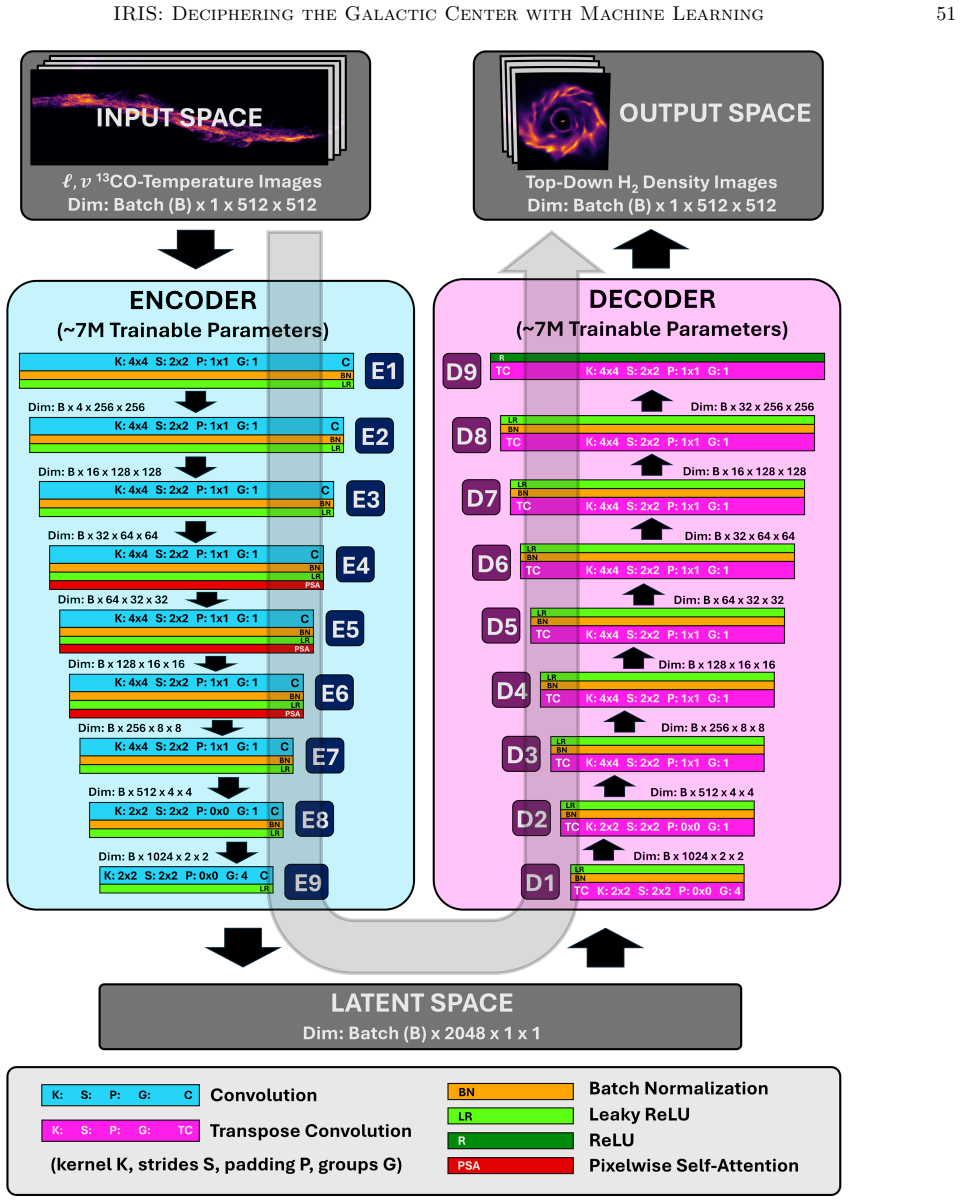
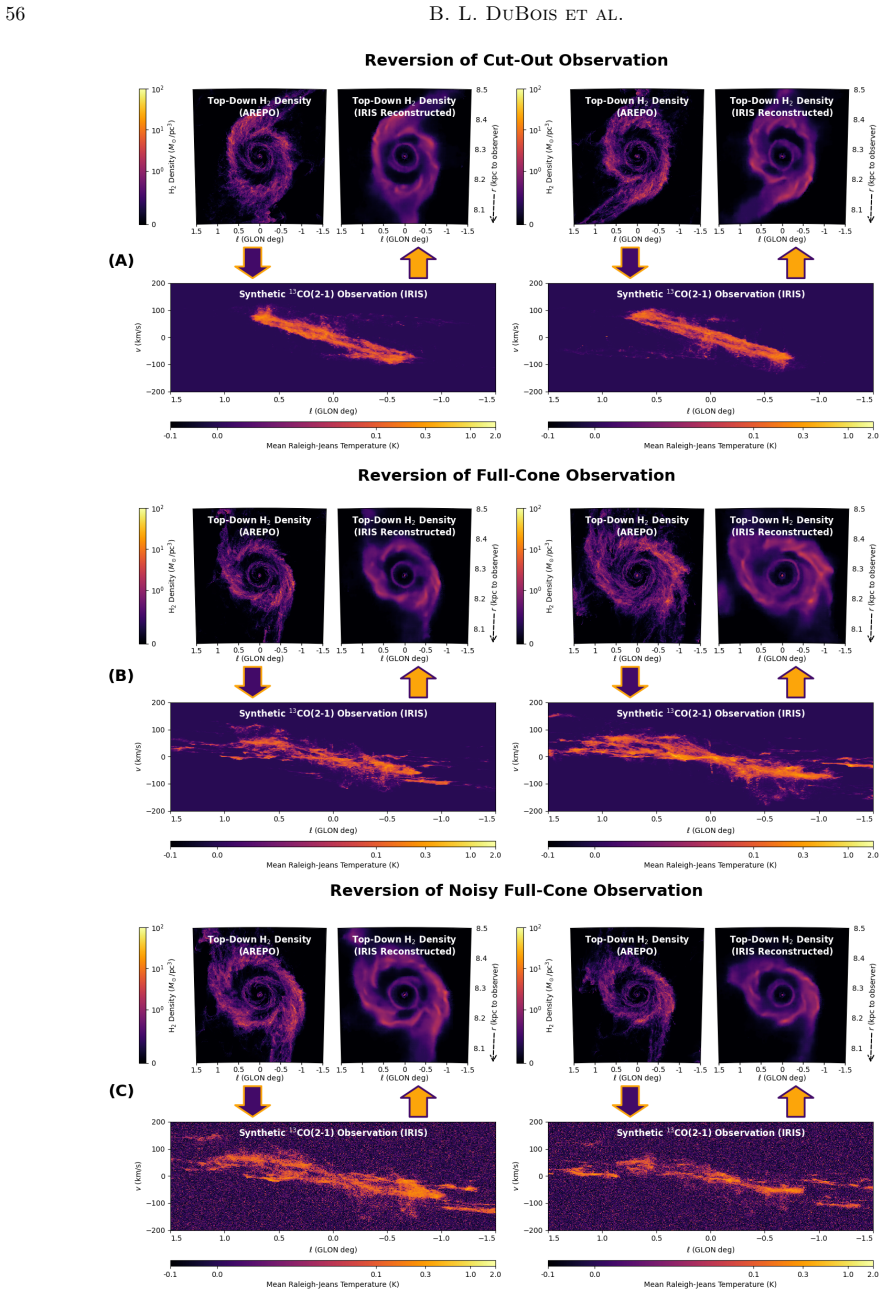
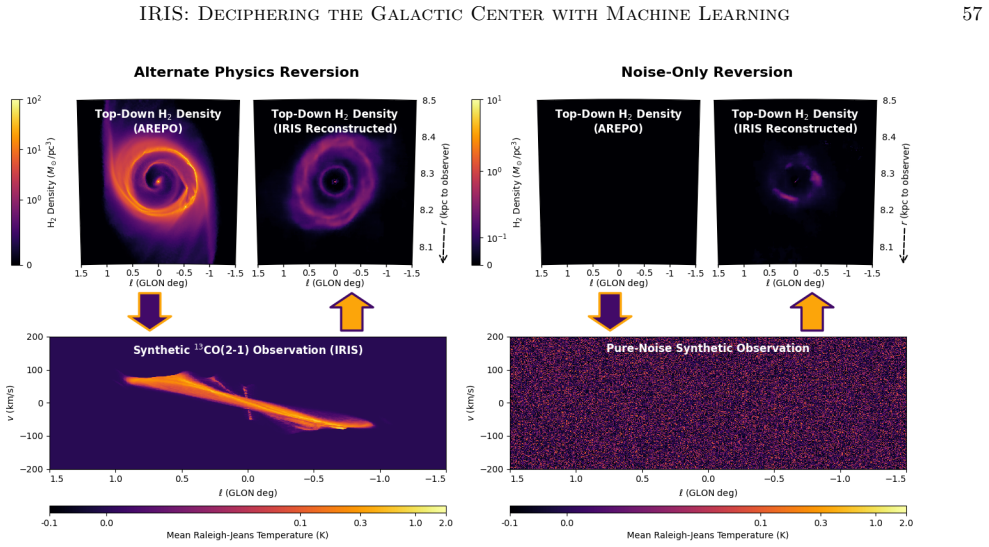
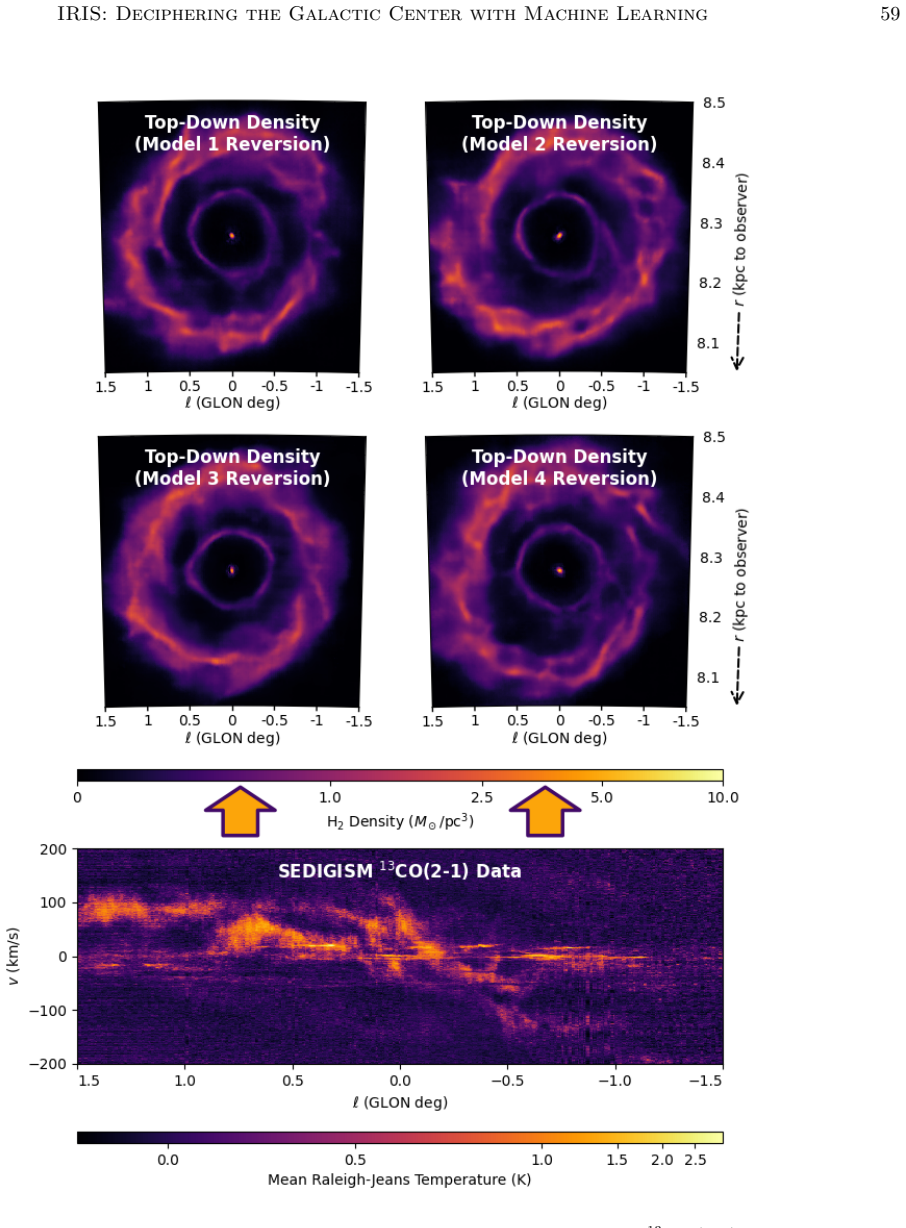
IRIS trains a bespoke deep convolutional neural network exclusively on 100,000 synthetic spectral-line observations produced from AREPO galaxy simulations via the new IRIS-SO code. The trained network performs supervised reversion that maps edge-on inputs to top-down outputs. Applied to SEDIGISM 13CO(2-1) data, the network generates new top-down images of the CMZ, although outputs vary across independent training runs. The authors conclude that these results demonstrate a viable route to recovering the three-dimensional structure of the CMZ through supervised reversion.
What carries the argument
The IRIS convolutional neural network that learns to map edge-on spectral-line images to top-down projections by supervised training on matched pairs of synthetic observations.
If this is right
- The method produces candidate top-down maps of the CMZ directly from existing SEDIGISM spectral-line cubes.
- IRIS-SO generates training data up to 10,000 times faster than earlier synthetic-observation codes, enabling larger training sets.
- Increasing the size and diversity of the simulation training set is expected to reduce variation across model runs.
- The same supervised-reversion architecture can be retrained on other spectral-line surveys once matching synthetic data exist.
Where Pith is reading between the lines
- If the reversion works, similar networks could be trained to recover additional quantities such as line-of-sight velocities or density gradients rather than only projected morphology.
- Discrepancies between simulation physics and real interstellar-medium conditions could systematically bias the output maps, so cross-checks against independent tracers would be needed.
- The open-source release of both the network and IRIS-SO allows other groups to test the approach on different simulation suites or observational datasets.
Load-bearing premise
Synthetic observations generated from AREPO simulations contain enough of the relevant physics, resolution, and noise properties that a model trained only on them will still produce useful reversions when given real telescope data.
What would settle it
If repeated independent training runs applied to the same SEDIGISM data produce top-down maps whose bright features differ by more than the known uncertainty in CMZ morphology, the claimed generalization would fail.
Figures
read the original abstract
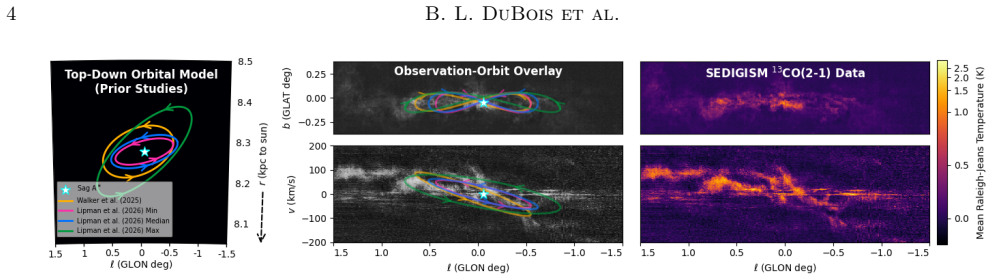
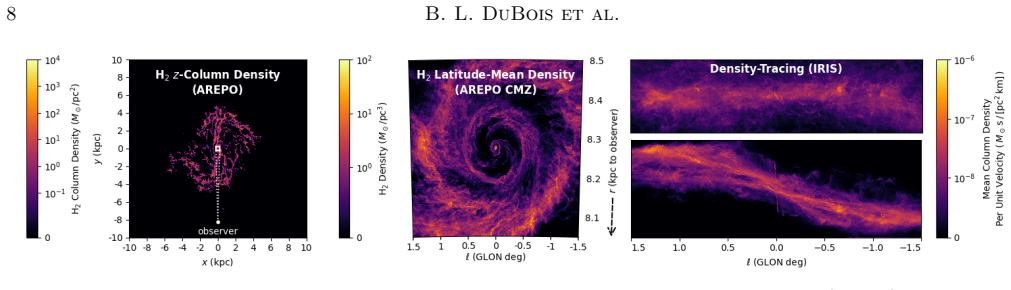
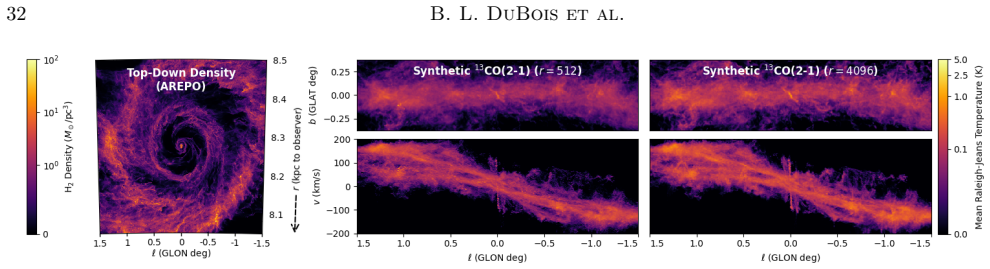
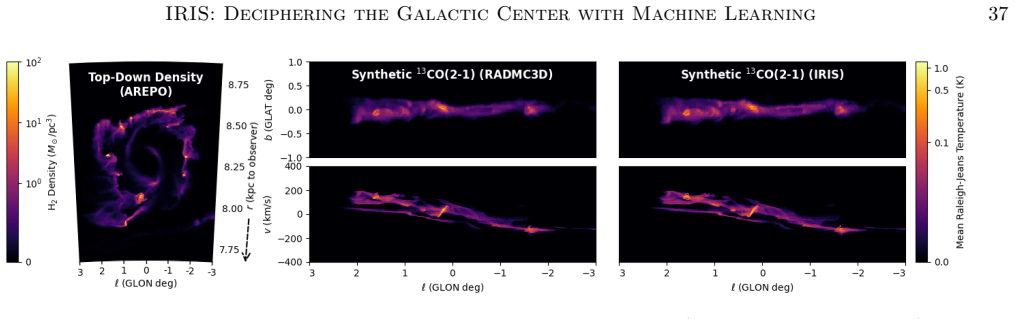
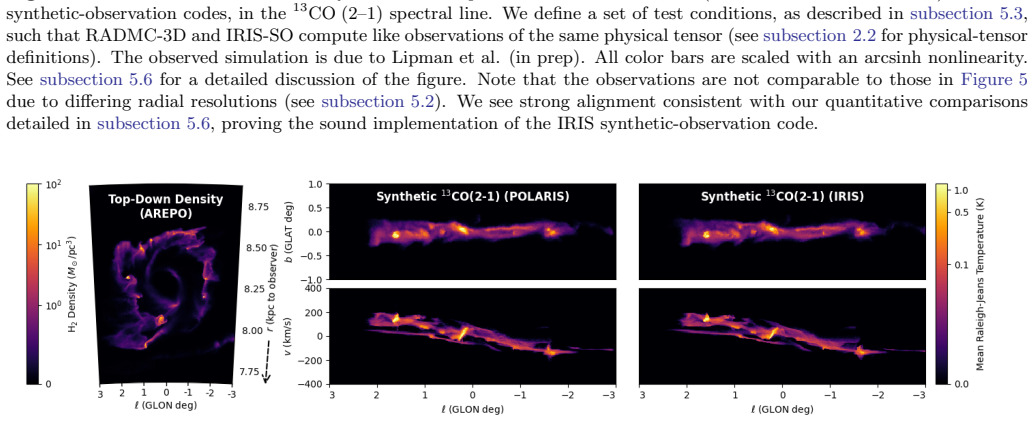
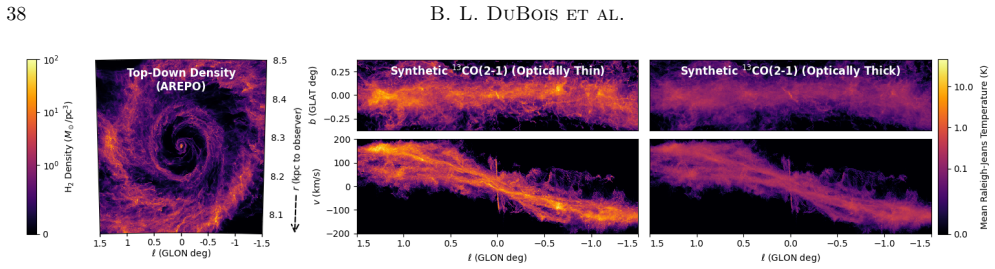
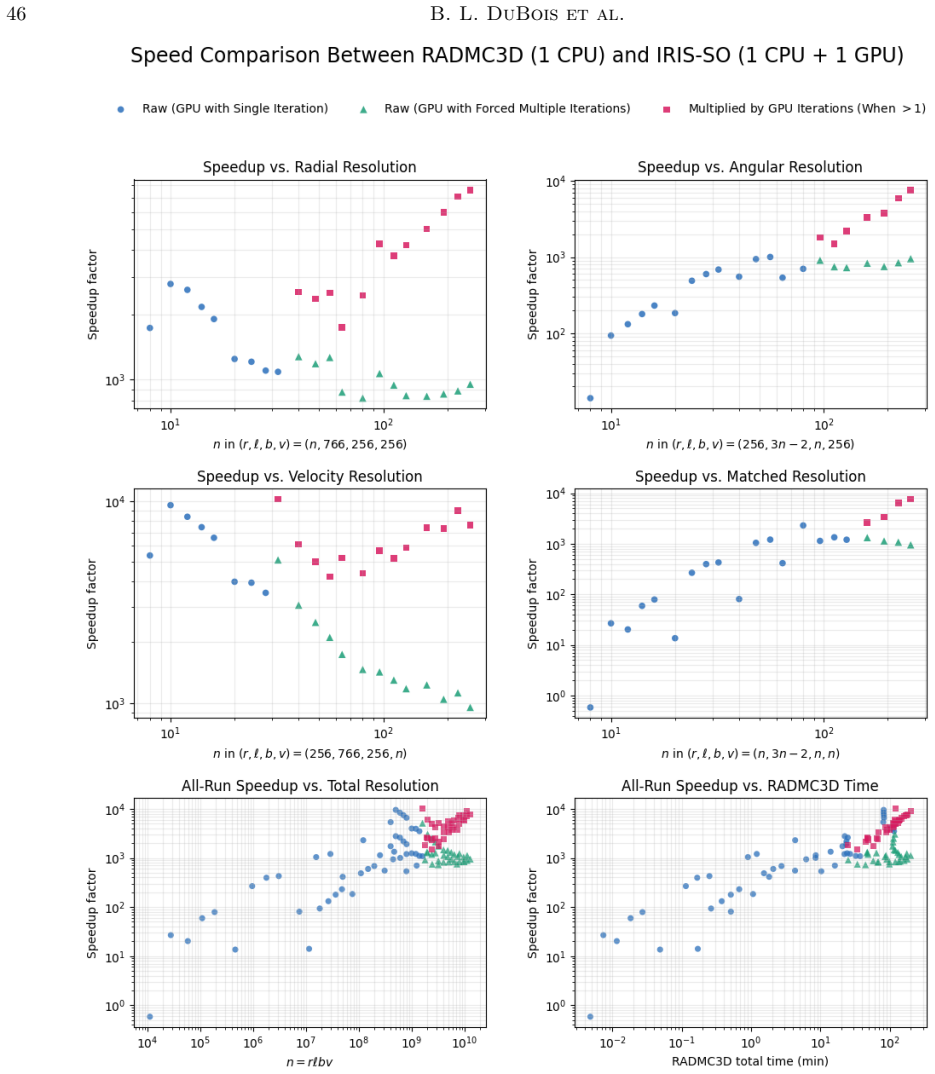
In understanding the 3D structure of the Milky Way's Central Molecular Zone (CMZ), we are limited by our edge-on perspective. Towards addressing this problem, we introduce Imagery Reversion Informed by Simulation (IRIS). IRIS is a novel machine-learning code base featuring a deep convolutional neural network (CNN), which we have designed to translate edge-on observations of our Milky Way Galaxy into top-down images by training on data generated from AREPO galaxy simulations and synthetic observations of those simulations. We develop a large custom dataset on which we train our bespoke model, and then test the trained model on synthetic data to probe the potential of this machine-learning method, which we call supervised reversion. We then apply our trained model to real observations from the SEDIGISM 13CO(2-1) survey, yielding new top-down views of our CMZ. Though our SEDIGISM reversions are not fully consistent across model training runs, we posit that this lack of convergence can be alleviated by expansion of the training dataset. We argue that these results represent a strong proof-of-concept for the use of supervised reversion to decipher our CMZ's 3D structure. Crucial in generating our training dataset's 100k synthetic observations, we introduce IRIS Synthetic Observation (IRIS-SO), a new GPU-accelerated and fully differentiable code implemented in PyTorch for the non-LTE synthetic observation of spectral lines and dust. We find that IRIS-SO provides up to 10,000x speedups in comparison to the synthetic-observation code RADMC-3D. We release all the IRIS code open-source at https://github.com/bldubois/IRIS.
Editorial analysis
A structured set of objections, weighed in public.
Referee Report
Summary. The paper introduces IRIS, a CNN-based supervised reversion technique trained on synthetic spectral-line observations generated from AREPO simulations via a new GPU-accelerated, differentiable code IRIS-SO. After testing on held-out synthetic data, the model is applied to real SEDIGISM 13CO(2-1) observations to produce top-down views of the CMZ; the authors note run-to-run inconsistencies in these reversions but argue the work constitutes a strong proof-of-concept for recovering 3D structure, and they release the full codebase openly.
Significance. If the supervised reversion approach can be made robust, it would offer a new route to inferring three-dimensional Galactic Center structure from edge-on data. The reported 10,000x speedup of IRIS-SO over RADMC-3D and the open-source release of IRIS constitute concrete, reusable contributions to the community.
major comments (2)
- [Abstract] Abstract: the assertion of a 'strong proof-of-concept' for deciphering CMZ 3D structure is load-bearing on the reliability of the SEDIGISM reversions, yet the text states that 'our SEDIGISM reversions are not fully consistent across model training runs' without providing quantitative measures of that variability (e.g., pixel-wise standard deviation or structural similarity indices across runs). This directly weakens the central claim.
- [Abstract] Abstract: no quantitative validation metrics, error bars, or cross-validation results are reported for the application to real SEDIGISM data, only the qualitative statement of inconsistency. Without such metrics it is impossible to assess whether the learned mapping generalizes beyond the specific synthetic training realizations to the target domain.
Simulated Author's Rebuttal
We thank the referee for their constructive comments, which highlight important aspects of how the SEDIGISM results are presented. We address each major comment below and will revise the manuscript to incorporate quantitative measures of variability where feasible.
read point-by-point responses
-
Referee: [Abstract] Abstract: the assertion of a 'strong proof-of-concept' for deciphering CMZ 3D structure is load-bearing on the reliability of the SEDIGISM reversions, yet the text states that 'our SEDIGISM reversions are not fully consistent across model training runs' without providing quantitative measures of that variability (e.g., pixel-wise standard deviation or structural similarity indices across runs). This directly weakens the central claim.
Authors: We agree that quantitative measures would strengthen the presentation of the SEDIGISM results and the associated claim. In the revised manuscript we will report pixel-wise standard deviations computed across multiple independent training runs on the SEDIGISM data, together with structural similarity index (SSIM) values between the resulting top-down maps. These additions will provide an objective assessment of run-to-run consistency and better support the proof-of-concept statement. revision: yes
-
Referee: [Abstract] Abstract: no quantitative validation metrics, error bars, or cross-validation results are reported for the application to real SEDIGISM data, only the qualitative statement of inconsistency. Without such metrics it is impossible to assess whether the learned mapping generalizes beyond the specific synthetic training realizations to the target domain.
Authors: We acknowledge that the manuscript currently provides only a qualitative statement of inconsistency for the real-data application. Because no ground truth exists for the three-dimensional CMZ structure, conventional validation metrics or cross-validation against observations are not possible. The run-to-run variability will now be quantified (as described in the response to the first comment) and presented as a practical uncertainty estimate. We will also expand the discussion to explicitly address the domain-shift limitations between synthetic training data and real SEDIGISM observations, while retaining the proof-of-concept framing for the overall supervised-reversion approach. revision: partial
Circularity Check
No significant circularity; empirical ML pipeline is self-contained
full rationale
The paper's derivation chain consists of generating synthetic observations from AREPO simulations via the new IRIS-SO code, training a CNN on that dataset, validating on held-out synthetics, and applying the model to real SEDIGISM data. None of the load-bearing steps reduce by construction to the inputs: the CNN outputs on real data are not fitted parameters renamed as predictions, no self-citation chain justifies a uniqueness theorem or ansatz, and the method does not define its target via its own results. The reported run-to-run inconsistency on real data is presented as an empirical observation rather than concealed, and the proof-of-concept claim rests on external performance metrics rather than tautological equivalence. This is the standard case of an independent empirical pipeline.
Axiom & Free-Parameter Ledger
axioms (1)
- domain assumption AREPO galaxy simulations plus non-LTE synthetic observations accurately capture the relevant physics and observational effects of the real CMZ.
invented entities (1)
-
IRIS-SO
independent evidence
Reference graph
Works this paper leans on
-
[1]
3D CMZ. V. A New Orbital Model of Our Galaxy's Center, Informed by Data Across the Electromagnetic Spectrum. , keywords =. doi:10.3847/1538-4357/ae561f , adsurl =
-
[2]
Cosmological smoothed particle hydrodynamics simulations: a hybrid multiphase model for star formation. , keywords =. doi:10.1046/j.1365-8711.2003.06206.x , archivePrefix =. astro-ph/0206393 , primaryClass =
-
[3]
Revista Mexicana de Astronomia y Astrofisica Conference Series , year = 2008, series =
Massive Star Evolution with Mass Loss and Rotation. Revista Mexicana de Astronomia y Astrofisica Conference Series , year = 2008, series =
2008
-
[4]
The SEDIGISM survey: First Data Release and overview of the Galactic structure. , keywords =. doi:10.1093/mnras/staa2369 , archivePrefix =. 2012.01527 , primaryClass =
-
[5]
, year = 1957, month = nov, volume =
A Mechanism of Non-Thermal Radio-Noise Origin. , year = 1957, month = nov, volume =. doi:10.1086/146421 , adsurl =
-
[6]
An atomic and molecular database for analysis of submillimetre line observations
An atomic and molecular database for analysis of submillimetre line observations. , keywords =. doi:10.1051/0004-6361:20041729 , archivePrefix =. astro-ph/0411110 , primaryClass =
work page internal anchor Pith review Pith/arXiv arXiv doi:10.1051/0004-6361:20041729
-
[7]
Quantum Calculation of Inelastic CO Collisions with H. II. Pure Rotational Quenching of High Rotational Levels. , keywords =. doi:10.1088/0004-637X/811/1/27 , archivePrefix =. 1511.04981 , primaryClass =
work page internal anchor Pith review Pith/arXiv arXiv doi:10.1088/0004-637x/811/1/27
-
[8]
BASECOL2023 scientific content. , keywords =. doi:10.1051/0004-6361/202348233 , adsurl =
-
[9]
, keywords =
Dust opacities for protostellar cores. , keywords =
-
[10]
The complex multiscale structure in simulated and observed emission maps of the proto-cluster cloud G0.253+0.016 ('the Brick'). , keywords =. doi:10.1093/mnras/stad229 , archivePrefix =. 2104.09558 , primaryClass =
-
[11]
ALMA Central Molecular Zone Exploration Survey (ACES) I: Overview. arXiv e-prints , keywords =. doi:10.48550/arXiv.2602.20340 , archivePrefix =. 2602.20340 , primaryClass =
-
[12]
The existence and shapes of dust lanes in galactic bars. , keywords =. doi:10.1093/mnras/259.2.345 , adsurl =
-
[13]
GALACTICNUCLEUS: A high-angular-resolution JHK _ s imaging survey of the Galactic centre. IV. Extinction maps and de-reddened photometry. , keywords =. doi:10.1051/0004-6361/202140996 , archivePrefix =. 2107.00021 , primaryClass =
-
[14]
SOFIA/HAWC+ Far-Infrared Polarimetric Large Area CMZ Exploration Survey. I. General Results from the Pilot Program. , keywords =. doi:10.3847/1538-4357/ad12b9 , archivePrefix =. 2306.01681 , primaryClass =
-
[15]
ATLASGAL - The APEX Telescope Large Area Survey of the Galaxy at 870 microns
ATLASGAL - The APEX telescope large area survey of the galaxy at 870 m. , keywords =. doi:10.1051/0004-6361/200811568 , archivePrefix =. 0903.1369 , primaryClass =
work page internal anchor Pith review Pith/arXiv arXiv doi:10.1051/0004-6361/200811568
-
[16]
The HI/OH/Recombination line survey of the inner Milky Way (THOR)
The HI/OH/Recombination line survey of the inner Milky Way (THOR). Survey overview and data release 1. , keywords =. doi:10.1051/0004-6361/201629143 , archivePrefix =. 1609.03329 , primaryClass =
work page internal anchor Pith review Pith/arXiv arXiv doi:10.1051/0004-6361/201629143
-
[17]
The VLA Galactic Plane Survey. , keywords =. doi:10.1086/505940 , archivePrefix =. astro-ph/0605422 , primaryClass =
work page internal anchor Pith review Pith/arXiv arXiv doi:10.1086/505940
-
[18]
Star Formation in Nuclear Rings with the TIGRESS Framework. , keywords =. doi:10.3847/1538-4357/abfa93 , archivePrefix =. 2104.10349 , primaryClass =
-
[19]
The effects of turbulence on galactic nuclear gas rings. arXiv e-prints , keywords =. doi:10.48550/arXiv.2010.04170 , archivePrefix =. 2010.04170 , primaryClass =
-
[20]
Understanding the kinematics of Galactic Centre gas. , keywords =. doi:10.1093/mnras/252.2.210 , adsurl =
-
[21]
Gas flow in barred potentials. , keywords =. doi:10.1093/mnras/stv441 , archivePrefix =. 1502.02740 , primaryClass =
work page internal anchor Pith review Pith/arXiv arXiv doi:10.1093/mnras/stv441
-
[22]
Recognizing the fingerprints of the Galactic bar: a quantitative approach to comparing model (l, v) distributions to observations. , keywords =. doi:10.1093/mnras/stu2316 , archivePrefix =. 1410.8073 , primaryClass =
work page internal anchor Pith review Pith/arXiv arXiv doi:10.1093/mnras/stu2316
-
[23]
Orbits in barred galaxies. , keywords =. doi:10.1007/BF00873080 , adsurl =
-
[24]
Rhea-RT: Dynamical impact of Central Molecular Zone conditions on ISM properties and stellar feedback coupling. arXiv e-prints , keywords =. doi:10.48550/arXiv.2512.09981 , archivePrefix =. 2512.09981 , primaryClass =
work page internal anchor Pith review Pith/arXiv arXiv doi:10.48550/arxiv.2512.09981
-
[25]
Dense gas in the Galactic central molecular zone is warm and heated by turbulence
Dense gas in the Galactic central molecular zone is warm and heated by turbulence. , keywords =. doi:10.1051/0004-6361/201526100 , archivePrefix =. 1509.01583 , primaryClass =
work page internal anchor Pith review Pith/arXiv arXiv doi:10.1051/0004-6361/201526100
-
[26]
The Dense Gas Fraction in Galactic Center Clouds
The Dense Gas Fraction in Galactic Center Clouds. , keywords =. doi:10.3847/1538-4357/aae581 , archivePrefix =. 1810.00266 , primaryClass =
work page internal anchor Pith review Pith/arXiv arXiv doi:10.3847/1538-4357/aae581
-
[27]
Molecular gas kinematics within the central 250 pc of the Milky Way
Molecular gas kinematics within the central 250 pc of the Milky Way. , keywords =. doi:10.1093/mnras/stw121 , archivePrefix =. 1601.03732 , primaryClass =
work page internal anchor Pith review Pith/arXiv arXiv doi:10.1093/mnras/stw121
-
[28]
The Bolocam Galactic Plane Survey. IX. Data Release 2 and Outer Galaxy Extension. , keywords =. doi:10.1088/0067-0049/208/2/14 , archivePrefix =. 1305.6622 , primaryClass =
work page internal anchor Pith review Pith/arXiv arXiv doi:10.1088/0067-0049/208/2/14
-
[29]
A 100 pc Elliptical and Twisted Ring of Cold and Dense Molecular Clouds Revealed by Herschel Around the Galactic Center. , keywords =. doi:10.1088/2041-8205/735/2/L33 , archivePrefix =. 1105.5486 , primaryClass =
work page internal anchor Pith review Pith/arXiv arXiv doi:10.1088/2041-8205/735/2/l33 2041
-
[30]
GLIMPSE. I. An SIRTF Legacy Project to Map the Inner Galaxy. , eprint =. doi:10.1086/376696 , adsurl =
-
[31]
3D CMZ. III. Constraining the 3D Structure of the Central Molecular Zone via Molecular Line Emission and Absorption. , keywords =. doi:10.3847/1538-4357/adb5ef , archivePrefix =. 2410.17320 , primaryClass =
-
[32]
Protostars and Planets VII , year = 2023, editor =
Star Formation in the Central Molecular Zone of the Milky Way. Protostars and Planets VII , year = 2023, editor =. doi:10.48550/arXiv.2203.11223 , archivePrefix =. 2203.11223 , primaryClass =
-
[33]
Galactic-Center Molecular Arms, Ring, and Expanding Shell. I. Kinematical Structures in Longitude--Velocity Diagrams. , keywords =
-
[34]
Three-dimensional structure of the central molecular zone. , keywords =. doi:10.1093/mnras/stac2243 , archivePrefix =. 2208.02451 , primaryClass =
-
[35]
The Galactic Center arms inferred from the ALMA CMZ Exploration Survey (ACES). , keywords =. doi:10.1093/pasj/psaf034 , archivePrefix =. 2504.03331 , primaryClass =
-
[36]
Orbital structure and evolutionary timeline
The dynamical evolution of molecular clouds near the Galactic Centre - I. Orbital structure and evolutionary timeline. , archivePrefix = "arXiv", eprint =. doi:10.1093/mnras/stu2526 , adsurl =
-
[37]
Simulations of the Milky Way's central molecular zone - I. Gas dynamics. , keywords =. doi:10.1093/mnras/staa3120 , archivePrefix =. 2004.06724 , primaryClass =
-
[38]
3D CMZ. I. Central Molecular Zone Overview. , keywords =. doi:10.3847/1538-4357/adb5f0 , archivePrefix =. 2410.17334 , primaryClass =
-
[39]
3D CMZ. II. Hierarchical Structure Analysis of the Central Molecular Zone. , keywords =. doi:10.3847/1538-4357/adb844 , archivePrefix =. 2410.17332 , primaryClass =
-
[40]
3D CMZ. IV. Distinguishing Near versus Far Distances in the Galactic Center Using Spitzer and Herschel. , keywords =. doi:10.3847/1538-4357/adb5ee , archivePrefix =. 2410.17321 , primaryClass =
-
[41]
Inflow, star formation, and winds
The life cycle of the Central Molecular Zone - I. Inflow, star formation, and winds. , keywords =. doi:10.1093/mnras/stz2880 , archivePrefix =. 1905.01309 , primaryClass =
-
[42]
Simulations of the Milky Way's Central Molecular Zone - II. Star formation. , keywords =. doi:10.1093/mnras/staa1999 , archivePrefix =. 2004.06731 , primaryClass =
-
[43]
Dynamically Driven Inflow onto the Galactic Center and its Effect upon Molecular Clouds. , keywords =. doi:10.3847/1538-4357/ac1e89 , archivePrefix =. 2106.08461 , primaryClass =
-
[44]
Magnetic field morphology and evolution in the Central Molecular Zone and its effect on gas dynamics. , keywords =. doi:10.1051/0004-6361/202450035 , archivePrefix =. 2403.13048 , primaryClass =
-
[45]
E pur si muove: Galilean-invariant cosmological hydrodynamical simulations on a moving mesh. , keywords =. doi:10.1111/j.1365-2966.2009.15715.x , archivePrefix =. 0901.4107 , primaryClass =
-
[46]
Magnetohydrodynamics on an unstructured moving grid. , keywords =. doi:10.1111/j.1365-2966.2011.19591.x , archivePrefix =. 1108.1792 , primaryClass =
-
[47]
Simulations of magnetic fields in isolated disk galaxies
Simulations of magnetic fields in isolated disc galaxies. , keywords =. doi:10.1093/mnras/stt428 , archivePrefix =. 1212.1452 , primaryClass =
work page internal anchor Pith review Pith/arXiv arXiv doi:10.1093/mnras/stt428
-
[48]
Improving the convergence properties of the moving-mesh code AREPO
Improving the convergence properties of the moving-mesh code AREPO. , keywords =. doi:10.1093/mnras/stv2380 , archivePrefix =. 1503.00562 , primaryClass =
work page internal anchor Pith review Pith/arXiv arXiv doi:10.1093/mnras/stv2380
-
[49]
The AREPO Public Code Release. , keywords =. doi:10.3847/1538-4365/ab908c , archivePrefix =. 1909.04667 , primaryClass =
-
[50]
Testing kinematic distances under a realistic Galactic potential: Investigating systematic errors in the kinematic distance method arising from a non-axisymmetric potential. , keywords =. doi:10.1051/0004-6361/202450000 , archivePrefix =. 2403.18000 , primaryClass =
-
[51]
Introducing the Rhea simulations of Milky-Way-like galaxies I: Effect of gravitational potential on morphology and star formation. arXiv e-prints , keywords =. doi:10.48550/arXiv.2502.02646 , archivePrefix =. 2502.02646 , primaryClass =
-
[52]
Approximations for modelling CO chemistry in giant molecular clouds: a comparison of approaches. , keywords =. doi:10.1111/j.1365-2966.2011.20260.x , archivePrefix =. 1102.0670 , primaryClass =
-
[53]
Simulating the Formation of Molecular Clouds. I. Slow Formation by Gravitational Collapse from Static Initial Conditions. , keywords =. doi:10.1086/512238 , archivePrefix =. astro-ph/0605120 , primaryClass =
work page internal anchor Pith review Pith/arXiv arXiv doi:10.1086/512238
-
[54]
Simulating the Formation of Molecular Clouds. II. Rapid Formation from Turbulent Initial Conditions. , keywords =. doi:10.1086/512227 , archivePrefix =. astro-ph/0605121 , primaryClass =
work page internal anchor Pith review Pith/arXiv arXiv doi:10.1086/512227
-
[55]
The Dynamics of Low-Mass Molecular Clouds in External Radiation Fields. , keywords =. doi:10.1086/304167 , adsurl =
-
[56]
Non-Equilibrium Chemistry and Destruction of CO by X-ray Flares
Non-equilibrium chemistry and destruction of CO by X-ray flares. , keywords =. doi:10.1093/mnras/stz902 , archivePrefix =. 1803.10367 , primaryClass =
work page internal anchor Pith review Pith/arXiv arXiv doi:10.1093/mnras/stz902
-
[57]
Mass inflow rate into the Central Molecular Zone: observational determination and evidence of episodic accretion. , keywords =. doi:10.1093/mnras/stz046 , archivePrefix =. 1901.00867 , primaryClass =
work page internal anchor Pith review Pith/arXiv arXiv doi:10.1093/mnras/stz046 1901
-
[58]
Nuclear rings are the inner edge of a gap around the Lindblad Resonance. , keywords =. doi:10.1093/mnras/stae082 , archivePrefix =. 2309.14093 , primaryClass =
-
[59]
Radiative Processes in Astrophysics
-
[60]
The size distribution of interstellar grains. , keywords =. doi:10.1086/155591 , adsurl =
-
[61]
Disentangling the independently controllable factors of variation by interacting with the world
Interstellar Dust Grains. , keywords =. doi:10.1146/annurev.astro.41.011802.094840 , archivePrefix =. astro-ph/0304489 , primaryClass =
work page internal anchor Pith review Pith/arXiv arXiv doi:10.1146/annurev.astro.41.011802.094840
-
[62]
Assessment of Models of Galactic Thermal Dust Emission Using COBE/FIRAS and COBE/DIRBE Observations
Assessment of Models of Galactic Thermal Dust Emission Using COBE/FIRAS and COBE/DIRBE Observations. , keywords =. doi:10.3847/0004-637X/828/1/16 , archivePrefix =. 1606.08783 , primaryClass =
work page internal anchor Pith review Pith/arXiv arXiv doi:10.3847/0004-637x/828/1/16
-
[63]
CMZoom: Survey Overview and First Data Release. , keywords =. doi:10.3847/1538-4365/aba18e , archivePrefix =. 2007.05023 , primaryClass =
-
[64]
A computer program for fast non-LTE analysis of interstellar line spectra
A computer program for fast non-LTE analysis of interstellar line spectra. With diagnostic plots to interpret observed line intensity ratios. , keywords =. doi:10.1051/0004-6361:20066820 , archivePrefix =. 0704.0155 , primaryClass =
work page internal anchor Pith review Pith/arXiv arXiv doi:10.1051/0004-6361:20066820
-
[65]
doi:10.4159/harvard.9780674864658 , adsurl =
Moving Envelopes of Stars. doi:10.4159/harvard.9780674864658 , adsurl =
-
[66]
Astronomy and Computing , keywords =
Magritte, a modern software library for spectral line radiative transfer. Astronomy and Computing , keywords =. doi:10.1016/j.ascom.2024.100889 , archivePrefix =. 2411.03040 , primaryClass =
-
[67]
Revealing Fine Structure in Protoplanetary Disks with Physics Constrained Neural Fields. arXiv e-prints , keywords =. doi:10.48550/arXiv.2509.03623 , archivePrefix =. 2509.03623 , primaryClass =
-
[68]
THOR: a GPU-accelerated and MPI-parallel radiative transfer code. arXiv e-prints , keywords =. doi:10.48550/arXiv.2507.11603 , archivePrefix =. 2507.11603 , primaryClass =
-
[69]
, year = 1994, month = jan, volume =
Abundances in the Interstellar Medium. , year = 1994, month = jan, volume =. doi:10.1146/annurev.aa.32.090194.001203 , adsurl =
-
[70]
Ultraviolet Detection of Interstellar 12C17O and the CO Isotopomeric Ratios toward X Persei
Ultraviolet Detection of Interstellar ^ 12 C ^ 17 O and the CO Isotopomeric Ratios toward X Persei. , keywords =. doi:10.1086/342501 , archivePrefix =. astro-ph/0206449 , primaryClass =
work page internal anchor Pith review Pith/arXiv arXiv doi:10.1086/342501
-
[71]
12C/ 13C Isotope Ratio across the Galaxy from Observations of 13C 18O in Molecular Clouds. , keywords =. doi:10.1086/168935 , adsurl =
-
[72]
Tracing gas accretion in the Galactic center using isotopic ratios
Tracing gas accretion in the Galactic center using isotopic ratios. , keywords =. doi:10.1051/0004-6361/201015008 , archivePrefix =. 1008.1873 , primaryClass =
work page internal anchor Pith review Pith/arXiv arXiv doi:10.1051/0004-6361/201015008
-
[73]
doi:10.1007/978-3-642-39950-3 , adsurl =
Tools of Radio Astronomy. doi:10.1007/978-3-642-39950-3 , adsurl =
-
[74]
1980 , publisher =
Introduction to numerical analysis , author =. 1980 , publisher =
1980
-
[75]
1996 , doi =
Hairer, Ernst and Wanner, Gerhard , title =. 1996 , doi =
1996
-
[76]
, year = 1974, month = jun, volume =
Aperture Synthesis with a Non-Regular Distribution of Interferometer Baselines. , year = 1974, month = jun, volume =
1974
-
[77]
Radiative transfer with POLARIS. I. Analysis of magnetic fields through synthetic dust continuum polarization measurements. , keywords =. doi:10.1051/0004-6361/201424930 , archivePrefix =. 1604.05305 , primaryClass =
work page internal anchor Pith review Pith/arXiv arXiv doi:10.1051/0004-6361/201424930
-
[78]
Radiative Transfer with POLARIS. II. Modeling of Synthetic Galactic Synchrotron Observations. , keywords =. doi:10.3847/1538-4357/ab3664 , archivePrefix =. 1907.12617 , primaryClass =
-
[79]
Magnetic fields in molecular clouds: Limitations of the analysis of Zeeman observations
Magnetic fields in molecular clouds: Limitations of the analysis of Zeeman observations. , keywords =. doi:10.1051/0004-6361/201629001 , archivePrefix =. 1703.02745 , primaryClass =
work page internal anchor Pith review Pith/arXiv arXiv doi:10.1051/0004-6361/201629001
-
[80]
Journal of Geophysical Research (Atmospheres) , keywords =
Optical constants of ice from the ultraviolet to the microwave: A revised compilation. Journal of Geophysical Research (Atmospheres) , keywords =. doi:10.1029/2007JD009744 , adsurl =
discussion (0)
Sign in with ORCID, Apple, or X to comment. Anyone can read and Pith papers without signing in.