Decohered toric code under quantum damping noise and its mapping to a classical spin model
Pith reviewed 2026-07-03 20:08 UTC · model grok-4.3
The pith
Decohered toric codes under generalized amplitude-damping channels map to statistical-mechanical models where channel parameters set the spin couplings and logical failure rates depend on temperature and squeezing.
A machine-rendered reading of the paper's core claim, the machinery that carries it, and where it could break.
Core claim
The action of the GAD and SGAD channels on the toric code is mapped to statistical-mechanical models using the double Hilbert-space formalism, and via Pauli twirling to stochastic Pauli-type errors yielding asymmetric depolarizing channels, with channel parameters related to spin-coupling constants and logical failure probabilities obtained as a function of temperature and squeezing.
What carries the argument
Double Hilbert-space formalism that converts the quantum damping channels into classical spin models, together with Pauli twirling that produces the asymmetric depolarizing error rates.
If this is right
- Logical failure probabilities are obtained as explicit functions of temperature and squeezing.
- The parameters of the GAD and SGAD channels become the spin-coupling constants of the equivalent statistical model.
- The toric code under these channels can be analyzed with classical statistical-mechanics techniques for both the full mapping and the twirled error model.
- Both the GAD and SGAD channels admit such mappings, allowing comparison of their effects on logical stability.
Where Pith is reading between the lines
- The mapping could be used to estimate error thresholds for toric codes in environments dominated by squeezed thermal noise.
- Direct comparison of the analytic failure-rate curves against small-code numerics would test the accuracy of the twirling step.
- Similar mappings might apply to other topological codes or to different non-Markovian damping models.
Load-bearing premise
The double Hilbert-space formalism and Pauli twirling capture the full effect of the non-Markovian and squeezed damping channels without introducing uncontrolled approximations that change the logical failure rates.
What would settle it
A direct simulation of logical error rates on a small toric code under the SGAD channel at fixed temperature but varying squeezing strength that deviates from the temperature-and-squeezing dependence predicted by the mapped spin model.
Figures


read the original abstract
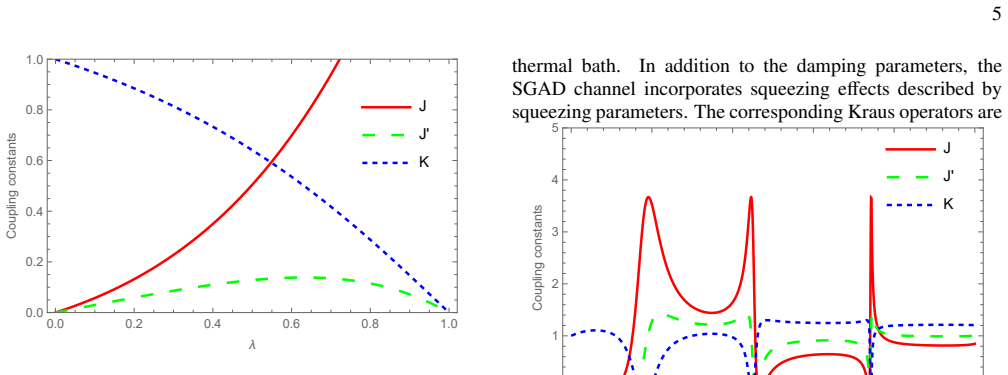
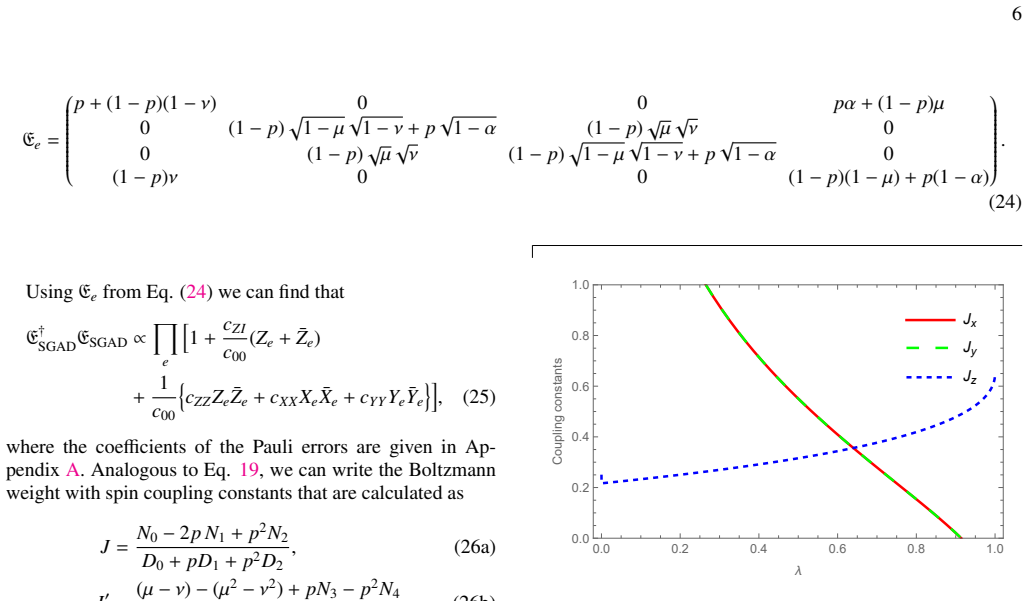
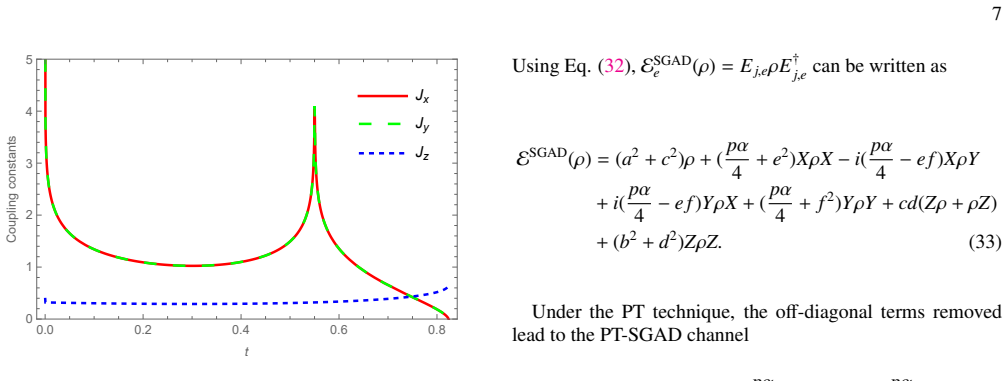
We investigate properties of toric codes under realistic damping error channels, which include squeezing, thermal and non-Markovian effects. First, we map the decohered toric code under the generalized amplitude-damping (GAD) and the squeezed generalized amplitude-damping (SGAD) channels to the statistical-mechanical models using the double Hilbert-space formalism. Second, we map the action of the GAD and SGAD channels on the toric code to stochastic Pauli-type errors via Pauli twirling, yielding asymmetric depolarizing channels, and obtain the logical failure probabilities as a function of temperature and squeezing. In both cases, we relate the channel parameters of the GAD and SGAD channels to the spin-coupling constants of the statistical-mechanical model.
Editorial analysis
A structured set of objections, weighed in public.
Referee Report
Summary. The paper maps the toric code under generalized amplitude-damping (GAD) and squeezed generalized amplitude-damping (SGAD) channels to classical statistical-mechanical models via the double Hilbert-space formalism. It also applies Pauli twirling to obtain asymmetric depolarizing channels, relates the damping-channel parameters to spin-coupling constants, and computes logical failure probabilities as functions of temperature and squeezing.
Significance. If the mappings hold without uncontrolled approximations, the work would connect realistic damping noise (including squeezing and non-Markovian effects) on a topological code to classical spin models, enabling computation of logical error rates via established statistical-mechanics techniques. The explicit parameter mapping and functional dependence on squeezing would be a concrete contribution.
major comments (2)
- [Abstract (mapping via Pauli twirling)] The Pauli-twirling step that replaces the SGAD channel by an asymmetric depolarizing channel (described in the abstract) averages over phase-sensitive operators. For a squeezed bath these coherences can survive stabilizer measurements and couple to the logical subspace differently than the twirled Pauli errors; no bound is given showing that the resulting logical failure probability remains accurate to the order of the reported squeezing dependence. This is load-bearing for the central claim that logical failure probabilities are obtained as a function of squeezing.
- [Abstract (double Hilbert-space formalism)] The double-Hilbert-space construction for the non-Markovian GAD/SGAD case likewise assumes a specific bath-correlation structure. The manuscript does not provide an error bound demonstrating that this structure preserves the logical-subspace dynamics to the precision needed for the claimed temperature and squeezing dependence.
minor comments (1)
- [Abstract] Notation for the spin-coupling constants obtained from the channel parameters should be introduced with an explicit equation relating each damping parameter to each coupling.
Simulated Author's Rebuttal
We thank the referee for their careful reading of the manuscript and for raising these points concerning the approximations underlying our mappings. We address each major comment below.
read point-by-point responses
-
Referee: [Abstract (mapping via Pauli twirling)] The Pauli-twirling step that replaces the SGAD channel by an asymmetric depolarizing channel (described in the abstract) averages over phase-sensitive operators. For a squeezed bath these coherences can survive stabilizer measurements and couple to the logical subspace differently than the twirled Pauli errors; no bound is given showing that the resulting logical failure probability remains accurate to the order of the reported squeezing dependence. This is load-bearing for the central claim that logical failure probabilities are obtained as a function of squeezing.
Authors: The Pauli twirling is used as a distinct second approach to obtain an effective asymmetric depolarizing channel whose parameters are related to temperature and squeezing; the logical failure probabilities are then computed for this effective channel via the spin-model mapping. The abstract presents this as a separate procedure from the double-Hilbert-space construction. While we acknowledge that the twirling neglects coherences that could in principle survive, the reported squeezing dependence is that of the twirled model. We will revise the manuscript to state this scope explicitly and to add a qualitative discussion of why the leading squeezing dependence is expected to be representative for the toric-code logical subspace. revision: partial
-
Referee: [Abstract (double Hilbert-space formalism)] The double-Hilbert-space construction for the non-Markovian GAD/SGAD case likewise assumes a specific bath-correlation structure. The manuscript does not provide an error bound demonstrating that this structure preserves the logical-subspace dynamics to the precision needed for the claimed temperature and squeezing dependence.
Authors: The double-Hilbert-space formalism supplies an exact mapping of the decoherence process onto a classical spin model once the bath-correlation structure of the GAD/SGAD channels is fixed. Temperature and squeezing enter directly as parameters of the resulting spin couplings, and the logical failure probabilities follow from this mapping without further approximation. The manuscript states the bath-correlation assumptions; within those assumptions the claimed dependences are exact. We will revise the text to reiterate that the results hold exactly for the assumed structure. revision: partial
Circularity Check
No circularity detected; mappings rely on external formalisms without self-referential reductions
full rationale
The abstract and description present two mappings (double Hilbert-space to statistical-mechanical models; Pauli twirling to asymmetric depolarizing channels) that relate channel parameters to spin couplings and yield logical failure probabilities as functions of temperature and squeezing. No equations, self-citations, or fitted-parameter steps are quoted that reduce any claimed prediction to its own inputs by construction. The derivation chain is therefore self-contained against external benchmarks (standard channel mappings and twirling) and receives the default non-finding.
Axiom & Free-Parameter Ledger
Reference graph
Works this paper leans on
-
[1]
P. W. Shor, Scheme for reducing decoherence in quantum com- puter memory, Phys. Rev. A52, R2493(R) (1995)
work page 1995
-
[2]
A. M. Steane, Error correcting codes in quantum theory, Phys. 10 Rev. Lett.77, 793 (1996)
work page 1996
-
[3]
D. A. Lidar and T. A. Brun,Quantum Error Correction(Cam- bridge University Press, 2013)
work page 2013
-
[4]
Kitaev, Fault-tolerant quantum computation by anyons, An- nals of Physics303, 2 (2003)
A. Kitaev, Fault-tolerant quantum computation by anyons, An- nals of Physics303, 2 (2003)
work page 2003
-
[5]
H. Bombin and M. A. Martin-Delgado, Topological quantum distillation, Phys. Rev. Lett.97, 180501 (2006)
work page 2006
-
[6]
Bombin, Topological subsystem codes, Phys
H. Bombin, Topological subsystem codes, Phys. Rev. A81, 032301 (2010)
work page 2010
-
[7]
A. Y . Kitaev, Quantum computations: algorithms and error cor- rection, Russian Mathematical Surveys52, 1191 (1997)
work page 1997
-
[8]
D. Bluvstein, H. Levine, G. Semeghini, T. T. Wang, S. Ebadi, M. Kalinowski, A. Keesling, N. Maskara, H. Pich- ler, M. Greiner,et al., A quantum processor based on coherent transport of entangled atom arrays, Nature604, 451 (2022)
work page 2022
- [9]
-
[10]
Quantum error correction with the toric code
A. Computing and Collaborators, Quantum error correction with the toric code (2026), arXiv:2606.04079 [quant-ph]
work page internal anchor Pith review Pith/arXiv arXiv 2026
- [11]
-
[12]
J. Ashkin and E. Teller, Statistics of two-dimensional lattices with four components, Physical Review64, 178 (1943)
work page 1943
-
[13]
C. T. Chubb and S. T. Flammia, Statistical mechanical models for quantum codes with correlated noise, Annales de l’Institut Henri Poincar´e D8, 269 (2021)
work page 2021
-
[14]
R. Fan, Y . Bao, E. Altman, and A. Vishwanath, Diagnostics of mixed-state topological order and breakdown of quantum mem- ory, PRX Quantum5, 020343 (2024)
work page 2024
-
[15]
J. Y . Lee, Exact calculations of coherent information for toric codes under decoherence: Identifying the fundamental error threshold, Phys. Rev. Lett.134, 250601 (2025)
work page 2025
-
[16]
J. Y . Lee, C.-M. Jian, and C. Xu, Quantum criticality under decoherence or weak measurement, PRX Quantum4, 030317 (2023)
work page 2023
- [17]
-
[18]
F. Venn, J. Behrends, and B. B ´eri, Coherent-error threshold for surface codes from majorana delocalization, Phys. Rev. Lett. 131, 060603 (2023)
work page 2023
-
[19]
J. Behrends and B. B ´eri, Statistical mechanical mapping and maximum-likelihood thresholds for the surface code under generic single-qubit coherent errors, PRX Quantum6, 040305 (2025)
work page 2025
-
[20]
D. W. Leung, M. A. Nielsen, I. L. Chuang, and Y . Yamamoto, Approximate quantum error correction can lead to better codes, Phys. Rev. A56, 2567 (1997)
work page 1997
-
[21]
I. L. Chuang, D. W. Leung, and Y . Yamamoto, Bosonic quan- tum codes for amplitude damping, Phys. Rev. A56, 1114 (1997)
work page 1997
-
[22]
M. A. Nielsen and I. L. Chuang,Quantum computation and quantum information(Cambridge university press, 2010)
work page 2010
- [23]
- [24]
-
[25]
P. K. Sarvepalli, A. Klappenecker, and M. R¨otteler, Asymmetric quantum codes: constructions, bounds and performance, Pro- ceedings of the Royal Society A: Mathematical, Physical and Engineering Sciences465, 1645 (2009)
work page 2009
-
[26]
Y . Tomita and K. M. Svore, Low-distance surface codes under realistic quantum noise, Phys. Rev. A90, 062320 (2014)
work page 2014
-
[27]
A. S. Darmawan and D. Poulin, Tensor-network simulations of the surface code under realistic noise, Phys. Rev. Lett.119, 040502 (2017)
work page 2017
-
[28]
M.-D. Choi, Completely positive linear maps on complex ma- trices, Linear Algebra and its Applications10, 285 (1975)
work page 1975
-
[29]
A. Jamiołkowski, Linear transformations which preserve trace and positive semidefiniteness of operators, Reports on mathe- matical physics3, 275 (1972)
work page 1972
-
[30]
J. Y . Lee, Y .-Z. You, and C. Xu, Symmetry protected topologi- cal phases under decoherence, Quantum9, 1607 (2025)
work page 2025
-
[31]
Y . Bao, R. Fan, A. Vishwanath, and E. Altman, Mixed-state topological order and the errorfield double formulation of decoherence-induced transitions, Phys. Rev. Lett.136, 220402 (2026)
work page 2026
-
[32]
S. Lee and E.-G. Moon, Mixed-state topological order under coherent noise, PRX Quantum6, 030355 (2025)
work page 2025
-
[33]
E. Magesan, D. Puzzuoli, C. E. Granade, and D. G. Cory, Mod- eling quantum noise for efficient testing of fault-tolerant cir- cuits, Phys. Rev. A87, 012324 (2013)
work page 2013
-
[34]
M. Guti ´errez, L. Svec, A. Vargo, and K. R. Brown, Approxima- tion of realistic errors by clifford channels and pauli measure- ments, Phys. Rev. A87, 030302(R) (2013)
work page 2013
-
[35]
S. Banerjee and R. Srikanth, Geometric phase of a qubit in- teracting with a squeezed-thermal bath, The European Physical Journal D46, 335 (2008)
work page 2008
-
[36]
S. Banerjee, R. Srikanth, C. M. Chandrashekar, and P. Rungta, Symmetry-noise interplay in a quantum walk on ann-cycle, Phys. Rev. A78, 052316 (2008)
work page 2008
-
[37]
R. Srikanth and S. Banerjee, Squeezed generalized amplitude damping channel, Phys. Rev. A77, 012318 (2008)
work page 2008
- [38]
-
[39]
Y . Jeong and H. Shin, Quantum correlation in squeezed gen- eralized amplitude damping channels with memory, Scientific Reports9, 4035 (2019)
work page 2019
-
[40]
Banerjee,Open Quantum Systems: Dynamics of Nonclassi- cal Evolution, 1st ed
S. Banerjee,Open Quantum Systems: Dynamics of Nonclassi- cal Evolution, 1st ed. (Springer Publishing Company, Incorpo- rated, 2018)
work page 2018
- [41]
-
[42]
U. Shrikant, R. Srikanth, and S. Banerjee, Non-markovian de- phasing and depolarizing channels, Phys. Rev. A98, 032328 (2018)
work page 2018
-
[43]
V . B. Sabale, N. R. Dash, A. Kumar, and S. Banerjee, Facets of correlated non-markovian channels, Annalen der Physik536, 2400151 (2024)
work page 2024
- [44]
-
[45]
Gottesman, Class of quantum error-correcting codes satu- rating the quantum hamming bound, Phys
D. Gottesman, Class of quantum error-correcting codes satu- rating the quantum hamming bound, Phys. Rev. A54, 1862 (1996)
work page 1996
-
[46]
A. R. Calderbank, E. M. Rains, P. W. Shor, and N. J. A. Sloane, Quantum error correction and orthogonal geometry, Phys. Rev. Lett.78, 405 (1997)
work page 1997
-
[47]
H. J. Briegel and R. Raussendorf, Persistent entanglement in arrays of interacting particles, Phys. Rev. Lett.86, 910 (2001)
work page 2001
-
[48]
R. Raussendorf, D. Browne, and H. Briegel, The one-way quan- 11 tum computer–a non-network model of quantum computation, Journal of Modern Optics49, 1299 (2002)
work page 2002
-
[49]
R. Raussendorf and H. J. Briegel, A one-way quantum com- puter, Phys. Rev. Lett.86, 5188 (2001)
work page 2001
-
[50]
Y .-H. Chen and T. Grover, Unconventional topological mixed- state transition and critical phase induced by self-dual coherent errors, Phys. Rev. B110, 125152 (2024)
work page 2024
-
[51]
Y .-H. Chen and T. Grover, Separability transitions in topolog- ical states induced by local decoherence, Phys. Rev. Lett.132, 170602 (2024)
work page 2024
- [52]
-
[53]
H. Nishimori, Internal energy, specific heat and correlation function of the bond-random ising model, Progress of Theo- retical Physics66, 1169 (1981)
work page 1981
-
[54]
H. Nishimori,Statistical physics of spin glasses and informa- tion processing: an introduction, 111 (Clarendon Press, 2001)
work page 2001
-
[55]
M. R. Geller and Z. Zhou, Efficient error models for fault- tolerant architectures and the pauli twirling approximation, Phys. Rev. A88, 012314 (2013)
work page 2013
-
[56]
A. Katabarwa and M. R. Geller, Logical error rate in the pauli twirling approximation, Scientific reports5, 14670 (2015)
work page 2015
- [57]
-
[58]
Z.-D. Wei, W. Han, Y .-J. Zhang, W.-B. Yan, Z.-X. Man, Y .- J. Xia, and Q.-Y . Cai, Non-markovian speedup dynamics via quantum cyclicn-switch, Phys. Rev. A112, 052404 (2025)
work page 2025
- [59]
-
[60]
A. G. Fowler, M. Mariantoni, J. M. Martinis, and A. N. Cleland, Surface codes: Towards practical large-scale quantum compu- tation, Phys. Rev. A86, 032324 (2012)
work page 2012
-
[61]
C. Vuillot, H. Asasi, Y . Wang, L. P. Pryadko, and B. M. Ter- hal, Quantum error correction with the toric gottesman-kitaev- preskill code, Phys. Rev. A99, 032344 (2019)
work page 2019
-
[62]
B. M. Terhal, Quantum error correction for quantum memories, Rev. Mod. Phys.87, 307 (2015)
work page 2015
-
[63]
D. K. Tuckett, S. D. Bartlett, and S. T. Flammia, Ultrahigh error threshold for surface codes with biased noise, Phys. Rev. Lett. 120, 050505 (2018)
work page 2018
- [64]
discussion (0)
Sign in with ORCID, Apple, or X to comment. Anyone can read and Pith papers without signing in.