Role-Aware Neural Convex Divergence Heads for Asymmetric Representation Learning
Pith reviewed 2026-07-03 17:33 UTC · model grok-4.3
The pith
Role-aware projections before convex divergences improve directional accuracy on asymmetric tasks while keeping scores nonnegative.
A machine-rendered reading of the paper's core claim, the machinery that carries it, and where it could break.
Core claim
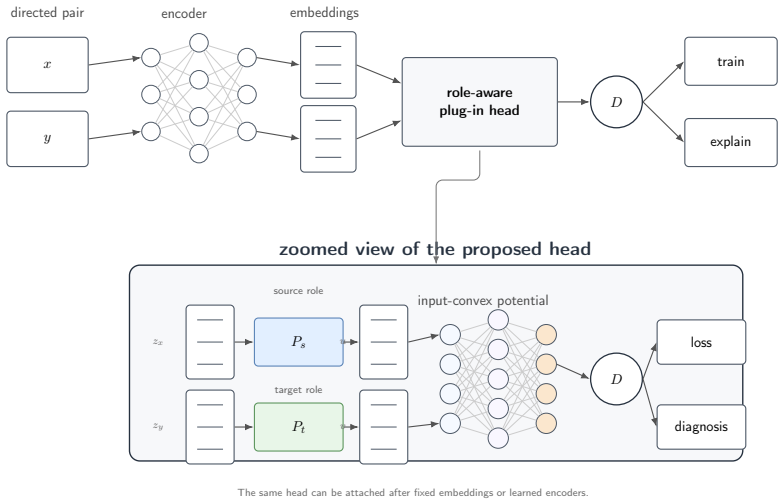
The role-aware neural convex divergence head applies source- and target-role projections before an input-convex neural Bregman divergence, yielding a nonnegative structured score in the role-projected space. It is characterized by its projected-space identity, source-role convexity, directional-gap decomposition, and Hessian-based local curvature. Across ten random seeds on the main semantic and ontology benchmarks, role-aware projections consistently improve directional accuracy over plain ICNN-Bregman heads while preserving zero observed negative divergence rate.
What carries the argument
Role-aware source and target projections applied before input-convex neural Bregman divergence evaluation, which produces nonnegative directional scores with explicit convexity and gap decomposition in the projected space.
If this is right
- Consistent directional accuracy gains over plain ICNN-Bregman heads on lexical, sentence, and ontology benchmarks.
- Zero observed negative divergence rates across tested configurations.
- Structured geometric properties including source-role convexity and directional-gap decomposition.
- Serves as a plug-in module for tasks with directed relations, though symmetric or hyperbolic baselines may outperform on some large fixed-feature citation tasks.
Where Pith is reading between the lines
- The head could be tested on additional directed tasks such as knowledge-graph link prediction to check if accuracy gains hold.
- Separating roles might allow post-training inspection of which features drive source versus target behavior in entailment models.
- Combining the projections with other geometries like hyperbolic embeddings could be explored for tasks where both direction and hierarchy matter.
Load-bearing premise
The learned source- and target-role projections capture directional structure without introducing negative scores or requiring post-hoc data exclusions that would affect the reported accuracy gains.
What would settle it
Running the role-aware head on the main semantic and ontology benchmarks and finding either no consistent directional accuracy gain over plain ICNN-Bregman heads across ten seeds or any negative divergence scores.
Figures

read the original abstract
Many representation learning problems involve directed relations, such as lexical entailment, sentence entailment, ontology hierarchy, and citation links. Standard Euclidean, cosine, and Mahalanobis heads are symmetric, while generic neural scorers can model directionality but provide limited geometric structure. This paper proposes a role-aware neural convex divergence head for asymmetric representation learning. The head applies source- and target-role projections before evaluating an input-convex neural Bregman divergence, yielding a nonnegative structured score in the role-projected space. We characterize its projected-space identity, source-role convexity, directional-gap decomposition, and Hessian-based local curvature. Experiments on lexical, sentence, ontology, and directed graph benchmarks compare symmetric distances, unstructured asymmetric scorers, order/hyperbolic baselines, plain ICNN-Bregman heads, and the proposed role-aware variant. Across ten random seeds on the main semantic and ontology benchmarks, role-aware projections consistently improve directional accuracy over plain ICNN-Bregman heads while preserving zero observed negative divergence rate. The results also identify a boundary case: on large fixed-feature citation prediction, specialized symmetric or hyperbolic baselines remain stronger in ranking accuracy. Overall, the proposed head is best understood as a structured and interpretable plug-in distance module for tasks where directional relations matter.
Editorial analysis
A structured set of objections, weighed in public.
Referee Report
Summary. The manuscript proposes a role-aware neural convex divergence head for asymmetric representation learning on directed relations (e.g., entailment, ontology hierarchies, citation links). Source- and target-role projections are applied before an input-convex neural network Bregman divergence, producing a nonnegative structured score in the projected space. The paper characterizes the head's projected-space identity, source-role convexity, directional-gap decomposition, and Hessian-based local curvature. Experiments compare it against symmetric distances, unstructured scorers, order/hyperbolic baselines, and plain ICNN-Bregman heads on lexical, sentence, ontology, and directed-graph benchmarks; across ten random seeds on the main semantic and ontology tasks the role-aware variant improves directional accuracy while reporting zero observed negative divergence, though specialized symmetric or hyperbolic baselines remain stronger on large fixed-feature citation prediction.
Significance. If the reported gains and nonnegativity hold under fuller experimental controls, the head supplies a geometrically structured, interpretable plug-in module that addresses the symmetry limitation of standard distances while retaining Bregman-derived properties. Explicit characterization of convexity, curvature, and decomposition is a strength that could facilitate adoption and analysis. The work also usefully identifies a boundary case where the method is outperformed, helping delineate its scope.
major comments (1)
- [Abstract] Abstract: the central claim of consistent directional-accuracy gains 'while preserving zero observed negative divergence rate' is load-bearing for the contribution, yet the abstract provides no error bars, dataset sizes, exclusion rules, or confirmation that optimization constraints and numerical checks were applied identically to the plain ICNN-Bregman baseline; if nonnegativity relies on training safeguards or post-hoc filtering that differ across variants, the accuracy improvements cannot be unambiguously attributed to the role-aware projections.
minor comments (2)
- [Abstract] Abstract: quantitative results (accuracy deltas, standard deviations across seeds) are not reported, only the qualitative statement of 'consistent' improvement.
- [Abstract] Abstract: the specific benchmarks, number of examples, and evaluation protocols underlying the 'main semantic and ontology benchmarks' are not named, hindering reproducibility assessment.
Simulated Author's Rebuttal
We thank the referee for the constructive feedback on the abstract. We address the major comment point-by-point below and will revise the manuscript to improve clarity and completeness.
read point-by-point responses
-
Referee: [Abstract] Abstract: the central claim of consistent directional-accuracy gains 'while preserving zero observed negative divergence rate' is load-bearing for the contribution, yet the abstract provides no error bars, dataset sizes, exclusion rules, or confirmation that optimization constraints and numerical checks were applied identically to the plain ICNN-Bregman baseline; if nonnegativity relies on training safeguards or post-hoc filtering that differ across variants, the accuracy improvements cannot be unambiguously attributed to the role-aware projections.
Authors: We agree that the abstract would benefit from additional detail to support the claim. The full manuscript reports results over ten random seeds with standard error bars shown in the tables for the main semantic and ontology benchmarks (Section 4 and Tables 1-3). Dataset sizes are specified in the experimental setup, and no special exclusion rules were applied beyond the standard train/validation/test splits described there. The same optimization constraints, numerical stability checks, and absence of any post-hoc filtering were used identically for the role-aware head and the plain ICNN-Bregman baseline. Nonnegativity follows from the input-convex neural Bregman divergence formulation itself (enforced by the convexity conditions on the network), which was applied uniformly; zero negatives were observed in both variants under these identical conditions. We will revise the abstract to include error bars (reporting means with standard deviations), reference the number of seeds and datasets, and explicitly state that identical procedures were followed for both heads. This revision clarifies that the directional accuracy gains are attributable to the role-aware projections. revision: yes
Circularity Check
No circularity: properties follow from standard Bregman definitions; no reduction to inputs by construction
full rationale
The paper defines a new role-aware projection module whose nonnegativity and source convexity are stated to follow directly from the definition of input-convex neural network Bregman divergence applied after the projections. No equations or claims in the abstract reduce a 'prediction' or central result to a fitted parameter or self-citation chain. The experimental statement uses 'observed' accuracy gains and 'zero observed negative divergence rate' without claiming a derivation that forces these outcomes by construction. The architecture is presented as a plug-in module whose geometric properties are inherited from established Bregman theory rather than being redefined in terms of the target metrics. This is the common case of an independent architectural proposal; no load-bearing step collapses to its own inputs.
Axiom & Free-Parameter Ledger
invented entities (1)
-
role-aware neural convex divergence head
no independent evidence
Reference graph
Works this paper leans on
-
[1]
Tversky, Features of similarity, Psychological Review 84 (1977) 327– 352
A. Tversky, Features of similarity, Psychological Review 84 (1977) 327– 352
work page 1977
-
[2]
I. Vendrov, R. Kiros, S. Fidler, R. Urtasun, Order-embeddings of im- ages and language, in: International Conference on Learning Represen- tations, 2016
work page 2016
- [3]
-
[4]
L. M. Bregman, The relaxation method of finding the common point of convex sets and its application to the solution of problems in convex programming, USSR Computational Mathematics and Mathematical Physics 7 (1967) 200–217
work page 1967
-
[5]
A. Banerjee, S. Merugu, I. S. Dhillon, J. Ghosh, Clustering with breg- man divergences, Journal of Machine Learning Research 6 (2005) 1705– 1749
work page 2005
-
[6]
R. T. Rockafellar, Convex Analysis, Princeton University Press, Prince- ton, NJ, 1970
work page 1970
-
[7]
S. Boyd, L. Vandenberghe, Convex Optimization, Cambridge University Press, Cambridge, 2004. 20
work page 2004
-
[8]
B. Amos, L. Xu, J. Z. Kolter, Input convex neural networks, in: Pro- ceedings of the International Conference on Machine Learning, 2017, pp. 146–155
work page 2017
-
[9]
H. K. Cilingir, R. Manzelli, B. Kulis, Deep divergence learning, in: Proceedings of the 37th International Conference on Machine Learn- ing, volume 119 ofProceedings of Machine Learning Research, 2020, pp. 2027–2037
work page 2020
-
[10]
F. Lu, E. Raff, F. Ferraro, Neural bregman divergences for distance learning, in: International Conference on Learning Representations, 2023
work page 2023
-
[11]
K. Q. Weinberger, L. K. Saul, Distance metric learning for large margin nearest neighbor classification, Journal of Machine Learning Research 10 (2009) 207–244
work page 2009
-
[12]
J. V. Davis, B. Kulis, P. Jain, S. Sra, I. S. Dhillon, Information-theoretic metric learning, in: Proceedings of the International Conference on Machine Learning, 2007, pp. 209–216
work page 2007
-
[13]
Kulis, Metric learning: A survey, Foundations and Trends in Machine Learning 5 (2013) 287–364
B. Kulis, Metric learning: A survey, Foundations and Trends in Machine Learning 5 (2013) 287–364
work page 2013
- [14]
- [15]
- [16]
- [17]
- [18]
-
[19]
G. A. Miller, Wordnet: A lexical database for english, Communications of the ACM 38 (1995) 39–41
work page 1995
-
[20]
M. Marelli, S. Menini, M. Baroni, L. Bentivogli, R. Bernardi, R. Zam- parelli, A sick cure for the evaluation of compositional distributional semantic models, in: Proceedings of the Ninth International Conference on Language Resources and Evaluation, 2014, pp. 216–223
work page 2014
-
[21]
S. R. Bowman, G. Angeli, C. Potts, C. D. Manning, A large anno- tated corpus for learning natural language inference, in: Proceedings of the Conference on Empirical Methods in Natural Language Processing, 2015, pp. 632–642
work page 2015
-
[22]
The Gene Ontology Consortium, The gene ontology resource: 20 years and still going strong, Nucleic Acids Research 47 (2019) D330–D338
work page 2019
-
[23]
W. Hu, M. Fey, M. Zitnik, Y. Dong, H. Ren, B. Liu, M. Catasta, J. Leskovec, Open graph benchmark: Datasets for machine learning on graphs, in: Advances in Neural Information Processing Systems, volume 33, 2020, pp. 22118–22133
work page 2020
-
[24]
J. Pennington, R. Socher, C. D. Manning, Glove: Global vectors for word representation, in: Proceedings of the Conference on Empirical Methods in Natural Language Processing, 2014, pp. 1532–1543
work page 2014
-
[25]
N. Reimers, I. Gurevych, Sentence-bert: Sentence embeddings using siamese bert-networks, in: Proceedings of the Conference on Empirical Methods in Natural Language Processing, 2019, pp. 3982–3992. 22
work page 2019
discussion (0)
Sign in with ORCID, Apple, or X to comment. Anyone can read and Pith papers without signing in.