Energetic particle-mediated interplanetary shocks observed by Solar Orbiter
Pith reviewed 2026-07-03 01:47 UTC · model grok-4.3
The pith
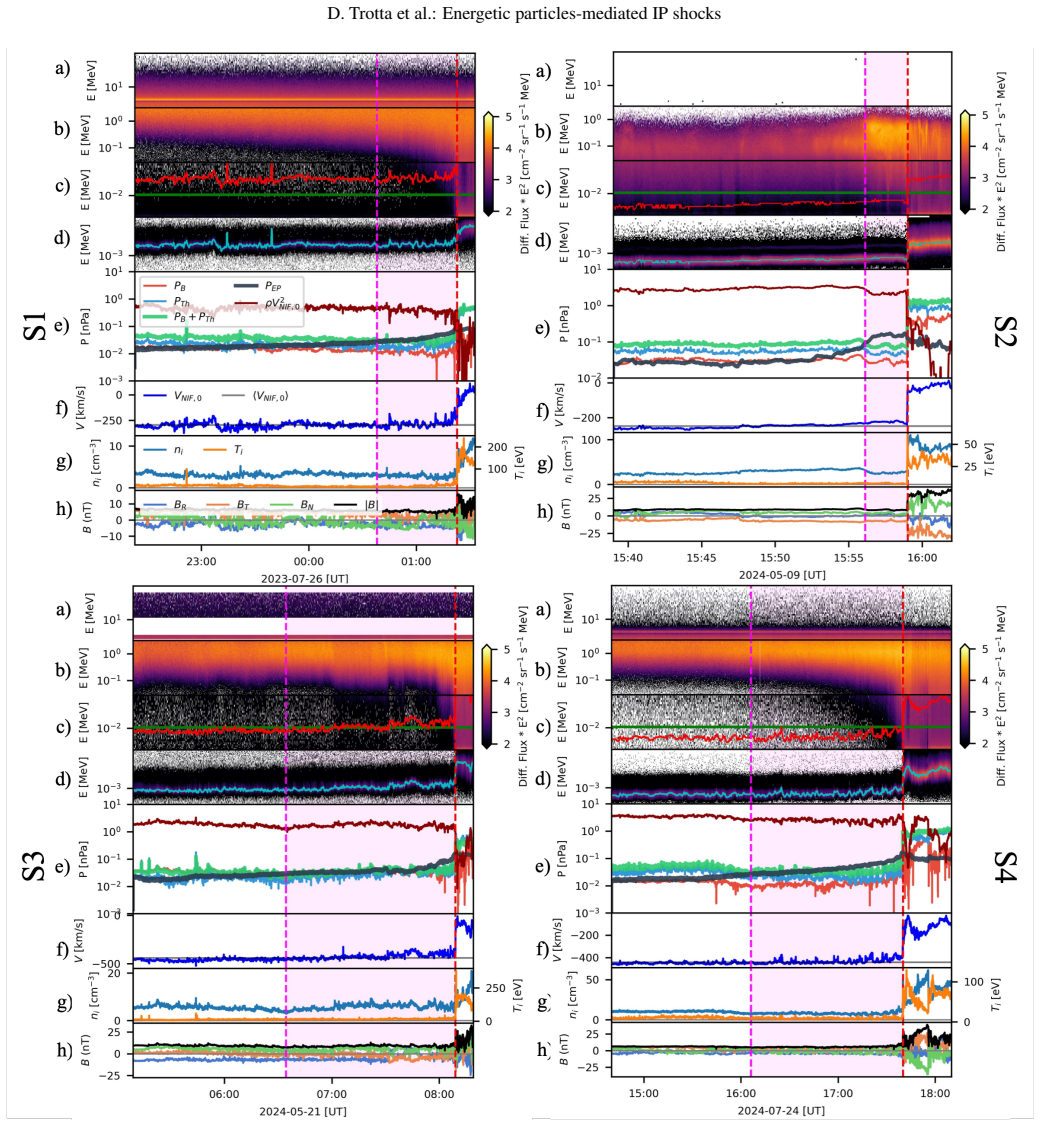
Four interplanetary shocks observed by Solar Orbiter have energetic particle pressure at least as large as the sum of thermal and magnetic pressures.
A machine-rendered reading of the paper's core claim, the machinery that carries it, and where it could break.
Core claim
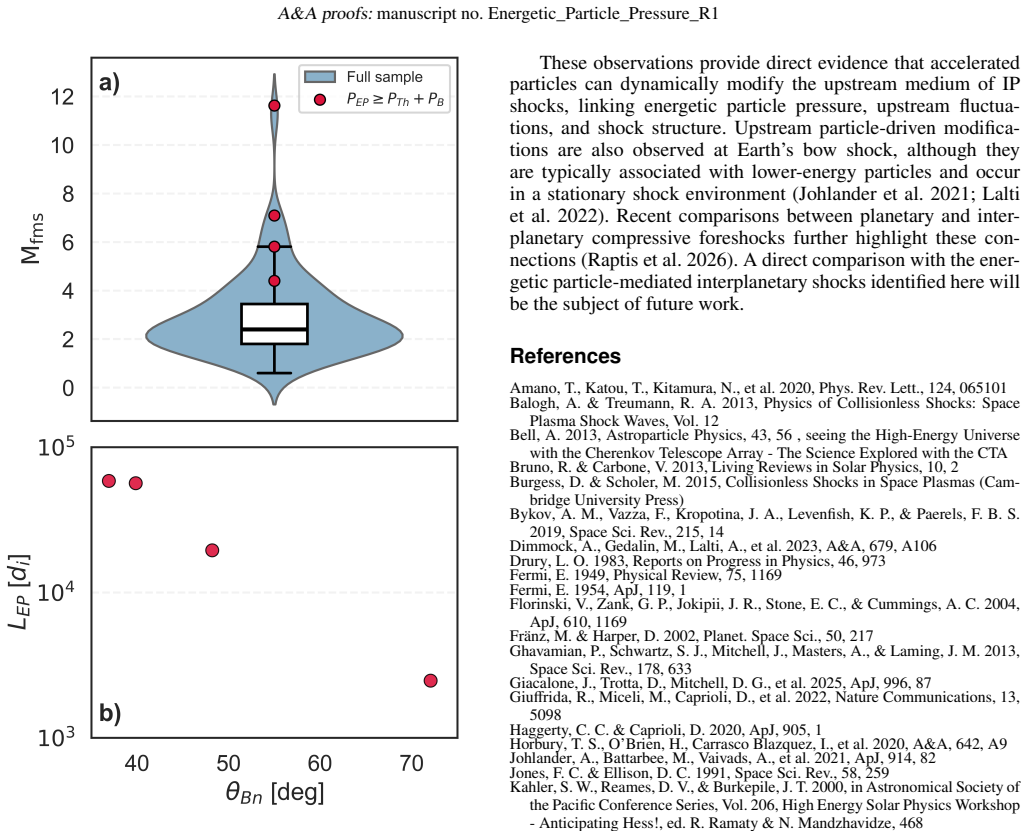
The paper claims that energetic particles dynamically dominate the upstream pressure at four observed interplanetary shocks, satisfying P_EP ≥ P_Th + P_B. These events are strong and fast, lie in the high-Mach-number tail of the Solar Orbiter shock sample, and show P_EP increases that coincide with decreasing upstream bulk flow speed in the shock frame. The resulting particle-mediated foreshocks extend to ~10^5 ion inertial lengths d_i, with the spatial extent depending on shock geometry. The observations demonstrate that accelerated particles can modify interplanetary shock structure through coupling with upstream fluctuations.
What carries the argument
Comparison of energetic particle pressure P_EP (computed from proton measurements above 10 keV) against upstream thermal pressure P_Th and magnetic pressure P_B to identify dominance cases.
If this is right
- The four shocks are strong and fast and belong to the high-Mach-number tail of the Solar Orbiter population.
- P_EP rise often coincides with a drop in upstream bulk flow speed measured in the shock frame.
- The particle-dominated foreshock regions reach lengths up to approximately 10^5 ion inertial lengths.
- The spatial extent of these regions varies with shock geometry.
- Accelerated particles can dynamically modify interplanetary shocks via coupling to upstream fluctuations.
Where Pith is reading between the lines
- Similar pressure dominance may occur at other collisionless shocks where full particle spectra are harder to measure.
- Models of cosmic-ray modified shocks could be tested directly against these heliospheric cases with known distances and speeds.
- Future instruments that extend energy coverage or include multiple species would tighten the pressure estimates for these events.
- The geometry dependence suggests that quasi-parallel shocks may sustain longer particle-mediated regions than quasi-perpendicular ones.
Load-bearing premise
The upstream region chosen for pressure comparison is the correct one and proton data above 10 keV capture essentially all the energetic particle pressure without missing flux from other energies or species.
What would settle it
Reanalysis of the same four events that includes protons below 10 keV or ions from other species and finds P_EP dropping below P_Th + P_B, or that shifts the upstream interval and changes the pressure balance.
Figures
read the original abstract
Context: In collisionless shocks, energetic particles can carry sufficient pressure to modify the upstream plasma and the shock structure itself, a regime often invoked in theories of cosmic-ray acceleration but rarely observed in the heliosphere. Aims: We find and characterize {interplanetary} IP shocks where energetic particles dynamically dominate the upstream pressure. Methods: We analyze IP shocks observed by Solar Orbiter inside 1 au and compute the energetic particle pressure $P_{EP}$ from proton measurements above 10\,keV, comparing it with the upstream thermal $P_{Th}$ and magnetic $P_{B}$ pressures. Results: We identify four shocks for which $P_{EP} \geq P_{Th} + P_B $. These events correspond to strong and fast shocks in the high-Mach-number tail of the Solar Orbiter shock population. In several cases the $P_{EP}$ increase coincides with a decreasing upstream bulk flow speed in the shock frame, and the resulting particle-mediated foreshocks extend up to $\sim10^5$ {ion inertial lengths} $d_i$. The extent of such energetic particle dominated region depends on shock geometry. Conclusions: These observations provide evidence that accelerated particles can dynamically modify interplanetary shocks. They highlight the importance of the coupling between energetic particles, upstream fluctuations, and shock structure for understanding particle acceleration at collisionless shocks.
Editorial analysis
A structured set of objections, weighed in public.
Referee Report
Summary. The paper analyzes interplanetary shocks observed by Solar Orbiter inside 1 au and identifies four events where the energetic-particle pressure P_EP (computed from proton measurements above 10 keV) satisfies P_EP ≥ P_Th + P_B in the upstream region. These shocks are characterized as strong and fast, lying in the high-Mach-number tail of the observed population, with associated foreshocks extending up to ~10^5 ion inertial lengths; the work concludes that accelerated particles can dynamically modify the upstream plasma and shock structure.
Significance. If the pressure comparisons hold under the stated definitions, the result supplies rare in-situ evidence that energetic particles can dominate upstream pressure at heliospheric shocks, directly supporting models of particle-mediated shock modification and cosmic-ray acceleration. The linkage to high-Mach events and the reported foreshock extents provide concrete observational anchors for theory.
major comments (2)
- [Results] Results section: The central claim that four shocks satisfy P_EP ≥ P_Th + P_B rests on the choice of upstream interval, yet the manuscript provides no explicit criteria (distance from shock, avoidance of foreshock, or plasma-state matching) for selecting that interval; any inclusion of reflected-ion or foreshock plasma would systematically inflate P_EP relative to P_Th and P_B evaluated in the same window.
- [Results] Results / Methods: The P_EP integral is restricted to protons above the 10 keV threshold with no reported error budget or sensitivity test for missing contributions from electrons, heavier ions, or the unmeasured high-energy tail; because the inequality is the load-bearing diagnostic for the four events, an incomplete integral directly undermines the dominance conclusion.
minor comments (2)
- [Abstract] Abstract: The phrase “{interplanetary} IP shocks” contains a stray LaTeX brace that should be removed.
- [Results] Notation: The manuscript should define the precise energy range and instrument channels used for the >10 keV proton pressure at first use in the Results section.
Simulated Author's Rebuttal
We thank the referee for the thorough and constructive review. The comments identify important gaps in methodological transparency that we will address in revision. We respond to each major comment below.
read point-by-point responses
-
Referee: [Results] Results section: The central claim that four shocks satisfy P_EP ≥ P_Th + P_B rests on the choice of upstream interval, yet the manuscript provides no explicit criteria (distance from shock, avoidance of foreshock, or plasma-state matching) for selecting that interval; any inclusion of reflected-ion or foreshock plasma would systematically inflate P_EP relative to P_Th and P_B evaluated in the same window.
Authors: We acknowledge that the original manuscript did not supply explicit selection criteria for the upstream intervals. This omission leaves open the possibility of foreshock contamination. In the revised manuscript we will add a new subsection in Methods that states the quantitative criteria: intervals are chosen 5–20 minutes upstream of the shock ramp (corresponding to ~10^4–10^5 km at typical solar-wind speeds), require magnetic-field variance below a threshold, show no reflected-ion beams in the EPD pitch-angle distributions, and exhibit stable bulk-flow speed and density. We will also tabulate the precise start and end times for each of the four events together with the justification that these windows lie outside detectable foreshock activity. revision: yes
-
Referee: [Results] Results / Methods: The P_EP integral is restricted to protons above the 10 keV threshold with no reported error budget or sensitivity test for missing contributions from electrons, heavier ions, or the unmeasured high-energy tail; because the inequality is the load-bearing diagnostic for the four events, an incomplete integral directly undermines the dominance conclusion.
Authors: We agree that the absence of an error budget and sensitivity tests weakens the robustness of the P_EP ≥ P_Th + P_B claim. The EPD proton channels above 10 keV constitute the dominant measured contribution, but electrons, heavy ions, and the > few-MeV tail are not directly available in the same dataset. In revision we will insert a dedicated paragraph that (i) cites typical electron-to-proton pressure ratios at these energies, (ii) bounds the heavy-ion contribution using abundance ratios from prior studies, (iii) extrapolates the high-energy tail with both the observed spectral index and a conservative steeper index, and (iv) reports the outcome of sensitivity tests in which the lower energy threshold is varied from 5 to 20 keV and the inequality is re-evaluated. These additions will quantify the uncertainty range for each event. revision: yes
Circularity Check
No circularity: purely observational identification of pressure dominance from direct measurements
full rationale
The paper reports an observational study that selects upstream intervals in Solar Orbiter data, integrates proton flux above 10 keV to obtain P_EP, and compares it directly to measured P_Th and P_B. No equations, fitted parameters, or model derivations are presented whose outputs are forced by construction to equal their inputs. The central claim (four events satisfying P_EP ≥ P_Th + P_B) is a data-processing result, not a self-referential reduction. Any self-citations that may exist are not invoked to justify uniqueness theorems or ansatzes that carry the result. The analysis is therefore self-contained against external benchmarks.
Axiom & Free-Parameter Ledger
free parameters (2)
- 10 keV energy threshold
- P_EP >= P_Th + P_B inequality
axioms (1)
- domain assumption Proton measurements above 10 keV dominate the energetic particle pressure
Reference graph
Works this paper leans on
-
[1]
Electron-Ion Temperature Equilibration in Collisionless Shocks: The Supernova Remnant-Solar Wind Connection. , keywords =. doi:10.1007/s11214-013-9999-0 , archivePrefix =. 1305.6617 , primaryClass =
work page internal anchor Pith review Pith/arXiv arXiv doi:10.1007/s11214-013-9999-0
-
[2]
Unraveling the drivers of the storm time radiation belt response. , keywords =. doi:10.1002/2015GL063542 , adsurl =
-
[3]
Ion Acceleration at the Earth's Bow Shock. , keywords =. doi:10.1007/s11214-012-9901-5 , adsurl =
-
[4]
doi:10.1007/978-1-4614-6099-2 , adsurl =
Physics of Collisionless Shocks: Space Plasma Shock Waves. doi:10.1007/978-1-4614-6099-2 , adsurl =
-
[5]
, year = 1954, month = jan, volume =
Galactic Magnetic Fields and the Origin of Cosmic Radiation. , year = 1954, month = jan, volume =. doi:10.1086/145789 , adsurl =
-
[6]
Origin of Coronal Shock Waves. Invited Review. , keywords =. doi:10.1007/s11207-008-9241-5 , adsurl =
-
[7]
Collisionless shocks in the heliosphere. A tutorial review. Geophysical Monograph Series , keywords =. doi:10.1029/GM034 , adsurl =
-
[8]
The temporal and spatial development of MeV proton acceleration at interplanetary shocks. , keywords =. doi:10.1029/97JA01678 , adsurl =
-
[9]
Living Reviews in Solar Physics , keywords =
Large gradual solar energetic particle events. Living Reviews in Solar Physics , keywords =. doi:10.1007/s41116-016-0002-5 , adsurl =
-
[10]
Nature Communications , keywords =
The supernova remnant SN 1006 as a Galactic particle accelerator. Nature Communications , keywords =. doi:10.1038/s41467-022-32781-4 , archivePrefix =. 2208.14491 , primaryClass =
-
[11]
, year = 2005, month = jun, volume =
The Foreshock. , year = 2005, month = jun, volume =. doi:10.1007/s11214-005-3824-3 , adsurl =
-
[12]
Emma E. Davies and Hannah T. Rüdisser and Ute V. Amerstorfer and Christian Möstl and Maike Bauer and Eva Weiler and Tanja Amerstorfer and Satabdwa Majumdar and Phillip Hess and Andreas J. Weiss and Martin A. Reiss and Lucie M. Green and David M. Long and Teresa Nieves-Chinchilla and Domenico Trotta and Timothy S. Horbury and Helen O’Brien and Edward Fauch...
-
[13]
The Need for Near-Earth Multi-Spacecraft Heliospheric Measurements and an Explorer Mission to Investigate Interplanetary Structures and Transients in the Near-Earth Heliosphere. , keywords =. doi:10.1007/s11214-024-01108-8 , adsurl =
-
[14]
John D. Richardson , keywords =. Shocks and sheaths in the heliosphere , journal =. 2011 , note =. doi:https://doi.org/10.1016/j.jastp.2010.06.005 , url =
-
[15]
, keywords =
First Observations of Irregular Surface of Interplanetary Shocks at Ion Scales by Cluster. , keywords =
-
[16]
The first SEPServer event catalogue 68-MeV solar proton events observed at 1 AU in 1996-2010 , DOI= "10.1051/swsc/2013030", url= "https://doi.org/10.1051/swsc/2013030", journal =
-
[17]
Rice, W. K. M. and Zank, G. P. and Li, G. , title =. , volume =. doi:https://doi.org/10.1029/2002JA009756 , url =. https://agupubs.onlinelibrary.wiley.com/doi/pdf/10.1029/2002JA009756 , abstract =
-
[18]
Corotating Interaction Regions , year = 1999, editor =
Modulation of Galactic Cosmic Rays at Solar Minimum. Corotating Interaction Regions , year = 1999, editor =. doi:10.1007/978-94-017-1179-1_10 , adsurl =
-
[19]
Living Reviews in Solar Physics , keywords =
Coronal Mass Ejections: Models and Their Observational Basis. Living Reviews in Solar Physics , keywords =. doi:10.12942/lrsp-2011-1 , adsurl =
-
[20]
An Essay on Terminology, Myths and Known Facts: Solar Transient - Flare - CME - Driver Gas - Piston - BDE - Magnetic Cloud - Shock Wave - Geomagnetic Storm. , keywords =. doi:10.1007/BF00644053 , adsurl =
-
[21]
Physics of the Inner Heliosphere I. Large-Scale Phenomena. doi:10.1007/978-3-642-75361-9 , adsurl =
-
[22]
Kruparova, Oksana and Szabo, Adam and Jian, Lan K. and Němec, František and Šafránková, Jana and Němeček, Zdeněk and Pasanen, Jacob and Narock, Ayris and Krupar, Vratislav , title =. , abstract =. 2025 , month =. doi:10.3847/2041-8213/ada558 , url =
-
[23]
The Interaction of Successive Coronal Mass Ejections: A Review
The Interaction of Successive Coronal Mass Ejections: A Review. , keywords =. doi:10.1007/s11207-017-1091-6 , archivePrefix =. 1612.02398 , primaryClass =
work page internal anchor Pith review Pith/arXiv arXiv doi:10.1007/s11207-017-1091-6
-
[24]
, year = 1995, month = feb, volume =
The Design Features of the GGS Wind and Polar Spacecraft. , year = 1995, month = feb, volume =. doi:10.1007/BF00751324 , adsurl =
-
[25]
Bimodal fluxes of near-relativistic electrons during the onset of solar particle events. , keywords =. doi:10.1002/jgra.50446 , adsurl =
-
[26]
Advances in Space Research , year = 1997, month = jan, volume =
The wind spacecraft and its early scientific results. Advances in Space Research , year = 1997, month = jan, volume =. doi:10.1016/S0273-1177(97)00439-0 , adsurl =
-
[27]
and Rees, Adam and Horbury, Timothy S
Intriligator, Devrie S. and Rees, Adam and Horbury, Timothy S. , title =. , volume =. doi:https://doi.org/10.1029/2007JA012699 , url =. https://agupubs.onlinelibrary.wiley.com/doi/pdf/10.1029/2007JA012699 , abstract =
-
[28]
A propagation tool to connect remote-sensing observations with in-situ measurements of heliospheric structures. , keywords =. doi:10.1016/j.pss.2017.07.001 , archivePrefix =. 1702.00399 , primaryClass =
work page internal anchor Pith review Pith/arXiv arXiv doi:10.1016/j.pss.2017.07.001 2017
-
[29]
Wang, Y. M. and Ye, P. Z. and Wang, S. , title =. , volume =. doi:10.1029/2003JA009850 , url =. https://agupubs.onlinelibrary.wiley.com/doi/pdf/10.1029/2003JA009850 , abstract =
-
[30]
Lugaz, N. and Farrugia, C. J. , title =. , volume =. doi:10.1002/2013GL058789 , url =. https://agupubs.onlinelibrary.wiley.com/doi/pdf/10.1002/2013GL058789 , abstract =
-
[31]
Magnetic Structure and Propagation of Two Interacting CMEs From the Sun to Saturn. , keywords =. doi:10.1029/2021JA029770 , archivePrefix =. 2110.02190 , primaryClass =
-
[32]
Living Reviews in Solar Physics , keywords =
Coronal mass ejections and their sheath regions in interplanetary space. Living Reviews in Solar Physics , keywords =. doi:10.1007/s41116-017-0009-6 , adsurl =
-
[33]
Clustering of magnetic reconnection exhausts in the solar wind: An automated detection study , DOI= "10.1051/0004-6361/202346043", url= "https://doi.org/10.1051/0004-6361/202346043", journal =
-
[34]
Geophysical Monograph Series , keywords =
Physics of magnetic flux ropes. Geophysical Monograph Series , keywords =. doi:10.1029/GM058 , adsurl =
-
[35]
Jones, G. H. and Balogh, A. and Horbury, T. S. , title =. , volume =. doi:10.1029/1998GL900258 , url =. https://agupubs.onlinelibrary.wiley.com/doi/pdf/10.1029/1998GL900258 , abstract =
-
[36]
Nakagawa, T. and Nishida, A. and Saito, T. , title =. , volume =. doi:https://doi.org/10.1029/JA094iA09p11761 , url =. https://agupubs.onlinelibrary.wiley.com/doi/pdf/10.1029/JA094iA09p11761 , abstract =
-
[37]
Planar magnetic structures in coronal mass ejection-driven sheath regions
Planar magnetic structures in coronal mass ejection-driven sheath regions. Annales Geophysicae , keywords =. doi:10.5194/angeo-34-313-2016 , archivePrefix =. 1701.08739 , primaryClass =
work page internal anchor Pith review Pith/arXiv arXiv doi:10.5194/angeo-34-313-2016 2016
-
[38]
Planar Magnetic Structures Downstream of Coronal Mass Ejection-driven Shocks in the Inner Heliosphere. , keywords =. doi:10.3847/1538-4357/acd245 , adsurl =
-
[39]
Successive CMEs and complex ejecta. , keywords =. doi:10.1029/2001JA000255 , adsurl =
-
[40]
Möstl, C. and Isavnin, A. and Boakes, P. D. and Kilpua, E. K. J. and Davies, J. A. and Harrison, R. A. and Barnes, D. and Krupar, V. and Eastwood, J. P. and Good, S. W. and Forsyth, R. J. and Bothmer, V. and Reiss, M. A. and Amerstorfer, T. and Winslow, R. M. and Anderson, B. J. and Philpott, L. C. and Rodriguez, L. and Rouillard, A. P. and Gallagher, P. ...
-
[41]
Compressive Structures in the Foreshock of Collisionless Shocks
Compressive Structures in the Foreshock of Collisionless Shocks. , keywords =. doi:10.3847/2041-8213/ae53e5 , archivePrefix =. 2603.17882 , primaryClass =
work page internal anchor Pith review Pith/arXiv arXiv doi:10.3847/2041-8213/ae53e5 2041
-
[42]
Ion Acceleration Efficiency at the Earth's Bow Shock: Observations and Simulation Results. , keywords =. doi:10.3847/1538-4357/abfafc , adsurl =
-
[43]
On the Magnetic Field Evolution of Interplanetary Coronal Mass Ejections from 0.07 to 5.4 au. , keywords =. doi:10.3847/1538-4357/ae50fe , archivePrefix =. 2512.04730 , primaryClass =
-
[44]
Christian Möstl and Andreas J. Weiss and Rachel L. Bailey and Martin A. Reiss and Tanja Amerstorfer and Jürgen Hinterreiter and Maike Bauer and Scott W. McIntosh and Noé Lugaz and David Stansby , title =. , abstract =. 2020 , month =. doi:10.3847/1538-4357/abb9a1 , url =
-
[45]
T. H. Zurbuchen and M. Weberg and R. von Steiger and R. A. Mewaldt and S. T. Lepri and S. K. Antiochos , title =. , abstract =. 2016 , month =. doi:10.3847/0004-637X/826/1/10 , url =
-
[46]
Howard, R. A. and Moses, J. D. and Vourlidas, A. and Newmark, J. S. and Socker, D. G. and Plunkett, S. P. and Korendyke, C. M. and Cook, J. W. and Hurley, A. and Davila, J. M. and Thompson, W. T. and. doi:10.1007/s11214-008-9341-4 , journal =
-
[47]
The STEREO Mission: An Introduction. , keywords =. doi:10.1007/s11214-007-9277-0 , adsurl =
-
[48]
Horbury and Lorenzo Matteini and Heli Hietala and Xochitl Blanco-Cano and Luca Franci and C
Domenico Trotta and Andrea Larosa and Georgios Nicolaou and Timothy S. Horbury and Lorenzo Matteini and Heli Hietala and Xochitl Blanco-Cano and Luca Franci and C. H. K Chen and Lingling Zhao and Gary P. Zank and Christina M. S. Cohen and Stuart D. Bale and Ronan Laker and Nais Fargette and Francesco Valentini and Yuri Khotyaintsev and Rungployphan Kieoka...
-
[49]
Oliveira, Denny M. , TITLE=. Frontiers in Astronomy and Space Sciences , VOLUME=. 2023 , URL=. doi:10.3389/fspas.2023.1240323 , ISSN=
-
[50]
The Solar Probe Plus Mission: Humanity's First Visit to Our Star. , keywords =. doi:10.1007/s11214-015-0211-6 , adsurl =
-
[51]
Non-thermal processes in large solar flares. , keywords =. doi:10.1007/BF00206199 , adsurl =
-
[52]
Tsurutani, Bruce T. and Gonzalez, Walter D. and Tang, Frances and Akasofu, Syun I. and Smith, Edward J. , title =. , volume =. doi:https://doi.org/10.1029/JA093iA08p08519 , url =. https://agupubs.onlinelibrary.wiley.com/doi/pdf/10.1029/JA093iA08p08519 , abstract =
-
[53]
Reames, Donald V. , title =. Reviews of Geophysics , volume =. doi:https://doi.org/10.1029/95RG00188 , url =. https://agupubs.onlinelibrary.wiley.com/doi/pdf/10.1029/95RG00188 , abstract =
-
[54]
Zhang, J. and Richardson, I. G. and Webb, D. F. and Gopalswamy, N. and Huttunen, E. and Kasper, J. C. and Nitta, N. V. and Poomvises, W. and Thompson, B. J. and Wu, C.-C. and Yashiro, S. and Zhukov, A. N. , title =. , volume =. doi:https://doi.org/10.1029/2007JA012321 , url =. https://agupubs.onlinelibrary.wiley.com/doi/pdf/10.1029/2007JA012321 , abstract =
-
[55]
Properties of Stream Interactions at One AU During 1995 2004. , keywords =. doi:10.1007/s11207-006-0132-3 , adsurl =
-
[56]
Physics of the Inner Heliosphere I , year = 1990, editor =
Large-Scale Structure of the Interplanetary Medium. Physics of the Inner Heliosphere I , year = 1990, editor =. doi:10.1007/978-3-642-75361-9_3 , adsurl =
-
[57]
Living Reviews in Solar Physics , keywords =
Solar wind stream interaction regions throughout the heliosphere. Living Reviews in Solar Physics , keywords =. doi:10.1007/s41116-017-0011-z , adsurl =
-
[58]
Shock acceleration of energetic particles in corotating interaction regions in the solar wind. , keywords =. doi:10.1086/157907 , adsurl =
-
[59]
Solar wind drivers of geomagnetic storms during more than four solar cycles , DOI= "10.1051/swsc/2012001", url= "https://doi.org/10.1051/swsc/2012001", journal =
-
[60]
Observations of the Outer Heliosphere, Heliosheath, and Interstellar Medium. , keywords =. doi:10.1007/s11214-022-00899-y , adsurl =
-
[61]
Living Reviews in Solar Physics , keywords =
Flare Observations. Living Reviews in Solar Physics , keywords =. doi:10.12942/lrsp-2008-1 , adsurl =
-
[62]
Solar energetic particle event onset as analyzed from simulated data , DOI= "10.1051/0004-6361:20034247", url= "https://doi.org/10.1051/0004-6361:20034247", journal =
-
[63]
Decker, R. B. , title =. , volume =. doi:https://doi.org/10.1029/JA095iA08p11993 , abstract =
-
[64]
William P. Wilkinson , keywords =. The Earth's quasi-parallel bow shock: Review of observations and perspectives for Cluster , journal =. 2003 , note =. doi:https://doi.org/10.1016/S0032-0633(03)00099-0 , url =
-
[65]
Evolution of the Suprathermal Proton Population at Interplanetary Shocks. , keywords =. doi:10.3847/1538-3881/ab1e49 , adsurl =
-
[66]
Koval, A. and Szabo, A. , title =. , volume =. doi:https://doi.org/10.1029/2008JA013337 , abstract =
-
[67]
The plasma physics of shock acceleration. , keywords =. doi:10.1007/BF01206003 , adsurl =
-
[68]
The Solar Orbiter Radio and Plasma Waves (RPW) instrument , DOI= "10.1051/0004-6361/201936214", url= "https://doi.org/10.1051/0004-6361/201936214", journal =
-
[69]
The 17 April 2021 widespread solar energetic particle event. , keywords =. doi:10.1051/0004-6361/202345938 , archivePrefix =. 2303.10969 , primaryClass =
-
[70]
Lario, D. and Decker, R. B. , title =. , volume =. doi:https://doi.org/10.1029/2001gl014017 , abstract =
-
[71]
, volume=
Acceleration of suprathermal protons near an interplanetary shock , author=. , volume=. 2023 , publisher=
2023
-
[72]
Wimmer-Schweingruber and Linghua Wang and Jia Yu and Antoinette B
Liu Yang and Lars Berger and Robert F. Wimmer-Schweingruber and Linghua Wang and Jia Yu and Antoinette B. Galvin and Eberhard Möbius , title =. , abstract =. 2020 , month =. doi:10.3847/2041-8213/ab629d , url =
-
[73]
M. Nakanotani and G. P. Zank and L.-L. Zhao , title =. , abstract =. 2022 , month =. doi:10.3847/1538-4357/ac4781 , url =
-
[74]
Shock Acceleration of Ions in the Heliosphere. , keywords =. doi:10.1007/s11214-012-9932-y , adsurl =
-
[75]
IBEX Interstellar Boundary Explorer. , keywords =. doi:10.1007/s11214-009-9499-4 , adsurl =
-
[76]
Jacco Vink and Ryo Yamazaki , title =. , abstract =. 2013 , month =. doi:10.1088/0004-637X/780/2/125 , url =
-
[77]
Nature Astronomy , year = 2022, month = dec, volume =
Oblique and rippled heliosphere structures from the Interstellar Boundary Explorer. Nature Astronomy , year = 2022, month = dec, volume =. doi:10.1038/s41550-022-01798-6 , adsurl =
-
[78]
Kajdic, P. and Pfau-Kempf, Y. and Turc, L. and Dimmock, A. P. and Palmroth, M. and Takahashi, K. and Kilpua, E. and Soucek, J. and Takahashi, N. and Preisser, L. and Blanco-Cano, X. and Trotta, D. and Burgess, D. , title =. , volume =. doi:https://doi.org/10.1029/2021JA029283 , url =. , note =
-
[79]
First year of energetic particle measurements in the inner heliosphere with Solar Orbiter's Energetic Particle Detector. , keywords =. doi:10.1051/0004-6361/202140940 , archivePrefix =. 2108.02020 , primaryClass =
-
[80]
A tale of two shocks. , keywords =. doi:10.1051/0004-6361/202555814 , archivePrefix =. 2506.03958 , primaryClass =
discussion (0)
Sign in with ORCID, Apple, or X to comment. Anyone can read and Pith papers without signing in.