REVIEW 2 major objections 2 minor 57 references
AdaCount: Training-Free Similarity-Guided Spatial and Feature Adaptation for Zero-Shot Object Counting
T0 review · 2 major / 2 minor · reviewed 2026-07-03 · grok-4.3
Pith's one-line read AdaCount uses a text-prompt similarity map to warp images spatially and modulate features for improved zero-shot counting with SAM3.
desk verdict AdaCount adds similarity-map-guided warping and modulation to SAM3 for training-free ZOC, but the map's accuracy on dense small-object scenes is unverified and central to the claimed gains. read the letter →
The pith
A machine-rendered reading of the paper's core claim, the machinery that carries it, and where it could break.
The reading
What carries the argument
The prototype-driven similarity map from the text prompt that identifies target regions and guides both spatial warping and feature modulation.
What would settle it
Apply the similarity-guided adaptations to SAM3 on a dense small-object counting benchmark and measure whether missed instances or false positives increase compared with the unadapted baseline.
Extended reading notes
Core claim
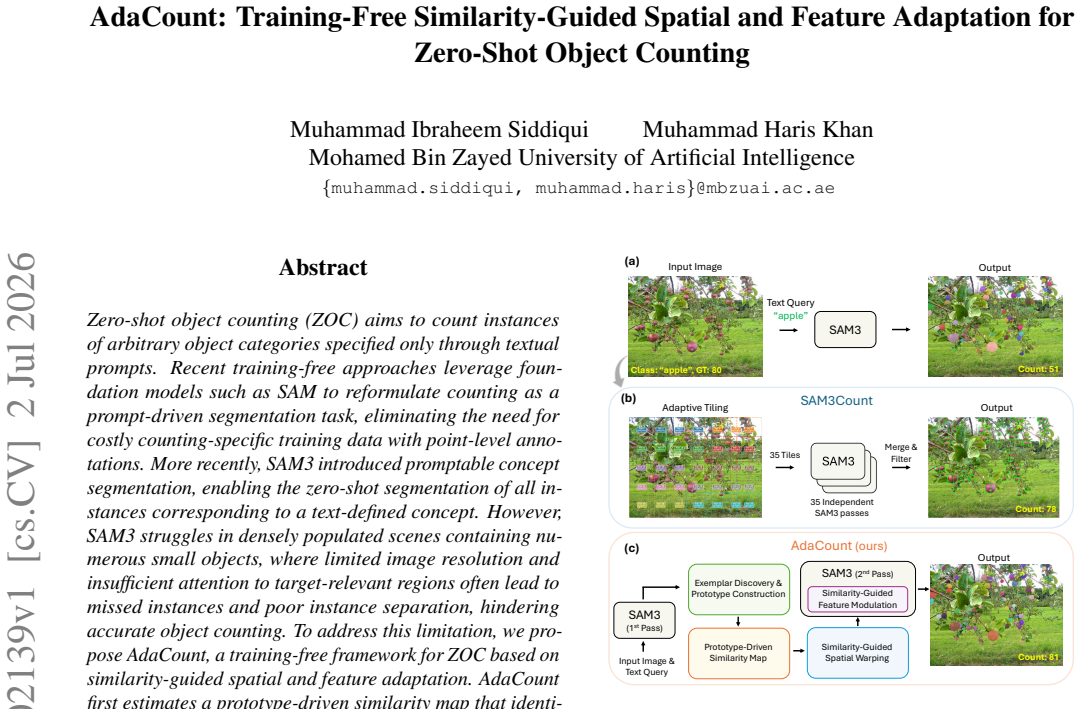
AdaCount first estimates a prototype-driven similarity map that identifies target-relevant regions. This similarity map subsequently guides two complementary adaptations: (i) similarity-guided spatial warping, which reallocates image resolution toward target instances, and (ii) feature modulation, which amplifies target-relevant encoder representations. Together, these adaptations enable SAM3 to devote greater representational capacity to target-relevant regions while preserving global image context, without requiring any model retraining.
Load-bearing premise
The prototype-driven similarity map computed from the text prompt accurately identifies target-relevant regions even in densely populated scenes with numerous small objects.
Editorial extensions
If this is right
- Better instance separation occurs in crowded scenes because resolution is reallocated toward target objects.
- New state-of-the-art results among training-free zero-shot counting methods hold across six diverse benchmarks.
- Global image context remains available while local focus on relevant regions increases.
- No counting-specific training data or retraining is needed for the gains.
Reading between the lines
- The same similarity-guided warping and modulation steps could be tested on other prompt-driven segmentation tasks that struggle with small or dense instances.
- If the similarity map proves reliable, it might reduce the need for higher-resolution inputs in related dense-prediction problems.
- Combining the map with refined text prompts could further lower error rates on categories where the initial prototype match is weak.
Editorial analysis
A structured set of objections, weighed in public.
Referee Report
Summary. The paper introduces AdaCount, a training-free zero-shot object counting method that computes a prototype-driven similarity map from a text prompt and SAM3 encoder features, then uses this map to perform similarity-guided spatial warping (to reallocate resolution toward target regions) and feature modulation (to amplify target-relevant representations) before feeding the adapted input to SAM3 for instance segmentation and counting. It claims this addresses SAM3's failures on dense scenes with small objects and establishes new SOTA results among training-free ZOC methods on six benchmarks.
Significance. If the empirical gains are shown to be causally attributable to the proposed adaptations rather than post-hoc tuning or dataset-specific effects, the work would be significant for demonstrating how lightweight, training-free guidance from foundation-model features can mitigate resolution and attention limitations in promptable segmentation models without retraining or additional supervision.
major comments (2)
- [§3] §3 (similarity map computation and downstream use): the central claim that the prototype-driven similarity map reliably identifies target instances in densely populated scenes with small objects is load-bearing for both the spatial warping and feature modulation steps, yet the manuscript provides no quantitative validation of map quality (e.g., IoU or precision against point/mask annotations on the hardest subsets of the six benchmarks); without this, the reported counting improvements cannot be confidently attributed to the adaptations rather than other factors.
- [Experiments] Experiments section (SOTA claim): the assertion of new state-of-the-art among training-free ZOC approaches requires explicit comparison tables with all recent baselines (including SAM3 itself) plus ablations isolating the contribution of warping versus modulation; the absence of such breakdowns on the dense-small-object subsets undermines the causal link asserted in the abstract.
minor comments (2)
- [Abstract] Abstract: states SOTA performance on six benchmarks but supplies no numerical results, baseline names, or error metrics; while common, this makes the strength of the claim difficult to assess from the front matter alone.
- [§3] Notation in §3: the definition of the prototype vector and the exact similarity computation (cosine vs. other) should be written as an explicit equation to allow reproduction.
Simulated Author's Rebuttal
We thank the referee for the constructive feedback. We respond point-by-point to the major comments and commit to revisions that directly address the concerns about causal attribution and experimental completeness.
read point-by-point responses
-
Referee: [§3] §3 (similarity map computation and downstream use): the central claim that the prototype-driven similarity map reliably identifies target instances in densely populated scenes with small objects is load-bearing for both the spatial warping and feature modulation steps, yet the manuscript provides no quantitative validation of map quality (e.g., IoU or precision against point/mask annotations on the hardest subsets of the six benchmarks); without this, the reported counting improvements cannot be confidently attributed to the adaptations rather than other factors.
Authors: We agree that direct quantitative validation of the similarity map would strengthen the causal link between the map and the observed counting gains. While end-to-end results and component ablations provide supporting evidence, we will add IoU, precision, and recall metrics for the similarity map against ground-truth annotations on the dense-small-object subsets of the benchmarks in the revised manuscript. revision: yes
-
Referee: [Experiments] Experiments section (SOTA claim): the assertion of new state-of-the-art among training-free ZOC approaches requires explicit comparison tables with all recent baselines (including SAM3 itself) plus ablations isolating the contribution of warping versus modulation; the absence of such breakdowns on the dense-small-object subsets undermines the causal link asserted in the abstract.
Authors: We acknowledge the value of more granular experimental breakdowns. The manuscript already reports comparisons against training-free ZOC baselines and SAM3, but we will expand the tables to make all comparisons fully explicit, add ablations that isolate spatial warping from feature modulation, and report these results specifically on the dense-small-object subsets to better substantiate the SOTA claim. revision: yes
Circularity Check
No circularity: similarity map computed from prompt/image then used for adaptations; empirical SOTA claim independent of derivation
full rationale
The paper describes a training-free pipeline in which a prototype-driven similarity map is first estimated from the text prompt and input image, after which the map is applied to guide spatial warping and feature modulation before feeding into SAM3. No equation or step is shown to reduce to its own inputs by construction, no fitted parameter is relabeled as a prediction, and no load-bearing premise rests on a self-citation chain. The central claim is an empirical performance improvement across benchmarks rather than a mathematical derivation, so the method remains self-contained against external evaluation.
Assumptions & free parameters
Cite this review
Pith. "Pith review of AdaCount: Training-Free Similarity-Guided Spatial and Feature Adaptation for Zero-Shot Object Counting." pith.science (2026). https://pith.science/paper/XM73K62M
@misc{pith2026260702139,
  author       = {Pith},
  title        = {Pith review of: AdaCount: Training-Free Similarity-Guided Spatial and Feature Adaptation for Zero-Shot Object Counting},
  year         = {2026},
  howpublished = {\url{https://pith.science/paper/XM73K62M}},
  note         = {Machine review of arXiv:2607.02139}
}
read the original abstract
Zero-shot object counting (ZOC) aims to count instances of arbitrary object categories specified only through textual prompts. Recent training-free approaches leverage foundation models such as SAM to reformulate counting as a prompt-driven segmentation task, eliminating the need for costly counting-specific training data with point-level annotations. More recently, SAM3 introduced promptable concept segmentation, enabling the zero-shot segmentation of all instances corresponding to a text-defined concept. However, SAM3 struggles in densely populated scenes containing numerous small objects, where limited image resolution and insufficient attention to target-relevant regions often lead to missed instances and poor instance separation, hindering accurate object counting. To address this limitation, we propose AdaCount, a training-free framework for ZOC based on similarity-guided spatial and feature adaptation. AdaCount first estimates a prototype-driven similarity map that identifies target-relevant regions. This similarity map subsequently guides two complementary adaptations: (i) similarity-guided spatial warping, which reallocates image resolution toward target instances, and (ii) feature modulation, which amplifies target-relevant encoder representations. Together, these adaptations enable SAM3 to devote greater representational capacity to target-relevant regions while preserving global image context, without requiring any model retraining. Extensive experiments across six diverse counting benchmarks establish AdaCount as a new SOTA among training-free ZOC approaches.
Figures


Figures from the paper (3 more)


Reference graph
Works this paper leans on
-
[1]
Open-world text-specifed object counting
Niki Amini, Kiana Amini-Naieni, Tengda Han, and Andrew Zisserman. Open-world text-specifed object counting. In BMVC, 2023. 2, 6
work page 2023
-
[2]
Niki Amini, Tengda Han, and Andrew Zisserman. Countgd: Multi-modal open-world counting.Advances in Neural In- formation Processing Systems, 37:48810–48837, 2024. 2, 6
work page 2024
-
[3]
Countgd++: Gen- eralized prompting for open-world counting
Niki Amini-Naieni and Andrew Zisserman. Countgd++: Gen- eralized prompting for open-world counting. InProceedings of the IEEE/CVF Conference on Computer Vision and Pattern Recognition, pages 37725–37734, 2026. 6
work page 2026
-
[4]
Open-world ob- ject counting in videos
Niki Amini-Naieni and Andrew Zisserman. Open-world ob- ject counting in videos. InProceedings of the AAAI Con- ference on Artificial Intelligence, pages 2300–2308, 2026. 6
work page 2026
-
[5]
Completely self-supervised crowd counting via distribution matching
Deepak Babu Sam, Abhinav Agarwalla, Jimmy Joseph, Vish- wanath A Sindagi, R Venkatesh Babu, and Vishal M Patel. Completely self-supervised crowd counting via distribution matching. InEuropean Conference on Computer Vision, pages 186–204. Springer, 2022. 1
work page 2022
-
[6]
Unveiling visual perception in language models: An attention head analysis approach
Jing Bi, Junjia Guo, Yunlong Tang, Lianggong Bruce Wen, Zhang Liu, Bingjie Wang, and Chenliang Xu. Unveiling visual perception in language models: An attention head analysis approach. InProceedings of the Computer Vision and Pattern Recognition Conference, pages 4135–4144, 2025. 3
work page 2025
-
[7]
Daniel Bolya, Po-Yao Huang, Peize Sun, Jang Hyun Cho, Andrea Madotto, Chen Wei, Tengyu Ma, Jiale Zhi, Jathushan Rajasegaran, Hanoona Bangalath, et al. Perception encoder: The best visual embeddings are not at the output of the net- work.Advances in Neural Information Processing Systems, 38:60884–60937, 2026. 3
work page 2026
-
[8]
A vehicle counts by class framework using distinguished regions tracking at mul- tiple intersections
Nam Bui, Hongsuk Yi, and Jiho Cho. A vehicle counts by class framework using distinguished regions tracking at mul- tiple intersections. InProceedings of the IEEE/CVF Confer- ence on Computer Vision and Pattern Recognition Workshops, pages 578–579, 2020. 1
work page 2020
Show all 57 references
-
[9]
Sam 3: Segment anything with concepts.The Fourteenth International Conference on Learning Representations., 2026
Nicolas Carion, Laura Gustafson, Yuan-Ting Hu, Shoub- hik Debnath, Ronghang Hu, Didac Suris, Chaitanya Ryali, Kalyan Vasudev Alwala, Haitham Khedr, Andrew Huang, et al. Sam 3: Segment anything with concepts.The Fourteenth International Conference on Learning Representations., ...
2026
-
[10]
Mind the prompt: A novel benchmark for prompt-based class-agnostic counting
Luca Ciampi, Nicola Messina, Matteo Pierucci, Giuseppe Amato, Marco Avvenuti, and Fabrizio Falchi. Mind the prompt: A novel benchmark for prompt-based class-agnostic counting. In2025 IEEE/CVF Winter Conference on Applica- tions of Computer Vision (WACV), pages 7970–7979. IEEE,
-
[11]
Constructive distortion: Improving MLLMs with attention-guided image warping
Dwip Dalal, Gautam Vashishtha, Utkarsh Mishra, Jeonghwan Kim, Madhav Kanda, Hyeonjeong Ha, Svetlana Lazebnik, Heng Ji, and Unnat Jain. Constructive distortion: Improving MLLMs with attention-guided image warping. InThe Four- teenth International Conference on Learning Representations,
-
[12]
Afreeca: Annotation-free counting for all
Adriano D’Alessandro, Ali Mahdavi-Amiri, and Ghassan Hamarneh. Afreeca: Annotation-free counting for all. In European Conference on Computer Vision, pages 75–91. Springer, 2024. 1
2024
-
[13]
Image retargeting using mesh parametrization
Yanwen Guo, Feng Liu, Jian Shi, Zhi-Hua Zhou, and Michael Gleicher. Image retargeting using mesh parametrization. IEEE Transactions on Multimedia, 11(5):856–867, 2009. 3
2009
-
[14]
Few-shot object counting with dynamic similarity-aware in latent space.IEEE Transactions on Geoscience and Remote Sensing, 62:1–14, 2024
Jinghui He, Bo Liu, Fan Cao, Jian Xu, and Yanshan Xiao. Few-shot object counting with dynamic similarity-aware in latent space.IEEE Transactions on Geoscience and Remote Sensing, 62:1–14, 2024. 1
2024
-
[15]
Learning to count anything: Reference-less class-agnostic counting with weak supervision.Proceedings of the IEEE/CVF Conference on Computer Vision and Pattern Recognition, 2023
Michael Hobley and Victor Prisacariu. Learning to count anything: Reference-less class-agnostic counting with weak supervision.Proceedings of the IEEE/CVF Conference on Computer Vision and Pattern Recognition, 2023. 1
2023
-
[16]
Drone- based object counting by spatially regularized regional pro- posal network
Meng-Ru Hsieh, Yen-Liang Lin, and Winston H Hsu. Drone- based object counting by spatially regularized regional pro- posal network. InProceedings of the IEEE international conference on computer vision, pages 4145–4153, 2017. 5
2017
-
[17]
Interac- tive class-agnostic object counting
Yifeng Huang, Viresh Ranjan, and Minh Hoai. Interac- tive class-agnostic object counting. InProceedings of the IEEE/CVF International Conference on Computer Vision, pages 22312–22322, 2023. 1
2023
-
[18]
Point segment and count: A gener- alized framework for object counting
Zhizhong Huang, Mingliang Dai, Yi Zhang, Junping Zhang, and Hongming Shan. Point segment and count: A gener- alized framework for object counting. InProceedings of the IEEE/CVF Conference on Computer Vision and Pattern Recognition, pages 17067–17076, 2024. 6
2024
-
[19]
Class- agnostic object counting with text-to-image diffusion model
Xiaofei Hui, Qian Wu, Hossein Rahmani, and Jun Liu. Class- agnostic object counting with text-to-image diffusion model. InEuropean Conference on Computer Vision, pages 1–18. Springer, 2024. 1
2024
-
[20]
Clip- count: Towards text-guided zero-shot object counting
Ruixiang Jiang, Lingbo Liu, and Changwen Chen. Clip- count: Towards text-guided zero-shot object counting. In Proceedings of the 31st ACM International Conference on Multimedia, pages 4535–4545, 2023. 2, 6
2023
-
[21]
Vlcounter: Text-aware visual representation for zero- shot object counting
Seunggu Kang, WonJun Moon, Euiyeon Kim, and Jae-Pil Heo. Vlcounter: Text-aware visual representation for zero- shot object counting. InProceedings of the AAAI Conference on Artificial Intelligence, pages 2714–2722, 2024. 2, 6
2024
-
[22]
Energy- based image deformation
Zachi Karni, Daniel Freedman, and Craig Gotsman. Energy- based image deformation. InComputer Graphics Forum, pages 1257–1268. Wiley Online Library, 2009. 3
2009
-
[23]
Segment any- thing
Alexander Kirillov, Eric Mintun, Nikhila Ravi, Hanzi Mao, Chloe Rolland, Laura Gustafson, Tete Xiao, Spencer White- head, Alexander C Berg, Wan-Yen Lo, et al. Segment any- thing. InProceedings of the IEEE/CVF international confer- ence on computer vision, pages 4015–4026, 2023. 2, 6
2023
-
[24]
Calibrating uncertainty for semi-supervised crowd counting
Chen Li, Xiaoling Hu, Shahira Abousamra, and Chao Chen. Calibrating uncertainty for semi-supervised crowd counting. In2023 IEEE/CVF international conference on computer vision (ICCV), pages 16685–16695. IEEE, 2023. 1
2023
-
[25]
Shuang Li, Faliang Chang, and Chunsheng Liu. Bi-directional dense traffic counting based on spatio-temporal counting fea- ture and counting-lstm network.IEEE Transactions on In- 9 telligent Transportation Systems, 22(12):7395–7407, 2020. 1
2020
-
[26]
A simple-but-effective baseline for training-free class- agnostic counting
Yuhao Lin, Haiming Xu, Lingqiao Liu, and Javen Qinfeng Shi. A simple-but-effective baseline for training-free class- agnostic counting. In2025 IEEE/CVF Winter Conference on Applications of Computer Vision (WACV), pages 8155–8164. IEEE, 2025. 2
2025
-
[27]
Improved baselines with visual instruction tuning
Haotian Liu, Chunyuan Li, Yuheng Li, and Yong Jae Lee. Improved baselines with visual instruction tuning. InPro- ceedings of the IEEE/CVF conference on computer vision and pattern recognition, pages 26296–26306, 2024. 5
2024
-
[28]
Grounding dino: Marrying dino with grounded pre-training for open-set object detection
Shilong Liu, Zhaoyang Zeng, Tianhe Ren, Feng Li, Hao Zhang, Jie Yang, Qing Jiang, Chunyuan Li, Jianwei Yang, Hang Su, et al. Grounding dino: Marrying dino with grounded pre-training for open-set object detection. InEuropean con- ference on computer vision, pages 38–55. Springe...
2024
-
[29]
Countse: Soft exemplar open-set object counting
Shuai Liu, Peng Zhang, Shiwei Zhang, and Wei Ke. Countse: Soft exemplar open-set object counting. InProceedings of the IEEE/CVF International Conference on Computer Vision, pages 21536–21546, 2025. 2
2025
-
[30]
Can sam count anything? an empirical study on sam counting
Zhiheng Ma, Xiaopeng Hong, and Qinnan Shangguan. Can sam count anything? an empirical study on sam counting. arXiv preprint arXiv:2304.10817, 2023. 2, 6
2023
-
[31]
Through the magnifying glass: Adaptive perception magnification for hallucination-free vlm decoding
Shunqi Mao, Chaoyi Zhang, and Weidong Cai. Through the magnifying glass: Adaptive perception magnification for hallucination-free vlm decoding. InProceedings of the 64th Annual Meeting of the Association for Computational Lin- guistics (Volume 1: Long Papers), pages 44480–4450...
2026
-
[32]
Omnicount: Multi-label object counting with semantic- geometric priors
Anindya Mondal, Sauradip Nag, Xiatian Zhu, and Anjan Dutta. Omnicount: Multi-label object counting with semantic- geometric priors. InProceedings of the AAAI Conference on Artificial Intelligence, pages 19537–19545, 2025. 2, 5, 6
2025
-
[33]
Few-shot object counting and detection
Thanh Nguyen, Chau Pham, Khoi Nguyen, and Minh Hoai. Few-shot object counting and detection. InEuropean Con- ference on Computer Vision, pages 348–365. Springer, 2022. 1
2022
-
[34]
Sam3count for zero-shot open vocabulary counting in images and videos
Joana Konadu Owusu and Shivanand Venkanna Sheshap- panavar. Sam3count for zero-shot open vocabulary counting in images and videos. InProceedings of the IEEE/CVF Con- ference on Computer Vision and Pattern Recognition, pages 581–591, 2026. 2, 6
2026
-
[35]
Count- ingdino: A training-free pipeline for class-agnostic count- ing using unsupervised backbones
Giacomo Pacini, Lorenzo Bianchi, Luca Ciampi, Nicola Messina, Giuseppe Amato, and Fabrizio Falchi. Count- ingdino: A training-free pipeline for class-agnostic count- ing using unsupervised backbones. InProceedings of the IEEE/CVF Winter Conference on Applications of Computer V...
2026
-
[36]
Count-ception: Counting by fully convolutional redundant counting
Joseph Paul Cohen, Genevieve Boucher, Craig A Glastonbury, Henry Z Lo, and Yoshua Bengio. Count-ception: Counting by fully convolutional redundant counting. InProceedings of the IEEE International conference on computer vision workshops, pages 18–26, 2017. 5
2017
-
[37]
A novel unified architecture for low-shot counting by detection and segmentation.Advances in Neural Information Processing Systems, 37:66260–66282, 2024
Jer Pelhan, Alan Lukezic, Vitjan Zavrtanik, and Matej Kris- tan. A novel unified architecture for low-shot counting by detection and segmentation.Advances in Neural Information Processing Systems, 37:66260–66282, 2024. 6
2024
-
[38]
Dave-a detect-and-verify paradigm for low-shot counting
Jer Pelhan, Vitjan Zavrtanik, Matej Kristan, et al. Dave-a detect-and-verify paradigm for low-shot counting. InPro- ceedings of the IEEE/CVF Conference on Computer Vision and Pattern Recognition, pages 23293–23302, 2024. 6
2024
-
[39]
T2icount: Enhancing cross-modal understanding for zero-shot counting
Yifei Qian, Zhongliang Guo, Bowen Deng, Chun Tong Lei, Shuai Zhao, Chun Pong Lau, Xiaopeng Hong, and Michael P Pound. T2icount: Enhancing cross-modal understanding for zero-shot counting. InProceedings of the Computer Vision and Pattern Recognition Conference, pages 25336–25345,
-
[40]
Deep count: fruit counting based on deep simulated learning.Sensors, 17(4): 905, 2017
Maryam Rahnemoonfar and Clay Sheppard. Deep count: fruit counting based on deep simulated learning.Sensors, 17(4): 905, 2017. 1
2017
-
[41]
Learning to count everything
Viresh Ranjan, Udbhav Sharma, Thu Nguyen, and Minh Hoai. Learning to count everything. InProceedings of the IEEE/CVF Conference on Computer Vision and Pattern Recognition, pages 3394–3403, 2021. 2, 5
2021
-
[42]
A comparative study of image retargeting
Michael Rubinstein, Diego Gutierrez, Olga Sorkine, and Ariel Shamir. A comparative study of image retargeting. InACM SIGGRAPH Asia 2010 papers, pages 1–10. 2010. 3
2010
-
[43]
Training-free ob- ject counting with prompts
Zenglin Shi, Ying Sun, and Mengmi Zhang. Training-free ob- ject counting with prompts. InProceedings of the IEEE/CVF Winter Conference on Applications of Computer Vision, pages 323–331, 2024. 2, 6
2024
-
[44]
Persense: Training-free personalized instance segmentation in dense images.BMVC, 2025
Muhammad Ibraheem Siddiqui, Muhammad Umer Sheikh, Hassan Abid, and Muhammad Haris Khan. Persense: Training-free personalized instance segmentation in dense images.BMVC, 2025. 5
2025
-
[45]
Learning to resize images for computer vision tasks
Hossein Talebi and Peyman Milanfar. Learning to resize images for computer vision tasks. InProceedings of the IEEE/CVF international conference on computer vision, pages 497–506, 2021. 3
2021
-
[46]
Degpr: Deep guided posterior regularization for multi-class cell de- tection and counting
Aayush Kumar Tyagi, Chirag Mohapatra, Prasenjit Das, Govind Makharia, Lalita Mehra, Prathosh AP, et al. Degpr: Deep guided posterior regularization for multi-class cell de- tection and counting. InProceedings of the IEEE/CVF Con- ference on Computer Vision and Pattern Recognit...
2023
-
[47]
Zero-shot object counting
Jingyi Xu, Hieu Le, Vu Nguyen, Viresh Ranjan, and Dim- itris Samaras. Zero-shot object counting. InProceedings of the IEEE/CVF Conference on Computer Vision and Pattern Recognition, pages 15548–15557, 2023. 2, 6
2023
-
[48]
Class-agnostic few-shot object counting
Shuo-Diao Yang, Hung-Ting Su, Winston H Hsu, and Wen- Chin Chen. Class-agnostic few-shot object counting. In Proceedings of the IEEE/CVF Winter Conference on Applica- tions of Computer Vision, pages 870–878, 2021. 1
2021
-
[49]
Content-driven retargeting of stereoscopic images.IEEE Signal Processing Letters, 20(5):519–522, 2013
Jin Woo Yoo, Sehoon Yea, and In Kyu Park. Content-driven retargeting of stereoscopic images.IEEE Signal Processing Letters, 20(5):519–522, 2013. 3
2013
-
[50]
Few-shot object counting with similarity-aware feature enhancement
Zhiyuan You, Kai Yang, Wenhan Luo, Xin Lu, Lei Cui, and Xinyi Le. Few-shot object counting with similarity-aware feature enhancement. InProceedings of the IEEE/CVF Winter Conference on Applications of Computer Vision, pages 6315– 6324, 2023. 1
2023
-
[51]
Yolo-count: Differentiable object counting for text-to-image generation
Guanning Zeng, Xiang Zhang, Zirui Wang, Haiyang Xu, Zeyuan Chen, Bingnan Li, and Zhuowen Tu. Yolo-count: Differentiable object counting for text-to-image generation. 10 InProceedings of the IEEE/CVF International Conference on Computer Vision, pages 16765–16775, 2025. 6
2025
-
[52]
Zero-shot object counting with vision-language prior guid- ance network.IEEE Transactions on Circuits and Systems for Video Technology, 2024
Wenzhe Zhai, Xianglei Xing, Mingliang Gao, and Qilei Li. Zero-shot object counting with vision-language prior guid- ance network.IEEE Transactions on Circuits and Systems for Video Technology, 2024. 1
2024
-
[53]
Boosting quantitive and spatial awareness for zero-shot object counting
Da Zhang, Bingyu Li, Feiyu Wang, Zhiyuan Zhao, and Junyu Gao. Boosting quantitive and spatial awareness for zero-shot object counting. InProceedings of the IEEE/CVF Conference on Computer Vision and Pattern Recognition, pages 20356– 20366, 2026. 2, 6
2026
-
[54]
Personalize segment anything model with one shot
Renrui Zhang, Zhengkai Jiang, Ziyu Guo, Shilin Yan, Junt- ing Pan, Hao Dong, Yu Qiao, Gao Peng, and Hongsheng Li. Personalize segment anything model with one shot. In International Conference on Learning Representations, pages 18250–18279, 2024. 2
2024
-
[55]
Enhancing zero-shot object counting via text-guided local ranking and number- evoked global attention
Shiwei Zhang, Qi Zhou, and Wei Ke. Enhancing zero-shot object counting via text-guided local ranking and number- evoked global attention. InProceedings of the IEEE/CVF International Conference on Computer Vision, pages 21097– 21106, 2025. 1
2025
-
[56]
Instance-warp: Saliency guided image warping for unsuper- vised domain adaptation
Shen Zheng, Anurag Ghosh, and Srinivasa Narasimhan. Instance-warp: Saliency guided image warping for unsuper- vised domain adaptation. InProceedings of the Winter Confer- ence on Applications of Computer Vision, pages 8186–8195,
-
[57]
apple” , GT:157 Count: 141 Spatial WarpingSimilarity Map Count: 159“stamp
Huilin Zhu, Jingling Yuan, Zhengwei Yang, Yu Guo, Zheng Wang, Xian Zhong, and Shengfeng He. Zero-shot object counting with good exemplars. InEuropean Conference on Computer Vision, pages 368–385. Springer, 2024. 2, 6 11 A. Additional Qualitative Results Fig. 6 provides additio...
2024
Reviewed July 3, 2026 · model on record in the stance chip above.
Discussion (0). Continue with ORCID to comment.