Synthetic Contact with AI Reduces Cross-Partisan Animosity
Pith reviewed 2026-07-03 06:07 UTC · model grok-4.3
The pith
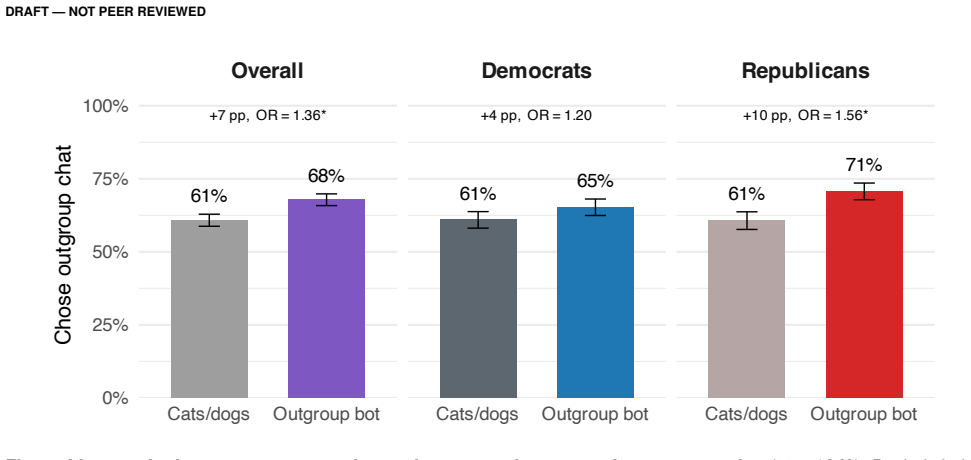
A single ten-minute conversation with an outgroup AI chatbot corrects misperceptions and increases the chance of real outgroup contact by six percentage points.
A machine-rendered reading of the paper's core claim, the machinery that carries it, and where it could break.
Core claim
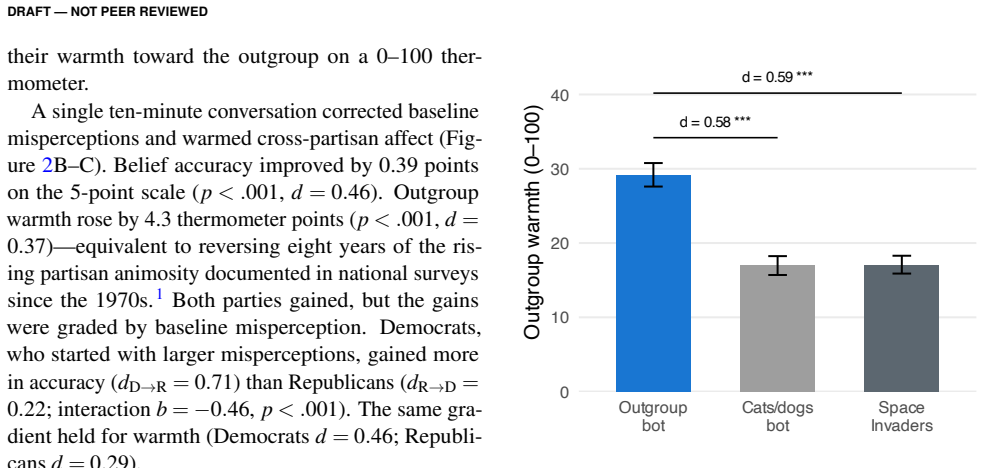
Across five preregistered studies with 3,960 U.S. partisans, brief interactions with AI chatbots representing the political outgroup correct misperceptions of outgroup attitudes, warm affect toward the outgroup, and increase the probability of choosing a real conversation with an outgroup member by six percentage points. A three-arm experiment rules out pure engagement and sociality as alternative explanations, and conversation analysis shows that the provision of accurate information distinguishes effective outgroup bots from controls.
What carries the argument
synthetic contact via short conversations with AI chatbots programmed to represent the political outgroup and supply accurate information about its attitudes.
If this is right
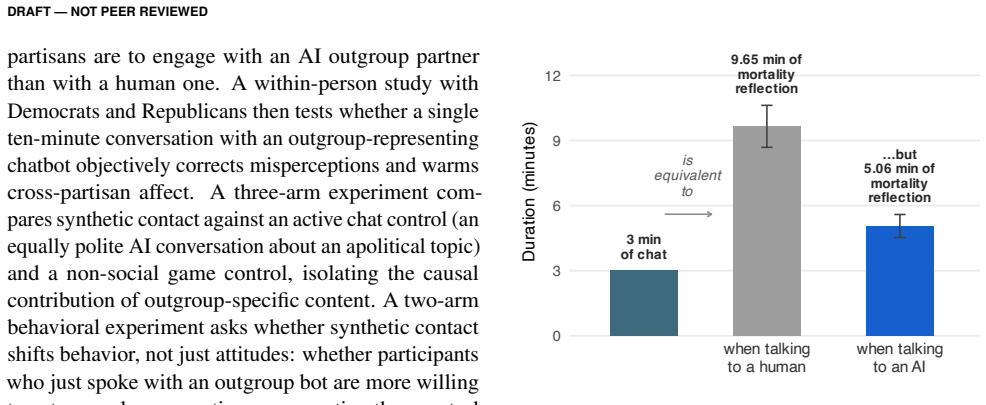
- Synthetic contact lowers the barrier to entry, with partisans willing to endure nearly twice as long contemplating mortality to avoid a human outgroup partner compared to an AI one.
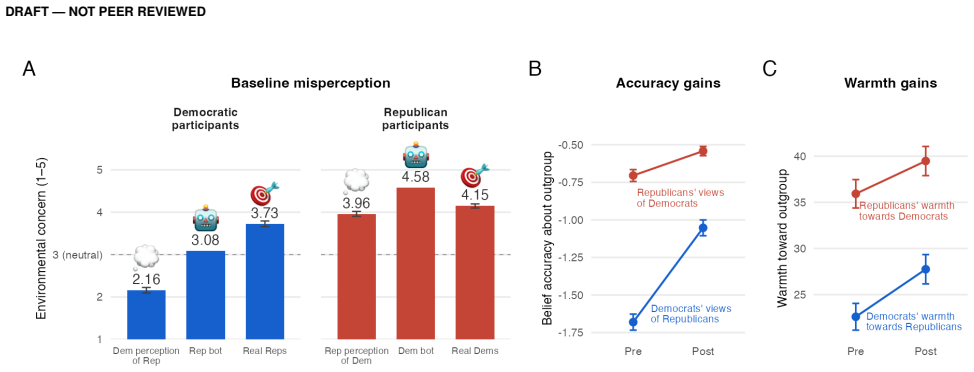
- It corrects misperceptions such as Democrats placing Republicans more than a standard deviation past their actual position on environmental consumption attitudes.
- It moves behavior, increasing the rate at which participants choose to have a real conversation with a partisan from the other side on issues like immigration.
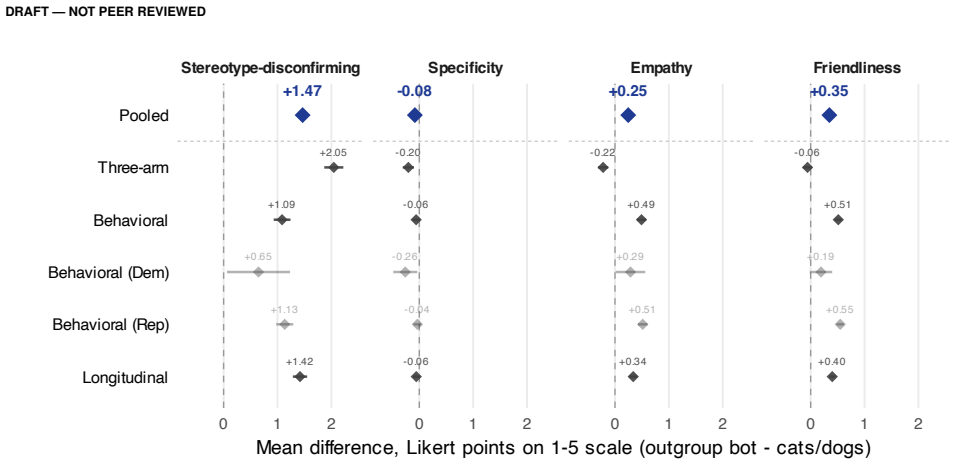
- Effects are driven more by information exchange than by the chatbot's friendliness.
- Most warmth gains fade within a week, with a small residual concentrated among the most extreme partisans.
Where Pith is reading between the lines
- Repeated sessions of synthetic contact could be examined to test whether they produce more lasting reductions in animosity.
- The method might be applied to other forms of group division beyond partisan politics.
- Deployment on existing platforms could allow gradual scaling of real-world cross-group interactions.
Load-bearing premise
The AI chatbots accurately represent genuine outgroup attitudes without researcher-introduced bias, and the short-term self-reported and behavioral measures reflect durable attitude change rather than temporary demand effects.
What would settle it
A replication in which outgroup AI chatbots produce no greater correction of misperceptions or no six-percentage-point rise in choosing real outgroup conversations than a neutral chatbot condition.
Figures
read the original abstract
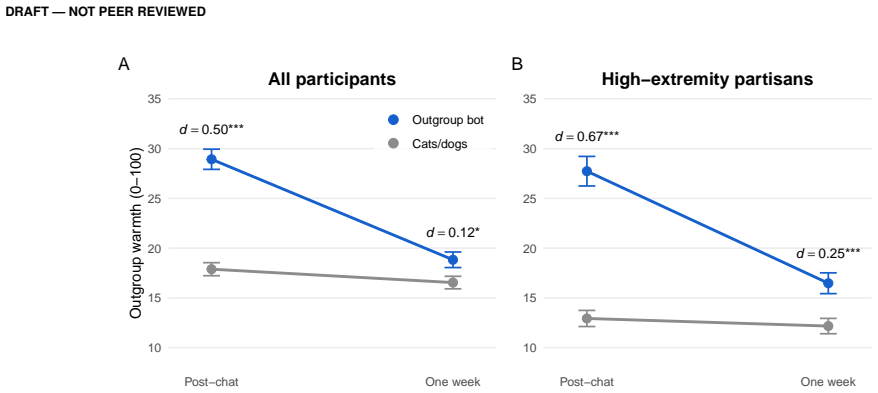
Americans' warmth toward members of the opposing political party has fallen sharply over the past three decades -- yet meaningful cross-partisan contact remains scarce, in part because people actively avoid it. Across five preregistered studies (total N = 3,960 U.S. partisans), we test whether brief conversations with AI chatbots representing the political outgroup can substitute for the contact people shun. Synthetic contact first lowers the barrier to entry: partisans would endure almost twice as long contemplating their own mortality to avoid a human outgroup partner as an AI one. These conversations then correct the misperceptions that fuel division. At baseline, Democrats placed Republicans more than a standard deviation past their actual position on environmental consumption attitudes -- enough to flip the average Republican from supportive to opposed -- and a single ten-minute conversation with an outgroup chatbot corrected those beliefs and warmed affect in a within-person study of both parties. A three-arm experiment ruled out pure engagement and sociality as drivers. Synthetic contact also moved behavior, in a sample of both parties and on a more affectively charged issue: participants who spoke with an outgroup bot about immigration were six percentage points more likely than controls to choose to have a real conversation with a partisan from the other side. A final study tested whether these gains last: the warmth effect replicated immediately in a new sample; most of it faded within a week, with a small residual concentrated among the most extreme partisans. Analyzing conversation content showed that information, more than friendliness, distinguishes outgroup bots from control chatbots. Together, these findings establish synthetic contact as a scalable, behaviorally consequential, and -- unlike face-to-face contact -- widely acceptable form of cross-partisan engagement.
Editorial analysis
A structured set of objections, weighed in public.
Referee Report
Summary. The manuscript reports results from five preregistered studies (total N=3,960 U.S. partisans) testing whether brief conversations with AI chatbots designed to represent the political outgroup can reduce cross-partisan animosity. Key findings include that such synthetic contact corrects misperceptions (e.g., Democrats' overestimation of Republican environmental attitudes by more than one SD), increases affective warmth in within-person designs, raises the probability of choosing a real outgroup conversation by six percentage points in a three-arm experiment that rules out generic engagement, and that information exchange rather than friendliness drives the distinction from control bots. A follow-up study shows most warmth gains fade within one week, with residual effects among extreme partisans.
Significance. If the experimental results and chatbot construction hold after detailed verification, the work would be significant for human-computer interaction and intergroup relations research by demonstrating a scalable, low-barrier intervention that substitutes for avoided real-world contact and produces measurable behavioral change. The preregistration, large samples, within-person and multi-arm designs, and behavioral outcome measures strengthen the contribution relative to typical attitude-change studies.
major comments (2)
- [Methods (chatbot construction and validation)] Methods (chatbot construction and validation): The abstract states that outgroup bots 'represent the political outgroup' and that 'information, more than friendliness, distinguishes outgroup bots,' yet provides no description of how outgroup attitudes on environment or immigration were elicited, how prompts were written, or how the resulting bot responses were validated against real outgroup survey distributions. This detail is load-bearing for the central claim that observed misperception correction and the 6pp behavioral shift reflect synthetic contact with genuine outgroup positions rather than exposure to researcher-curated content.
- [Results (three-arm experiment)] Results (three-arm experiment): The claim that the three-arm design 'ruled out pure engagement and sociality as drivers' rests on the outgroup bot outperforming controls, but without the exact arm definitions, exclusion criteria, or full statistical outputs (including effect sizes and confidence intervals for the 6pp shift), it is not possible to evaluate whether the design isolates representation of outgroup attitudes from other confounds.
minor comments (2)
- [Abstract] The abstract references preregistration but does not include registration IDs or links, which would aid verification of the design and analysis plan.
- [Results (conversation analysis)] Conversation-content analysis is invoked to support the information-over-friendliness claim, but the specific coding scheme, inter-rater reliability, or example transcripts are not summarized.
Simulated Author's Rebuttal
We thank the referee for highlighting the need for greater methodological transparency in chatbot construction and the three-arm experiment. These points strengthen the manuscript's claims about synthetic contact representing genuine outgroup positions. We will revise accordingly to provide the requested details without altering the core findings or interpretations.
read point-by-point responses
-
Referee: Methods (chatbot construction and validation): The abstract states that outgroup bots 'represent the political outgroup' and that 'information, more than friendliness, distinguishes outgroup bots,' yet provides no description of how outgroup attitudes on environment or immigration were elicited, how prompts were written, or how the resulting bot responses were validated against real outgroup survey distributions. This detail is load-bearing for the central claim that observed misperception correction and the 6pp behavioral shift reflect synthetic contact with genuine outgroup positions rather than exposure to researcher-curated content.
Authors: We agree these details are essential for substantiating that the bots instantiate real outgroup attitude distributions rather than curated content. The revised Methods section will include: (1) elicitation of target attitudes from large-scale surveys (e.g., Pew Research and ANES items on environmental consumption and immigration policy, with exact question wording and response distributions reported); (2) the full prompt templates and system instructions used to instantiate partisan bots, including how outgroup identity and attitude sampling were operationalized; and (3) validation results comparing bot-generated response distributions to human survey benchmarks (e.g., mean and variance alignment, with supplementary figures). This addition will directly support the misperception-correction and behavioral findings. revision: yes
-
Referee: Results (three-arm experiment): The claim that the three-arm design 'ruled out pure engagement and sociality as drivers' rests on the outgroup bot outperforming controls, but without the exact arm definitions, exclusion criteria, or full statistical outputs (including effect sizes and confidence intervals for the 6pp shift), it is not possible to evaluate whether the design isolates representation of outgroup attitudes from other confounds.
Authors: We will expand the Results section to report the precise arm definitions (outgroup bot, neutral engagement bot, and no-bot control), all exclusion criteria applied (with CONSORT-style flow diagram), and complete statistical outputs for the behavioral outcome. This will include the 6pp difference with 95% CIs, effect sizes (e.g., risk difference and odds ratio), preregistered analysis code, and robustness checks. These additions will allow readers to assess isolation of the outgroup-representation mechanism from generic engagement effects. revision: yes
Circularity Check
No circularity: empirical claims rest on new experimental data
full rationale
The paper reports five preregistered experiments (N=3960) measuring attitude and behavior change after chatbot interactions. All load-bearing claims derive from direct participant responses, pre/post measures, and control arms rather than from any derivation, fitted parameter, or self-referential equation. No mathematical models, uniqueness theorems, or ansatzes appear; the single mention of conversation-content analysis is post-hoc data coding, not a definitional loop. Self-citations are absent from the provided text and would not affect the experimental results even if present.
Axiom & Free-Parameter Ledger
Reference graph
Works this paper leans on
-
[1]
Iyengar, Y
S. Iyengar, Y . Lelkes, M. Levendusky, N. Malhotra, S. J. West- wood, The origins and consequences of affective polarization in the United States.Annual Review of Political Science22, 129–146 (2019)
2019
-
[2]
D. J. Ahler, G. Sood, The parties in our heads: Mispercep- tions about party composition and their consequences.The Journal of Politics80, 964–981 (2018)
2018
-
[3]
D. A. Yudkin, S. Hawkins, T. Dixon, The perception gap: How false impressions are pulling Americans apart,Tech. rep., More in Common (2019)
2019
-
[4]
S. L. Moore-Berg, L.-O. Ankori-Karlinsky, B. Hameiri, E. Bruneau, Exaggerated meta-perceptions predict inter- group hostility between American political partisans.Pro- ceedings of the National Academy of Sciences117, 14864– 14872 (2020)
2020
-
[5]
J. Lees, M. Cikara, Inaccurate group meta-perceptions drive negative out-group attributions in competitive contexts.Na- ture Human Behaviour4, 279–286 (2020)
2020
-
[6]
Hermann, J
E. Hermann, J. De Freitas, S. Puntoni, Reducing prejudice with counter-stereotypical AI.Consumer Psychology Review 8, 75–86 (2025)
2025
-
[7]
G. W. Allport,The Nature of Prejudice(Addison-Wesley, 1954)
1954
-
[8]
T. F . Pettigrew, L. R. Tropp, A meta-analytic test of intergroup contact theory.Journal of Personality and Social Psychology 90, 751–783 (2006)
2006
-
[9]
Hartman, W
R. Hartman, W. Blakey, J. Womick, C. Bail, E. J. Finkel, H. Han, J. Sarrouf, J. Schroeder, P . Sheeran, J. J. Van Bavel, R. Willer, K. Gray, Interventions to reduce partisan animosity. Nature Human Behaviour6, 1194–1205 (2022)
2022
-
[10]
E. L. Paluck, S. A. Green, D. P . Green, The contact hypothesis re-evaluated.Behavioural Public Policy3, 129–158 (2019)
2019
-
[11]
T. F . Pettigrew, L. R. Tropp, How does intergroup contact reduce prejudice? Meta-analytic tests of three mediators. European Journal of Social Psychology38, 922–934 (2008)
2008
-
[12]
M. S. Levendusky, D. A. Stecula,We Need to Talk: How Cross-Party Dialogue Reduces Affective Polarization, Ele- ments in Experimental Political Science (Cambridge Univer- sity Press, 2021)
2021
-
[13]
Santoro, D
E. Santoro, D. E. Broockman, The promise and pitfalls of cross-partisan conversations for reducing affective polariza- tion: Evidence from randomized experiments.Science Ad- vances8, eabn5515 (2022)
2022
-
[14]
M. K. Chen, R. Rohla, The effect of partisanship and political advertising on close family ties.Science360, 1020–1024 (2018)
2018
-
[15]
J. A. Frimer, L. J. Skitka, M. Motyl, Liberals and conservatives are similarly motivated to avoid exposure to one another’s opinions.Journal of Experimental Social Psychology72, 1–12 (2017)
2017
-
[16]
C. A. Dorison, J. A. Minson, T. Rogers, Selective exposure partly relies on faulty affective forecasts.Cognition188, 98–107 (2019)
2019
-
[17]
C. A. Bail, L. P . Argyle, T. W. Brown, J. P . Bumpus, H. Chen, M. B. F . Hunzaker, J. Lee, M. Mann, F . Merhout, A. Volfovsky, Exposure to opposing views on social media can increase political polarization.Proceedings of the National Academy of Sciences115, 9216–9221 (2018)
2018
-
[18]
Saveski, N
M. Saveski, N. Gillani, A. Yuan, P . Vijayaraghavan, D. Roy, Proceedings of the International AAAI Conference on Web and Social Media (ICWSM)(2022), vol. 16, pp. 885–895
2022
-
[19]
Gillani, A
N. Gillani, A. Yuan, M. Saveski, S. Vosoughi, D. Roy,Pro- ceedings of the 2018 World Wide Web Conference (WWW ’18)(2018), pp. 823–831
2018
-
[20]
J. S. Park, C. Q. Zou, A. Shaw, B. M. Hill, C. Cai, M. R. Morris, R. Willer, P . Liang, M. S. Bernstein, Generative agent simulations of 1,000 people.arXiv preprint arXiv:2411.10109 (2024)
work page internal anchor Pith review Pith/arXiv arXiv 2024
-
[21]
Toubia, G
O. Toubia, G. Z. Gui, T. Peng, D. J. Merlau, A. Li, H. Chen, Database report: Twin-2K-500: A dataset for building digital twins of over 2,000 people based on their answers to over 500 questions.Marketing Science(2025)
2025
-
[22]
C. Nass, Y . Moon, Machines and mindlessness: Social re- sponses to computers.Journal of Social Issues56, 81–103 (2000)
2000
-
[23]
S. H. Klein, The effects of human-like social cues on so- cial responses towards text-based conversational agents—a meta-analysis.Humanities and Social Sciences Communi- cations12(2025). July 3, 2026|12 DRAFT — NOT PEER REVIEWED
2025
-
[24]
Pereira da Costa, K
L. Pereira da Costa, K. Bierwiaczonek, M. Bianchi, Does digital intergroup contact reduce prejudice? a meta-analysis. Cyberpsychology, Behavior, and Social Networking27, 440– 451 (2024)
2024
-
[25]
L. Lu, Z. L. Tormala, A. Duhachek, How AI sources can increase openness to opposing views.Scientific Reports15, 17170 (2025)
2025
-
[26]
T. H. Costello, G. Pennycook, D. G. Rand, Durably reducing conspiracy beliefs through dialogues with AI.Science385, eadq1814 (2024)
2024
-
[27]
H. Lin, G. Czarnek, B. Lewis, J. P . White, A. J. Berinsky, T. Costello, G. Pennycook, D. G. Rand, Persuading voters using human–artificial intelligence dialogues.Nature(2025)
2025
-
[28]
Salvi, M
F . Salvi, M. Horta Ribeiro, R. Gallotti, R. West, On the conver- sational persuasiveness of GPT -4.Nature Human Behaviour 9, 1645–1653 (2025)
2025
-
[29]
Santurkar, E
S. Santurkar, E. Durmus, F . Ladhak, C. Lee, P . Liang, T. Hashimoto,Proceedings of the 40th International Con- ference on Machine Learning (ICML)(2023)
2023
-
[30]
J. Hartmann, J. Schwenzow, M. Witte, The political ideology of conversational AI: Converging evidence on ChatGPT’s pro-environmental, left-libertarian orientation.arXiv preprint arXiv:2301.01768(2023)
-
[31]
K. L. Haws, K. P . Winterich, R. W. Naylor, Seeing the world through GREEN-tinted glasses: Green consumption values and responses to environmentally friendly products.Journal of Consumer Psychology24, 336–354 (2014)
2014
-
[32]
J. G. Voelkel, M. N. Stagnaro, J. Chu, S. L. Pink, J. S. Mernyk, C. Redekopp, I. Ghezae, M. Cashman, D. Adjodah,et al., Megastudy testing 25 treatments to reduce antidemocratic attitudes and partisan animosity.Science386, eadh4764 (2024)
2024
-
[33]
J. N. Druckman, M. S. Levendusky, What do we measure when we measure affective polarization?Public Opinion Quarterly83, 114–122 (2019)
2019
-
[34]
Bates, M
D. Bates, M. Mächler, B. Bolker, S. Walker, Fitting linear mixed-effects models using lme4.Journal of Statistical Soft- ware67, 1–48 (2015)
2015
-
[35]
S. G. Luke, Evaluating significance in linear mixed-effects models in R.Behavior Research Methods49, 1494–1502 (2017)
2017
-
[36]
M. A. Hernán, J. M. Robins,Causal Inference: What If(Chap- man & Hall/CRC, Boca Raton, 2020). July 3, 2026|13 DRAFT — NOT PEER REVIEWED Supplementary Information for Synthetic Contact with AI Reduces Cross-Partisan Animosity Benjamin Lira Luttges1,∗ , Noah Castelo 2, Stefano Puntoni 1, Olivier Toubia 3 1The Wharton School, University of Pennsylvania. 2Alb...
2020
-
[37]
Pre-warmth 29.32 24.54 —
-
[38]
Post-warmth 33.66 25.70 0.89* —
-
[39]
Pre-accuracy -1.19 0.89 0.49* 0.45* —
-
[40]
Post-accuracy -0.80 0.72 0.32* 0.35* 0.46* —
-
[41]
Extremity 38.02 14.14 -0.31* -0.27* -0.20* -0.16* —
-
[42]
Informativeness 3.84 1.06 0.22* 0.29* 0.22* 0.25* 0.03 —
-
[43]
Empathy 3.53 1.04 0.13* 0.18* 0.04 0.13* -0.01 0.35* —
-
[44]
Bot turns 11.11 6.00 -0.03 -0.05 -0.05 -0.04 -0.04 -0.08 -0.05 —
-
[45]
did the bot hit every item at some point
Words written 199.86 123.31 -0.02 -0.04 -0.03 -0.02 0.02 -0.03 0.06 0.18* — S3.4 Mixed-effects models Table S7.Mixed-effects models predicting outgroup warmth and belief accuracy. Belief accuracy is the negative absolute error between a participant’s guess of the outgroup’s environmental attitudes and the outgroup’s actual mean (higher = more accurate). C...
2026
-
[46]
Outgroup warmth 20.57 20.85 —
-
[47]
Ingroup warmth 76.43 19.02 0.01 —
-
[48]
Age 40.16 14.06 -0.03 0.19* —
-
[49]
Extremity 79.60 22.43 -0.13* 0.58* 0.17* —
-
[50]
Duration (sec) 755.97 223.28 0.05 0.09* 0.04 0.03 —
-
[51]
Bot: stereotype-disconfirming 2.21 1.44 0.20* 0.09 0.04 0.11* -0.06 —
-
[52]
Bot: empathy 3.88 0.37 -0.07 0.02 0.06 0.02 -0.05 -0.04 —
-
[53]
Attrition
Bot: friendliness 4.41 0.50 0.02 0.14* -0.04 0.05 -0.01 -0.01 0.12* — S4.3 Main-effects regression Table S12.OLS models predicting outgroup warmth from condition assignment. Model (1) uses the outgroup bot as reference; Model (2) uses the cats-and-dogs control. Standard errors in parentheses. Outgroup bot ref. Cats/dogs ref. Intercept 29.187*** 16.967*** ...
2026
-
[54]
It is important to me that the products I use do not harm the environment
-
[55]
I consider the potential environmental impact of my actions when making many of my decisions
-
[56]
My purchase habits are affected by my concern for our environment
-
[57]
I am concerned about wasting the resources of our planet
-
[58]
I would describe myself as environmentally responsible
-
[59]
Have a three-minute conversation with a real {Republican/Democrat}
I am willing to be inconvenienced in order to take actions that are more environmentally friendly. Political extremity.A 0–100 slider indexing strength of partisan identity, used as a screening criterion and as a preregistered moderator. Behavioral choice (behavioral experiment).After the chat, participants made an incentive-compatible binary choice betwe...
2026
discussion (0)
Sign in with ORCID, Apple, or X to comment. Anyone can read and Pith papers without signing in.