Entropy of Non-Abelian Anyons from Slow Quasiparticle Dynamics in Quantum Hall Interferometers
Pith reviewed 2026-07-03 06:48 UTC · model grok-4.3
The pith
An antidot inside a quantum Hall interferometer can yield the O(1) entropy of non-Abelian anyons from equilibrium charge inferred via phase switching.
A machine-rendered reading of the paper's core claim, the machinery that carries it, and where it could break.
Core claim
By embedding an antidot in an interferometer and using the recently observed time-dependent switching of the interference phase to infer the antidot charge at equilibrium, the characteristic O(1) entropy ΔS = k_B log d of non-Abelian anyons can be extracted via Maxwell relations for intermediate temperatures that exceed the level spacing of the interferometer edge but remain much smaller than the level spacing of the antidot.
What carries the argument
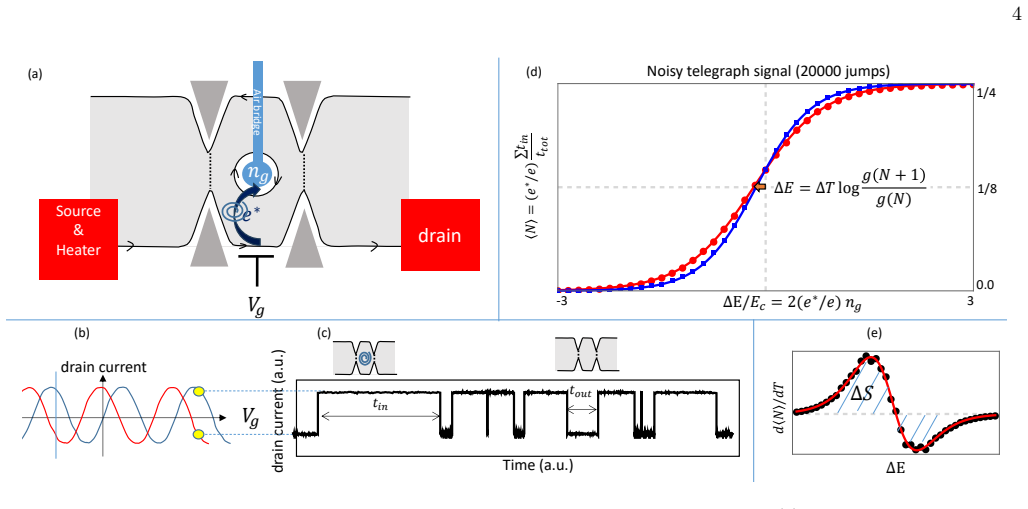
Inference of antidot charge from time-dependent switching of the interference phase, which serves as a non-local charge sensor at equilibrium.
If this is right
- The entropy signal for d = √2 becomes accessible at filling factor 5/2 without direct charge sensing.
- The method works only in the temperature window between edge and antidot level spacings.
- It converts an existing experimental signature (phase switching) into a thermodynamic probe of anyonic statistics.
Where Pith is reading between the lines
- Similar phase-switching readouts could be tested in other fractional states to map quantum dimensions across the hierarchy.
- If the entropy extraction succeeds, it would supply an independent check on whether observed quasiparticles are indeed non-Abelian before braiding experiments are attempted.
- The approach might be adapted to interferometers with multiple antidots to probe fusion channels or higher-order anyonic correlations.
Load-bearing premise
The observed time-dependent switching of the interference phase directly reports the antidot charge at equilibrium without calibration offsets or other systematics that would mask the entropy signal.
What would settle it
An experiment in which the entropy extracted from the inferred charge fluctuations fails to equal k_B log d (for example, showing zero instead of log √2 at u = 5/2) while the phase switching still occurs.
Figures
read the original abstract
Non-Abelian anyons emerging in fractional quantum Hall states carry a characteristic entropy, $\Delta S = k_B \log d$, where \(d\) is the anyon's quantum dimension. This \(\mathcal{O}(1)\) entropy can, in principle, be extracted from charge measurements of an antidot via Maxwell relations. However, equilibrium charge measurements in fractional antidots have proven to be challenging with conventional charge detectors. Here, we propose a scheme based on an antidot embedded in an interferometer, in which the charge can be inferred from the recently observed time-dependent switching of the interference phase. Performing such non-local charge measurements at equilibrium, the characteristic \(\mathcal{O}(1)\) entropy of non-Abelian anyons (e.g., $d = \sqrt{2}$ for the $\nu = 5/2$ state) can be extracted for intermediate temperatures, which exceed the level spacing of the interferometer edge, but are much smaller than the level spacing of the antidot.
Editorial analysis
A structured set of objections, weighed in public.
Referee Report
Summary. The manuscript proposes extracting the characteristic entropy ΔS = k_B log d of non-Abelian anyons (e.g., d=√2 at ν=5/2) from equilibrium antidot charge Q(T,μ) via Maxwell relations. The charge is to be inferred non-locally from the recently observed time-dependent switching of the interference phase in an antidot-embedded quantum Hall interferometer, in the temperature window set by edge level spacing ≪ T ≪ antidot level spacing.
Significance. If the inference of Q from phase switching can be shown to achieve the required ~0.1e precision without unquantified systematics, the approach would provide a concrete experimental route to the O(1) anyonic entropy that has so far eluded direct measurement. The proposal builds on existing interferometer observations and avoids conventional charge detectors, which is a genuine strength; however, the manuscript supplies no derivations, error budgets, or numerical checks, so the practical significance cannot yet be assessed.
major comments (3)
- [Abstract / proposal description] The central claim that phase-switching events yield equilibrium antidot charge Q at the precision needed to resolve ΔS ~ k_B log √2 rests on two unverified conditions: (i) the system remains in true thermal equilibrium on the antidot during switching, and (ii) edge-state or dynamical contributions to the phase can be subtracted to better than the target entropy scale. Neither condition is demonstrated analytically or numerically; the temperature window is stated but not shown to suppress corrections below ~0.1e.
- [Abstract] No Maxwell-relation derivation, thermodynamic identity, or finite-temperature correction is supplied to convert the inferred Q(T,μ) into ΔS; the abstract asserts that the entropy “can be extracted” but provides neither the explicit relation nor an estimate of the required charge resolution.
- [Proposal section (inferred from abstract)] The manuscript contains no error analysis, Monte-Carlo simulation of phase-to-charge conversion, or estimate of systematic offsets from non-equilibrium quasiparticle dynamics; without these, it is impossible to judge whether the O(1) entropy signal survives the measurement protocol.
minor comments (2)
- [Abstract] Notation for the anyonic dimension d and the temperature window should be introduced with explicit inequalities rather than prose only.
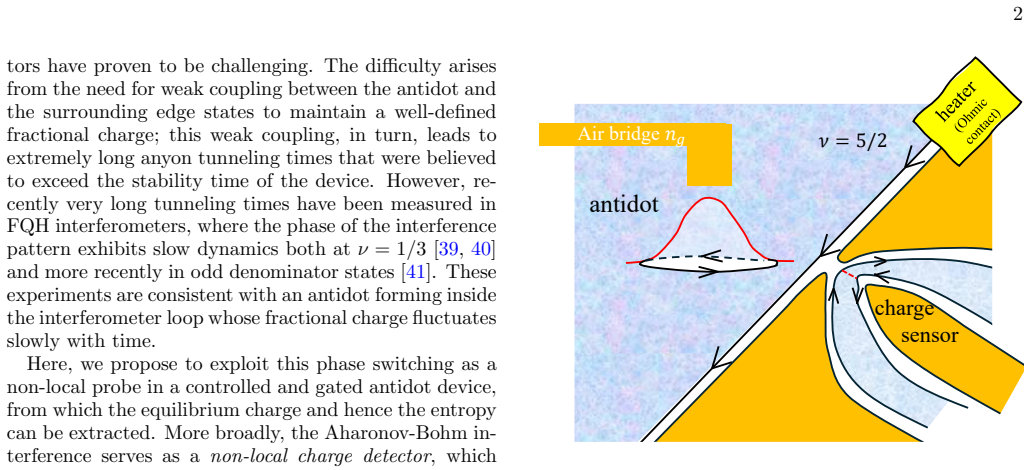
- [N/A] The manuscript would benefit from a schematic figure showing the interferometer geometry, antidot, and the phase-switching observable.
Simulated Author's Rebuttal
We thank the referee for the thorough review and for identifying key areas where the proposal requires additional analytical support. We agree that the manuscript, as a concise proposal, would benefit from explicit derivations and estimates to allow assessment of the scheme's viability. We will revise the manuscript to incorporate these elements while preserving its focus on the non-local measurement approach. Point-by-point responses follow.
read point-by-point responses
-
Referee: [Abstract / proposal description] The central claim that phase-switching events yield equilibrium antidot charge Q at the precision needed to resolve ΔS ~ k_B log √2 rests on two unverified conditions: (i) the system remains in true thermal equilibrium on the antidot during switching, and (ii) edge-state or dynamical contributions to the phase can be subtracted to better than the target entropy scale. Neither condition is demonstrated analytically or numerically; the temperature window is stated but not shown to suppress corrections below ~0.1e.
Authors: We acknowledge that the conditions for equilibrium and the suppression of corrections were stated but not derived in detail. In the revised manuscript we will add an analytical section demonstrating that, within the window edge level spacing ≪ T ≪ antidot level spacing, the antidot remains in thermal equilibrium on the timescale of the observed switching events. We will also derive bounds on edge-state phase contributions and show how they can be subtracted using the time-dependent data, with corrections falling below the ~0.1e threshold needed for ΔS resolution. revision: yes
-
Referee: [Abstract] No Maxwell-relation derivation, thermodynamic identity, or finite-temperature correction is supplied to convert the inferred Q(T,μ) into ΔS; the abstract asserts that the entropy “can be extracted” but provides neither the explicit relation nor an estimate of the required charge resolution.
Authors: The abstract refers to extraction via Maxwell relations, but we agree an explicit derivation was omitted. The revision will include a short thermodynamic subsection presenting the relevant Maxwell relation connecting Q(T,μ) to entropy, the finite-temperature corrections for the anyonic contribution, and a numerical estimate confirming that charge resolution of order 0.1e suffices to resolve k_B log √2. revision: yes
-
Referee: [Proposal section (inferred from abstract)] The manuscript contains no error analysis, Monte-Carlo simulation of phase-to-charge conversion, or estimate of systematic offsets from non-equilibrium quasiparticle dynamics; without these, it is impossible to judge whether the O(1) entropy signal survives the measurement protocol.
Authors: We accept that a quantitative error analysis is necessary. The revised version will contain an error-budget subsection that analytically estimates systematic offsets arising from non-equilibrium dynamics and phase-to-charge conversion, together with bounds showing that the O(1) entropy signal remains detectable. A full Monte-Carlo simulation lies outside the scope of this proposal-style manuscript, but the analytical estimates will allow readers to assess feasibility. revision: partial
Circularity Check
No circularity; proposal uses external experimental observations of phase switching
full rationale
The manuscript proposes extracting non-Abelian anyon entropy ΔS = k_B log d from equilibrium antidot charge Q(T,μ) via Maxwell relations, with Q inferred from time-dependent interference-phase switching reported in prior experiments. No equations or steps reduce the target entropy to a fitted parameter, self-citation, or ansatz internal to the paper. The temperature window and measurement scheme are presented as a proposal relying on external data rather than internal consistency conditions. No load-bearing self-citations or self-definitional relations appear in the provided abstract or described derivation chain.
Axiom & Free-Parameter Ledger
Reference graph
Works this paper leans on
-
[1]
On the other hand, switching toν= 1/3, all the anyons are abelian, d= 1, and there is no change in degeneracy factor
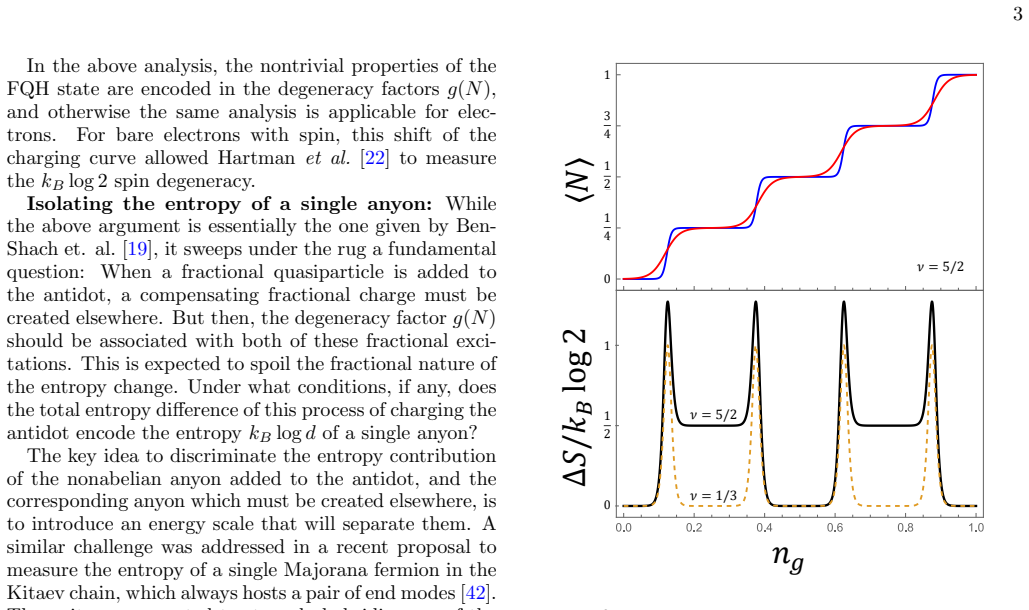
separating the two different entropy values of the paired and unpaired states. On the other hand, switching toν= 1/3, all the anyons are abelian, d= 1, and there is no change in degeneracy factor. 𝜈 = 5/2 𝜈 = 1/3 𝜈 = 5/2 ⟨𝑁⟩Δ𝑆/𝑘𝐵 log 2 𝑛𝑔 1 2 1 0 0 1 4 1 2 3 4 1 FIG. 2. e 4 charge steps, and resulting entropy obtained by in- tegrating the Maxwell relation...
2020
-
[2]
(17) As above, the Dedekind functions factor out, and the factorp 1/16 gives a temperature-independent shift of the degeneracy point
= χσ(p)p1/16 η(p) , χ I,ψ(p,0) = χI,ψ(p) η(p) . (17) As above, the Dedekind functions factor out, and the factorp 1/16 gives a temperature-independent shift of the degeneracy point. We are left with the extra partition functionsχ I,ψ,σ (p) from the Ising CFT. We now consider a short antidot edge so thatp≪1. Then these partition functions are dominated by ...
-
[3]
2, this results in an entropy change between theN= 0 andN= 1/4 charge plateaus of ∆S= 1 2 kB log 2
As shown in Fig. 2, this results in an entropy change between theN= 0 andN= 1/4 charge plateaus of ∆S= 1 2 kB log 2. At the peak, the entropy isk B log(dI +d σ). Physically, this result uses the smallness of the dot. In this limit, due to a large level spacing, the antidot has a single ground state. A similar situation was assumed in the model of Ref. [53...
-
[4]
Moore and N
G. Moore and N. Read, Nonabelions in the fractional quantum hall effect, Nuclear Physics B360, 362 (1991)
1991
-
[5]
Nayak, S
C. Nayak, S. H. Simon, A. Stern, M. Freedman, and S. Das Sarma, Non-abelian anyons and topological quan- tum computation, Reviews of Modern Physics80, 1083 (2008)
2008
-
[6]
Wen and Q
X.-G. Wen and Q. Niu, Ground-state degeneracy of the fractional quantum hall states in the presence of a ran- dom potential and on high-genus riemann surfaces, Phys- ical Review B41, 9377 (1990)
1990
-
[7]
Read and D
N. Read and D. Green, Paired states of fermions in two dimensions with breaking of parity and time-reversal symmetries and the fractional quantum hall effect, Phys- ical Review B61, 10267–10297 (2000)
2000
-
[8]
Willett, J
R. Willett, J. P. Eisenstein, H. L. St¨ ormer, D. C. Tsui, A. C. Gossard, and J. H. English, Observation of an even- denominator quantum number in the fractional quantum hall effect, Phys. Rev. Lett.59, 1776 (1987)
1987
-
[9]
Dolev, M
M. Dolev, M. Heiblum, V. Umansky, A. Stern, and D. Mahalu, Observation of a quarter of an electron charge at theν= 5/2 quantum hall state, Nature452, 829–834 (2008)
2008
-
[10]
D.-K. Ki, V. I. Fal’ko, D. A. Abanin, and A. F. Morpurgo, Observation of even denominator fractional quantum hall effect in suspended bilayer graphene, Nano Letters14, 2135–2139 (2014)
2014
-
[11]
Y. Kim, D. S. Lee, S. Jung, V. Sk´ akalov´ a, T. Taniguchi, K. Watanabe, J. S. Kim, and J. H. Smet, Fractional quan- tum hall states in bilayer graphene probed by transcon- ductance fluctuations, Nano Letters15, 7445 (2015)
2015
-
[12]
A. A. Zibrov, C. Kometter, H. Zhou, E. M. Spanton, T. Taniguchi, K. Watanabe, M. P. Zaletel, and A. F. Young, Tunable interacting composite fermion phases in a half-filled bilayer-graphene landau level, Nature549, 360–364 (2017)
2017
-
[13]
J. I. A. Li, C. Tan, S. Chen, Y. Zeng, T. Taniguchi, K. Watanabe, J. Hone, and C. R. Dean, Even- denominator fractional quantum hall states in bilayer graphene, Science358, 648–652 (2017)
2017
-
[14]
Y. Kim, A. C. Balram, T. Taniguchi, K. Watanabe, J. K. Jain, and J. H. Smet, Even denominator fractional quan- tum hall states in higher landau levels of graphene, Na- ture Physics15, 154–158 (2018)
2018
-
[15]
R. Kumar, A. Haug, J. Kim, M. Yutushui, K. Khudi- akov, V. Bhardwaj, A. Ilin, K. Watanabe, T. Taniguchi, D. F. Mross, and Y. Ronen, Quarter- and half-filled quan- tum hall states and their topological orders revealed by daughter states in bilayer graphene, Nature Communica- tions16, 10.1038/s41467-025-62650-9 (2025)
-
[16]
K. Yang and B. I. Halperin, Thermopower as a possi- ble probe of non-abelian quasiparticle statistics in frac- tional quantum hall liquids, Physical Review B79, 10.1103/physrevb.79.115317 (2009)
-
[17]
N. R. Cooper and A. Stern, Observable bulk signatures of non-abelian quantum hall states, Physical Review Letters 102, 10.1103/physrevlett.102.176807 (2009)
-
[18]
G. Gervais and K. Yang, Adiabatic cooling with non-abelian anyons, Physical Review Letters105, 10.1103/physrevlett.105.086801 (2010)
-
[19]
C.-Y. Hou, K. Shtengel, G. Refael, and P. M. Goldbart, Ettingshausen effect due to majorana modes, New Jour- nal of Physics14, 105005 (2012)
2012
-
[20]
G. Viola, S. Das, E. Grosfeld, and A. Stern, Ther- moelectric probe for neutral edge modes in the frac- tional quantum hall regime, Physical Review Letters109, 10.1103/physrevlett.109.146801 (2012)
-
[21]
B. A. Schmidt, K. Bennaceur, S. Gaucher, G. Gervais, L. N. Pfeiffer, and K. W. West, Specific heat and entropy of fractional quantum hall states in the second landau level, Physical Review B95, 10.1103/physrevb.95.201306 (2017)
-
[22]
G. Ben-Shach, C. R. Laumann, I. Neder, A. Yacoby, and B. I. Halperin, Detecting non-abelian anyons by charging spectroscopy, Physical Review Letters110, 10.1103/physrevlett.110.106805 (2013)
-
[23]
N. Schiller, H. Ebisu, G. Refael, and Y. Oreg, Internal en- tropy from heat current (2024), arXiv:2407.03402 [cond- mat.mes-hall]
-
[24]
Venkatachalam, A
V. Venkatachalam, A. Yacoby, L. Pfeiffer, and K. West, Local charge of theν= 5/2 fractional quantum hall state, Nature469, 185–188 (2011)
2011
-
[25]
Hartman, C
N. Hartman, C. Olsen, S. L¨ uscher, M. Samani, S. Fallahi, G. C. Gardner, M. Manfra, and J. Folk, Direct entropy measurement in a mesoscopic quantum system, Nature Physics14, 1083–1086 (2018)
2018
-
[26]
Child, O
T. Child, O. Sheekey, S. L¨ uscher, S. Fallahi, G. C. Gardner, M. Manfra, A. Mitchell, E. Sela, Y. Klee- orin, Y. Meir, and J. Folk, Entropy measurement of a strongly coupled quantum dot, Phys. Rev. Lett.129, 227702 (2022)
2022
-
[27]
C. Adam, H. Duprez, N. Lehmann, A. Yglesias, S. Can- ces, M. J. Ruckriegel, M. Masseroni, C. Tong, A. O. Denisov, W. W. Huang, D. Kealhofer, R. Garreis, K. Watanabe, T. Taniguchi, K. Ensslin, and T. Ihn, En- tropy spectroscopy of a bilayer graphene quantum dot (2024), arXiv:2412.18000 [cond-mat.mes-hall]
-
[28]
D. Kealhofer, C. Adam, M. J. Ruckriegel, P. Tomi´ c, B. Kratochwil, C. Reichl, Y. Meir, W. Wegscheider, T. Ihn, and K. Ensslin, Entropy of a double quantum dot (2025), arXiv:2508.09481 [cond-mat.mes-hall]
-
[29]
Remote entropy measurement in coupled quantum dots
O. Sheekey, T. Child, E. Cornick, S. Fallahi, G. C. Gardner, M. J. Manfra, E. Sela, Y. Kleeorin, Y. Meir, S. L¨ uscher, and J. Folk, Remote entropy measurement in coupled quantum dots (2026), arXiv:2605.03876 [cond- mat.mes-hall]
work page internal anchor Pith review Pith/arXiv arXiv 2026
-
[30]
C. Piquard, P. Glidic, C. Han, A. Aassime, A. Cavanna, U. Gennser, Y. Meir, E. Sela, A. Anthore, and F. Pierre, Observing the universal screening of a kondo impurity, 8 Nature Communications14, 10.1038/s41467-023-42857- 4 (2023)
-
[31]
Experimental Evidence of Fractional Entropy in Critical Kondo Systems
C. Piquard, A. Veillon, Y. Sato, F. Zanichelli, A. Aas- sime, A. Cavanna, U. Gennser, A. K. Mitchell, A. Anthore, and F. Pierre, Experimental evidence of fractional entropy in critical kondo systems (2026), arXiv:2605.00669 [cond-mat.mes-hall]
work page internal anchor Pith review Pith/arXiv arXiv 2026
-
[32]
C. Han, Z. Iftikhar, Y. Kleeorin, A. Anthore, F. Pierre, Y. Meir, A. K. Mitchell, and E. Sela, Fractional entropy of multichannel kondo systems from conductance-charge relations, Physical Review Letters128, 10.1103/phys- revlett.128.146803 (2022)
-
[33]
Z. Ma, C. Han, Y. Meir, and E. Sela, Identifying an environment-induced localization transition from en- tropy and conductance, Physical Review Letters131, 10.1103/physrevlett.131.126502 (2023)
-
[34]
Sankar, E
S. Sankar, E. Sela, and C. Han, Measuring topological en- tanglement entropy using maxwell relations, Phys. Rev. Lett.131, 016601 (2023)
2023
-
[35]
Metallic island array as synthetic quantum matter: fractionalized entropy and thermal transport
N. Hurvitz, G. Finkelstein, and E. Sela, Metallic island array as synthetic quantum matter: fractionalized en- tropy and thermal transport (2025), arXiv:2510.20491 [cond-mat.str-el]
work page internal anchor Pith review Pith/arXiv arXiv 2025
-
[36]
Goldman and B
V. Goldman and B. Su, Resonant tunneling in the quan- tum hall regime: measurement of fractional charge, Sci- ence267, 1010 (1995)
1995
-
[37]
Franklin, I
J. Franklin, I. Zailer, C. Ford, P. Simpson, J. Frost, D. Ritchie, M. Simmons, and M. Pepper, The aharonov- bohm effect in the fractional quantum hall regime, Sur- face Science361-362, 17–21 (1996)
1996
-
[38]
Kataoka, C
M. Kataoka, C. J. B. Ford, G. Faini, D. Mailly, M. Y. Simmons, D. R. Mace, C.-T. Liang, and D. A. Ritchie, Detection of coulomb charging around an antidot in the quantum hall regime, Physical Review Letters83, 160–163 (1999)
1999
-
[39]
A. Kou, C. M. Marcus, L. N. Pfeiffer, and K. W. West, Coulomb oscillations in antidots in the integer and frac- tional quantum hall regimes, Physical Review Letters 108, 10.1103/physrevlett.108.256803 (2012)
-
[40]
S. Mills, D. Averin, and X. Du, Localizing fractional quasiparticles on graphene quantum hall antidots, Phys- ical Review Letters125, 10.1103/physrevlett.125.227701 (2020)
- [41]
-
[42]
Werkmeister, J
T. Werkmeister, J. R. Ehrets, M. E. Wesson, D. H. Na- jafabadi, K. Watanabe, T. Taniguchi, B. I. Halperin, A. Yacoby, and P. Kim, Anyon braiding and telegraph noise in a graphene interferometer, Science388, 730–735 (2025)
2025
- [43]
- [44]
-
[45]
E. Sela, Y. Oreg, S. Plugge, N. Hartman, S. L¨ uscher, and J. Folk, Detecting the universal fractional entropy of majorana zero modes, Physical Review Letters123, 10.1103/physrevlett.123.147702 (2019)
- [46]
- [47]
-
[48]
S. Gustavsson, R. Leturcq, B. Simoviˇ c, R. Schleser, T. Ihn, P. Studerus, K. Ensslin, D. C. Driscoll, and A. C. Gossard, Counting statistics of single electron transport in a quantum dot, Physical Review Letters96, 10.1103/physrevlett.96.076605 (2006)
-
[49]
Werkmeister, J
T. Werkmeister, J. R. Ehrets, M. E. Wesson, D. H. Na- jafabadi, K. Watanabe, T. Taniguchi, B. I. Halperin, A. Yacoby, and P. Kim, Anyon braiding and telegraph noise in a graphene interferometer, Science388, 730 (2025)
2025
- [50]
-
[51]
Banerjee, M
M. Banerjee, M. Heiblum, A. Rosenblatt, Y. Oreg, D. E. Feldman, A. Stern, and V. Umansky, Observed quanti- zation of anyonic heat flow, Nature545, 75–79 (2017)
2017
-
[52]
Fendley, M
P. Fendley, M. P. Fisher, and C. Nayak, Topological en- tanglement entropy from the holographic partition func- tion, Journal of Statistical Physics126, 1111 (2007)
2007
-
[53]
Jezouin, F
S. Jezouin, F. D. Parmentier, A. Anthore, U. Gennser, A. Cavanna, Y. Jin, and F. Pierre, Quantum limit of heat flow across a single electronic channel, Science342, 601–604 (2013)
2013
-
[54]
M. Levin, B. I. Halperin, and B. Rosenow, Particle-hole symmetry and the pfaffian state, Physical Review Letters 99, 10.1103/physrevlett.99.236806 (2007)
-
[55]
D. T. Son, Is the composite fermion a dirac particle?, Physical Review X5, 10.1103/physrevx.5.031027 (2015)
-
[56]
D. V. Averin and J. A. Nesteroff, Coulomb blockade of anyons in quantum antidots, Physical Review Letters99, 10.1103/physrevlett.99.096801 (2007)
discussion (0)
Sign in with ORCID, Apple, or X to comment. Anyone can read and Pith papers without signing in.