How wrong is too wrong: A numerical study on the relevance of positional memory in the generalized Langevin equation
Pith reviewed 2026-07-03 03:58 UTC · model grok-4.3
The pith
Additional memory terms beyond the linear kernel are required in generalized Langevin equations that include a potential of mean force.
A machine-rendered reading of the paper's core claim, the machinery that carries it, and where it could break.
Core claim
In the model system the exact generalized Langevin equation contains memory terms in addition to the linear one. These additional terms are important for the dynamics and cannot be neglected if one intends to model core aspects of the underlying system correctly.
What carries the argument
The exact generalized Langevin equation derived for the model system, which augments the usual linear memory kernel with further positional memory terms required by consistency with the potential of mean force.
If this is right
- Approximate generalized Langevin equations that retain only a linear memory kernel will produce incorrect long-time dynamics even when the potential of mean force is simple.
- Any modeling effort that requires correct reproduction of the underlying system's core statistics must retain the additional memory contributions.
- The second fluctuation-dissipation relation cannot be imposed exactly once a potential of mean force and a linear kernel are both present.
- Numerical integration of the exact equation (with extra terms) is required to recover the correct equilibrium and dynamical properties in this class of systems.
Where Pith is reading between the lines
- Similar extra memory contributions are likely to appear whenever a coarse-grained variable is coupled to a non-quadratic free-energy landscape.
- Practical simulation methods may need to be extended to incorporate position-dependent memory kernels rather than assuming time-only dependence.
- The result supplies a concrete benchmark against which future approximate schemes that try to restore consistency can be tested.
Load-bearing premise
The chosen model system, whose potential of mean force admits a low-order polynomial approximation, supplies a valid test case for whether extra memory terms matter in generalized Langevin equations more generally.
What would settle it
If trajectories generated from the approximate generalized Langevin equation (linear kernel only) reproduce the exact position autocorrelation, velocity autocorrelation, and mean-force statistics of the underlying model system to within numerical precision, the claim that the extra terms are necessary would be falsified.
Figures


read the original abstract
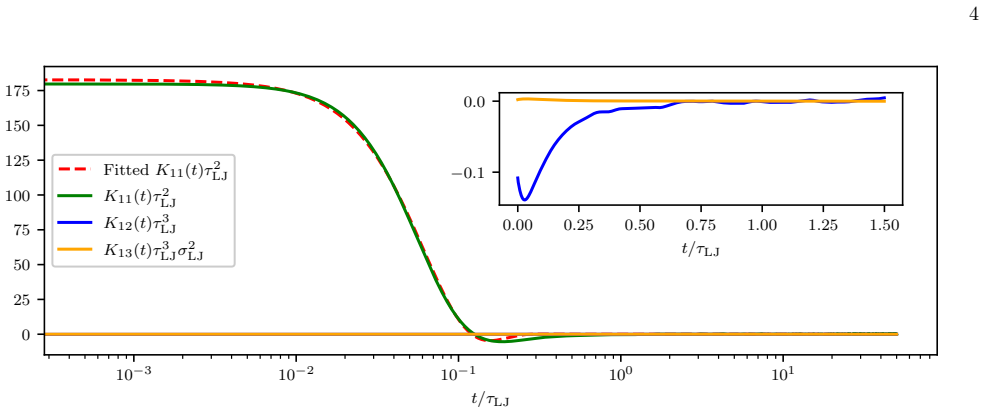
If a generalized Langevin equation contains a potential of mean force, it cannot at the same time contain a linear memory kernel and a fluctuating force that obeys a second fluctuation dissipation theorem in the sense of Kubo, and be exact. As modelers often prefer to use generalized Langevin equations that have the first three properties, one needs to ask how close the model dynamics is to the dynamics of the underlying microscopic system. To test this, we analyze a simple model system in which the potential of mean force can be well approximated by a polynomial of low order. The exact generalized Langevin equation of this model contains memory terms in addition to the linear one. We show that these additional terms, at least for the model system regarded in this article, are important for the dynamics and cannot be neglected if one intends to model core aspects of the underlying system correctly.
Editorial analysis
A structured set of objections, weighed in public.
Referee Report
Summary. The paper claims that a generalized Langevin equation (GLE) containing a potential of mean force cannot simultaneously include a linear memory kernel and a fluctuating force obeying the second fluctuation-dissipation theorem while remaining exact. For a simple model system in which the potential of mean force is well approximated by a low-order polynomial, the exact GLE contains additional memory terms; numerical comparison shows these terms are required to reproduce core aspects of the underlying dynamics and cannot be neglected.
Significance. If the numerical evidence holds, the work supplies a concrete, controlled counter-example demonstrating that linear-memory approximations to the GLE are inadequate even for elementary systems whose PMF admits a low-order polynomial representation. The direct comparison against exact dynamics in a single, analytically tractable model is a methodological strength.
major comments (1)
- [Abstract, Introduction] Abstract and introduction: the central claim is explicitly limited to 'the model system regarded in this article,' yet the title and framing ('How wrong is too wrong') invite a broader reading. Because only one low-order-polynomial PMF is examined, with no variation in polynomial degree, interaction range, or second model system, the numerical evidence establishes importance inside this instance but does not yet load-bear a general statement about when linear-memory GLEs fail for core dynamics.
minor comments (2)
- Provide explicit definitions or references for the quantitative observables (e.g., mean-squared displacement, velocity autocorrelation, or error norms) used to declare that the additional terms are 'important for the dynamics.'
- Clarify the precise form of the additional memory terms derived for the model; if they appear only in an appendix, move the key expressions to the main text.
Simulated Author's Rebuttal
We thank the referee for the positive assessment and the constructive comment on scope. We address the point below and are happy to make a minor revision to clarify the framing.
read point-by-point responses
-
Referee: [Abstract, Introduction] Abstract and introduction: the central claim is explicitly limited to 'the model system regarded in this article,' yet the title and framing ('How wrong is too wrong') invite a broader reading. Because only one low-order-polynomial PMF is examined, with no variation in polynomial degree, interaction range, or second model system, the numerical evidence establishes importance inside this instance but does not yet load-bear a general statement about when linear-memory GLEs fail for core dynamics.
Authors: We agree that the numerical results are specific to the single analytically tractable model examined. The abstract already states the limitation explicitly ('at least for the model system regarded in this article'). The title is deliberately posed as a question to frame the broader modeling issue that motivated the work, but we acknowledge that this can invite a wider reading than the evidence supports. In the revised manuscript we will add one clarifying sentence in the introduction stating that the study supplies a controlled counter-example rather than a general criterion, and that the relevance of non-linear memory terms for other PMFs or interaction ranges remains open for future investigation. revision: yes
Circularity Check
No circularity: numerical comparison to exact dynamics is independent
full rationale
The paper conducts a numerical study of a specific model system whose PMF is low-order polynomial approximable. It derives the exact GLE (containing extra memory terms) from the microscopic dynamics and compares approximate linear-memory GLE trajectories against those exact dynamics. This comparison is external to any fitted parameters or self-citations; the discrepancy is measured directly via simulation. No step reduces a claimed prediction to a fitted input by construction, nor does any load-bearing premise rest on a self-citation chain. The result is therefore self-contained against the model's own exact benchmark.
Axiom & Free-Parameter Ledger
Reference graph
Works this paper leans on
-
[1]
I. Snook,The Langevin and generalised Langevin ap- proach to the dynamics of atomic, polymeric and colloidal systems(Elsevier, 2006)
work page 2006
-
[2]
Schilling, Coarse-grained modelling out of equilibrium, Physics Reports972, 1 (2022)
T. Schilling, Coarse-grained modelling out of equilibrium, Physics Reports972, 1 (2022)
work page 2022
-
[3]
H. Grabert,Projection Operator Techniques in Nonequi- librium Statistical Mechanics, Springer Tracts in Modern Physics (Springer Berlin Heidelberg, 2006)
work page 2006
-
[4]
Zwanzig,Nonequilibrium statistical mechanics(Ox- ford university press, 2001)
R. Zwanzig,Nonequilibrium statistical mechanics(Ox- ford university press, 2001)
work page 2001
- [5]
-
[6]
H. Vroylandt and P. Monmarch´ e, Position-dependent memory kernel in generalized langevin equations: The- ory and numerical estimation, The Journal of Chemical Physics156(2022)
work page 2022
-
[7]
H. Vroylandt, On the derivation of the generalized langevin equation and the fluctuation-dissipation theo- rem, Europhysics Letters140, 62003 (2022)
work page 2022
-
[8]
F. Glatzel and T. Schilling, The interplay between mem- ory and potentials of mean force: A discussion on the structure of equations of motion for coarse-grained ob- servables, Europhysics Letters136, 36001 (2022)
work page 2022
-
[9]
F. Koch, T. Wasmer, and T. Schilling, Snap, crackle, and pop: This is why the potential of mean force clashes with the fluctuation dissipation relation, Europhysics Letters 154, 57001 (2026)
work page 2026
-
[10]
C. Ayaz, L. Tepper, and R. R. Netz, Self-consistent markovian embedding of generalized langevin equations with configuration-dependent mass and a nonlinear fric- tion kernel, Turkish Journal of Physics46, 194 (2022)
work page 2022
-
[11]
R. F. Grote and J. T. Hynes, The stable states picture of chemical reactions. ii. rate constants for condensed and gas phase reaction models, The Journal of Chemi- cal Physics73, 2715 (1980)
work page 1980
-
[12]
S. Chaudhury and B. J. Cherayil, Approximate first pas- sage time distribution for barrier crossing in a double well under fractional gaussian noise, The Journal of chemical physics125(2006)
work page 2006
-
[13]
R. Satija and D. E. Makarov, Generalized langevin equa- tion as a model for barrier crossing dynamics in biomolec- ular folding, The Journal of Physical Chemistry B123, 802 (2019)
work page 2019
-
[14]
V. Singh and P. Biswas, A generalized langevin equation approach for barrier crossing dynamics in conformational transitions of proteins, Journal of Statistical Mechanics: Theory and Experiment2021, 063502 (2021)
work page 2021
-
[15]
B. Roy, V. Hridya, and A. Mukherjee, Memory effects explain the fractional viscosity dependence of rates as- sociated with internal friction: Simple models and ap- plications to butane dihedral rotation, The Journal of Physical Chemistry B128, 10615 (2024)
work page 2024
-
[16]
J. Schmidt, A. Meistrenko, H. van Hees, Z. Xu, and C. Greiner, Simulation of stationary gaussian noise with regard to the langevin equation with memory effect, Physical Review E91, 032125 (2015)
work page 2015
-
[17]
A. N. Drozdov and S. C. Tucker, An improved reactive flux method for evaluation of rate constants in dissipa- tive systems, The Journal of Chemical Physics115, 9675 (2001)
work page 2001
-
[18]
L. Lavacchi, J. O. Daldrop, and R. R. Netz, Non- arrhenius barrier crossing dynamics of non-equilibrium non-markovian systems, Europhysics Letters139, 51001 (2022)
work page 2022
-
[19]
Q. Zhou, A. Bakaev, L. Lavacchi, R. R. Netz, and B. A. Dalton, Rapid state-recrossing kinetics and slow escape kinetics in non-markovian systems, Physical Review E 111, 064110 (2025)
work page 2025
-
[20]
H. Mori, Transport, Collective Motion, and Brow- nian Motion, Progress of Theoretical Physics33, 423 (1965), https://academic.oup.com/ptp/article- pdf/33/3/423/5428510/33-3-423.pdf
work page 1965
-
[21]
Kubo, The fluctuation-dissipation theorem, Reports on progress in physics29, 255 (1966)
R. Kubo, The fluctuation-dissipation theorem, Reports on progress in physics29, 255 (1966)
work page 1966
-
[22]
Zwanzig, Memory effects in irreversible thermodynam- ics, Phys
R. Zwanzig, Memory effects in irreversible thermodynam- ics, Phys. Rev.124, 983 (1961). 7
work page 1961
-
[23]
A. J. Chorin, O. H. Hald, and R. Kupferman, Optimal prediction with memory, Physica D: Nonlinear Phenom- ena166, 239 (2002)
work page 2002
- [24]
-
[25]
E. H. Hauge and A. Martin-L¨ of, Fluctuating hydro- dynamics and Brownian motion, Journal of Statistical Physics7, 259 (1973)
work page 1973
-
[26]
M. Shugard, J. C. Tully, and A. Nitzan, Dynamics of gas–solid interactions: Calculations of energy transfer and sticking, The Journal of Chemical Physics66, 2534 (1977)
work page 1977
-
[27]
Z. Li, H. S. Lee, E. Darve, and G. E. Karniadakis, Com- puting the non-markovian coarse-grained interactions de- rived from the mori–zwanzig formalism in molecular sys- tems: Application to polymer melts, The Journal of chemical physics146(2017)
work page 2017
-
[28]
T. J. Doerries, S. A. M. Loos, and S. H. L. Klapp, Corre- lation functions of non-Markovian systems out of equilib- rium: analytical expressions beyond single-exponential memory, Journal of Statistical Mechanics: Theory and Experiment2021, 033202 (2021)
work page 2021
discussion (0)
Sign in with ORCID, Apple, or X to comment. Anyone can read and Pith papers without signing in.