Dual-Selective Network for Domain-Incremental Change Detection
Pith reviewed 2026-07-03 15:34 UTC · model grok-4.3
The pith
A dual-selective network adapts change detection models to new geographic domains while preserving prior spatial representations.
A machine-rendered reading of the paper's core claim, the machinery that carries it, and where it could break.
Core claim
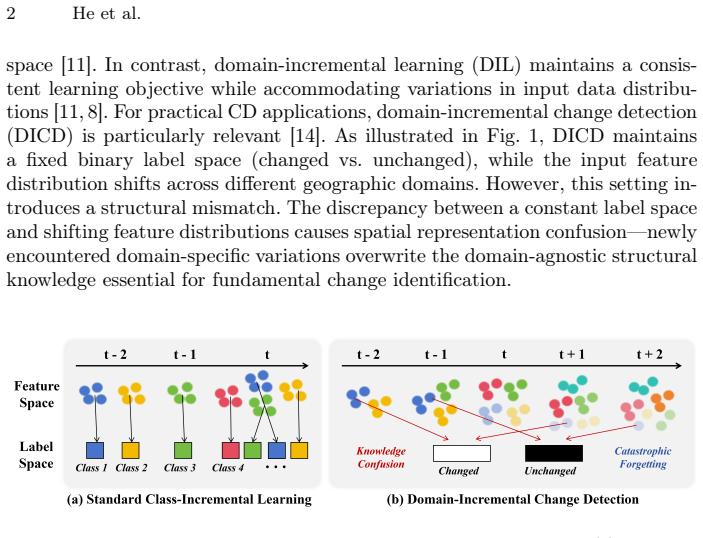
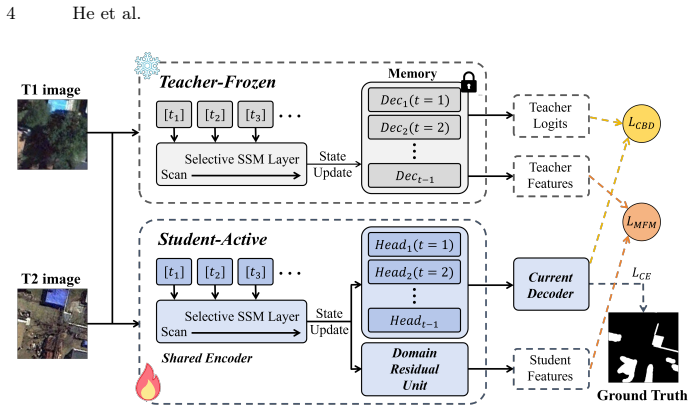
DSINet is a unified framework on visual state space models that uses a selective spatial state unit (S3U) to preserve stable spatial change structures while filtering domain-specific variations during feature propagation, paired with a concentration-balanced distillation (CBD) strategy that balances hardness and confidence concentration to ensure reliable probability mass allocation and stable learning dynamics across incremental stages.
What carries the argument
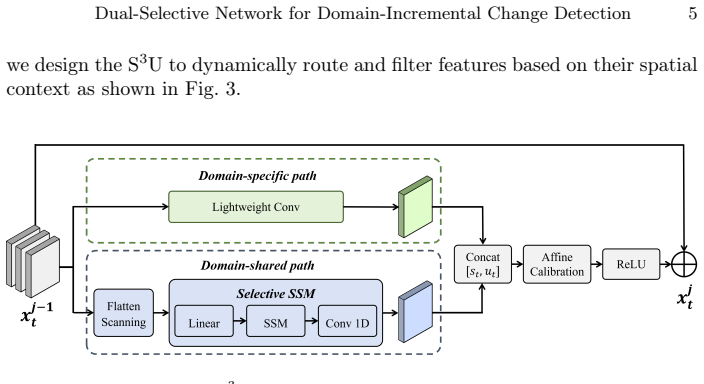
The selective spatial state unit (S3U), which adapts Mamba's input-dependent selective mechanism to maintain stable spatial change structures while filtering domain-specific variations during propagation.
If this is right
- Spatial representations remain stable across domains and prevent accumulation of feature confusion over incremental steps.
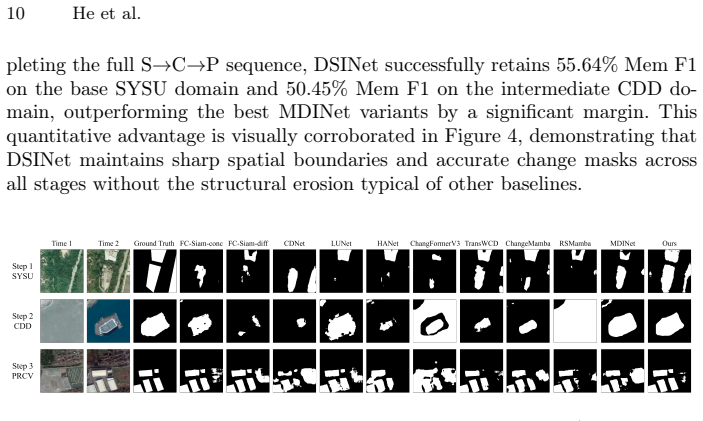
- Knowledge degradation is mitigated across long domain sequences.
- Linear computational efficiency of state space models is retained during incremental updates.
- Probability mass allocation stays reliable without over-smoothing or mode collapse in distillation.
Where Pith is reading between the lines
- The same selective filtering idea may extend to other incremental tasks where output classes stay fixed but input statistics shift.
- Performance on sequences longer than those tested could expose whether S3U stability eventually saturates.
- Replacing the underlying state space backbone with newer variants might change the efficiency-stability trade-off.
Load-bearing premise
The input-dependent selective mechanism can reliably preserve stable spatial change structures while filtering domain-specific variations during feature propagation.
What would settle it
Measure whether accuracy on the first domain falls more than 5 percent after training on five or more later domains when using DSINet versus a replay baseline on the same sequence.
Figures
read the original abstract
Domain-incremental change detection (DICD) continuously adapts models to new geographic domains while preserving prior knowledge. However, a structural mismatch exists: the label space remains fixed while domain characteristics vary drastically. Consequently, incremental models struggle to maintain stable spatial change representations across domains. Existing strategies, such as replay-based or regularization-based methods, often fail to scale to long domain sequences, leading to knowledge degradation or increased computational cost. We propose Dual-Selective Incremental Network (DSINet), a unified framework built on visual state space models. DSINet leverages Mamba's input-dependent selective mechanism through a selective spatial state unit (S3U). This unit preserves stable spatial change structures while filtering domain-specific variations during feature propagation. As a result, spatial representations remain stable across domains, preventing the accumulation of feature confusion over incremental steps. Additionally, we employ a concentration-balanced distillation (CBD) strategy to stabilize knowledge transfer across domains. It balances hardness and confidence concentration effects during incremental updates. This ensures reliable probability mass allocation and prevents over-smoothing or mode collapse during distillation. Together, these mechanisms maintain stable learning dynamics throughout incremental stages. Experimental results demonstrate that DSINet mitigates knowledge degradation across long domain sequences while maintaining the linear computational efficiency of state space models.
Editorial analysis
A structured set of objections, weighed in public.
Referee Report
Summary. The paper proposes Dual-Selective Incremental Network (DSINet) for domain-incremental change detection (DICD). It builds a framework on visual state space models, introducing the Selective Spatial State Unit (S3U) that adapts Mamba's input-dependent selective mechanism to preserve stable spatial change structures while filtering domain-specific variations during feature propagation. It further introduces Concentration-Balanced Distillation (CBD) to balance hardness and confidence concentration effects for stable knowledge transfer. The central claim is that the combination of S3U and CBD mitigates knowledge degradation across long domain sequences while retaining the linear computational efficiency of state space models, as demonstrated by experimental results.
Significance. If the empirical results hold, the work would be significant for continual learning in computer vision applications such as remote sensing change detection, where domain shifts across geographic areas are common. It offers a potential efficient alternative to replay- or regularization-based methods that often fail to scale to long sequences. The integration of state space models for linear scaling is a noted strength, and the dual-selective design targets the specific structural mismatch of fixed label space with varying domains.
major comments (2)
- [Experiments] Experiments section: the central performance claim that DSINet mitigates knowledge degradation rests on experimental results, yet the manuscript provides no dataset descriptions, number of domains in the incremental sequences, ablation studies isolating S3U versus CBD, error bars, or implementation details. This is load-bearing for the empirical claim.
- [§3.2] §3.2 (S3U description): the assertion that the input-dependent selective mechanism reliably preserves stable spatial change structures while filtering domain-specific variations lacks a concrete mathematical formulation or stability analysis showing how the selection gates achieve this separation without introducing new instabilities over incremental steps.
minor comments (2)
- [Abstract] The abstract and introduction use the term 'long domain sequences' without defining what constitutes 'long' (e.g., number of domains or total samples), which should be clarified for reproducibility.
- [§3] Notation for the state space model components in the S3U could be made more consistent with standard Mamba formulations to aid readers familiar with the base architecture.
Simulated Author's Rebuttal
We thank the referee for the constructive comments on our manuscript. We address each major point below and will revise the paper accordingly to strengthen the presentation.
read point-by-point responses
-
Referee: [Experiments] Experiments section: the central performance claim that DSINet mitigates knowledge degradation rests on experimental results, yet the manuscript provides no dataset descriptions, number of domains in the incremental sequences, ablation studies isolating S3U versus CBD, error bars, or implementation details. This is load-bearing for the empirical claim.
Authors: We agree that the current experimental section is insufficiently detailed to fully substantiate the central claims. In the revised manuscript we will add: (i) complete dataset descriptions including the geographic domains and acquisition conditions, (ii) the exact number of domains used in each incremental sequence, (iii) ablation studies that isolate the contribution of S3U from that of CBD, (iv) results reported with standard error bars across multiple runs, and (v) full implementation details (hyper-parameters, training schedules, and hardware). These additions will make the empirical evidence for reduced knowledge degradation transparent and reproducible. revision: yes
-
Referee: [§3.2] §3.2 (S3U description): the assertion that the input-dependent selective mechanism reliably preserves stable spatial change structures while filtering domain-specific variations lacks a concrete mathematical formulation or stability analysis showing how the selection gates achieve this separation without introducing new instabilities over incremental steps.
Authors: We acknowledge that the current description of S3U would benefit from greater mathematical precision. In the revision we will expand §3.2 to include the explicit equations governing the input-dependent selection gates, the state-update rule, and a short stability argument showing that the selective mechanism separates domain-invariant change features from domain-specific variations while preserving bounded state norms across successive incremental steps. revision: yes
Circularity Check
No significant circularity
full rationale
The paper presents an architectural proposal (DSINet with S3U unit and CBD strategy) for domain-incremental change detection, relying on Mamba/SSM mechanisms from prior external literature. No equations, derivations, parameter-fitting procedures, or self-citations appear in the provided text that reduce any claimed result to a definition, fit, or imported uniqueness theorem by construction. Performance claims rest on experimental outcomes rather than internal algebraic identities or self-referential predictions. The derivation chain is therefore self-contained against external benchmarks with no load-bearing circular steps.
Axiom & Free-Parameter Ledger
axioms (1)
- domain assumption Mamba's input-dependent selective mechanism can preserve stable spatial change structures while filtering domain-specific variations
invented entities (2)
-
Selective Spatial State Unit (S3U)
no independent evidence
-
Concentration-Balanced Distillation (CBD)
no independent evidence
Reference graph
Works this paper leans on
-
[1]
Autonomous Robots42(7), 1301–1322 (2018)
Alcantarilla, P.F., Stent, S., Ros, G., Arroyo, R., Gherardi, R.: Street-view change detection with deconvolutional networks. Autonomous Robots42(7), 1301–1322 (2018). https://doi.org/10.1007/s10514-018-9734-5
-
[2]
In: IGARSS 2022 - 2022 IEEE Interna- tional Geoscience and Remote Sensing Symposium
Bandara, W.G.C., Patel, V.M.: A transformer-based siamese net- work for change detection. In: IGARSS 2022 - 2022 IEEE Interna- tional Geoscience and Remote Sensing Symposium. pp. 207–210 (2022). https://doi.org/10.1109/IGARSS46834.2022.9883686
-
[3]
In: 2018 25th IEEE International Conference on Image Process- ing (ICIP)
Caye Daudt, R., Le Saux, B., Boulch, A.: Fully convolutional siamese networks for change detection. In: 2018 25th IEEE International Conference on Image Process- ing (ICIP). pp. 4063–4067 (2018). https://doi.org/10.1109/ICIP.2018.8451652 12 He et al
-
[4]
IEEE Transactions on Geoscience and Remote Sensing62, 1–20 (2024)
Chen, H., Song, J., Han, C., Xia, J., Yokoya, N.: Changemamba: Re- mote sensing change detection with spatiotemporal state space model. IEEE Transactions on Geoscience and Remote Sensing62, 1–20 (2024). https://doi.org/10.1109/TGRS.2024.3417253
-
[5]
Remote Sensing16(13), 2355 (2024)
Cheng, G., Huang, Y., Li, X., Lyu, S., Xu, Z., Zhao, H., Zhao, Q., Xiang, S.: Change detection methods for remote sensing in the last decade: A comprehensive review. Remote Sensing16(13), 2355 (2024). https://doi.org/10.3390/rs16132355
-
[6]
IEEE Journal of Selected Topics in Applied Earth Observations and Remote Sensing16, 3867–3878 (2023)
Han, C., Wu, C., Guo, H., Hu, M., Chen, H.: Hanet: A hierarchical attention net- work for change detection with bitemporal very-high-resolution remote sensing im- ages. IEEE Journal of Selected Topics in Applied Earth Observations and Remote Sensing16, 3867–3878 (2023). https://doi.org/10.1109/JSTARS.2023.3264802
-
[7]
In- formation Fusion115, 102742 (2025)
Himeur, Y., Aburaed, N., Elharrouss, O., Varlamis, I., Atalla, S., Mansoor, W., Al- Ahmad, H.: Applications of knowledge distillation in remote sensing: A survey. In- formation Fusion115, 102742 (2025). https://doi.org/10.1016/j.inffus.2024.102742
-
[8]
IEEE Transactions on Geoscience and Remote Sensing62, 1–15 (2024)
Huang, W., Ding, M., Deng, F.: Domain-incremental learning for remote sensing semantic segmentation with multifeature constraints in graph space. IEEE Transactions on Geoscience and Remote Sensing62, 1–15 (2024). https://doi.org/10.1109/TGRS.2024.3481875
-
[9]
Lee, Y., Lee, D., Kwak, T., Kim, Y.: Er-pass: Experience replay with performance- aware submodular sampling for domain-incremental learning in remote sensing. Preprints (2025). https://doi.org/10.3390/rs17183233
-
[10]
IEEE Transactions on Geoscience and Remote Sensing59(9), 7651–7668 (2021)
Papadomanolaki, M., Vakalopoulou, M., Karantzalos, K.: A deep multitask learn- ing framework coupling semantic segmentation and fully convolutional lstm net- works for urban change detection. IEEE Transactions on Geoscience and Remote Sensing59(9), 7651–7668 (2021). https://doi.org/10.1109/TGRS.2021.3055584
-
[11]
Quantum-inspired algorithms in practice,
van de Ven, G.M., Tuytelaars, T., Tolias, A.S.: Three types of incremental learning. Nature Machine Intelligence4, 1185–1197 (2022). https://doi.org/10.1038/s42256- 022-00568-3
-
[12]
In: Proceedings of the 42nd International Conference on Machine Learning (ICML) (2025)
Wang, G., Yang, Z., Wang, Z., Wang, S., Xu, Q., Huang, Q.: ABKD: Pursu- ing a proper allocation of the probability mass in knowledge distillation viaα- β-divergence. In: Proceedings of the 42nd International Conference on Machine Learning (ICML) (2025)
2025
-
[13]
IEEE Transactions on Pattern Analysis and Machine Intelligence46, 5362–5383 (2023)
Wang, L., Zhang, X., Su, H., Zhu, J.: A comprehensive survey of continual learning: Theory, method and application. IEEE Transactions on Pattern Analysis and Machine Intelligence46, 5362–5383 (2023). https://doi.org/10.1109/TPAMI.2024.3367329
-
[14]
IEEE Transactions on Geoscience and Remote Sensing62, 1–15 (2024)
Weng, L., Yang, W., Hu, B., Han, P., Xue, S., Zhang, Y., Li, H., Jin, J., Bu, S.: Mdinet: Multidomain incremental network for change detection. IEEE Transactions on Geoscience and Remote Sensing62, 1–15 (2024). https://doi.org/10.1109/TGRS.2023.3348878
-
[15]
IEEE Transactions on Geoscience and Re- mote Sensing62, 1–14 (2024)
Zhao, S., Chen, H., Zhang, X.l., Xiao, P., Lei, B., Wanli, O.: Rs-mamba for large remote sensing image dense prediction. IEEE Transactions on Geoscience and Re- mote Sensing62, 1–14 (2024). https://doi.org/10.1109/TGRS.2024.3425540
-
[16]
IEEE Transactions on Geoscience and Remote Sensing63, 1–12 (2025)
Zhao, Z., Ru, L., Wu, C., Wang, D.: Transwcd: Scene-adaptive joint constrained framework for weakly supervised change detection. IEEE Transactions on Geoscience and Remote Sensing63, 1–12 (2025). https://doi.org/10.1109/TGRS.2025.3545051
discussion (0)
Sign in with ORCID, Apple, or X to comment. Anyone can read and Pith papers without signing in.