Pressure-drop localization and momentum insulation in liquid-gas coexistence Poiseuille flow
Pith reviewed 2026-07-03 04:48 UTC · model grok-4.3
The pith
In liquid-gas coexistence Poiseuille flow, the pressure difference concentrates at the interface and sharply reduces the particle current.
A machine-rendered reading of the paper's core claim, the machinery that carries it, and where it could break.
Core claim
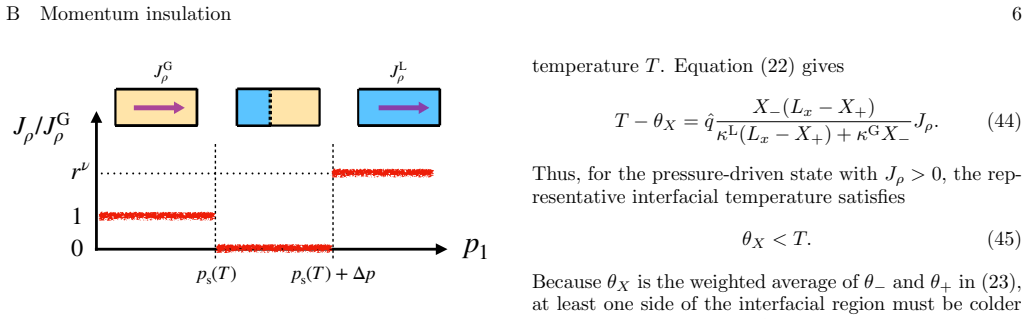
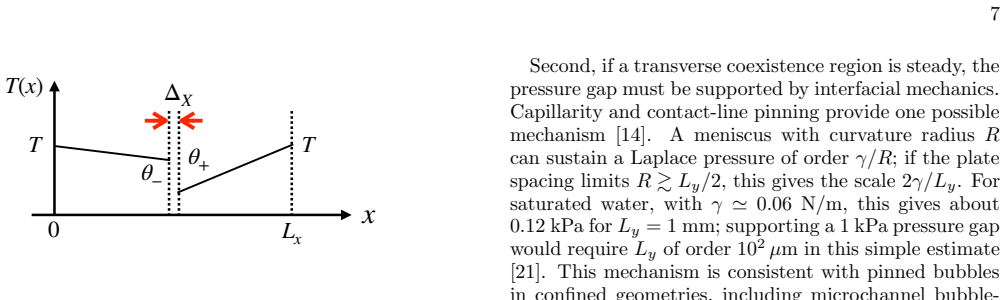
From the bulk equations of Poiseuille flow and Fourier heat conduction together with particle and energy conservation, extremely small dimensionless parameters A^L and A^G are identified for coexistence Poiseuille flow. In weak driving with macroscopic liquid and gas regions, the pressure difference is concentrated across the interfacial region, and the ordinary Poiseuille particle current is strongly reduced. For equal-temperature reservoirs, this residual particle current produces interfacial cooling.
What carries the argument
The extremely small dimensionless parameters A^L and A^G that arise from squared microscopic-to-macroscopic length ratios and enforce pressure-drop localization together with momentum insulation at the interface.
Load-bearing premise
The bulk liquid and gas regions obey Poiseuille flow profiles and Fourier heat conduction while particle number and energy are conserved across the entire system.
What would settle it
Measurement of the pressure profile in a channel with macroscopic liquid and gas regions that shows nearly the entire drop occurring inside the interfacial zone rather than distributed through the bulks.
Figures

read the original abstract
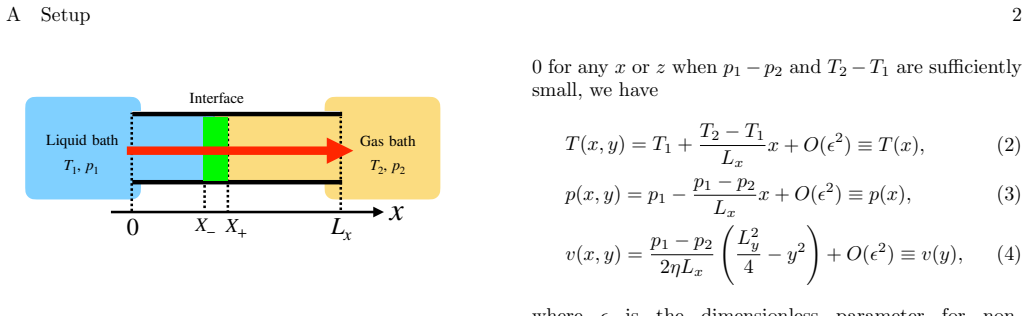
We study pressure-driven Poiseuille flow of a one-component fluid between adiabatic plates in liquid-gas coexistence. The analysis uses Poiseuille flow and Fourier heat conduction in the bulk regions together with particle and energy conservation. From these bulk equations, we identify extremely small dimensionless parameters $A^\mathrm{L}$ and $A^\mathrm{G}$ describing coexistence Poiseuille flow, whose smallness comes from squared microscopic-to-macroscopic length ratios. In weak driving with macroscopic liquid and gas regions, the pressure difference is concentrated across the interfacial region, and the ordinary Poiseuille particle current is strongly reduced. For equal-temperature reservoirs, this residual particle current produces interfacial cooling.
Editorial analysis
A structured set of objections, weighed in public.
Referee Report
Summary. The manuscript analyzes pressure-driven Poiseuille flow of a one-component fluid in liquid-gas coexistence between adiabatic plates. Applying standard Poiseuille flow and Fourier heat conduction in the bulk regions together with particle and energy conservation across the interface, it identifies the dimensionless parameters A^L and A^G whose smallness follows from squared microscopic-to-macroscopic length ratios. The central claims are that, under weak driving with macroscopic phase regions, the imposed pressure difference localizes at the interface (producing momentum insulation), the net particle current is strongly suppressed relative to single-phase Poiseuille flow, and equal-temperature reservoirs induce net interfacial cooling from the residual flux.
Significance. If the derivation holds, the work supplies a transparent, parameter-free explanation for pressure-drop localization and interfacial cooling that follows directly from scale separation and standard bulk constitutive relations. The explicit identification of A^L and A^G as O((l_micro/l_macro)^2) and the closure via conservation laws constitute a strength; the resulting predictions for current reduction and cooling are falsifiable and could inform microfluidic or heat-transfer applications involving two-phase coexistence.
minor comments (3)
- The abstract and introduction would benefit from a single sentence stating the numerical order of magnitude expected for A^L and A^G at typical laboratory channel widths (e.g., 100 µm–1 mm) to make the phrase 'extremely small' quantitative.
- Notation for the interfacial energy flux and the precise definition of the residual particle current should be introduced once in the bulk-equation section and used consistently thereafter.
- A brief remark on the range of validity (e.g., when the interface width remains negligible compared with the channel height) would clarify the domain of the macroscopic description.
Simulated Author's Rebuttal
We thank the referee for their positive summary and significance assessment of the manuscript, as well as the recommendation for minor revision. No specific major comments were raised in the report.
Circularity Check
No significant circularity identified
full rationale
The derivation applies standard Poiseuille flow and Fourier conduction in the bulk phases, closes with particle and energy conservation at the interface, and identifies that the resulting dimensionless groups A^L and A^G are O((micro/macro length)^2) ≪ 1 from the explicit length-scale separation. This structure directly yields pressure-drop localization and reduced current without any fitted parameters, self-citations, or self-definitional steps. The small-parameter argument is the expected macroscopic outcome of a molecular-scale interface and does not reduce the target claims to the inputs by construction. The paper is self-contained against external benchmarks.
Axiom & Free-Parameter Ledger
free parameters (2)
- A^L
- A^G
axioms (2)
- domain assumption Poiseuille flow and Fourier heat conduction hold in the bulk liquid and gas regions
- standard math Particle and energy conservation across the system
Reference graph
Works this paper leans on
-
[1]
For water atL y = 1 cm, (32) yieldsA L = 2.936× 10⁻¹² andA G = 7.574×10 −12
for H 2O at the 1 atm saturation point,T= 373.12 K, and argon atT= 90 K, far from the critical tempera- tures. For water atL y = 1 cm, (32) yieldsA L = 2.936× 10⁻¹² andA G = 7.574×10 −12. Even for micrometer plate separations, the values in Table I giveA α ≲10 −3. MakingA α of order unity would require lengths outside the range where ordinary continuum Po...
-
[2]
L. D. Landau and E. M. Lifshitz,Fluid Mechanics(Perg- amon Press, Oxford, 1959)
work page 1959
-
[3]
S. M. Ghiaasiaan,Two-Phase Flow, Boiling, and Con- densation in Conventional and Miniature Systems, 2nd ed. (Cambridge University Press, Cambridge, 2017)
work page 2017
-
[4]
V. K. Dhir, Boiling heat transfer, Annu. Rev. Fluid Mech.30, 365–401 (1998)
work page 1998
-
[5]
J. R. Thome, Boiling in microchannels: a review of ex- periment and theory, Int. J. Heat Fluid Flow25, 128–139 (2004)
work page 2004
-
[6]
T. G. Karayiannis and M. M. Mahmoud, Flow boiling in microchannels: Fundamentals and applications, Appl. Therm. Eng.115, 1372–1397 (2017)
work page 2017
-
[7]
D. Bedeaux, S. Kjelstrup, and J. M. Rubi, Nonequilib- rium translational effects in evaporation and condensa- tion, J. Chem. Phys.119, 9163–9170 (2003)
work page 2003
-
[8]
Chen, On paradoxical phenomena during evaporation and condensation between two parallel plates, J
G. Chen, On paradoxical phenomena during evaporation and condensation between two parallel plates, J. Chem. Phys.159, 151101 (2023)
work page 2023
-
[9]
G. Fang and C. A. Ward, Temperature measured close to the interface of an evaporating liquid, Phys. Rev. E 59, 417–428 (1999)
work page 1999
-
[10]
J. Muscatello, E. Chac´ on, P. Tarazona, and F. Bresme, Deconstructing temperature gradients across fluid inter- faces: The structural origin of the thermal resistance of liquid-vapor interfaces, Phys. Rev. Lett.119, 045901 (2017)
work page 2017
-
[11]
S. Fechter, C.-D. Munz, C. Rohde, and C. Zeiler, A sharp interface method for compressible liquid-vapor flow with phase transition and surface tension, J. Comput. Phys. 336, 347–374 (2017)
work page 2017
-
[12]
J. D. van der Waals, The thermodynamic theory of cap- illarity under the hypothesis of a continuous variation of density, translated by J. S. Rowlinson, J. Stat. Phys.20, 197–244 (1979), doi:10.1007/BF01011513
-
[13]
D. J. Korteweg, Sur la forme que prennent les ´ equations du mouvement des fluides si l’on tient compte des forces capillaires caus´ ees par des variations de densit´ e, Arch. N´ eerl. Sci. Exactes Nat.6, 1–24 (1901)
work page 1901
-
[14]
Onuki, Dynamic van der Waals theory of two-phase fluids in heat flow, Phys
A. Onuki, Dynamic van der Waals theory of two-phase fluids in heat flow, Phys. Rev. Lett.94, 054501 (2005)
work page 2005
-
[15]
D. Bonn, J. Eggers, J. Indekeu, J. Meunier, and E. Rolley, Wetting and spreading, Rev. Mod. Phys.81, 739–805 (2009)
work page 2009
-
[16]
L. C. Ruspini, C. P. Marcel, and A. Clausse, Two-phase flow instabilities: a review, Int. J. Heat Mass Transfer 71, 521–548 (2014)
work page 2014
-
[17]
D. M. Anderson, G. B. McFadden, and A. A. Wheeler, Diffuse-interface methods in fluid mechanics, Annu. Rev. Fluid Mech.30, 139–165 (1998)
work page 1998
-
[18]
R. Saurel and C. Pantano, Diffuse-interface capturing methods for compressible two-phase flows, Annu. Rev. Fluid Mech.50, 105–130 (2018)
work page 2018
-
[19]
G. Chen, On the molecular picture and interfacial tem- perature discontinuity during evaporation and condensa- tion, Int. J. Heat Mass Transfer191, 122845 (2022)
work page 2022
-
[20]
G. Chen, Interfacial cooling and heating, temperature discontinuity and inversion in evaporation and condensa- tion, Int. J. Heat Mass Transfer218, 124762 (2024)
work page 2024
-
[21]
D. Kalempa and I. Graur, Temperature and pressure jump coefficients at a liquid-vapor interface, Phys. Fluids 36, 083622 (2024)
work page 2024
-
[22]
E. W. Lemmon, I. H. Bell, M. L. Huber, and M. O. McLinden, Thermophysical Properties of Fluid Systems, inNIST Chemistry WebBook, NIST Standard Reference Database Number 69, eds. P. J. Linstrom and W. G. Mal- lard, National Institute of Standards and Technology, Gaithersburg MD, 20899,https://doi.org/10.18434/ T4D303, retrieved May 24, 2026
work page 2026
-
[23]
M. Mohammadi and K. V. Sharp, The role of contact line (pinning) forces on bubble blockage in microchannels, J. Fluids Eng.137, 031208 (2015)
work page 2015
-
[24]
J. E. Dunn and J. Serrin, On the thermomechanics of interstitial working, Arch. Rational Mech. Anal.88, 95– 133 (1985)
work page 1985
-
[25]
N. Nakagawa and S.-i. Sasa, Thermodynamic variational principle unifying gravity and heat flow, Phys. Rev. Lett. 136, 057101 (2026), doi:10.1103/bbqy-hptc
-
[26]
Global thermodynamics for heat-conducting fluids under weak gravity
N. Nakagawa and S.-i. Sasa, Global thermodynam- ics for heat-conducting fluids under weak gravity, arXiv:2605.31233 (2026)
work page internal anchor Pith review Pith/arXiv arXiv 2026
discussion (0)
Sign in with ORCID, Apple, or X to comment. Anyone can read and Pith papers without signing in.