NEvo: Neural-Guided Evolutionary Video Synthesis for Dynamic Visual Selectivity
Pith reviewed 2026-07-03 15:27 UTC · model grok-4.3
The pith
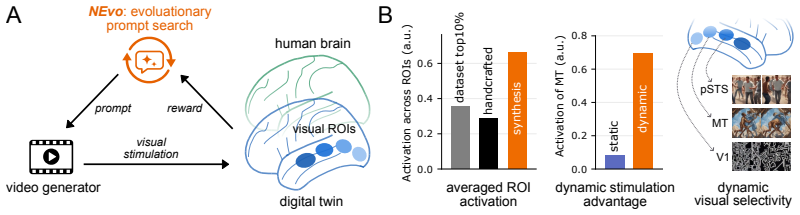
Evolutionary search over video prompts finds stimuli that hyper-activate target brain regions more than handcrafted localizers.
A machine-rendered reading of the paper's core claim, the machinery that carries it, and where it could break.
Core claim
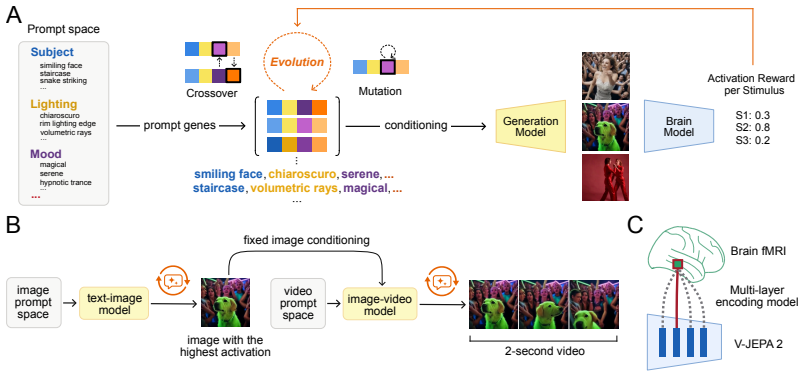
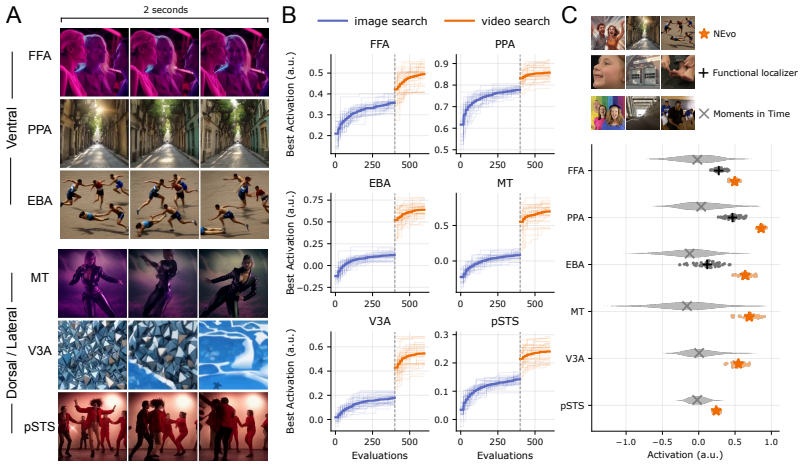
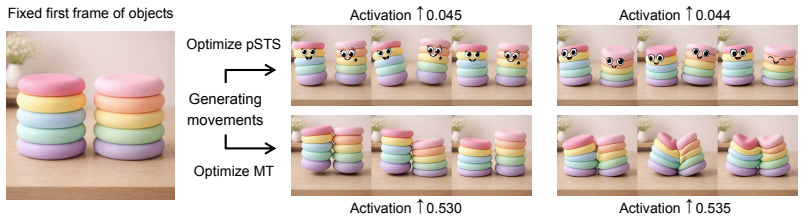
By performing evolutionary search over a structured prompt space guided by a dynamic encoding model that predicts voxel-level responses to video inputs, the framework generates stimuli that maximize predicted activity for a target ROI, consistently surpassing handcrafted localizer videos while recovering known selectivities across ventral, dorsal, and lateral pathways and revealing systematic differences in sensitivity to temporal dynamics.
What carries the argument
Evolutionary search over structured prompt space guided by dynamic encoding model predictions to maximize target ROI activity
If this is right
- Synthesized videos recover known selectivities across ventral, dorsal, and lateral pathways.
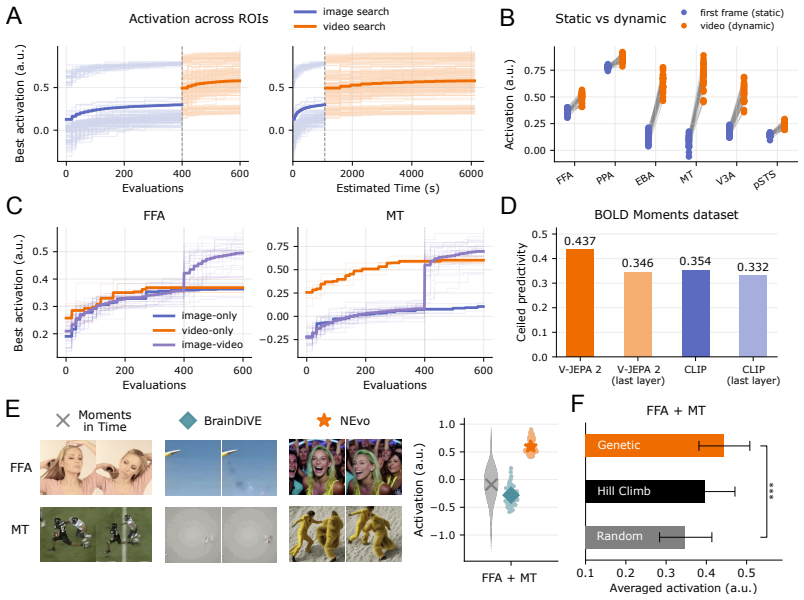
- Systematic differences appear in sensitivity to temporal dynamics.
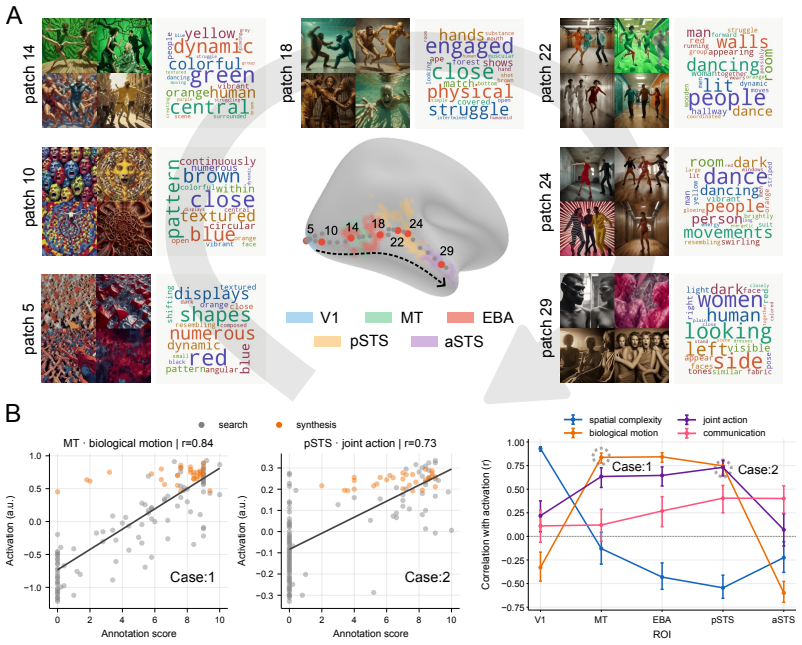
- Searchlight analysis shows progression toward complex social-dynamic features along the lateral stream.
- The framework supplies new predictions for in vivo experiments on dynamic visual selectivity.
Where Pith is reading between the lines
- The same search procedure could be used to generate candidate stimuli for testing specific hypotheses about brain function before running actual scans.
- Applying the method to abstract non-naturalistic videos may isolate the minimal features sufficient to drive selectivity.
- Extending the framework beyond visual cortex could identify optimized stimuli for other sensory or cognitive regions.
Load-bearing premise
The dynamic encoding model must accurately predict voxel responses to the arbitrary videos produced during search.
What would settle it
Run fMRI on human subjects viewing both the synthesized videos and the handcrafted localizers and compare measured activation in the target ROI; equal or lower activation for the synthesized videos would falsify the claim.
Figures
read the original abstract
The human brain processes dynamic visual input through hierarchically organized, functionally specialized regions. While recent in silico brain encoding models can synthesize optimal stimuli to probe selectivity in different brain regions, prior work has been largely limited to static images, leaving dynamic visual processing underexplored. We introduce a novel neural-guided video synthesis framework that generates stimuli optimized for target brain regions across visual cortex. Our method performs evolutionary search over a structured prompt space, guided by a dynamic encoding model that predicts voxel-level responses to video inputs. By maximizing predicted activity for a target ROI, the framework efficiently discovers hyper-activating dynamic stimuli that consistently surpass handcrafted localizer videos. The synthesized videos recover known selectivities across ventral, dorsal, and lateral pathways, and further reveal systematic differences in sensitivity to temporal dynamics. A searchlight analysis provides new insight into the progression toward increasingly complex social-dynamic features along the lateral stream, further supported by probing with synthesized abstract, non-naturalistic stimuli. Taken together, our framework enables in silico exploration of dynamic visual selectivity, with new predictions for in vivo experiments
Editorial analysis
A structured set of objections, weighed in public.
Referee Report
Summary. The paper introduces NEvo, a neural-guided evolutionary video synthesis framework that performs evolutionary search over a structured prompt space, guided by a dynamic encoding model predicting voxel-level responses to videos. By maximizing predicted activity in target ROIs, it claims to discover hyper-activating dynamic stimuli that surpass handcrafted localizer videos, recover known selectivities across ventral/dorsal/lateral pathways, reveal differences in temporal dynamics sensitivity, and provide searchlight insights into progression toward complex social-dynamic features along the lateral stream, supported by abstract non-naturalistic stimuli probes.
Significance. If the encoding model generalizes accurately, the framework offers a scalable in silico method for generating novel dynamic stimuli to probe functional selectivity in visual cortex, extending prior static-image work and generating testable predictions for in vivo experiments.
major comments (2)
- [Abstract] Abstract: The central claim that evolved videos 'consistently surpass handcrafted localizer videos' and recover known selectivities requires the dynamic encoding model to accurately predict responses to the novel, complex temporal dynamics and abstract features it generates; no held-out correlation, noise-ceiling, or OOD validation metrics are reported for these stimuli.
- [Abstract] Abstract: The searchlight analysis claiming 'new insight into the progression toward increasingly complex social-dynamic features along the lateral stream' is presented without quantitative details on the analysis procedure, statistical thresholds, or how the synthesized abstract stimuli specifically support this progression.
Simulated Author's Rebuttal
We thank the referee for their constructive comments on the validation of the dynamic encoding model and the searchlight analysis. We address each point below and will incorporate clarifications and additional analyses in the revised manuscript.
read point-by-point responses
-
Referee: [Abstract] Abstract: The central claim that evolved videos 'consistently surpass handcrafted localizer videos' and recover known selectivities requires the dynamic encoding model to accurately predict responses to the novel, complex temporal dynamics and abstract features it generates; no held-out correlation, noise-ceiling, or OOD validation metrics are reported for these stimuli.
Authors: We acknowledge the importance of OOD validation for the generated stimuli. The dynamic encoding model was trained and cross-validated on large-scale video datasets with standard metrics, but we agree that explicit evaluation on stimuli with complex temporal dynamics would strengthen the claims. In the revision, we will add held-out correlation, noise-ceiling, and OOD performance metrics for the encoding model on a held-out video set that includes abstract and dynamic features similar to NEvo outputs. revision: yes
-
Referee: [Abstract] Abstract: The searchlight analysis claiming 'new insight into the progression toward increasingly complex social-dynamic features along the lateral stream' is presented without quantitative details on the analysis procedure, statistical thresholds, or how the synthesized abstract stimuli specifically support this progression.
Authors: We will revise the methods and results sections to provide full quantitative details on the searchlight procedure (including voxel selection, radius, and cross-validation), statistical thresholds (e.g., cluster-corrected p-values), and specific metrics (such as feature complexity scores or activation gradients) demonstrating how the abstract non-naturalistic stimuli support the observed progression along the lateral stream. Additional supplementary figures will illustrate these quantitative results. revision: yes
Circularity Check
No significant circularity; derivation relies on external encoding model
full rationale
The paper introduces a neural-guided evolutionary search framework that uses a pre-existing dynamic encoding model to predict voxel responses and optimize video stimuli. No equations, parameter fitting steps, or derivations appear in the abstract or described method. The encoding model is treated as an independent input whose accuracy is an external assumption, not derived or fitted within the paper itself. The central claim of discovering hyper-activating stimuli therefore does not reduce to any self-referential construction or self-citation chain. This is the common case of a method whose validity hinges on an external benchmark rather than internal circularity.
Axiom & Free-Parameter Ledger
Reference graph
Works this paper leans on
-
[1]
Cognitive neuroscience of human social behaviour.Nature reviews neuroscience, 4(3):165–178, 2003
Ralph Adolphs. Cognitive neuroscience of human social behaviour.Nature reviews neuroscience, 4(3):165–178, 2003
2003
-
[2]
From language to cognition: How llms outgrow the human language network
Badr AlKhamissi, Greta Tuckute, Yingtian Tang, Taha Osama A Binhuraib, Antoine Bosselut, and Martin Schrimpf. From language to cognition: How llms outgrow the human language network. InProceedings of the 2025 Conference on Empirical Methods in Natural Language Processing, pages 24332–24350, 2025
2025
-
[3]
Social perception from visual cues: role of the sts region.Trends in cognitive sciences, 4(7):267–278, 2000
Truett Allison, Aina Puce, and Gregory McCarthy. Social perception from visual cues: role of the sts region.Trends in cognitive sciences, 4(7):267–278, 2000
2000
-
[4]
V-JEPA 2: Self-Supervised Video Models Enable Understanding, Prediction and Planning
Mido Assran, Adrien Bardes, David Fan, Quentin Garrido, Russell Howes, Matthew Muckley, Ammar Rizvi, Claire Roberts, Koustuv Sinha, Artem Zholus, et al. V-jepa 2: Self-supervised video models enable understanding, prediction and planning.arXiv preprint arXiv:2506.09985, 2025
work page internal anchor Pith review Pith/arXiv arXiv 2025
-
[5]
The functional specialization of visual cortex emerges from training parallel pathways with self-supervised predictive learning
Shahab Bakhtiari, Patrick Mineault, Timothy Lillicrap, Christopher Pack, and Blake Richards. The functional specialization of visual cortex emerges from training parallel pathways with self-supervised predictive learning. InAdvances in Neural Information Processing Systems, volume 34, pages 25164–25178. Curran Associates, Inc., 2021. URL https://papers.ni...
2021
-
[6]
Guangyin Bao, Qi Zhang, Zixuan Gong, Zhuojia Wu, and Duoqian Miao. Mindsimulator: Exploring brain concept localization via synthetic fmri.arXiv preprint arXiv:2503.02351, 2025
-
[7]
A map of object space in primate inferotemporal cortex.Nature, 583(7814):103–108, 2020
Pinglei Bao, Liang She, Mason McGill, and Doris Y Tsao. A map of object space in primate inferotemporal cortex.Nature, 583(7814):103–108, 2020
2020
-
[8]
Pouya Bashivan, Kohitij Kar, and James J. DiCarlo. Neural population control via deep image synthesis.Science, May 2019. doi: 10.1126/science.aav9436. URL https://www. science.org/doi/10.1126/science.aav9436. Publisher: American Association for the Advancement of Science
-
[9]
Julia Berezutskaya, Mariska J. Vansteensel, Erik J. Aarnoutse, Zachary V . Freudenburg, Giovanni Piantoni, Mariana P. Branco, and Nick F. Ramsey. Open multimodal iEEG- fMRI dataset from naturalistic stimulation with a short audiovisual film.Scientific Data, 9:91, March 2022. ISSN 2052-4463. doi: 10.1038/s41597-022-01173-0. URL https: //www.ncbi.nlm.nih.go...
-
[10]
Richard T. Born and David C. Bradley. STRUCTURE AND FUNCTION OF VISUAL AREA MT.Annual Review of Neuroscience, 28(1):157–189, July 2005. ISSN 0147-006X, 1545-4126. doi: 10.1146/annurev.neuro.26.041002.131052. URL https://www.annualreviews.org/ doi/10.1146/annurev.neuro.26.041002.131052
-
[11]
Cneuromod data collection complete: 200h of individual fmri across diverse naturalistic and controlled tasks to build neuroai models
Julie A Boyle, Basile Pinsard, and Lune Pierre Bellec. Cneuromod data collection complete: 200h of individual fmri across diverse naturalistic and controlled tasks to build neuroai models
-
[12]
Brains and algorithms partially converge in nat- ural language processing.Communications Biology, 5(1):1–10, February 2022
Charlotte Caucheteux and Jean-Rémi King. Brains and algorithms partially converge in nat- ural language processing.Communications Biology, 5(1):1–10, February 2022. ISSN 2399-
2022
-
[13]
URL https://www.nature.com/articles/ s42003-022-03036-1
doi: 10.1038/s42003-022-03036-1. URL https://www.nature.com/articles/ s42003-022-03036-1. Number: 1 Publisher: Nature Publishing Group
-
[14]
Brainactiv: Identifying visuo-semantic properties driving cortical selectivity using diffusion-based image manipulation.bioRxiv, pages 2024–10, 2024
Diego García Cerdas, Christina Sartzetaki, Magnus Petersen, Gemma Roig, Pascal Mettes, and Iris Groen. Brainactiv: Identifying visuo-semantic properties driving cortical selectivity using diffusion-based image manipulation.bioRxiv, pages 2024–10, 2024
2024
-
[15]
Minkyu Choi, Kuan Han, Xiaokai Wang, Yizhen Zhang, and Zhongming Liu. A dual-stream neural network explains the functional segregation of dorsal and ventral visual pathways in human brains.Advances in Neural Information Processing Systems, 36:50408–50428, 2023. 11
2023
-
[16]
Kristl G. Claeys, Delwin T. Lindsey, Erik De Schutter, and Guy A. Orban. A higher order motion region in human inferior parietal lobule: evidence from fMRI.Neuron, 40(3):631–642, October 2003. ISSN 0896-6273. doi: 10.1016/s0896-6273(03)00590-7
-
[17]
Stéphane d’Ascoli, Jérémy Rapin, Yohann Benchetrit, Hubert Banville, and Jean-Rémi King. Tribe: Trimodal brain encoder for whole-brain fmri response prediction.arXiv preprint arXiv:2507.22229, 2025
-
[18]
Functional organization of social perception and cognition in the superior temporal sulcus.Cerebral cortex, 25(11): 4596–4609, 2015
Ben Deen, Kami Koldewyn, Nancy Kanwisher, and Rebecca Saxe. Functional organization of social perception and cognition in the superior temporal sulcus.Cerebral cortex, 25(11): 4596–4609, 2015
2015
-
[20]
The parahippocampal place area: recognition, navigation, or encoding?Neuron, 23(1):115–125, 1999
Russell Epstein, Alison Harris, Damian Stanley, and Nancy Kanwisher. The parahippocampal place area: recognition, navigation, or encoding?Neuron, 23(1):115–125, 1999
1999
-
[21]
A single computational objective drives specialization of streams in visual cortex.bioRxiv, pages 2023–12, 2023
Dawn Finzi, Eshed Margalit, Kendrick Kay, Daniel LK Yamins, and Kalanit Grill-Spector. A single computational objective drives specialization of streams in visual cortex.bioRxiv, pages 2023–12, 2023
2023
-
[22]
Bruce Fischl. FreeSurfer. 62(2):774–781. ISSN 10538119. doi: 10.1016/j.neuroimage.2012.01
-
[23]
URLhttps://linkinghub.elsevier.com/retrieve/pii/S1053811912000389
-
[24]
The brain basis of language processing: from structure to function
Angela D Friederici. The brain basis of language processing: from structure to function. Physiological reviews, 2011
2011
-
[25]
Gibson.The Ecological Approach to Visual Perception: Classic Edition
James J. Gibson.The Ecological Approach to Visual Perception: Classic Edition. Psychology Press, November 2014. ISBN 978-1-317-57938-0. Google-Books-ID: 8BSLBQAAQBAJ
2014
-
[26]
Catalyzing in silico neuroscience with a toolkit of accurate encoding models of the brain
Alessandro T Gifford, Domenic Bersch, Daniel Janini, Gemma Roig, and Radoslaw M Cichy. Catalyzing in silico neuroscience with a toolkit of accurate encoding models of the brain
-
[27]
The role of human ventral visual cortex in motion perception.Brain, 136(9): 2784–2798, 2013
Sharon Gilaie-Dotan, Ayse P Saygin, Lauren J Lorenzi, Ryan Egan, Geraint Rees, and Marlene Behrmann. The role of human ventral visual cortex in motion perception.Brain, 136(9): 2784–2798, 2013
2013
-
[28]
Matthew F. Glasser, Timothy S. Coalson, Emma C. Robinson, Carl D. Hacker, John Harwell, Essa Yacoub, Kamil Ugurbil, Jesper Andersson, Christian F. Beckmann, Mark Jenkinson, Stephen M. Smith, and David C. Van Essen. A multi-modal parcellation of human cerebral cortex.Nature, 536(7615):171–178, August 2016. ISSN 1476-4687. doi: 10.1038/nature18933. URL http...
-
[29]
Abdulkadir Gokce and Martin Schrimpf. Scaling laws for task-optimized models of the primate visual ventral stream.arXiv preprint arXiv:2411.05712, 2024
-
[30]
Ariel Goldstein, Zaid Zada, Eliav Buchnik, Mariano Schain, Amy Price, Bobbi Aubrey, Samuel A. Nastase, Amir Feder, Dotan Emanuel, Alon Cohen, Aren Jansen, Harshvard- han Gazula, Gina Choe, Aditi Rao, Catherine Kim, Colton Casto, Lora Fanda, Werner Doyle, Daniel Friedman, Patricia Dugan, Lucia Melloni, Roi Reichart, Sasha Devore, Adeen Flinker, Liat Hasenf...
-
[31]
M. A. Goodale and A. D. Milner. Separate visual pathways for perception and action.Trends in Neurosciences, 15(1):20–25, January 1992. ISSN 0166-2236. doi: 10.1016/0166-2236(92) 90344-8. 12
-
[32]
Google. Gemini. https://gemini.google.com/, 2026. Large language model; accessed 2026-05-06
2026
-
[33]
The human visual cortex.Annu
Kalanit Grill-Spector and Rafael Malach. The human visual cortex.Annu. Rev. Neurosci., 27 (1):649–677, 2004
2004
-
[34]
Brain areas active during visual perception of biological motion.Neuron, 35(6):1167–1175, 2002
Emily D Grossman and Randolph Blake. Brain areas active during visual perception of biological motion.Neuron, 35(6):1167–1175, 2002
2002
-
[35]
Neurogen: activation optimized image synthesis for discovery neuroscience.NeuroImage, 247:118812, 2022
Zijin Gu, Keith Wakefield Jamison, Meenakshi Khosla, Emily J Allen, Yihan Wu, Ghislain St-Yves, Thomas Naselaris, Kendrick Kay, Mert R Sabuncu, and Amy Kuceyeski. Neurogen: activation optimized image synthesis for discovery neuroscience.NeuroImage, 247:118812, 2022
2022
-
[36]
LTX-Video: Realtime Video Latent Diffusion
Yoav HaCohen, Nisan Chiprut, Benny Brazowski, Daniel Shalem, Dudu Moshe, Eitan Richard- son, Eran Levin, Guy Shiran, Nir Zabari, Ori Gordon, Poriya Panet, Sapir Weissbuch, Victor Kulikov, Yaki Bitterman, Zeev Melumian, and Ofir Bibi. Ltx-video: Realtime video latent diffusion, 2024. URLhttps://arxiv.org/abs/2501.00103
work page internal anchor Pith review Pith/arXiv arXiv 2024
-
[37]
Ltx-2: Efficient joint audio-visual foundation model, 2026
Yoav HaCohen, Benny Brazowski, Nisan Chiprut, Yaki Bitterman, Andrew Kvochko, Avishai Berkowitz, Daniel Shalem, Daphna Lifschitz, Dudu Moshe, Eitan Porat, Eitan Richardson, Guy Shiran, Itay Chachy, Jonathan Chetboun, Michael Finkelson, Michael Kupchick, Nir Zabari, Nitzan Guetta, Noa Kotler, Ofir Bibi, Ori Gordon, Poriya Panet, Roi Benita, Shahar Armon, V...
2026
-
[38]
Uri Hasson, Janice Chen, and Christopher J. Honey. Hierarchical process memory: memory as an integral component of information processing.Trends in cognitive sciences, 19(6):304–313, June 2015. ISSN 1364-6613. doi: 10.1016/j.tics.2015.04.006. URL https://www.ncbi.nlm. nih.gov/pmc/articles/PMC4457571/
-
[39]
Naturalistic stimuli reveal a dominant role for agentic action in visual representation.Neuroimage, 216:116561, 2020
James V Haxby, M Ida Gobbini, and Samuel A Nastase. Naturalistic stimuli reveal a dominant role for agentic action in visual representation.Neuroimage, 216:116561, 2020
2020
-
[40]
Ethan Hwang, Hossein Adeli, Wenxuan Guo, Andrew Luo, and Nikolaus Kriegeskorte. In silico mapping of visual categorical selectivity across the whole brain.arXiv preprint arXiv:2510.21142, 2025
-
[41]
Leyla Isik, Kami Koldewyn, David Beeler, and Nancy Kanwisher. Perceiving social interactions in the posterior superior temporal sulcus.Proceedings of the National Academy of Sciences, 114(43):E9145–E9152, October 2017. doi: 10.1073/pnas.1714471114
-
[42]
Popivanov, Rufin V ogels, Wim Vanduffel, and Guy A
Jan Jastorff, Ivo D. Popivanov, Rufin V ogels, Wim Vanduffel, and Guy A. Orban. Integration of shape and motion cues in biological motion processing in the monkey STS.NeuroImage, 60(2):911–921, April 2012. ISSN 1053-8119. doi: 10.1016/j.neuroimage.2011.12.087. URL https://www.sciencedirect.com/science/article/pii/S1053811912000286
-
[43]
The fusiform face area: a module in human extrastriate cortex specialized for face perception.Journal of neuroscience, 17(11): 4302–4311, 1997
Nancy Kanwisher, Josh McDermott, and Marvin M Chun. The fusiform face area: a module in human extrastriate cortex specialized for face perception.Journal of neuroscience, 17(11): 4302–4311, 1997
1997
-
[44]
Umit Keles, Julien Dubois, Kevin J. M. Le, J. Michael Tyszka, David A. Kahn, Chrystal M. Reed, Jeffrey M. Chung, Adam N. Mamelak, Ralph Adolphs, and Ueli Rutishauser. Multimodal single- neuron, intracranial EEG, and fMRI brain responses during movie watching in human patients. Scientific Data, 11(1):214, February 2024. ISSN 2052-4463. doi: 10.1038/s41597-...
-
[45]
Alexander J.E. Kell, Daniel L.K. Yamins, Erica N. Shook, Sam V . Norman-Haignere, and Josh H. McDermott. A Task-Optimized Neural Network Replicates Human Auditory Behavior, Predicts Brain Responses, and Reveals a Cortical Processing Hierarchy.Neuron, 98(3):630– 644.e16, May 2018. ISSN 08966273. doi: 10.1016/j.neuron.2018.03.044. URL https: //linkinghub.el...
-
[46]
Seyed-Mahdi Khaligh-Razavi and Nikolaus Kriegeskorte. Deep supervised, but not unsuper- vised, models may explain IT cortical representation.PLoS computational biology, 10(11): e1003915, November 2014. ISSN 1553-7358. doi: 10.1371/journal.pcbi.1003915
-
[47]
Tim C. Kietzmann, Courtney J. Spoerer, Lynn K. A. Sörensen, Radoslaw M. Cichy, Olaf Hauk, and Nikolaus Kriegeskorte. Recurrence is required to capture the representational dynamics of the human visual system.Proceedings of the National Academy of Sciences, 116(43):21854– 21863, October 2019. doi: 10.1073/pnas.1905544116. URL https://www.pnas.org/doi/ abs/...
-
[48]
HunyuanVideo: A Systematic Framework For Large Video Generative Models
Weijie Kong, Qi Tian, Zijian Zhang, Rox Min, Zuozhuo Dai, Jin Zhou, Jiangfeng Xiong, Xin Li, Bo Wu, Jianwei Zhang, et al. Hunyuanvideo: A systematic framework for large video generative models.arXiv preprint arXiv:2412.03603, 2024
work page internal anchor Pith review Pith/arXiv arXiv 2024
-
[49]
Terry K. Koo and Mae Y . Li. A Guideline of Selecting and Reporting Intraclass Cor- relation Coefficients for Reliability Research. 15(2):155–163. ISSN 1556-3707. doi: 10.1016/j.jcm.2016.02.012. URL https://www.sciencedirect.com/science/article/ pii/S1556370716000158
-
[50]
Information-based functional brain mapping.Proceedings of the National Academy of Sciences, 103(10):3863–3868, March
Nikolaus Kriegeskorte, Rainer Goebel, and Peter Bandettini. Information-based functional brain mapping.Proceedings of the National Academy of Sciences, 103(10):3863–3868, March
-
[51]
doi: 10.1073/pnas.0600244103
-
[52]
Emel Küçük, Matthew Foxwell, Daniel Kaiser, and David Pitcher. Moving and static faces, bod- ies, objects and scenes are differentially represented across the three visual pathways. preprint, Neuroscience, December 2022. URL http://biorxiv.org/lookup/doi/10.1101/2022. 11.30.518408
-
[53]
Naturalistic fmri mapping reveals superior temporal sulcus as the hub for the distributed brain network for social perception.Frontiers in human neuroscience, 6:233, 2012
Juha M Lahnakoski, Enrico Glerean, Juha Salmi, Iiro P Jääskeläinen, Mikko Sams, Riitta Hari, and Lauri Nummenmaa. Naturalistic fmri mapping reveals superior temporal sulcus as the hub for the distributed brain network for social perception.Frontiers in human neuroscience, 6:233, 2012
2012
-
[54]
Apurva Ratan Murty, Kendrick Kay, Aude Oliva, and Radoslaw Cichy
Benjamin Lahner, Kshitij Dwivedi, Polina Iamshchinina, Monika Graumann, Alex Lascelles, Gemma Roig, Alessandro Thomas Gifford, Bowen Pan, SouYoung Jin, N. Apurva Ratan Murty, Kendrick Kay, Aude Oliva, and Radoslaw Cichy. Modeling short visual events through the BOLD moments video fMRI dataset and metadata.Nature Communications, 15(1):6241, July
-
[55]
doi: 10.1038/s41467-024-50310-3
ISSN 2041-1723. doi: 10.1038/s41467-024-50310-3. URL https://www.nature. com/articles/s41467-024-50310-3. Publisher: Nature Publishing Group
-
[56]
Anumanchipalli, Abdelrahman Mohamed, Peili Chen, Laurel H
Yuanning Li, Gopala K. Anumanchipalli, Abdelrahman Mohamed, Peili Chen, Laurel H. Carney, Junfeng Lu, Jinsong Wu, and Edward F. Chang. Dissecting neural computations in the human auditory pathway using deep neural networks for speech.Nature Neuroscience, 26(12):2213– 2225, December 2023. ISSN 1097-6256, 1546-1726. doi: 10.1038/s41593-023-01468-4. URL http...
-
[57]
Brain diffusion for visual exploration: Cortical discovery using large scale generative models.Advances in Neural Information Processing Systems, 36:75740–75781, 2023
Andrew Luo, Maggie Henderson, Leila Wehbe, and Michael Tarr. Brain diffusion for visual exploration: Cortical discovery using large scale generative models.Advances in Neural Information Processing Systems, 36:75740–75781, 2023
2023
-
[58]
Forming inferences about some intraclass correlation coefficients.Psychological methods, 1(1):30, 1996
Kenneth O McGraw and Seok P Wong. Forming inferences about some intraclass correlation coefficients.Psychological methods, 1(1):30, 1996
1996
-
[59]
Seeing social interactions.Trends in Cognitive Sciences, 27(12):1165–1179, December 2023
Emalie McMahon and Leyla Isik. Seeing social interactions.Trends in Cognitive Sciences, 27(12):1165–1179, December 2023. ISSN 1364-6613, 1879-307X. doi: 10.1016/j.tics. 2023.09.001. URL https://www.cell.com/trends/cognitive-sciences/abstract/ S1364-6613(23)00248-6. Publisher: Elsevier
-
[60]
Emalie McMahon, Michael F. Bonner, and Leyla Isik. Hierarchical organization of social action features along the lateral visual pathway.Current Biology, 33(23):5035–5047.e8, December 2023. ISSN 0960-9822. doi: 10.1016/j.cub.2023.10.015. URL https://www. sciencedirect.com/science/article/pii/S0960982223013738. 14
-
[61]
Oup Oxford, 2006
David Milner and Mel Goodale.The visual brain in action, volume 27. Oup Oxford, 2006
2006
-
[62]
Mortimer Mishkin, Leslie G. Ungerleider, and Kathleen A. Macko. Object vision and spatial vision: two cortical pathways.Trends in Neurosciences, 6:414–417, January 1983. ISSN 0166-2236. doi: 10.1016/0166-2236(83)90190-X. URL https://www.sciencedirect. com/science/article/pii/016622368390190X
-
[63]
Moments in time dataset: one million videos for event understanding.IEEE transactions on pattern analysis and machine intelligence, 42(2):502–508, 2019
Mathew Monfort, Alex Andonian, Bolei Zhou, Kandan Ramakrishnan, Sarah Adel Bargal, Tom Yan, Lisa Brown, Quanfu Fan, Dan Gutfreund, Carl V ondrick, et al. Moments in time dataset: one million videos for event understanding.IEEE transactions on pattern analysis and machine intelligence, 42(2):502–508, 2019
2019
-
[64]
Moments in Time Dataset: one million videos for event understanding
Mathew Monfort, Alex Andonian, Bolei Zhou, Kandan Ramakrishnan, Sarah Adel Bargal, Tom Yan, Lisa Brown, Quanfu Fan, Dan Gutfruend, Carl V ondrick, and Aude Oliva. Moments in Time Dataset: one million videos for event understanding, February 2019. URL http: //arxiv.org/abs/1801.03150. arXiv:1801.03150 [cs]
work page internal anchor Pith review Pith/arXiv arXiv 2019
-
[65]
Task-Driven Convolutional Recurrent Models of the Vi- sual System
Aran Nayebi, Daniel Bear, Jonas Kubilius, Kohitij Kar, Surya Ganguli, David Sussillo, James J DiCarlo, and Daniel L Yamins. Task-Driven Convolutional Recurrent Models of the Vi- sual System. InAdvances in Neural Information Processing Systems, volume 31. Curran Associates, Inc., 2018. URL https://proceedings.neurips.cc/paper/2018/hash/ 6be93f7a96fed60c477...
2018
-
[66]
Subotnik, Lauren Cassani Davis, and Frank C
Paula Olszewski-Kubilius, Rena F. Subotnik, Lauren Cassani Davis, and Frank C. Worrell. Benchmarking Psychosocial Skills Important for Talent Development.New Directions for Child and Adolescent Development, 2019(168):161–176, 2019. ISSN 1534-8687. doi: 10.1002/ cad.20318. URL https://onlinelibrary.wiley.com/doi/abs/10.1002/cad.20318. _eprint: https://onli...
-
[67]
Orban, Alessia Sepe, and Luca Bonini
Guy A. Orban, Alessia Sepe, and Luca Bonini. Parietal maps of visual signals for bod- ily action planning.Brain Structure and Function, 226(9):2967–2988, December 2021. ISSN 1863-2661. doi: 10.1007/s00429-021-02378-6. URL https://doi.org/10.1007/ s00429-021-02378-6
-
[68]
Energy guided diffusion for generating neurally exciting images.Advances in Neural Information Processing Systems, 36:32574–32601, 2023
Pawel Pierzchlewicz, Konstantin Willeke, Arne Nix, Pavithra Elumalai, Kelli Restivo, Tori Shinn, Cate Nealley, Gabrielle Rodriguez, Saumil Patel, Katrin Franke, et al. Energy guided diffusion for generating neurally exciting images.Advances in Neural Information Processing Systems, 36:32574–32601, 2023
2023
-
[69]
David Pitcher and Leslie G. Ungerleider. Evidence for a Third Visual Pathway Specialized for Social Perception.Trends in Cognitive Sciences, 25(2):100–110, February 2021. ISSN 1364- 6613, 1879-307X. doi: 10.1016/j.tics.2020.11.006. URL https://www.cell.com/trends/ cognitive-sciences/abstract/S1364-6613(20)30278-3. Publisher: Elsevier
-
[70]
David Pitcher, Daniel D. Dilks, Rebecca R. Saxe, Christina Triantafyllou, and Nancy Kanwisher. Differential selectivity for dynamic versus static information in face-selective cortical regions. NeuroImage, 56(4):2356–2363, June 2011. ISSN 1053-8119. doi: 10.1016/j.neuroimage.2011. 03.067
-
[71]
Carlos R. Ponce, Will Xiao, Peter F. Schade, Till S. Hartmann, Gabriel Kreiman, and Margaret S. Livingstone. Evolving Images for Visual Neurons Using a Deep Generative Network Reveals Coding Principles and Neuronal Preferences.Cell, 177(4):999–1009.e10, May 2019. ISSN 0092-8674. doi: 10.1016/j.cell.2019.04.005. URL https://www.sciencedirect.com/ science/a...
-
[72]
Learning transferable visual models from natural language supervision
Alec Radford, Jong Wook Kim, Chris Hallacy, Aditya Ramesh, Gabriel Goh, Sandhini Agarwal, Girish Sastry, Amanda Askell, Pamela Mishkin, Jack Clark, et al. Learning transferable visual models from natural language supervision. InInternational conference on machine learning, pages 8748–8763. PmLR, 2021
2021
-
[73]
Computational models of category-selective brain regions enable high-throughput tests of selectivity.Nature communications, 12(1):5540, 2021
N Apurva Ratan Murty, Pouya Bashivan, Alex Abate, James J DiCarlo, and Nancy Kanwisher. Computational models of category-selective brain regions enable high-throughput tests of selectivity.Nature communications, 12(1):5540, 2021. 15
2021
-
[74]
Ungerleider, and Maryam Vaziri-Pashkam
Sophia Robert, Leslie G. Ungerleider, and Maryam Vaziri-Pashkam. Disentangling Ob- ject Category Representations Driven by Dynamic and Static Visual Input.The Jour- nal of Neuroscience, 43(4):621–634, January 2023. ISSN 0270-6474, 1529-2401. doi: 10.1523/JNEUROSCI.0371-22.2022. URL https://www.jneurosci.org/lookup/doi/ 10.1523/JNEUROSCI.0371-22.2022
-
[75]
Christina Sartzetaki, Gemma Roig, Cees G. M. Snoek, and Iris I. A. Groen. One Hun- dred Neural Networks and Brains Watching Videos: Lessons from Alignment, Decem- ber 2024. URL https://www.biorxiv.org/content/10.1101/2024.12.05.626975v1. Pages: 2024.12.05.626975 Section: New Results
-
[76]
One hundred neural networks and brains watching videos: Lessons from alignment
Christina Sartzetaki, Gemma Roig, Cees GM Snoek, and Iris Groen. One hundred neural networks and brains watching videos: Lessons from alignment. InThe Thirteenth International Conference on Learning Representations, 2025
2025
-
[77]
The human brain as a dynamic mixture of expert models in video understanding.bioRxiv, pages 2025–10, 2025
Christina Sartzetaki, Anne W Zonneveld, Pablo Oyarzo, Alessandro T Gifford, Radoslaw M Cichy, Pascal Mettes, and Iris IA Groen. The human brain as a dynamic mixture of expert models in video understanding.bioRxiv, pages 2025–10, 2025
2025
-
[78]
Adversarial diffusion distillation, 2023
Axel Sauer, Dominik Lorenz, Andreas Blattmann, and Robin Rombach. Adversarial diffusion distillation, 2023. URLhttps://arxiv.org/abs/2311.17042
-
[79]
Clara Sava-Segal, Chandler Richards, Megan Leung, and Emily S Finn. Individual differences in neural event segmentation of continuous experiences.Cerebral Cortex, 33(13):8164–8178, July 2023. ISSN 1047-3211. doi: 10.1093/cercor/bhad106. URL https://doi.org/10. 1093/cercor/bhad106
-
[80]
Majaj, Rishi Rajalingham, Elias B
Martin Schrimpf, Jonas Kubilius, Ha Hong, Najib J. Majaj, Rishi Rajalingham, Elias B. Issa, Kohitij Kar, Pouya Bashivan, Jonathan Prescott-Roy, Franziska Geiger, Kailyn Schmidt, Daniel L. K. Yamins, and James J. DiCarlo. Brain-Score: Which Artificial Neural Network for Object Recognition is most Brain-Like? preprint, Neuroscience, September 2018. URL http...
-
[81]
Martin Schrimpf, Jonas Kubilius, Michael J. Lee, N. Apurva Ratan Murty, Robert Ajemian, and James J. DiCarlo. Integrative Benchmarking to Advance Neurally Mechanistic Models of Human Intelligence.Neuron, 108(3):413–423, November 2020. ISSN 0896-6273. doi: 10.1016/j. neuron.2020.07.040. URL https://www.cell.com/neuron/abstract/S0896-6273(20) 30605-X. Publi...
work page doi:10.1016/j 2020
discussion (0)
Sign in with ORCID, Apple, or X to comment. Anyone can read and Pith papers without signing in.