Symmetries of Pauli Noise from Lindbladian Dynamics
Pith reviewed 2026-07-03 11:26 UTC · model grok-4.3
The pith
Realistic noise processes impose approximate symmetries on Pauli fidelities that relate each Pauli to its gate conjugate.
A machine-rendered reading of the paper's core claim, the machinery that carries it, and where it could break.
Core claim
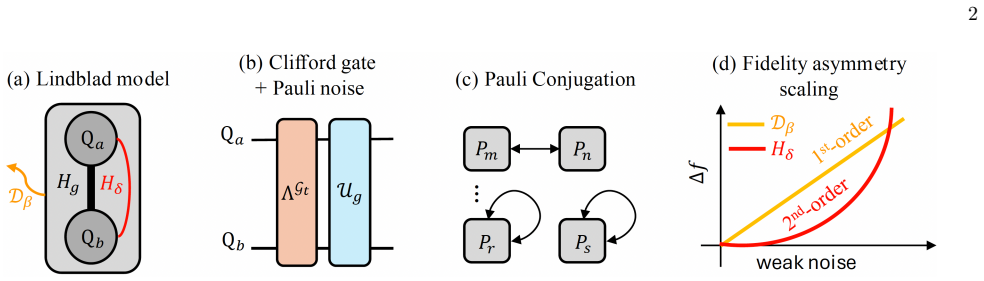
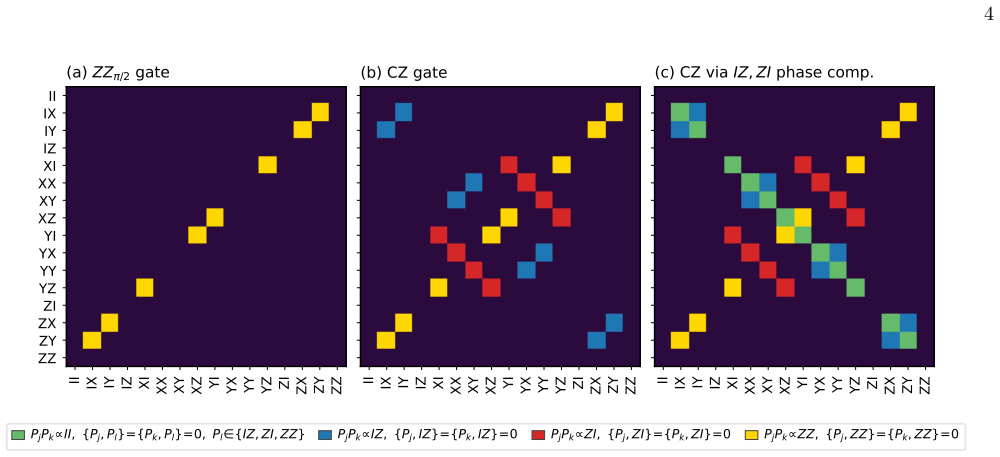
First-order Lindbladian perturbation theory applied to the noise superoperator for gates such as ZZ_{\pi/2}, CZ, CNOT, iSWAP and SWAP shows that coherent errors produce no first-order asymmetry in Pauli fidelities, while only a restricted class of predominantly off-diagonal dissipative generators can break the symmetry at first order; explicit selection rules identify which generators are allowed to break it. Common single-qubit processes such as T1-relaxation and T_{2\phi}-pure-dephasing break symmetry only at second order. The resulting approximate symmetries can be used to fix the gauge in Pauli noise models.
What carries the argument
Lindbladian perturbation expansion of the noise channel, which supplies selection rules identifying which dissipative generators produce first-order asymmetry between the fidelities of P and U_g P U_g†.
If this is right
- Coherent errors preserve the symmetry at leading order for all examined gates.
- T1 relaxation and pure dephasing produce detectable asymmetry only at second order.
- Gauge fixing becomes possible from knowledge of error type without magnitude information.
- The symmetries enable systematic separation of SPAM errors from gate noise in characterization protocols.
Where Pith is reading between the lines
- Similar perturbation analysis could be applied to additional gate families to derive analogous symmetry rules.
- The second-order nature of common noise asymmetries suggests that low-order models remain accurate for many practical characterization tasks.
- Gauge fixing via these symmetries may reduce the experimental overhead required for full noise tomography.
Load-bearing premise
The dominant noise belongs to the analyzed class of Markovian processes and is captured by first-order terms in the Lindbladian expansion.
What would settle it
Observation of first-order asymmetry between the fidelities of P and U_g P U_g† for T1 relaxation or T2φ dephasing under any of the listed Clifford gates would falsify the selection rules.
Figures
read the original abstract
Characterizing noise in quantum circuits is fundamentally limited by gauge degrees of freedom; certain parameters, such as the individual contributions of state preparation and measurement (SPAM) errors, are in principle unlearnable from any experiment within the gate set. Here, we show that the physical structure of realistic noise processes imposes approximate symmetry constraints on the Pauli fidelities of gate noise channels. These symmetries relate the fidelity of a Pauli $P$ and its gate-conjugate $U_g P U_g ^{\dagger}$, and can be used to fix the gauge using only knowledge of the error type and not its magnitude. Using Lindbladian perturbation theory, we analyze a broad class of Clifford gates, including $ZZ_{\pi/2}$, CZ, CNOT, iSWAP, and SWAP, and demonstrate that coherent errors do not induce first-order asymmetry, while only a restricted set of predominantly off-diagonal dissipative errors can break the symmetry at first order, for which we derive simple selection rules. Notably, common single-qubit noise sources such as $T_1$-relaxation and $T_{2\phi}$-pure-dephasing can only cause asymmetry at second order. Leveraging these symmetries to fix the gauge enables systematic identification of SPAM errors, simplifying error characterization and mitigation. We validate our results numerically and experimentally on IBM Kingston.
Editorial analysis
A structured set of objections, weighed in public.
Referee Report
Summary. The paper claims that the physical structure of Markovian noise, modeled via Lindbladian dynamics, imposes approximate symmetries on the Pauli fidelities of noise channels for Clifford gates (ZZ_{\pi/2}, CZ, CNOT, iSWAP, SWAP). Using first-order perturbation theory, coherent errors and common single-qubit dissipators (T1 relaxation, T_{2\phi} dephasing) preserve the relation F(P) \approx F(U_g P U_g^\dagger) at O(\gamma), while only a restricted class of off-diagonal dissipative terms break the symmetry; explicit selection rules are derived. These symmetries fix the gauge in Pauli noise characterization, enabling SPAM error identification without knowledge of error magnitudes. The results are validated numerically and via experiments on IBM Kingston hardware.
Significance. If the first-order regime holds, the work provides a parameter-free, physically grounded method to resolve gauge ambiguities in gate noise tomography that are otherwise unlearnable from circuit experiments. It leverages standard Lindbladian perturbation without ad-hoc assumptions and supplies concrete selection rules plus hardware validation, which could streamline error mitigation protocols. The approach is falsifiable via the derived symmetry-breaking conditions and does not rely on fitted parameters.
major comments (2)
- [§4] §4 (first-order Lindbladian expansion for T1/T2\phi): the central claim that these channels induce asymmetry only at second order is load-bearing for the gauge-fixing utility, yet the manuscript provides no explicit bound or scaling analysis showing when |O(\gamma^2 \tau^2)| remains negligible relative to the O(\gamma) SPAM correction term for realistic gate durations (\gamma \tau_gate \approx 10^{-3}–10^{-2}).
- [Table 2] Table 2 / numerical validation section: while simulations confirm first-order symmetry for the listed gates, the reported error rates do not include a sweep into the regime where second-order contributions become comparable, leaving open whether the extracted gauge fix remains accurate at hardware-relevant fidelities.
minor comments (2)
- [Eq. (12)] Notation for the Lindblad operators in Eq. (12) is introduced without an explicit statement of the basis ordering used for the off-diagonal terms; this should be clarified for reproducibility of the selection rules.
- [Figure 3] Figure 3 caption does not specify the number of shots or the fitting procedure used to extract the experimental Pauli fidelities on IBM Kingston.
Simulated Author's Rebuttal
We thank the referee for their careful reading and constructive comments on the applicability of the first-order approximation. We address each major comment point-by-point below.
read point-by-point responses
-
Referee: [§4] §4 (first-order Lindbladian expansion for T1/T2φ): the central claim that these channels induce asymmetry only at second order is load-bearing for the gauge-fixing utility, yet the manuscript provides no explicit bound or scaling analysis showing when |O(γ^2 τ^2)| remains negligible relative to the O(γ) SPAM correction term for realistic gate durations (γ τ_gate ≈ 10^{-3}–10^{-2}).
Authors: We agree that an explicit scaling comparison would strengthen the presentation. The asymmetry for T1/T2φ channels appears only at O((γτ)^2), while the leading dissipative and SPAM contributions are O(γτ). For the quoted range γτ_gate ≈ 10^{-3}–10^{-2}, the relative size of the second-order term is therefore suppressed by an additional factor of γτ_gate. In the revised manuscript we have added a short scaling paragraph to §4 that makes this comparison explicit and notes that the resulting error on the extracted gauge parameters remains below typical experimental precision in this regime. revision: yes
-
Referee: [Table 2] Table 2 / numerical validation section: while simulations confirm first-order symmetry for the listed gates, the reported error rates do not include a sweep into the regime where second-order contributions become comparable, leaving open whether the extracted gauge fix remains accurate at hardware-relevant fidelities.
Authors: The simulations in Table 2 were performed at error rates matching current hardware. To directly address the request for a sweep, we have added a supplementary figure that varies γτ from 10^{-3} to 0.2 for the same gates and noise channels. The figure shows that the symmetry-breaking deviation stays below 10^{-4} for γτ ≲ 0.05 (well beyond typical gate durations) and that the gauge-fixed SPAM estimates remain accurate to within 1% in this window. We have also updated the main text to reference this figure. revision: yes
Circularity Check
No significant circularity; derivation self-contained from standard Lindbladian perturbation theory
full rationale
The paper derives approximate symmetry constraints on Pauli fidelities directly from first-order expansion of the Lindblad generator applied to Clifford gate channels. No load-bearing step reduces to a fitted parameter renamed as prediction, a self-citation chain, or an ansatz smuggled via prior work by the same authors. The central result follows from explicit computation of the first-order term in the channel expansion for the listed gates and noise classes, with common T1/T2 sources shown to contribute only at second order. Validation on IBM hardware is external to the derivation and does not close any loop. This is the normal case of a self-contained perturbative analysis.
Axiom & Free-Parameter Ledger
axioms (2)
- domain assumption Noise processes are described by Lindbladian dynamics
- domain assumption First-order perturbation theory is sufficient to capture leading asymmetries
Reference graph
Works this paper leans on
-
[1]
The first-order fidelity asymmetry reads ∆f(1) mn = 1 D Z τg 0 dt′ Tr{−i δl 2 P † m[Pl(t′), Pm]} − 1 D Z τg 0 dt′ Tr{−i δl 2 P † mP † g [Pl(t′), PgPm]}
Hamiltonian noise Assume the noise consists of a single Hamiltonian term as Hδ = (δl/2)Pl. The first-order fidelity asymmetry reads ∆f(1) mn = 1 D Z τg 0 dt′ Tr{−i δl 2 P † m[Pl(t′), Pm]} − 1 D Z τg 0 dt′ Tr{−i δl 2 P † mP † g [Pl(t′), PgPm]} . (B4) Here, each individual term is zero as the trace of a commutator is zero due to the cyclic property. The fir...
-
[2]
The first-order fidelity asymmetry is found as ∆f(1) mn = 1 D Z τg 0 dt′ Tr{βllP † m[Pl(t′)PmP † l (t′) − Pm]} − 1 D Z τg 0 dt′ Tr{βllP † mP † g [Pl(t′)PgPmP † l (t′) − PgPm]}
Diagonal dissipator Consider a single diagonal dissipator noise term as Dβ = βll(Pl • P † l − I • I). The first-order fidelity asymmetry is found as ∆f(1) mn = 1 D Z τg 0 dt′ Tr{βllP † m[Pl(t′)PmP † l (t′) − Pm]} − 1 D Z τg 0 dt′ Tr{βllP † mP † g [Pl(t′)PgPmP † l (t′) − PgPm]} . (B7) Note that the second terms in the two lines cancel each other since Tr {...
-
[3]
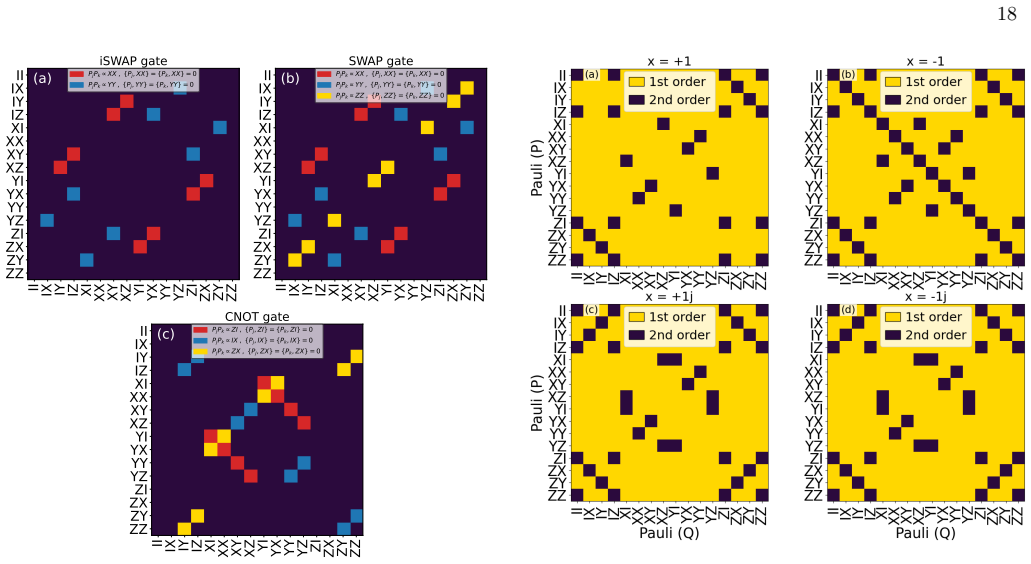
Off-diagonal dissipator noise Next, we assume an off-diagonal dissipator noise term of the form Dβ = βjk D[Pj, Pk] = βjk(Pj • P † k − 1 2 {P † k Pj, •}) , (B13) where j ̸= k. The fidelity asymmetry for Pauli pairs Pm and Pn that are mapped by the ideal gate according to Pn = iPgPm can be written as ∆f(1) mn,jk = 1 D Z τg 0 dt′ Tr{βjk P † m[Pj(t′)PmP † k(t...
-
[4]
Sixteen non-overlapping qubit pairs are selected from the device coupling map and executed simultaneously in a single circuit of width 2 × 16 = 32 qubits (Fig
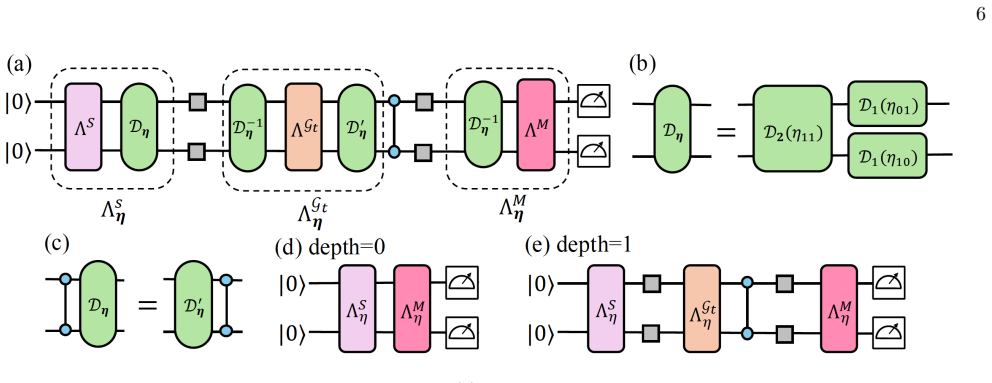
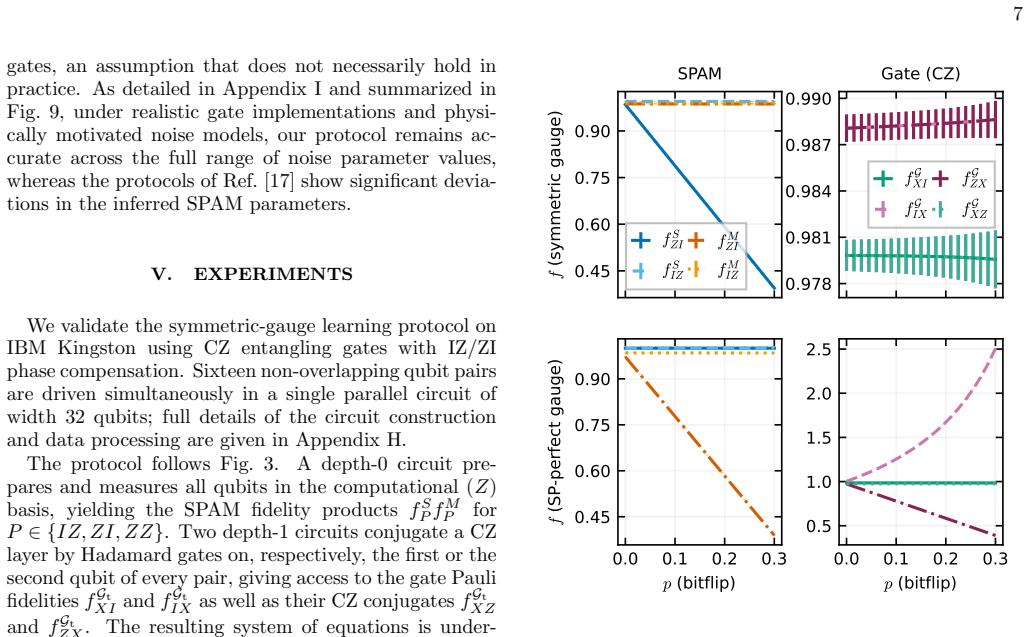
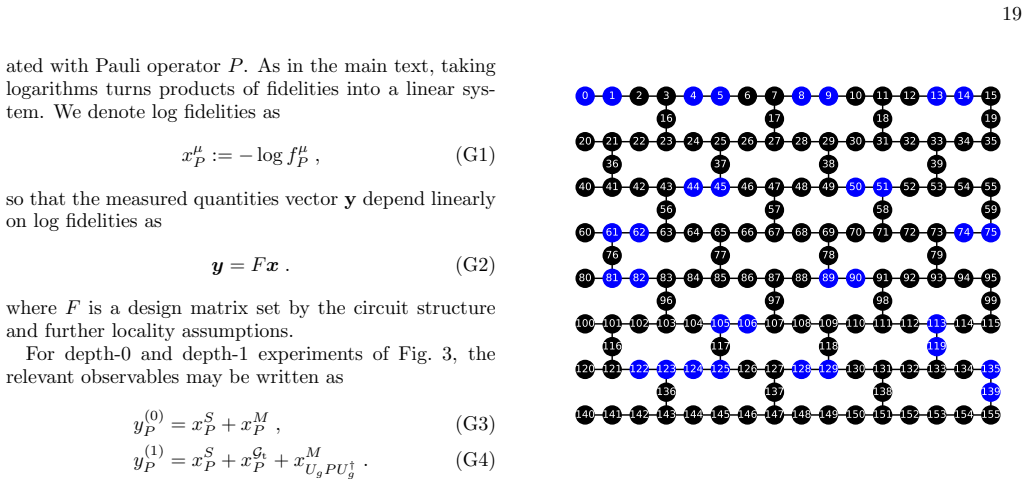
Circuit construction The learning protocol is implemented on the IBM Kingston backend. Sixteen non-overlapping qubit pairs are selected from the device coupling map and executed simultaneously in a single circuit of width 2 × 16 = 32 qubits (Fig. 8). Three circuit families are used: • Depth-0 (SP AM): Prepare |0⟩⊗32 and measure in the computational basis....
-
[5]
The active circuit strategy with the full two-qubit Pauli twirling group is used throughout
Pauli twirling and sampling Each transpiled circuit is Pauli-twirled (via samplo- matic [50]) by inserting random Pauli gates before and after each CZ layer, with corresponding classical bit-flips on the measurement outcomes. The active circuit strategy with the full two-qubit Pauli twirling group is used throughout. For each base circuit, 500 independent...
-
[6]
We track each Pauli P through the circuit using Clifford conjugation rules
Pauli tracking and equation formation For each qubit pair the observables of interest are {IZ, ZI, ZZ }. We track each Pauli P through the circuit using Clifford conjugation rules. The depth-0 circuit yields yd0,P = xS P + xM P , P ∈ {IZ, ZI }, (H1) with xS P ≡ − log f S P and xM P ≡ − log f M P . For the H0 circuit, each observable P is conjugated by (I ...
-
[7]
For pair i we extract the two-bit marginal at positions (2i, 2i+1)
Post-processing Each job returns bitstrings of length 32 (two classical bits per pair). For pair i we extract the two-bit marginal at positions (2i, 2i+1). Readout-twirling flips are applied to the raw bitstrings before computing expectation val- ues. For a Z-type observable with binary mask z, the single-randomization estimator is ⟨P ⟩ = 1 Nshots X shots...
-
[8]
Synthetic error-injection protocol Controlled incoherent state-preparation errors are con- structed by mixing experimental data collected under two preparation settings for each qubit pair: the identity I, and a bit-flip on the first qubit X. The noise injection is implemented by first Pauli twirling and then inserting an X gate at the beginning of the ci...
-
[9]
non-Markovianity or violation of the symmetric-gauge condition) has corrupted the estimate for that qubit pair
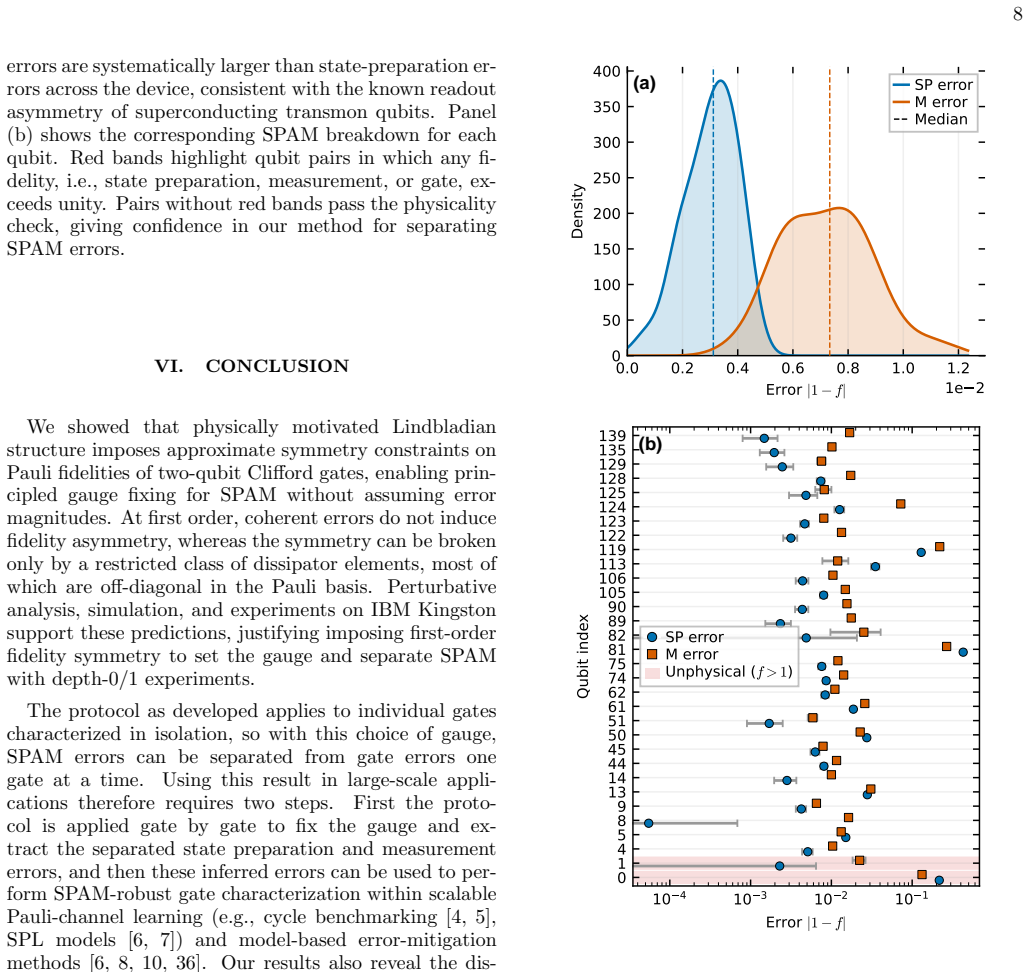
Physicality self-verification All Pauli fidelities extracted by the gauge decomposi- tion must satisfy f ≤ 1; a violation places the solution outside the physical domain and signals that statistical noise, calibration drift, or a breakdown of the model assumptions (e.g. non-Markovianity or violation of the symmetric-gauge condition) has corrupted the esti...
-
[10]
We first follow the notation in Ref
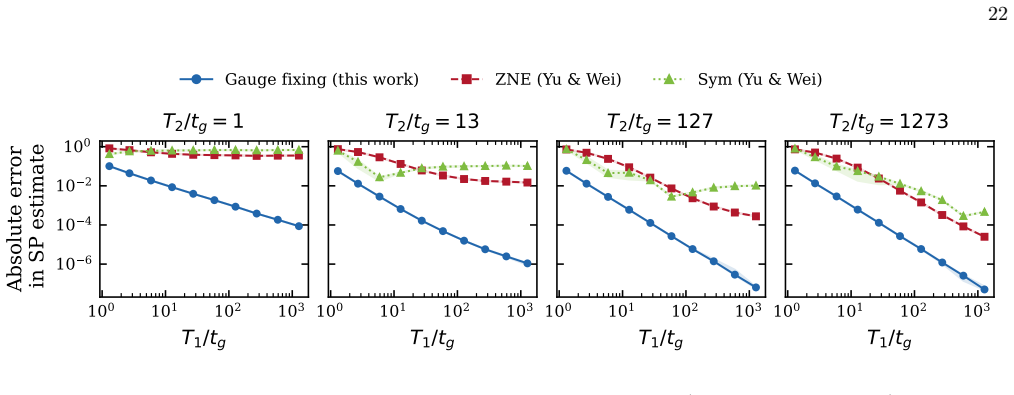
Symmetrization method The main idea of this approach is that using a CNOT gate, one can measure additional combination of state preparation and measurement errors that would enable resolving them individually. We first follow the notation in Ref. [17] to introduce the method and then connect it to our formalism. A single-qubit readout is described by a tw...
-
[11]
[17]) To mitigate the bias from gate noise, Ref
Zero-noise extrapolation (Appendix B of Ref. [17]) To mitigate the bias from gate noise, Ref. [17] pro- poses repeating the noisy CNOT gate an odd number of times m = 1 , 3, 5, . . . (so that the net unitary remains a single CX) and measuring the ancilla SPAM error at each m. The gate-noise contribution grows with m, while the SP error contribution is ind...
-
[12]
The simulation proceeds as follows
Numerical comparison We compare the two methods above with the gauge- optimization approach described in the main text on a Lindblad simulation of a noisy CX gate. The simulation proceeds as follows. The two-qubit gate is generated by the Hamiltonian HCX = XI − XZ − II + IZ , (I7) which produces CX10 (control on the second qubit, target on the first) via ...
-
[13]
M. R. Geller and Z. Zhou, Efficient error models for fault- tolerant architectures and the pauli twirling approxima- tion, arXiv preprint arXiv:1305.2021 (2013)
work page internal anchor Pith review Pith/arXiv arXiv 2021
-
[14]
J. J. Wallman and J. Emerson, Noise tailoring for scalable quantum computation via randomized compiling, Physi- cal Review A 94, 052325 (2016)
2016
-
[15]
Hashim, R
A. Hashim, R. K. Naik, A. Morvan, J.-L. Ville, B. Mitchell, J. M. Kreikebaum, M. Davis, E. Smith, C. Iancu, K. P. O’Brien, I. Hincks, J. J. Wallman, J. Emerson, and I. Siddiqi, Randomized compiling for scalable quantum computing on a noisy superconduct- ing quantum processor, Physical Review X 11, 041039 (2021)
2021
-
[16]
Erhard, J
A. Erhard, J. J. Wallman, L. Postler, M. Meth, R. Stricker, E. A. Martinez, P. Schindler, T. Monz, J. Emerson, and R. Blatt, Characterizing large-scale quantum computers via cycle benchmarking, Nature Communications 10, 5347 (2019)
2019
-
[17]
S. T. Flammia and J. J. Wallman, Efficient estimation of Pauli channels, ACM Transactions on Quantum Com- puting 1, 1 (2020)
2020
-
[18]
van den Berg, Z
E. van den Berg, Z. K. Minev, A. Kandala, and K. Temme, Probabilistic error cancellation with sparse Pauli–Lindblad models on noisy quantum processors, Na- 23 ture Physics 19, 1116 (2023)
2023
-
[19]
van den Berg and P
E. van den Berg and P. Wocjan, Techniques for learning sparse Pauli-Lindblad noise models, Quantum 8, 1556 (2024)
2024
-
[20]
Temme, S
K. Temme, S. Bravyi, and J. M. Gambetta, Error mitiga- tion for short-depth quantum circuits, Physical Review Letters 119, 180509 (2017)
2017
-
[21]
Z. Cai, R. Babbush, S. C. Benjamin, S. Endo, W. J. Hug- gins, Y. Li, J. R. McClean, and T. E. O’Brien, Quantum error mitigation, Reviews of Modern Physics 95, 045005 (2023)
2023
-
[22]
Y. Kim, A. Eddins, S. Anand, et al. , Evidence for the utility of quantum computing before fault tolerance, Na- ture 618, 500 (2023)
2023
- [23]
-
[24]
Nielsen, J
E. Nielsen, J. K. Gamble, K. Rudinger, T. Scholten, K. Young, and R. Blume-Kohout, Gate set tomography, Quantum 5, 557 (2021)
2021
-
[25]
S. Chen, Y. Liu, M. Otten, A. Seif, B. Fefferman, and L. Jiang, The learnability of Pauli noise, Nature Com- munications 14, 52 (2023)
2023
-
[26]
S. Chen, Z. Zhang, L. Jiang, and S. T. Flammia, Effi- cient self-consistent learning of gate set pauli noise, PRX Quantum 7, 010305 (2026)
2026
-
[27]
van den Berg, Z
E. van den Berg, Z. K. Minev, and K. Temme, Model-free readout-error mitigation for quantum expectation values, Physical Review A 105, 032620 (2022)
2022
- [28]
-
[29]
Yu and T.-C
H. Yu and T.-C. Wei, Efficient separate quantification of state preparation errors and measurement errors on quantum computers and their mitigation, Quantum 9, 1724 (2025)
2025
- [30]
-
[31]
C. J. Haupt, A. Carrera Vazquez, L. E. Fischer, S. Wo- erner, and D. J. Egger, Mitigating errors in state prepa- ration and measurement with noncomputational states, Phys. Rev. Appl. 25, 024079 (2026)
2026
-
[32]
Malekakhlagh, A
M. Malekakhlagh, A. Seif, D. Puzzuoli, L. C. Govia, and E. van den Berg, Efficient lindblad synthesis for noise model construction, npj Quantum Information 11, 191 (2025)
2025
-
[33]
Gorini, A
V. Gorini, A. Kossakowski, and E. C. G. Sudarshan, Completely positive dynamical semigroups of N-level systems, Journal of Mathematical Physics17, 821 (1976)
1976
-
[34]
Lindblad, On the generators of quantum dynamical semigroups, Communications in mathematical physics 48, 119 (1976)
G. Lindblad, On the generators of quantum dynamical semigroups, Communications in mathematical physics 48, 119 (1976)
1976
-
[35]
Breuer and F
H.-P. Breuer and F. Petruccione, The theory of open quantum systems (Oxford University Press, USA, 2002)
2002
-
[36]
Blume-Kohout, M
R. Blume-Kohout, M. P. da Silva, E. Nielsen, T. Proctor, K. Rudinger, M. Sarovar, and K. Young, A taxonomy of small Markovian errors, PRX Quantum3, 020335 (2022)
2022
- [37]
- [38]
-
[39]
J. M. Gambetta, A. D. C´ orcoles, S. T. Merkel, B. R. Johnson, J. A. Smolin, J. M. Chow, C. A. Ryan, C. Rigetti, S. Poletto, T. A. Ohki, et al. , Characteriza- tion of addressability by simultaneous randomized bench- marking, Physical review letters 109, 240504 (2012)
2012
-
[40]
Introduction to Quantum Gate Set Tomography
D. Greenbaum, Introduction to quantum gate set tomog- raphy (2015), arXiv preprint arXiv:1509.02921
work page internal anchor Pith review Pith/arXiv arXiv 2015
-
[41]
The Heisenberg Representation of Quantum Computers
D. Gottesman, The heisenberg representation of quan- tum computers, arXiv preprint quant-ph/9807006 (1998)
work page internal anchor Pith review Pith/arXiv arXiv 1998
-
[42]
Dehaene and B
J. Dehaene and B. De Moor, Clifford group, stabilizer states, and linear and quadratic operations over GF(2), Physical Review A 68, 042318 (2003)
2003
-
[43]
Aaronson and D
S. Aaronson and D. Gottesman, Improved simulation of stabilizer circuits, Physical Review A—Atomic, Molecu- lar, and Optical Physics 70, 052328 (2004)
2004
-
[44]
F. Yan, P. Krantz, Y. Sung, M. Kjaergaard, D. L. Camp- bell, T. P. Orlando, S. Gustavsson, and W. D. Oliver, Tunable coupling scheme for implementing high-fidelity two-qubit gates, Physical Review Applied 10, 054062 (2018)
2018
-
[45]
Stehlik, D
J. Stehlik, D. Zajac, D. Underwood, T. Phung, J. Blair, S. Carnevale, D. Klaus, G. Keefe, A. Carniol, M. Kumph, et al. , Tunable coupling architecture for fixed-frequency transmon superconducting qubits, Physical review letters 127, 080505 (2021)
2021
-
[46]
Foxen, C
B. Foxen, C. Neill, A. Dunsworth, P. Roushan, B. Chiaro, A. Megrant, J. Kelly, Z. Chen, K. Satzinger, R. Barends, et al., Demonstrating a continuous set of two-qubit gates for near-term quantum algorithms, Physical Review Let- ters 125, 120504 (2020)
2020
-
[47]
Y. Sung, L. Ding, J. Braum¨ uller, A. Veps¨ al¨ ainen, B. Kan- nan, M. Kjaergaard, A. Greene, G. O. Samach, C. Mc- Nally, D. Kim, et al. , Realization of high-fidelity CZ and ZZ-free iSWAP gates with a tunable coupler, Physical Review X 11, 021058 (2021)
2021
-
[48]
S. Filippov, M. Leahy, M. A. Rossi, and G. Garc´ ıa-P´ erez, Scalable tensor-network error mitigation for near-term quantum computing, arXiv preprint arXiv:2307.11740 (2023)
-
[49]
C. Dai, Z. Shi, and X. Yi, Floquet theorem with open sys- tems and its applications, Physical Review A 93, 032121 (2016)
2016
-
[50]
Schnell, S
A. Schnell, S. Denisov, and A. Eckardt, High-frequency expansions for time-periodic Lindblad generators, Phys- ical Review B 104, 165414 (2021)
2021
-
[51]
Malekakhlagh, E
M. Malekakhlagh, E. Magesan, and L. C. Govia, Time- dependent schrieffer-wolff-lindblad perturbation theory: Measurement-induced dephasing and second-order stark shift in dispersive readout, Physical Review A 106, 052601 (2022)
2022
-
[52]
Mizuta, K
K. Mizuta, K. Takasan, and N. Kawakami, Breakdown of Markovianity by interactions in stroboscopic Floquet- Lindblad dynamics under high-frequency drive, Physical Review A 103, L020202 (2021)
2021
-
[53]
T. M. Ture, C. Hyeon, and S. J. Jang, A simple fourth order propagator based on the magnus expansion in the liouville space: Application to a λ-system and assess- ment of the rotating wave approximation, The Journal of Chemical Physics 164 (2026). 24
2026
-
[54]
Huang, H.-E
J.-C. Huang, H.-E. Li, Y.-C. Wang, G.-Z. Zhang, J. Li, and H.-S. Hu, Towards robust variational quantum sim- ulation of lindblad dynamics via stochastic magnus ex- pansion, PRX Quantum 6, 040312 (2025)
2025
-
[55]
Magnus, On the exponential solution of differential equations for a linear operator, Communications on pure and applied mathematics 7, 649 (1954)
W. Magnus, On the exponential solution of differential equations for a linear operator, Communications on pure and applied mathematics 7, 649 (1954)
1954
-
[56]
Blanes, F
S. Blanes, F. Casas, J.-A. Oteo, and J. Ros, The Magnus expansion and some of its applications, Physics reports 470, 151 (2009)
2009
-
[57]
Blanes, F
S. Blanes, F. Casas, J. A. Oteo, and J. Ros, A pedagogical approach to the Magnus expansion, European Journal of Physics 31, 907 (2010)
2010
-
[58]
Puzzuoli, S
D. Puzzuoli, S. F. Lin, M. Malekakhlagh, E. Pritchett, B. Rosand, and C. J. Wood, Algorithms for perturbative analysis and simulation of quantum dynamics, Journal of Computational Physics 489, 112262 (2023)
2023
-
[59]
F. J. Dyson, The s matrix in quantum electrodynamics, Phys. Rev. 75, 1736 (1949)
1949
-
[60]
F. J. Dyson, The radiation theories of tomonaga, schwinger, and feynman, Phys. Rev. 75, 486 (1949)
1949
-
[61]
Shillito, J
R. Shillito, J. A. Gross, A. Di Paolo, ´E. Genois, and A. Blais, Fast and differentiable simulation of driven quantum systems, Physical Review Research 3, 033266 (2021)
2021
-
[62]
Qiskit Development Team, Samplomatic (2026), python package for sampling randomizations of quantum cir- cuits
2026
discussion (0)
Sign in with ORCID, Apple, or X to comment. Anyone can read and Pith papers without signing in.