REVIEW 2 major objections 5 minor 63 references
A lock-free GPU graph index can absorb streaming inserts and deletes without rebuilding, with proven monotone deletion and memory bounded by the live set.
Reviewed by Pith at T0; open to challenge. T0 means a machine referee read the full paper against a public rubric. the ladder, T0–T4 →
T0 review · grok-4.5
2026-07-12 12:19 UTC pith:WISI6ZLX
load-bearing objection Solid GPU systems paper: lock-free COW slab with inlined deletion flag gives real safety proofs and large measured maintenance wins over rebuilds; navigability after repair is empirical only. the 2 major comments →
ETALE: Evolving Topology with Accelerated Lock-free Execution for Dynamic Graph ANN Search on GPUs
The pith
A machine-rendered reading of the paper's core claim, the machinery that carries it, and where it could break.
Core claim
ETALE shows that a proximity graph for ANN can live entirely on the GPU and absorb concurrent streaming inserts and deletes without a global rebuild, by packing deletion state and adjacency into one atomically published 64-bit word so that every adjacency rewrite is a single lock-free compare-and-swap, deletion is monotone by construction, and periodic reclaim keeps GPU memory bounded by the live set at a cost that saturates rather than grows with tombstones.
What carries the argument
Lock-free copy-on-write slab graph with a packed 64-bit node reference: each node’s deletion flag, out-degree, and slab identifier occupy one atomic word that names an immutable neighbor slab; Publish allocates a fresh slab, writes the new neighbor list, and installs the whole rewrite with one compare-and-swap that carries the deletion flag forward, so no later publication can revive a tombstone.
Load-bearing premise
Local connectivity repair around a deleted node is assumed to keep the graph navigable enough for high recall under continuous churn; that navigability is measured, not proven, so quality claims fail if repair systematically severs long-range paths on some data distributions.
What would settle it
Run the pure-deletion stress of Section 5.5 on a distribution where hub nodes dominate paths: if Recall@10 falls steadily as half the live set is deleted with only local RobustPrune repair, the navigability claim fails even while deletion monotonicity still holds.
Editorial analysis
A structured set of objections, weighed in public.
Referee Report
Summary. ETALE is a GPU-native graph ANN index for streaming insertion and deletion without global rebuild. Its core is a lock-free copy-on-write slab graph in which each node’s deletion flag, degree, and slab pointer share one 64-bit word published by a single CAS. From this design the paper proves deletion monotonicity (Prop. 1), no use-after-free under two-phase reclaim plus epoch separation (Prop. 2, Lemma 1), a VRAM footprint equal to the live-set size after reclaim (Prop. 3), and a reclaim cost that saturates sublinearly in accumulated tombstones under a uniform in-edge model (Prop. 4). A CUDA implementation is evaluated on five multimodal datasets against CAGRA, Tagore, HNSW, and DIGRA; under 1% continuous churn ETALE maintains the index in hundreds of milliseconds per round at Recall@10 above 0.95, 4.8–8.8× faster than CAGRA rebuilds and 1.8–2.5× faster than Tagore, while keeping memory bounded where tombstone-only systems grow.
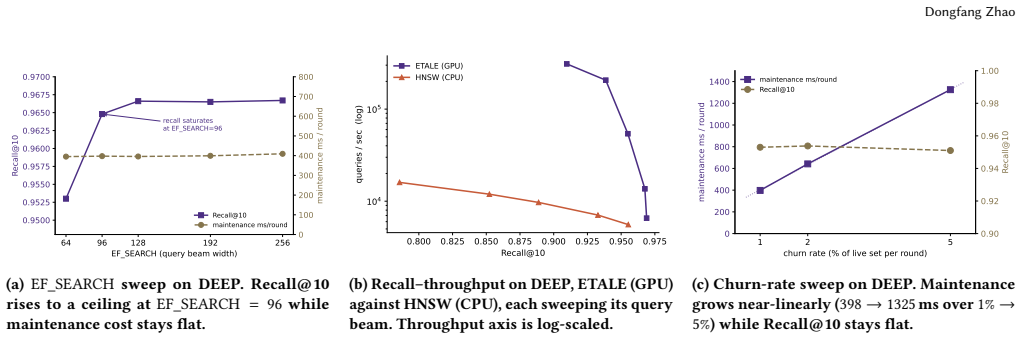
Significance. If the results hold, ETALE closes a clear systems gap: GPU graph ANN indexes have been static (rebuild-to-update) while dynamic graph indexes have lived on the CPU. The combination of a lock-free COW slab with an inlined deletion bit, machine-checkable-style proofs of monotonicity and reclaim safety, a live-set-bounded VRAM footprint, and multi-baseline measurements at matched recall is a substantial contribution to GPU vector search and concurrent data structures. Strengths that should be credited explicitly include the clean derivation of Props. 1–3 from the packed reference and launch model, the open CUDA implementation with reproduction scripts, concurrent query/update latency results (Table 3) that support the wait-free reader claim, and the empirical saturating reclaim fit (R²=0.999) that corroborates the cost analysis.
major comments (2)
- §3.4.2 Algorithm 3 and §5.5–5.8: Local RobustPrune repair on the deleted node’s live neighbors is assumed to keep the proximity graph navigable enough for high recall under sustained incremental churn. Navigability after repair is not proven—only measured (flat Recall@10 under pure deletion and multi-round churn). The structural claims (deletion monotonicity, reclaim safety, bounded footprint) hold independently of navigability, so this does not falsify the central contribution; it does, however, leave open whether quality can degrade on distributions where local repair severs long-range paths. A short discussion of failure modes, or an additional stress distribution, would strengthen the quality claim without changing the proofs.
- §4.5 Proposition 4 and Remark 1: The sublinear reclaim argument rests on a uniform independent placement model for stranded in-edges. Remark 1 already notes that real hubs saturate dirty nodes faster than the model predicts and treats the saturating form as an empirical regularity rather than a quantitative predictor of τ. That caveat is appropriate; the proposition should be framed more clearly as a qualitative explanation of the observed saturation (and of the ceiling reclaim(t)<M) rather than as a tight predictive bound, so that readers do not over-read the model.
minor comments (5)
- Table 1 lists SIGMOD’26 / ICDE’24 venues for Tagore, DIGRA, and CAGRA; confirm final citation status and page numbers before camera-ready.
- Figure 1 and the abstract both report “hundreds of milliseconds” and 4.8–8.8×; ensure the exact per-dataset numbers in §5.3 are consistent with the figure caption (SIFT 7.1× vs. the range).
- §3.3: the CAS attempt budget in Publish is mentioned but not quantified in the evaluation; a one-line note on observed retry rates under the churn workload would help.
- Notation: R is both slab capacity and (implicitly) warp width; a brief reminder when R=32 is fixed would reduce ambiguity for readers outside GPU systems.
- §5.4: the large margin over DIGRA is correctly attributed to DIGRA’s range-filter design; a single sentence clarifying that the comparison is unfiltered-only would further avoid misreading.
Circularity Check
No significant circularity: structural invariants follow from the COW/CAS design by construction, and empirical claims are measured against external baselines rather than fitted inputs renamed as predictions.
full rationale
The load-bearing derivation chain is self-contained. Proposition 1 (deletion monotonicity) follows directly from packing the deletion flag into the same 64-bit word that every Publish/Delete/Reclaim CAS swaps; the proof enumerates the three operations that write r(u) and shows none can clear a set flag. Propositions 2–3 (no use-after-free; footprint = L after reclaim) follow from the two-phase Reclaim order plus epoch separation (Lemma 1) under the stated launch/execution model. Proposition 4 derives the saturating dirty-node count under an explicit uniform in-edge placement model; Corollary 1 then bounds reclaim cost by a full live-set rebuild. Remark 1 honestly demotes the model from quantitative predictor of τ to a mechanism for an empirical regularity, and §5.7 presents the M(1−e^{−t/τ}) fit as validation of shape (R²=0.999), not as a design-justifying prediction. End-to-end speedups and recall are measured against external systems (CAGRA, Tagore, HNSW, DIGRA) on public datasets. Self-citations ([54] SIVF, [55] 2009 local-repair lineage) appear only as related-work context and do not underwrite the CAS proofs or the measured claims. Navigability after RobustPrune repair is an unproven empirical assumption, not a circular step. No fitted parameter is renamed as a first-principles result, and no uniqueness theorem is imported from the authors to forbid alternatives.
Axiom & Free-Parameter Ledger
free parameters (5)
- slab capacity R
- RobustPrune slack α and build/search beam widths (EF_BUILD, EF_SEARCH)
- reclaim interval / accumulated-tombstone threshold
- CAS attempt budget in Publish
- fitted reclaim ceiling M and time constant τ
axioms (5)
- domain assumption GPU launch/execution model: kernels are finite concurrent thread sets; successive launches are fully serialized by device sync; retired slabs return to free pool only between launches (Definition 2, Lemma 1).
- domain assumption Aligned 64-bit load/store/CAS on the packed node reference is atomic and the memory fence in Publish orders slab contents before the reference becomes visible (Algorithm 1; GPU relaxed memory model [1]).
- domain assumption RobustPrune_α / Vamana-style slack pruning yields a navigable bounded-degree proximity graph under both initial build and local repair after deletion.
- ad hoc to paper Uniform independent placement of stranded in-edges over live nodes for expected dirty-node count D(t) (Proposition 4).
- standard math Standard concurrent-object progress notions: readers wait-free via single atomic load; writers lock-free because a failed CAS implies another writer succeeded.
invented entities (2)
-
ETALE packed 64-bit node reference r(u)=⟨δ_u, d_u, s_u⟩ with immutable COW adjacency slabs
independent evidence
-
Two-stack free/retired slab pool with host-side recycle only at kernel boundaries
independent evidence
read the original abstract
Graph-based approximate nearest neighbor (ANN) indexes on the GPU are originally built for static collections and must reconstruct the affected window to absorb any update, while the dynamic graph indexes that update incrementally run on the CPU and cannot exploit GPU parallelism. This paper presents a new ANN index, namely ETALE (Evolving Topology with Accelerated Lock-free Execution), which is among the first GPU-native graph ANN indexes to support streaming insertion and deletion without a global rebuild. The core of ETALE is a lock-free copy-on-write slab graph whose deletion state and adjacency share a single atomically published word, which yields a provable deletion-monotonicity invariant together with a bounded reclaim of GPU memory that is sublinear in accumulated deletions. We have implemented ETALE in CUDA and evaluate it on five diverse multimodal datasets against four state-of-the-art indexes: Tagore (GPU static, SIGMOD'26), DIGRA (CPU dynamic, SIGMOD'26), CAGRA (GPU static, ICDE'24), and HNSW (CPU dynamic, TPAMI'20). Under continuous churn, ETALE maintains the index in hundreds of milliseconds per round at recall above $0.95$, which is $4.8$--$8.8\times$ faster than CAGRA's per-window rebuild, $1.8$--$2.5\times$ faster than the more recent Tagore, and $3.3$--$147\times$ faster than the CPU dynamic indexes. In addition, the memory footprint of ETALE stays bounded where tombstone-only systems grow indefinitely.
Figures


Reference graph
Works this paper leans on
-
[1]
Donaldson, Ganesh Gopalakrishnan, Jeroen Ketema, Daniel Poetzl, Tyler Sorensen, and John Wickerson
Jade Alglave, Mark Batty, Alastair F. Donaldson, Ganesh Gopalakrishnan, Jeroen Ketema, Daniel Poetzl, Tyler Sorensen, and John Wickerson. 2015. GPU Concur- rency: Weak Behaviours and Programming Assumptions.SIGPLAN Not.50, 4 (March 2015), 577–591. doi:10.1145/2775054.2694391
-
[2]
Alexandr Andoni, Piotr Indyk, Thijs Laarhoven, Ilya Razenshteyn, and Ludwig Schmidt. 2015. Practical and Optimal LSH for Angular Dis- tance. InAdvances in Neural Information Processing Systems, C. Cortes, N. Lawrence, D. Lee, M. Sugiyama, and R. Garnett (Eds.), Vol. 28. Curran Associates, Inc. https://proceedings.neurips.cc/paper_files/paper/2015/file/ 28...
2015
-
[3]
Dmitry Baranchuk, Matthijs Douze, Yash Upadhyay, and I. Zeki Yalniz. 2023. DeDrift: Robust Similarity Search under Content Drift. In2023 IEEE/CVF In- ternational Conference on Computer Vision (ICCV). 10992–11001. doi:10.1109/ ICCV51070.2023.01012
arXiv 2023
-
[4]
Jon Louis Bentley. 1975. Multidimensional binary search trees used for associative searching.Commun. ACM18, 9 (Sept. 1975), 509–517. doi:10.1145/361002.361007
-
[5]
Blelloch, Daniel Anderson, and Laxman Dhulipala
Guy E. Blelloch, Daniel Anderson, and Laxman Dhulipala. 2020. ParlayLib - A Toolkit for Parallel Algorithms on Shared-Memory Multicore Machines. In Proceedings of the 32nd ACM Symposium on Parallelism in Algorithms and Archi- tectures(Virtual Event, USA)(SPAA ’20). Association for Computing Machinery, New York, NY, USA, 507–509. doi:10.1145/3350755.3400254
-
[6]
Mayur Datar, Nicole Immorlica, Piotr Indyk, and Vahab S. Mirrokni. 2004. Locality-sensitive hashing scheme based on p-stable distributions. InProceedings of the Twentieth Annual Symposium on Computational Geometry(Brooklyn, New York, USA)(SCG ’04). Association for Computing Machinery, New York, NY, USA, 253–262. doi:10.1145/997817.997857
-
[7]
Wei Dong, Charikar Moses, and Kai Li. 2011. Efficient k-nearest neighbor graph construction for generic similarity measures. InProceedings of the 20th Interna- tional Conference on World Wide Web(Hyderabad, India)(WWW ’11). Association for Computing Machinery, New York, NY, USA, 577–586. doi:10.1145/1963405. 1963487
-
[8]
Matthijs Douze, Alexandr Guzhva, Chengqi Deng, Jeff Johnson, Gergely Szilvasy, Pierre-Emmanuel Mazaré, Maria Lomeli, Lucas Hosseini, and Hervé Jégou. 2025. The Faiss library. arXiv:2401.08281 [cs.LG] https://arxiv.org/abs/2401.08281
Pith/arXiv arXiv 2025
-
[9]
Cong Fu and Deng Cai. 2016. EFANNA : An Extremely Fast Approximate Nearest Neighbor Search Algorithm Based on kNN Graph. arXiv:1609.07228 [cs.CV] https://arxiv.org/abs/1609.07228
Pith/arXiv arXiv 2016
-
[10]
Cong Fu, Chao Xiang, Changxu Wang, and Deng Cai. 2019. Fast approximate nearest neighbor search with the navigating spreading-out graph.Proc. VLDB Endow.12, 5 (Jan. 2019), 461–474. doi:10.14778/3303753.3303754
-
[11]
Jianyang Gao and Cheng Long. 2024. RaBitQ: Quantizing High-Dimensional Vectors with a Theoretical Error Bound for Approximate Nearest Neighbor Search.Proc. ACM Manag. Data2, 3, Article 167 (May 2024), 27 pages. doi:10. 1145/3654970
2024
-
[12]
Tiezheng Ge, Kaiming He, Qifa Ke, and Jian Sun. 2014. Optimized Product Quantization.IEEE Trans. Pattern Anal. Mach. Intell.36, 4 (April 2014), 744–755. doi:10.1109/TPAMI.2013.240
-
[13]
Siddharth Gollapudi, Neel Karia, Varun Sivashankar, Ravishankar Krishnaswamy, Nikit Begwani, Swapnil Raz, Yiyong Lin, Yin Zhang, Neelam Mahapatro, Premku- mar Srinivasan, Amit Singh, and Harsha Vardhan Simhadri. 2023. Filtered- DiskANN: Graph Algorithms for Approximate Nearest Neighbor Search with Filters. InProceedings of the ACM Web Conference 2023(Aust...
-
[14]
Ruiqi Guo, Philip Sun, Erik Lindgren, Quan Geng, David Simcha, Felix Chern, and Sanjiv Kumar. 2020. Accelerating Large-Scale Inference with Anisotropic Vector Quantization. InProceedings of the 37th International Conference on Machine Learning (Proceedings of Machine Learning Research, Vol. 119), Hal Daumé III and Aarti Singh (Eds.). PMLR, 3887–3896. http...
2020
-
[15]
Ben Harwood and Tom Drummond. 2016. FANNG: Fast Approximate Nearest Neighbour Graphs. InProceedings of the IEEE Conference on Computer Vision and Pattern Recognition (CVPR)
2016
-
[16]
Piotr Indyk and Rajeev Motwani. 1998. Approximate nearest neighbors: towards removing the curse of dimensionality. InProceedings of the Thirtieth Annual ACM Symposium on Theory of Computing(Dallas, Texas, USA)(STOC ’98). Association for Computing Machinery, New York, NY, USA, 604–613. doi:10.1145/276698. 276876
doi:10.1145/276698 1998
-
[17]
Suhas Jayaram Subramanya, Fnu Devvrit, Harsha Vardhan Simhadri, Ravishankar Krishnawamy, and Rohan Kadekodi. 2019. DiskANN: Fast Accurate Billion-point Nearest Neighbor Search on a Single Node. InAdvances in Neural Information Pro- cessing Systems, H. Wallach, H. Larochelle, A. Beygelzimer, F. d'Alché-Buc, E. Fox, and R. Garnett (Eds.), Vol. 32. Curran As...
2019
-
[18]
Mengxu Jiang, Zhi Yang, Fangyuan Zhang, Guanhao Hou, Jieming Shi, Wenchao Zhou, Feifei Li, and Sibo Wang. 2025. DIGRA: A Dynamic Graph Indexing for Approximate Nearest Neighbor Search with Range Filter.Proc. ACM Manag. Data3, 3, Article 148 (June 2025), 26 pages. doi:10.1145/3725399
doi:10.1145/3725399 2025
-
[19]
Herve Jégou, Matthijs Douze, and Cordelia Schmid. 2011. Product Quantization for Nearest Neighbor Search.IEEE Transactions on Pattern Analysis and Machine Intelligence33, 1 (2011), 117–128. doi:10.1109/TPAMI.2010.57
-
[20]
Patrick Lewis, Ethan Perez, Aleksandra Piktus, Fabio Petroni, Vladimir Karpukhin, Naman Goyal, Heinrich Küttler, Mike Lewis, Wen-tau Yih, Tim Rocktäschel, Sebastian Riedel, and Douwe Kiela. 2020. Retrieval-augmented generation for knowledge-intensive NLP tasks. InProceedings of the 34th Inter- national Conference on Neural Information Processing Systems(V...
2020
-
[21]
Wen Li, Ying Zhang, Yifang Sun, Wei Wang, Mingjie Li, Wenjie Zhang, and Xuemin Lin. 2020. Approximate Nearest Neighbor Search on High Dimensional Data — Experiments, Analyses, and Improvement.IEEE Transactions on Knowl- edge and Data Engineering32, 8 (2020), 1475–1488. doi:10.1109/TKDE.2019. 2909204
-
[22]
Zhonggen Li, Xiangyu Ke, Yifan Zhu, Bocheng Yu, Baihua Zheng, and Yunjun Gao
-
[23]
ACM Manag
Scalable Graph Indexing using GPUs for Approximate Nearest Neighbor Search.Proc. ACM Manag. Data3, 6, Article 360 (Dec. 2025), 27 pages. doi:10. 1145/3769825
2025
-
[24]
Dawei Liu, Bolong Zheng, Ziyang Yue, Fuhao Ruan, Xiaofang Zhou, and Chris- tian S. Jensen. 2025. Wolverine: Highly Efficient Monotonic Search Path Repair for Graph-Based ANN Index Updates.Proc. VLDB Endow.18, 7 (March 2025), 2268–2280. doi:10.14778/3734839.3734860
-
[25]
Qin Lv, William Josephson, Zhe Wang, Moses Charikar, and Kai Li. 2007. Multi- probe LSH: efficient indexing for high-dimensional similarity search. InPro- ceedings of the 33rd International Conference on Very Large Data Bases(Vienna, Austria)(VLDB ’07). VLDB Endowment, 950–961
2007
-
[26]
Yury Malkov, Alexander Ponomarenko, Andrey Logvinov, and Vladimir Krylov
-
[27]
Approximate nearest neighbor algorithm based on navigable small world graphs.Information Systems45 (2014), 61–68. doi:10.1016/j.is.2013.10.006
-
[28]
Yu A. Malkov and D. A. Yashunin. 2020. Efficient and Robust Approximate Nearest Neighbor Search Using Hierarchical Navigable Small World Graphs. IEEE Trans. Pattern Anal. Mach. Intell.42, 4 (April 2020), 824–836. doi:10.1109/ TPAMI.2018.2889473
arXiv 2020
-
[29]
Magdalen Dobson Manohar, Zheqi Shen, Guy Blelloch, Laxman Dhulipala, Yan Gu, Harsha Vardhan Simhadri, and Yihan Sun. 2024. ParlayANN: Scalable and Deterministic Parallel Graph-Based Approximate Nearest Neighbor Search Algorithms. InProceedings of the 29th ACM SIGPLAN Annual Symposium on Principles and Practice of Parallel Programming(Edinburgh, United Kin...
-
[30]
Hoos, and James J
Julieta Martinez, Shobhit Zakhmi, Holger H. Hoos, and James J. Little. 2018. LSQ++: Lower running time and higher recall in multi-codebook quantization. InProceedings of the European Conference on Computer Vision (ECCV)
2018
-
[31]
Brian McFee, Thierry Bertin-Mahieux, Daniel P.W. Ellis, and Gert R.G. Lanck- riet. 2012. The million song dataset challenge. InProceedings of the 21st In- ternational Conference on World Wide Web(Lyon, France)(WWW ’12 Com- panion). Association for Computing Machinery, New York, NY, USA, 909–916. doi:10.1145/2187980.2188222
-
[32]
Marius Muja and David G. Lowe. 2014. Scalable Nearest Neighbor Algorithms for High Dimensional Data .IEEE Transactions on Pattern Analysis & Machine Intelligence36, 11 (Nov. 2014), 2227–2240. doi:10.1109/TPAMI.2014.2321376
-
[33]
Naoki Ono and Yusuke Matsui. 2023. Relative NN-Descent: A Fast Index Con- struction for Graph-Based Approximate Nearest Neighbor Search. InProceedings of the 31st ACM International Conference on Multimedia(Ottawa ON, Canada) (MM ’23). Association for Computing Machinery, New York, NY, USA, 1659–1667. doi:10.1145/3581783.3612290
-
[34]
Hiroyuki Ootomo, Akira Naruse, Corey Nolet, Ray Wang, Tamas Feher, and Yong Wang. 2024. CAGRA: Highly Parallel Graph Construction and Approximate Nearest Neighbor Search for GPUs . In2024 IEEE 40th International Conference on Data Engineering (ICDE). IEEE Computer Society, Los Alamitos, CA, USA, 4236–4247. doi:10.1109/ICDE60146.2024.00323
-
[35]
Yu Pan, Jianxin Sun, and Hongfeng Yu. 2023. LM-DiskANN: Low Memory Foot- print in Disk-Native Dynamic Graph-Based ANN Indexing. InIEEE International Conference on Big Data, BigData 2023, Sorrento, Italy, December 15-18, 2023, Jingrui He, Themis Palpanas, Xiaohua Hu, Alfredo Cuzzocrea, Dejing Dou, Dominik Slezak, Wei Wang, Aleksandra Gruca, Jerry Chun-Wei ...
-
[36]
Liana Patel, Peter Kraft, Carlos Guestrin, and Matei Zaharia. 2024. ACORN: Performant and Predicate-Agnostic Search Over Vector Embeddings and Struc- tured Data.Proc. ACM Manag. Data2, 3, Article 120 (May 2024), 27 pages. doi:10.1145/3654923
doi:10.1145/3654923 2024
-
[37]
Runwen Qiu and Jing Tang. 2025. Efficient Approximate Nearest Neighbor Search via Hemi-Sphere Centroids Graph.Proc. ACM Manag. Data3, 6, Article 321 (Dec. 2025), 26 pages. doi:10.1145/3769786 13 Dongfang Zhao
-
[38]
Jiancheng Ruan, Tingyang Chen, Renchi Yang, Xiangyu Ke, and Yunjun Gao. 2025. Empowering Graph-based Approximate Nearest Neighbor Search with Adaptive Awareness Capabilities. InProceedings of the 31st ACM SIGKDD Conference on Knowledge Discovery and Data Mining V.2(Toronto ON, Canada)(KDD ’25). Association for Computing Machinery, New York, NY, USA, 2444–...
arXiv 2025
-
[39]
Aditi Singh, Suhas Jayaram Subramanya, Ravishankar Krishnaswamy, and Har- sha Vardhan Simhadri. 2021. FreshDiskANN: A Fast and Accurate Graph- Based ANN Index for Streaming Similarity Search. arXiv:2105.09613 [cs.IR] https://arxiv.org/abs/2105.09613
Pith/arXiv arXiv 2021
-
[40]
Yiping Sun, Yang Shi, and Jiaolong Du. 2024. A Real-Time Adaptive Multi- Stream GPU System For Online Approximate Nearest Neighborhood Search. InProceedings of the 33rd ACM International Conference on Information and Knowledge Management(Boise, ID, USA)(CIKM ’24). Association for Computing Machinery, New York, NY, USA, 4906–4913. doi:10.1145/3627673.3680054
-
[41]
Gonçalves, Zanoni Dias, and Ricardo da S
Javier Vargas Muñoz, Marcos A. Gonçalves, Zanoni Dias, and Ricardo da S. Torres
-
[42]
Hierarchical Clustering-Based Graphs for Large Scale Approximate Nearest Neighbor Search.Pattern Recogn.96, C (Dec. 2019), 10 pages. doi:10.1016/j.patcog. 2019.106970
doi:10.1016/j.patcog 2019
-
[43]
Karthik Venkatasubba, Saim Khan, Somesh Singh, Harsha Vardhan Simhadri, and Jyothi Vedurada. 2025. BANG: Billion-Scale Approximate Nearest Neighbour Search Using a Single GPU.IEEE Transactions on Big Data11, 6 (2025), 3142–3157. doi:10.1109/TBDATA.2025.3581085
-
[44]
Hui Wang, Wan-Lei Zhao, Xiangxiang Zeng, and Jianye Yang. 2021. Fast k-NN Graph Construction by GPU based NN-Descent. InProceedings of the 30th ACM International Conference on Information & Knowledge Management(Virtual Event, Queensland, Australia)(CIKM ’21). Association for Computing Machinery, New York, NY, USA, 1929–1938. doi:10.1145/3459637.3482344
-
[45]
Jianguo Wang, Xiaomeng Yi, Rentong Guo, Hai Jin, Peng Xu, Shengjun Li, Xi- angyu Wang, Xiangzhou Guo, Chengming Li, Xiaohai Xu, Kun Yu, Yuxing Yuan, Yinghao Zou, Jiquan Long, Yudong Cai, Zhenxiang Li, Zhifeng Zhang, Yihua Mo, Jun Gu, Ruiyi Jiang, Yi Wei, and Charles Xie. 2021. Milvus: A Purpose-Built Vector Data Management System. InProceedings of the 202...
-
[46]
Mengzhao Wang, Weizhi Xu, Xiaomeng Yi, Songlin Wu, Zhangyang Peng, Xi- angyu Ke, Yunjun Gao, Xiaoliang Xu, Rentong Guo, and Charles Xie. 2024. Starling: An I/O-Efficient Disk-Resident Graph Index Framework for High- Dimensional Vector Similarity Search on Data Segment.Proc. ACM Manag. Data2, 1, Article 14 (March 2024), 27 pages. doi:10.1145/3639269
doi:10.1145/3639269 2024
-
[47]
Mengzhao Wang, Xiaoliang Xu, Qiang Yue, and Yuxiang Wang. 2021. A com- prehensive survey and experimental comparison of graph-based approximate nearest neighbor search.Proc. VLDB Endow.14, 11 (July 2021), 1964–1978. doi:10.14778/3476249.3476255
-
[48]
Chuangxian Wei, Bin Wu, Sheng Wang, Renjie Lou, Chaoqun Zhan, Feifei Li, and Yuanzhe Cai. 2020. AnalyticDB-V: a hybrid analytical engine towards query fusion for structured and unstructured data.Proc. VLDB Endow.13, 12 (Aug. 2020), 3152–3165. doi:10.14778/3415478.3415541
-
[49]
Bernstein, Badrish Chan- dramouli, Richard Wen, and Harsha Vardhan Simhadri
Haike Xu, Magdalen Dobson Manohar, Philip A. Bernstein, Badrish Chan- dramouli, Richard Wen, and Harsha Vardhan Simhadri. 2025. In-Place Up- dates of a Graph Index for Streaming Approximate Nearest Neighbor Search. arXiv:2502.13826 [cs.IR] https://arxiv.org/abs/2502.13826
Pith/arXiv arXiv 2025
-
[50]
Yuming Xu, Hengyu Liang, Jin Li, Shuotao Xu, Qi Chen, Qianxi Zhang, Cheng Li, Ziyue Yang, Fan Yang, Yuqing Yang, Peng Cheng, and Mao Yang. 2023. SPFresh: Incremental In-Place Update for Billion-Scale Vector Search. InProceedings of the 29th Symposium on Operating Systems Principles(Koblenz, Germany)(SOSP ’23). Association for Computing Machinery, New York...
arXiv 2023
-
[51]
Artem Babenko Yandex and Victor Lempitsky. 2016. Efficient Indexing of Billion- Scale Datasets of Deep Descriptors. In2016 IEEE Conference on Computer Vision and Pattern Recognition (CVPR). 2055–2063. doi:10.1109/CVPR.2016.226
-
[52]
Shuo Yang, Jiadong Xie, Yingfan Liu, Jeffrey Xu Yu, Xiyue Gao, Qianru Wang, Yanguo Peng, and Jiangtao Cui. 2025. Revisiting the Index Construction of Proximity Graph-Based Approximate Nearest Neighbor Search.Proc. VLDB Endow.18, 6 (Feb. 2025), 1825–1838. doi:10.14778/3725688.3725709
-
[53]
Rex Ying, Ruining He, Kaifeng Chen, Pong Eksombatchai, William L. Hamilton, and Jure Leskovec. 2018. Graph Convolutional Neural Networks for Web-Scale Recommender Systems. InProceedings of the 24th ACM SIGKDD International Conference on Knowledge Discovery & Data Mining(London, United Kingdom) (KDD ’18). Association for Computing Machinery, New York, NY, ...
-
[54]
Song Yu, Shengyuan Lin, Shufeng Gong, Yongqing Xie, Ruicheng Liu, Yijie Zhou, Ji Sun, Yanfeng Zhang, Guoliang Li, and Ge Yu. 2025. A Topology-Aware Localized Update Strategy for Graph-Based ANN Index.Proc. VLDB Endow.19, 3 (Nov. 2025), 495–508. doi:10.14778/3778092.3778108
-
[55]
Yuanhang Yu, Dong Wen, Ying Zhang, Lu Qin, Wenjie Zhang, and Xuemin Lin. 2022. GPU-accelerated Proximity Graph Approximate Nearest Neighbor Search and Construction . In2022 IEEE 38th International Conference on Data Engineering (ICDE). IEEE Computer Society, Los Alamitos, CA, USA, 552–564. doi:10.1109/ICDE53745.2022.00046
-
[56]
Qianxi Zhang, Shuotao Xu, Qi Chen, Guoxin Sui, Jiadong Xie, Zhizhen Cai, Yaoqi Chen, Yinxuan He, Yuqing Yang, Fan Yang, Mao Yang, and Lidong Zhou
-
[57]
In17th USENIX Symposium on Operating Systems Design and Implementation (OSDI 23)
VBASE: Unifying Online Vector Similarity Search and Relational Queries via Relaxed Monotonicity. In17th USENIX Symposium on Operating Systems Design and Implementation (OSDI 23). USENIX Association, Boston, MA, 377–395. https://www.usenix.org/conference/osdi23/presentation/zhang-qianxi
-
[58]
Dongfang Zhao. 2026. SIVF: GPU-Resident IVF Index for Streaming Vector Analytics. InProceedings of the 35th International Symposium on High-Performance Parallel and Distributed Computing (HPDC ’26)(Cleveland, OH, USA). Association for Computing Machinery, New York, NY, USA, 1–14. doi:10.1145/3806645. 3807575
-
[59]
Dongfang Zhao and Li Yang. 2009. Incremental Isometric Embedding of High- Dimensional Data Using Connected Neighborhood Graphs.IEEE Trans. Pattern Anal. Mach. Intell.31, 1 (Jan. 2009), 86–98. doi:10.1109/TPAMI.2008.34
-
[60]
Weijie Zhao, Shulong Tan, and Ping Li. 2020. SONG: Approximate Near- est Neighbor Search on GPU. In36th IEEE International Conference on Data Engineering, ICDE 2020, Dallas, TX, USA, April 20-24, 2020. IEEE, 1033–1044. doi:10.1109/ICDE48307.2020.00094
-
[61]
Xi Zhao, Yao Tian, Kai Huang, Bolong Zheng, and Xiaofang Zhou. 2023. Towards Efficient Index Construction and Approximate Nearest Neighbor Search in High- Dimensional Spaces.Proc. VLDB Endow.16, 8 (April 2023), 1979–1991. doi:10. 14778/3594512.3594527
arXiv 2023
-
[62]
Yifan Zhu, Ruiyao Ma, Baihua Zheng, Xiangyu Ke, Lu Chen, and Yunjun Gao
-
[63]
GTS: GPU-based Tree Index for Fast Similarity Search.Proc. ACM Manag. Data2, 3, Article 142 (May 2024), 27 pages. doi:10.1145/3654945 14
discussion (0)
Sign in with ORCID, Apple, or X to comment. Anyone can read and Pith papers without signing in.