REVIEW 2 major objections 5 minor 114 references
Spatially resolved radio spectral indices can distinguish compact AGN jets from winds when morphology alone is ambiguous.
Reviewed by Pith at T0; open to challenge. T0 means a machine referee read the full paper against a public rubric. the ladder, T0–T4 →
T0 review · grok-4.5
2026-07-12 07:55 UTC pith:N6GWVSHT
load-bearing objection Solid upgrade of the authors’ jet/wind series: self-consistent CRE aging produces usable spectral-index diagnostics that survive free-parameter choices. the 2 major comments →
Non-thermal emission in jets and winds: Expected emission and spectral index distributions
The pith
A machine-rendered reading of the paper's core claim, the machinery that carries it, and where it could break.
Core claim
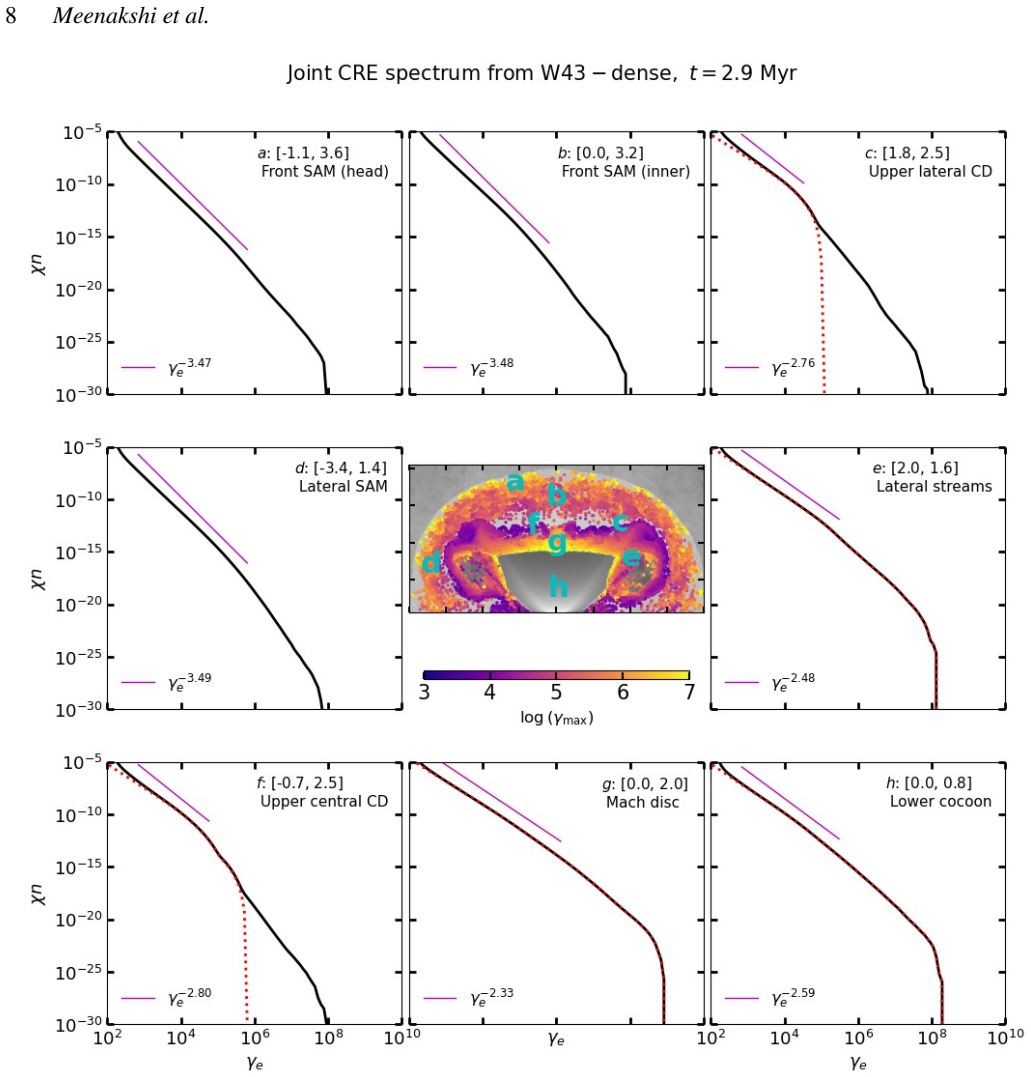
When cosmic-ray electrons are evolved self-consistently with shocks, adiabatic losses and radiative cooling, jets produce spectral indices that are flattest near the hotspot (approximately −0.5 to −0.6) and steepen away from it, while winds produce indices that are flattest at the Mach disc and steepen with distance, more strongly at high radio frequency. The Mach disc remains a far more efficient accelerator than the forward shock once a wind has expanded, and the continuous mixing of differently aged electron populations inside cocoons produces signatures that cannot be recovered from instantaneous fluid quantities alone.
What carries the argument
Lagrangian microparticle tracking of cosmic-ray electrons that records successive shock re-accelerations (via a convolution spectral update) together with adiabatic, synchrotron and inverse-Compton losses; the resulting joint spectra and multi-frequency maps are the direct diagnostic.
Load-bearing premise
A fixed fraction of the fluid’s internal energy is permanently assigned to cosmic-ray electrons everywhere in the flow, so all fluxes and spectra scale with that free normalization.
What would settle it
High-resolution multi-frequency maps of compact radio sources that show either no spectral-index gradient from a putative hotspot or Mach disc, or gradients that reverse the predicted direction, would falsify the claimed diagnostic patterns.
Editorial analysis
A structured set of objections, weighed in public.
Referee Report
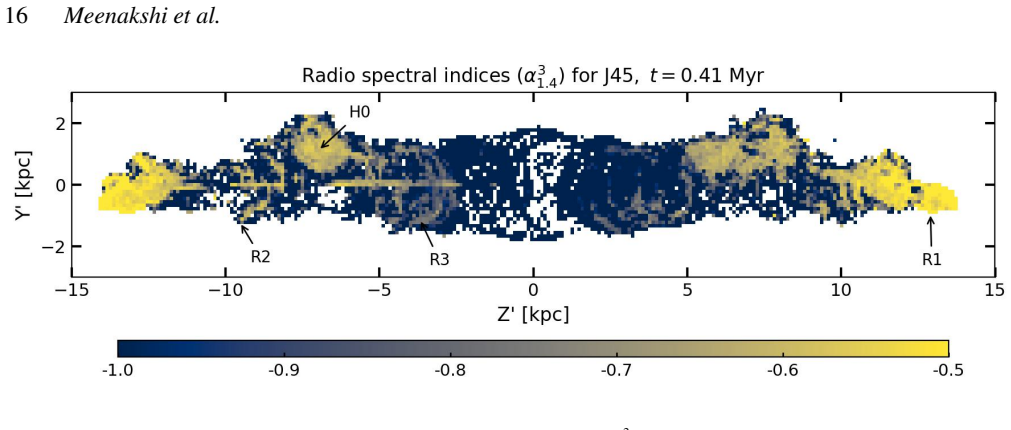
Summary. This paper uses the Lagrangian Particle module in PLUTO to evolve cosmic-ray electrons self-consistently with RMHD jets and winds of comparable power and extent. CREs are injected with a steep spectrum, accelerated via a convolution-based DSA update (Eq. 3) that preserves prior shock history, and cooled by adiabatic expansion, synchrotron, and inverse-Compton losses. The central claim is that the resulting multi-frequency emission and spectral-index maps provide diagnostics that distinguish jets from winds when low-resolution morphology is ambiguous: jet spectra are flattest near hotspots (α ≈ −0.5 to −0.6) and steepen into the cocoon, while wind spectra are flattest at the Mach disc and steepen with distance (more strongly at high frequency). Mean indices, SEDs, and a large-scale jet case (J45) support the same picture. The work extends the authors’ earlier post-processed Papers I/II by tracking particle history rather than assuming a fixed power-law spectrum.
Significance. If the reported spectral-index gradients hold under more realistic ISM and absorption physics, they supply a practical, observationally accessible diagnostic for compact radio sources where jet versus wind morphology is ambiguous. The convolution DSA update (Eq. 3), multi-frequency maps across powers and viewing angles (Figs. 7–9, A3, Table 2), and the explicit comparison of Mach-disc versus forward-shock efficiency are concrete, falsifiable predictions that go beyond the instantaneous-fluid approach of Papers I/II. The large-scale J45 run further links the compact results to classical FRII spectral aging. These are useful contributions for interpreting LOFAR/VLASS/SKA and VLBI data of CSS/GPS and wind-candidate sources.
major comments (2)
- Sec. 2.1 (after Eq. 3) and the shock criterion: a cell is treated as shocked for DSA only if the relative thermal pressure gradient exceeds 3, and compression ratios >4 (numerical) are forced to q=4.23. The paper states that weaker forward shocks in late-stage winds are therefore not registered (footnote 5; Sec. 3.1). Because the claim that the Mach disc is “significantly more efficient” than the forward shock rests on this selection, a short sensitivity test (or explicit statement of how many wind CREs would be reclassified under a milder threshold) is needed so that the efficiency contrast is not an artifact of the strong-shock cut.
- Sec. 4.3 and the diagnostic claim in the Abstract/§4.2: the simulations assume optically thin emission and omit SSA, FFA, and multi-phase ISM. The authors correctly note that SSA optical depth scales roughly as B^(δ+2)/2 and that jets reach higher B than winds, so localized SSA could flatten spectra near hotspots/Mach discs differently. Because the paper’s main selling point is that spectral-index maps diagnose jets versus winds in compact sources (where SSA/FFA are often important), the discussion should either quantify the expected bias on the reported α gradients or clearly bound the frequency/size regime in which the diagnostic remains valid.
minor comments (5)
- Table 1 / Sec. 2: injection cadence and pressure/density thresholds for forward-shock CRE injection differ by run; a one-sentence justification (or pointer to the J43 convergence test) would help readers assess robustness.
- Figs. 7 and A3: the 1 kpc² SED boxes a,b,c are useful, but the exact mid-point coordinates or a scale bar would make the spatial sampling reproducible.
- Sec. 3.3.3 / Table 2: flux-weighted means exclude regions more than 3 dex below the 3 GHz peak and Z below a floor; these cuts should be stated once in the table caption.
- Fig. 13 schematic is helpful; ensure the α ranges quoted match the cocoon values in Figs. 7 and A3 for both light and dense winds.
- A few typos and spacing issues (e.g., “weinvestigatetheinsituevolution” in the abstract block; occasional missing spaces around units) should be cleaned in production.
Circularity Check
No significant circularity: spectral-index gradients are measured outputs of forward Lagrangian CRE evolution, not inputs or fitted quantities; self-citations supply only the independent hydro setups.
full rationale
The paper's central claims (flattest spectral indices near jet hotspots / wind Mach discs, progressive steepening away from those sites, stronger high-frequency steepening in winds) are obtained by injecting CREs with a fixed steep initial spectrum (δ=9), evolving them via the PLUTO LP module (adiabatic + synchrotron + IC losses + DSA convolution at shocks), computing multi-frequency synchrotron maps, and measuring α = log(S2/S1)/log(ν2/ν1) on those maps. Nothing in Eqs. (1)–(3) or the DSA update forces the reported spatial gradients; they emerge from the simulated shock histories and cooling. The fixed fractions f_ε=0.1 and f_N (jet-tracer or 0.1) set absolute normalization and therefore absolute fluxes/SEDs, but cancel in spectral-index ratios, so they do not manufacture the diagnostic patterns. Self-citations to Papers I/II and Mukherjee et al. (2020, 2021) supply the RMHD setups and the LP/DSA numerical machinery; those prior works used fixed power-law spectra or different questions and do not presuppose the present spectral-index maps. No uniqueness theorem, fitted-to-data prediction, or definitional loop is present. Minor self-citation of the series framing is normal and non-load-bearing. Score 1 reflects only that framing citation.
Axiom & Free-Parameter Ledger
free parameters (6)
- f_ε (CRE energy fraction) =
0.1
- f_N (CRE number-density fraction) =
tracer or 0.1
- initial spectral index δ =
9
- γ_min, γ_max at injection =
(100, 1e6)
- pressure/density thresholds for forward-shock injection =
4p0 / 2p0 / 1.5p0
- CRE injection cadence =
simulation-dependent
axioms (4)
- domain assumption Diffusive shock acceleration produces a power-law spectrum whose index q depends on shock obliquity and compression ratio (Keshet & Waxman 2005; Takamoto & Kirk 2015), with asymptotic q = 4.23 for ultra-relativistic shocks.
- domain assumption Synchrotron, inverse-Compton (CMB) and adiabatic losses fully describe CRE energy evolution; no other cooling or re-acceleration channels operate.
- ad hoc to paper A computational cell is shocked for DSA purposes if the relative thermal pressure gradient exceeds 3.
- domain assumption The ambient medium has a random magnetic field correlated on ≤1 kpc scales and the jet/wind carries a purely toroidal field at injection.
read the original abstract
The origin of synchrotron emission in compact radio sources associated with active galactic nuclei (AGN) remains poorly understood. In a series of papers, we have examined diagnostic tools to disentangle the dominant underlying processes. In this study, we investigate the in situ evolution of cosmic-ray electrons (CREs) in compact AGN jets and winds, and examine how their evolution shapes the resulting observable radio properties. In jets, CREs experience multiple shock interactions as they propagate along the spine toward the hotspot and flow into the cocoon via backflows. In winds, CREs are predominantly accelerated at the Mach disc, with occasional re-acceleration within turbulent cocoon backflows. The continuous mixing of different CRE populations within the cocoon produces observational signatures that cannot be inferred from instantaneous conditions alone. In all jet simulations, spectral indices are flattest near the hotspot and steepen progressively away from the hotspots. In winds, spectra steepen with increasing distance from the Mach disc, with this trend becoming more pronounced at high radio frequencies due to radiative losses. We find the Mach disc to be a significantly more efficient CRE acceleration site than the forward shock in winds, which weakens as the wind expands to large scales. Since morphology, especially at low resolution, can be ambiguous for compact sources, spatially resolved spectral indices, particularly when combined with emission and polarization signatures, can provide a powerful diagnostic.
Figures





Reference graph
Works this paper leans on
-
[1]
Simulating the dynamics and synchrotron emission from relativistic jets - II. Evolution of non-thermal electrons. MNRAS , keywords =. doi:10.1093/mnras/stab1327 , archivePrefix =. 2105.02836 , primaryClass =
work page internal anchor Pith review Pith/arXiv arXiv doi:10.1093/mnras/stab1327
-
[2]
A Particle Module for the PLUTO Code. II. Hybrid Framework for Modeling Nonthermal Emission from Relativistic Magnetized Flows. ApJ , keywords =. doi:10.3847/1538-4357/aadd17 , archivePrefix =. 1808.08960 , primaryClass =
-
[3]
Resolved simulations of jet-ISM interaction: Implications for gas dynamics and star formation
Resolved simulations of jet-ISM interaction: Implications for gas dynamics and star formation. Astronomische Nachrichten , keywords =. doi:10.1002/asna.20210061 , archivePrefix =. 2110.11900 , primaryClass =
work page internal anchor Pith review Pith/arXiv arXiv doi:10.1002/asna.20210061
-
[4]
A polarization study of jets interacting with turbulent magnetic fields
A polarization study of jets interacting with turbulent magnetic fields. MNRAS , keywords =. doi:10.1093/mnras/stad3092 , archivePrefix =. 2310.03139 , primaryClass =
work page internal anchor Pith review Pith/arXiv arXiv doi:10.1093/mnras/stad3092
-
[5]
A comparative study of radio signatures from winds and jets: Modelling synchrotron emission and polarization. MNRAS , keywords =. doi:10.1093/mnras/stae1890 , archivePrefix =. 2408.00099 , primaryClass =
-
[6]
Relation between winds and jets in radio-loud AGN. , keywords =. doi:10.1051/0004-6361/201935205 , archivePrefix =. 1903.11605 , primaryClass =
-
[7]
Reports on Progress in Physics , keywords =
REVIEW ARTICLE: An introduction to the theory of diffusive shock acceleration of energetic particles in tenuous plasmas. Reports on Progress in Physics , keywords =. doi:10.1088/0034-4885/46/8/002 , adsurl =
-
[8]
Rapid cosmic-ray acceleration at perpendicular shocks in supernova remnants
Rapid Cosmic-ray Acceleration at Perpendicular Shocks in Supernova Remnants. ApJ , keywords =. doi:10.1088/0004-637X/809/1/29 , archivePrefix =. 1506.04354 , primaryClass =
work page internal anchor Pith review Pith/arXiv arXiv doi:10.1088/0004-637x/809/1/29
-
[9]
Particle Acceleration in Pulsar Wind Nebulae: PIC modelling
Particle Acceleration in Pulsar Wind Nebulae: PIC Modelling. Modelling Pulsar Wind Nebulae , year = 2017, editor =. doi:10.1007/978-3-319-63031-1_11 , archivePrefix =. 1705.10815 , primaryClass =
work page internal anchor Pith review Pith/arXiv arXiv doi:10.1007/978-3-319-63031-1_11 2017
-
[10]
The spectrum of particles accelerated in relativistic, collisionless shocks
Energy Spectrum of Particles Accelerated in Relativistic Collisionless Shocks. PRL , keywords =. doi:10.1103/PhysRevLett.94.111102 , archivePrefix =. astro-ph/0408489 , primaryClass =
work page internal anchor Pith review Pith/arXiv arXiv doi:10.1103/physrevlett.94.111102
-
[11]
PLUTO: A Numerical Code for Computational Astrophysics. ApJS , keywords =. doi:10.1086/513316 , archivePrefix =. astro-ph/0701854 , primaryClass =
-
[12]
Particle Acceleration at Ultrarelativistic Shocks: An Eigenfunction Method. ApJ , keywords =. doi:10.1086/309533 , archivePrefix =. astro-ph/0005222 , primaryClass =
-
[13]
Spectral evolution of superluminal components in parsec-scale jets
Spectral Evolution of Superluminal Components in Parsec-Scale Jets. ApJ , keywords =. doi:10.1088/0004-637X/696/2/1142 , archivePrefix =. 0811.1143 , primaryClass =
work page internal anchor Pith review Pith/arXiv arXiv doi:10.1088/0004-637x/696/2/1142
-
[14]
Spectral evolution of flaring blazars from numerical simulations. A & A , keywords =. doi:10.1051/0004-6361/201527139 , archivePrefix =. 1601.03181 , primaryClass =
-
[15]
Annual Review of Astron and Astrophysis , year = 1997, month = jan, volume =
Parsec-Scale Jets in Extragalactic Radio Sources. Annual Review of Astron and Astrophysis , year = 1997, month = jan, volume =. doi:10.1146/annurev.astro.35.1.607 , adsurl =
-
[16]
Detecting Radio-AGN signatures in Red geysers
Detecting Radio AGN Signatures in Red Geysers. ApJ , keywords =. doi:10.3847/1538-4357/aaee72 , archivePrefix =. 1811.04072 , primaryClass =
work page internal anchor Pith review Pith/arXiv arXiv doi:10.3847/1538-4357/aaee72
-
[17]
Outflow-related radio emission in radio-quiet quasars
Outflow-related radio emission in radio-quiet quasars. MNRAS , keywords =. doi:10.1093/mnras/stae126 , archivePrefix =. 2401.05212 , primaryClass =
work page internal anchor Pith review Pith/arXiv arXiv doi:10.1093/mnras/stae126
-
[18]
The Spectacular Radio-Near-IR-X-ray Jet of 3C 111: X-ray Emission Mechanism and Jet Kinematics
The Spectacular Radio-near-IR-X-Ray Jet of 3C 111: The X-Ray Emission Mechanism and Jet Kinematics. ApJ , keywords =. doi:10.3847/0004-637X/826/2/109 , archivePrefix =. 1602.04794 , primaryClass =
work page internal anchor Pith review Pith/arXiv arXiv doi:10.3847/0004-637x/826/2/109
-
[19]
Kiloparsec-scale Jets: Physics, Emission Mechanisms, and Challenges
Kiloparsec-scale Jets: Physics, Emission Mechanisms, and Challenges. Bulletin of the AAS , keywords =. doi:10.48550/arXiv.1903.03657 , archivePrefix =. 1903.03657 , primaryClass =
work page internal anchor Pith review Pith/arXiv arXiv doi:10.48550/arxiv.1903.03657 1903
-
[20]
Studying X-ray spectra from large-scale jets of FR II radio galaxies: application of shear particle acceleration. MNRAS , keywords =. doi:10.1093/mnras/stad2542 , archivePrefix =. 2308.11370 , primaryClass =
work page internal anchor Pith review Pith/arXiv arXiv doi:10.1093/mnras/stad2542
-
[21]
A Survey of Kiloparsec-Scale Radio Outflows in Radio-Quiet Active Galactic Nuclei
A Survey of Kiloparsec-Scale Radio Outflows in Radio-Quiet Active Galactic Nuclei. AJ , keywords =. doi:10.1086/504593 , archivePrefix =. astro-ph/0604219 , primaryClass =
work page internal anchor Pith review Pith/arXiv arXiv doi:10.1086/504593
-
[22]
Compact radio emission from z~0.2 X-ray bright AGN
Compact radio emission from z -0.5ex 0.2 X-ray bright AGN. A & A , keywords =. doi:10.1051/0004-6361/201118200 , archivePrefix =. 1204.3162 , primaryClass =
work page internal anchor Pith review Pith/arXiv arXiv doi:10.1051/0004-6361/201118200
-
[23]
Kpc-scale Radio Structure in $z\sim0.25$ Radio-Quiet QSOs
Kiloparsec-scale Radio Structure in z 0.25 Radio-quiet QSOs. AJ , keywords =. doi:10.3847/1538-3881/ac853e , archivePrefix =. 2207.13792 , primaryClass =
work page internal anchor Pith review Pith/arXiv arXiv doi:10.3847/1538-3881/ac853e
-
[24]
Observational signatures of galactic winds powered by active galactic nuclei. MNRAS , keywords =. doi:10.1093/mnras/stu2648 , archivePrefix =. 1408.5141 , primaryClass =
-
[25]
Insights from deep LOFAR-VLBI sub-arcsecond resolution images
Revealing the intricacies of radio galaxies and filaments in the merging galaxy cluster Abell 2255: I. Insights from deep LOFAR-VLBI sub-arcsecond resolution images. , keywords =. doi:10.1051/0004-6361/202555268 , archivePrefix =. 2505.13595 , primaryClass =
-
[26]
Origin of the ring structures in Hercules A -- Sub-arcsecond 144 MHz to 7 GHz observations
Origin of the ring structures in Hercules A. Sub-arcsecond 144 MHz to 7 GHz observations. , keywords =. doi:10.1051/0004-6361/202140880 , archivePrefix =. 2108.07287 , primaryClass =
work page internal anchor Pith review Pith/arXiv arXiv doi:10.1051/0004-6361/202140880
-
[27]
Deciphering Radio Emissions from Accretion Disk Winds in Radio-Quiet Active Galactic Nuclei
Deciphering Radio Emissions from Accretion Disk Winds in Radio-quiet Active Galactic Nuclei. ApJ , keywords =. doi:10.3847/1538-4357/ad3a63 , archivePrefix =. 2404.04632 , primaryClass =
work page internal anchor Pith review Pith/arXiv arXiv doi:10.3847/1538-4357/ad3a63
-
[28]
Particle acceleration in astrophysical jets. NAR , keywords =. doi:10.1016/j.newar.2020.101543 , archivePrefix =. 2003.06587 , primaryClass =
-
[29]
Radiative processes in astrophysics
-
[30]
Winds as the origin of radio emission in $z=2.5$ radio-quiet extremely red quasars
Winds as the origin of radio emission in z = 2.5 radio-quiet extremely red quasars. MNRAS , keywords =. doi:10.1093/mnras/sty742 , archivePrefix =. 1803.02821 , primaryClass =
work page internal anchor Pith review Pith/arXiv arXiv doi:10.1093/mnras/sty742
-
[31]
Probing the origin of low-frequency radio emission in PG quasars with the uGMRT -- I
Probing the origin of low-frequency radio emission in PG quasars with the uGMRT - I. MNRAS , keywords =. doi:10.1093/mnras/staa2970 , archivePrefix =. 2009.12264 , primaryClass =
work page internal anchor Pith review Pith/arXiv arXiv doi:10.1093/mnras/staa2970 2009
-
[32]
The Quasar Feedback Survey: zooming into the origin of radio emission with e-MERLIN
The Quasar Feedback Survey: zooming into the origin of radio emission with e-MERLIN. MNRAS , keywords =. doi:10.1093/mnras/staf020 , archivePrefix =. 2501.03433 , primaryClass =
work page internal anchor Pith review Pith/arXiv arXiv doi:10.1093/mnras/staf020
-
[33]
Kiloparsec-scale radio emission in Seyfert and LINER galaxies. MNRAS , keywords =. doi:10.1093/mnras/stu2124 , archivePrefix =. 1410.2720 , primaryClass =
-
[34]
Ubiquitous radio emission in quasars: Predominant AGN origin and a connection to jets, dust, and winds. A & A , keywords =. doi:10.1051/0004-6361/202348982 , archivePrefix =. 2312.10177 , primaryClass =
work page internal anchor Pith review Pith/arXiv arXiv doi:10.1051/0004-6361/202348982
-
[35]
The quasar feedback survey: discovering hidden Radio-AGN and their connection to the host galaxy ionized gas. MNRAS , keywords =. doi:10.1093/mnras/stab549 , archivePrefix =. 2103.00014 , primaryClass =
work page internal anchor Pith review Pith/arXiv arXiv doi:10.1093/mnras/stab549
-
[36]
The Quasar Feedback Survey: revealing the interplay of jets, winds, and emission-line gas in type 2 quasars with radio polarization. MNRAS , keywords =. doi:10.1093/mnras/stac1044 , archivePrefix =. 2204.05613 , primaryClass =
work page internal anchor Pith review Pith/arXiv arXiv doi:10.1093/mnras/stac1044
-
[37]
Estimating Star Formation Rates from Infrared and Radio Luminosities: The Origin of the Radio-Infrared Correlation. ApJ , keywords =. doi:10.1086/367829 , archivePrefix =. astro-ph/0212121 , primaryClass =
-
[38]
Deep VLA Imaging of Twelve Extended 3CR Quasars. AJ , keywords =. doi:10.1086/117112 , adsurl =
-
[39]
The radio loudness of SDSS quasars from the LOFAR Two-metre Sky Survey: ubiquitous jet activity and constraints on star formation. MNRAS , keywords =. doi:10.1093/mnras/stab1998 , archivePrefix =. 2107.09141 , primaryClass =
-
[40]
Simulating Electron Transport and Synchrotron Emission in Radio Galaxies: Shock Acceleration and Synchrotron Aging in Axisymmetric Flows. ApJ , keywords =. doi:10.1086/306772 , archivePrefix =. astro-ph/9809081 , primaryClass =
work page internal anchor Pith review Pith/arXiv arXiv doi:10.1086/306772
-
[41]
RAiSE II: resolved spectral evolution in radio AGN. MNRAS , keywords =. doi:10.1093/mnras/stx2591 , archivePrefix =. 1710.01078 , primaryClass =
-
[42]
PRAiSE: Resolved spectral evolution in simulated radio sources
PRAiSE: resolved spectral evolution in simulated radio sources. MNRAS , keywords =. doi:10.1093/mnras/stac385 , archivePrefix =. 2202.04420 , primaryClass =
work page internal anchor Pith review Pith/arXiv arXiv doi:10.1093/mnras/stac385
-
[43]
CosmoDRAGoN simulations I. Dynamics and observable signatures of radio jets in cosmological environments. PASA , keywords =. doi:10.1017/pasa.2023.10 , archivePrefix =. 2212.10059 , primaryClass =
work page internal anchor Pith review Pith/arXiv arXiv doi:10.1017/pasa.2023.10 2023
-
[44]
Simulating the dynamics and non-thermal emission of relativistic magnetised jets I. Dynamics
Simulating the dynamics and non-thermal emission of relativistic magnetized jets I. Dynamics. MNRAS , keywords =. doi:10.1093/mnras/staa2934 , archivePrefix =. 2009.10475 , primaryClass =
work page internal anchor Pith review Pith/arXiv arXiv doi:10.1093/mnras/staa2934 2009
-
[45]
Spectral ageing in the lobes of FR-II radio galaxies: new methods of analysis for broad-band radio data. MNRAS , keywords =. doi:10.1093/mnras/stt1526 , archivePrefix =. 1308.4137 , primaryClass =
-
[46]
Particles in Relativistic Magnetohydrodynamic Jets. II. Bridging Jet Dynamics with Multi wave band Nonthermal Emission Signatures. ApJ , keywords =. doi:10.3847/1538-4357/ad8135 , archivePrefix =. 2409.15983 , primaryClass =
-
[47]
Particles in Relativistic MHD Jets. I. Role of Jet Dynamics in Particle Acceleration. ApJ , keywords =. doi:10.3847/1538-4357/ace0bf , archivePrefix =. 2306.10902 , primaryClass =
-
[48]
Nature Communications , year = 2020, month = aug, volume =
Gamma-ray flares from relativistic magnetic reconnection in the jet of the quasar 3C 279. Nature Communications , year = 2020, month = aug, volume =. doi:10.1038/s41467-020-17912-z , adsurl =
-
[49]
Radiation and Polarization Signatures from Magnetic Reconnection in Relativistic Jets. II. Connection with -Rays. ApJ , keywords =. doi:10.3847/1538-4357/ac3669 , archivePrefix =. 2111.02578 , primaryClass =
work page internal anchor Pith review Pith/arXiv arXiv doi:10.3847/1538-4357/ac3669
-
[50]
Numerical Modeling and Physical Interplay of Stochastic Turbulent Acceleration for Nonthermal Emission Processes. ApJ , keywords =. doi:10.3847/1538-4357/ac1ba5 , archivePrefix =. 2108.03242 , primaryClass =
-
[51]
A numerical study of the interplay between Fermi acceleration mechanisms in radio lobes of FR-II radio galaxies. A & A , keywords =. doi:10.1051/0004-6361/202244251 , archivePrefix =. 2208.12823 , primaryClass =
work page internal anchor Pith review Pith/arXiv arXiv doi:10.1051/0004-6361/202244251
-
[52]
High-Resolution Millimeter and Infrared Observations of the Hot Spots of Cygnus A. AJ , keywords =. doi:10.1086/301137 , adsurl =
-
[53]
Multiwavelength study of Cygnus A. V. The hotspots in the lobe. A & A , keywords =. doi:10.1051/0004-6361/201425061 , adsurl =
-
[54]
Cygnus A: A Long Wavelength Resolution of the Hot Spots
Cygnus A: A Long-Wavelength Resolution of the Hot Spots. ApJl , keywords =. doi:10.1086/504408 , archivePrefix =. astro-ph/0603717 , primaryClass =
work page internal anchor Pith review Pith/arXiv arXiv doi:10.1086/504408
-
[55]
LOFAR imaging of Cygnus A -- Direct detection of a turnover in the hotspot radio spectra
LOFAR imaging of Cygnus A - direct detection of a turnover in the hotspot radio spectra. MNRAS , keywords =. doi:10.1093/mnras/stw2105 , archivePrefix =. 2103.16961 , primaryClass =
work page internal anchor Pith review Pith/arXiv arXiv doi:10.1093/mnras/stw2105
-
[56]
Jansky VLA observations of synchrotron emitting optical hotspots of 3C 227 and 3C 445 radio galaxies
Jansky VLA observations of synchrotron emitting optical hotspots of 3C 227 and 3C 445 radio galaxies. MNRAS , keywords =. doi:10.1093/mnras/staa777 , archivePrefix =. 2004.13757 , primaryClass =
work page internal anchor Pith review Pith/arXiv arXiv doi:10.1093/mnras/staa777 2004
-
[57]
A Multiwavelength Study of the High Surface Brightness Hot Spot in PKS 1421-490. ApJ , keywords =. doi:10.1088/0004-637X/695/1/707 , archivePrefix =. 0901.3552 , primaryClass =
-
[58]
Internal Structure of the Jets in 3C 353. ApJl , keywords =. doi:10.1086/311663 , adsurl =
-
[59]
The Unusual Radio Galaxy 3C 288. AJ , keywords =. doi:10.1086/115013 , adsurl =
-
[60]
Origin of the Structures and Polarization in the Classical Double 3C 219. ApJ , keywords =. doi:10.1086/170925 , adsurl =
-
[61]
Analysis of the radio properties and evidence for interrupted activity in active galactic nuclei
Radio galaxies with a `double-double morphology' - I. Analysis of the radio properties and evidence for interrupted activity in active galactic nuclei. MNRAS , keywords =. doi:10.1046/j.1365-8711.2000.03430.x , archivePrefix =. astro-ph/9912141 , primaryClass =
-
[62]
Production of ring-like structure in the cocoon of Hercules A
Production of Ringlike Structure in the Cocoon of Hercules A. ApJ , keywords =. doi:10.1086/342679 , archivePrefix =. astro-ph/0204475 , primaryClass =
work page internal anchor Pith review Pith/arXiv arXiv doi:10.1086/342679
-
[63]
Jets in radio galaxies and quasars: an observational perspective
Jets in radio galaxies and quasars: an observational perspective. Journal of Astrophysics and Astronomy , keywords =. doi:10.1007/s12036-022-09863-2 , archivePrefix =. 2206.05803 , primaryClass =
work page internal anchor Pith review Pith/arXiv arXiv doi:10.1007/s12036-022-09863-2
-
[64]
Radio Loud and Radio Quiet Active Galactic Nuclei
Radio-loud and Radio-quiet Active Galactic Nuclei. AJ , keywords =. doi:10.1086/301007 , archivePrefix =. astro-ph/9905322 , primaryClass =
work page internal anchor Pith review Pith/arXiv arXiv doi:10.1086/301007
-
[65]
Cosmic Ray Acceleration by a Versatile Family of Galactic Wind Termination Shocks. ApJ , keywords =. doi:10.3847/1538-4357/835/1/72 , archivePrefix =. 1610.06565 , primaryClass =
-
[66]
Diffusive shock acceleration at EeV and associated multimessenger flux from ultra-fast outflows driven by active galactic nuclei. MNRAS , keywords =. doi:10.1093/mnras/stad2740 , archivePrefix =. 2301.13689 , primaryClass =
work page internal anchor Pith review Pith/arXiv arXiv doi:10.1093/mnras/stad2740
-
[67]
Interstellar bubbles. II. Structure and evolution. ApJ , keywords =. doi:10.1086/155692 , adsurl =
-
[68]
Dynamics of Powerful Radio Galaxies. Galaxies , keywords =. doi:10.3390/galaxies11040087 , archivePrefix =. 2307.08341 , primaryClass =
-
[69]
Radiative signature of magnetic fields in internal shocks. MNRAS , keywords =. doi:10.1111/j.1365-2966.2012.20495.x , archivePrefix =. 1111.6108 , primaryClass =
-
[70]
The origin of radio emission from radio-quiet active galactic nuclei. Nature Astronomy , keywords =. doi:10.1038/s41550-019-0765-4 , archivePrefix =. 1902.05917 , primaryClass =
-
[71]
Radio jets in NGC 1068 with e-MERLIN and VLA: structure and morphology
Radio jets in NGC 1068 with e-MERLIN and VLA: structure and morphology. MNRAS , keywords =. doi:10.1093/mnras/stad3864 , archivePrefix =. 2312.09722 , primaryClass =
work page internal anchor Pith review Pith/arXiv arXiv doi:10.1093/mnras/stad3864
-
[72]
Unveiling the 100 pc scale nuclear radio structure of NGC 6217 with e-MERLIN and the VLA. MNRAS , keywords =. doi:10.1093/mnras/stz1135 , archivePrefix =. 1904.10259 , primaryClass =
-
[73]
Radio jets in NGC 4151: where eMERLIN meets HST. MNRAS , keywords =. doi:10.1093/mnras/stx2205 , archivePrefix =. 1708.07011 , primaryClass =
-
[74]
Parsec-scale Imaging of the Radio-bubble Seyfert galaxy NGC 6764
Parsec-scale Imaging of the Radio-bubble Seyfert Galaxy NGC 6764. ApJ , keywords =. doi:10.1088/0004-637X/723/1/580 , archivePrefix =. 1009.0702 , primaryClass =
work page internal anchor Pith review Pith/arXiv arXiv doi:10.1088/0004-637x/723/1/580
-
[75]
Astronomische Nachrichten , keywords =
Radio properties of Compact Steep Spectrum and GHz-Peaked Spectrum radio sources. Astronomische Nachrichten , keywords =. doi:10.1002/asna.201512257 , archivePrefix =. 1511.00436 , primaryClass =
-
[76]
A low frequency sub-arcsecond view of powerful radio galaxies in rich-cluster environments: 3C 34 and 3C 320. arXiv e-prints , keywords =. doi:10.48550/arXiv.2302.01357 , archivePrefix =. 2302.01357 , primaryClass =
work page internal anchor Pith review Pith/arXiv arXiv doi:10.48550/arxiv.2302.01357
-
[77]
The B3-VLA CSS sample. V. VLBA images at 6 and 3.6 cm. A & A , keywords =. doi:10.1051/0004-6361:20041204 , adsurl =
-
[78]
Multifrequency Radio Observations of Cygnus A: Spectral Aging in Powerful Radio Galaxies. ApJ , keywords =. doi:10.1086/170813 , adsurl =
-
[79]
Spectral Ages of CSOs and CSS Sources
Spectral Ages of CSOs and CSS Sources. PASA , keywords =. doi:10.1071/AS02033 , archivePrefix =. astro-ph/0302376 , primaryClass =
work page internal anchor Pith review Pith/arXiv arXiv doi:10.1071/as02033
-
[80]
Parsec-scale morphology and spectral-index distribution in faint high-frequency peakers. MNRAS , keywords =. doi:10.1111/j.1365-2966.2012.21226.x , archivePrefix =. 1205.0395 , primaryClass =
discussion (0)
Sign in with ORCID, Apple, or X to comment. Anyone can read and Pith papers without signing in.