REVIEW 3 major objections 5 minor 72 references
At extreme Reynolds numbers the small-scale dynamo saturates with a magnetic-to-kinetic energy ratio near 0.55 and an integral-scale ratio near 3, independent of magnetic Prandtl number.
Reviewed by Pith at T0; open to challenge. T0 means a machine referee read the full paper against a public rubric. the ladder, T0–T4 →
2026-07-12 07:19 UTC pith:SPSEQMFX
load-bearing objection Clean Kazantsev recovery plus new high-Re/Rm asymptotic plateaus inside EDQNM; the numbers are useful but still conditional on the fixed Cs=0.26 damping that was never varied. the 3 major comments →
Small-scale dynamo saturation across magnetic Prandtl numbers using the EDQNM closure
The pith
A machine-rendered reading of the paper's core claim, the machinery that carries it, and where it could break.
Core claim
When fluid Reynolds number exceeds roughly 10^6 (for Pm > 1) or magnetic Reynolds number exceeds roughly 10^6 (for Pm < 1), nonhelical EDQNM simulations of the small-scale dynamo yield a Prandtl-number-independent kinematic growth rate, a saturated magnetic-to-kinetic energy ratio that converges to approximately 0.55, and a magnetic-to-kinetic integral-wavenumber ratio that asymptotes to approximately 3; both spectra share a -3/2 inertial range produced by Alfvénisation.
What carries the argument
The eddy-damped quasi-normal Markovian (EDQNM) closure for incompressible MHD turbulence: its triad relaxation time reduces exactly to the classic Kazantsev kinematic dynamo equation when magnetic back-reaction is neglected and the relaxation time is held constant, and the same equations with scale-dependent damping then evolve the nonlinear saturation.
Load-bearing premise
The fixed eddy-damping coefficient and the assumption that the turbulence remains spectrally isotropic continue to hold all the way through nonlinear saturation; if either fails, the reported asymptotic ratios can shift.
What would settle it
A high-resolution direct numerical simulation of nonhelical MHD turbulence at Re or Rm of order 10^6 that measures a saturated magnetic-to-kinetic energy ratio substantially different from 0.55, or an integral-scale ratio substantially different from 3, would falsify the claimed asymptotes.
If this is right
- Astrophysical models of galaxy-cluster or elliptical-galaxy magnetisation can adopt a universal saturation efficiency of order 55 percent once the plasma is sufficiently turbulent.
- The saturated magnetic integral scale is predicted to lie only a factor of three below the kinetic integral scale, independent of microscopic Prandtl number.
- Saturated kinetic and magnetic spectra should both display a -3/2 inertial range once Alfvénisation has equalised the effective viscous and resistive cut-offs.
- Global simulations that cannot reach extreme Reynolds numbers can still calibrate their sub-grid dynamo models against these asymptotic ratios.
Where Pith is reading between the lines
- The same asymptotic ratios may serve as fixed points for any spectral model that includes Alfvénic damping, not only EDQNM.
- If the -3/2 range is observed in Faraday-rotation or synchrotron spectra of clusters, it would be indirect evidence that the plasma has already entered the Prandtl-independent regime.
- The critical magnetic Reynolds number’s mild rise at low Pm suggests that planetary and stellar interiors may still host efficient small-scale dynamos once Rm exceeds a few tens.
- Extensions that restore weak helicity could test whether the same energy and scale ratios survive when a large-scale dynamo is also present.
Editorial analysis
A structured set of objections, weighed in public.
Referee Report
Summary. The paper shows that the nonhelical EDQNM closure for incompressible MHD recovers the classical Kazantsev/Kulsrud–Anderson kinematic small-scale dynamo when the triad relaxation time is taken constant (θ_kpq = τ), both analytically (Appendix A) and numerically. It then uses the full scale-dependent EDQNM equations to explore SSD growth and saturation over a wide (Re, Rm, Pm) range inaccessible to DNS. The central claims are that, for Re ≳ 10^6 (Pm > 1) or Rm ≳ 10^6 (Pm < 1), the kinematic growth rate becomes approximately Pm-independent, the saturated magnetic-to-kinetic energy ratio converges to χ ≃ 0.55, the integral-wavenumber ratio k_M/k_V asymptotes to ≃ 3, and both spectra develop a shared −3/2 inertial range attributed to Alfvénisation.
Significance. If the reported asymptotic regimes hold, they supply concrete, Pm-independent targets (χ ≃ 0.55, k_M/k_V ≃ 3, shared −3/2 spectra) for modeling SSD-dominated systems such as elliptical galaxies and the ICM, and for interpreting future high-Re global simulations. Strengths include a careful analytic recovery of the Kazantsev equation (Appendix A), term-by-term transfer analysis of saturation, public release of code and data, and systematic coverage of both Pm ≫ 1 and Pm ≪ 1 at extreme Reynolds numbers. The work usefully unifies earlier kinematic models with a nonlinear spectral closure and identifies an effective Pm = 1 saturated state driven by Alfvénisation.
major comments (3)
- The quantitative asymptotes χ ≃ 0.55 and k_M/k_V ≃ 3 (Figs. 16–17, §V.C) and the Pm-independent growth-rate plateau (Fig. 13, §V.B) are obtained exclusively with the damping rate of Eq. (20) and the fixed coefficient C_s = 0.26 taken from Grappin et al. (1982). Because the nonlinear transfers T^M_MM and T^V_VM that set saturation are proportional to θ_kpq, a change in C_s (or in the Alfvénic contribution inside µ_k) rescales the effective nonlinear diffusion and can shift the spectral peak and energy ratio. No sensitivity scan of C_s, of the Alfvénic term, or of the Markovian approximation is reported. A modest variation of C_s (or an explicit statement that the numbers are closure-dependent) is needed before the claimed universality can be treated as robust.
- The thresholds Re_asym ∼ 10^6 and Rm_asym ∼ 10^6 are stated as sharp asymptotic onsets (§V.B–C and abstract), yet the manuscript provides neither resolution-variation checks at those extremes beyond the Fres = 16 vs 32 comparison in Appendix A.3 nor uncertainty estimates on the fitted plateaus. Given that the logarithmic grid and the choice of k_max = 4 max(k_η, k_ν) control the dissipative range, the precise numerical values of the thresholds and of χ, k_M/k_V should be accompanied by a short resolution/parameter-uncertainty discussion so that readers can judge how firmly the asymptotes are established.
- Section VI correctly notes that EDQNM assumes spectral isotropy and cannot capture intermittency or reconnection, yet the abstract and conclusions present the asymptotic ratios as guidance for astrophysical systems without quantifying how strongly those assumptions may bias the numbers. A clearer separation between (i) the robust qualitative existence of high-Re/Rm plateaus and (ii) the precise numerical values that are closure- and isotropy-dependent would strengthen the paper’s claims and avoid over-interpretation by the community.
minor comments (5)
- Fig. 12: the scaling R_cr_m ∝ Re^{−5/4} in the viscous regime is stated but not overlaid on the plot; adding a guide line would help the reader.
- Notation: both M(k) and M_k are used for the magnetic spectrum; a single convention would improve readability.
- Eq. (26) defines k_M/k_V with the inverse-moment convention of Monin & Yaglom; a brief reminder that this is not the peak-wavenumber ratio would avoid confusion with DNS literature that often quotes k_peak.
- Typographical: “Alfv´enisation” / “Alfv`enisation” appear with inconsistent accents; standardize to Alfvénisation throughout.
- Table I lists only two Kazantsev runs; a short note on how many full-EDQNM runs underlie Figs. 13–17 would aid reproducibility.
Circularity Check
No circularity: asymptotic ratios and growth rates are direct numerical outputs of the EDQNM equations, not forced by definition, fitting, or load-bearing self-citation.
full rationale
The paper’s central claims (Pm-independent kinematic growth rate, saturated χ ≃ 0.55, k_M/k_V ≃ 3, and shared −3/2 spectra) are obtained by integrating the nonhelical EDQNM spectral equations (9)–(10) with the standard triad relaxation (19) and damping rate (20). The analytic recovery of the Kazantsev equation in the constant-θ limit (Eqs. 21–25 reducing exactly to Eq. 3) is a straightforward algebraic reduction of the transfer integrals under the stated assumptions; it does not redefine the target quantities in terms of themselves. The single free coefficient C_s = 0.26 is taken unchanged from the external literature (Grappin et al. 1982) and is never adjusted to reproduce the reported ratios. No parameter is fitted to a subset of the asymptotic data and then re-presented as a prediction; the high-Re/Rm plateaus emerge as outputs of the same un-tuned closure. Self-citations to the authors’ earlier kinematic or nonlinear models appear only as background and are not used to forbid alternatives or to import uniqueness theorems that force the present results. Consequently the derivation chain is self-contained and non-circular; any dependence of the numerical values on the particular form of µ_k is a robustness/correctness question, not a circularity.
Axiom & Free-Parameter Ledger
free parameters (3)
- Cs (eddy-damping coefficient) =
0.26
- Fres (sub-octave resolution) =
16
- Forcing amplitude F0 and peak kf
axioms (5)
- domain assumption Quasi-normal approximation: fourth-order moments factor into products of second-order moments plus an irreducible part replaced by eddy damping.
- domain assumption Markovianization: third-order moments respond instantaneously to the product of second-order moments, yielding a local-in-time equation.
- domain assumption Strict spectral isotropy of the turbulence throughout kinematic and nonlinear stages.
- domain assumption Incompressible, nonhelical MHD with constant viscosity and resistivity.
- domain assumption Form of the damping rate μk that includes viscous/resistive, nonlinear-scrambling and Alfvénic contributions (Eq. 20).
read the original abstract
Small-scale dynamos (SSDs) are believed to be the primary source of magnetic fields in all turbulent astrophysical systems, especially those with weak rotation such as elliptical galaxies and galaxy clusters. The initial kinematic phase of these dynamos is relatively well understood. Here we demonstrate analytically and numerically that, in an appropriate limit, the eddy-damped quasi-normal Markovian (EDQNM) closure for incompressible magnetohydrodynamic turbulence is strictly equivalent to the earlier models of kinematic dynamos. Moreover, it allows the extension of the kinematic dynamo framework to multi-scale turbulent flows and into the nonlinear regime. The EDQNM closure also enables us to explore a wide parameter range which is inaccessible to direct numerical simulations of the SSD. Using nonhelical EDQNM simulations, we identify several asymptotic regimes of nonlinear dynamo action when the system is highly turbulent with fluid Reynolds number $Re \gtrsim 10^6$ for magnetic Prandtl number $Pm > 1$ and magnetic Reynolds number $Rm \gtrsim 10^6$ for $Pm < 1$: 1) the kinematic growth rate approaches a value independent of $Pm$, 2) the saturated magnetic to kinetic energy ratio similarly converges to $\simeq 0.55$ across $Pm$, while the ratio of magnetic to kinetic integral wavenumbers asymptotes to $\simeq 3$. For all $Pm$, we further find strong feedback between magnetic field and velocity field largely via Alfv\'{e}nisation leading to a saturated kinetic and magnetic spectra with almost the same inertial range with a slope of $-3/2$. These findings could provide guidance for future global simulations and for modeling the nonlinear regime of astrophysical systems living in these extreme limits.
Figures




Reference graph
Works this paper leans on
-
[1]
Quasi - normal:In the evolution equation for the third order correlators, the fourth order correlations are ex- pressed as sum of product of second order moments, and an irreducible part
-
[2]
The resulting solution is substituted back into the evolution for the second order moments
Eddy damping:This irreducible part is replaced by a damping term proportional to the third order correla- tion, the ‘eddy damping’ term. The resulting solution is substituted back into the evolution for the second order moments
-
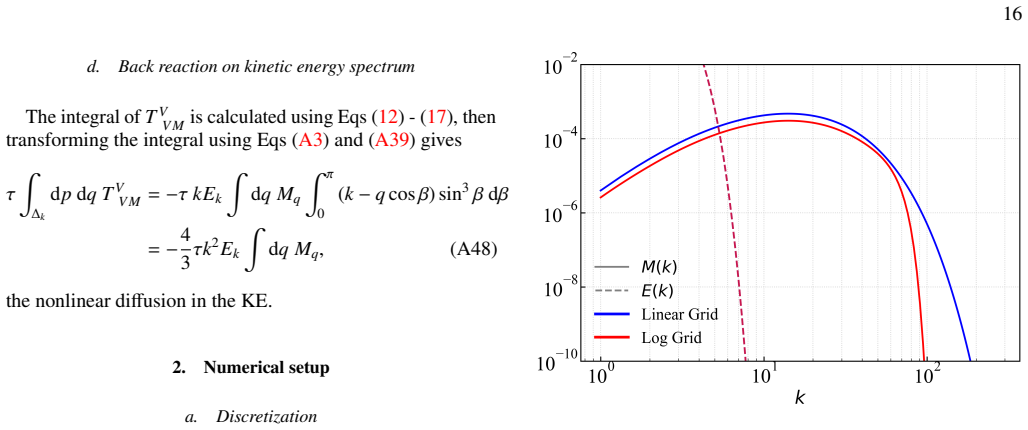
[3]
The evolution equation for the second order moments then becomes local in time
Markovianization:To ensure the positivity of energy spectra, the eddy damping is assumed so strong that the third order moment responds to the instantaneous value of the product of second order moments. The evolution equation for the second order moments then becomes local in time. The resulting equations for the kinetic energy spectrum Ek ≡ E(k,t ) and m...
-
[4]
Details of our numerical implementation are provided in Appendix A 2. The prescribed kinetic energy spectrum and the initial magnetic energy spectrum share a functional form similar to the forcing function in Eq.(11), peaking at k =2, but with respective amplitudes E0 and M0. To isolate the kinematic stage, we neglect the magnetic back-reaction term, T M ...
-
[5]
To the best of our knowledge, this is the first time such a clear asymptotic state has been established across a wide range ofP m, albeit within a closure formalism
showed indications of this asymptote, they were unable to probe the requisite high Re and Rm due to computational constraints. To the best of our knowledge, this is the first time such a clear asymptotic state has been established across a wide range ofP m, albeit within a closure formalism. Prior to reaching the asymptotic plateau, the growth rate follow...
-
[6]
C. V ogt and T. A. Enßlin, Astron. Astrophys.434, 67 (2005), arXiv:astro-ph/0501211 [astro-ph]
Pith/arXiv arXiv 2005
-
[7]
Reiners, Living Rev
A. Reiners, Living Rev. Solar Phys.9, 1 (2012)
2012
-
[8]
Fletcher, R
A. Fletcher, R. Beck, A. Shukurov, E. M. Berkhuijsen, and C. Horellou, Mon. Not. R. Astron. Soc.412, 2396 (2011)
2011
-
[9]
Beck, Astron
R. Beck, Astron. Astrophys. Rev.24, 4 (2015)
2015
-
[10]
Vacca, M
V . Vacca, M. Murgia, F. Govoni, T. Enßlin, N. Oppermann, L. Feretti, G. Giovannini, and F. Loi, Galaxies6, 142 (2018)
2018
-
[11]
C. L. H. Hull and Q. Zhang, Front. Astron. Space Sci.6(2019)
2019
-
[12]
R. Beck, L. Chamandy, E. Elson, and E. G. Blackman, Galaxies 8, 4 (2020)
2020
-
[13]
A. S. Borlaff, E. Lopez-Rodriguez, R. Beck, S. E. Clark, E. Ntor- mousi, K. Tassis, S. Martin-Alvarez, M. Tahani, D. A. Dale, I. del Moral-Castro, J. Roman-Duval, P. M. Marcum, J. E. Beck- man, K. Subramanian, S. Eftekharzadeh, and L. Proudfit, Astro- phys. J.952, 4 (2023)
2023
-
[14]
Brandenburg and K
A. Brandenburg and K. Subramanian, Phys. Rep.417, 1 (2005)
2005
-
[15]
Rincon, J
F. Rincon, J. Plasma Phys.85, 900539 (2019)
2019
-
[16]
S. M. Tobias, J. Fluid Mech.912, P1 (2021)
2021
-
[17]
Shukurov and K
A. Shukurov and K. Subramanian,Astrophysical Magnetic Fields: From Galaxies to the Early Universe(Cambridge Uni- versity Press, Cambridge, 2021)
2021
-
[18]
Moss and A
D. Moss and A. Shukurov, Mon. Not. R. Astron. Soc.279, 229 (1996)
1996
-
[19]
Subramanian, A
K. Subramanian, A. Shukurov, and N. E. L. Haugen, Mon. Not. R. Astron. Soc.366, 1437 (2006)
2006
-
[20]
Bhat and K
P. Bhat and K. Subramanian, Mon. Not. R. Astron. Soc.429, 2469 (2013)
2013
-
[21]
Sur, Mon
S. Sur, Mon. Not. R. Astron. Soc.488, 3439 (2019)
2019
-
[22]
A. Seta, L. F. S. Rodrigues, C. Federrath, and C. A. Hales, Astrophys. J.907, 2 (2021)
2021
-
[23]
Irshad, P
M. Irshad, P. Bhat, K. Subramanian, and A. Shukurov, Phys. Rev. Lett.136, 091201 (2026)
2026
-
[24]
A. A. Schekochihin, J. Plasma Phys.88, 155880501 (2022)
2022
-
[25]
A. P. Kazantsev, Sov. Phys. JETP26, 1031 (1968),http://www. jetp.ras.ru/cgi-bin/dn/e_026_05_1031.pdf
1968
-
[26]
R. H. Kraichnan and S. Nagarajan, Phys. Fluids10, 859 (1967)
1967
-
[27]
R. M. Kulsrud and S. W. Anderson, Astrophys. J.396, 606 (1992)
1992
-
[28]
K. Subramanian, Dynamics of fluctuating magnetic fields in turbulent dynamos incorporating ambipolar drifts (1997), arXiv:astro-ph/9708216 [astro-ph]
Pith/arXiv arXiv 1997
-
[29]
P. Bhat and K. Subramanian, Astrophys. J. Lett.791, L34 (2014), arXiv:1406.4250 [physics.plasm-ph]
Pith/arXiv arXiv 2014
-
[30]
Bhat and K
P. Bhat and K. Subramanian, J. Plasma Phys.81, 395810502 (2015)
2015
-
[31]
N. E. L. Haugen, A. Brandenburg, and W. Dobler, Phys. Rev. E 70, 016308 (2004)
2004
-
[32]
A. A. Schekochihin, S. C. Cowley, S. F. Taylor, J. L. Maron, and J. C. McWilliams, Astrophys. J.612, 276 (2004)
2004
-
[33]
Subramanian, Phys
K. Subramanian, Phys. Rev. Lett.83, 2957 (1999)
1999
-
[34]
Subramanian, Phys
K. Subramanian, Phys. Rev. Lett.90, 245003 (2003)
2003
-
[35]
Kim, Phys
E. Kim, Phys. Lett. A259, 232 (1999)
1999
-
[36]
A. A. Schekochihin, S. C. Cowley, G. W. Hammett, J. L. Maron, and J. C. McWilliams, New J. Phys.4, 84 (2002)
2002
-
[37]
A. Seta, P. Bhat, and K. Subramanian, J. Plasma Phys.81, 395810503 (2015), arXiv:1410.8455 [astro-ph.SR]
Pith/arXiv arXiv 2015
-
[38]
Xu and A
S. Xu and A. Lazarian, Astrophys. J.833, 215 (2016)
2016
-
[39]
Meneguzzi, U
M. Meneguzzi, U. Frisch, and A. Pouquet, Phys. Rev. Lett.47, 1060 (1981)
1981
-
[40]
A. A. Schekochihin, A. B. Iskakov, S. C. Cowley, J. C. McWilliams, M. R. E. Proctor, and T. A. Yousef, New J. Phys. 9, 300 (2007)
2007
-
[41]
Sahoo, P
G. Sahoo, P. Perlekar, and R. Pandit, New J. Phys.13, 013036 (2011)
2011
-
[42]
Brandenburg, Astrophys
A. Brandenburg, Astrophys. J.741, 92 (2011)
2011
-
[43]
A. Seta, P. J. Bushby, A. Shukurov, and T. S. Wood, Phys. Rev. Fluids5, 043702 (2020)
2020
-
[44]
Sur and K
S. Sur and K. Subramanian, Mon. Not. R. Astron. Soc.527, 3968 (2024)
2024
-
[45]
Warnecke, M
J. Warnecke, M. J. Korpi-Lagg, F. A. Gent, and M. Rheinhardt, Nat. Astron.7, 662 (2023)
2023
-
[46]
J. R. Beattie, C. Federrath, N. Kriel, P. Mocz, and A. Seta, Mon. Not. R. Astron. Soc.524, 3201 (2023)
2023
-
[47]
Kriel, M
N. Kriel, M. R. Krumholz, P. J. Armstrong, J. R. Beattie, and J. Schober, Phys. Rev. E113, 045208 (2026)
2026
-
[48]
F. A. Gent, M.-M. Mac Low, M. J. Korpi-Lagg, T. Puro, and M. Rheinhardt, Astrophys. J. Lett.1000, L40 (2026)
2026
-
[49]
Beresnyak, Phys
A. Beresnyak, Phys. Rev. Lett.108, 035002 (2012)
2012
-
[50]
A. K. Galishnikova, M. W. Kunz, and A. A. Schekochihin, Phys. Rev. X12, 041027 (2022)
2022
-
[51]
Pouquet, U
A. Pouquet, U. Frisch, and J. L ´eorat, J. Fluid Mech.77, 321 (1976)
1976
-
[52]
L´eorat, A
J. L´eorat, A. Pouquet, and U. Frisch, J. Fluid Mech.104, 419 (1981)
1981
-
[53]
Grappin, U
R. Grappin, U. Frisch, A. Pouquet, and J. Leorat, Astron. Astro- phys.105, 6 (1982)
1982
-
[54]
S. D. Murugan, G. Krstulovic, D. Vincenzi, and S. S. Ray, J. Phys. A: Math. Theor.59, 215702 (2026)
2026
-
[55]
S. I. Vainshtein and L. L. Kichatinov, Geophys. Astrophys. Fluid Dyn.24, 273 (1983)
1983
-
[56]
Kim and D
E. Kim and D. W. Hughes, Phys. Lett. A236, 211 (1997)
1997
-
[57]
Schober, D
J. Schober, D. Schleicher, C. Federrath, S. Glover, R. S. Klessen, and R. Banerjee, Astrophys. J.754, 99 (2012)
2012
-
[58]
Bovino, D
S. Bovino, D. R. G. Schleicher, and J. Schober, New J. Phys.15, 013055 (2013)
2013
-
[59]
Lesieur,Turbulence in Fluids, 4th ed., Fluid Mechanics and Its Applications (Springer, Dordrecht, 2008)
M. Lesieur,Turbulence in Fluids, 4th ed., Fluid Mechanics and Its Applications (Springer, Dordrecht, 2008)
2008
-
[60]
Brandenburg and M
A. Brandenburg and M. Rempel, Astrophys. J.879, 57 (2019)
2019
-
[61]
A. S. Monin and A. M. Yaglom,Statistical Fluid Mechanics, V olume II: Mechanics of Turbulence, Dover Books on Physics (Dover Publications, 2013)
2013
-
[62]
Frisch,Turbulence: The Legacy of A
U. Frisch,Turbulence: The Legacy of A. N. Kolmogorov(Cam- bridge University Press, 1995)
1995
-
[63]
S. Ghosh and P. Bhat, Astrophys. J. Lett.979, L15 (2025), arXiv:2407.11156 [astro-ph.CO]. 13
Pith/arXiv arXiv 2025
-
[64]
Tevlin, T
L. Tevlin, T. Berlok, C. Pfrommer, R. Y . Talbot, J. Whittingham, E. Puchwein, R. Pakmor, R. Weinberger, and V . Springel, Astron. Astrophys.701, A114 (2025)
2025
-
[65]
T. Berlok, C. Pfrommer, E. Puchwein, R. Talbot, R. Pak- mor, L. Perrone, R. Weinberger, V . Springel, J. Whittingham, L. Tevlin, N. Dusch, and M. Sparre, The pico-cluster project: Presenting the galaxy cluster sample and studying magnetic field growth, faraday rotation, and braginskii heating (2026), arXiv:2606.23798 [astro-ph.GA]
Pith/arXiv arXiv 2026
-
[66]
P. Bhat, K. Subramanian, and A. Brandenburg, Mon. Not. R. Astron. Soc.461, 240 (2016), arXiv:1508.02706 [astro-ph.GA]
Pith/arXiv arXiv 2016
-
[67]
Irshad, K
M. Irshad, K. Subramanian, and P. Bhat, Dataset for ”small-scale dynamo saturation across magnetic prandtl numbers using the edqnm closure” (2026)
2026
-
[68]
S. K. Lam, A. Pitrou, and S. Seibert, inProceedings of the Second Workshop on the LLVM Compiler Infrastructure in HPC, LLVM ’15 (Association for Computing Machinery, New York, NY , USA, 2015)
2015
-
[69]
Virtanen, R
P. Virtanen, R. Gommers, T. E. Oliphant, M. Haber- land, T. Reddy, D. Cournapeau, E. Burovski, P. Peterson, W. Weckesser, J. Bright,et al., Nat. Methods17, 261 (2020). Appendix Appendix A: Evaluation of transfer integrals
2020
-
[70]
The integral overT M V M is I=τ Z ∆k dpdq ( k5 p3q ckpq E p Mq + k3 pq hkpq MpEq − kp q hkpq EqMk ) ,(A1) I=I 1 +I 2 +I 3
Stretching term Here we give the detailed evaluation of the transfer integrals in the case ofθ kpq(t)=τ=const. The integral overT M V M is I=τ Z ∆k dpdq ( k5 p3q ckpq E p Mq + k3 pq hkpq MpEq − kp q hkpq EqMk ) ,(A1) I=I 1 +I 2 +I 3. The 3rd term is I3 =−τkM k Z ∆k dpdq p q hkpq Eq.(A2) From Eqs (17) and (18) we have hkpq = sin2 β. And we trans- form the ...
1967
-
[71]
Discretization We employ two distinct wavenumber discretizations depend- ing on the scenario
Numerical setup a. Discretization We employ two distinct wavenumber discretizations depend- ing on the scenario. For the EDQNM simulations with scale dependent damping time θkpq(t), we utilize a logarithmically spaced grid: ki =k min ri,i=0,1,· · ·,N−1, where r =2 1/Fres with the sub-octave resolution Fres. Through- out this work, unless otherwise stated,...
-
[72]
As demon- strated in Fig
Convergence study To verify numerical convergence and ensure the inertial and dissipative ranges are fully resolved, we repeated the target simulations with a doubled resolution of Fres =32. As demon- strated in Fig. 23, the kinetic and magnetic spectra during both the kinematic phase and the fully saturated nonlinear phase are indistinguishable between t...
This paper was first reviewed by grok-4.5 on July 12, 2026.
discussion (0)
Sign in with ORCID, Apple, or X to comment. Anyone can read and Pith papers without signing in.