REVIEW 5 minor 48 references
The (2+1)-dimensional Boussinesq equation with arbitrary nonlinearity has a four-dimensional Lie algebra that expands to five dimensions only for four specific forms of f(u).
Reviewed by Pith at T0; open to challenge. T0 means a machine referee read the full paper against a public rubric. the ladder, T0–T4 →
T0 review · grok-4.5
2026-07-12 07:12 UTC pith:H2CUX4ID
load-bearing objection Solid, complete classical Lie classification of the generalized (2+1)-Boussinesq with arbitrary f(u); modest novelty but clean execution and useful tables.
Analysis of Lie symmetries and traveling wave solutions for the (2+1)-dimensional Boussinesq equation with general nonlinearity
The pith
A machine-rendered reading of the paper's core claim, the machinery that carries it, and where it could break.
Core claim
Theorem 1 states that the Lie algebra of utt = uxx + uyy + uxxxx + [f(u)]xx is four-dimensional for arbitrary f and becomes five-dimensional if and only if f belongs to one of the four families αe^{βu}−u, ln|u|−u, αu^n−u (n≠0,1,2) or αu^{2}+γu; the algebra never exceeds dimension five.
What carries the argument
The complete Lie-symmetry classification of the determining equations (2.2)–(2.5) under the standing assumption fuu≠0, which isolates the four admissible nonlinearities and yields the five-dimensional algebras L2–L5 together with their optimal systems of two-dimensional subalgebras.
Load-bearing premise
The classification rests on the assumption that the second derivative of the nonlinearity never vanishes and that the infinitesimal generators remain at most linear in the independent variables; if either restriction is dropped, further symmetries or further admissible f could appear.
What would settle it
Re-solve the determining equations allowing fuu=0 or permitting the coefficient of ∂u to depend non-trivially on t and y; any additional admissible f or any sixth independent generator would falsify the completeness claim of Theorem 1.
Editorial analysis
A structured set of objections, weighed in public.
Referee Report
Summary. The paper performs a complete classical Lie-point symmetry classification of the (2+1)-dimensional Boussinesq equation utt = uxx + uyy + uxxxx + [f(u)]xx with arbitrary nonlinearity f. Theorem 1 states that the algebra is four-dimensional for generic f and becomes five-dimensional precisely for the four families αe^{βu}-u, ln|u|-u, αu^n-u (n≠0,1,2) and αu^{2}+γu. Optimal systems of two-dimensional subalgebras are constructed (via SymboLie) and the corresponding reductions to ODEs are tabulated for each canonical equation. For the quadratic-cubic case the traveling-wave ODE is integrated by quadrature, yielding Jacobi-elliptic, hyperbolic and trigonometric solutions; the pure-cubic reduction is then rewritten as a planar Hamiltonian system whose phase portraits are classified and matched to the explicit solutions.
Significance. A systematic classification of admissible nonlinearities for a physically motivated (2+1)-dimensional Boussinesq model is useful: it isolates the exponential and logarithmic cases that enlarge the symmetry algebra beyond the usual polynomial nonlinearities treated in the literature, and it supplies exhaustive reduction tables that can serve as a starting point for further analytic or numerical work. The traveling-wave catalogue and the phase-plane analysis are standard but carefully executed and internally consistent. The work therefore constitutes a solid, self-contained contribution to the symmetry analysis of nonlinear wave equations.
minor comments (5)
- In the comparison with the potential form of the double-dispersion equation (around Eqs. (2.33)–(2.35)) the references [43] and [44] appear to be swapped relative to the statements made; a quick cross-check of the citation numbers would remove the ambiguity.
- Several reduced ODEs in Tables 2–5 are left unsolved. While this is acceptable, a short remark indicating which of them admit elementary or elliptic first integrals would help the reader assess the practical utility of each reduction.
- The phrase “stability analysis” in the title and abstract is slightly misleading: Section 4 is a classical phase-portrait classification of equilibria of the traveling-wave ODE, not an orbital-stability or spectral-stability study of the PDE solutions. Replacing “stability” by “qualitative phase-plane analysis” (or similar) would be more accurate.
- Figures 1–5 are described as “numerical simulations” of exact solutions; they are simply plots of closed-form expressions. The wording can be adjusted accordingly.
- A few typographical slips remain (e.g., “isomoporphic”, “subelgabras”, “perfom”). A final proof-reading pass is recommended.
Circularity Check
No circularity: Lie classification, reductions, exact solutions and phase portraits are obtained by direct solution of determining equations and quadratures with free constants.
full rationale
The central result (Theorem 1) is obtained by writing the classical point-symmetry determining system (2.2a–k), solving it under the standing assumption fuu ≠ 0, and reading off the admissible nonlinearities (2.7)/(2.9) together with the corresponding finite-dimensional algebras L1–L5. No parameter is fitted to data, no uniqueness theorem is imported from the authors’ prior work, and no ansatz is smuggled in via self-citation; the only external computational aid is the independent package SymboLie used to list an optimal system of two-dimensional subalgebras. Traveling-wave solutions follow by the standard reduction under the subalgebra S4 (or its isomorphic copy), double integration of the resulting ODE, and evaluation of elementary or elliptic integrals whose constants remain free. Phase-portrait classification of the planar system (4.1) is a qualitative consistency check that matches the already-derived closed-form solutions; it does not redefine or force those solutions. Self-citations (e.g., the Rosenau example [48]) appear only as illustrative remarks in the conclusion and are not load-bearing for any claim. The derivation chain is therefore self-contained and free of the six circularity patterns.
Axiom & Free-Parameter Ledger
free parameters (2)
- wave numbers and speed (k,m,c) in traveling-wave ansatz
- integration constants A0, K, δ0 in the first-integral ODE
axioms (3)
- standard math The classical Lie invariance criterion: the second prolongation of the vector field annihilates the PDE on its solution set.
- domain assumption fuu ≠ 0 (nonlinearity is genuinely nonlinear).
- domain assumption The optimal system of two-dimensional subalgebras generated by SymboLie is complete for the five-dimensional algebras L2–L5.
read the original abstract
In this study, we investigate Lie symmetries of the (2+1)-dimensional Boussinesq equation, which has been proposed to model the propagation of gravity waves on the water surface, with particular emphasis on the head-on collision of oblique waves. We consider this equation in a more general form involving an arbitrary function f(u) and establish a complete Lie symmetry classification with respect to the admissible forms of the nonlinearity. For the canonical equations arising from the classification, we construct reductions to ordinary differential equations by using an optimal system of two-dimensional subalgebras. Furthermore, we examine the exact solutions of the equation and analyze the stability of the traveling wave solutions.
Figures




Reference graph
Works this paper leans on
-
[1]
A two-dimensional Boussinesq equation for water w aves and some of its solutions
RS Johnson. A two-dimensional Boussinesq equation for water w aves and some of its solutions. Journal of Fluid Mechanics , 323:65–78, 1996
1996
-
[2]
S oliton solution of general- ized 2d Boussinesq equation with quadratic and cubic nonlinearity
Michiaki Matsukawa, Shinsuke Watanabe, and Hiroshi Tanaca. S oliton solution of general- ized 2d Boussinesq equation with quadratic and cubic nonlinearity. Journal of the Physical Society of Japan , 58(3):827–830, 1989
1989
-
[3]
N-soliton solution of two dimensional modi- fied Boussinesq equation
Michiaki Matsukawa and Shinsuke Watanabe. N-soliton solution of two dimensional modi- fied Boussinesq equation. Journal of the Physical Society of Japan , 57(9):2936–2940, 1988
1988
-
[4]
On the transverse instabilities of solitary w aves
MA Allen and G Rowlands. On the transverse instabilities of solitary w aves. Physics Letters A, 235(2):145–146, 1997
1997
-
[5]
Lump solution of (2+ 1)-dimensiona l Boussinesq equa- tion
Hong-Cai Ma and Ai-Ping Deng. Lump solution of (2+ 1)-dimensiona l Boussinesq equa- tion. Communications in Theoretical Physics , 65(5):546, 2016. 19
2016
-
[6]
Dynamics of reso nant soliton, novel hybrid interaction, complex n-soliton and the abundant wave solutio ns to the (2+ 1)- dimensional Boussinesq equation
Kang-Jia Wang, Feng Shi, Shuai Li, and Peng Xu. Dynamics of reso nant soliton, novel hybrid interaction, complex n-soliton and the abundant wave solutio ns to the (2+ 1)- dimensional Boussinesq equation. Alexandria Engineering Journal , 105:485–495, 2024
2024
-
[7]
Multiple -order rogue wave so- lutions to a (2+ 1)-dimensional Boussinesq type equation
Mengqi Zheng, Xiaona Dong, Caifeng Chen, and Maohua Li. Multiple -order rogue wave so- lutions to a (2+ 1)-dimensional Boussinesq type equation. Communications in Theoretical Physics, 74(8):085002, 2022
2022
-
[8]
Exact solitary wave solutions of th e generalized (2+ 1) dimensional Boussinesq equation
Ming Song and Shuguang Shao. Exact solitary wave solutions of th e generalized (2+ 1) dimensional Boussinesq equation. Applied Mathematics and Computation , 217(7):3557– 3563, 2010
2010
-
[9]
Exact solutions to t he (2+ 1)- dimensional Boussinesq equation via exp ( φ(η))-expansion method
MN Alam, MG Hafez, MA Akbar, and H-O Roshid. Exact solutions to t he (2+ 1)- dimensional Boussinesq equation via exp ( φ(η))-expansion method. Journal of Scientific Research, 7(3):1–10, 2015
2015
-
[10]
Solut ions and conservation laws of a (2+ 1)-dimensional Boussinesq equation
Letlhogonolo Daddy Moleleki and Chaudry Masood Khalique. Solut ions and conservation laws of a (2+ 1)-dimensional Boussinesq equation. In Abstract and Applied Analysis , volume 2013, page 548975. Wiley Online Library, 2013
2013
-
[11]
General high-order breat hers, lumps in the (2 + 1)- dimensional Boussinesq equation
Yunkai Liu, Biao Li, and Hong-Li An. General high-order breat hers, lumps in the (2 + 1)- dimensional Boussinesq equation. Nonlinear Dynamics , 92:2061–2076, 2018
2061
-
[12]
Soliton molecules and other diverse wave solution s of the (2+ 1)- dimensional Boussinesq equation for the shallow water
Kang-Jia Wang. Soliton molecules and other diverse wave solution s of the (2+ 1)- dimensional Boussinesq equation for the shallow water. The European Physical Journal Plus, 138(10):891, 2023
2023
-
[13]
Rational and periodic wave solutions of two-dimensional Boussi- nesq equation
Zhang Yi and Ye Ling-Ya. Rational and periodic wave solutions of two-dimensional Boussi- nesq equation. Communications in Theoretical Physics , 49(4):815, 2008
2008
-
[14]
Exact periodic-wave s olutions for (2+ 1)- dimensional Boussinesq equation and (3+ 1)-dimensional KP equatio n
Zhao Qiang, Liu Shi-Kuo, and Fu Zun-Tao. Exact periodic-wave s olutions for (2+ 1)- dimensional Boussinesq equation and (3+ 1)-dimensional KP equatio n. Communications in Theoretical Physics , 42(2):239, 2004
2004
-
[15]
Characteristics of the breathers, rogue waves and solitary waves in a generalized (2+ 1)- dimensional Boussinesq equation
Xiu-Bin Wang, Shou-Fu Tian, Chun-Yan Qin, and Tian-Tian Zhang. Characteristics of the breathers, rogue waves and solitary waves in a generalized (2+ 1)- dimensional Boussinesq equation. Europhysics Letters, 115(1):10002, 2016
2016
-
[16]
Breath er transitions and their mechanisms of a (2+ 1)-dimensional Sine-Gordon equation and a mod ified Boussinesq equation in nonlinear dynamics
Qian Gao, Shou-Fu Tian, Ji-Chuan Liu, and Yan-Qiang Wu. Breath er transitions and their mechanisms of a (2+ 1)-dimensional Sine-Gordon equation and a mod ified Boussinesq equation in nonlinear dynamics. Qualitative Theory of Dynamical Systems , 23(4):171, 2024
2024
-
[17]
The decomposition method fo r solving (2+ 1)- dimensional Boussinesq equation and (3+ 1)-dimensional KP equatio n
Salah M El-Sayed and Doˇ gan Kaya. The decomposition method fo r solving (2+ 1)- dimensional Boussinesq equation and (3+ 1)-dimensional KP equatio n. Applied Math- ematics and Computation , 157(2):523–534, 2004
2004
-
[18]
Orbital stability o f dn periodic wave solutions of the Boussinesq equation with quadratic-cubic nonlinear terms
Si-Yu Hong, Wei-Guo Zhang, and Xing-Qian Ling. Orbital stability o f dn periodic wave solutions of the Boussinesq equation with quadratic-cubic nonlinear terms. Journal of Nonlinear Mathematical Physics , 30(2):455–474, 2023. 20
2023
-
[19]
Stability analysis of solutions f or the sixth-order nonlinear Boussinesq water wave equations in two-dimensions and its applications
MA Helal, AR Seadawy, and M Zekry. Stability analysis of solutions f or the sixth-order nonlinear Boussinesq water wave equations in two-dimensions and its applications. Chinese Journal of Physics , 55(2):378–385, 2017
2017
-
[20]
Analytical and numerical r esults on global dynamics of the generalized Boussinesq equation with cubic nonlinear ity and external excitation
Mingyuan Li, Wei Zhang, and Qiliang Wu. Analytical and numerical r esults on global dynamics of the generalized Boussinesq equation with cubic nonlinear ity and external excitation. Mathematical Problems in Engineering , 2021(1):6629095, 2021
2021
-
[21]
B¨ acklund tr ansformations, nonlocal symmetries and soliton–cnoidal interaction solutions of the (2+ 1)- dimensional Boussinesq equation
Lian-Li Feng, Shou-Fu Tian, and Tian-Tian Zhang. B¨ acklund tr ansformations, nonlocal symmetries and soliton–cnoidal interaction solutions of the (2+ 1)- dimensional Boussinesq equation. Bulletin of the Malaysian Mathematical Sciences Society , 43:141–155, 2020
2020
-
[22]
B¨ acklund transfor- mation, infinite conservation laws and periodic wave solutions to a gen eralized (2+ 1)- dimensional Boussinesq equation
Mei-Juan Xu, Shou-Fu Tian, Jian-Min Tu, and Tian-Tian Zhang. B¨ acklund transfor- mation, infinite conservation laws and periodic wave solutions to a gen eralized (2+ 1)- dimensional Boussinesq equation. Nonlinear Analysis: Real World Applications , 31:388– 408, 2016
2016
-
[23]
Non-classical symmetry reduction: ex ample of the Boussinesq equation
D Levi and P Winternitz. Non-classical symmetry reduction: ex ample of the Boussinesq equation. Journal of Physics A: Mathematical and General , 22(15):2915, 1989
1989
-
[24]
Travelling wave solutions for a gen eralized double disper- sion equation
MS Bruz´ on and ML Gandarias. Travelling wave solutions for a gen eralized double disper- sion equation. Nonlinear Analysis: Theory, Methods & Applications , 71(12):e2109–e2117, 2009
2009
-
[25]
Lie symmetry reductions and exact solutions of a multidimensional double dispersion equation
Jiali Yu, Fuzhi Li, and Lianbing She. Lie symmetry reductions and exact solutions of a multidimensional double dispersion equation. Applied Mathematics , 8(5):712–723, 2017
2017
-
[27]
Symmetries and conser vation laws for a sixth- order Boussinesq equation
E Recio, ML Gandarias, and MS Bruz´ on. Symmetries and conser vation laws for a sixth- order Boussinesq equation. Chaos, Solitons & Fractals , 89:572–577, 2016
2016
-
[28]
Exact solutions of a generalized Boussinesq equatio n
MS Bruzon. Exact solutions of a generalized Boussinesq equatio n. Theoretical and math- ematical physics , 160:894–904, 2009
2009
-
[29]
On some Boussinesq systems in two space dimensions: Theory and numerical analysis
Vassilios A Dougalis, Dimitrios E Mitsotakis, and Jean-Claude Saut. On some Boussinesq systems in two space dimensions: Theory and numerical analysis. ESAIM: Mathematical Modelling and Numerical Analysis , 41(5):825–854, 2007
2007
-
[30]
Numerical investigation of a two-dimensional Boussine sq system
Min Chen. Numerical investigation of a two-dimensional Boussine sq system. Discrete Contin. Dyn. Syst , 28(4):1169–1190, 2009
2009
-
[31]
Dissipative Boussinesq equa tions
Denys Dutykh and Fr´ ed´ eric Dias. Dissipative Boussinesq equa tions. Comptes Rendus Mecanique, 335(9-10):559–583, 2007
2007
-
[32]
Three-wave interactions in a more gener al (2+ 1)-dimensional Boussinesq equation
Dan Zhao and Zhaqilao. Three-wave interactions in a more gener al (2+ 1)-dimensional Boussinesq equation. The European Physical Journal Plus , 135:1–16, 2020. 21
2020
-
[33]
Symmetries for a family of Boussine sq equations with nonlinear dispersion
MS Bruzon and ML Gandarias. Symmetries for a family of Boussine sq equations with nonlinear dispersion. Communications in Nonlinear Science and Numerical Simulat ion, 14(8):3250–3257, 2009
2009
-
[34]
Strong instability of solitary-wave solutions of a genera lized Boussinesq equation
Yue Liu. Strong instability of solitary-wave solutions of a genera lized Boussinesq equation. Journal of Differential Equations , 164(2):223–239, 2000
2000
-
[35]
Lie analysis, conserved vectors, nonlinear se lf-adjoint classifica- tion and exact solutions of generalized (n+ 1)-dimensional nonlinear Boussinesq equation
Amjad Hussain, Muhammad Khubaib Zia, Kottakkaran Sooppy Nis ar, Velusamy Vijayaku- mar, and Ilyas Khan. Lie analysis, conserved vectors, nonlinear se lf-adjoint classifica- tion and exact solutions of generalized (n+ 1)-dimensional nonlinear Boussinesq equation. AIMS Math , 7(7):13139–13168, 2022
2022
-
[36]
Gustavo Farah and Felipe Linares
L. Gustavo Farah and Felipe Linares. Global Rough Solutions to t he Cubic Nonlinear Boussinesq Equation. Journal of the London Mathematical Society , 81(1):241–254, 2010
2010
-
[37]
Symmetries and differential equations , volume 81
George W Bluman and Sukeyuki Kumei. Symmetries and differential equations , volume 81. Springer Science & Business Media, 2013
2013
-
[38]
Symmetry methods for differential equations: a beginner’s g uide, volume 22
Peter Ellsworth Hydon. Symmetry methods for differential equations: a beginner’s g uide, volume 22. Cambridge University Press, 2000
2000
-
[39]
Differential equations: their solution using symmetries
Hans Stephani. Differential equations: their solution using symmetries . Cambridge Uni- versity Press, 1989
1989
-
[40]
Automatic determination o f optimal systems of lie subalgebras: the package symbolie
Luca Amata, Francesco Oliveri, et al. Automatic determination o f optimal systems of lie subalgebras: the package symbolie. In The Diverse World of PDEs: Algebraic and Cohomological Aspects, volume 789, pages 1–16. American Mathematical Society, 2023
2023
-
[41]
Optimal sys tems of lie subalgebras: A computational approach
Luca Amata, Francesco Oliveri, and Emanuele Sgroi. Optimal sys tems of lie subalgebras: A computational approach. Journal of Geometry and Physics , 204:105290, 2024
2024
-
[42]
Symbolic com putation of optimal systems of subalgebras of three-and four-dimensional real lie alg ebras
Luca Amata, Francesco Oliveri, and Emanuele Sgroi. Symbolic com putation of optimal systems of subalgebras of three-and four-dimensional real lie alg ebras. Open Communica- tions in Nonlinear Mathematical Physics , 2025
2025
-
[43]
Conservation laws and travelling wave solutions for double dispersion equations in (1 + 1) and (2+ 1) dimensions
Mar ´ ıa Luz Gandarias, Mar ´ ıa Rosa Dur´ an, and Chaudry Masood Khalique. Conservation laws and travelling wave solutions for double dispersion equations in (1 + 1) and (2+ 1) dimensions. Symmetry, 12(6):950, 2020
2020
-
[44]
Hamiltonian structure, symmetries and conservation laws for a generalized (2 + 1)-dimensional double dispersion equation
Elena Recio, Tamara M Garrido, Rafael de la Rosa, and Mar ´ ıa S Br uz´ on. Hamiltonian structure, symmetries and conservation laws for a generalized (2 + 1)-dimensional double dispersion equation. Symmetry, 11(8):1031, 2019
2019
-
[45]
Conservation laws, symmetries, and line soliton solutions of generalized kp and boussinesq equations with p-p ower nonlinearities in two dimensions
Stephen C Anco, ML Gandarias, and E Recio. Conservation laws, symmetries, and line soliton solutions of generalized kp and boussinesq equations with p-p ower nonlinearities in two dimensions. Theoretical and Mathematical Physics , 197(1):1393–1411, 2018
2018
-
[46]
P. F. Byrd and M. D. Friedman. Handbook of Elliptic Integrals for Engineers and Physi- cists. Springer-Verlag, 1954. 22
1954
-
[47]
Chaot ic behavior and traveling wave solutions of the fractional stochastic zakharov system with multiplicative noise in the stratonovich sense
Tianyong Han, Chao Tang, Kun Zhang, and Lingzhi Zhao. Chaot ic behavior and traveling wave solutions of the fractional stochastic zakharov system with multiplicative noise in the stratonovich sense. Results in Physics , 48:106404, 2023
2023
-
[48]
Analytica l and algebraic insights to the generalized rosenau equation: Lie symmetries and exact solu tions
Ayse Tiryakioglu, Yasin Hasanoglu, and Cihangir Ozemir. Analytica l and algebraic insights to the generalized rosenau equation: Lie symmetries and exact solu tions. Chaos, Solitons & Fractals, 195:116263, 2025
2025
-
[49]
Dynamics of dense discrete systems: High order effects
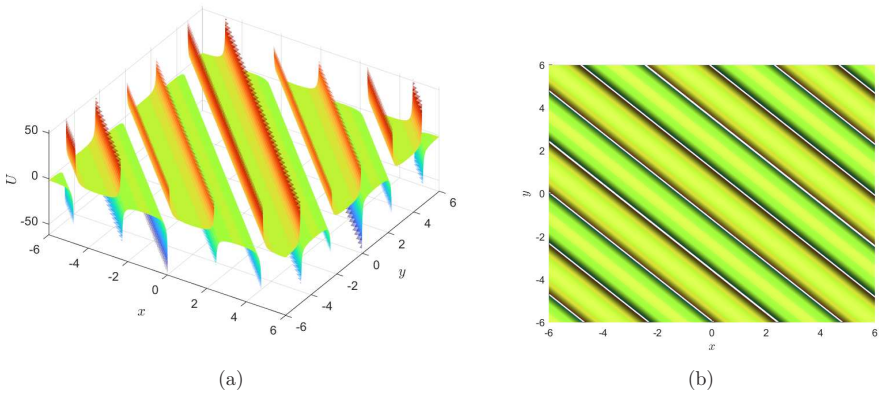
Philip Rosenau. Dynamics of dense discrete systems: High order effects. Progress of Theoretical Physics, 79(5):1028–1042, 1988. Figure 1: Numerical simulation of the solution ( 3.13) for t = 0. The values of parameters are k = 1, m = 8, c = 10, α = 15, β = − 2, K = − 25, A 0 = 24 and the roots of the Eq. ( 3.13) are 4, 3, 2, 1, respectively. 23 Figure 2: N...
1988
discussion (0)
Sign in with ORCID, Apple, or X to comment. Anyone can read and Pith papers without signing in.