REVIEW 3 major objections 5 minor 27 references
A frozen robot policy can be steered at deployment by imagining candidate futures with a latent world model and ranking them with a language-conditioned value model—no finetuning required.
Reviewed by Pith at T0; open to challenge. T0 means a machine referee read the full paper against a public rubric. the ladder, T0–T4 →
T0 review · grok-4.5
2026-07-12 06:29 UTC pith:YUR6ZPTI
load-bearing objection Training-free VLA steering with real-robot gains that hold up under the ablations; ranking correlation is the softest link, not a contradiction. the 3 major comments →
DREAMSTEER: Latent World Models Can Steer VLA Policies During Deployment Without Any Finetuning
The pith
A machine-rendered reading of the paper's core claim, the machinery that carries it, and where it could break.
Core claim
Deployment-time steering of a frozen VLA is possible by ranking short imagined rollouts: candidate action chunks from the policy and simple Cartesian primitives are rolled out in a multi-embodiment latent world model and scored by a language-conditioned progress value model; the highest-scoring chunk is executed. With no component finetuned on target data, this composition alone lifts real-robot OOD manipulation success from 23.75% to 66.25% and instruction-following accuracy from 38.75% to 56.25% over single-sample policy execution.
What carries the argument
DreamSteer: a training-free selection loop that samples action chunks, predicts their futures with an action-conditioned latent world model (frozen visual latents plus a factorized spatio-temporal transformer), and ranks the decoded rollouts with a language-conditioned value model before execution.
Load-bearing premise
Short imagined futures from the latent world model must keep the same preference order as real futures under the value model well enough that the top-ranked candidate is usually the right one to run.
What would settle it
On the same OOD pick-and-place trials, if ranking candidates by value scores on world-model rollouts no longer beats random selection among the same candidate set—or if value scores on imagined clips systematically reverse the order of matched ground-truth clips—the claimed steering gain collapses.
If this is right
- Useful action chunks often already sit inside a pretrained VLA’s sampling distribution; under distribution shift the bottleneck is selection, not generation.
- A world model and value model trained on broader interaction data can correct a policy trained only on successful demonstrations.
- Zero-shot rollout ranking becomes a practical alternative when target-environment finetuning is unwanted or infeasible.
- Short-horizon latent prediction, rather than pixel video generation, is fast enough for online ranking of many candidates on real hardware.
- Adding simple fixed Cartesian primitives expands coverage when policy samples alone stall near the object.
Where Pith is reading between the lines
- The same sample–imagine–rank loop could wrap any stochastic generative policy, not only VLAs, wherever a latent dynamics model and a progress critic exist.
- Multi-view value scoring would cut ranking errors caused by single-camera visual similarity and tighten imagined versus true preference order.
- Candidate coverage is a hard ceiling: when neither policy samples nor fixed primitives approach the goal, steering cannot invent a solution—latent planning or iterative proposal refinement is the natural next lever.
- The complementary-data story invites deliberate system-level training splits (policy on demos, world model on mixed play, value on action-free video) rather than only post-hoc assembly of frozen parts.
Editorial analysis
A structured set of objections, weighed in public.
Referee Report
Summary. The paper proposes DREAMSTEER, a deployment-time steering method that improves a frozen pretrained VLA (π0) without any target-environment finetuning or parameter updates. At each steering step it forms a candidate set of action chunks from stochastic VLA samples plus a small library of Cartesian primitives, rolls each candidate out with a multi-embodiment action-conditioned latent world model (DINOv2 latents, spatio-temporal transformer), decodes the imagined observations, and ranks them with a frozen language-conditioned value model (VLAC). The highest-scoring chunk is executed. Real-robot experiments on a Franka/DROID-style setup under substantial distribution shift report OOD pick-and-place success rising from 23.75% to 66.25% and instruction-following accuracy from 38.75% to 56.25% over single-sample π0, with ablations showing that both candidate diversity and value ranking are necessary.
Significance. If the reported gains hold under broader evaluation, the work offers a practical, training-free route to improve generalist VLAs at deployment—an important operational need given the cost and risk of collecting target-domain demonstrations. Strengths include a clean training-free composition claim, multi-embodiment world-model training, explicit ablations (Table 2) that isolate diversity versus ranking, Wilson confidence intervals on real-robot trials, and a quantified check that imagined rollouts preserve relative value order (Pearson r=0.66, Spearman ρ=0.69). The approach is complementary to finetuning and is immediately usable with existing frozen VLAs, latent world models, and progress estimators.
major comments (3)
- §4.2 / Fig. 6: The ranking assumption that H=10 latent rollouts preserve VLAC order is supported only by moderate correlation (Pearson r=0.66, Spearman ρ=0.69) on held-out RoboArena clips. This is the softest load-bearing link for the central claim. The paper should either (i) report ranking accuracy / top-1 selection agreement on the same clips (not only correlation of scalar scores), or (ii) show that the real-robot gains remain when the value model is replaced by an oracle ranking of ground-truth futures, so readers can bound how much of the 23.75%→66.25% lift is limited by ranking error.
- §4.3 / Tables 2–3: Evaluation covers only four OOD objects and four IF targets (20 trials each). Aggregate Wilson CIs are reported, but object-level variance is large (e.g., Tape 6/20→16/20 vs. Mustard 3/20→11/20). For a claim of broad OOD robustness under deployment shift, the manuscript needs either more objects/scenes or a clearer statement that the result is a controlled demonstration on this object set rather than a general guarantee. Expanding the object suite or adding a leave-one-object-out style check would strengthen the central numbers.
- §3.2 / Eq. (1) and candidate construction: The full method’s gain over π0+DREAMSTEER (42.5%→66.25%) comes largely from the hand-designed Cartesian primitive library. The paper should quantify how sensitive results are to the primitive set (e.g., remove gripper open/close, change step sizes, or replace primitives with pure noise around the current pose). Without that, it remains unclear how much of the reported improvement is portable versus dependent on a carefully chosen C_prim for this workbench.
minor comments (5)
- §4.3: Steering latency (~13 s for 13 candidates) is acknowledged but not placed in context of closed-loop control rates; a short note on how often steering is applied relative to the low-level controller would help practitioners.
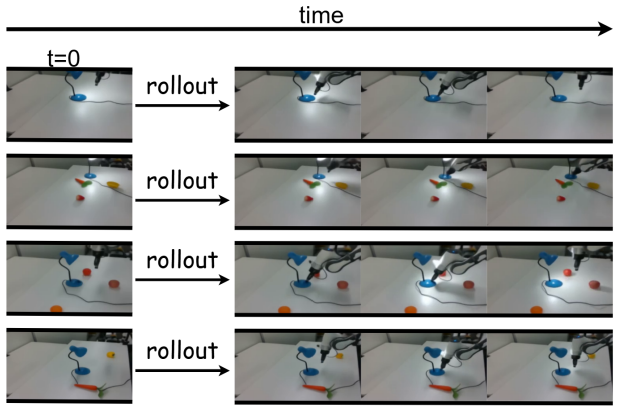
- Fig. 5 / Fig. 10: Rollout visualizations are useful; adding the corresponding VLAC scores next to selected frames would make the ranking story more self-contained.
- Table 1: “Training-free composition” is a useful axis; a one-sentence clarification that VLAC and the world model are themselves pretrained (just not on the target lab) would avoid any ambiguity about “zero training.”
- Notation: C_t = C_VLA ∪ C_prim is clear; stating the exact |C_prim| and the numerical K used in the main tables once in the main text (not only in the supplement) would improve reproducibility.
- Related work: V-GPS, FOREWARN, GPC, VLA-Reasoner, and LaDi-WM are fairly compared; a brief note on whether any of those methods could be run zero-shot with the same frozen π0 would make the novelty claim sharper.
Circularity Check
No circularity: empirical real-robot gains from frozen composition, not quantities forced by definition or self-citation.
full rationale
DREAMSTEER is a systems/empirical paper whose central claims are measured physical success rates (Table 2: 23.75%→66.25% OOD; Table 3: 38.75%→56.25% IF) under a frozen π0 + multi-embodiment latent world model + off-the-shelf VLAC ranking pipeline with no target-environment data. The selection rule (Eq. 1) simply argmaxes value scores over imagined rollouts; those scores are not fitted to the evaluation tasks, nor is any reported gain algebraically identical to a training objective or a self-cited uniqueness result. World-model training (heterogeneous DROID/EgoDex/RoboMIND/etc. data, latent MSE) and VLAC are independent of the target lab; the Pearson/Spearman consistency check (§4.2) is a post-hoc validation of ranking fidelity, not a circular fit. Ablations (π0 alone, π0+DREAMSTEER, primitives-only, random) further show the gains require both candidate diversity and ranking rather than tautological re-labeling. No self-definitional equation, fitted-input-as-prediction, load-bearing self-citation uniqueness claim, or renamed known result appears in the derivation chain.
Axiom & Free-Parameter Ledger
free parameters (4)
- number of VLA samples K =
5
- action chunk horizon H =
10
- steering frequency =
every 5 steps
- Cartesian primitive library =
6 directions + open/close
axioms (3)
- domain assumption Latent DINOv2 dynamics trained on multi-embodiment data transfer to the evaluation robot and novel objects sufficiently for relative ranking.
- domain assumption VLAC pairwise progress scores, when summed, produce a ranking that correlates with true task progress under the given language instruction.
- domain assumption Useful action chunks exist inside the pretrained VLA distribution or the primitive library for the evaluated tasks.
invented entities (1)
-
DREAMSTEER candidate set C_t = C_VLA ∪ C_prim
no independent evidence
read the original abstract
Pretrained vision-language-action (VLA) policies show promising zero-shot generalization, but often fail under deployment-time distribution shift, leading to decreased robustness and inconsistent instruction following. While prior work commonly tackles this by finetuning on in-distribution data, it assumes demonstrations collected on tasks in the target environment. In this work, we propose DREAMSTEER, a deployment-time steering framework for pretrained VLAs without any finetuning or parameter modifications. The key insight in DREAMSTEER is to leverage a latent world model and a value model to steer pretrained VLA policies. During deployment, DREAMSTEER samples candidate action chunks from a VLA policy and predefined motion primitives, imagines their outcomes using an action-conditioned latent world model, and ranks the imagined trajectories with a language-conditioned value model. Across four real-world manipulation benchmarks with unseen objects, DREAMSTEER improves task success rate from 23.75% to 66.25% and instruction-following accuracy from 38.75% to 56.25% over the base VLA policy.
Figures



Reference graph
Works this paper leans on
-
[1]
K. Black, N. Brown, D. Driess, A. Esmail, M. Equi, C. Finn, N. Fusai, L. Groom, K. Hausman, B. Ichter, et al.π0: A vision-language-action flow model for general robot control. corr, abs/2410.24164, 2024. doi: 10.48550.arXiv preprint ARXIV .2410.24164
Pith/arXiv arXiv 2024
-
[2]
J. Bjorck, F. Casta ˜neda, N. Cherniadev, X. Da, R. Ding, L. Fan, Y . Fang, D. Fox, F. Hu, S. Huang, et al. Gr00t n1: An open foundation model for generalist humanoid robots.arXiv preprint arXiv:2503.14734, 2025
Pith/arXiv arXiv 2025
-
[3]
M. J. Kim, K. Pertsch, S. Karamcheti, T. Xiao, A. Balakrishna, S. Nair, R. Rafailov, E. Foster, G. Lam, P. Sanketi, et al. Openvla: An open-source vision-language-action model.arXiv preprint arXiv:2406.09246, 2024
Pith/arXiv arXiv 2024
-
[4]
Zitkovich, T
B. Zitkovich, T. Yu, S. Xu, P. Xu, T. Xiao, F. Xia, J. Wu, P. Wohlhart, S. Welker, A. Wahid, et al. Rt-2: Vision-language-action models transfer web knowledge to robotic control. In Conference on Robot Learning, pages 2165–2183. PMLR, 2023
2023
-
[5]
K. Pertsch, K. Stachowicz, B. Ichter, D. Driess, S. Nair, Q. Vuong, O. Mees, C. Finn, and S. Levine. Fast: Efficient action tokenization for vision-language-action models.arXiv preprint arXiv:2501.09747, 2025
Pith/arXiv arXiv 2025
-
[6]
Z. Kang, X. Zhao, and D. Song. Scalable best-of-n selection for large language models via self-certainty.arXiv preprint arXiv:2502.18581, 2025
arXiv 2025
-
[7]
R. Pi, H. Bai, Q. Chen, X. S. Wang, J. Shan, X. Liu, and M. Cao. Mr. judge: Multimodal reasoner as a judge. InProceedings of the 2025 Conference on Empirical Methods in Natural Language Processing, pages 20192–20216, 2025
2025
-
[8]
N. Agarwal, A. Ali, M. Bala, Y . Balaji, E. Barker, T. Cai, P. Chattopadhyay, Y . Chen, Y . Cui, Y . Ding, et al. Cosmos world foundation model platform for physical ai.arXiv preprint arXiv:2501.03575, 2025
Pith/arXiv arXiv 2025
-
[9]
M. Assran, A. Bardes, D. Fan, Q. Garrido, R. Howes, M. Muckley, A. Rizvi, C. Roberts, K. Sinha, A. Zholus, et al. V-jepa 2: Self-supervised video models enable understanding, prediction and planning.arXiv preprint arXiv:2506.09985, 2025
Pith/arXiv arXiv 2025
-
[10]
G. Zhou, H. Pan, Y . LeCun, and L. Pinto. Dino-wm: World models on pre-trained visual features enable zero-shot planning 2024.URL https://arxiv. org/abs/2411, 4983
2024
-
[11]
A. Khazatsky, K. Pertsch, S. Nair, A. Balakrishna, S. Dasari, S. Karamcheti, S. Nasiriany, M. K. Srirama, L. Y . Chen, K. Ellis, et al. Droid: A large-scale in-the-wild robot manipulation dataset.arXiv preprint arXiv:2403.12945, 2024
Pith/arXiv arXiv 2024
-
[12]
M. Nakamoto, O. Mees, A. Kumar, and S. Levine. Steering your generalists: Improving robotic foundation models via value guidance.arXiv preprint arXiv:2410.13816, 2024
Pith/arXiv arXiv 2024
-
[13]
Y . Wu, R. Tian, G. Swamy, and A. Bajcsy. From foresight to forethought: Vlm-in-the-loop policy steering via latent alignment.arXiv preprint arXiv:2502.01828, 2025
Pith/arXiv arXiv 2025
-
[14]
H. Qi, H. Yin, Y . Du, and H. Yang. Strengthening generative robot policies through predictive world modeling.arXiv e-prints, pages arXiv–2502, 2025. 10
2025
-
[15]
J. Jang, S. Ye, Z. Lin, J. Xiang, J. Bjorck, Y . Fang, F. Hu, S. Huang, K. Kundalia, Y .-C. Lin, et al. Dreamgen: Unlocking generalization in robot learning through neural trajectories.arXiv e-prints, pages arXiv–2505, 2025
2025
-
[16]
C. Higuera, S. Arnaud, B. Boots, M. Mukadam, F. R. Hogan, and F. Meier. Visuo-tactile world models.arXiv preprint arXiv:2602.06001, 2026
arXiv 2026
-
[17]
W. Guo, G. Lu, H. Deng, Z. Wu, Y . Tang, and Z. Wang. Vla-reasoner: Empowering vision- language-action models with reasoning via online monte carlo tree search.arXiv preprint arXiv:2509.22643, 2025
arXiv 2025
-
[18]
Y . Huang, J. Zhang, S. Zou, X. Liu, R. Hu, and K. Xu. Ladi-wm: A latent diffusion-based world model for predictive manipulation.arXiv preprint arXiv:2505.11528, 2025
Pith/arXiv arXiv 2025
-
[19]
Q. Bu, J. Cai, L. Chen, X. Cui, Y . Ding, S. Feng, S. Gao, X. He, X. Hu, X. Huang, et al. Agibot world colosseo: A large-scale manipulation platform for scalable and intelligent embodied systems.arXiv preprint arXiv:2503.06669, 2025
Pith/arXiv arXiv 2025
-
[20]
R. Hoque, P. Huang, D. J. Yoon, M. Sivapurapu, and J. Zhang. Egodex: Learning dexterous manipulation from large-scale egocentric video.arXiv preprint arXiv:2505.11709, 2025
Pith/arXiv arXiv 2025
-
[21]
K. Wu, C. Hou, J. Liu, Z. Che, X. Ju, Z. Yang, M. Li, Y . Zhao, Z. Xu, G. Yang, et al. Robomind: Benchmark on multi-embodiment intelligence normative data for robot manipulation.arXiv preprint arXiv:2412.13877, 2024
Pith/arXiv arXiv 2024
-
[22]
Y . Guo, L. X. Shi, J. Chen, and C. Finn. Ctrl-world: A controllable generative world model for robot manipulation.arXiv preprint arXiv:2510.10125, 2025
Pith/arXiv arXiv 2025
-
[23]
M. Xu, W. Dai, C. Liu, X. Gao, W. Lin, G.-J. Qi, and H. Xiong. Spatial-temporal transformer networks for traffic flow forecasting.arXiv preprint arXiv:2001.02908, 2020
Pith/arXiv arXiv 2001
-
[24]
M. Oquab, T. Darcet, T. Moutakanni, H. V o, M. Szafraniec, V . Khalidov, P. Fernandez, D. Haz- iza, F. Massa, A. El-Nouby, et al. Dinov2: Learning robust visual features without supervision. arXiv preprint arXiv:2304.07193, 2023
Pith/arXiv arXiv 2023
-
[25]
S. Zhai, Q. Zhang, T. Zhang, F. Huang, H. Zhang, M. Zhou, S. Zhang, L. Liu, S. Lin, and J. Pang. A vision-language-action-critic model for robotic real-world reinforcement learning. arXiv preprint arXiv:2509.15937, 2025
arXiv 2025
-
[26]
Z. Chen, W. Wang, Y . Cao, Y . Liu, Z. Gao, E. Cui, J. Zhu, S. Ye, H. Tian, Z. Liu, et al. Expanding performance boundaries of open-source multimodal models with model, data, and test-time scaling.arXiv preprint arXiv:2412.05271, 2024
Pith/arXiv arXiv 2024
-
[27]
Pick up the{phone}and place it into the brown box
P. Atreya, K. Pertsch, T. Lee, M. J. Kim, A. Jain, A. Kuramshin, C. Eppner, C. Neary, E. Hu, F. Ramos, et al. Roboarena: Distributed real-world evaluation of generalist robot policies. arXiv preprint arXiv:2506.18123, 2025. 11 Supplementary Materials 7 World Model Design and Training The world model is an action-conditioned latent predictor optimized for ...
arXiv 2025
discussion (0)
Sign in with ORCID, Apple, or X to comment. Anyone can read and Pith papers without signing in.