REVIEW 3 major objections 6 minor 130 references
CoFEND: A Cross-Modal Fusion End-to-End Network for Cold-Start Drug-Drug Interaction Prediction
T0 review · 3 major / 6 minor · reviewed 2026-07-12 · grok-4.5
Pith's one-line read Cold-start drug interaction prediction works better when four biomedical views of each drug are fused end-to-end, not scored offline.
desk verdict Solid multi-view cold-start DDI model with real tables and ablations; the main open question is whether the four KGs fully isolate held-out drugs. read the letter →
The pith
A machine-rendered reading of the paper's core claim, the machinery that carries it, and where it could break.
The reading
What carries the argument
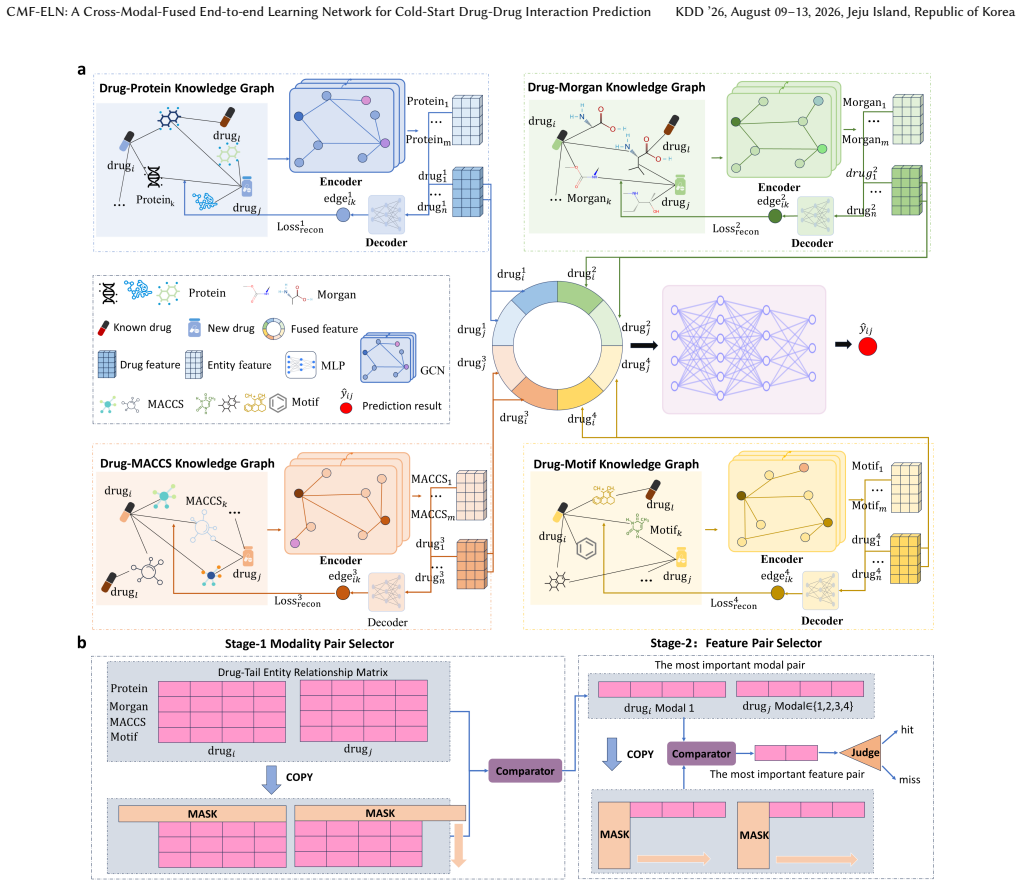
Four-channel graph autoencoder with joint loss L = L_label + Σ λ_k L_edge_k: each channel is a GCN encoder–decoder pair that reconstructs its own drug–entity edges while the concatenated drug embeddings feed an MLP that predicts DDI type; the shared gradient couples similarity learning to the prediction task.
What would settle it
Re-run the identical five-fold cold-start protocol after systematically ablating or randomizing one or more of the four graphs (or after replacing the joint loss with offline similarity features); if the accuracy and Friedman-rank gains disappear, the claimed benefit of end-to-end cross-modal fusion is not supported.
Extended reading notes
Core claim
CMF-ELN shows that cold-start multi-class DDI prediction accuracy rises when four modality-specific drug knowledge graphs are encoded by parallel graph autoencoders and fused inside a single end-to-end objective that jointly reconstructs drug–entity relations and classifies interaction types; the same fused representation also supports a two-stage attribution that localizes risk factors for both the perpetrator and the victim drug.
Load-bearing premise
The four hand-built drug–entity graphs, especially the reduced set of 13 MACCS keys and chemistry-rule motifs, must encode a similarity geometry that still holds for completely held-out drug types under the paper’s fold protocol.
Editorial extensions
If this is right
- Cold-start DDI predictors should keep similarity learning and interaction classification inside one gradient path rather than pre-computing fixed multi-modal similarity matrices.
- Protein, fingerprint, key, and motif channels are complementary; dropping any of them, especially the protein channel, measurably weakens multi-class accuracy.
- Interpretability for DDI can and should attribute both the perpetrator’s aggressive factors and the victim’s susceptibility, not only the former.
- When new drugs arrive with incomplete annotations, the reconstruction-supervised multi-channel design still supplies usable embeddings for interaction prediction.
Reading between the lines
- The same four-channel end-to-end pattern could transfer to other cold-start biomedical link tasks (drug–target, drug–side-effect) that already possess multi-view entity graphs.
- Because the method relies on fixed chemistry-rule motifs and a curated MACCS subset, future work that learns motifs or expands key coverage may further reduce the gap on (new,new) pairs.
- Dual-end attribution could be turned into a clinical triage tool that flags both high-risk perpetrators and especially vulnerable victims for experimental follow-up.
Editorial analysis
A structured set of objections, weighed in public.
Referee Report
Summary. The manuscript proposes CMF-ELN, an end-to-end multi-modal framework for cold-start drug–drug interaction (DDI) prediction. It builds four drug-centered knowledge graphs (protein/enzyme–transporter, Morgan fingerprints, selected MACCS keys, and chemistry-rule motifs), encodes each with a GCN-based graph autoencoder under edge-reconstruction supervision (Eqs. 1–6), fuses the four drug embeddings via concatenation and an MLP for multi-class DDI prediction (Eqs. 7–9), and jointly optimizes label and reconstruction losses (Eq. 10). A two-stage perturbation scheme attributes dominant modalities and tail-entity pairs for both perpetrator and victim drugs. On two DrugBank-derived datasets, under five-fold cold-start splits for (known,new) and (new,new) pairs, CMF-ELN reports the best Friedman ranks against eight baselines, with Wilcoxon p-values < 0.05, plus modality ablations and embedding visualizations.
Significance. Cold-start DDI prediction is practically important and methodologically hard because new drugs lack interaction labels and often have incomplete multimodal annotations. If the reported gains hold under a truly inductive protocol, the paper offers a useful integration of multi-view biomedical graphs with joint similarity–prediction training and a dual-sided interpretability pipeline that goes beyond single-modality perpetrator analysis. Strengths include a clear multi-channel design, joint supervision aligning reconstruction with DDI labels, broad multi-metric comparison with statistical tests, modality ablations (Table 3), and public code/data. These make the work a credible empirical contribution to multimodal biomedical graph learning, contingent on resolving whether the cold-start protocol fully isolates held-out drugs in the knowledge graphs.
major comments (3)
- Section 5.2 states that one-fifth of drug types are designated “new” and “all associated DDI pairs” form the test set, but never states whether triples involving those drugs are removed from the four modality graphs used by the GCN encoders (Eq. 2) and edge losses (Eq. 6). If protein, fingerprint, MACCS, or motif links of held-out drugs remain in the adjacency matrices during training, neighborhood aggregation and shared-tail reconstruction can embed “new” drugs non-inductively. This is load-bearing for the central cold-start claim. Please specify the isolation protocol for each channel, and if graphs currently include cold-start drugs, re-run Task 1/2 with those triples removed (or provide a controlled leakage ablation).
- Section 4.3 and the dual-end interpretability claim: victim evidence is fixed a priori to modality 1 (enzyme-related features) following MeT-DDI’s mechanistic chain, while only the perpetrator modality is selected by size-calibrated masking (Eqs. 11–13). This design choice undercuts the claim of discovering “underlying causes of susceptibility for the victim drug” in a multi-modal, data-driven way. Either (i) allow Stage-1 to select victim modality as well and report agreement with enzyme-centric ground truth, or (ii) reframe the contribution as perpetrator-side multi-modal attribution under a fixed victim enzyme hypothesis, with quantitative recovery metrics on the MeT-DDI evaluation cases rather than Top-1 ranking alone.
- Eq. (10) and free parameters: the joint objective depends on four reconstruction weights λ_k, embedding size (set to 128), and the hand-selected subset of 13 MACCS keys (Section 4.1), none of which receive sensitivity analysis. Table 3 ablates channel presence but not λ_k or MACCS selection. Because the paper’s claim is that reconstruction-supervised cross-modal fusion is what drives cold-start gains, please report λ_k values used, a small sensitivity study (e.g., λ_k ∈ {0, 0.1, 1}), and a brief justification or ablation for retaining only 13 MACCS keys versus the full key set.
minor comments (6)
- Title/branding inconsistency: the arXiv-facing title uses “CoFEND” in the provided metadata while the manuscript body consistently uses “CMF-ELN.” Align naming across title, abstract, and repository.
- Table 1, Dataset 2: CMF-ELN loses F1 to MDDI-SCL (0.6171 vs 0.6322) and is not best on Pre; the text’s “significantly higher … than its peers” should acknowledge metric-level exceptions rather than only aggregate Win/Loss and Friedman rank.
- Figure 2: Silhouette and KNN accuracy are mentioned in the text but not reported as numbers in the figure caption or a small table; add the quantitative values for the fused vs unimodal embeddings.
- Section 2.4 is disproportionately long relative to its direct relevance to DDI cold-start and reads as a broad latent-factor/GNN survey; consider tightening to work that directly motivates multi-modal sparsity handling in biomedical graphs.
- Notation: embedding dimension is written as both D and C (Eqs. 3 vs 7); unify. Also clarify whether relation types C_k in Eq. (6) are multi-class beyond a binary “include” for Morgan/MACCS/motif channels.
- Implementation details (Section 5.1) omit batch size, number of epochs, early stopping, and how multi-class AUPR/AUC are macro/micro-averaged for 4 vs 86 DDI types; add these for reproducibility.
Circularity Check
Standard supervised multi-modal GNN for cold-start DDI; held-out metrics are not forced by construction. Only minor non-load-bearing self-citation density in related-work motivation.
-
self citation load bearing
[Section 2.4 Representation Learning for Incomplete and Heterogeneous Data]
"A series of latent factor and feature-selection models by Wu, Luo, and collaborators investigate robust representations for high-dimensional sparse matrices, online streams, and web-service quality prediction [45, 73–89, 92, 93, 98, 99, 111]. Recent tensor, federated, and autoencoding extensions further emphasize learning reliable latent structure from dynamic, privacy-sensitive, and partially observed data [3, 8, 17, 23, 25, 28, 34–36, 39, 46, 48, 59–61, 66, 68, 94, 95, 100, 106, 107, 110, 112, 119]."
Large block of overlapping-author citations frames the incomplete-data motivation. Not load-bearing for the paper’s central claim (superior cold-start DDI accuracy on held-out pairs): no uniqueness theorem is imported, and Tables 1–2 compare against independent baselines on DrugBank. Minor self-citation density only; does not force the reported metrics.
full rationale
CMF-ELN is an empirical ML method: four drug-centered KGs feed a four-channel GAE whose embeddings are fused by an MLP and trained with the joint objective L = L_label + Σ λ_k L_edge_k (Eqs. 6–10). Test metrics in Tables 1–2 come from five-fold cold-start splits that hold out drug types and their DDI pairs; those metrics are not algebraically determined by the reconstruction losses or by any fitted scalar renamed as a prediction. There is no uniqueness theorem, no ansatz smuggled in as a forced form, and no self-definitional identity between a claimed first-principles result and its inputs. Dense citations to the authors’ prior latent-factor / incomplete-data work (Sec. 2.4) motivate representation learning under sparsity but do not underwrite the DDI accuracy claims, which rest on external DrugBank baselines. Possible KG leakage of cold-start drugs’ entity links (if any) is a methodology/generalization risk, not circularity by construction. Score 1 only for non-load-bearing self-citation volume; central derivation chain is self-contained empirical evaluation.
Assumptions & free parameters
free parameters (4)
- λ_k reconstruction loss weights (k=1..4)
- embedding dimension D / C (set to 128)
- learning rate 1e-3 and regularization 1e-6
- selected 13 MACCS keys retained as entities
assumptions (5)
- domain assumption Drug similarity relevant to cold-start DDI can be adequately captured by protein (enzyme/transporter), Morgan bit, MACCS key, and motif inclusion graphs.
- domain assumption Holding out one-fifth of drug types and all associated pairs yields a valid cold-start evaluation of new drugs.
- ad hoc to paper Multi-class cross-entropy on DDI types plus edge reconstruction is an appropriate joint objective for similarity–prediction alignment.
- domain assumption Victim-side evidence can be fixed to enzyme-related modality 1 when attributing mechanisms, following MeT-DDI’s inhibition narrative.
- standard math Standard GCN neighborhood aggregation and MLP classifiers are valid representation learners on these heterogeneous graphs.
invented entities (2)
-
CMF-ELN four-channel graph autoencoder + MLP fusion architecture
-
Two-stage size-calibrated modality-then-tail masking interpretability scheme
Cite this review
Pith. "Pith review of CoFEND: A Cross-Modal Fusion End-to-End Network for Cold-Start Drug-Drug Interaction Prediction." pith.science (2026). https://pith.science/paper/SI6O6ZVK
@misc{pith2026260702928,
  author       = {Pith},
  title        = {Pith review of: CoFEND: A Cross-Modal Fusion End-to-End Network for Cold-Start Drug-Drug Interaction Prediction},
  year         = {2026},
  howpublished = {\url{https://pith.science/paper/SI6O6ZVK}},
  note         = {Machine review of arXiv:2607.02928}
}
read the original abstract
Cold-start drug-drug interaction (DDI) prediction for new drugs is critical for minimizing unexpected adverse drug reactions. The key challenge is to capture similarity between new and known drugs. However, such similarity is closely associated with complex relationships and mechanisms among drugs, enzymes, transporters, molecular structures, and other biomedical entities. Existing methods have three limitations in capturing such similarity: (1) only partial relationships and mechanisms are considered, which overlooks cross-modal information and yields incomplete or biased similarity modeling; (2) similarity computation between new and known drugs is conducted separately across modalities and performed offline for cold-start DDI prediction, leading to misalignment between similarity computation and DDI prediction; and (3) existing interpretability analyses are typically single-modality and focus primarily on key determinants of the perpetrator drug, while the underlying causes of susceptibility for the victim drug are seldom investigated. To address these issues, this paper proposes a novel Cross-Modal-Fused End-to-End Learning Network (CMF-ELN) with three components. First, diverse multimodal information is leveraged to construct four types of drug-centered knowledge graphs, enabling comprehensive similarity modeling under reconstruction-based supervision. Second, a four-channel graph autoencoder is designed to fuse cross-modal similarity within an end-to-end learning framework. Finally, a two-stage interpretability scheme is devised to precisely localize key factors for both perpetrator and victim drugs. Extensive experiments on two real datasets demonstrate that CMF-ELN achieves significantly higher prediction accuracy and more comprehensive interpretability of mechanisms than its peers.
Figures

Reference graph
Works this paper leans on
-
[1]
E Amiri Souri, Roman Laddach, SN Karagiannis, Lazaros G Papageorgiou, and Sophia Tsoka. 2022. Novel drug-target interactions via link prediction and network embedding.BMC bioinformatics23, 1 (2022), 121
2022
-
[2]
F. Bi, T. He, Y. S. Ong, and X. Luo. 2024. Graph Linear Convolution Pooling for Learning in Incomplete High-Dimensional Data.IEEE Transactions on Knowledge and Data Engineering37, 4 (2024), 1838–1852
2024
-
[3]
J. Chen, K. Liu, X. Luo, Y. Yuan, K. Sedraoui, Y. Al-Turki, and M. C. Zhou. 2024. A State-Migration Particle Swarm Optimizer for Adaptive Latent Factor Analysis of High-Dimensional and Incomplete Data.IEEE/CAA Journal of Automatica Sinica11, 11 (2024), 2220–2235
2024
-
[4]
J. Chen, X. Luo, Y. Yuan, and Z. Wang. 2025. Enhancing Graph Convolutional Networks with an Efficient k-Hop Neighborhood Approach.Information Fusion 124 (2025), 103297
2025
-
[5]
J. Chen, Y. Yuan, and X. Luo. 2024. SDGNN: Symmetry-Preserving Dual-Stream Graph Neural Networks.IEEE/CAA Journal of Automatica Sinica11, 7 (2024), 1717–1719
2024
-
[6]
J. Chen, Y. Yuan, X. Luo, and X. Gao. 2025. An Adaptive Neighborhood-Resonated Graph Convolution Network for Undirected Weighted Graph Representation. IEEE Transactions on Neural Networks and Learning Systems(2025)
2025
-
[7]
Lifan Chen, Xiaoqin Tan, Dingyan Wang, Feisheng Zhong, Xiaohong Liu, Tian- biao Yang, Xiaomin Luo, Kaixian Chen, Hualiang Jiang, and Mingyue Zheng
-
[8]
TransformerCPI: improving compound–protein interaction prediction by sequence-based deep learning with self-attention mechanism and label reversal experiments.Bioinformatics36, 16 (2020), 4406–4414
2020
Show all 130 references
-
[9]
M. Chen, R. Wang, Y. Qiao, and X. Luo. 2024. A Generalized Nesterov’s Accel- erated Gradient-Incorporated Non-Negative Latent-Factorization-of-Tensors Model for Efficient Representation to Dynamic QoS Data.IEEE Transactions on Emerging Topics in Computational Intelligence8, 3 (2024)
2024
-
[10]
M. Chen, M. Zhang, and C. Qu. 2025. Towards Interpretable Drug-Drug Interac- tion Prediction: A Graph-Based Approach with Molecular and Network-Level Explanations. InProceedings of the 31st ACM SIGKDD Conference on Knowledge Discovery and Data Mining (KDD ’25). ACM, 203–214
2025
-
[11]
Thomas Cover and Peter Hart. 1967. Nearest neighbor pattern classification. IEEE transactions on information theory13, 1 (1967), 21–27
1967
-
[12]
Jorg Degen, Christof Wegscheid-Gerlach, Andrea Zaliani, and Matthias Rarey
-
[13]
ChemMedChem3, 10 (2008), 1503
On the art of compiling and using’drug-like’chemical fragment spaces. ChemMedChem3, 10 (2008), 1503
2008
-
[14]
Janez Demšar. 2006. Statistical comparisons of classifiers over multiple data sets.Journal of Machine learning research7, Jan (2006), 1–30. CMF-ELN: A Cross-Modal-Fused End-to-end Learning Network for Cold-Start Drug-Drug Interaction Prediction KDD ’26, August 09–13, 2026, Jej...
2006
-
[15]
Y. Deng, X. Xu, Y. Qiu, et al. 2020. A multimodal deep learning framework for predicting drug–drug interaction events.Bioinformatics36, 15 (2020), 4316– 4322
2020
-
[16]
Joseph L Durant, Burton A Leland, Douglas R Henry, and James G Nourse. 2002. Reoptimization of MDL keys for use in drug discovery.Journal of chemical information and computer sciences42, 6 (2002), 1273–1280
2002
-
[17]
Feng, S.-W
Y. Feng, S.-W. Zhang, and J.-Y. Shi. 2020. DPDDI: A deep predictor for drug–drug interactions.BMC Bioinformatics21, 1 (Sept. 2020), 419
2020
-
[18]
Milton Friedman. 1937. The use of ranks to avoid the assumption of normality implicit in the analysis of variance.Journal of the american statistical association 32, 200 (1937), 675–701
1937
-
[19]
J. X. Gao, D. Wu, J. Chen, M. Zhou, and X. Luo. 2025. Federated Deep Latent Factor Model for Privacy-Preserving Recommendation. InProceedings of the IEEE International Conference on Systems, Man, and Cybernetics
2025
-
[20]
Assaf Gottlieb, Gideon Y Stein, Yoram Oron, Eytan Ruppin, and Roded Sharan
-
[21]
INDI: a computational framework for inferring drug interactions and their associated recommendations.Molecular systems biology8, 1 (2012), 592
2012
-
[22]
J. Gou, Y. Cheng, B. Ma, L. Du, X. Luo, and Z. Yi. 2025. Multi-Scale Collaborative Distillation Graph Neural Networks for Session-Based Recommendation.IEEE Transactions on Services Computing(2025)
2025
-
[23]
M. Han, L. Wang, Y. Yuan, and X. Luo. 2025. SGD-DYG: Self-Reliant Global Dependency Apprehending on Dynamic Graphs. InProceedings of the ACM SIGKDD Conference on Knowledge Discovery and Data Mining
2025
-
[24]
T. He, Z. Duan, and X. Luo. 2026. Modularized Graph Convolutional Network. IEEE/CAA Journal of Automatica Sinica13, 3 (2026), 737–739
2026
-
[25]
T. He, Y. Liu, Y. S. Ong, X. Wu, and X. Luo. 2024. Polarized Message-Passing in Graph Neural Networks.Artificial Intelligence331 (2024), 104129
2024
-
[26]
He and X
Y. He and X. Luo. 2026. Tensor Low-Rank Orthogonal Compression for Convo- lutional Neural Networks.IEEE/CAA Journal of Automatica Sinica13, 1 (2026), 227–229
2026
-
[27]
Yi He, Tengfei Ma, Chen Li, et al. 2025. ImageDDI: Image-enhanced molecular motif sequence representation for drug-drug interaction prediction.Information Fusion117 (2025), 103574. doi:10.1016/j.inffus.2024.103574
2025 doi
-
[28]
Y. He, H. Wu, W. Liu, and X. Luo. 2026. A Survey of Latent Factorization of Tensor-Based Model Compression: Algorithms, Toolboxes and Future Directions. Neurocomputing(2026), 133455
2026
-
[29]
Z. He, M. Lin, X. Luo, and Z. Xu. 2024. Structure-Preserved Self-Attention for Fusion Image Information in Multiple Color Spaces.IEEE Transactions on Neural Networks and Learning Systems36, 7 (2024), 13021–13035
2024
-
[30]
Y. Hong, P. Luo, S. Jin, and X. Liu. 2022. LaGAT: link-aware graph attention network for drug–drug interaction prediction.Bioinformatics38, 24 (2022), 5406–5412
2022
-
[31]
Y. Hou, P. Tang, and X. Luo. 2026. Multi-Aspect Self-Attending Neural Tucker Factorization for Spatiotemporal Representation Learning.IEEE/CAA Journal of Automatica Sinica13, 4 (2026), 986–988
2026
-
[32]
Z. Hou, X. Liu, Y. Cen, et al. 2022. Graphmae: Self-supervised masked graph autoencoders. InProceedings of the 28th ACM SIGKDD conference on knowledge discovery and data mining. 594–604
2022
-
[33]
Kexin Huang, Tianfan Fu, Lucas M Glass, Marinka Zitnik, Cao Xiao, and Jimeng Sun. 2020. DeepPurpose: a deep learning library for drug–target interaction prediction.Bioinformatics36, 22-23 (2020), 5545–5547
2020
-
[34]
Glass, and Jimeng Sun
Kexin Huang, Cao Xiao, Lucas M. Glass, and Jimeng Sun. 2021. Molecular Interaction Transformer for drug–target interaction prediction.Bioinformatics 37, 6 (2021), 830–836. doi:10.1093/bioinformatics/btaa880
2021 doi
-
[35]
Kexin Huang, Cao Xiao, Trong Hoang, Lucas Glass, and Jimeng Sun. 2020. Caster: Predicting drug interactions with chemical substructure representation. InProceedings of the AAAI conference on artificial intelligence, Vol. 34. 702–709
2020
-
[36]
C. Li, P. Huang, J. Qin, and X. Luo. 2025. Knowledge-Driven Multiple Instance Learning with Hierarchical Cluster-Incorporated Aware Filtering for Larynx Pathological Grading.IEEE Journal of Biomedical and Health Informatics(2025)
2025
-
[37]
J. Li, Y. Yuan, T. He, and X. Luo. 2026. Adaptive PID-Incorporated Nonnegative Latent Factor Analysis.IEEE Transactions on Systems, Man, and Cybernetics: Systems(2026)
2026
-
[38]
X. Liao, H. Wu, T. He, and X. Luo. 2025. A Proximal-ADMM-Incorporated Nonnegative Latent-Factorization-of-Tensors Model for Representing Dynamic Cryptocurrency Transaction Network.IEEE Transactions on Systems, Man, and Cybernetics: Systems(2025)
2025
-
[39]
X. Liao, H. Wu, and X. Luo. 2025. A Novel Tensor Causal Convolution Network Model for Highly-Accurate Representation to Spatio-Temporal Data.IEEE Transactions on Automation Science and Engineering(2025)
2025
-
[40]
L. Lin, Q. Li, M. Qiao, Z. Wang, J. Zhao, R. H. Li, X. Luo, and T. Jia. 2025. NCSAC: Effective Neural Community Search via Attribute-Augmented Conductance. IEEE Transactions on Knowledge and Data Engineering38, 2 (2025), 1221–1235
2025
-
[41]
Lin and X
L. Lin and X. Luo. 2026. Dual Channel Graph Convolutional Networks via Personalized PageRank.IEEE/CAA Journal of Automatica Sinica13, 1 (2026), 221–223
2026
-
[42]
M. Lin, X. Lin, X. Xu, Z. Xu, and X. Luo. 2025. Neural Networks-Incorporated Latent Factor Analysis for High-Dimensional and Incomplete Data.IEEE Trans- actions on Systems, Man, and Cybernetics: Systems(2025)
2025
-
[43]
S. Lin, W. Chen, G. Chen, et al. 2022. MDDI-SCL: predicting multi-type drug-drug interactions via supervised contrastive learning.Journal of Cheminformatics14, 1 (2022), 1–12
2022
-
[44]
S. Lin, Y. Wang, L. Zhang, et al . 2022. MDF-SA-DDI: Predicting drug–drug interaction events based on multi-source drug fusion, multi-source feature fusion and transformer self-attention mechanism.Briefings in Bioinformatics 23, 1 (2022), bbab421. doi:10.1093/bib/bbab421
2022 doi
-
[45]
X. Lin, Z. Quan, Z.-J. Wang, T. Ma, and X. Zeng. 2020. KGNN: Knowledge Graph Neural Network for Drug-Drug Interaction Prediction.IJCAI380 (2020), 2739–2745
2020
-
[46]
J. Liu, X. Shen, X. Zhang, and H. Chen. 2022. Predicting drug–drug interactions by graph convolutional network with multi-kernel.Briefings in Bioinformatics 23, 1 (Jan. 2022)
2022
-
[47]
Liu, X.-N
Z. Liu, X.-N. Wang, H. Yu, J.-Y. Shi, and W.-M. Dong. 2022. Predict multi-type drug–drug interactions in cold-start scenario.BMC Bioinformatics23, 1 (Feb. 2022), 75
2022
-
[48]
Xin Luo, MengChu Zhou, Shuai Li, Di Wu, Zhigang Liu, and Mingsheng Shang
-
[49]
doi:10.1109/ TBDATA.2019.2916868
Algorithms of Unconstrained Non-Negative Latent Factor Analysis for Recommender Systems.IEEE Transactions on Big Data(2019). doi:10.1109/ TBDATA.2019.2916868
2019
-
[50]
C. Lyu, J. Cheng, X. Luo, and Y. Shi. 2025. Genetic Algorithm-Based Two-Step Optimization for Precise Latent Factor Analysis.IEEE Transactions on Neural Networks and Learning Systems(2025)
2025
-
[51]
T. Lyu, J. Gao, L. Tian, et al . 2021. MDNN: A multimodal deep neural net- work for predicting drug-drug interaction events. InProceedings of the Thirtieth International Joint Conference on Artificial Intelligence (IJCAI-21). 3536–3542. doi:10.24963/ijcai.2021/487
2021 doi
-
[52]
Q. Ma, D. Wu, and X. Luo. 2025. A Review of Deep Learning-Based Power Load Forecasting Methods.International Journal of Network Dynamics and Intelligence KDD ’26, August 09–13, 2026, Jeju Island, Republic of Korea Di Wu et al. 4, 4 (2025), 100027
2025
-
[53]
Tengfei Ma, Cao Xiao, Jiayu Zhou, and Fei Wang. 2018. Drug similarity in- tegration through attentive multi-view graph auto-encoders.arXiv preprint arXiv:1804.10850(2018)
2018 arXiv
-
[54]
Milo et al
R. Milo et al. 2002. Network Motifs: Simple Building Blocks of Complex Net- works.Science298, 5594 (2002), 824–827
2002
-
[55]
A. K. Nyamabo, H. Yu, and J.-Y. Shi. 2021. SSI–DDI: Substructure–substructure interactions for drug–drug interaction prediction.Briefings in Bioinformatics 22, 6 (2021), bbab133. doi:10.1093/bib/bbab133
2021 doi
-
[56]
Bethany Percha and Russ B Altman. 2013. Informatics confronts drug–drug interactions.Trends in pharmacological sciences34, 3 (2013), 178–184
2013
-
[57]
J Peter and Silhouettes Rousseeuw. 1987. A graphical aid to the interpretation and validation of cluster analysis.J. Comput. Appl. Math20 (1987)
1987
-
[58]
Y. Qiao, L. Hu, J. Zhang, P. Hu, and X. Luo. 2025. Identifying Novel Therapeutic Targets of Natural Compounds in Traditional Chinese Medicine Herbs with Hypergraph Representation Learning.Briefings in Bioinformatics26, 4 (2025), bbaf399
2025
-
[59]
David Rogers and Mathew Hahn. 2010. Extended-connectivity fingerprints. Journal of chemical information and modeling50, 5 (2010), 742–754
2010
-
[60]
Narjes Rohani and Changiz Eslahchi. 2019. Drug-drug interaction predicting by neural network using integrated similarity.Scientific reports9, 1 (2019), 13645
2019
-
[61]
J. Y. Ryu, H. U. Kim, and S. Y. Lee. 2018. Deep learning improves prediction of drug–drug and drug–food interactions.Proceedings of the National Academy of Sciences115, 18 (2018), E4304–E4311
2018
-
[62]
X. Su, L. Hu, Z. You, P. Hu, and B. Zhao. 2022. Attention-based knowledge graph representation learning for predicting drug-drug interactions.Briefings in Bioinformatics23, 3 (2022), bbac140. doi:10.1093/bib/bbac140
2022 doi
-
[63]
P. Tang, Y. Hou, and X. Luo. 2026. MPSANT: A Novel Multi-Projection Self- Attending Neural Tucker Factorization Model for High-Dimensional and Incom- plete Data Representation Learning.Information Fusion(2026), 104449
2026
-
[64]
P. Tang, X. Luo, and J. Woodcock. 2025. Auto-Encoding Neural Tucker Factor- ization.IEEE Transactions on Knowledge and Data Engineering(2025)
2025
-
[65]
P. Tang, T. Ruan, H. Wu, and X. Luo. 2024. Temporal Pattern-Aware QoS Predic- tion by Biased Non-Negative Tucker Factorization of Tensors.Neurocomputing 582 (2024), 127447
2024
-
[66]
Zhenchao Tang, Guanxing Chen, Hualin Yang, Weihe Zhong, and Calvin Yu- Chian Chen. 2023. DSIL-DDI: A domain-invariant substructure interaction learning for generalizable drug–drug interaction prediction.IEEE Transactions on Neural Networks and Learning Systems35, 8 (2023), 10552–10560
2023
-
[67]
Farhan Tanvir, Khaled Mohammed Saifuddin, Muhammad Ifte Khairul Islam, and Esra Akbas. 2023. Predicting drug-drug interactions using heterogeneous graph attention networks. InProceedings of the 14th ACM International Conference on Bioinformatics, Computational Biology, and Hea...
2023
-
[68]
N. P. Tatonetti, P. P. Ye, R. Daneshjou, and R. B. Altman. 2012. Data-driven prediction of drug effects and interactions.Science Translational Medicine4, 125 (Mar. 2012), 125
2012
-
[69]
Santiago Vilar, Eugenio Uriarte, Lourdes Santana, Tal Lorberbaum, George Hripcsak, Carol Friedman, and Nicholas P Tatonetti. 2014. Similarity-based modeling in large-scale prediction of drug-drug interactions.Nature protocols9, 9 (2014), 2147–2163
2014
-
[70]
J. Wang, W. Li, and X. Luo. 2024. A Distributed Adaptive Second-Order Latent Factor Analysis Model.IEEE/CAA Journal of Automatica Sinica11, 11 (2024), 2343–2345
2024
-
[71]
L. Wang, Y. Yuan, and X. Luo. 2026. Advanced High-Order Graph Convolutional Networks with Assorted Time-Frequency Transforms.IEEE/CAA Journal of Automatica Sinica13, 2 (2026), 394–408
2026
-
[72]
Q. Wang, H. Wu, and X. Luo. 2025. A Convolution Bias-Incorporated Non- negative Latent Factorization of Tensors Model for Accurate Representation Learning to Dynamic Directed Graphs.IEEE Transactions on Systems, Man, and Cybernetics: Systems(2025)
2025
-
[73]
Y. Wang, Z. Yang, and Q. Yao. 2024. Accurate and interpretable drug-drug inter- action prediction enabled by knowledge subgraph learning.Communications Medicine4, 1 (2024), 59. doi:10.1038/s43856-024-00486-y
2024 doi
-
[74]
Ziyan Wang, Zhankun Xiong, Feng Huang, Xuan Liu, and Wen Zhang. 2024. ZeroDDI: a zero-shot drug-drug interaction event prediction method with se- mantic enhanced learning and dual-modal uniform alignment.arXiv preprint arXiv:2407.00891(2024)
2024 arXiv
-
[75]
Larry C Wienkers and Timothy G Heath. 2005. Predicting in vivo drug inter- actions from in vitro drug discovery data.Nature reviews Drug discovery4, 10 (2005), 825–833
2005
-
[76]
D. S. Wishart, Y. D. Feunang, A. C. Guo, E. J. Lo, A. Marcu, et al. 2018. DrugBank 5.0: A major update to the DrugBank database for 2018.Nucleic Acids Research 46, D1 (Jan. 2018), D1074–D1082
2018
-
[77]
Di Wu, Qiang He, Xin Luo, Mingsheng Shang, Yi He, and Guoyin Wang. 2022. A Posterior-Neighborhood-Regularized Latent Factor Model for Highly Accurate Web Service QoS Prediction.IEEE Transactions on Services Computing15, 2 (2022), 793–805
2022
-
[78]
Di Wu, Yi He, and Xin Luo. 2023. A Graph-Incorporated Latent Factor Analysis Model for High-Dimensional and Sparse Data.IEEE Transactions on Emerging Topics in Computing11, 4 (2023), 907–917. doi:10.1109/TETC.2023.3292866
2023 doi
-
[79]
Di Wu, Yi He, Xin Luo, and MengChu Zhou. 2022. A Latent Factor Analysis- Based Approach to Online Sparse Streaming Feature Selection.IEEE Transactions on Systems, Man, and Cybernetics: Systems52, 11 (2022), 6744–6758. doi:10.1109/ TSMC.2021.3096065
2022
-
[80]
Di Wu, Yuanpeng Hu, Kechen Liu, Jing Li, Xianmin Wang, Song Deng, Nenggan Zheng, and Xin Luo. 2025. An Outlier-Resilient Autoencoder for Representing High-Dimensional and Incomplete Data.IEEE Transactions on Emerging Topics in Computational Intelligence9, 2 (2025), 1379–1391. ...
2025 doi
-
[81]
Di Wu, Long Jin, and Xin Luo. 2020. PMLF: Prediction-Sampling-Based Multilayer-Structured Latent Factor Analysis. InProceedings of the IEEE In- ternational Conference on Data Mining
2020
-
[82]
Di Wu, Shihui Li, Yi He, Xin Luo, and Xinbo Gao. 2026. Non-Gradient Hash Factor Learning for High-Dimensional and Incomplete Data Representation Learning.IEEE Transactions on Pattern Analysis and Machine Intelligence48, 5 (2026), 5811–5826. doi:10.1109/TPAMI.2026.3653780
2026 doi
-
[83]
Di Wu, Zechao Li, Zhikai Yu, Yi He, and Xin Luo. 2025. Robust Low-Rank Latent Feature Analysis for Spatiotemporal Signal Recovery.IEEE Transactions on Neural Networks and Learning Systems36, 2 (2025), 2829–2842. doi:10.1109/ TNNLS.2023.3339786
2025
-
[84]
Di Wu, Cheng Liang, Yi He, Yan Qiao, and Xin Luo. 2026. Multimetric Au- toencoder for Representing High-Dimensional and Incomplete Data.IEEE Transactions on Systems, Man, and Cybernetics: Systems56, 3 (2026), 1533–1546. doi:10.1109/TSMC.2025.3646863
2026 doi
-
[85]
Di Wu and Xin Luo. 2021. Robust Latent Factor Analysis for Precise Represen- tation of High-Dimensional and Sparse Data.IEEE/CAA Journal of Automatica Sinica8, 4 (2021). doi:10.1109/JAS.2020.1003533
2021 doi
-
[86]
Di Wu, Xin Luo, Yi He, and MengChu Zhou. 2024. A Prediction-Sampling- Based Multilayer-Structured Latent Factor Model for Accurate Representation to High-Dimensional and Sparse Data.IEEE Transactions on Neural Networks and Learning Systems35, 3 (2024), 3845–3858. doi:10.1109/T...
2024 doi
-
[88]
In Proceedings of the Pacific-Asia Conference on Knowledge Discovery and Data Mining
A Data-Aware Latent Factor Model for Web Service QoS Prediction. In Proceedings of the Pacific-Asia Conference on Knowledge Discovery and Data Mining
-
[90]
InProceedings of the IEEE International Conference on Big Data
Online Feature Selection with Capricious Streaming Features: A General Framework. InProceedings of the IEEE International Conference on Big Data
-
[91]
Di Wu, Xin Luo, Mingsheng Shang, Yi He, Guoyin Wang, and Xindong Wu
-
[92]
A Data-Characteristic-Aware Latent Factor Model for Web Service QoS Prediction.IEEE Transactions on Knowledge and Data Engineering34, 6 (2022), 2525–2538
2022
-
[93]
Di Wu, Xin Luo, Mingsheng Shang, Yi He, Guoyin Wang, and MengChu Zhou
-
[94]
doi:10.1109/TSMC.2019.2931393
A Deep Latent Factor Model for High-Dimensional and Sparse Matrices in Recommender Systems.IEEE Transactions on Systems, Man, and Cybernetics: Systems51, 7 (2021), 4285–4296. doi:10.1109/TSMC.2019.2931393
2021 doi
-
[95]
Di Wu, Xin Luo, Guoyin Wang, Mingsheng Shang, Ye Yuan, and Huyong Yan
-
[96]
A Highly-Accurate Framework for Self-Labeled Semi-Supervised Classifi- cation in Industrial Applications.IEEE Transactions on Industrial Informatics14, 3 (2018), 909–920
2018
-
[97]
Di Wu, Mingsheng Shang, Xin Luo, and Zidong Wang. 2022. An L1-and-L2- Norm-Oriented Latent Factor Model for Recommender Systems.IEEE Trans- actions on Neural Networks and Learning Systems33, 10 (2022), 5775–5788. doi:10.1109/TNNLS.2021.3071392
2022 doi
-
[98]
Di Wu, Mingsheng Shang, Xin Luo, Ji Xu, Huyong Yan, Weihui Deng, and Guoyin Wang. 2018. Self-Training Semi-Supervised Classification Based on Density Peaks of Data.Neurocomputing275 (2018), 180–191
2018
-
[99]
D. Wu, W. Sun, Y. He, Z. Chen, and X. Luo. 2024. MKG-FENN: A Multimodal Knowledge Graph Fused End-to-End Neural Network for Accurate Drug–Drug Interaction Prediction.Proceedings of the AAAI Conference on Artificial Intelli- gence38, 9 (2024), 10216–10224. doi:10.1609/aaai.v38i9.28887
2024 doi
-
[100]
Di Wu, Zetong Tang, Yi He, and Xin Luo. 2026. SchemaRAG: A Schema-aware Retrieval-Augmented Generation Framework for Text-to-SQL.Proceedings of the ACM on Management of Data4, 1 (2026), 82:1–82:26. doi:10.1145/3786696
2026 doi
-
[101]
Di Wu, Peng Zhang, Yi He, and Xin Luo. 2023. A Double-Space and Double- Norm Ensembled Latent Factor Model for Highly Accurate Web Service QoS Prediction.IEEE Transactions on Services Computing16, 2 (2023), 802–814. doi:10.1109/TSC.2022.3178543
2023 doi
-
[102]
Di Wu, Peng Zhang, Yi He, and Xin Luo. 2024. MMLF: Multi-Metric Latent Feature Analysis for High-Dimensional and Incomplete Data.IEEE Transactions on Services Computing17, 2 (2024), 575–588. doi:10.1109/TSC.2023.3331570
2024 doi
-
[103]
Di Wu, Shuai Zhong, Yi He, Xin Luo, and Xinbo Gao. 2026. Federated La- tent Factorization of Tensors for Privacy-Preserving Representation Learning to Large-scale Dynamic Weighted Directed Network.IEEE Transactions on Dependable and Secure Computing(2026). doi:10.1109/TDSC.202...
2026 doi
-
[104]
H. Wu, Q. Wang, X. Luo, and Z. Wang. 2025. Learning Accurate Representation to Nonstandard Tensors via a Mode-Aware Tucker Network.IEEE Transactions on Knowledge and Data Engineering(2025)
2025
-
[105]
M. Y. Wu, P. W. Hu, Z. H. You, J. Zhang, L. Hu, and X. Luo. 2025. Graph- Based Prediction of miRNA-Drug Associations with Multisource Information and Metapath Enhancement Matrices.IEEE Journal of Biomedical and Health Informatics(2025)
2025
-
[106]
Zhaoping Xiong, Dingyan Wang, Xiaohong Liu, Feisheng Zhong, Xiaozhe Wan, Xutong Li, Zhaojun Li, Xiaomin Luo, Kaixian Chen, Hualiang Jiang, et al. 2019. Pushing the boundaries of molecular representation for drug discovery with the graph attention mechanism.Journal of medicinal...
2019
-
[107]
Ruiyang Xu, Di Wu, and Xin Luo. 2025. Recursion-and-Fuzziness Reinforced Online Sparse Streaming Feature Selection.IEEE Transactions on Fuzzy Systems 33, 8 (2025), 2574–2586. doi:10.1109/TFUZZ.2025.3569272
2025 doi
-
[108]
Ruiyang Xu, Di Wu, Renfang Wang, and Xin Luo. 2025. A Highly-Accurate Three-Way Decision-Incorporated Online Sparse Streaming Features Selection Model.IEEE Transactions on Systems, Man, and Cybernetics: Systems55, 6 (2025)
2025
-
[109]
X. Xu, M. Lin, Z. Xu, and X. Luo. 2025. Attention-Mechanism-Based Neu- ral Latent-Factorization-of-Tensors Model.ACM Transactions on Knowledge Discovery from Data19, 4 (2025), 1–27
2025
-
[110]
F. Yang, D. Wu, Y. He, L. Tao, and X. Luo. 2024. End-to-End Graph Learn- ing Approach for Cognitive Diagnosis of Student Tutorial.arXiv preprint arXiv:2411.00845(2024)
2024 arXiv
-
[111]
Y. Yang, L. Hu, G. Li, D. Li, P. Hu, and X. Luo. 2025. FMvPCI: A Multiview Fusion Neural Network for Identifying Protein Complex via Fuzzy Clustering.IEEE Transactions on Systems, Man, and Cybernetics: Systems(2025)
2025
-
[112]
Y. Yang, L. Hu, G. Li, D. Li, P. Hu, and X. Luo. 2025. Link-Based Attributed Graph Clustering via Approximate Generative Bayesian Learning.IEEE Transactions on Systems, Man, and Cybernetics: Systems(2025)
2025
-
[113]
Qing Ye, Chang-Yu Hsieh, Ziyi Yang, Yu Kang, Jiming Chen, Dongsheng Cao, Shibo He, and Tingjun Hou. 2021. A unified drug–target interaction prediction framework based on knowledge graph and recommendation system.Nature communications12, 1 (2021), 6775
2021
-
[114]
Y. Ye, J. Zhou, S. Li, C. Xiao, H. Ying, and H. Xiong. 2024. Hierarchical Cross- Level Graph Contrastive Learning for Drug-Drug Interaction Prediction. In Database Systems for Advanced Applications (DASFAA 2024). Springer Nature Singapore, Singapore, 232–242. doi:10.1007/978-9...
2024 doi
-
[115]
C. Yu, D. Wu, J. Chen, M. Zhou, and X. Luo. 2025. Multi-Indicator Latent Factorization of Tensors for Spatio-Temporal Signal Recovery. InProceedings of the IEEE International Conference on Parallel and Distributed Systems
2025
-
[116]
Chengjun Yu, Di Wu, Yi He, Jia Chen, and Xin Luo. 2026. Federated Latent Factor Learning for Privacy-Preserving Spatio-Temporal Signal Recovery. In Proceedings of the ACM Web Conference. 2905–2916. doi:10.1145/3774904.3792353
2026 doi
-
[117]
Yue Yu, Kexin Huang, Chao Zhang, Lucas M Glass, Jimeng Sun, and Cao Xiao
-
[118]
SumGNN: multi-typed drug interaction prediction via efficient knowledge graph summarization.Bioinformatics37, 18 (2021), 2988–2995
2021
-
[119]
Zhaoning Yu and Hongyang Gao. 2022. Molecular Representation Learning via Heterogeneous Motif Graph Neural Networks. InProceedings of the 39th International Conference on Machine Learning (ICML) (Proceedings of Machine Learning Research, Vol. 162). PMLR, 25581–25594
2022
-
[120]
Y. Yuan, J. Li, and X. Luo. 2024. A Fuzzy PID-Incorporated Stochastic Gradi- ent Descent Algorithm for Fast and Accurate Latent Factor Analysis.IEEE Transactions on Fuzzy Systems32, 7 (2024), 4049–4061
2024
-
[121]
Ye Yuan, Xin Luo, Mingsheng Shang, and Di Wu. 2020. A Generalized and Fast- Converging Nonnegative Latent Factor Model for Predicting User Preferences in Recommender Systems. InProceedings of The Web Conference. 498–507
2020
-
[122]
Y. Yuan, S. Wang, H. Zhou, L. Wang, and X. Luo. 2026. A Novel Approach to Temporal QoS Estimation via Extended Kalman Filter-Incorporated Latent Feature Analysis.IEEE Transactions on Services Computing(2026)
2026
-
[123]
Y. Yuan, Y. Wang, and X. Luo. 2024. A Node-Collaboration-Informed Graph Con- volutional Network for Highly Accurate Representation to Undirected Weighted Graph.IEEE Transactions on Neural Networks and Learning Systems36, 6 (2024), 11507–11519
2024
-
[124]
Zhang, Y
Y. Zhang, Y. Ling, W. Xian, Z. Ziheng, L. Zhenxi, Z. Yefeng Yao, and Quanming
-
[125]
doi:10.1038/s43588-023-00558-4
Emerging drug interaction prediction enabled by a flow-based graph neural network with biomedical network.Nature Computational Science3, 12 (2023), 1023–1033. doi:10.1038/s43588-023-00558-4
2023 doi
-
[126]
Zaixi Zhang, Qi Liu, Hao Wang, Chengqiang Lu, and Chee-Kong Lee. 2021. Motif-based graph self-supervised learning for molecular property prediction. InAdvances in Neural Information Processing Systems (NeurIPS), Vol. 34. 15870– 15882
2021
-
[127]
B. W. Zhao, X. R. Su, Y. Yang, D. X. Li, G. D. Li, P. W. Hu, X. Luo, and L. Hu. 2024. A Heterogeneous Information Network Learning Model with Neighborhood- Level Structural Representation for Predicting lncRNA-miRNA Interactions. Computational and Structural Biotechnology Jour...
2024
-
[128]
B. W. Zhao, X. R. Su, Y. Yang, D. X. Li, G. D. Li, P. W. Hu, Z. H. You, X. Luo, and L. Hu. 2025. Regulation-Aware Graph Learning for Drug Repositioning over Heterogeneous Biological Network.Information Sciences686 (2025), 121360
2025
-
[129]
Zhong, G
Y. Zhong, G. Li, J. Yang, et al. 2024. Learning motif-based graphs for drug–drug interaction prediction via local–global self-attention.Nature Machine Intelligence 6 (2024), 1094–1105. doi:10.1038/s42256-024-00888-6
2024 doi
-
[130]
Zhong, K
Y. Zhong, K. Liu, S. Gao, and X. Luo. 2024. Alternating-Direction-Method of Multipliers-Based Adaptive Nonnegative Latent Factor Analysis.IEEE Transac- tions on Emerging Topics in Computational Intelligence8, 5 (2024)
2024
-
[131]
X. Zhu, L. Li, W. Liu, and X. Luo. 2024. Multi-Level Sequence Denoising with Cross-Signal Contrastive Learning for Sequential Recommendation.Neural Networks179 (2024), 106480
2024
-
[132]
Marinka Zitnik, Monica Agrawal, and Jure Leskovec. 2018. Modeling polyphar- macy side effects with graph convolutional networks.Bioinformatics34, 13 (2018), i457–i466
2018
Reviewed July 12, 2026 · model on record in the stance chip above.
Discussion (0). Continue with ORCID to comment.