REVIEW 2 major objections 5 minor 110 references
Microcosmos models artificial life as elastic filaments in a viscous fluid that is both GPU-scalable and fully differentiable.
Reviewed by Pith at T0; open to challenge. T0 means a machine referee read the full paper against a public rubric. the ladder, T0–T4 →
T0 review · grok-4.5
2026-07-12 05:51 UTC pith:MFN5I4ZT
load-bearing objection Solid systems paper that actually fills the three-way gap it claims (differentiable Cosserat filaments + resolved LBM fluid + evolutionary search) and ships open code; the hydrodynamics are approximate but not load-bearing for the platform claim. the 2 major comments →
Microcosmos: Reimagining Artificial Life for the GPU Era
The pith
A machine-rendered reading of the paper's core claim, the machinery that carries it, and where it could break.
Core claim
A single simulation engine can simultaneously be physically grounded in viscous fluid dynamics, fully end-to-end differentiable, and linear-scaling on modern GPUs, thereby supporting both gradient-based morphology optimization and evolutionary discovery of diverse locomotion and chemotaxis behaviors.
What carries the argument
Elastic Cosserat filaments coupled to a lattice-Boltzmann fluid via the immersed-boundary method, with all constraints and forces expressed so that JAX can differentiate through the entire time-stepping loop.
Load-bearing premise
The combination of grid-based soft repulsion and diffuse immersed-boundary forcing is accurate enough that the evolutionary dynamics remain physically credible even though fluid can still leak through the zero-thickness filaments and collisions are never exact.
What would settle it
Run the same hand-designed reciprocal and non-reciprocal gaits at progressively higher viscosity and check whether net displacement of reciprocal strategies collapses to zero while non-reciprocal strategies continue to propel, exactly as Purcell's scallop theorem requires; any persistent reciprocal locomotion would falsify the fluid coupling.
Editorial analysis
A structured set of objections, weighed in public.
Referee Report
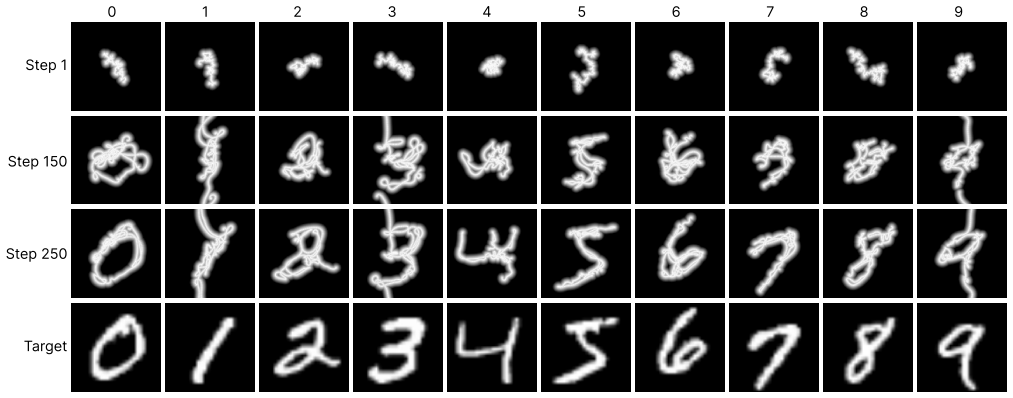
Summary. Microcosmos is a JAX-based, GPU-native, end-to-end differentiable simulator for artificial life in which organisms are elastic Cosserat filament chains immersed in a 2D viscous fluid solved by lattice Boltzmann (D2Q9) with immersed-boundary coupling. The authors validate the engine with four experiments: hand-designed gaits that recover the qualitative signature of Purcell’s scallop theorem under a viscosity sweep; gradient-based folding of 1000-node filaments into MNIST digit shapes; NEAT/CPPN neuroevolution and MAP-Elites quality-diversity search that discover diverse swimming and chemotaxis behaviors; and wall-clock measurements showing linear scaling with particle count up to 500k particles. The platform is released open-source with the long-term aim of supporting large-scale open-ended evolution in a physically grounded substrate.
Significance. If the engineering claims hold, the paper supplies a missing middle ground between abstract ALife substrates and high-fidelity but non-scalable biophysical simulators. The combination of differentiable Cosserat rods, a resolved LBM fluid, linear scaling, and open code is a concrete platform contribution that the community can immediately build upon for morphology and controller co-evolution. Explicit strengths include the open GitHub release, the end-to-end differentiability demonstrated by MNIST folding through PBD and fluid, the qualitative recovery of scallop-theorem behavior, and the linear scaling data. These are falsifiable, reproducible engineering results rather than purely aspirational claims.
major comments (2)
- Methods (Fluid-filament Interaction) and Discussion acknowledge fluid leakage through zero-thickness filaments and non-exact collisions from grid-based steric repulsion. The hand-designed locomotion experiment (Figure 2) recovers only the qualitative scallop-theorem distinction. For a platform paper this is acceptable, but the manuscript should state more explicitly that the hydrodynamics are approximate and that quantitative drag coefficients or force-free swimming speeds have not been validated against analytic Stokes solutions or established Cosserat-fluid benchmarks (e.g., SophT, PyElastica). Without that caveat the claim of “physically plausible” locomotion risks overstatement for readers who expect quantitative fidelity.
- The strongest novelty claim (“first system to combine differentiable flexible filament simulation with a resolved fluid solver for both morphology and controller optimization”) is asserted in the Introduction and Related Work. The comparisons to SophT, PyElastica, Diff-FlowFSI and DiffAqua are useful, yet a short table or paragraph that enumerates which of the three ingredients (differentiable Cosserat, resolved fluid, evolutionary morphology/controller search) each prior system lacks would make the gap claim fully checkable rather than narrative.
minor comments (5)
- Figure 5 caption and text claim linear scaling; the plot itself is not shown in the supplied manuscript text. Ensure the figure and any fit statistics appear in the final version.
- Equations (1)–(4) for the PBD bending and position passes are clear, but the shear-stiffness blending in Eq. (3) would benefit from a one-sentence geometric interpretation of the Kirchhoff–Love residual.
- The MAP-Elites behavioral descriptors E_bend and E_pos (Eqs. 5–6) are sums of squared rest-parameter changes; a brief note on why these particular descriptors were chosen over, e.g., center-of-mass trajectory features would help reproducibility.
- Typographical: “M üller et al.” appears with a space artifact; “Guti érrez” likewise. Standardize author names and accents.
- The Discussion mentions restriction to cactus graphs; a short forward-looking sentence on how general graphs or self-assembly would be added would clarify the roadmap without over-claiming current capability.
Circularity Check
No significant circularity; engine is validated against external physical constraints and empirical benchmarks rather than tautological self-definition.
full rationale
Microcosmos is an engineering systems paper that introduces a GPU-native, differentiable filament-fluid simulator and exercises it on four independent validation tasks. Hand-designed gaits recover the qualitative signature of Purcell’s scallop theorem (reciprocal motion fails at high viscosity; non-reciprocal succeeds), an external physical constraint not encoded in the free parameters. Filament folding optimizes rest angles/lengths via Adam through the full PBD+LBM pipeline to match external MNIST targets; success demonstrates differentiability and expressivity rather than predicting a quantity already fitted. Neuroevolution/QD maximize external fitness (net displacement or energy collected) and discover diverse gaits; the archive is an empirical outcome, not a construction. Linear wall-clock scaling is a measured runtime property. No equation reduces a claimed prediction to a fitted constant by construction, no uniqueness theorem is imported from overlapping authors to forbid alternatives, and self-citations (NEAT, CPPN, MAP-Elites) are ordinary method references, not load-bearing premises. The approximate hydrodynamics (grid steric repulsion, diffuse IBM) are acknowledged limitations of fidelity, not circularities in the derivation chain. The paper is therefore self-contained against external benchmarks.
Axiom & Free-Parameter Ledger
free parameters (6)
- Adam learning rate and update budget for folding =
0.04 / 300 steps
- Simulation horizon for folding loss =
250 steps
- Viscosity / Reynolds sweep range =
10^{-3}–2
- Behavioral descriptors E_bend and E_pos for MAP-Elites
- Grid resolution and particle counts for scaling =
256×256 / ≤500k
- Per-edge stiffnesses and rest lengths/angles of hand-designed gaits
axioms (5)
- domain assumption D2Q9 lattice Boltzmann with TRT collision approximates the incompressible Navier-Stokes equations at the viscosities used
- domain assumption Position-based dynamics iterations sufficiently enforce Cosserat stretch/shear/bend constraints for the chosen time-step
- ad hoc to paper Diffuse immersed-boundary multi-direct forcing plus artificial two-layer thickening yields an adequate no-slip condition for zero-thickness filaments
- ad hoc to paper Grid-deposited, FFT-diffused density fields produce acceptable self-avoidance without pairwise collision resolution
- domain assumption Purcell’s scallop theorem and known low-Re gaits are the correct qualitative benchmarks for physical credibility
invented entities (1)
-
Microcosmos filament-field engine
independent evidence
read the original abstract
Most artificial life simulators either operate on abstract substrates disconnected from physical reality, or simulate physically grounded worlds that do not scale to the population sizes required for open-ended evolution. We present Microcosmos, a simulation engine in which artificial lifeforms are modeled as elastic filament chains inhabiting a two-dimensional viscous fluid world, designed from the ground up for modern GPU hardware and end-to-end differentiable simulation. We validate the engine through four experiments. Hand-designed locomotion strategies confirm that the fluid coupling respects known physical constraints. Gradient-based optimization of filament folding demonstrates both the full differentiability of the simulator and the expressivity of the filament encodings. Neuroevolution and quality-diversity search produce a wide range of swimming and chemotaxis behaviors automatically. Linear scaling with particle count confirms the engine supports large-scale simulation. Microcosmos is released as an open platform with the long-term goal of supporting large-scale open-ended evolutionary simulations, designed to be physically plausible and computationally scalable.
Figures




Reference graph
Works this paper leans on
-
[1]
, title =
Adami, C. , title =. Physics Letters A , year = 1995, volume =
1995
-
[2]
and Brown, C
Adami, C. and Brown, C. T. , title =. Artificial Life IV , pages =
-
[3]
and Brown, C.T
Adami, C. and Brown, C.T. and Haggerty, M.R. , title =. Proceedings of the Third European Conference on Advances in Artificial Life , editor =
-
[4]
and Paczuski, M
Bak, P. and Paczuski, M. , title =. 1996 , abstract =
1996
-
[5]
and Sneppen, K
Bak, P. and Sneppen, K. , title =. Physical Review Letters , year = 1993, volume = 71, pages =
1993
-
[6]
and Tang, C
Bak, P. and Tang, C. and Wiesenfeld, K. , title =. Physical Review Letters , year =
-
[7]
and Tang, C
Bak, P. and Tang, C. and Wiesenfeld, K. , title =. Physical Review A , year =
-
[8]
, title =
Burlando, B. , title =. Journal of Theoretical Biology , year =
-
[9]
and Adami, C
Chu, J. and Adami, C. , title =. Artificial Life V , pages =
-
[10]
and Cooper, V.S
Elena, S.F. and Cooper, V.S. and Lenski, R.E. , title =. Science , year = 1996, volume = 272, pages =
1996
-
[11]
and Sornette, D
Gil, L. and Sornette, D. , title =. Physical Review Letters , year =
-
[12]
and Eldredge, N
Gould, S.J. and Eldredge, N. , title =. Palaeobiology , year = 1977, volume = 3, pages =
1977
-
[13]
and Eldredge, N
Gould, S.J. and Eldredge, N. , title =. Nature , year =
-
[14]
and Travisano, M
Lenski, R. and Travisano, M. , title =. Proceedings of the National Academy of Science USA , year = 1994, volume = 91, pages =
1994
-
[15]
, title =
Newman, M.E.J. , title =. Proceedings of the Royal Society of London, Series B , year = 1996, volume = 263, pages =
1996
- [16]
-
[17]
and Fraser, S.M
Newman, M.E.J. and Fraser, S.M. and Sneppen, K. and Tozier, W.A. , title =. Physics Letters A , year = 1997, volume =
1997
-
[18]
and Brown, C.T
Ofria, C. and Brown, C.T. , title =. 1998 , abstract =
1998
-
[19]
, title =
Raup, D.M. , title =. Paleobiology , year =
-
[20]
and Johansen, A
Sornette, D. and Johansen, A. and Dornic, I. , title =. Journal de Physique I. , year =
-
[21]
and Bascompte, J
Sol\'e, R.V. and Bascompte, J. , title =. Proceedings of the Royal Society of London, Series B , year =
-
[22]
, title =
Willis, J.C. , title =. 1922 , abstract =
1922
-
[23]
American Journal of Physics , volume=
Life at low Reynolds number , author=. American Journal of Physics , volume=
-
[24]
Reports on progress in physics , volume=
The hydrodynamics of swimming microorganisms , author=. Reports on progress in physics , volume=
-
[25]
Taylor, G. I. , title =. Proceedings of the Royal Society of London. Series A , volume =. 1951 , abstract =
1951
-
[26]
Reports on progress in physics , volume=
Physics of microswimmers—single particle motion and collective behavior: a review , author=. Reports on progress in physics , volume=. 2015 , publisher=
2015
-
[27]
elegans: an integrated neuromechanical model , author=
Gait modulation in C. elegans: an integrated neuromechanical model , author=. Frontiers in computational neuroscience , volume=. 2012 , publisher=
2012
-
[28]
Artificial life , volume=
Open problems in artificial life , author=. Artificial life , volume=. 2000 , publisher=
2000
-
[29]
and Bedau, M
Packard, N. and Bedau, M. A. and Channon, A. and Ikegami, T. and Rasmussen, S. and Stanley, K. O. and Taylor, T. , title =. Artificial Life , volume =. 2019 , abstract =
2019
-
[30]
Peskin, C. S. , title =. Acta Numerica , volume =. 2002 , abstract =
2002
-
[31]
, title =
Succi, S. , title =. 2018 , abstract =
2018
-
[32]
Position based dynamics , journal =
M\". Position based dynamics , journal =. 2007 , abstract =
2007
-
[33]
ACM SIGGRAPH 2008 Papers , pages=
Discrete elastic rods , author=. ACM SIGGRAPH 2008 Papers , pages=. 2008 , publisher=
2008
-
[34]
2005 , publisher=
Nonlinear problems of elasticity , author=. 2005 , publisher=
2005
-
[35]
Astrophysics Source Code Library , pages=
Jax: Autograd and xla , author=. Astrophysics Source Code Library , pages=. 2021 , abstract =
2021
-
[36]
arXiv preprint arXiv:1910.00935 , year=
Difftaichi: Differentiable programming for physical simulation , author=. arXiv preprint arXiv:1910.00935 , year=
Pith/arXiv arXiv 1910
-
[37]
ACM SIGGRAPH , year =
Sims, Karl , title =. ACM SIGGRAPH , year =
-
[38]
Plantec, Erwan and Hamon, Gautier and Etcheverry, Mayalen and Oudeyer, Pierre-Yves and Moulin-Frier, Cl\'. Flow-. 2023 , doi=
2023
-
[39]
ACM Transactions on Graphics (ToG) , volume=
Diffpd: Differentiable projective dynamics , author=. ACM Transactions on Graphics (ToG) , volume=. 2021 , publisher=
2021
-
[40]
and Doolen, G
Chen, S. and Doolen, G. D. , title =. Annual Review of Fluid Mechanics , volume =. 1998 , abstract =
1998
-
[41]
Qian, Y. H. and d'Humi\`. Lattice. Europhysics Letters , volume =. 1992 , abstract =
1992
-
[42]
and Zheng, C
Guo, Z. and Zheng, C. and Shi, B. , title =. Physical Review E , volume =. 2002 , abstract =
2002
-
[43]
and Fan, J
Wang, Z. and Fan, J. and Luo, K. , title =. International Journal of Multiphase Flow , volume =. 2008 , abstract =
2008
-
[44]
Physica D: nonlinear phenomena , volume=
Studying artificial life with cellular automata , author=. Physica D: nonlinear phenomena , volume=. 1986 , publisher=
1986
-
[45]
Holland, J. H. , title =. 1975 , abstract =
1975
-
[46]
Proceedings of the National Academy of Sciences , volume=
A scalable pipeline for designing reconfigurable organisms , author=. Proceedings of the National Academy of Sciences , volume=. 2020 , publisher=
2020
-
[47]
and Miikkulainen, Risto , title =
Stanley, Kenneth O. and Miikkulainen, Risto , title =. Evolutionary Computation , volume =. 2002 , doi =
2002
-
[48]
, title =
Stanley, Kenneth O. , title =. Genetic Programming and Evolvable Machines , volume =. 2007 , doi =
2007
-
[49]
arXiv preprint arXiv:1504.04909 , year =
Mouret, Jean-Baptiste and Clune, Jeff , title =. arXiv preprint arXiv:1504.04909 , year =
-
[50]
Daniel and Frey, Erik and Raichuk, Anton and Girgin, Sertan and Mordatch, Igor and Bachem, Olivier , title =
Freeman, C. Daniel and Frey, Erik and Raichuk, Anton and Girgin, Sertan and Mordatch, Igor and Bachem, Olivier , title =. Thirty-fifth Conference on Neural Information Processing Systems Datasets and Benchmarks Track , year =
-
[51]
Computer Physics Communications , volume =
Ataei, Mohammadmehdi and Salehipour, Hesam , title =. Computer Physics Communications , volume =. 2024 , doi =
2024
-
[52]
Proceedings of the ACM on Computer Graphics and Interactive Techniques , volume =
Stuyck, Tuur and Chen, Hsiao-yu , title =. Proceedings of the ACM on Computer Graphics and Interactive Techniques , volume =. 2023 , doi =
2023
-
[53]
and Alieva, Ayya and Wang, Qing and Brenner, Michael P
Kochkov, Dmitrii and Smith, Jamie A. and Alieva, Ayya and Wang, Qing and Brenner, Michael P. and Hoyer, Stephan , title =. Proceedings of the National Academy of Sciences , volume =. 2021 , doi =
2021
-
[54]
Nature Communications , volume =
Zhang, Xiaotian and Chan, Fan Kiat and Parthasarathy, Tejaswin and Gazzola, Mattia , title =. Nature Communications , volume =. 2019 , doi =
2019
-
[55]
and Lu, Xi-Yun , title =
Tian, Fang-Bao and Luo, Haoxiang prestige and Zhu, Luoding and Liao, James C. and Lu, Xi-Yun , title =. Journal of Computational Physics , volume =. 2011 , doi =
2011
-
[56]
Proceedings of the 9th International Conference on Motion in Games , year =
Macklin, Miles and M. Proceedings of the 9th International Conference on Motion in Games , year =. doi:10.1145/2994258.2994272 , abstract =
-
[57]
ACM Transactions on Graphics (TOG) , volume=
Diffaqua: A differentiable computational design pipeline for soft underwater swimmers with shape interpolation , author=. ACM Transactions on Graphics (TOG) , volume=. 2021 , publisher=
2021
-
[58]
, title =
Lehman, Joel and Stanley, Kenneth O. , title =. Evolutionary Computation , volume =. 2011 , doi =
2011
-
[59]
Complex Systems , volume =
Chan, Bert Wang-Chak , title =. Complex Systems , volume =. 2019 , abstract =
2019
-
[60]
Scientific Excellence in Supercomputing , year=
Evolution and optimization of digital organisms , author=. Scientific Excellence in Supercomputing , year=
-
[61]
, title =
Ofria, Charles and Wilke, Claus O. , title =. Artificial Life , volume =. 2004 , doi =
2004
-
[62]
ACM SIGEVOlution , volume=
Unshackling evolution: evolving soft robots with multiple materials and a powerful generative encoding , author=. ACM SIGEVOlution , volume=. 2014 , publisher=
2014
-
[63]
and Stanton, Adam and Timperley, Christopher and Vostinar, Anya and Wiser, Michael , title =
Taylor, Tim and Bedau, Mark and Channon, Alastair and Ackley, David and Banzhaf, Wolfgang and Beslon, Guillaume and Dolson, Emily and Froese, Tom and Hickinbotham, Simon and Ikegami, Takashi and McMullin, Barry and Packard, Norman and Rasmussen, Steen and Virgo, Nathaniel and Agmon, Eran and Clark, Edward and McGregor, Simon and Ofria, Charles and Ropella...
2016
-
[64]
and Soros, Lisa B
Pugh, Justin K. and Soros, Lisa B. and Stanley, Kenneth O. , title =. Frontiers in Robotics and AI , volume =. 2016 , doi =
2016
-
[65]
Informatik Spektrum , volume =
Heinemann, Christian , title =. Informatik Spektrum , volume =. 2008 , doi =
2008
-
[66]
2025 , howpublished =
Whidden, Peter , title =. 2025 , howpublished =
2025
-
[67]
2024 , howpublished =
Heinemann, Christian , title =. 2024 , howpublished =
2024
-
[68]
Artificial Life conference proceedings , pages=
Indefinitely scalable computing= artificial life engineering , author=. Artificial Life conference proceedings , pages=. 2014 , organization=
2014
-
[69]
Briefings in bioinformatics , volume=
High performance cellular level agent-based simulation with FLAME for the GPU , author=. Briefings in bioinformatics , volume=. 2010 , publisher=
2010
-
[70]
Software: Practice and Experience , volume=
FLAME GPU 2: A framework for flexible and performant agent based simulation on GPUs , author=. Software: Practice and Experience , volume=. 2023 , publisher=
2023
-
[71]
International Conference on Learning Representations , year =
Matthews, Michael and Beukman, Michael and Lu, Chris and Foerster, Jakob , title =. International Conference on Learning Representations , year =
-
[72]
, title =
Peskin, Charles S. , title =. Journal of Computational Physics , volume =. 1972 , doi =
1972
-
[73]
Royal Society open science , volume=
Forward and inverse problems in the mechanics of soft filaments , author=. Royal Society open science , volume=. 2018 , publisher=
2018
-
[74]
arXiv preprint arXiv:2301.07028 , year=
Aquarium: A fully differentiable fluid-structure interaction solver for robotics applications , author=. arXiv preprint arXiv:2301.07028 , year=
-
[75]
Computer Methods in Applied Mechanics and Engineering , volume=
Self-propelling, soft, and slender structures in fluids: Cosserat rods immersed in the velocity--vorticity formulation of the incompressible Navier--Stokes equations , author=. Computer Methods in Applied Mechanics and Engineering , volume=. 2025 , publisher=
2025
-
[76]
Journal of Computational Physics , volume =
Fan, Xiantao and Wang, Jian-Xun , title =. Journal of Computational Physics , volume =. 2024 , doi =
2024
-
[77]
Computer Methods in Applied Mechanics and Engineering , volume=
Diff-FlowFSI: A GPU-optimized differentiable CFD platform for high-fidelity turbulence and FSI simulations , author=. Computer Methods in Applied Mechanics and Engineering , volume=. 2026 , publisher=
2026
-
[78]
arXiv preprint arXiv:2504.08339 , year=
TensorNEAT: a GPU-accelerated library for NeuroEvolution of Augmenting Topologies , author=. arXiv preprint arXiv:2504.08339 , year=
-
[79]
Proceedings of the companion conference on genetic and evolutionary computation , pages=
Towards large-scale simulations of open-ended evolution in continuous cellular automata , author=. Proceedings of the companion conference on genetic and evolutionary computation , pages=. 2023 , abstract =
2023
-
[80]
Science Advances , volume=
Discovering sensorimotor agency in cellular automata using diversity search , author=. Science Advances , volume=. 2025 , publisher=
2025
discussion (0)
Sign in with ORCID, Apple, or X to comment. Anyone can read and Pith papers without signing in.