REVIEW 2 major objections 4 minor 44 references
Time-dependent multiparameter estimation for quantum experiments via online-offline sequential Monte-Carlo method
T0 review · 2 major / 4 minor · reviewed 2026-07-12 · grok-4.5
Pith's one-line read A hybrid SMC-plus-batch method tracks multiparameter drifts in noisy quantum data better than static calibration, recovering a hidden jump.
desk verdict Solid hybrid SMC + batch-averaged Kraus map that improves reconstruction on two real qubit datasets and surfaces a bias jump calibration missed; RMSE is relative evidence, not ground truth. read the letter →
The pith
A machine-rendered reading of the paper's core claim, the machinery that carries it, and where it could break.
The reading
What carries the argument
The batch-averaged Kraus map (exact form Eq. 28, O(Δτ^{2}) approximation Eq. 43) that lets a single particle filter evolve an averaged trajectory while still computing the correct Gaussian likelihood for the mean record.
What would settle it
Re-run the identical algorithm on the same fluorescence and dispersive-z data sets with deliberately halved batch size; if the reconstructed RMSE no longer improves over calibration and the bias jump disappears, the batch-constancy premise has failed.
Extended reading notes
Core claim
When continuous homodyne records from superconducting qubits are partitioned into batches, averaged, and processed by an SMC particle filter whose resampling is itself an SMC sampler, the resulting multiparameter trajectories reconstruct the observed signals more accurately than the published static calibrations and reveal previously undetected jumps in the bias parameter.
Load-bearing premise
Parameters are treated as constant inside each batch so that a single averaged Kraus map remains valid; any drift on the batch timescale systematically biases the posterior.
Editorial extensions
If this is right
- Slow parameter drifts that static calibrations miss become visible in continuous quantum experiments without new hardware.
- Signal-reconstruction RMSE supplies a model-independent figure of merit for comparing estimators when true parameter values are unknown.
- The modular SMC-plus-batch skeleton can be dropped onto any Markovian continuous-measurement model once an averaged Kraus map is written.
- FPGA-friendly simplifications of the same recursion open a path to real-time feedback estimation on nanosecond platforms.
Reading between the lines
- The same batch-averaged likelihood could be paired with an unscented Kalman filter or variational Bayes recursion, testing whether the performance gain is specific to SMC or generic to any sequential Bayesian update.
- Because the method already recovers a jump that calibration missed, it could serve as an online diagnostic for sudden environmental events (flux jumps, TLS flips) in larger quantum processors.
- Smoothing the particle trajectories with future data (as the authors themselves flag) would turn the present filter into a smoother and further reduce the residual RMSE.
Editorial analysis
A structured set of objections, weighed in public.
Referee Report
Summary. The paper develops a hybrid online-offline sequential Monte Carlo (SMC) algorithm for time-dependent multiparameter estimation under continuous quantum measurement. It combines sequential importance sampling (with a static/zero-noise transition) as the main recursion, an SMC-sampler resampling step to combat degeneracy, and batch partitioning of noisy trajectories. Batch-averaged signals are evolved with an efficient O(Δτ^{2}) approximation to the trajectory-averaged Kraus map (derived in Appendix A). Hyperparameters are selected via independent numerical simulations (Appendix B). The method is demonstrated on two superconducting-qubit datasets (fluorescence and dispersive z-measurement). Validation uses signal reconstruction RMSE of batch-averaged voltage traces against laboratory calibrations; the authors report lower RMSE than calibration for fluorescence and recovery of an unreported jump in total bias after batch 17 for the dispersive case.
Significance. If the claims hold, the work supplies a practical, modular tool for tracking slowly drifting multiparameters in high-rate, low-SNR continuous-measurement experiments that are common in superconducting platforms. The explicit derivation of the batch-averaged Kraus map, the pedagogical modular presentation of particle filters versus SMC samplers, and the use of real experimental records (rather than purely synthetic data) are concrete strengths that lower the barrier to adoption. The hyperparameter selection protocol on independent simulations and the open acknowledgment of the Γ–η identification problem further increase the paper’s utility as a methodological reference.
major comments (2)
- [Sections 4.1–4.2, Eq. (33), Sec. 4.3, Fig. 6] Sections 4.1–4.2 and Eq. (33): The central experimental claim that the SMC estimates are “better” than laboratory calibration rests on lower signal-reconstruction RMSE of the batch-averaged voltage trajectory. Because the observation model (Eqs. 24/29 and the O(Δτ^{2}) map of Appendix A) is incomplete, a systematically biased parameter set can still produce a lower RMSE simply by absorbing residual model error (unmodeled T_{2} dephasing, residual T_{1}, scaling-factor mismatch). The authors themselves document a near-perfect Γ–η degeneracy (Sec. 4.3, Fig. 6). Consequently the RMSE ranking and the reported bias jump cannot be taken as conclusive evidence of multiparameter accuracy without either (i) an independent ground-truth check or (ii) controlled misspecification simulations that quantify how much RMSE improvement can be obtained from compensating bias alone. The language of the abst
- [Section 2.6, Appendix A] Section 2.6 and Appendix A: The batch-averaged Kraus map and the subsequent weight updates assume that the unknown parameters are constant (or negligibly varying) inside each batch of Ns trajectories. The chosen Ns values (10 200 for fluorescence, 4 000 for dispersive) are large enough that any drift on the batch acquisition timescale systematically biases the posterior. The sudden jump recovered after batch 17 in the dispersive data set itself suggests that the constant-within-batch premise can be violated. A quantitative bound on the bias incurred when the premise fails, or an adaptive batch-size procedure, is needed to underwrite the time-dependent claims.
minor comments (4)
- [Section 3] Section 3, paragraph after Eq. (19): the sentence “The reasons for the order of operations is threefolds: Firstly, . Secondly, .” is incomplete; the missing clauses should be restored or the sentence deleted.
- [Figures 2, 4] Figures 2 and 4: the blue error bars and red shaded regions are defined only in the captions; a short legend or explicit statement in the main text would improve readability.
- [Sections 4.1–4.2] Notation for the residual offset switches between v_off,t, ˆV_off and V_off without a single clarifying equation; a short glossary or consistent definition would help.
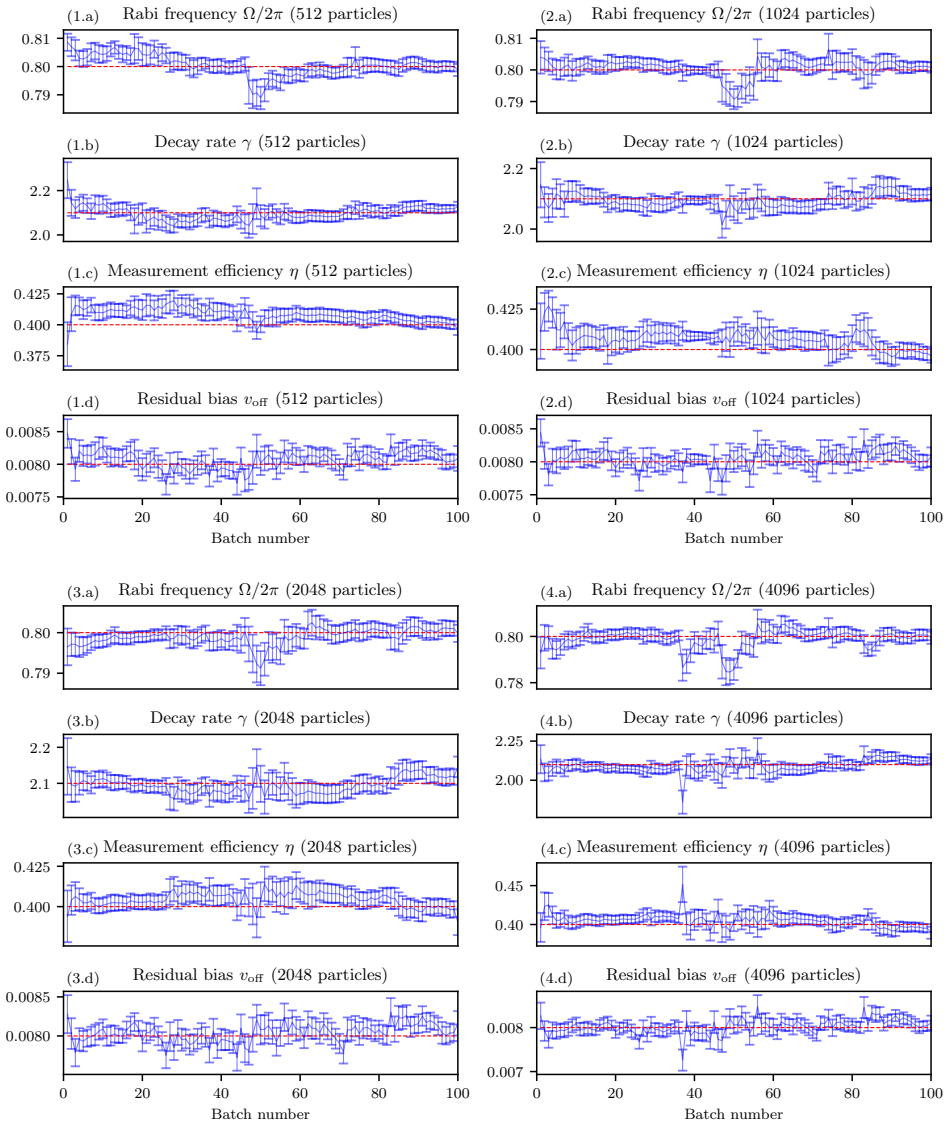
- [Appendix B] Appendix B figures: the true-parameter dashed lines are sometimes hard to distinguish from the estimated traces; thicker or differently styled lines would improve clarity.
Circularity Check
Method derivation is self-contained; only mild tautology is treating in-sample mean-trajectory RMSE as independent proof that multiparameter estimates are more accurate than calibration.
-
fitted input called prediction
[Sec. 4.2 (fluorescence signal reconstruction; RMSE after Eq. 33 / Fig. 3)]
"We calculate RMSE with Eq.(33) for both the SMC algorithm and the calibration respectively: RMSE_est = 0.3699 and RMSE_cal = 0.7465, confirming that our algorithm produces better estimates for the parameters than the standard calibration process."
Particle weights are updated by the Gaussian observation model f(ȳ_t|x_t) ∝ exp[−(ȳ_t−μ_t)²/(2σ̄²)] (Eqs. 29–30), i.e., by matching the model mean trajectory to the same batch-averaged voltages later used for RMSE. Declaring lower in-sample reconstruction RMSE as confirmation of superior multiparameter accuracy is therefore partly forced by the estimation criterion itself, not an independent external check of the individual parameters (especially under model incompleteness / Γ–η trade-offs).
full rationale
The paper’s algorithmic core (SIS with zero-noise transition, SMC-sampler resampling, batch partitioning, and the O(Δτ²) averaged Kraus map in Appendix A) is derived modularly from standard Bayesian/SMC identities and a first-order expansion of the measurement superoperator; none of these steps define the target in terms of itself or import a uniqueness theorem from overlapping authors as an external fact. Hyperparameters are chosen on synthetic data with known ground truth (Appendix B), which is an independent calibration of the algorithm, not a fit to the experimental claims. The only mild circularity is in the experimental validation rhetoric: parameters are updated by a Gaussian likelihood that rewards matching the batch-averaged mean μ_t to ȳ_t, and “better estimation than calibration” is then declared because the same mean trajectory has lower RMSE under the estimated parameters than under static calibration values. That ranking is partly forced by the estimation objective and does not constitute an out-of-sample prediction of multiparameter truth (especially given the Γ–η degeneracy the authors themselves document). This is a weak fitted-input-as-validation step, not a load-bearing self-definition of the method, so the overall circularity score remains low (2).
Assumptions & free parameters
free parameters (4)
- Ns (trajectories per batch) =
10200 / 4000
- Np (number of particles) =
1024 / 2048
- defensive-strategy ratios p,q =
0.9 / 0.1
- resampling threshold Nth =
Np/2
assumptions (4)
- domain assumption System dynamics are Markovian and admit a stochastic master equation of Lindblad form.
- ad hoc to paper Unknown parameters vary slowly compared with the batch duration, so a single averaged map is valid inside each batch.
- domain assumption Observation likelihood may be approximated as Gaussian with variance scaled by 1/Ns.
- ad hoc to paper Zero-noise (static) transition model inside the SIS weight update is adequate when parameters are slow.
invented entities (1)
-
O(Δτ²) batch-averaged Kraus map (Eq. 43)
Cite this review
Pith. "Pith review of Time-dependent multiparameter estimation for quantum experiments via online-offline sequential Monte-Carlo method." pith.science (2026). https://pith.science/paper/U2LFH3EQ
@misc{pith2026260702987,
  author       = {Pith},
  title        = {Pith review of: Time-dependent multiparameter estimation for quantum experiments via online-offline sequential Monte-Carlo method},
  year         = {2026},
  howpublished = {\url{https://pith.science/paper/U2LFH3EQ}},
  note         = {Machine review of arXiv:2607.02987}
}
abstract
While typical online estimation methods can estimate the multiparameter dynamics of many systems, they may not be sufficient for a system with highly noisy measurement and rapid detection rate. In this paper, we create a hybrid estimation method by augmenting the sequential Monte Carlo (SMC) sampler, an online estimation method with an offline technique known as the time-batch estimation technique. By continuously monitoring the system, we may divide signals into batches and average them into an averaged trajectory. The system dynamics is then evolved with batch-averaged Kraus maps, for which we derive a highly efficient approximation. To facilitate the adoption of our algorithm, we present a modular derivation of the SMC methods and showcase our algorithm as an explicit example. We then implement our algorithm on the measurement signals obtained from superconducting-qubit experiments under two types of measurement setting: a fluorescence measurement and a dispersive $z$-measurement. The algorithm's hyperparameter values are chosen from independent numerical simulation, while the accuracy of our estimation is validated by a signal reconstruction method. Our results show that, for the fluorescence case, our algorithm can estimate the system's parameters better than the standard calibration method, and, for the dispersive case, our estimation is capable of finding an unexpected jump in parameter values that the standard calibration method could not find.
Figures


Figures from the paper (6 more)




Reference graph
Works this paper leans on
-
[1]
Single-shot parameter estimation via con- tinuous quantum measurement
Bradley A. Chase and J. M. Geremia. “Single-shot parameter estimation via con- tinuous quantum measurement”. Physical Review A79(2009)
2009
-
[2]
Frequency tracking and parameter es- timation for robust quantum state estima- tion
Jason F. Ralph, Kurt Jacobs, and Charles D. Hill. “Frequency tracking and parameter es- timation for robust quantum state estima- tion”. Physical Review A84(2011)
2011
-
[3]
Parameter esti- mation from measurements along quantum trajectories
P. Six, Ph. Campagne-Ibarcq, L. Bretheau, B. Huard, and P. Rouchon. “Parameter esti- mation from measurements along quantum trajectories”. In 2015 54th IEEE Confer- ence on Decision and Control (CDC). Pages 7742–7748. IEEE (2015)
2015
-
[4]
Bayesian parameter estimation by continuous homodyne detection
Alexander Holm Kiilerich and Klaus Mølmer. “Bayesian parameter estimation by continuous homodyne detection”. Physical Review A94, 032103 (2016)
2016
-
[5]
Multiparameter estimation along quantum trajectories with sequential monte carlo methods
Jason F. Ralph, Simon Maskell, and Kurt Jacobs. “Multiparameter estimation along quantum trajectories with sequential monte carlo methods”. Phys. Rev. A96, 052306 (2017)
2017
-
[6]
Rapid estimation of drifting parameters in continuously mea- sured quantum systems
Luis Cortez, Areeya Chantasri, Luis Pe- dro García-Pintos, Justin Dressel, and An- drew N. Jordan. “Rapid estimation of drifting parameters in continuously mea- sured quantum systems”. Physical Review A95(2017)
2017
-
[7]
Online parameter estimation for continuously monitored quan- tum systems
Henrik Glavind Clausen, Pierre Rouchon, and Rafal Wisniewski. “Online parameter estimation for continuously monitored quan- tum systems”. IEEE Control Systems Let- ters8, 1247–1252 (2024)
2024
-
[8]
Bayesian parameter inference from continu- ously monitored quantum systems
Søren Gammelmark and Klaus Mølmer. “Bayesian parameter inference from continu- ously monitored quantum systems”. Physical Review A87(2013)
2013
Show all 44 references
-
[9]
Parameters estimation by fitting correlation functions of con- tinuous quantum measurement
Pierre Guilmin, Pierre Rouchon, and An- toine Tilloy. “Parameters estimation by fitting correlation functions of con- tinuous quantum measurement” (2024). arXiv:2410.11955
2024 arXiv
-
[10]
Quantum-tailored machine-learning characterization of a superconducting qubit
Elie Genois, Jonathan A. Gross, Agustin Di Paolo, Noah J. Stevenson, Gerwin Koolstra, Akel Hashim, Irfan Siddiqi, and Alexandre Blais. “Quantum-tailored machine-learning characterization of a superconducting qubit”. PRX Quan- tum2(2021)
2021
-
[11]
Parameter estima- tion from quantum-jump data using neural networks
Enrico Rinaldi, Manuel González Lastre, Sergio García Herreros, Shahnawaz Ahmed, Maryam Khanahmadi, Franco Nori, and Carlos Sánchez Muñoz. “Parameter estima- tion from quantum-jump data using neural networks”. Quantum Science and Technol- ogy9, 035018 (2024)
2024
-
[12]
Hamiltonian learning using machine- learning models trained with continuous measurements
Kris Tucker, Amit Kiran Rege, Conor Smith, Claire Monteleoni, and Tameem Al- bash. “Hamiltonian learning using machine- learning models trained with continuous measurements”. Physical Review Ap- plied22(2024)
2024
-
[13]
Parame- ter estimation for quantum jump unravel- ing
Marco Radaelli, Joseph A. Smiga, Gabriel T. Landi, and Felix C. Binder. “Parame- ter estimation for quantum jump unravel- ing” (2024). arXiv:2402.06556
2024
-
[14]
Adaptive measurement filter: efficient strategy for op- timalestimationofquantummarkovchains
Alfred Godley and Madalin Guta. “Adaptive measurement filter: efficient strategy for op- timalestimationofquantummarkovchains”. Quantum7, 973 (2023)
2023
-
[15]
Bayesian optimization of non-classical optomechan- ical correlations
Alexander Pitchford, Andrey A Rakhubovsky, Rick Mukherjee, Darren W Moore, Frédéric Sauvage, Daniel Burgarth, Radim Filip, and Florian Mintert. “Bayesian optimization of non-classical optomechan- ical correlations”. Quantum Science and Technology9, 045044 (2024)
2024
-
[16]
Multidimensional quantum estimation and model learning framework based on varia- tional bayesian inference
Federico Belliardo, Erik M. Gauger, Mo- hamed H. Abobeih, Tim H. Taminiau, 17 Yoann Altmann, and Cristian Bonato. “Multidimensional quantum estimation and model learning framework based on varia- tional bayesian inference”. PRX Quantum 7, 020360 (2026)
2026
-
[17]
A sequential particle filter method for static models
N. Chopin. “A sequential particle filter method for static models”. Biometrika89, 539–552 (2002)
2002
-
[18]
A tutorial on particle filters for online nonlinear/non-gaussian bayesian tracking
M.S. Arulampalam, S. Maskell, N. Gordon, and T. Clapp. “A tutorial on particle filters for online nonlinear/non-gaussian bayesian tracking”. IEEE Transactions on Signal Pro- cessing50, 174–188 (2002)
2002
-
[19]
An overview of existing meth- ods and recent advances in sequential monte carlo
Olivier Cappe, Simon J. Godsill, and Eric Moulines. “An overview of existing meth- ods and recent advances in sequential monte carlo”. Proceedings of the IEEE95, 899– 924 (2007)
2007
-
[20]
An Invitation to Sequential Monte Carlo Samplers
Chenguang Dai, Jeremy Heng, Pierre E. Ja- cob, and Nick Whiteley. “An Invitation to Sequential Monte Carlo Samplers”. Journal of the American Statistical Association117, 1587–1600 (2022)
2022
-
[21]
A survey of con- vergence results on particle filtering methods for practitioners
D. Crisan and A. Doucet. “A survey of con- vergence results on particle filtering methods for practitioners”. IEEE Transactions on Sig- nal Processing50, 736–746 (2002)
2002
-
[22]
Sequential monte carlo samplers
Pierre Del Moral, Arnaud Doucet, and Ajay Jasra. “Sequential monte carlo samplers”. Journal of the Royal Statistical Society Se- ries B: Statistical Methodology68, 411– 436 (2006)
2006
-
[23]
Mapping quan- tum state dynamics in spontaneous emis- sion
M. Naghiloo, N. Foroozani, D. Tan, A. Jad- babaie, and K. W. Murch. “Mapping quan- tum state dynamics in spontaneous emis- sion”. Nature Communications7(2016)
2016
-
[24]
Quantum caustics in resonance-fluorescence trajectories
M. Naghiloo, D. Tan, P. M. Harrington, P. Lewalle, A. N. Jordan, and K. W. Murch. “Quantum caustics in resonance-fluorescence trajectories”. Physical Review A96(2017)
2017
-
[25]
Map- pingtheoptimalroutebetweentwoquantum states
S. J. Weber, A. Chantasri, J. Dressel, A. N. Jordan, K. W. Murch, and I. Siddiqi. “Map- pingtheoptimalroutebetweentwoquantum states”. Nature511, 570 (2014)
2014
-
[26]
Superconducting Qubits: Current State of Play
Morten Kjaergaard, Mollie E. Schwartz, Jochen Braumüller, Philip Krantz, Joel I.-J. Wang, Simon Gustavsson, and William D. Oliver. “Superconducting Qubits: Current State of Play”. Annual Review of Condensed Matter Physics11, 369–395 (2020)
2020
-
[27]
Advance- ments in superconducting quantum comput- ing
Yao-Yao Jiang, Chunqing Deng, Heng Fan, Bing-Yang Li, Luyan Sun, Xin-Sheng Tan, Weiting Wang, Guang-Ming Xue, Fei Yan, Hai-Feng Yu, Ying-Shan Zhang, Yu-Ran Zhang, and Chang-Ling Zou. “Advance- ments in superconducting quantum comput- ing”. National Science Review12(2025)
2025
-
[28]
Sequential Monte Carlo Methods in Practice
Arnaud Doucet, Nando de Freitas, and Neil Gordon. “Sequential Monte Carlo Methods in Practice”. Springer Science & Business Media. (2001). url:https: //books.google.com/books/about/ Sequential_Monte_Carlo_Methods_in_ Practi.html?hl=&id=uxX-koqKtMMC
2001
-
[29]
Im- portance sampling: A review
Surya T. Tokdar and Robert E. Kass. “Im- portance sampling: A review”. WIREs Com- putational Statistics2, 54–60 (2010)
2010
-
[30]
On sequential monte carlo sampling methods for bayesian fil- tering
Arnaud Doucet, Simon Godsill, and Christophe Andrieu. “On sequential monte carlo sampling methods for bayesian fil- tering”. Statistics and Computing10, 197–208 (2000)
2000
-
[31]
A review of resampling techniques in parti- cle filtering framework
Chanin Kuptametee and Nattapol Aunsri. “A review of resampling techniques in parti- cle filtering framework”. Measurement193, 110836 (2022)
2022
-
[32]
An application of sequen- tial monte carlo samplers: an alternative to particle filters for non-linear non- gaussian sequential inference with zero process noise
S. Maskell. “An application of sequen- tial monte carlo samplers: an alternative to particle filters for non-linear non- gaussian sequential inference with zero process noise”. Pages 13/1–13/8. In- stitute of Engineering and Technology (IET). (2012). arXiv:https://digital- lib...
2012 doi
-
[33]
Estimating the parameters of dynamical systems from big data using sequential monte carlo samplers
P.L. Green and S. Maskell. “Estimating the parameters of dynamical systems from big data using sequential monte carlo samplers”. Mechanical Systems and Signal Processing 93, 379–396 (2017)
2017
-
[34]
Recursive Bayesian Estimation
Niclas Bergman and Universitetet i Linköping. Department of Electri- cal Engineering. “Recursive Bayesian Estimation”. Linköping University. (1999). url:https://books.google.com/books/ about/Recursive_Bayesian_Estimation. html?hl=&id=1Jj3AQAACAAJ. 18
1999
-
[35]
Monte Carlo Filter and Smoother for Non-Gaussian Nonlinear State Space Models
Genshiro Kitagawa. “Monte Carlo Filter and Smoother for Non-Gaussian Nonlinear State Space Models”. Journal of Computational and Graphical Statistics5, 1–25 (1996)
1996
-
[36]
Combined Pa- rameter and State Estimation in Simulation- Based Filtering
Jane Liu and Mike West. “Combined Pa- rameter and State Estimation in Simulation- Based Filtering”. Pages 197–223. Springer New York. (2001)
2001
-
[37]
Weighted average impor- tance sampling and defensive mixture distri- butions
Tim Hesterberg. “Weighted average impor- tance sampling and defensive mixture distri- butions”. Technometrics37, 185–194 (1995)
1995
-
[38]
An open systems ap- proach to quantum optics: lectures pre- sented at the université libre de bruxelles, october 28 to november 4, 1991
Howard Carmichael. “An open systems ap- proach to quantum optics: lectures pre- sented at the université libre de bruxelles, october 28 to november 4, 1991”. Volume 18. Springer Science & Business Media. (2009)
1991
-
[39]
Quan- tum measurement and control
H. M. Wiseman and G. J. Milburn. “Quan- tum measurement and control”. Cambridge University Press UK. (2010)
2010
-
[40]
Quantum measurement the- ory and its applications
Kurt Jacobs. “Quantum measurement the- ory and its applications”. Cambridge Uni- versity Press. (2014)
2014
-
[41]
Completely positive trace-preserving maps for higher- order unraveling of Lindblad master equa- tions
Nattaphong Wonglakhon, Howard M. Wise- man, and Areeya Chantasri. “Completely positive trace-preserving maps for higher- order unraveling of Lindblad master equa- tions”. Physical Review A110(2024)
2024
-
[42]
Time-Symmetric Quantum Theory of Smoothing
Mankei Tsang. “Time-Symmetric Quantum Theory of Smoothing”. Physical Review Let- ters102(2009)
2009
-
[43]
Quantum State Smoothing
Ivonne Guevara and Howard Wiseman. “Quantum State Smoothing”. Physical Re- view Letters115, 180407 (2015)
2015
-
[44]
Unify- ing theory of quantum state estimation us- ing past and future information
Areeya Chantasri, Ivonne Guevara, Kiarn T. Laverick, and Howard M. Wiseman. “Unify- ing theory of quantum state estimation us- ing past and future information”. Physics Reports930, 1–40 (2021). A Full form of the signal-averaged map Here we present a first-order expansion of t...
2021
Reviewed July 12, 2026 · model on record in the stance chip above.
Discussion (0). Sign in to comment.