REVIEW 4 major objections 6 minor 60 references
A DSGE is a structured world model: its state is the belief state learners seek, and its structure manufactures the off-path coverage pure learning cannot sample.
Reviewed by Pith at T0; open to challenge. T0 means a machine referee read the full paper against a public rubric. the ladder, T0–T4 →
T0 review · grok-4.5
2026-07-12 04:34 UTC pith:WIA6Q7U5
load-bearing objection Clean reframing plus a real benchmark: learned world models collapse off-path and DSGE-generated coverage recovers them, with the large regime numbers correctly scoped as synthesis rather than pure OOD. the 4 major comments →
DSGE as a Structured World Model:Benchmarking Counterfactual Generalization in Economic Worlds
The pith
A machine-rendered reading of the paper's core claim, the machinery that carries it, and where it could break.
Core claim
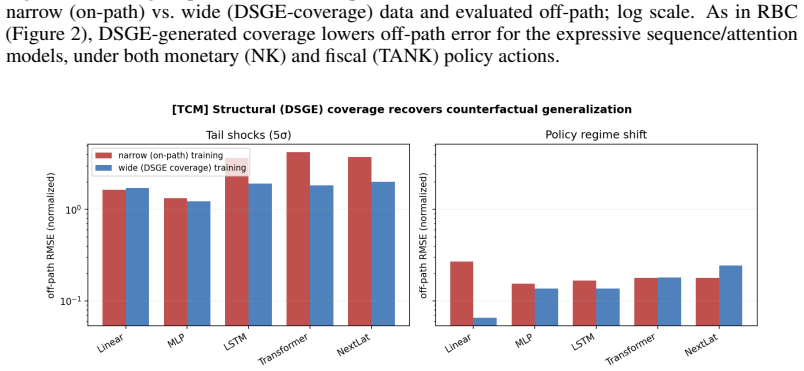
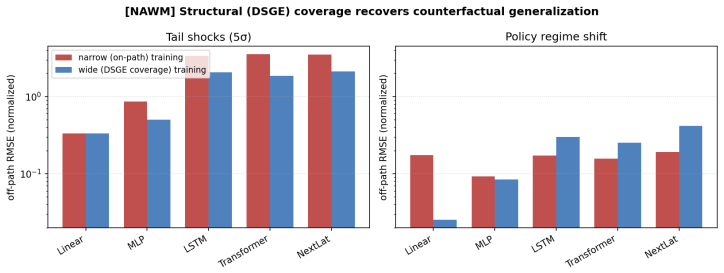
Learned world models match structured dynamics on-path (normalized RMSE roughly 0.004–0.08) but collapse off-path, with 5-sigma tail RMSE rising by up to about 40 times; training the identical architectures at fixed sample size on DSGE-generated rare and counterfactual-policy states roughly halves tail error and cuts policy-regime error by factors of 10–280 wherever the counterfactual rule shifts the ergodic support. The operative mechanism is coverage generation, not imposed constraints.
What carries the argument
The identity that a DSGE structural state is a belief state (Proposition 1): a sufficient statistic of history for future observations, supplied by construction together with the transition map and cross-equation restrictions that hold at every state. DSGE-Gym turns that identity into a measurement by drawing train and off-path test sets from the same solved model.
Load-bearing premise
That the solved DSGE is a trustworthy generator of the missing off-path distribution—i.e., that synthetic coverage remains valid precisely where real data cannot check it.
What would settle it
Train the same architectures on non-structural coverage of equal size and support (for example regime-dummy VARs or parameter-perturbation augmentation) and on a leave-one-regime-out wide set that withholds the exact test-regime parameters; if the large regime recovery disappears, the claim that equilibrium structure itself manufactures the missing distribution fails.
Editorial analysis
A structured set of objections, weighed in public.
Referee Report
Summary. The paper reframes DSGE models as structured world models whose recursive state is a belief state (Proposition 1), and introduces DSGE-Gym: eight DSGE environments with unified interfaces and off-path counterfactual test sets (tail shocks, policy-regime shifts), scaling to the ECB’s 230-variable NAWM. On a controlled one-step prediction task (T1), standard learned architectures (linear, MLP, LSTM, Transformer, NextLat) match the structured dynamics on-path but collapse under 5σ tails; training the same architectures at fixed sample size on DSGE-generated wide coverage roughly halves tail error and, where the counterfactual rule shifts the ergodic support, cuts regime error by large factors. Negative results show that a first-order oracle and static equilibrium penalties do not close the gap. Code and the benchmark are released.
Significance. If the scoped claims hold, the paper supplies a reusable, reproducible testbed for counterfactual generalization of world models in economics and a clean empirical demonstration that structure’s practical value is coverage generation of states no single history contains. Strengths include: a controlled protocol (same architectures, fixed N, z-scored RMSE, multiple seeds); replication across real, monetary, fiscal, open-economy, labor, climate, and firm-entry actions; an honest capacity interaction at 230 variables; useful negative results on approximate imposed structure; and full code/data release with datasheet-style documentation. The belief-state bridge (Proposition 1) is elementary but useful as identification. The work is a solid Datasets & Benchmarks / ML-for-economics contribution and a natural foundation for the announced Paper 2 on learned structured latents.
major comments (4)
- [Abstract, §5.3, Appendix B] Abstract and §5.3 / Appendix B: the headline regime multipliers (10–280×, and up to ~670× in Table 6) measure synthesis of a distribution that, by design, includes the exact test_regime policy parameters (Appendix B transparency note). The body scopes this correctly as generativity of structure rather than learner OOD extrapolation (§5.3, Remark 2), but the abstract and introduction state the numbers without that design fact. Because these figures will be the most-cited claim, the abstract must state that wide training spans the evaluated regime parameters and that H2 measures manufactured coverage, not withheld-regime generalization. A leave-one-regime-out number (already promised in the release) should appear in the main text if the large multipliers are retained.
- [§5.3, Limitations §6.2] §5.3 and Limitations §6.2: the central thesis is that structure helps off-path by manufacturing coverage. The design shows DSGE-generated coverage helps, but does not yet separate equilibrium structure from coverage per se. The paper correctly flags a non-structural control (regime-dummy VAR / parameter-perturbation augmentation) as the key missing piece and defers it to Paper 2. For this manuscript’s claim that structure (not merely a wider training region) is doing the work, either (i) include at least one matched non-structural coverage baseline on the main environments, or (ii) demote language that attributes the gain specifically to equilibrium structure until that control exists. As written, the load-bearing identification is incomplete.
- [Abstract, §5.4, Tables 3–6] §5.4 and Tables 3–6 vs. Abstract: regime recovery is large only where the counterfactual shifts the ergodic support (RBC, DMP, E-NK, Firm); in NK/TANK/TCM the counterfactual contracts support and narrow-trained regime error is already small, so gains are small or reverse for expressive models. The abstract’s unqualified “cuts policy-regime error 10–280×” averages over this heterogeneity. The support-shift vs. support-contract distinction should be in the abstract and treated as a primary result, not only in §5.4/§5.6.
- [§4 Tasks, §5] §4 Tasks and §5 Setup: the paper studies only T1 (one-step map fidelity with realized ε_{t+1} supplied). World-model value for planning lives in multi-step rollouts and action selection (T2/T3), which are released but not analyzed. The collapse/recovery story may change under compounding error. At minimum, report a short T2 multi-step probe on one or two environments (e.g., RBC and NK) so the off-path claim is not solely a one-step regression result; otherwise, further soften “world model” language in the abstract to “one-step transition model.”
minor comments (6)
- [§3.3] Proposition 1 is correctly labeled elementary; consider moving the full proof sketch to an appendix and keeping only the identification statement in the main text to free space for the non-structural control or T2 results.
- [Figures 2–5] Figure 1 and Table 1 are clear; ensure log-scale axes in Figures 2–5 are labeled as such in the caption, not only in the text.
- [References] NextLat citation appears as arXiv:2511.0XXXX (placeholder). Replace with the final identifier before camera-ready.
- [§5.2, Appendix C] §5.2: the static-penalty ablation is important; report the exact penalty weight and collocation construction in the main text or a short appendix table so the negative result is reproducible without reading the code.
- [Abstract, §5.5] NAWM is first-order only (§5.5, Limitations §6.1). State this in the abstract’s “scaling to 230 variables” clause so readers do not infer a nonlinear production-scale test.
- [§4, Appendix C] Terminology note in Appendix C (policy action vs. shock as input) is helpful; a one-sentence version in §4 would reduce confusion for ML readers.
Circularity Check
No load-bearing circular derivation; mild design overlap on regime H2 is disclosed and scoped as generativity, not OOD prediction-by-construction.
specific steps
-
fitted input called prediction
[§5.3; Appendix B (train_wide / test_regime construction)]
"Transparency on overlap: the four wide regimes include the parameter setting used to build test_regime, so the H2 regime result quantifies the value of a structural generator synthesizing the counterfactual distribution (which no single history contains; §5, Remark 2), not a learner extrapolating to a withheld regime."
For the policy-regime split, the wide training distribution is constructed to contain the same counterfactual policy parameters later used as test_regime. Large regime RMSE reductions (10–280×, up to ~670×) therefore largely reflect training on support that already covers the evaluation regime—i.e., learning under manufactured in-support coverage—rather than predicting a regime never present in training. The paper discloses and scopes this as measuring generativity of structure, so the step is mild design circularity of claim framing, not a forced identity equating input parameters to output RMSE.
full rationale
This is primarily an empirical benchmark paper. Proposition 1 is an elementary restatement that a recursive equilibrium state is a sufficient statistic, explicitly labeled as identification rather than a novel derivation; it does not force the experimental numbers. H1 (off-path collapse under narrow training) is a genuine empirical comparison against the same DGP used as ground truth—standard for synthetic benchmarks, not circular. H2’s tail recovery (rare-shock coverage at fixed sample size) is likewise an empirical capacity/coverage result. The only soft point is the regime half of H2: Appendix B states that train_wide includes the exact policy-parameter setting used for test_regime, so the large regime multipliers measure what happens once a structural generator synthesizes a distribution that already contains the test support, not withheld-regime extrapolation. The paper is explicit about this (§5.3, Remark 2, Limitations) and scopes the claim as structure’s generativity. That design choice weakens the rhetorical force of “counterfactual generalization” but does not make RMSE recovery a mathematical identity: networks can still fail to absorb wide coverage (as seen for some expressive models on contracting-support regimes and at NAWM scale). There is no self-citation chain, no uniqueness theorem imported from the author, and no fitted scalar renamed as a prediction. Score 2 reflects one minor, disclosed design overlap rather than circular derivation of the central claims.
Axiom & Free-Parameter Ledger
free parameters (3)
- Wide-training regime band and shock-scale segments
- Baseline architecture hyperparameters (layers, latent dim, lr, epochs)
- Environment-specific calibrations (β, α, ϕπ, b, μ̄, fE, …)
axioms (4)
- standard math The recursive (Bellman) state of a rational-expectations equilibrium is a belief state / sufficient statistic of history (Proposition 1).
- domain assumption Deep parameters θ are invariant to policy-rule parameters ψ (Lucas critique / Proposition 2 factorization).
- domain assumption A pruned third-order (or first-order for NAWM) perturbation solution is an adequate ground-truth generator for the environments studied.
- ad hoc to paper Normalized one-step RMSE on z-scored variables is a sufficient probe of world-model quality for the claims made (T1).
invented entities (1)
-
DSGE-Gym benchmark suite
no independent evidence
read the original abstract
Modern world models -- Dreamer, transformer world models (IRIS, Genie), and JEPA / next-latent architectures -- learn dynamics from observed trajectories but share a weakness: their transition map is disciplined only where data were seen, so it degrades under policy-induced distribution shift and on counterfactual states off the training path. We argue that a Dynamic Stochastic General Equilibrium (DSGE) model is a structured world model: its state is a belief state -- the very object a latent world model learns, but supplied with causal structure and hard cross-equation constraints. We introduce DSGE-Gym, a benchmark of eight DSGE environments with off-path counterfactual test sets, scaling to the ECB's 230-variable New Area-Wide Model. We find that (i)learned world models match the dynamics on-path but collapse off-path (5{\sigma} tail RMSE up to \sim 40 the on-path level), and (ii)training the same architectures on data the DSGE generates across rare and counterfactual-policy states -- coverage only a structural model can synthesize -- roughly halves tail error and cuts policy-regime error 10--280 where the counterfactual rule shifts the ergodic support. Because such coverage cannot be sampled from any single history, this measures structure's ability to manufacture the missing distribution. DSGE-Gym and all code are released as a reproducible testbed for counterfactual generalization.
Figures


Reference graph
Works this paper leans on
-
[2]
International Conference on Machine Learning (ICML) , year=
Learning Latent Dynamics for Planning from Pixels , author=. International Conference on Machine Learning (ICML) , year=
-
[3]
International Conference on Learning Representations (ICLR) , year=
Dream to Control: Learning Behaviors by Latent Imagination , author=. International Conference on Learning Representations (ICLR) , year=
-
[4]
International Conference on Learning Representations (ICLR) , year=
Mastering Atari with Discrete World Models , author=. International Conference on Learning Representations (ICLR) , year=
-
[6]
International Conference on Learning Representations (ICLR) , year=
Transformers are Sample-Efficient World Models , author=. International Conference on Learning Representations (ICLR) , year=
-
[7]
International Conference on Machine Learning (ICML) , year=
Genie: Generative Interactive Environments , author=. International Conference on Machine Learning (ICML) , year=
-
[8]
Advances in Neural Information Processing Systems (NeurIPS) , year=
Diffusion for World Modeling: Visual Details Matter in Atari , author=. Advances in Neural Information Processing Systems (NeurIPS) , year=
-
[9]
Open Review , year=
A Path Towards Autonomous Machine Intelligence , author=. Open Review , year=
-
[10]
IEEE/CVF Conference on Computer Vision and Pattern Recognition (CVPR) , year=
Self-Supervised Learning from Images with a Joint-Embedding Predictive Architecture , author=. IEEE/CVF Conference on Computer Vision and Pattern Recognition (CVPR) , year=
-
[12]
arXiv preprint arXiv:2511.0XXXX , year=
Next-Latent Prediction Transformers Learn Compact World Models , author=. arXiv preprint arXiv:2511.0XXXX , year=
-
[13]
International Conference on Machine Learning (ICML) , year=
Understanding Self-Predictive Learning for Reinforcement Learning , author=. International Conference on Machine Learning (ICML) , year=
-
[14]
International Conference on Learning Representations (ICLR) , year=
Bridging State and History Representations: Understanding Self-Predictive RL , author=. International Conference on Learning Representations (ICLR) , year=
-
[15]
International Conference on Learning Representations (ICLR) , year=
Belief State Transformers , author=. International Conference on Learning Representations (ICLR) , year=
-
[16]
Artificial Intelligence , volume=
Planning and Acting in Partially Observable Stochastic Domains , author=. Artificial Intelligence , volume=
-
[17]
Journal of Mathematical Analysis and Applications , volume=
Sufficient Statistics in the Optimum Control of Stochastic Systems , author=. Journal of Mathematical Analysis and Applications , volume=
-
[19]
International Economic Review , volume=
Deep Equilibrium Nets , author=. International Economic Review , volume=
-
[20]
Journal of Monetary Economics , volume=
Deep Learning for Solving Dynamic Economic Models , author=. Journal of Monetary Economics , volume=
-
[21]
Econometrica , volume=
Financial Frictions and the Wealth Distribution , author=. Econometrica , volume=
-
[24]
Econometrica , volume=
Time to Build and Aggregate Fluctuations , author=. Econometrica , volume=
-
[25]
Carnegie-Rochester Conference Series on Public Policy , volume=
Econometric Policy Evaluation: A Critique , author=. Carnegie-Rochester Conference Series on Public Policy , volume=
-
[26]
American Economic Review , volume=
Shocks and Frictions in US Business Cycles: A Bayesian DSGE Approach , author=. American Economic Review , volume=
-
[27]
American Economic Review , volume=
Monetary Policy According to HANK , author=. American Economic Review , volume=
-
[28]
2023 , note=
MacroModelling.jl: A Julia Package for Developing and Solving Dynamic Stochastic General Equilibrium Models , author=. 2023 , note=
2023
-
[29]
2018 , note=
The Real Business Cycle Model , author=. 2018 , note=
2018
-
[30]
2021 , note=
The New Keynesian Model and the TANK Model , author=. 2021 , note=
2021
-
[31]
Journal of the European Economic Association , volume=
Understanding the Effects of Government Spending on Consumption , author=. Journal of the European Economic Association , volume=
-
[32]
Journal of Economic Theory , volume=
Limited Asset Markets Participation, Monetary Policy and (Inverted) Aggregate Demand Logic , author=. Journal of Economic Theory , volume=
-
[33]
ECB Working Paper / International Finance , year=
The New Area-Wide Model of the Euro Area: A Micro-Founded Open-Economy Model for Forecasting and Policy Analysis , author=. ECB Working Paper / International Finance , year=
-
[34]
Diffusion for world modeling: Visual details matter in atari
Eloi Alonso, Adam Jelley, Vincent Micheli, Anssi Kanervisto, Amos Storkey, Tim Pearce, and Fran c ois Fleuret. Diffusion for world modeling: Visual details matter in atari. In Advances in Neural Information Processing Systems (NeurIPS), 2024
2024
-
[35]
Self-supervised learning from images with a joint-embedding predictive architecture
Mahmoud Assran, Quentin Duval, Ishan Misra, Piotr Bojanowski, Pascal Vincent, Michael Rabbat, Yann LeCun, and Nicolas Ballas. Self-supervised learning from images with a joint-embedding predictive architecture. In IEEE/CVF Conference on Computer Vision and Pattern Recognition (CVPR), 2023
2023
-
[36]
Deep equilibrium nets
Marlon Azinovic, Luca Gaegauf, and Simon Scheidegger. Deep equilibrium nets. International Economic Review, 63 0 (4): 0 1471--1525, 2022
2022
-
[37]
Economics-inspired neural networks with stabilizing homotopies
Marlon Azinovic, Harold Cole, and Felix Kubler. Economics-inspired neural networks with stabilizing homotopies. arXiv preprint arXiv:2303.14802, 2023
Pith/arXiv arXiv 2023
-
[38]
Revisiting feature prediction for learning visual representations from video
Adrien Bardes, Quentin Garrido, Jean Ponce, Xinlei Chen, Michael Rabbat, Yann LeCun, Mahmoud Assran, and Nicolas Ballas. Revisiting feature prediction for learning visual representations from video. arXiv preprint arXiv:2404.08471, 2024
Pith/arXiv arXiv 2024
-
[39]
Florin O. Bilbiie. Limited asset markets participation, monetary policy and (inverted) aggregate demand logic. Journal of Economic Theory, 140 0 (1): 0 162--196, 2008
2008
-
[40]
Genie: Generative interactive environments
Jake Bruce, Michael Dennis, Ashley Edwards, Jack Parker-Holder, Yuge Shi, et al. Genie: Generative interactive environments. In International Conference on Machine Learning (ICML), 2024
2024
-
[41]
The new area-wide model of the euro area: A micro-founded open-economy model for forecasting and policy analysis
G \"u nter Coenen, Roland Straub, and Mathias Trabandt. The new area-wide model of the euro area: A micro-founded open-economy model for forecasting and policy analysis. ECB Working Paper / International Finance, 2008. New Area-Wide Model (NAWM), Euro Area--US
2008
-
[42]
Financial frictions and the wealth distribution
Jes \'u s Fern \'a ndez-Villaverde, Samuel Hurtado, and Galo Nu \ n o. Financial frictions and the wealth distribution. Econometrica, 91 0 (3): 0 869--901, 2023
2023
-
[43]
David L \'o pez-Salido, and Javier Vall \'e s
Jordi Gal \' , J. David L \'o pez-Salido, and Javier Vall \'e s. Understanding the effects of government spending on consumption. Journal of the European Economic Association, 5 0 (1): 0 227--270, 2007
2007
-
[44]
David Ha and J \"u rgen Schmidhuber. World models. arXiv preprint arXiv:1803.10122, 2018
Pith/arXiv arXiv 2018
-
[45]
Learning latent dynamics for planning from pixels
Danijar Hafner, Timothy Lillicrap, Ian Fischer, Ruben Villegas, David Ha, Honglak Lee, and James Davidson. Learning latent dynamics for planning from pixels. In International Conference on Machine Learning (ICML), 2019
2019
-
[46]
Dream to control: Learning behaviors by latent imagination
Danijar Hafner, Timothy Lillicrap, Jimmy Ba, and Mohammad Norouzi. Dream to control: Learning behaviors by latent imagination. In International Conference on Learning Representations (ICLR), 2020
2020
-
[47]
Mastering atari with discrete world models
Danijar Hafner, Timothy Lillicrap, Mohammad Norouzi, and Jimmy Ba. Mastering atari with discrete world models. In International Conference on Learning Representations (ICLR), 2021
2021
-
[48]
Mastering diverse domains through world models
Danijar Hafner, Jurgis Pasukonis, Jimmy Ba, and Timothy Lillicrap. Mastering diverse domains through world models. arXiv preprint arXiv:2301.04104, 2023
Pith/arXiv arXiv 2023
-
[49]
Hu et al
Edward S. Hu et al. Belief state transformers. In International Conference on Learning Representations (ICLR), 2025
2025
-
[50]
Littman, and Anthony R
Leslie Pack Kaelbling, Michael L. Littman, and Anthony R. Cassandra. Planning and acting in partially observable stochastic domains. Artificial Intelligence, 101 0 (1-2): 0 99--134, 1998
1998
-
[51]
Violante
Greg Kaplan, Benjamin Moll, and Giovanni L. Violante. Monetary policy according to hank. American Economic Review, 108 0 (3): 0 697--743, 2018
2018
-
[52]
Kydland and Edward C
Finn E. Kydland and Edward C. Prescott. Time to build and aggregate fluctuations. Econometrica, 50 0 (6): 0 1345--1370, 1982
1982
-
[53]
A path towards autonomous machine intelligence
Yann LeCun. A path towards autonomous machine intelligence. Open Review, 2022. Version 0.9.2
2022
-
[54]
Robert E. Lucas. Econometric policy evaluation: A critique. Carnegie-Rochester Conference Series on Public Policy, 1: 0 19--46, 1976
1976
-
[55]
Deep learning for solving dynamic economic models
Lilia Maliar, Serguei Maliar, and Pablo Winant. Deep learning for solving dynamic economic models. Journal of Monetary Economics, 122: 0 76--101, 2021
2021
-
[56]
Transformers are sample-efficient world models
Vincent Micheli, Eloi Alonso, and Fran c ois Fleuret. Transformers are sample-efficient world models. In International Conference on Learning Representations (ICLR), 2023
2023
-
[57]
Macromodelling.jl: A julia package for developing and solving dynamic stochastic general equilibrium models, 2023
Thore M \"u ller. Macromodelling.jl: A julia package for developing and solving dynamic stochastic general equilibrium models, 2023. Julia package
2023
-
[58]
Bridging state and history representations: Understanding self-predictive rl
Tianwei Ni, Benjamin Eysenbach, Erfan Seyedsalehi, et al. Bridging state and history representations: Understanding self-predictive rl. International Conference on Learning Representations (ICLR), 2024
2024
-
[59]
The real business cycle model, 2018
Valerio Nispi Landi. The real business cycle model, 2018. Lecture notes, Bank of Italy
2018
-
[60]
The new keynesian model and the tank model, 2021
Valerio Nispi Landi. The new keynesian model and the tank model, 2021. Lecture notes, Bank of Italy
2021
-
[61]
A survey of reinforcement learning for economics
Pranjal Rawat. A survey of reinforcement learning for economics. arXiv preprint arXiv:2603.08956, 2026
arXiv 2026
-
[62]
Andreas Schaab and Simon Scheidegger. Equilibrium world models. arXiv preprint arXiv:2606.23463, 2026
Pith/arXiv arXiv 2026
-
[63]
Shocks and frictions in us business cycles: A bayesian dsge approach
Frank Smets and Rafael Wouters. Shocks and frictions in us business cycles: A bayesian dsge approach. American Economic Review, 97 0 (3): 0 586--606, 2007
2007
-
[64]
Sufficient statistics in the optimum control of stochastic systems
Charlotte Striebel. Sufficient statistics in the optimum control of stochastic systems. Journal of Mathematical Analysis and Applications, 12 0 (3): 0 576--592, 1965
1965
-
[65]
Understanding self-predictive learning for reinforcement learning
Yunhao Tang, Zhaohan Daniel Guo, Pierre Harvey Richemond, et al. Understanding self-predictive learning for reinforcement learning. International Conference on Machine Learning (ICML), 2023
2023
-
[66]
Hu, Tim Pearce, Pratyusha Sharma, Akshay Krishnamurthy, Riashat Islam, Alex Lamb, and John Langford
Jayden Teoh, Manan Tomar, Kwangjun Ahn, Edward S. Hu, Tim Pearce, Pratyusha Sharma, Akshay Krishnamurthy, Riashat Islam, Alex Lamb, and John Langford. Next-latent prediction transformers learn compact world models. arXiv preprint arXiv:2511.0XXXX, 2025. Microsoft Research
2025
discussion (0)
Sign in with ORCID, Apple, or X to comment. Anyone can read and Pith papers without signing in.