REVIEW 2 major objections 7 minor 101 references
Effect of sampling on the descriptive distributions of correlated random walks
T0 review · 2 major / 7 minor · reviewed 2026-07-12 · grok-4.5
Pith's one-line read Sub-sampling a correlated random walk maps its turning-angle density to an explicit convolution of the original density.
desk verdict Clean exact convolution for r=2 plus a usable recursive approximation for 2^k; practical diagnostic value, with the free parameter p as the main soft spot. read the letter →
The pith
A machine-rendered reading of the paper's core claim, the machinery that carries it, and where it could break.
The reading
What carries the argument
Recursive isosceles triangulation: each composite turning angle is written as a signed linear combination of the original angles by repeatedly bisecting successive triangles; the distribution then follows by ordinary convolution of the scaled densities, with signs averaged into the single geometric weight p.
What would settle it
Generate long CRWs with highly variable step lengths (e.g. exponential or log-normal with large variance), sub-sample at rates 4 and 8, and test whether the observed turning-angle histograms still match the multi-fold convolution of Theorem 2 for the optimally fitted p; systematic mismatch would falsify the equal-step approximation.
Extended reading notes
Core claim
For a constant-step CRW whose turning angles follow any zero-centred symmetric circular density f_◦, the turning-angle density after every-other-point sampling is exactly the circular wrapping of 4 f_◦(θ) convolved with the double convolution of the scaled density f_◦(2θ). For sampling rate 2^k the same geometric decomposition yields an explicit multi-fold convolution whose coefficients are determined by a single tortuosity parameter p; the match to simulation is already high once p is fitted.
Load-bearing premise
Even when original step lengths vary, successive steps are treated as equal so that every composite triangle remains isosceles and the same tortuosity weight p can be used at every recursion level.
Editorial extensions
If this is right
- An observed sub-sampled turning-angle peak that is sharper than the original density diagnoses bias rather than pure correlation.
- A sub-sampled peak that sits between the original density and the pure-CRW prediction flags multi-state movement without needing hidden-Markov fitting.
- The exact rate-2 step-length formula supplies a parameter-free check on speed statistics under down-sampling.
- No non-uniform circular family is closed under the rate-2 map, so re-fitting the same parametric family after sub-sampling is formally inconsistent.
Reading between the lines
- A simple regression or look-up table for the tortuosity weight p against mean resultant length and sampling rate would turn the approximation into a routine diagnostic tool.
- The overlapping triangles supply the precise linear dependence that produces the artificial turn auto-correlation previously observed only in simulation.
- The same path-counting graph can be re-weighted for non-dyadic sampling rates, closing the gap between theory and arbitrary telemetry frequencies.
Editorial analysis
A structured set of objections, weighed in public.
Referee Report
Summary. The paper studies how temporal sub-sampling changes the turning-angle and step-length distributions of a discrete-time correlated random walk (CRW). For fixed step length and sampling every second point (r=2), Theorem 1 gives an exact circular density via convolution of the original turning-angle law with a rescaled double convolution; Corollary 1 gives the exact induced step-length density via the cosine rule. For sampling rates r=2^k (k≥2), Theorem 2 supplies a multi-fold convolution formula that is exact once successive steps are treated as equal length and a single tortuosity parameter p is held constant across recursion levels; p is then fitted by L2 matching to simulated histograms. The authors verify both results by large Monte-Carlo experiments, explore the sensitivity of p, and illustrate two qualitative uses in movement ecology: distinguishing biased from correlated walks and flagging multi-state trajectories.
Significance. The exact r=2 result (Theorem 1 and Corollary 1) is a clean, parameter-free contribution that closes a long-standing gap left by earlier simulation studies (Codling & Hill 2005; Rosser et al. 2013; Nams 2013). The geometric derivation also supplies an explicit mechanism for the artificial turn autocorrelation noted by Nams. The approximate formula for powers of two, while dependent on a fitted tortuosity parameter, is still useful for practitioners who routinely thin telemetry tracks. The two application sketches are modest but immediately actionable and do not require large-scale simulation. Overall the work strengthens the mathematical toolkit available for scale-aware analysis of animal movement and related CRW models.
major comments (2)
- §3.3 and Theorem 2: the single free parameter p is obtained by minimising L2 distance between the convolution formula and the same simulated turning-angle histograms later used for visual validation (Figs. 7–9). Once p is fixed the formula is an independent prediction, but the fitting step is not cross-validated (e.g., fit on one ensemble, score on a held-out ensemble) nor linked a priori to a measurable sinuosity index. A short cross-validation or an explicit map from Benhamou-type sinuosity to p would remove residual circularity and make the approximation claim fully predictive.
- Remark 2 / Claim 1: the closed-form coefficients rest on treating every composite triangle as isosceles and on replacing the level-dependent sign probabilities p_j by a single constant p. Appendix C shows that step-length variance has only a small visual effect, yet no quantitative error bound (e.g., total-variation or Kolmogorov distance as a function of step-length CV and ρ) is supplied. For a math.ST audience a brief analytic or numerical bound on the approximation error would substantially strengthen Theorem 2.
minor comments (7)
- Abstract and Introduction: the phrase “descriptive distributions” is slightly ambiguous; “turning-angle and step-length distributions” would be clearer on first use.
- Eq. (8) and surrounding text: the four possible sign combinations are asserted to leave the distribution unchanged by symmetry; a one-line appeal to the evenness of f_∘ would make the step fully rigorous.
- Figure 4 caption: “y-axis has been log transformed” — state whether natural or common log and whether the density itself or only the plot scale is transformed.
- Section 4.1.2: the Marsh–Jones classifications are cited from supplementary material of Bailey et al. (2021a); a one-sentence reminder of the numerical thresholds used would help readers who do not have that file open.
- Appendix A, triangle distribution: the re-scaling formula for a>π is correct but the notation F(|x|>a) is non-standard; writing 2(1-F(a)) would avoid confusion.
- Typographical: “Onenaturalproblem” (p. 2), “whichaCRWissampledateveryotherpoint” (p. 2), and several missing spaces after commas in the Introduction should be corrected in copy-editing.
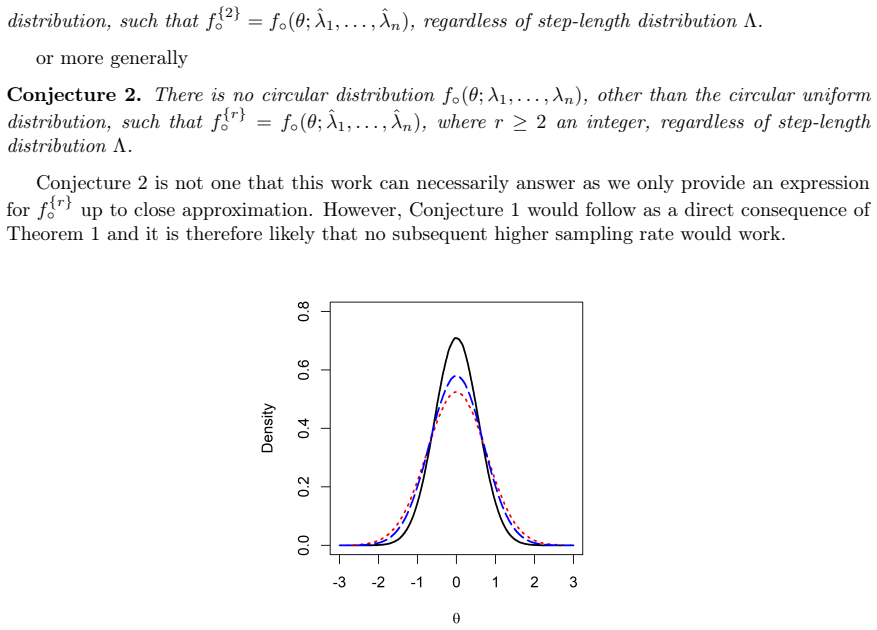
- Conjectures 1–2 are interesting but sit outside the proved results; moving them to a short “Open questions” paragraph would keep the main claims cleanly separated from speculation.
Circularity Check
Mild fitted-input circularity limited to the scalar tortuosity parameter p in the approximate higher-rate formula; the exact r=2 case and the convolution functional form itself are independently derived.
-
fitted input called prediction
[§3.2.1 Accuracy of Theorem 2; §3.3 The parameter p; Figs. 7–9]
"In each plot and for each sub-sampling rate, the value of the parameter p was found by best-fitting the predicted curve (points) to the observed results (solid lines) … as a function of the length of the mean resultant vector ρ … by minimising the MSD (L2 distance) between the distributions for simulated results and those found by a parameter sweep over p"
The multi-fold convolution of Theorem 2 is evaluated only after p is chosen to minimise L2 distance to the identical simulated turning-angle histograms that are then plotted as the 'observed' curves. Once p is so fitted, agreement is partly forced by construction of the scalar; the paper acknowledges sensitivity of order ±0.02 and that p encodes geometry/tortuosity, but still presents the matched curves as validation of the formula.
full rationale
Theorem 1 (r=2, fixed step lengths) is a pure geometric derivation: isosceles triangles yield the linear combination of three independent angles, whose distribution is the stated convolution after wrapping; no free parameters and no fitting. Corollary 1 follows identically. Theorem 2 extends the same recursion under two openly stated approximations (Remark 2: successive steps treated as equal-length so triangles remain isosceles; constant p across recursion levels). The resulting multi-fold convolution form is obtained by induction on the expected coefficients (Claim 1) and is therefore independent of data. The single free scalar p is then calibrated by minimising L2 distance to the same simulated histograms later used for visual validation (Figs. 7–9, §3.3). This is a classic fitted-input-called-prediction step, but it affects only the numerical value of one parameter, not the functional form, and the paper itself recovers the exact Theorem-1 case when p=1 and quantifies residual sensitivity. Self-citations appear only in background and applications and are not load-bearing for either theorem. No self-definitional loops, uniqueness imports, or renamed known results. Overall circularity is therefore modest and confined to calibration of the approximation parameter.
Assumptions & free parameters
free parameters (1)
- p (tortuosity / geometry probability) =
typically 0.94–1.0 (best-fit per ρ and k)
assumptions (4)
- domain assumption Turning angles of the original CRW are i.i.d. draws from a zero-centred symmetric unimodal circular density f_◦; step lengths are independent of angles and of each other.
- ad hoc to paper Successive steps may be treated as equal in length when forming the composite turning angle, even if the original step-length distribution has positive variance (isosceles-triangle approximation).
- ad hoc to paper The sign-probability p that appears at each recursion level may be replaced by a single constant p independent of level.
- standard math Standard wrapping formula that converts a density on the real line into a circular density on (−π,π].
invented entities (1)
-
tortuosity parameter p
Cite this review
Pith. "Pith review of Effect of sampling on the descriptive distributions of correlated random walks." pith.science (2026). https://pith.science/paper/7V7C4WNK
@misc{pith2026260703186,
  author       = {Pith},
  title        = {Pith review of: Effect of sampling on the descriptive distributions of correlated random walks},
  year         = {2026},
  howpublished = {\url{https://pith.science/paper/7V7C4WNK}},
  note         = {Machine review of arXiv:2607.03186}
}
read the original abstract
Random walks are commonly used to model movement throughout the sciences, from the motion of particles and molecules to the observed behaviour of animals and crowds. The correlated random walk, which assumes a level of persistence between movement directions, has become ubiquitous in the analysis and modelling of movement in recent times. Whilst many properties of the correlated random walk are known, there are still many which are not fully understood and, therefore, under utilised in movement data analysis. Here we consider the effect that sub-sampling has on the descriptive distributions of correlated random walks. Our work demonstrates the connection between the distributions of turning angles and step-lengths that characterise a correlated random walk, along with the resulting distributions found after sub-sampling. We provide examples for where this approach could aid in movement analysis as well as determining future ways the work could be extended.
Figures


Figures from the paper (14 more)




Reference graph
Works this paper leans on
-
[1]
Journal of the Royal society interface , volume=
Random walk models in biology , author=. Journal of the Royal society interface , volume=. 2008 , publisher=
2008
-
[2]
Ecology , volume=
Navigational efficiency in a biased and correlated random walk model of individual animal movement , author=. Ecology , volume=. 2018 , publisher=
2018
-
[3]
Random walk with persistence and external bias
Patlak, Clifforrd S. Random walk with persistence and external bias. The bulletin of mathematical biophysics. 1953
1953
-
[4]
Journal of mathematical biology , volume=
Biased random walk models for chemotaxis and related diffusion approximations , author=. Journal of mathematical biology , volume=. 1980 , publisher=
1980
-
[5]
Financial analysts journal , volume=
Random walks in stock market prices , author=. Financial analysts journal , volume=. 1995 , publisher=
1995
-
[6]
International conference on swarm intelligence , pages=
Random walks in swarm robotics: an experiment with kilobots , author=. International conference on swarm intelligence , pages=. 2016 , organization=
2016
-
[7]
Journal of Agricultural, Biological and Environmental Statistics , volume=
Bayesian inference for multistate `step and turn' animal movement in continuous time , author=. Journal of Agricultural, Biological and Environmental Statistics , volume=. 2017 , publisher=
2017
-
[8]
Acta biotheoretica , volume=
Sampling animal movement paths causes turn autocorrelation , author=. Acta biotheoretica , volume=. 2013 , publisher=
2013
Show all 101 references
-
[9]
Movement ecology , volume=
When to be discrete: the importance of time formulation in understanding animal movement , author=. Movement ecology , volume=. 2014 , publisher=
2014
-
[10]
Theoretical Ecology , volume=
An assessment of the contact rates between individuals when movement is modelled by a correlated random walk , author=. Theoretical Ecology , volume=. 2023 , publisher=
2023
-
[11]
Journal of mathematical biology , volume=
Robustness of movement models: can models bridge the gap between temporal scales of data sets and behavioural processes? , author=. Journal of mathematical biology , volume=. 2016 , publisher=
2016
-
[12]
Proceedings of the National Academy of Sciences , volume=
A movement ecology paradigm for unifying organismal movement research , author=. Proceedings of the National Academy of Sciences , volume=. 2008 , publisher=
2008
-
[13]
Science , volume=
Big-data approaches lead to an increased understanding of the ecology of animal movement , author=. Science , volume=. 2022 , publisher=
2022
-
[14]
Methods in Ecology and Evolution , volume=
Finding turning-points in ultra-high-resolution animal movement data , author=. Methods in Ecology and Evolution , volume=. 2018 , publisher=
2018
-
[15]
Oecologia , volume=
Analyzing insect movement as a correlated random walk , author=. Oecologia , volume=. 1983 , publisher=
1983
-
[16]
Oecologia , volume=
Caribou movement as a correlated random walk , author=. Oecologia , volume=. 2000 , publisher=
2000
-
[17]
Ecology , volume=
Telemetry and random-walk models reveal complex patterns of partial migration in a large marine predator , author=. Ecology , volume=. 2013 , publisher=
2013
-
[18]
Ecology , volume=
Animal search strategies: a quantitative random-walk analysis , author=. Ecology , volume=. 2005 , publisher=
2005
-
[19]
many-wrongs principle
Group navigation and the "many-wrongs principle" in models of animal movement , author=. Ecology , volume=. 2007 , publisher=
2007
-
[20]
Animal Behaviour , volume=
Distinguishing between elementary orientation mechanisms by means of path analysis , author=. Animal Behaviour , volume=. 1992 , publisher=
1992
-
[21]
Philosophical Transactions of the Royal Society B: Biological Sciences , volume=
Mechanistic movement models to understand epidemic spread , author=. Philosophical Transactions of the Royal Society B: Biological Sciences , volume=. 2017 , publisher=
2017
-
[22]
Methods in Ecology and Evolution , volume=
Why did the animal turn? Time-varying step selection analysis for inference between observed turning-points in high frequency data , author=. Methods in Ecology and Evolution , volume=. 2021 , publisher=
2021
-
[23]
Journal of theoretical biology , volume=
How to reliably estimate the tortuosity of an animal's path:: straightness, sinuosity, or fractal dimension? , author=. Journal of theoretical biology , volume=. 2004 , publisher=
2004
-
[24]
Zoologia (Curitiba) , volume=
Indices of movement behaviour: conceptual background, effects of scale and location errors , author=. Zoologia (Curitiba) , volume=. 2010 , publisher=
2010
-
[25]
International Journal of Geographical Information Science , volume=
Ecological metrics and methods for GPS movement data , author=. International Journal of Geographical Information Science , volume=. 2018 , publisher=
2018
-
[26]
Generalized run-and-turn motions: From bacteria to L
Detcheverry, Fran. Generalized run-and-turn motions: From bacteria to L. Physical Review E , volume=. 2017 , publisher=
2017
-
[27]
2001 , publisher=
Topics in circular statistics , author=. 2001 , publisher=
2001
-
[28]
Transactions of the American Fisheries Society , volume=
An individual-based model of ontogenetic migration in reef fish using a biased random walk , author=. Transactions of the American Fisheries Society , volume=. 2012 , publisher=
2012
-
[29]
Journal of Theoretical Biology , volume=
Sampling rate effects on measurements of correlated and biased random walks , author=. Journal of Theoretical Biology , volume=. 2005 , publisher=
2005
-
[30]
The American Naturalist , volume=
How do grazers achieve their distribution? A continuum of models from random diffusion to the ideal free distribution using biased random walks , author=. The American Naturalist , volume=. 1999 , publisher=
1999
-
[31]
Oikos , volume=
The evolution of an `intelligent' dispersal strategy: biased, correlated random walks in patchy landscapes , author=. Oikos , volume=. 2009 , publisher=
2009
-
[32]
Ecology letters , volume=
Are there general mechanisms of animal home range behaviour? A review and prospects for future research , author=. Ecology letters , volume=. 2008 , publisher=
2008
-
[33]
Bulletin of the Ecological Society of America , volume=
The correlated random walk and the rise of movement ecology , author=. Bulletin of the Ecological Society of America , volume=. 2014 , publisher=
2014
-
[34]
Journal of Animal Ecology , volume=
A guide to pre-processing high-throughput animal tracking data , author=. Journal of Animal Ecology , volume=. 2022 , publisher=
2022
-
[35]
Ecology and Evolution , volume=
``Micropersonality'' traits and their implications for behavioral and movement ecology research , author=. Ecology and Evolution , volume=. 2021 , publisher=
2021
-
[36]
Philosophical Transactions of the Royal Society B: Biological Sciences , volume=
Stochastic modelling of animal movement , author=. Philosophical Transactions of the Royal Society B: Biological Sciences , volume=. 2010 , publisher=
2010
-
[37]
AIMS Mathematics , volume=
Correlated random walks in heterogeneous landscapes: Derivation, homogenization, and invasion fronts , author=. AIMS Mathematics , volume=
-
[38]
https://www.oxfordbibliographies.com/view/document/obo-9780199830060/obo-9780199830060-0254.xml
Codling, Edward A and Bailey, Joseph D and B. Modeling and Data Analysis in Movement Ecology. Oxford Bibliographies , url = "https://www.oxfordbibliographies.com/view/document/obo-9780199830060/obo-9780199830060-0254.xml", publisher=
-
[39]
1993 , publisher=
Random walks in biology , author=. 1993 , publisher=
1993
-
[40]
2017 , publisher=
Animal movement: statistical models for telemetry data , author=. 2017 , publisher=
2017
-
[41]
Lecture notes in mathematics (mathematics bioscience series) , volume=
Dispersal, individual movement and spatial ecology , author=. Lecture notes in mathematics (mathematics bioscience series) , volume=. 2013 , publisher=
2013
-
[42]
Biometrika , volume=
Random dispersal in theoretical populations , author=. Biometrika , volume=. 1951 , publisher=
1951
-
[43]
1998 , publisher=
Quantitative analysis of movement: measuring and modeling population redistribution in animals and plants , author=. 1998 , publisher=
1998
-
[44]
2001 , publisher=
Diffusion and ecological problems: modern perspectives , author=. 2001 , publisher=
2001
-
[45]
Locating patches and distant resources
Bell, William J. Locating patches and distant resources. Searching Behaviour: The behavioural ecology of finding resources. 1990
1990
-
[46]
Philosophical Transactions of the Royal Society of London
Population dynamics in spatially complex environments: theory and data , author=. Philosophical Transactions of the Royal Society of London. Series B: Biological Sciences , volume=. 1990 , publisher=
1990
-
[47]
Journal of Animal Ecology , volume=
Dynamic, spatial models of parasite transmission in wildlife: Their structure, applications and remaining challenges , author=. Journal of Animal Ecology , volume=. 2018 , publisher=
2018
-
[48]
Physical Review E , volume=
Gaseous diffusion as a correlated random walk , author=. Physical Review E , volume=. 2024 , publisher=
2024
-
[49]
Ecology , volume=
Detecting an orientation component in animal paths when the preferred direction is individual-dependent , author=. Ecology , volume=. 2006 , publisher=
2006
-
[50]
Journal of the Royal Society Interface , volume=
The effect of sampling rate on observed statistics in a correlated random walk , author=. Journal of the Royal Society Interface , volume=. 2013 , publisher=
2013
-
[51]
Journal of Physics A: Mathematical and Theoretical , volume=
Exact solution of an anisotropic 2D random walk model with strong memory correlations , author=. Journal of Physics A: Mathematical and Theoretical , volume=. 2013 , publisher=
2013
-
[52]
Physical Review E , volume=
Persistent-random-walk approach to anomalous transport of self-propelled particles , author=. Physical Review E , volume=. 2015 , publisher=
2015
-
[53]
Langmuir , volume=
Multicomponent Effective Medium--Correlated Random Walk Theory for the Diffusion of Fluid Mixtures through Porous Media , author=. Langmuir , volume=. 2012 , publisher=
2012
-
[54]
Soft Matter , volume=
Correlated continuous-time random walk in the velocity field: the role of velocity and weak asymptotics , author=. Soft Matter , volume=. 2021 , publisher=
2021
-
[55]
Applied Intelligence , volume=
Effect of random walk methods on searching efficiency in swarm robots for area exploration , author=. Applied Intelligence , volume=. 2021 , publisher=
2021
-
[56]
Movement Ecology , volume=
Copycat dynamics in leaderless animal group navigation , author=. Movement Ecology , volume=. 2014 , publisher=
2014
-
[57]
Ecological Modelling , volume=
Predicting monarch butterfly (Danaus plexippus) movement and egg-laying with a spatially-explicit agent-based model: the role of monarch perceptual range and spatial memory , author=. Ecological Modelling , volume=. 2018 , publisher=
2018
-
[58]
Bulletin of Entomological Research , volume=
Walking behaviour in the ground beetle, Poecilus cupreus: dispersal potential, intermittency and individual variation , author=. Bulletin of Entomological Research , volume=. 2021 , publisher=
2021
-
[59]
Methods in Ecology and Evolution , volume=
momentuHMM: R package for generalized hidden Markov models of animal movement , author=. Methods in Ecology and Evolution , volume=. 2018 , publisher=
2018
-
[60]
Proceedings of the Royal Society B: Biological Sciences , volume=
Socially informed random walks: incorporating group dynamics into models of population spread and growth , author=. Proceedings of the Royal Society B: Biological Sciences , volume=. 2008 , publisher=
2008
-
[61]
Biological Control , volume=
Risk analysis and management decisions for weed biological control agents: ecological theory and modeling results , author=. Biological Control , volume=. 2005 , publisher=
2005
-
[62]
Journal of Theoretical Biology , volume=
Efficiency of area-concentrated searching behaviour in a continuous patchy environment , author=. Journal of Theoretical Biology , volume=. 1992 , publisher=
1992
-
[63]
Ecological Modelling , volume=
On random walk models as a baseline for animal movement in three-dimensional space , author=. Ecological Modelling , volume=. 2023 , publisher=
2023
-
[64]
Ecology , volume=
Edge-mediated dispersal behavior in a prairie butterfly , author=. Ecology , volume=. 2001 , publisher=
2001
-
[65]
Royal Society open science , volume=
Optimal switching between geocentric and egocentric strategies in navigation , author=. Royal Society open science , volume=. 2016 , publisher=
2016
-
[66]
AStA Advances in Statistical Analysis , volume=
Emergence of the wrapped Cauchy distribution in mixed directional data , author=. AStA Advances in Statistical Analysis , volume=. 2021 , publisher=
2021
-
[67]
The Journal of Chemical Physics , volume=
Velocity jump processes: An alternative to multi-timestep methods for faster and accurate molecular dynamics simulations , author=. The Journal of Chemical Physics , volume=. 2020 , publisher=
2020
-
[68]
SIAM Journal on Applied Mathematics , volume=
The diffusion limit of transport equations derived from velocity-jump processes , author=. SIAM Journal on Applied Mathematics , volume=. 2000 , publisher=
2000
-
[69]
Physical Review E , volume=
Generalized Ornstein-Uhlenbeck model for active motion , author=. Physical Review E , volume=. 2019 , publisher=
2019
-
[70]
Ecology , volume=
Predicting animal home-range structure and transitions using a multistate Ornstein-Uhlenbeck biased random walk , author=. Ecology , volume=. 2017 , publisher=
2017
-
[71]
Ecology , volume=
Continuous-time correlated random walk model for animal telemetry data , author=. Ecology , volume=. 2008 , publisher=
2008
-
[72]
Methods in Ecology and Evolution , volume=
A new approach for objective identification of turns and steps in organism movement data relevant to random walk modelling , author=. Methods in Ecology and Evolution , volume=. 2013 , publisher=
2013
-
[73]
Zaburdaev, Vasily and Denisov, Sergey and Klafter, Joseph , journal=. L. 2015 , publisher=
2015
-
[74]
Journal of mathematical biology , volume=
Analyzing fish movement as a persistent turning walker , author=. Journal of mathematical biology , volume=. 2009 , publisher=
2009
-
[75]
Movement ecology , volume=
Applications of step-selection functions in ecology and conservation , author=. Movement ecology , volume=. 2014 , publisher=
2014
-
[76]
PloS one , volume=
Equivalence between step selection functions and biased correlated random walks for statistical inference on animal movement , author=. PloS one , volume=. 2015 , publisher=
2015
-
[77]
Ecology , volume=
Analyzing animal movements using Brownian bridges , author=. Ecology , volume=. 2007 , publisher=
2007
-
[78]
Ecology , volume=
Extracting more out of relocation data: building movement models as mixtures of random walks , author=. Ecology , volume=. 2004 , publisher=
2004
-
[79]
Methods in Ecology and Evolution , volume=
moveHMM: an R package for the statistical modelling of animal movement data using hidden Markov models , author=. Methods in Ecology and Evolution , volume=. 2016 , publisher=
2016
-
[80]
How many animals really do the L
Benhamou, Simon , journal=. How many animals really do the L. 2007 , publisher=
2007
-
[81]
Mussels realize Weierstrassian L
Reynolds, Andy M , journal=. Mussels realize Weierstrassian L. 2014 , publisher=
2014
-
[82]
Trends in ecology & evolution , volume=
State--space models of individual animal movement , author=. Trends in ecology & evolution , volume=. 2008 , publisher=
2008
-
[83]
Ecology letters , volume=
A novel method for identifying behavioural changes in animal movement data , author=. Ecology letters , volume=. 2009 , publisher=
2009
-
[84]
Journal of Animal Ecology , volume=
What is the animal doing? Tools for exploring behavioural structure in animal movements , author=. Journal of Animal Ecology , volume=. 2016 , publisher=
2016
-
[85]
1995 , publisher=
Statistical analysis of circular data , author=. 1995 , publisher=
1995
-
[86]
2013 , publisher=
Circular statistics in R , author=. 2013 , publisher=
2013
-
[87]
2009 , publisher=
Directional statistics , author=. 2009 , publisher=
2009
-
[88]
Australian Journal of Statistics , volume=
Discriminating between the von Mises and wrapped normal distributions , author=. Australian Journal of Statistics , volume=. 1981 , publisher=
1981
-
[89]
Biometrika , volume=
Random walk on a circle , author=. Biometrika , volume=. 1963 , publisher=
1963
-
[90]
Wiley Interdisciplinary Reviews: Computational Statistics , volume=
Circular data , author=. Wiley Interdisciplinary Reviews: Computational Statistics , volume=. 2010 , publisher=
2010
-
[91]
Journal of Theoretical Biology , volume=
The form and consequences of random walk movement models , author=. Journal of Theoretical Biology , volume=. 1988 , publisher=
1988
-
[92]
Movement ecology , volume=
Path segmentation for beginners: an overview of current methods for detecting changes in animal movement patterns , author=. Movement ecology , volume=. 2016 , publisher=
2016
-
[93]
Methods in Ecology and Evolution , volume=
Elliptical Time-Density model to estimate wildlife utilization distributions , author=. Methods in Ecology and Evolution , volume=. 2014 , publisher=
2014
-
[94]
Ecology , volume=
Diffusion about the mean drift location in a biased random walk , author=. Ecology , volume=. 2010 , publisher=
2010
-
[95]
Agostinelli and U
C. Agostinelli and U. Lund , address =. 2022 , url =
2022
-
[96]
Random walks: theory and selected applications , author=. Adv. Chem. Phys , volume=. 1983 , publisher=
1983
-
[97]
American Scientist , volume=
Random walks and their applications: Widely used as mathematical models, random walks play an important role in several areas of physics, chemistry, and biology , author=. American Scientist , volume=. 1983 , publisher=
1983
-
[98]
Physics reports , volume=
Anomalous diffusion in disordered media: statistical mechanisms, models and physical applications , author=. Physics reports , volume=. 1990 , publisher=
1990
-
[99]
Journal of theoretical biology , volume=
A biased random walk model for the trajectories of swimming micro-organisms , author=. Journal of theoretical biology , volume=. 1997 , publisher=
1997
-
[100]
and Bailey, Joseph D
Ahmed, Danish A. and Bailey, Joseph D. and Petrovskii, Sergei V. and Bonsall, Michael B. Mathematical Bases for 2D Insect Trap Counts Modelling. Advances in Artificial Intelligence, Computation, and Data Science: For Medicine and Life Science. 2021
2021
-
[101]
Physics of life reviews , volume=
Multiscale approach to pest insect monitoring: random walks, pattern formation, synchronization, and networks , author=. Physics of life reviews , volume=. 2014 , publisher=
2014
Reviewed July 12, 2026 · model on record in the stance chip above.
Discussion (0). Continue with ORCID to comment.