REVIEW 3 major objections 4 minor 22 references
Round-Trip Mutation Testing: Translating Code to Natural Language Intent and back
T0 review · 3 major / 4 minor · reviewed 2026-07-12 · grok-4.5
Pith's one-line read Round-trip code-to-intent translation with LLMs yields mutants that find more real faults with far fewer tests than traditional mutation.
desk verdict Solid LLM-based mutant generator that improves early fault detection under a small budget; the 4 imes claim is real under their protocol but rests on an oracle-aware test pool. read the letter →
The pith
A machine-rendered reading of the paper's core claim, the machinery that carries it, and where it could break.
The reading
What carries the argument
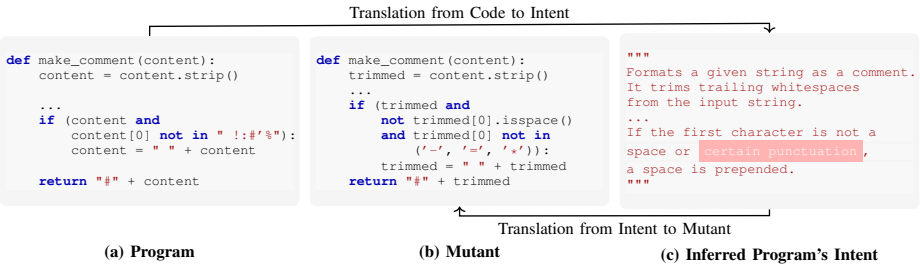
The round-trip operator Pm = M^{-1}(μ(M(P))), where M maps code to natural-language intent, μ optionally mutates that intent, and M^{-1} regenerates code; imperfect LLM translations supply the semantic differences that become the mutants.
What would settle it
Repeat the exact same test-selection simulation on the same forty BugsInPy methods but replace the LLM-generated tests with only the original developer tests (or with tests generated by an independent model) and check whether RTM still yields four-fold higher fault detection at a budget of four tests.
Extended reading notes
Core claim
Round-trip mutation testing (RTM) generates mutants by translating a program into a natural-language intent and then back into code; the mistranslations, optionally amplified by deliberate intent edits, produce valid mutants that are more diverse than traditional pattern-based mutants and that guide the selection of markedly smaller yet stronger test suites on real bugs.
Load-bearing premise
The simulation assumes that mutants generated on already-buggy code, together with tests written by the same LLM family from the already-fixed code, correctly measure how well the method would help a developer who has neither the bug fix nor the fault-revealing tests.
Editorial analysis
A structured set of objections, weighed in public.
Referee Report
Summary. The paper proposes Round-Trip Mutation Testing (RTM), which generates mutants of a program by using an LLM to translate its code into a natural-language intent description and then back into code (optionally after mutating the intent). Four variants (Broad/Precise intent prompts, with/without intent mutation) are implemented with GPT-4o-mini and compared to a reimplementation of MutPy operators. Evaluation on 40 real buggy methods from BugsInPy measures mutant validity (RQ1), syntactic diversity via BLEU (RQ2), and fault-detection rates of test suites built by a random mutant-killing selection simulation (RQ3). The central empirical claim is that RTM yields more diverse mutants and, for small budgets, substantially stronger suites (approximately 4.3× and 1.7× higher average fault detection at 4 and 30 tests respectively) than traditional operators.
Significance. If the early-budget advantage holds under more realistic conditions, RTM would be a practically useful, operator-free, language-agnostic way to obtain intent-based mutants even when developer documentation is absent (only ~34 % of methods in the studied projects have docstrings). The idea of deliberately exploiting LLM mistranslation noise, the four controlled variants, the concrete validity/diversity/fault-detection measurements, and the 100-run simulation averages are genuine contributions that advance mutation-testing research beyond purely syntactic operators. The work also surfaces useful negative findings (intent mutation increases incompetent mutants; lower semantic uniqueness of RTM mutants).
major comments (3)
- [IV-A / Figure 6 / Abstract] Section IV-A (“Test Augmentation” and “Mutation Testing Simulation”) and the headline numbers in the Abstract / Figure 6: mutants are generated from the buggy method while the candidate test pool is produced by the same LLM family from the already-fixed method, with explicit filtering that guarantees at least one fault-revealing test and 89–94 % coverage. Selection then repeatedly adds a random killer of a random surviving mutant. Consequently the measured “guidance” largely reflects how preferentially RTM mutants’ killing sets contain those already-known, oracle-aware fault-revealers. In a real developer workflow tests would be written without knowledge of the fix; the 4.3× early-budget claim therefore rests on a protocol assumption that is common in the literature but does not faithfully simulate oracle-free guidance. A stronger evaluation (developer-written tests only, tests generated
- [Table I / Section IV-A] Table I and the subject selection: only 40 methods drawn from five Python projects. While the threats-to-validity section acknowledges limited generalizability, the quantitative claims (especially the 4× factor) are presented as general. With so few subjects the averages are sensitive to a handful of methods; either a substantially larger multi-language corpus or a clear restriction of the claims to the studied setting is required.
- [Table III / Section VI] Table III and the Discussion section: RTM mutants exhibit markedly lower semantic uniqueness (~20 % vs ~38 % for traditional mutants). This directly explains the early plateau of the RTM curves in Figure 6 and the fact that traditional mutation eventually overtakes RTM for larger budgets. The paper notes the phenomenon but does not quantify how much of the early advantage is simply an artifact of fewer distinct killing sets, nor does it explore whether the lower uniqueness can be mitigated (e.g., by diversity-aware selection or better context for back-translation). Without that analysis the practical recommendation for “small test suites” remains incomplete.
minor comments (4)
- [Figure 5] Figure 5 caption and axis labels: “distance (1-BLEU)” is clear, but the box-plot legend (white = distance to original, grey = pairwise) would be easier to read if the two series were also distinguished by hatch or explicit labels inside the figure.
- [Figure 3 / Section III-B] The full prompt templates for intent generation (Figure 3) and for intent mutation are only partially shown; releasing the complete prompts (or a repository link) would improve reproducibility.
- [Table II] Table II: the “Incompetent” column mixes runtime errors with other failures; a short clarification of the exact criteria used to classify a mutant as incompetent would help readers interpret the higher rates for µPrecise.
- [Figures 2, 6 / Section V-C] A few minor wording issues: “thefuck youtube-dl auqdm black httpie” in the axis of Figure 2; “surviving” vs “survived” inconsistency; and the repeated “≈” symbols in the text of RQ3 could be standardized.
Circularity Check
No significant circularity; the method definitions and empirical claims are self-contained without by-construction reductions of predictions to inputs.
full rationale
The paper is an empirical software-engineering contribution. Equations (1)–(2) simply define the RTM construction (Pm = M^{-1}(M(P)) and the optional intent-mutation variant); they are not presented as independent first-principles derivations that later “predict” quantities already fixed by those equations. All headline results (mutant validity ratios in Table II, BLEU diversity in Figure 5, fault-detection curves in Figure 6) are obtained by executing generated mutants against an external test pool on BugsInPy subjects and comparing against a re-implemented MutPy baseline and random selection; none of these quantities is a fitted parameter renamed as a prediction. The single self-citation to Hamidi et al. [14] re-uses an existing intent-mutation procedure for two of the four RTM variants and is not load-bearing for the core round-trip idea or for the performance claims (which remain visible even for the non-mutated Precise/Broad variants). No uniqueness theorem, ansatz, or known empirical pattern is imported and re-labeled. The evaluation protocol (LLM tests generated from already-fixed methods) is a recognized external-validity threat discussed by the authors themselves; it does not render any claimed derivation circular by construction. Consequently the paper scores 0 under the stated criteria.
Assumptions & free parameters
free parameters (4)
- mutants_per_method =
10
- LLM_choice =
GPT-4o-mini
- simulation_repetitions =
100
- intent_prompt_style =
Broad / Precise templates
assumptions (4)
- domain assumption Higher mutant-killing ability of a test suite implies higher real-fault detection capability.
- ad hoc to paper LLM mistranslations between code and natural-language intent produce mutants that simulate realistic specification-misunderstanding faults.
- domain assumption Random selection of an unkilled mutant followed by a random killing test models how a developer would use mutation guidance.
- domain assumption BLEU distance on de-docstringed code is a meaningful proxy for syntactic diversity of mutants.
invented entities (2)
-
Round-Trip Mutation Testing (RTM)
-
Broad vs Precise intent generation prompts
Cite this review
Pith. "Pith review of Round-Trip Mutation Testing: Translating Code to Natural Language Intent and back." pith.science (2026). https://pith.science/paper/L433VWLX
@misc{pith2026260703223,
  author       = {Pith},
  title        = {Pith review of: Round-Trip Mutation Testing: Translating Code to Natural Language Intent and back},
  year         = {2026},
  howpublished = {\url{https://pith.science/paper/L433VWLX}},
  note         = {Machine review of arXiv:2607.03223}
}
read the original abstract
This paper presents Round-Trip Mutation Testing (RTM), a novel approach that generates mutants from LLM mistranslations between a program code and its intent. Leveraging the generative capability of LLMs from and to programming and natural language, and given an input program, our approach predicts its intent, that is used to generate programs, which when different from the original one, constitute the output mutants. The approach produces additionally mutants, stemming from artificially provoked mistranslations, by mutating the intent prior to the final programs (mutants) generation. Originating from the propagation of small changes in the intent to the code, our intuition is that these programs would present subtle semantic differences from the original one, simulating likely-to-occur faults that could result from specification misunderstandings, and enabling mutation testing. To evaluate RTM, we run it on 40 real buggy methods and evaluate its effectiveness and cost-efficiency in guiding testing towards detecting the bugs. Our results demonstrate the potential of round-trip mutation testing to produce syntactically more diverse mutants, potentially exposing faults that traditional mutation operators fail to reveal. More interestingly, RTM outperforms traditional pattern-based mutation in producing smaller and stronger test-suites, detecting on average over 4 and 1.7 times more faults when selecting only 4 and 30 tests respectively.
Figures


Figures from the paper (3 more)


Reference graph
Works this paper leans on
-
[1]
Metallaxis-fl: mutation-based fault localization,
M. Papadakis and Y . Le Traon, “Metallaxis-fl: mutation-based fault localization,”Software Testing, Verification and Reliability, vol. 25, no. 5-7, pp. 605–628, 2015
2015
-
[2]
Chapter six - mutation testing advances: An analysis and survey,
M. Papadakis, M. Kintis, J. Zhang, Y . Jia, Y . L. Traon, and M. Harman, “Chapter six - mutation testing advances: An analysis and survey,” Advances in Computers, vol. 112, pp. 275–378, 2019
2019
-
[3]
Ammann and J
P. Ammann and J. Offutt,Introduction to Software Testing. Cambridge University Press, 2008
2008
-
[4]
An experimental determination of sufficient mutant operators,
A. J. Offutt, A. Lee, G. Rothermel, R. H. Untch, and C. Zapf, “An experimental determination of sufficient mutant operators,”ACM Trans. Softw. Eng. Methodol., vol. 5, no. 2, pp. 99–118, 1996
1996
-
[5]
Time to clean your test objectives,
M. Marcozzi, S. Bardin, N. Kosmatov, M. Papadakis, V . Prevosto, and L. Correnson, “Time to clean your test objectives,” inInternational Conference on Software Engineering, ICSE, 2018, pp. 456–467
2018
-
[6]
How effective are mutation testing tools? an empirical analysis of java mutation testing tools with manual analysis and real faults,
M. Kintis, M. Papadakis, A. Papadopoulos, E. Valvis, N. Malevris, and Y . L. Traon, “How effective are mutation testing tools? an empirical analysis of java mutation testing tools with manual analysis and real faults,”Empir. Softw. Eng., vol. 23, no. 4, pp. 2426–2463, 2018
2018
-
[7]
Mujava: an automated class mutation system,
Y . Ma, J. Offutt, and Y . R. Kwon, “Mujava: an automated class mutation system,”Softw. Test. Verification Reliab., vol. 15, no. 2, pp. 97–133, 2005
2005
-
[8]
Assessing and improving the mutation testing practice of pit,
T. Laurent, M. Papadakis, M. Kintis, C. Henard, Y . L. Traon, and A. Ventresque, “Assessing and improving the mutation testing practice of pit,” in2017 IEEE International Conference on Software Testing, Verification and Validation (ICST), March 2017, pp. 430–435
2017
Show all 22 references
-
[9]
Pit: A practical mutation testing tool for java (demo),
H. Coles, T. Laurent, C. Henard, M. Papadakis, and A. Ventresque, “Pit: A practical mutation testing tool for java (demo),” inProceedings of the 25th International Symposium on Software Testing and Analysis, 2016, p. 449–452
2016
-
[10]
µbert: Mutation testing using pre- trained language models,
R. Degiovanni and M. Papadakis, “µbert: Mutation testing using pre- trained language models,” in15th IEEE International Conference on Software Testing, Verification and Validation Workshops ICST Work- shops, 2022, pp. 160–169
2022
-
[11]
Efficient mutation testing via pre-trained language models,
A. Khanfir, R. Degiovanni, M. Papadakis, and Y . L. Traon, “Efficient mutation testing via pre-trained language models,”arXiv:2301.03543, 2023
2023 arXiv
-
[12]
Semantic bug seeding: A learning-based approach for creating realistic bugs,
J. Patra and M. Pradel, “Semantic bug seeding: A learning-based approach for creating realistic bugs,” inESEC/FSE Joint European Software Engineering Conference and Symposium on the Foundations of Software Engineering, 2021, p. 906–918
2021
-
[13]
Ibir: Bug report driven fault injection,
A. Khanfir, A. Koyuncu, M. Papadakis, M. Cordy, T. F. Bissyand ´e, J. Klein, and Y . Le Traon, “Ibir: Bug report driven fault injection,”ACM Trans. Softw. Eng. Methodol., may 2022
2022
-
[14]
Intent-based mutation testing: From naturally written programming intents to mutants,
A. Hamidi, A. Khanfir, and M. Papadakis, “Intent-based mutation testing: From naturally written programming intents to mutants,” in2025 IEEE International Conference on Software Testing, Verification and Validation Workshops (ICSTW), 2025, pp. 347–357
2025
-
[15]
Unsupervised evaluation of code llms with round-trip correctness,
M. Allamanis, S. Panthaplackel, and P. Yin, “Unsupervised evaluation of code llms with round-trip correctness,”arXiv preprint arXiv:2402.08699, 2024
2024 arXiv
-
[16]
A novel approach for automatic program repair using round-trip translation with large language models,
F. V . Ruiz, A. Grishina, M. Hort, and L. Moonen, “A novel approach for automatic program repair using round-trip translation with large language models,”arXiv preprint arXiv:2401.07994, 2024
2024
-
[17]
Bugsinpy: a database of existing bugs in python programs to enable controlled testing and debugging studies,
R. Widyasari, S. Q. Sim, C. Lok, H. Qi, J. Phan, Q. Tay, C. Tan, F. Wee, J. E. Tan, Y . Yiehet al., “Bugsinpy: a database of existing bugs in python programs to enable controlled testing and debugging studies,” inProceedings of the 28th ACM joint meeting on european software e...
2020
-
[18]
Employing second-order mutation for isolating first-order equivalent mutants,
M. Kintis, M. Papadakis, and N. Malevris, “Employing second-order mutation for isolating first-order equivalent mutants,”Softw. Test. Veri- fication Reliab., vol. 25, no. 5-7, pp. 508–535, 2015
2015
-
[19]
Syntactic versus semantic similarity of artificial and real faults in mutation testing studies,
M. Ojdanic, A. Garg, A. Khanfir, R. Degiovanni, M. Papadakis, and Y . Le Traon, “Syntactic versus semantic similarity of artificial and real faults in mutation testing studies,”IEEE Transactions on Software Engineering, vol. 49, no. 7, pp. 3922–3938, 2023
2023
-
[20]
On comparing mutation testing tools through learning- based mutant selection,
M. Ojdanic, A. Khanfir, A. Garg, R. Degiovanni, M. Papadakis, and Y . Le Traon, “On comparing mutation testing tools through learning- based mutant selection,” in2023 IEEE/ACM International Conference on Automation of Software Test (AST). IEEE, 2023, pp. 35–46
2023
-
[21]
Mutpy: Mutation testing tool for python 3.x code,
“Mutpy: Mutation testing tool for python 3.x code,” https://github.com/ mutpy/mutpy, 2019, accessed: 2026-03-12
2019
-
[22]
An empirical study on mutation, statement and branch coverage fault revelation that avoids the unreliable clean program assumption,
T. T. Chekam, M. Papadakis, Y . L. Traon, and M. Harman, “An empirical study on mutation, statement and branch coverage fault revelation that avoids the unreliable clean program assumption,” inInternational Conference on Software Engineering, ICSE, 2017, pp. 597–608
2017
Reviewed July 12, 2026 · model on record in the stance chip above.
Discussion (0). Continue with ORCID to comment.