REVIEW 2 major objections 5 minor 1 cited by
A UV-faint quasar at z=7.7 sits in the brightest [CII] host yet seen among its peers, so UV dimness does not mean a low-mass galaxy.
Reviewed by Pith at T0; open to challenge. T0 means a machine referee read the full paper against a public rubric. the ladder, T0–T4 →
T0 review · grok-4.5
2026-07-12 02:31 UTC pith:T4JGFATT
load-bearing objection Solid single-object NOEMA paper: most distant [CII]/dust in a quasar host, and a UV-faint Euclid source that is the brightest [CII] emitter among the three known z≈7.5 systems. the 2 major comments →
Euclid: A UV-faint quasar in a highly luminous star-forming host galaxy at z approx 7.7
The pith
A machine-rendered reading of the paper's core claim, the machinery that carries it, and where it could break.
Core claim
Despite M_1450 = −24.06 (nearly two magnitudes fainter than the prior z≈7.5 sample), EUCL J1253+7054 hosts the brightest [CII] emission yet measured at these redshifts (L_[CII] = 2.03^{+0.26}_{-0.23}×10^9 L_☉) together with L_FIR = 3.6×10^{12} L_☉, a dust mass ~1.4×10^8 M_☉ and SFR >250 M_☉ yr⁻¹, showing that UV-faint quasars at z>6 can reside in massive, actively star-forming galaxies.
What carries the argument
The [CII] 158 µm luminosity and single-band 1.3 mm continuum, converted via a modified black-body (T_dust=47 K, β=1.6) and standard SFR calibrations, which together quantify host star-formation rate, dust mass and dynamical mass and allow direct comparison with UV-brighter z≈7.5 quasars.
Load-bearing premise
The conversion of the single 1.3 mm continuum point into FIR luminosity, dust mass and star-formation rate rests on fixed dust temperature and emissivity values that the paper itself shows can change the derived quantities by factors of two to five.
What would settle it
A multi-band submillimetre SED that measures a substantially different dust temperature or emissivity (or a high-resolution [CII] map that yields a much larger dynamical mass) would reverse the claim that the host is as massive and vigorously star-forming as the UV-bright comparison sample.
If this is right
- UV luminosity is not a reliable proxy for host-galaxy mass or star-formation rate at z>7.
- UV-faint quasars can still host luminous [CII] reservoirs and short gas-depletion times, consistent with an extreme starburst phase.
- The MBH/Mdyn ratio for such systems may sit closer to the local relation once black-hole masses are measured, implying a different evolutionary stage from UV-bright quasars.
- Combining wide-area optical surveys with millimetre interferometry can systematically map black-hole–galaxy co-evolution across a broader luminosity baseline.
Where Pith is reading between the lines
- If dust obscuration or sub-Eddington accretion is common among UV-faint systems, the true space density of massive black holes at z>7 is higher than UV-selected samples alone imply.
- JWST spectroscopy of the same objects that measures Civ or MgII black-hole masses would immediately test whether these hosts already follow the local MBH–Mdyn relation.
- The short gas-depletion times suggest that the starburst phase is brief; larger samples will show whether UV-faint and UV-bright quasars occupy sequential or parallel tracks.
Editorial analysis
A structured set of objections, weighed in public.
Referee Report
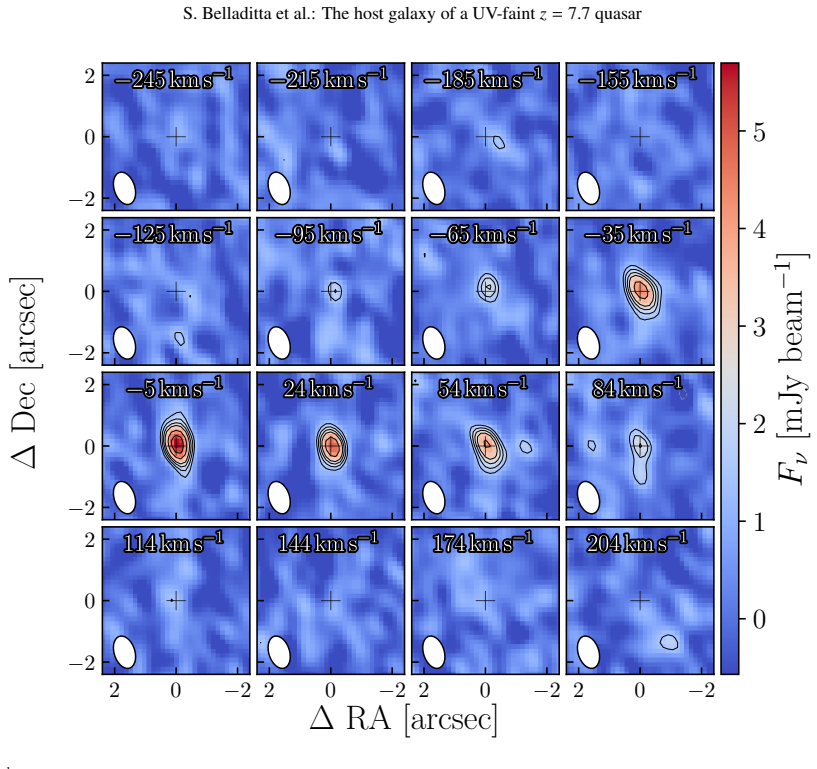
Summary. This paper presents IRAM/NOEMA observations of the Euclid-discovered quasar EUCL J1253+7054 at z_[CII]=7.6980±0.0004, reporting the most distant [CII] 158 µm and cold-dust continuum detections in a quasar host to date. The source has L_[CII]=2.03^{+0.26}_{-0.23}×10^9 L_⊙ (brightest among known z≈7.5 quasars), L_FIR=3.6×10^{12} L_⊙, M_dust≈1.4×10^8 M_⊙, and M_dyn in the range (0.33–1.3)×10^{10} M_⊙ from simplified dispersion- and rotation-dominated estimators. Despite being ~2 mag fainter in the rest-frame UV (M_1450=−24.06) than the previously known z≈7.5 quasars, the host is vigorously star-forming (SFR ≳250 M_⊙ yr^{−1} from both [CII] and IR estimators). The authors interpret the UV-faintness as likely due to dust obscuration or sub-Eddington accretion rather than lower host mass, and position the source as a bridge between UV-bright quasars and fainter JWST AGNs.
Significance. The result is significant: it extends [CII] and dust continuum detections of quasar hosts to the highest redshift yet, and demonstrates that a UV-faint Euclid quasar can host the brightest [CII] emission among z≈7.5 systems. The central observational claim (highest L_[CII] at lower M_1450) is model-independent and rests on consistent image-plane and uv-plane flux measurements plus a BIC-preferred single-Gaussian line fit. The work illustrates the scientific return of combining Euclid’s wide-area UV-faint quasar discoveries with submillimetre follow-up, and is consistent with emerging evidence that UV-faint z>6 quasars preferentially reside in [CII]-luminous hosts. Derived quantities that depend on assumed dust parameters are appropriately flagged.
major comments (2)
- Sect. 3.6 and Fig. 5: The M_BH/M_dyn discussion is load-bearing for the evolutionary interpretation (UV-faint systems possibly closer to the local relation). M_BH is only a lower limit under the Eddington assumption (Eq. 7) and M_dyn is a first estimate from unresolved data (Eqs. 5–6, with large R_[CII] and inclination uncertainties). The paper already notes that M_dyn >10^{10} M_⊙ and M_BH below a few 10^8 M_⊙ would be needed to sit on the local relation, but the abstract and concluding remarks still present the evolutionary-stage claim relatively strongly. Soften the language to match the data limitations, or explicitly state that the ratio remains consistent with UV-bright high-z quasars within the present uncertainties.
- Sect. 3.2 and Table 1: L_FIR, L_TIR, SFR_IR, M_dust and the [CII] deficit all depend on the fixed MBB parameters T_dust=47 K, β=1.6 and the optically thin assumption. The paper correctly reports that varying these within the Costa et al. (2026) range changes results by factors of ≈2–5 (and optical-depth tests by ≈2.6). Because the abstract quotes specific L_FIR and SFR values, a short quantitative range (or a note that the [CII]-based SFRs already give SFR>250 M_⊙ yr^{−1}) should appear in the abstract or Table 1 notes so that the headline numbers are not over-interpreted.
minor comments (5)
- Sect. 3.1: The aperture choice (r=1.5 arcsec) is well motivated by the plateau method, but a brief statement of the enclosed flux fraction relative to the synthesised beam would help readers assess possible missing extended emission.
- Fig. 3: The tentative southern extension at ~3σ in a single 84 km s^{−1} channel is noted; a short remark on whether it survives alternative continuum subtraction or uv-tapering would strengthen the claim that the source is not a merger.
- Eq. (2) vs. Table 1: Kennicutt & Evans (2012) is applied with L_IR integrated 3–1100 µm, while L_TIR is defined 8–1000 µm; a one-sentence clarification that the numerical difference is negligible for the adopted MBB would avoid confusion.
- Sect. 3.6: The molecular-to-total gas fraction of 0.75 and δ_GDR=100 (or 80±40) are standard but should be referenced more explicitly when quoting the M_gas range 0.41–1.24×10^{10} M_⊙.
- Typographical: Abstract and text use both L_FIR and L_TIR; ensure consistent subscripting. A few references appear as “submitted” or arXiv-only; update if possible before final acceptance.
Circularity Check
No significant circularity: [CII] luminosity and UV comparison are direct measurements; dust/SFR parameters are literature assumptions with reported sensitivity, not fitted to force the claim.
full rationale
This is a standard observational astronomy paper reporting NOEMA detections of [CII] and continuum for a newly discovered Euclid quasar. The central claim (brightest [CII] among z≈7.5 quasars despite ~2 mag fainter M_1450) rests on the Gaussian-fitted line flux converted via the standard Carilli & Walter (2013) formula (Eq. 1) and a literature UV magnitude; neither quantity is fitted to produce the other. SFR estimates use published calibrations (Kennicutt & Evans 2012; De Looze et al. 2014; Herrera-Camus et al. 2015) applied to the measured luminosities. Dust temperature, β, gas-to-dust ratio and inclination are taken from external literature (Beelen et al. 2006; Costa et al. 2026; Wang et al. 2024) rather than optimized against the target result; the paper itself quantifies that varying them changes derived L_FIR, M_dust and [CII] deficit by factors of ~2–5 while the [CII]-based SFR still exceeds 250 M_⊙ yr^{-1}. Dynamical-mass formulae (Eqs. 5–6) are standard order-of-magnitude estimators applied to unresolved data, with large stated uncertainties. No equation reduces a claimed prediction to a fitted input by construction, no uniqueness theorem is imported from the authors, and self-citations (e.g. to Yang et al. 2026 for discovery/M_1450) supply independent observational inputs rather than load-bearing circular premises. Score 0 is therefore appropriate.
Axiom & Free-Parameter Ledger
free parameters (5)
- T_dust =
47 K
- beta (emissivity index) =
1.6
- delta_GDR (gas-to-dust ratio) =
100
- inclination angle i =
46 deg
- molecular-to-total gas fraction =
0.75
axioms (5)
- domain assumption Modified black-body dust emission with CMB correction of da Cunha et al. (2013) and opacity law of Dunne et al. (2000) correctly converts single-band continuum to IR luminosity and dust mass.
- domain assumption SFR calibrations of Kennicutt & Evans (2012), De Looze et al. (2014) and Herrera-Camus et al. (2015) apply to this z=7.7 quasar host.
- domain assumption Dynamical mass can be estimated from unresolved [CII] size and line width via either dispersion-dominated (Eq. 5) or inclined rotating-disk (Eq. 6) formulae.
- domain assumption Bolometric luminosity from M_1450 via Runnoe et al. (2012) and Eddington-limited accretion give a valid lower bound on M_BH.
- standard math Flat ΛCDM cosmology with H0=70, Ωm=0.3, ΩΛ=0.7.
read the original abstract
Constraining the co-evolution of supermassive black holes and their host galaxies in the first billion years after the Big Bang is essential for understanding the formation of the earliest cosmic structures. Here, we present IRAM/NOrthern Extended Millimeter Array (NOEMA) observations of the $z \approx 7.7$ quasar EUCL\,J125308.55+705432.3, recently discovered in the first data release of the Euclid Wide Survey. We report the most distant detections of [CII] 158$\mu\mathrm{m}$ and cold dust emission in a quasar host to date. The [CII] emission line sets the systemic redshift at $z=7.6980\pm0.0004$. The source exhibits luminosities of $L_{\rm FIR}=3.6\times10^{12}\,L_{\odot}$ and $L_{[CII]}=2\times10^9\,L_{\odot}$, respectively, a dust mass of 1.4$\times 10^{8}\,M_{\odot}$, and a dynamical mass in the range 0.33-1.3$\times10^{10}\,M_{\odot}$. Remarkably, despite being nearly two magnitudes fainter in the rest-frame UV ($M_{1450}=-24.06$) than previously known $z\approx7.5$ quasars (<M$_{1450}$> $\sim-$26.5), EUCL\,J125308.55+705432.3 exhibits the brightest [CII] emission among them. This indicates that the host galaxy is actively star-forming, with a star-formation rate $>250\,M_{\odot}\,\mathrm{yr}^{-1}$, consistent with recent findings that UV-faint quasars at $z>6$ preferentially reside in [CII]-luminous galaxies. The UV-faintness likely reflects dust obscuration or sub-Eddington accretion, rather than lower host mass, suggesting these systems are at a different stage in their evolution compared to UV-bright quasars. These IRAM/NOEMA observations highlight the power of combining Euclid's wide-area quasar discovery potential with submillimetre follow-up observations to characterise the host galaxies of early supermassive black holes across a broader redshift and luminosity range than previously accessible.
Figures




Forward citations
Cited by 1 Pith paper
-
The eROSITA X-ray luminosity function of active galactic nuclei
The eROSITA DR2 sample yields a new soft-band AGN X-ray luminosity function spanning eight decades in luminosity to z≈6, with lower low-redshift bright-end densities and higher high-redshift abundances than previous models.
Reference graph
Works this paper leans on
-
[1]
M., Lim, P
Astropy Collaboration, Price-Whelan, A. M., Lim, P. L., et al. 2022, ApJ, 935, 167 Astropy Collaboration, Price-Whelan, A. M., Sip˝ocz, B. M., et al. 2018, AJ, 156, 123 Astropy Collaboration, Robitaille, T. P., Tollerud, E. J., et al. 2013, A&A, 558, A33 Bañados, E., Decarli, R., Walter, F., et al. 2015, ApJ, 805, L8 Bañados, E., Khusanova, Y ., Decarli, ...
2022
-
[2]
J., Banerji, M., et al
Barnett, R., Warren, S. J., Banerji, M., et al. 2015, A&A, 575, A31
2015
-
[3]
J., et al
Beelen, A., Cox, P., Benford, D. J., et al. 2006, ApJ, 642, 694
2006
-
[4]
2025, A&A, 699, A335
Belladitta, S., Bañados, E., Xie, Z.-L., et al. 2025, A&A, 699, A335
2025
-
[5]
Boogaard, L., Meyer, R. A., & Novak, M. 2021, pypi.org, doi: 10.5281/ZEN- ODO.5775603
doi:10.5281/zen- 2021
-
[6]
Bosman, S. E. I., Álvarez-Márquez, J., Davies, F. B., et al. 2025, arXiv e-prints, arXiv:2511.02902
arXiv 2025
-
[7]
J., Banados, E., Decarli, R., et al
Bouwens, R. J., Banados, E., Decarli, R., et al. 2025, arXiv e-prints, arXiv:2506.24128
Pith/arXiv arXiv 2025
-
[8]
J., Smit, R., Schouws, S., et al
Bouwens, R. J., Smit, R., Schouws, S., et al. 2022, ApJ, 931, 160
2022
-
[9]
Carilli, C. L. & Walter, F. 2013, ARA&A, 51, 105
2013
-
[10]
M., Narayanan, D., & Cooray, A
Casey, C. M., Narayanan, D., & Cooray, A. 2014, Phys. Rep., 541, 45
2014
-
[11]
2026, A&A, 706, A285 da Cunha, E., Groves, B., Walter, F., et al
Costa, M., Decarli, R., Pozzi, F., et al. 2026, A&A, 706, A285 da Cunha, E., Groves, B., Walter, F., et al. 2013, ApJ, 766, 13 de Blok, W. J. G. & Walter, F. 2014, AJ, 147, 96 De Looze, I., Cormier, D., Lebouteiller, V ., et al. 2014, A&A, 568, A62
2026
-
[12]
& Díaz-Santos, T
Decarli, R. & Díaz-Santos, T. 2025, A&A Rev., 33, 4
2025
-
[13]
2023, A&A, 673, A157
Decarli, R., Pensabene, A., Diaz-Santos, T., et al. 2023, A&A, 673, A157
2023
-
[14]
2022, A&A, 662, A60
Decarli, R., Pensabene, A., Venemans, B., et al. 2022, A&A, 662, A60
2022
-
[15]
P., et al
Decarli, R., Walter, F., Venemans, B. P., et al. 2017, Nature, 545, 457
2017
-
[16]
P., et al
Decarli, R., Walter, F., Venemans, B. P., et al. 2018, ApJ, 854, 97 Di Matteo, T., Springel, V ., & Hernquist, L. 2005, Nature, 433, 604 Díaz-Santos, T., Armus, L., Charmandaris, V ., et al. 2017, ApJ, 846, 32 Díaz-Santos, T., Armus, L., Charmandaris, V ., et al. 2013, ApJ, 774, 68 Díaz-Santos, T., Assef, R. J., Blain, A. W., et al. 2016, ApJ, 816, L6
2018
-
[17]
D., et al
Ding, X., Onoue, M., Silverman, J. D., et al. 2025, ApJ, 993, 91
2025
-
[18]
2000, MNRAS, 315, 115 Euclid Collaboration: Barnett, R., Warren, S
Dunne, L., Eales, S., Edmunds, M., et al. 2000, MNRAS, 315, 115 Euclid Collaboration: Barnett, R., Warren, S. J., Mortlock, D. J., et al. 2019, A&A, 631, A85 Euclid Collaboration: Jahnke, K., Gillard, W., Schirmer, M., et al. 2025, A&A, 697, A3 Euclid Collaboration: Mellier, Y ., Abdurro’uf, Acevedo Barroso, J., et al. 2025, A&A, 697, A1
2000
-
[19]
Fan, X., Bañados, E., & Simcoe, R. A. 2023, ARA&A, 61, 373
2023
-
[20]
P., Schindler, J.-T., Walter, F., et al
Farina, E. P., Schindler, J.-T., Walter, F., et al. 2022, ApJ, 941, 106
2022
-
[21]
Farrah, D., Lebouteiller, V ., Spoon, H. W. W., et al. 2013, ApJ, 776, 38
2013
-
[22]
2023, ApJ, 954, L10
Feruglio, C., Maio, U., Tripodi, R., et al. 2023, ApJ, 954, L10
2023
-
[23]
2019, ApJ, 887, 107 Gildas Team
Fujimoto, S., Ouchi, M., Ferrara, A., et al. 2019, ApJ, 887, 107 Gildas Team. 2013, GILDAS: Grenoble Image and Line Data Analysis Software, Astrophysics Source Code Library, record ascl:1305.010 Graciá-Carpio, J., Sturm, E., Hailey-Dunsheath, S., et al. 2011, ApJ, 728, L7
2019
-
[24]
2023, ApJ, 959, 39
Harikane, Y ., Zhang, Y ., Nakajima, K., et al. 2023, ApJ, 959, 39
2023
-
[25]
R., Millman, K
Harris, C. R., Millman, K. J., van der Walt, S. J., et al. 2020, Nature, 585, 357
2020
-
[26]
R., Malek, L., & Boehmer, L
Helou, G., Khan, I. R., Malek, L., & Boehmer, L. 1988, ApJS, 68, 151
1988
-
[27]
D., Wolfire, M
Herrera-Camus, R., Bolatto, A. D., Wolfire, M. G., et al. 2015, ApJ, 800, 1
2015
-
[28]
2018, ApJ, 861, 94
Herrera-Camus, R., Sturm, E., Graciá-Carpio, J., et al. 2018, ApJ, 861, 94
2018
-
[29]
Hodge, J. A. & da Cunha, E. 2020, Royal Society Open Science, 7, 200556
2020
-
[30]
F., Hernquist, L., Cox, T
Hopkins, P. F., Hernquist, L., Cox, T. J., & Kereš, D. 2008, ApJS, 175, 356
2008
-
[31]
2020, ARA&A, 58, 27
Inayoshi, K., Visbal, E., & Haiman, Z. 2020, ARA&A, 58, 27
2020
-
[32]
2024, ApJ, 972, 116
Izumi, T., Matsuoka, Y ., Onoue, M., et al. 2024, ApJ, 972, 116
2024
-
[33]
C., et al
Kaasinen, M., Venemans, B., Harrington, K. C., et al. 2024, A&A, 684, A33
2024
-
[34]
2020, PASJ, 72, 84
Kato, N., Matsuoka, Y ., Onoue, M., et al. 2020, PASJ, 72, 84
2020
-
[35]
Kennicutt, R. C. & Evans, N. J. 2012, ARA&A, 50, 531
2012
-
[36]
2022, A&A, 664, A39
Khusanova, Y ., Bañados, E., Mazzucchelli, C., et al. 2022, A&A, 664, A39
2022
-
[37]
Kormendy, J. & Ho, L. C. 2013, ARA&A, 51, 511
2013
-
[38]
Langer, W. D. & Pineda, J. L. 2015, A&A, 580, A5
2015
-
[39]
2013, ApJ, 772, 103
Leipski, C., Meisenheimer, K., Walter, F., et al. 2013, ApJ, 772, 103
2013
-
[40]
2014, ApJ, 785, 154
Leipski, C., Meisenheimer, K., Walter, F., et al. 2014, ApJ, 785, 154
2014
-
[41]
D., Shen, Y ., et al
Li, J., Silverman, J. D., Shen, Y ., et al. 2025, ApJ, 981, 19
2025
-
[42]
P., Walter, F., et al
Li, J., Venemans, B. P., Walter, F., et al. 2022, ApJ, 930, 27
2022
-
[43]
E., Rigopoulou, D., Hopwood, R., et al
Magdis, G. E., Rigopoulou, D., Hopwood, R., et al. 2014, ApJ, 796, 63
2014
-
[44]
2024, A&A, 691, A145
Maiolino, R., Scholtz, J., Curtis-Lake, E., et al. 2024, A&A, 691, A145
2024
-
[45]
2025, ApJS, 280, 68
Matsuoka, Y ., Iwasawa, K., Onoue, M., et al. 2025, ApJS, 280, 68
2025
-
[46]
2023, ApJ, 949, L42
Matsuoka, Y ., Onoue, M., Iwasawa, K., et al. 2023, ApJ, 949, L42
2023
-
[47]
2019, ApJ, 872, L2
Matsuoka, Y ., Onoue, M., Kashikawa, N., et al. 2019, ApJ, 872, L2
2019
-
[48]
2023, A&A, 676, A71
Mazzucchelli, C., Bischetti, M., D’Odorico, V ., et al. 2023, A&A, 676, A71
2023
-
[49]
2025, A&A, 694, A171
Mazzucchelli, C., Decarli, R., Belladitta, S., et al. 2025, A&A, 694, A171
2025
-
[50]
P., Waters, B., Schiebel, D., Young, W., & Golap, K
McMullin, J. P., Waters, B., Schiebel, D., Young, W., & Golap, K. 2007, in As- tronomical Society of the Pacific Conference Series, V ol. 376, Astronomical Data Analysis Software and Systems XVI, ed. R. A. Shaw, F. Hill, & D. J. Bell, 127
2007
-
[51]
2019, ApJ, 882, 10
Neeleman, M., Bañados, E., Walter, F., et al. 2019, ApJ, 882, 10
2019
-
[52]
P., et al
Neeleman, M., Novak, M., Venemans, B. P., et al. 2021, ApJ, 911, 141
2021
-
[53]
2019, ApJ, 881, 63
Novak, M., Bañados, E., Decarli, R., et al. 2019, ApJ, 881, 63
2019
-
[54]
2019, ApJ, 880, 77
Onoue, M., Kashikawa, N., Matsuoka, Y ., et al. 2019, ApJ, 880, 77
2019
-
[55]
2025, ApJ, 983, 18
Roberts-Borsani, G., Bagley, M., Rojas-Ruiz, S., et al. 2025, ApJ, 983, 18
2025
-
[56]
2024, ApJ, 976, 193
Roberts-Borsani, G., Treu, T., Shapley, A., et al. 2024, ApJ, 976, 193
2024
-
[57]
2021, ApJ, 920, 150
Rojas-Ruiz, S., Bañados, E., Neeleman, M., et al. 2021, ApJ, 920, 150
2021
-
[58]
C., Brotherton, M
Runnoe, J. C., Brotherton, M. S., & Shang, Z. 2012, MNRAS, 422, 478
2012
-
[59]
A., et al
Rybak, M., Calistro Rivera, G., Hodge, J. A., et al. 2019, ApJ, 876, 112
2019
-
[60]
2025, A&A, 695, A23
Salvestrini, F., Feruglio, C., Tripodi, R., et al. 2025, A&A, 695, A23
2025
-
[61]
B., Mazzarella, J
Sanders, D. B., Mazzarella, J. M., Kim, D. C., Surace, J. A., & Soifer, B. T. 2003, AJ, 126, 1607
2003
-
[62]
F., Davies, F
Schindler, J.-T., Hennawi, J. F., Davies, F. B., et al. 2025, Nature Astronomy, 9, 1732–1744
2025
-
[63]
2015, A&A, 579, A60
Schneider, R., Bianchi, S., Valiante, R., Risaliti, G., & Salvadori, S. 2015, A&A, 579, A60
2015
-
[64]
K., et al
Shankar, F., Bernardi, M., Sheth, R. K., et al. 2016, MNRAS, 460, 3119
2016
-
[65]
C., et al
Shao, Y ., Wang, R., Jones, G. C., et al. 2017, ApJ, 845, 138
2017
-
[66]
2025, arXiv e-prints, arXiv:2507.23066
Silverman, J., Li, J., Ding, X., et al. 2025, arXiv e-prints, arXiv:2507.23066
arXiv 2025
-
[67]
2024, A&A, 689, A220
Tripodi, R., Feruglio, C., Fiore, F., et al. 2024, A&A, 689, A220
2024
-
[68]
2023, ApJ, 946, L45
Tripodi, R., Feruglio, C., Kemper, F., et al. 2023, ApJ, 946, L45
2023
-
[69]
P., Decarli, R., Walter, F., et al
Venemans, B. P., Decarli, R., Walter, F., et al. 2018, ApJ, 866, 159
2018
-
[70]
P., Walter, F., Neeleman, M., et al
Venemans, B. P., Walter, F., Neeleman, M., et al. 2020, ApJ, 904, 130
2020
-
[71]
P., Walter, F., Zschaechner, L., et al
Venemans, B. P., Walter, F., Zschaechner, L., et al. 2016, ApJ, 816, 37
2016
-
[72]
E., et al
Virtanen, P., Gommers, R., Oliphant, T. E., et al. 2020, Nature Methods, 17, 261 V olonteri, M. & Reines, A. E. 2016, ApJ, 820, L6
2020
-
[73]
2021, ApJ, 907, L1
Wang, F., Yang, J., Fan, X., et al. 2021, ApJ, 907, L1
2021
-
[74]
2024, ApJ, 968, 9
Wang, F., Yang, J., Fan, X., et al. 2024, ApJ, 968, 9
2024
-
[75]
J., Albert, L., Arzoumanian, D., et al
Willott, C. J., Albert, L., Arzoumanian, D., et al. 2010, AJ, 140, 546
2010
-
[76]
J., Bergeron, J., & Omont, A
Willott, C. J., Bergeron, J., & Omont, A. 2015, ApJ, 801, 123
2015
-
[77]
C., Maiolino, R., Smit, R., & Schneider, R
Witstok, J., Jones, G. C., Maiolino, R., Smit, R., & Schneider, R. 2023, MNRAS, 523, 3119
2023
-
[78]
F., Guarneri, F., Wolf, J., & Belladitta, S
Yang, D., Hennawi, J. F., Guarneri, F., Wolf, J., & Belladitta, S. 2026, A&A submitted
2026
-
[79]
2021, ApJ, 923, 262
Yang, J., Wang, F., Fan, X., et al. 2021, ApJ, 923, 262
2021
-
[80]
2020, ApJ, 897, L14
Yang, J., Wang, F., Fan, X., et al. 2020, ApJ, 897, L14
2020
discussion (0)
Sign in with ORCID, Apple, or X to comment. Anyone can read and Pith papers without signing in.