REVIEW 4 major objections 5 minor 63 references
Lattice QCD at the physical pion mass yields the first nucleon unpolarized Mellin moments through fourth order and the Q^{2} dependence of the associated generalized form factors.
Reviewed by Pith at T0; open to challenge. T0 means a machine referee read the full paper against a public rubric. the ladder, T0–T4 →
T0 review · grok-4.5
2026-07-12 02:20 UTC pith:LL6UYX35
load-bearing objection First physical-pion-mass lattice values of the third and fourth unpolarized Mellin moments (plus associated GFFs) with careful renormalization and excited-state control; single-ensemble and neglected disconnected pieces are the real limits. the 4 major comments →
The nucleon unpolarized generalized form factors and Mellin moments up to fourth order
The pith
A machine-rendered reading of the paper's core claim, the machinery that carries it, and where it could break.
Core claim
On a physical-pion-mass twisted-mass ensemble the authors obtain non-perturbatively renormalized nucleon unpolarized Mellin moments through fourth order, extract the associated generalized form factors as functions of Q^{2}, and reconstruct an isovector valence PDF that is larger at high x than current phenomenological determinations.
What carries the argument
The twist-two local operators with two and three covariant derivatives, evaluated in boosted frames and reduced via a weighted least-squares solution of the Lorentz decomposition into generalized form factors An,i, Bn,i, Cn,0.
Load-bearing premise
Disconnected quark-loop contributions to the isoscalar (and therefore separate up and down) moments are dropped on the claim that they become negligible for higher moments, even though the same ensemble shows they already reach about a quarter of the connected piece for the second moment.
What would settle it
A full calculation of the same three- and four-derivative matrix elements that includes the disconnected diagrams on this or a finer ensemble, or a continuum extrapolation of the local-operator moments, would show whether the reported high-x excess survives.
If this is right
- The fourth-order moments and their Q^{2} dependence become available as lattice benchmarks for global GPD fits and for Ji’s angular-momentum sum rule.
- The reconstructed isovector valence PDF supplies a lattice prediction of the large-x shape that can be tested against future EIC data.
- Agreement between the two mixed three-derivative operators and the unmixed operator validates the practical use of the less-noisy mixed operators for higher moments.
- The tabulated dipole parameters for all GFFs give a compact parametrization that can be inserted into phenomenological models without further lattice analysis.
Where Pith is reading between the lines
- If the high-x excess persists after continuum and disconnected-systematics control, phenomenological PDFs may need a stiffer large-x tail for the isovector combination.
- The same boosted-frame and mixed-operator strategy can be applied immediately to polarized and transversity moments on the same ensemble.
- Wilson-flow methods mentioned in the paper would allow fifth- and higher-order moments on the same configurations once the flow-time matching is validated for nucleons.
Editorial analysis
A structured set of objections, weighed in public.
Referee Report
Summary. The paper reports a lattice-QCD calculation of the unpolarized nucleon generalized form factors (GFFs) A_{n i}, B_{n i}, C_{n 0} and the associated forward Mellin moments ⟨x^{n-1}⟩ for n=2,3,4, performed on a single N_f=2+1+1 twisted-mass ensemble at the physical pion mass. Boosted frames are used to access operators with two and three derivatives; matrix elements are extracted via plateau and summation methods, renormalized non-perturbatively in RI′-MOM (with AIC-averaged continuum extrapolation of Z factors) and converted to MS-bar at 2 GeV. Dipole (or constant) fits describe the Q^{2} dependence of the accessible GFFs; the isovector moments are combined with external anti-quark moments from JAM to reconstruct a valence PDF that is compared with phenomenology and with other lattice results.
Significance. If the quoted values hold under further scrutiny, this is the first physical-pion-mass determination of the third and fourth unpolarized Mellin moments (and of the corresponding GFFs) with local operators. The isovector results supply a useful benchmark for quasi-/pseudo-PDF methods and for global PDF analyses that will be tested at the EIC. The careful documentation of excited-state control, operator-choice consistency checks, and non-perturbative renormalization (including one-loop artifact subtraction) constitutes a solid technical foundation that later multi-ensemble studies can build upon.
major comments (4)
- Sec. III B and the conclusions assert that disconnected contributions to the isoscalar (and therefore u and d) moments “become suppressed as the order of the moment increases.” The only quantitative information supplied is that the second-moment disconnected piece is already ~25 % of the connected piece on the same ensemble. No direct estimate, scaling argument or literature bound is given for n=3,4. Because the isoscalar and flavor-separated moments enter both the phenomenological comparison (Fig. 18) and the PDF reconstruction discussion, an O(10–20 %) residual disconnected piece would shift the central values by an amount comparable to the quoted errors. Either a quantitative bound or a clear restriction of the isoscalar claims is required.
- The entire analysis rests on a single ensemble (a≃0.08 fm, L≃5.1 fm). While the authors note that O(a^{2}) effects are expected to be small from earlier studies, neither a continuum nor an infinite-volume extrapolation is performed, and no dedicated estimate of residual cutoff or finite-volume systematics is provided for the higher-derivative operators. For a “first” result that is intended as a benchmark, these systematics must be quantified or the claims must be explicitly limited to the present lattice spacing and volume.
- Sec. IV: for the three-derivative operators O_{44ij} and O_{44ij}-O_{kkij} the authors neglect mixing with the five same-dimension operators that share the H(4) representation and approximate the renormalization as purely multiplicative (Eq. 28). Consistency with the non-mixing operator O_{1234} is shown only for A_{40} (Fig. 7). Because the remaining GFFs (A_{42}, B_{40}, B_{42}, C_{40}) are extracted solely from the mixed operators and are largely consistent with zero, an unquantified mixing contamination could alter the conclusion that only A_{40} is non-vanishing. A more complete treatment (or a clearer statement of the residual uncertainty) is needed.
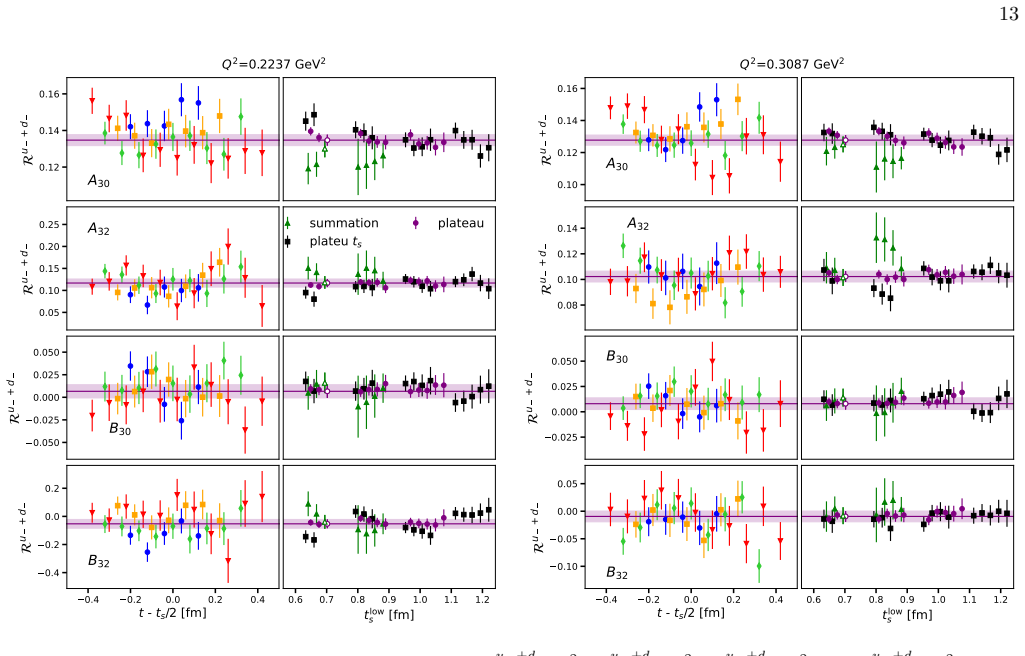
- Sec. III D and V B: for the three-derivative operators the linear system is frequently rank-deficient at a single Q^{2}; the authors therefore cluster nearby Q^{2} values. The smoothness assumption underlying the clustering is not tested (e.g., by varying the bin width or by comparing with a global fit in Q^{2}). Given that the higher GFFs are already noise-dominated, any bias introduced by clustering directly affects the dipole parameters listed in Table IV and the claim that only A_{40} is non-zero.
minor comments (5)
- Throughout Sec. V the phrase “dipole Ansantz” appears; correct to “Ansatz”.
- Fig. 18 caption and surrounding text: the labels “x^{2} d”, “x^{3} d+” etc. are ambiguous; clarify whether the moments are isovector, isoscalar or flavor-separated and whether the anti-quark sign convention of Eq. (37) has been applied.
- Table IV: the entry for B_{u+d}^{30} lists no dipole mass because a constant fit was used; this should be stated explicitly in the table caption rather than only in the text.
- Eq. (13) for the effective-energy fit contains an undefined c_{1}; a brief definition or reference would help the reader.
- Several figure panels (e.g., Figs. 5, 9, 12) show only two source-sink separations for the non-mixing operator O_{1234}; a short remark on why higher separations were omitted would improve transparency.
Circularity Check
No circularity: lattice matrix elements, renormalization, and GFF extraction are independent of the phenomenological inputs used only for optional PDF reconstruction.
full rationale
The paper's central results are the non-perturbatively renormalized lattice matrix elements of local two- and three-derivative operators, the extraction of GFFs A_ni, B_ni, C_n0 via weighted least-squares solution of the kinematic decompositions (Eqs. 3, 6, 12-14), and the forward-limit Mellin moments obtained from plateau/summation fits. These steps are self-contained lattice computations on a single physical-pion-mass ensemble; they do not fit parameters to phenomenological PDFs and then re-predict those PDFs. The only external phenomenological input appears late, in Sec. VI B, where anti-quark moments from JAM are subtracted so that the lattice moments can be cast into a simple valence-quark Ansatz for visual comparison. That reconstruction is presented as an optional illustration, not as a first-principles prediction forced by the lattice data. Self-citations (prior ETMC renormalization factors, earlier <x> results, etc.) supply technical ingredients that are independently computed and do not close a definitional loop around the new third- and fourth-order moments. Consequently the derivation chain contains no self-definitional step, no fitted-input-called-prediction, and no load-bearing uniqueness claim imported from the authors' own prior work. Score 0 is therefore appropriate.
Axiom & Free-Parameter Ledger
free parameters (3)
- dipole masses M for each GFF
- PDF shape parameters α, β in q(x)=N x^α (1-x)^β
- t_low^s and t_cut choices for plateau/summation
axioms (4)
- domain assumption Twisted-mass fermions with clover term automatically improve O(a) discretization errors for the operators considered.
- ad hoc to paper Disconnected contributions to higher Mellin moments are negligible compared with statistical errors.
- ad hoc to paper Mixing of the chosen three-derivative operators with same-dimension operators can be neglected at the present precision.
- domain assumption The continuum and infinite-volume limits of the moments are already close to the single-ensemble values reported.
read the original abstract
Nucleon Mellin moments of parton distribution are computed up to the fourth order in lattice QCD. The computation is performed using one ensemble of twisted mass fermions at the physical pion mass point. We employ boosted frames to access the higher-order Mellin moments of generalized parton distributions. We also extract the forward-limit Mellin moments $\langle x^{n-1}\rangle$ for $n=2,3,4$. These Mellin moments are used to construct unpolarized parton distribution functions and compare to phenomenological extractions.
Figures




Reference graph
Works this paper leans on
-
[1]
M. Burkardt, Phys. Rev. D62, 071503 (2000), [Erratum: Phys.Rev.D 66, 119903 (2002)], arXiv:hep-ph/0005108
Pith/arXiv arXiv 2000
- [2]
- [3]
-
[4]
X.-D. Ji, J. Phys. G24, 1181 (1998), arXiv:hep- ph/9807358
arXiv 1998
- [5]
-
[6]
A. V. Radyushkin, Phys. Rev. D56, 5524 (1997), arXiv:hep-ph/9704207
Pith/arXiv arXiv 1997
-
[7]
M. Gockeler, R. Horsley, D. Pleiter, P. E. L. Rakow, A. Schafer, G. Schierholz, H. Stuben, and J. M. Zanotti, Phys. Rev. D72, 054507 (2005), arXiv:hep-lat/0506017
Pith/arXiv arXiv 2005
-
[8]
A. Francis, P. Fritzsch, R. Karur, J. Kim, G. Pederiva, D. A. Pefkou, A. Rago, A. Shindler, A. Walker-Loud, and S. Zafeiropoulos, Phys. Rev. D113, 074520 (2026), arXiv:2510.26738 [hep-lat]
arXiv 2026
-
[9]
A. Franciset al., Phys. Rev. Lett.136, 171903 (2026), arXiv:2509.02472 [hep-lat]
Pith/arXiv arXiv 2026
-
[10]
W. Detmold, A. V. Grebe, I. Kanamori, C. J. D. Lin, R. J. Perry, and Y. Zhao (HOPE), Phys. Rev. D113, 014510 (2026), arXiv:2509.04799 [hep-lat]
Pith/arXiv arXiv 2026
-
[11]
Itzykson and J
C. Itzykson and J. B. Zuber,Quantum Field Theory, In- ternational Series In Pure and Applied Physics (McGraw- Hill, New York, 1980)
1980
-
[12]
P. Hagler, J. W. Negele, D. B. Renner, W. Schroers, T. Lippert, and K. Schilling (LHPC, SESAM), Phys. Rev. D68, 034505 (2003), arXiv:hep-lat/0304018
Pith/arXiv arXiv 2003
-
[13]
G. Beccarini, M. Bianchi, S. Capitani, and G. Rossi, Nucl. Phys. B456, 271 (1995), arXiv:hep-lat/9506021
Pith/arXiv arXiv 1995
-
[14]
M. Gockeler, R. Horsley, E.-M. Ilgenfritz, H. Perlt, P. E. L. Rakow, G. Schierholz, and A. Schiller, Phys. Rev. D54, 5705 (1996), arXiv:hep-lat/9602029
Pith/arXiv arXiv 1996
-
[15]
L¨ uscher, PoSLATTICE2013, 016 (2014), arXiv:1308.5598 [hep-lat]
M. L¨ uscher, PoSLATTICE2013, 016 (2014), arXiv:1308.5598 [hep-lat]
Pith/arXiv arXiv 2014
-
[16]
C. Alexandrouet al., Phys. Rev. D98, 054518 (2018), arXiv:1807.00495 [hep-lat]
Pith/arXiv arXiv 2018
- [17]
-
[18]
R. Frezzotti, P. A. Grassi, S. Sint, and P. Weisz (Alpha), JHEP08, 058, arXiv:hep-lat/0101001
-
[19]
Sheikholeslami and R
B. Sheikholeslami and R. Wohlert, Nucl. Phys. B259, 20 572 (1985)
1985
-
[20]
C. Alexandrou, S. Bacchio, M. Constantinou, J. Finken- rath, K. Hadjiyiannakou, K. Jansen, G. Koutsou, and A. Vaquero Aviles-Casco, Phys. Rev. D100, 014509 (2019), arXiv:1812.10311 [hep-lat]
Pith/arXiv arXiv 2019
-
[21]
C. Alexandrou, S. Gusken, F. Jegerlehner, K. Schilling, and R. Sommer, Nucl. Phys. B414, 815 (1994), arXiv:hep-lat/9211042
Pith/arXiv arXiv 1994
-
[22]
Gusken, Nucl
S. Gusken, Nucl. Phys. B Proc. Suppl.17, 361 (1990)
1990
-
[23]
Albaneseet al.(APE), Phys
M. Albaneseet al.(APE), Phys. Lett. B192, 163 (1987)
1987
-
[24]
C. Alexandrou, S. Bacchio, M. Constantinou, J. Finken- rath, K. Hadjiyiannakou, K. Jansen, G. Koutsou, H. Panagopoulos, and G. Spanoudes, Phys. Rev. D101, 094513 (2020), arXiv:2003.08486 [hep-lat]
Pith/arXiv arXiv 2020
-
[25]
C. Alexandrou, M. Constantinou, K. Hadjiyiannakou, K. Jansen, C. Kallidonis, G. Koutsou, A. Vaquero Avil´ es- Casco, and C. Wiese, Phys. Rev. Lett.119, 142002 (2017), arXiv:1706.02973 [hep-lat]
Pith/arXiv arXiv 2017
-
[26]
Alexandrou, S
C. Alexandrou, S. Bacchio, J. Finkenrath, C. Iona, G. Koutsou, C. Kummer, Y. Li, B. Prasad, and G. Spanoudes (2026), in preparation
2026
-
[27]
C. Alexandrou, M. Constantinou, S. Dinter, V. Drach, K. Jansen, C. Kallidonis, and G. Koutsou, Phys. Rev. D 88, 014509 (2013), arXiv:1303.5979 [hep-lat]
Pith/arXiv arXiv 2013
-
[28]
C. Alexandrou, M. Brinet, J. Carbonell, M. Constanti- nou, P. A. Harraud, P. Guichon, K. Jansen, T. Ko- rzec, and M. Papinutto, Phys. Rev. D83, 094502 (2011), arXiv:1102.2208 [hep-lat]
Pith/arXiv arXiv 2011
-
[29]
C. Alexandrou, G. Koutsou, J. W. Negele, and A. Tsapalis, Phys. Rev. D74, 034508 (2006), arXiv:hep- lat/0605017
arXiv 2006
-
[30]
G. S. Bali, S. Collins, M. G¨ ockeler, R. R¨ odl, A. Sch¨ afer, and A. Sternbeck, Phys. Rev. D100, 014507 (2019), arXiv:1812.08256 [hep-lat]
Pith/arXiv arXiv 2019
-
[31]
C. Alexandrouet al., Phys. Rev. D101, 034519 (2020), arXiv:1908.10706 [hep-lat]
Pith/arXiv arXiv 2020
-
[32]
D. C. Hackett, D. A. Pefkou, and P. E. Shanahan, Phys. Rev. Lett.132, 251904 (2024), arXiv:2310.08484 [hep- lat]
Pith/arXiv arXiv 2024
-
[33]
G. Martinelli, C. Pittori, C. T. Sachrajda, M. Testa, and A. Vladikas, Nucl. Phys. B445, 81 (1995), arXiv:hep- lat/9411010
arXiv 1995
-
[34]
C. Alexandrou, S. Bacchio, P. Jana, M. Petschlies, L. A. R. Chacon, G. Spanoudes, F. Steffens, C. Urbach, and U. Wenger, arXiv:2605.29998 [hep-lat] (2026)
arXiv 2026
-
[35]
C. Alexandrou, in42th International Symposium on Lat- tice Field Theory(2026) arXiv:2603.28604 [hep-lat]
Pith/arXiv arXiv 2026
-
[36]
Alexandrouet al.(Extended Twisted Mass), Phys
C. Alexandrouet al.(Extended Twisted Mass), Phys. Rev. Lett.134, 131902 (2025), arXiv:2405.08529 [hep- lat]
Pith/arXiv arXiv 2025
-
[37]
C. Alexandrou, S. Bacchio, J. Finkenrath, C. Iona, G. Koutsou, Y. Li, and G. Spanoudes, Phys. Rev. D111, 054505 (2025), arXiv:2412.01535 [hep-lat]
Pith/arXiv arXiv 2025
-
[38]
C. Alexandrou, S. Bacchio, G. Koutsou, B. Prasad, and G. Spanoudes, arXiv:2507.20910 [hep-lat] (2025)
Pith/arXiv arXiv 2025
-
[39]
J. A. Gracey, JHEP04, 127, arXiv:0903.4623 [hep-ph]
-
[40]
J. A. Gracey, Phys. Rev. D84, 016002 (2011), arXiv:1105.2138 [hep-ph]
Pith/arXiv arXiv 2011
-
[41]
B. A. Kniehl and O. L. Veretin, Nucl. Phys. B961, 115229 (2020), arXiv:2009.11325 [hep-ph]
Pith/arXiv arXiv 2020
-
[42]
M. Gockeler, R. Horsley, H. Perlt, P. E. L. Rakow, A. Schafer, G. Schierholz, and A. Schiller, Nucl. Phys. B717, 304 (2005), arXiv:hep-lat/0410009
Pith/arXiv arXiv 2005
-
[43]
J. A. Gracey, JHEP10, 040, arXiv:hep-ph/0609231
-
[44]
Alexandrouet al.(Extended Twisted Mass), Phys
C. Alexandrouet al.(Extended Twisted Mass), Phys. Rev. D104, 074515 (2021), arXiv:2104.13408 [hep-lat]
Pith/arXiv arXiv 2021
-
[45]
M. Gockeler, R. Horsley, H. Oelrich, H. Perlt, D. Petters, P. E. L. Rakow, A. Schafer, G. Schierholz, and A. Schiller, Nucl. Phys. B544, 699 (1999), arXiv:hep-lat/9807044
Pith/arXiv arXiv 1999
-
[46]
C. Alexandrou, S. Bacchio, I. Clo¨ et, M. Constantinou, K. Hadjiyiannakou, G. Koutsou, and C. Lauer (ETM), Phys. Rev. D104, 054504 (2021), arXiv:2104.02247 [hep- lat]
Pith/arXiv arXiv 2021
-
[47]
C. Alexandrou, M. Constantinou, and H. Panagopou- los (ETM), Phys. Rev. D95, 034505 (2017), arXiv:1509.00213 [hep-lat]
Pith/arXiv arXiv 2017
-
[48]
M. Gockeleret al., Phys. Rev. D82, 114511 (2010), [Er- ratum: Phys.Rev.D 86, 099903 (2012)], arXiv:1003.5756 [hep-lat]
Pith/arXiv arXiv 2010
-
[49]
P. A. Baikov, K. G. Chetyrkin, and J. H. K¨ uhn, Nucl. Part. Phys. Proc.261-262, 3 (2015), arXiv:1501.06739 [hep-ph]
Pith/arXiv arXiv 2015
-
[50]
F. Herzog, S. Moch, B. Ruijl, T. Ueda, J. A. M. Ver- maseren, and A. Vogt, Phys. Lett. B790, 436 (2019), arXiv:1812.11818 [hep-ph]
Pith/arXiv arXiv 2019
-
[51]
W. I. Jay and E. T. Neil, Phys. Rev. D103, 114502 (2021), arXiv:2008.01069 [stat.ME]
Pith/arXiv arXiv 2021
-
[52]
H.-W. Linet al., Prog. Part. Nucl. Phys.100, 107 (2018), arXiv:1711.07916 [hep-ph]
Pith/arXiv arXiv 2018
-
[53]
Aokiet al.(Flavour Lattice Averaging Group (FLAG)), Phys
Y. Aokiet al.(Flavour Lattice Averaging Group (FLAG)), Phys. Rev. D113, 014508 (2026), arXiv:2411.04268 [hep-lat]
Pith/arXiv arXiv 2026
-
[54]
E. Taggi, M. Engelhardt, J. R. Green, S. Krieg, S. Meinel, J. W. Negele, A. Pochinsky, M. Rodekamp, and S. Syrit- syn, arXiv:2605.02808 [hep-lat] (2026)
Pith/arXiv arXiv 2026
-
[55]
C. Cocuzza, W. Melnitchouk, A. Metz, and N. Sato (Jef- ferson Lab Angular Momentum (JAM)), Phys. Rev. D 106, L031502 (2022), arXiv:2202.03372 [hep-ph]
Pith/arXiv arXiv 2022
-
[56]
R. D. Ballet al.(NNPDF), Eur. Phys. J. C82, 428 (2022), arXiv:2109.02653 [hep-ph]
Pith/arXiv arXiv 2022
-
[57]
X. Gao, A. D. Hanlon, J. Holligan, N. Karthik, S. Mukherjee, P. Petreczky, S. Syritsyn, and Y. Zhao, Phys. Rev. D107, 074509 (2023), arXiv:2212.12569 [hep- lat]
Pith/arXiv arXiv 2023
- [58]
-
[59]
X. Ji, Sci. China Phys. Mech. Astron.57, 1407 (2014), arXiv:1404.6680 [hep-ph]
Pith/arXiv arXiv 2014
-
[60]
A. V. Radyushkin, Phys. Rev. D96, 034025 (2017), arXiv:1705.01488 [hep-ph]
Pith/arXiv arXiv 2017
-
[61]
K. Orginos, A. Radyushkin, J. Karpie, and S. Zafeiropou- los, Phys. Rev. D96, 094503 (2017), arXiv:1706.05373 [hep-ph]
Pith/arXiv arXiv 2017
-
[62]
A. L. Kataev, in11th Lomonosov Conference on Ele- mentary Particle Physics(2003) pp. 194–200, arXiv:hep- ph/0311091
arXiv 2003
-
[63]
J¨ ulich Supercomputing Centre, Journal of large-scale re- search facilities7, 10.17815/jlsrf-7-183 (2021)
discussion (0)
Sign in with ORCID, Apple, or X to comment. Anyone can read and Pith papers without signing in.