REVIEW 2 major objections 5 minor 29 references
MUTE unlearns low-return messages so multi-agent teams keep almost full performance at a fraction of the bandwidth.
Reviewed by Pith at T0; open to challenge. T0 means a machine referee read the full paper against a public rubric. the ladder, T0–T4 →
T0 review · grok-4.5
2026-07-12 02:14 UTC pith:F5BR6HA3
load-bearing objection Solid systems paper: post-hoc value-guided unlearning from a dense expert beats joint MI/gating training for sparse MARL communication, with real multi-benchmark evidence and a conditional bound. the 2 major comments →
MUTE: Return-Preserving Communication Unlearning for Efficient Multi-Agent Coordination
The pith
A machine-rendered reading of the paper's core claim, the machinery that carries it, and where it could break.
Core claim
Communication reduction in cooperative MARL can be cast as return-preserving unlearning: after training an unrestricted joint policy, an attention-based Message Value Estimator scores each message by its Counterfactual Message Value, low-value messages are driven toward zero by an L1 sparsity loss, and a behavioral-anchoring loss keeps individual Q-functions close to the expert, yielding a controllable performance gap and large bandwidth savings.
What carries the argument
Counterfactual Message Value (CMV) — the difference in joint action-value with versus without a given message — estimated in one attention pass by the Message Value Estimator and used to select the redundant set that is unlearned under the dual sparsity-plus-anchoring objective of Theorem 4.2.
Load-bearing premise
The joint value function is assumed smooth enough in the continuous message embeddings, and single-message counterfactual scores plus anchoring are assumed to catch the messages that matter even when several messages interact.
What would settle it
On a map where several messages are jointly necessary but each alone looks low-value, check whether MUTE’s estimated Counterfactual Message Values still keep at least one of them and whether the observed return gap stays inside the bound of Theorem 4.2; a large, unexplained drop would falsify the claim.
Editorial analysis
A structured set of objections, weighed in public.
Referee Report
Summary. The paper introduces MUTE, a three-stage framework that first trains an unrestricted full-communication MARL expert (value-based CTDE backbone), then fits an attention-based Message Value Estimator to approximate Counterfactual Message Value (CMV = difference in Q*_tot with vs. without a given message), and finally unlearns low-CMV messages via the dual objective L_sparse (L1 on messages below an adaptive threshold) + β L_anchor (behavioral anchoring of individual Q_i to the frozen expert). A performance-difference bound (Theorem 4.2) is derived under L-smoothness of Q*_tot and bounded estimation errors. Empirically, MUTE is evaluated on Hallway, Traffic Junction, SMAC, SMAC-Communication and SMACv2, reporting 80–99 % communication reduction while matching or nearly matching full-communication baselines, with dropout-AUC robustness, component ablations, hyper-parameter sweeps and empirical checks that estimation errors remain small.
Significance. If the empirical results hold under broader scrutiny, MUTE offers a practically useful alternative to information-theoretic or gating-based communication sparsification: by decoupling expert coordination learning from subsequent value-guided pruning, it avoids the unstable multi-objective trade-offs that plague joint training. The CMV estimator, dual unlearning loss, and explicit return-gap bound constitute clear technical contributions relative to SMS (Shapley), NDQ/IMAC (mutual information) and IC3Net/TarMAC. Strengths that raise the paper above typical MARL communication work include the multi-environment evaluation with 95 % CIs over five seeds, the dropout-AUC table, the budget-allocation and L1-vs-L2 ablations, the empirical verification of the bound assumptions (Appendix I), and the release of anonymous code. These elements make the central claim falsifiable and reproducible.
major comments (2)
- [Theorem 4.2, Lemma A.2, §6] Theorem 4.2 / Lemma A.2 and Assumption A.1: the return-gap certificate rests on L-smoothness of the joint action-value with respect to the continuous concatenated message vector together with a first-order Taylor remainder that bounds multi-message interaction residuals. The Limitations section already acknowledges that single-message CMV does not enumerate subsets. Because the bound is presented as a guarantee of controlled degradation, an additional empirical diagnostic (e.g., measured return gap under simultaneous masking of the entire M_red set versus the sum of individual CMVs on held-out trajectories) would make the theoretical claim more robust and would directly address the higher-order interaction concern.
- [Algorithm 1, §4.3, Appendix I] Algorithm 1 and §4.3: the Message Value Estimator is trained once on the unrestricted expert and then frozen; during the unlearning phase only θ and ψ are updated. Although Appendix I reports that “MVE loss” stays small, it is not stated whether this loss is recomputed against fresh counterfactual targets under the evolving (sparsified) message distribution or merely the original Phase-1 targets. Clarifying this point, and if necessary re-estimating CMV periodically or with a small online update, is load-bearing for the claim that the messages being driven to zero remain the truly low-value ones.
minor comments (5)
- [Abstract, §5.2] Abstract and §5.2 claim “80 % to 90 %” reduction while the Hallway results and text repeatedly cite up to 99 %. Align the abstract wording with the strongest reported figures.
- [Title page] Author email for Qinru Qiu is listed as qiqiu@syr.com (missing .edu). Correct for reproducibility.
- [Appendix K] Appendix K title contains the typo “Compuatational”. Fix throughout.
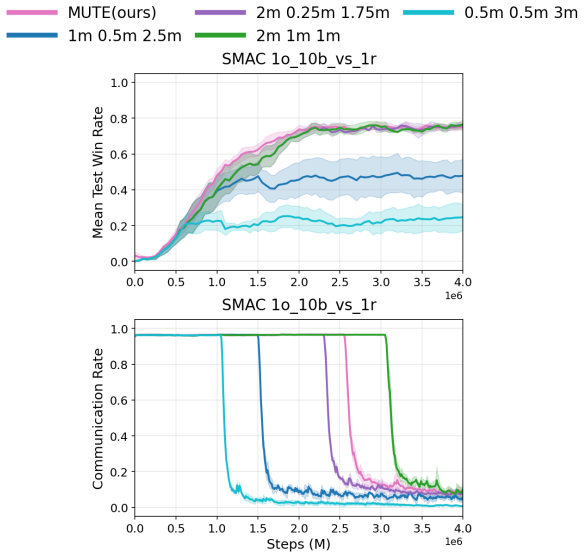
- [Figure 2, §5.1] Figure 2 caption and main text should more explicitly remind the reader that the triangles mark the 2 M-step expert performance that MUTE subsequently sparsifies; this avoids any residual confusion about training-budget fairness.
- [Definition 4.1] In Definition 4.1 the notation Q*_tot(τ, m) ≔ Q*_tot(τ, a) is convenient but slightly overloads the second argument; a short clarifying sentence would help readers.
Circularity Check
No significant circularity: MUTE trains an unrestricted expert first, estimates CMV from frozen counterfactual Q* queries, then unlearns under an independent anchoring regularizer; the performance bound is conditional on stated assumptions rather than tautological.
full rationale
The derivation chain is sequential and non-circular. An unrestricted joint policy and critic Q*_tot are first obtained by ordinary TD training (Eq. 1). Counterfactual Message Value targets are then computed by explicit masking-and-resampling queries against that frozen critic (Definition 4.1 / Eq. 3), and an attention MVE is fitted to those targets (Eq. 5). Unlearning subsequently minimizes an L1 sparsity penalty on the low-CMV set together with a separate behavioral-anchoring term that keeps individual Q_i close to the frozen expert (Eqs. 6–8). The performance gap bound (Theorem 4.2) follows from the Performance Difference Lemma plus an L-smoothness assumption and bounded estimation errors; it is an upper bound under those hypotheses, not an identity that forces the reported win rates. Hyper-parameters λ and β are selected by ablation (Appendix H), not fitted so as to reproduce the final metrics. Self-citations are to standard external MARL baselines (QMIX, MAPPO, MASIA backbone, COMA-style counterfactuals) and do not load-bear the central claim. The Limitations section already notes that single-message CMV does not enumerate higher-order subsets; that is a genuine modeling gap, not circularity. Empirical checks (Appendix I, Figure 4) further show that the bounded-error and anchoring conditions hold in practice. Consequently the paper’s strongest claim—value-guided unlearning yields large bandwidth reduction with near-baseline return—is supported by independent experimental evidence rather than by construction.
Axiom & Free-Parameter Ledger
free parameters (4)
- sparsity threshold multiplier λ (default 1.0 · μ_MVE)
- anchoring weight β (default 10)
- three-stage step budget (2M pretrain / 0.5M MVE / 1.5M unlearn)
- EMA momentum τ_ema = 0.01 for μ_MVE
axioms (4)
- ad hoc to paper Joint action-value Q*_tot is continuously differentiable and L-smooth in the concatenated continuous message vector (Assumption A.1).
- domain assumption MVE error |V_ϕ(m)−ΔQ(m)| ≤ δ and critic gap ||Q*_tot−Q_tot|| ≤ ϵ remain bounded during unlearning.
- domain assumption Cooperative task is a Dec-POMDP under CTDE with broadcast messages and value factorization (QMIX-style Q_tot).
- standard math Performance Difference Lemma applies to the unlearned vs expert joint policies.
invented entities (3)
-
Counterfactual Message Value (CMV) ΔQ_i
no independent evidence
-
Message Value Estimator (attention MVE V_ϕ)
no independent evidence
-
MUTE dual-objective unlearning loss L_sparse + β L_anchor
no independent evidence
read the original abstract
Inter-agent communication is critical for coordinating Multi-Agent Reinforcement Learning (MARL) agents under partial observability to perform effectively in cooperative games; however, real-world bandwidth constraints demand sparse interactions. Prior approaches primarily address this trade-off by optimizing information-theoretic surrogates. We argue that these statistical proxies are fundamentally misaligned with the true objective: a message can be highly informative yet irrelevant to the joint return of the task. In this work, we propose Message Unlearning for Targeted Efficiency (MUTE), a framework that views communication reduction as a value-guided machine unlearning problem. MUTE rigorously quantifies the Counterfactual Message Value using an attention-based estimator, and systematically unlearns the transmission of low-value messages from a policy trained without any communication constraints. This is achieved through a dual-objective mechanism that enforces communication sparsity while preserving the return of the original joint policy. We derive a theoretical upper bound on the performance gap induced by this sparsification, guaranteeing controlled return degradation. We also empirically evaluate MUTE on various complex multi-agent environments, achieving 80% to 90% bandwidth reduction while maintaining performance comparable to state-of-the-art baselines.
Figures


Reference graph
Works this paper leans on
-
[1]
Multi-agent reinforcement learning for autonomous vehicles: A survey.Autonomous Intelligent Systems, 2 (1):27, 2022
Joris Dinneweth, Abderrahmane Boubezoul, René Mandiau, and Stéphane Espié. Multi-agent reinforcement learning for autonomous vehicles: A survey.Autonomous Intelligent Systems, 2 (1):27, 2022
2022
-
[2]
Mikayel Samvelyan, Tabish Rashid, Christian Schroeder de Witt, Gregory Farquhar, Nantas Nardelli, Tim G. J. Rudner, Chia-Man Hung, Philip H. S. Torr, Jakob Foerster, and Shimon Whiteson. The starcraft multi-agent challenge. InProceedings of the 18th International Conference on Autonomous Agents and MultiAgent Systems, AAMAS ’19, page 2186–2188, Richland, ...
2019
-
[3]
Multi-agent reinforcement learning as a rehearsal for decentralized planning.Neurocomputing, 190:82–94, 2016
Landon Kraemer and Bikramjit Banerjee. Multi-agent reinforcement learning as a rehearsal for decentralized planning.Neurocomputing, 190:82–94, 2016
2016
-
[4]
Monotonic value function factorisation for deep multi-agent reinforcement learning.Journal of Machine Learning Research, 21(178):1–51, 2020
Tabish Rashid, Mikayel Samvelyan, Christian Schroeder De Witt, Gregory Farquhar, Jakob Foerster, and Shimon Whiteson. Monotonic value function factorisation for deep multi-agent reinforcement learning.Journal of Machine Learning Research, 21(178):1–51, 2020
2020
-
[5]
Multi-agent incentive communication via decentralized teammate modeling
Lei Yuan, Jianhao Wang, Fuxiang Zhang, Chenghe Wang, Zongzhang Zhang, Yang Yu, and Chongjie Zhang. Multi-agent incentive communication via decentralized teammate modeling. InProceedings of the AAAI conference on artificial intelligence, volume 36, pages 9466–9474, 2022
2022
-
[6]
The surprising effectiveness of ppo in cooperative multi-agent games.Advances in neural information processing systems, 35:24611–24624, 2022
Chao Yu, Akash Velu, Eugene Vinitsky, Jiaxuan Gao, Yu Wang, Alexandre Bayen, and Yi Wu. The surprising effectiveness of ppo in cooperative multi-agent games.Advances in neural information processing systems, 35:24611–24624, 2022
2022
-
[7]
Multi-agent actor-critic for mixed cooperative-competitive environments
Ryan Lowe, YI WU, Aviv Tamar, Jean Harb, OpenAI Pieter Abbeel, and Igor Mordatch. Multi-agent actor-critic for mixed cooperative-competitive environments. In I. Guyon, U. V on Luxburg, S. Bengio, H. Wallach, R. Fergus, S. Vishwanathan, and R. Garnett, ed- itors,Advances in Neural Information Processing Systems, volume 30. Curran Associates, Inc., 2017. UR...
2017
-
[8]
Learning to communicate with deep multi-agent reinforcement learning.Advances in neural information processing systems, 29, 2016
Jakob Foerster, Ioannis Alexandros Assael, Nando De Freitas, and Shimon Whiteson. Learning to communicate with deep multi-agent reinforcement learning.Advances in neural information processing systems, 29, 2016
2016
-
[9]
Learning multiagent communication with backpropa- gation.Advances in neural information processing systems, 29, 2016
Sainbayar Sukhbaatar, Rob Fergus, et al. Learning multiagent communication with backpropa- gation.Advances in neural information processing systems, 29, 2016
2016
-
[10]
Learning when to communicate at scale in multiagent cooperative and competitive tasks
Amanpreet Singh, Tushar Jain, and Sainbayar Sukhbaatar. Learning when to communicate at scale in multiagent cooperative and competitive tasks. InInternational Conference on Learning Representations
-
[11]
Efficient multi-agent communication via self-supervised information aggregation.Advances in Neural Information Processing Systems, 35:1020–1033, 2022
Cong Guan, Feng Chen, Lei Yuan, Chenghe Wang, Hao Yin, Zongzhang Zhang, and Yang Yu. Efficient multi-agent communication via self-supervised information aggregation.Advances in Neural Information Processing Systems, 35:1020–1033, 2022
2022
-
[12]
T2mac: Targeted and trusted multi-agent communication through selective engagement and evidence-driven integration
Chuxiong Sun, Zehua Zang, Jiabao Li, Jiangmeng Li, Xiao Xu, Rui Wang, and Changwen Zheng. T2mac: Targeted and trusted multi-agent communication through selective engagement and evidence-driven integration. InProceedings of the AAAI Conference on Artificial Intelligence, volume 38, pages 15154–15163, 2024. 10
2024
-
[13]
Tonghan Wang, Jianhao Wang, Chongyi Zheng, and Chongjie Zhang. Learning nearly decom- posable value functions via communication minimization.arXiv preprint arXiv:1910.05366, 2019
Pith/arXiv arXiv 1910
-
[14]
Learning efficient multi-agent communication: An information bottleneck approach
Rundong Wang, Xu He, Runsheng Yu, Wei Qiu, Bo An, and Zinovi Rabinovich. Learning efficient multi-agent communication: An information bottleneck approach. InInternational conference on machine learning, pages 9908–9918. PMLR, 2020
2020
-
[15]
Ruiqi Zhang, Jing Hou, Florian Walter, Shangding Gu, Jiayi Guan, Florian Röhrbein, Yali Du, Panpan Cai, Guang Chen, and Alois Knoll. Multi-agent reinforcement learning for autonomous driving: A survey.arXiv preprint arXiv:2408.09675, 2024
Pith/arXiv arXiv 2024
-
[16]
Efficient multi-agent communication via shapley message value
Di Xue, Lei Yuan, Zongzhang Zhang, and Yang Yu. Efficient multi-agent communication via shapley message value. InIJCAI, pages 578–584, 2022
2022
-
[17]
A value for n-person games
Lloyd S Shapley et al. A value for n-person games. 1953
1953
-
[18]
Dop: Off- policy multi-agent decomposed policy gradients
Yihan Wang, Beining Han, Tonghan Wang, Heng Dong, and Chongjie Zhang. Dop: Off- policy multi-agent decomposed policy gradients. InInternational conference on learning representations, 2020
2020
-
[19]
Towards making systems forget with machine unlearning
Yinzhi Cao and Junfeng Yang. Towards making systems forget with machine unlearning. In 2015 IEEE symposium on security and privacy, pages 463–480. IEEE, 2015
2015
-
[20]
Eternal sunshine of the spotless net: Selective forgetting in deep networks
Aditya Golatkar, Alessandro Achille, and Stefano Soatto. Eternal sunshine of the spotless net: Selective forgetting in deep networks. InProceedings of the IEEE/CVF conference on computer vision and pattern recognition, pages 9304–9312, 2020
2020
-
[21]
A survey of machine unlearning.ACM Transactions on Intelligent Systems and Technology, 16(5):1–46, 2025
Thanh Tam Nguyen, Thanh Trung Huynh, Zhao Ren, Phi Le Nguyen, Alan Wee-Chung Liew, Hongzhi Yin, and Quoc Viet Hung Nguyen. A survey of machine unlearning.ACM Transactions on Intelligent Systems and Technology, 16(5):1–46, 2025
2025
-
[22]
Smacv2: An improved benchmark for cooperative multi-agent reinforcement learning.Advances in Neural Information Processing Systems, 36:37567–37593, 2023
Benjamin Ellis, Jonathan Cook, Skander Moalla, Mikayel Samvelyan, Mingfei Sun, Anuj Mahajan, Jakob Foerster, and Shimon Whiteson. Smacv2: An improved benchmark for cooperative multi-agent reinforcement learning.Advances in Neural Information Processing Systems, 36:37567–37593, 2023
2023
-
[23]
Tarmac: Targeted multi-agent communication
Abhishek Das, Théophile Gervet, Joshua Romoff, Dhruv Batra, Devi Parikh, Mike Rabbat, and Joelle Pineau. Tarmac: Targeted multi-agent communication. InInternational Conference on machine learning, pages 1538–1546. PMLR, 2019
2019
-
[24]
Towards true lossless sparse communication in multi-agent systems
Seth Karten, Mycal Tucker, Siva Kailas, and Katia Sycara. Towards true lossless sparse communication in multi-agent systems. In2023 ieee international conference on robotics and automation (icra), pages 7191–7197. IEEE, 2023
2023
-
[25]
Rescom: Reward- shaped curriculum for efficient multi-agent communication learning
Xinghai Wei, Tingting Yuan, Jie Yuan, Dongxiao Liu, and Xiaoming Fu. Rescom: Reward- shaped curriculum for efficient multi-agent communication learning. InProceedings of the 24th International Conference on Autonomous Agents and Multiagent Systems, pages 2153–2161, 2025
2025
-
[26]
Counterfactual multi-agent policy gradients
Jakob Foerster, Gregory Farquhar, Triantafyllos Afouras, Nantas Nardelli, and Shimon Whiteson. Counterfactual multi-agent policy gradients. InProceedings of the AAAI conference on artificial intelligence, volume 32, 2018
2018
-
[27]
Trust region policy optimisation in multi-agent reinforcement learning
Jakub Grudzien Kuba, Ruiqing Chen, Muning Wen, Ying Wen, Fanglei Sun, Jun Wang, and Yaodong Yang. Trust region policy optimisation in multi-agent reinforcement learning. In International Conference on Learning Representations, 2022
2022
-
[28]
Rgmcomm: Return gap minimization via discrete communications in multi-agent reinforcement learning
Jingdi Chen, Tian Lan, and Carlee Joe-Wong. Rgmcomm: Return gap minimization via discrete communications in multi-agent reinforcement learning. InProceedings of the AAAI Conference on Artificial Intelligence, volume 38, pages 17327–17336, 2024
2024
-
[29]
surrounded and reflect
Sham Kakade and John Langford. Approximately optimal approximate reinforcement learning. InProceedings of the nineteenth international conference on machine learning, pages 267–274, 2002. 11 Appendix Table of Contents Contents A Proof of Theorem 4.2 13 B Complete Algorithm for MUTE 15 C Environments Details 15 C.1 StarCraft Multi-Agent Challenge (SMAC) . ...
2002
discussion (0)
Sign in with ORCID, Apple, or X to comment. Anyone can read and Pith papers without signing in.