REVIEW 2 major objections 4 minor 72 references
Semiclassical Langevin dynamics of long-range dissipative time crystals
T0 review · 2 major / 4 minor · reviewed 2026-07-12 · grok-4.5
Pith's one-line read Semiclassical Langevin dynamics shows dissipative time crystals remain robust past the mean-field range of power-law couplings.
desk verdict Useful finite-size lifetime exponents for two known long-range BTCs, with the α>1 claims resting on a factorization the authors themselves flag as uncontrolled. read the letter →
The pith
A machine-rendered reading of the paper's core claim, the machinery that carries it, and where it could break.
The reading
What carries the argument
Semiclassical Langevin (Itô) equations for local spins or Gell-Mann variables: the quantum Langevin hierarchy is closed by factorizing multi-site correlators, multiplicative white noise from the Lindblad channels is retained, and trajectory averages of the resulting stochastic ODEs supply the finite-size magnetization signal.
What would settle it
Exact or high-order cumulant simulations of either model at moderate sizes that show the extracted lifetime exponent becoming zero (or negative) already for power-law exponents well below the reported threshold of roughly 1.2 would falsify the claimed extension of the time-crystal regime.
Extended reading notes
Core claim
In both long-range dissipative spin models studied, algebraic growth of the finite-size oscillation lifetime with system size continues past the power-law exponent at which the thermodynamic limit ceases to be mean-field, furnishing a concrete numerical diagnostic of time-crystalline order that agrees with earlier cumulant-expansion thresholds.
Load-bearing premise
The method assumes that multi-site quantum correlations beyond those already generated by the noise can be safely replaced by products of single-site averages—an approximation that is known to weaken once the interactions become short-ranged.
Editorial analysis
A structured set of objections, weighed in public.
Referee Report
Summary. The manuscript develops a semiclassical Langevin method (from the quantum Langevin equation closed by factorizing multi-site operator products, with multiplicative noise retained) to probe finite-size lifetimes of dissipative time crystals. For the spin-1/2 model with power-law Lindblad operators it extracts an algebraic decay rate D(L)∼L^{-β} of the magnetization-envelope oscillations and reports β>0 up to α≃1.2. For the spin-1 model with local dissipation and power-law Hamiltonian interactions it formulates the dynamics in the Gell-Mann basis and reports power-law growth of both the mean-field deviation time and the dominant Fourier-peak power for α≲1.2. The authors conclude that the method supplies a practical finite-size diagnostic beyond exact Lindblad numerics and that time-crystalline robustness extends past the α=1 threshold where mean-field becomes exact in the thermodynamic limit.
Significance. If the reported exponents are reliable, the work supplies a concrete, scalable numerical probe of dissipative time-crystal lifetimes in long-range open spin systems that are inaccessible to exact master-equation methods. The full operator-to-stochastic derivations (Appendices A, D), tabulated Gell-Mann algebra, and small-system Lindblad benchmarks (Appendix B) are genuine strengths that make the method reusable. The agreement of the spin-1 Fourier-peak threshold with prior cumulant-expansion results is a useful consistency check. The claim that robustness survives for α>1 is potentially interesting, but its weight depends on the controlled validity of the underlying factorization.
major comments (2)
- [Sec. IV, Fig. 2(c); Sec. VI B 2, Fig. 6(c); Appendices A, D] The central claim that time-crystalline robustness extends past α=1 (β>0 up to ≃1.2 for the spin-1/2 model; s>0 up to ≃1.2 for the spin-1 Fourier peak) rests on the semiclassical closure of Sec. II and Appendices A, D. That closure replaces every multi-site product by a product of local expectations (Eqs. (A.7)–(A.8) and the analogous Gell-Mann factorization). The paper itself states that the closure is controlled only when the thermodynamic-limit dynamics is mean-field (α≤1). For α>1 the same uncontrolled factorization is still used, yet that is precisely the regime in which connected correlations remain relevant and mean-field already predicts relaxation. Consequently the residual positive exponents may be an artifact. Either additional validation (larger-system exact or higher-order cumulant benchmarks for α>1) or a clear restriction of the claim to the controlled window α≤1 is requir
- [Sec. VI B 1, Fig. 5; Sec. VI B 2] For the spin-1 model the deviation-time diagnostic t⋆(L) is defined with respect to the mean-field trajectory (Eqs. (37)–(39)). The authors correctly note that this comparison is meaningful only for α≤1. The reported positive b(α) for α slightly above 1 is therefore outside the method’s stated domain of validity and should not be used to locate the time-crystal boundary. The Fourier-peak analysis is free of this reference, but still inherits the same factorization approximation; its threshold α≃1.2 therefore needs independent support before it can be presented as confirming the cumulant-expansion result of Ref. [36].
minor comments (4)
- [Abstract] Abstract and opening paragraph: the phrase “the robustness of the time-crystalline” is incomplete; insert “phase” or “order”.
- [Sec. IV A] Fig. 1 caption and surrounding text contain a duplicated sentence fragment (“and on the finite-size decay of its oscillations”).
- [Sec. VI B 1] The choice of the deviation-time threshold q=0.12 is stated to be robust, but a short sensitivity plot (or table) for a few neighboring values of q would make the claim quantitative.
- [Sec. III and Sec. V A] Notation for the Kac factor and the distance function D(r) is introduced twice with slightly different wording; a single consistent definition would improve readability.
Circularity Check
Minor self-citation of the two models under study; the Langevin equations, decay-rate/Fourier diagnostics, and extracted exponents are independent numerical results, not algebraic rearrangements of the cited works.
-
self citation load bearing
[Sec. I (Introduction) and abstract]
"One example is the spin-1/2 model of Ref. [47], where the collective Lindblad operators of [20] were replaced by power-law long-range Lindblad operators. ... Another example is provided by [36], where a spin-1 system with power-law long-range interacting Hamiltonian behaves as a dissipative time crystal in presence of a local dissipation."
The two models that supply the entire numerical content of the paper are introduced solely by citation to prior works that share co-authors (for [47]). While this is normal for model selection, the paper’s strongest claim (robustness past the mean-field threshold α=1) is framed as an extension of those same references; the self-citation therefore carries a mild load-bearing role in defining the systems whose finite-size exponents are reported.
full rationale
The paper takes two microscopic models from prior literature (spin-1/2 power-law Lindbladians of Ref. [47] sharing co-authors Fazio/Russomanno; spin-1 local-dissipation + long-range Hamiltonian of Ref. [36] with no author overlap) and applies a semiclassical Langevin closure of the quantum Langevin hierarchy (factorization of multi-site products, Sec. II and Apps. A/D). The new content is the derivation of the stochastic SDEs, their numerical integration, and the extraction of finite-size scaling exponents β(α), b(α), s(α) for oscillation lifetime and Fourier-peak power. These exponents are obtained by direct power-law fits to the simulated trajectories; no parameter is fitted to one observable and then re-labeled as a prediction of a related observable. The agreement with prior cumulant-expansion thresholds is presented as a consistency check, not as a uniqueness theorem that forces the result. Small-system Lindblad benchmarks (App. B) provide an independent external check. The only circularity is the ordinary self-citation that defines the models themselves; the load-bearing finite-size diagnostics do not reduce to those citations by construction. Score 2 therefore reflects a single non-load-bearing self-citation of the systems under study.
Assumptions & free parameters
free parameters (2)
- deviation-time threshold q =
0.12
- model couplings (χ, Ω, Δ, E, J, γ) =
various (e.g. χ=0.1,0.5; Ω=4, Δ=-8.9, E=4, χ=16)
assumptions (5)
- domain assumption Quantum Langevin equation equivalent to the Lindblad master equation for Markovian baths (Gardiner–Zoller).
- ad hoc to paper Connected multi-site correlations may be factorized: ⟨O_i O_l⟩ ≈ ⟨O_i⟩⟨O_l⟩ for i≠l, with residual fluctuations carried only by the multiplicative noise.
- domain assumption Quantum noise operators can be replaced by classical real Gaussian white noises (Itô interpretation).
- domain assumption For α≤1 the thermodynamic-limit dynamics of the spin-1 model is exactly mean-field (Wang et al. / Appendix E).
- ad hoc to paper Sampling over discrete truncated-Wigner initial conditions is unnecessary because memory of the initial state is lost after a short transient.
Cite this review
Pith. "Pith review of Semiclassical Langevin dynamics of long-range dissipative time crystals." pith.science (2026). https://pith.science/paper/Q525NTQX
@misc{pith2026260703486,
  author       = {Pith},
  title        = {Pith review of: Semiclassical Langevin dynamics of long-range dissipative time crystals},
  year         = {2026},
  howpublished = {\url{https://pith.science/paper/Q525NTQX}},
  note         = {Machine review of arXiv:2607.03486}
}
abstract
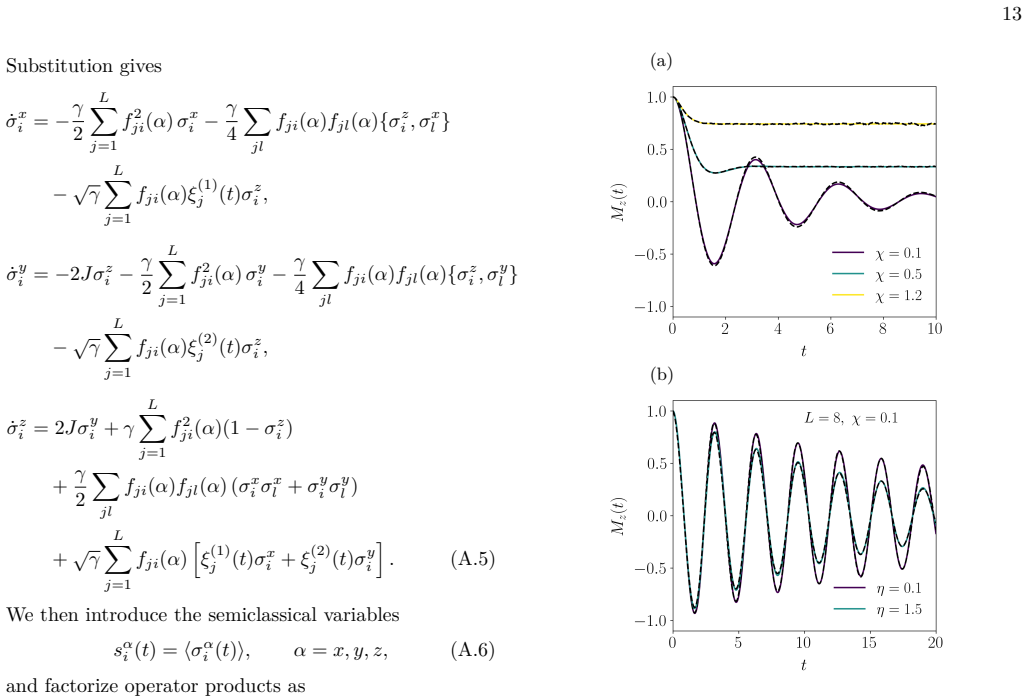
We develop a semiclassical Langevin approach to study finite-size effects in dissipative time-crystalline spin systems. For a spin-$1/2$ model with power-law Lindblad operators, we find finite-size oscillations exponentially decaying in time, and their decay rate decreases algebraically with system size in the long-range regime. The scaling exponent of this decay time provides a direct diagnostic of the robustness of the time-crystalline, and we find that this robustness extends beyond the range of power-law dissipation exponents where the system dynamics is mean-field in the thermodynamic limit. We also apply our approach to a spin-one model with local dissipation and long-range Hamiltonian interactions, formulating it in terms of Gell-Mann variables. In this case, finite-size stability is quantified through the deviation time from the mean-field behavior and the behavior of the dominant Fourier peak. We find that both quantities scale as a power law with the system size -- marking thereby a time-crystal behavior -- when the exponent of the power-law interaction is below a certain threshold, that turns out to be in agreement with previous cumulant-expansion findings. Our results show that semiclassical Langevin dynamics provides a useful finite-size probe of dissipative time crystals in regimes beyond exact Lindblad simulations.
Figures


Figures from the paper (5 more)



Reference graph
Works this paper leans on
-
[36]
M. Krishna, P. Solanki, M. Hajdušek, and S. Vinjanam- pathy, Measurement Induced Continuous Time Crystals, arXiv e-prints (2022), arXiv:2206.14438 [quant-ph]
arXiv 2022
-
[1]
For the spin- one model, the oscillations ofMz(t)are not symmetric around zero
Finite-size scaling of the deviation time from the mean-field dynamics Whenα≤1we expect that the thermodynamic- limit dynamics is described by the Lindblad mean-field one [36], so it is meaningful to compare the finite-size Langevin mean-field results with that limit. For the spin- one model, the oscillations ofMz(t)are not symmetric around zero. Therefor...
-
[2]
Finite-size scaling of the dominant Fourier peak We investigate the finite-size scaling of the dominant peak in the Fourier spectrum of the magnetization. A peak increasing as a power law with the system size is a mark of time-translation symmetry breaking oscillations that last more and more for increasing system size, that’s to say a mark of a time-crys...
-
[3]
Wilczek, Quantum time crystals, Phys
F. Wilczek, Quantum time crystals, Phys. Rev. Lett. 109, 160401 (2012)
2012
-
[4]
Shapere and F
A. Shapere and F. Wilczek, Classical time crystals, Phys. Rev. Lett.109, 160402 (2012)
2012
-
[5]
Bruno, Impossibility of spontaneously rotating time crystals: A no-go theorem, Phys
P. Bruno, Impossibility of spontaneously rotating time crystals: A no-go theorem, Phys. Rev. Lett.111, 070402 (2013)
2013
-
[6]
Watanabe and M
H. Watanabe and M. Oshikawa, Absence of quantum time crystals, Phys. Rev. Lett.114, 251603 (2015)
2015
-
[7]
Viotti, M
L. Viotti, M. Huber, R. Fazio, and G. Manzano, Quan- tum time crystal clock and its performance, Phys. Rev. Lett.136, 110401 (2026)
2026
Show all 72 references
-
[9]
Seibold, R
K. Seibold, R. Rota, and V. Savona, Dissipative time crystal in an asymmetric nonlinear photonic dimer, Phys. Rev. A101, 033839 (2020)
2020
-
[10]
S. B. Jäger, J. M. Giesen, I. Schneider, and S. Eggert, 19 Dissipative dicke time crystals: An atom’s point of view, Phys. Rev. A110, L010202 (2024)
2024
-
[11]
Xiang, Q.-L
Y.-X. Xiang, Q.-L. Lei, Z. Bai, and Y.-Q. Ma, Self- organized time crystal in driven-dissipative quantum sys- tem, Phys. Rev. Res.6, 033185 (2024)
2024
-
[12]
Cabot, G
A. Cabot, G. L. Giorgi, and R. Zambrini, Nonequilib- rium transition between dissipative time crystals, PRX Quantum5, 030325 (2024)
2024
-
[14]
B. Zhu, J. Marino, N. Y. Yao, M. D. Lukin, and E. A. Demler, Dicke time crystals in driven-dissipative quan- tum many-body systems, New Journal of Physics21, 073028 (2019)
2019
-
[15]
Cabot, L
A. Cabot, L. S. Muhle, F. Carollo, and I. Lesanovsky, Quantum trajectories of dissipative time crystals, Phys. Rev. A108, L041303 (2023)
2023
-
[16]
O’Sullivan, O
J. O’Sullivan, O. Lunt, C. W. Zollitsch, M. L. W. The- walt, J. J. L. Morton, and A. Pal, Dissipative discrete time crystals (2019), arXiv:1807.09884 [cond-mat.mes- hall]
2019 arXiv
-
[17]
G. W. Harmon, G. Morigi, and S. B. Jäger, Col- lective excitations of dissipative time crystals (2025), arXiv:2506.12414 [quant-ph]
2025 arXiv
-
[18]
H.AlaeianandB.Buča,Exactmultistabilityanddissipa- tive time crystals in interacting fermionic lattices, Com- munications Physics5, 316 (2022)
2022
-
[19]
B.Buča, J.Tindall,andD.Jaksch,Non-stationarycoher- ent quantum many-body dynamics through dissipation, Nature Communications10, 1730 (2019)
2019
-
[20]
Booker, B
C. Booker, B. Buča, and D. Jaksch, Non-stationarity and dissipative time crystals: spectral properties and finite- size effects, New Journal of Physics22, 085007 (2020)
2020
-
[21]
Carollo and I
F. Carollo and I. Lesanovsky, Exact solution of a bound- ary time-crystal phase transition: Time-translation sym- metry breaking and non-markovian dynamics of correla- tions, Phys. Rev. A105, L040202 (2022)
2022
-
[22]
Iemini, A
F. Iemini, A. Russomanno, J. Keeling, M. Schirò, M. Dal- monte, and R. Fazio, Boundary time crystals, Phys. Rev. Lett.121, 035301 (2018)
2018
-
[23]
Z. Gong, R. Hamazaki, and M. Ueda, Discrete time- crystalline order in cavity and circuit qed systems, Phys. Rev. Lett.120, 040404 (2018)
2018
-
[24]
Tucker, B
K. Tucker, B. Zhu, R. J. Lewis-Swan, J. Marino, F. Jimenez, J. G. Restrepo, and A. M. Rey, Shattered time: can a dissipative time crystal survive many-body correlations?, New Journal of Physics20, 123003 (2018)
2018
-
[25]
Shammah, S
N. Shammah, S. Ahmed, N. Lambert, S. De Liberato, and F. Nori, Open quantum systems with local and col- lective incoherent processes: Efficient numerical simula- tions using permutational invariance, Phys. Rev. A98, 063815 (2018)
2018
-
[26]
B. Zhu, A. M. Rey, and J. Schachenmayer, A generalized phasespaceapproachforsolvingquantumspindynamics, New Journal of Physics21, 082001 (2019)
2019
-
[27]
Lledó, T
C. Lledó, T. K. Mavrogordatos, and M. Szymańska, Driven bose-hubbard dimer under nonlocal dissipation: Abistabletimecrystal,Phys.Rev.A100,054303(2019)
2019
-
[28]
Carollo, K
F. Carollo, K. Brandner, and I. Lesanovsky, Nonequi- librium many-body quantum engine driven by time- translation symmetry breaking, Phys. Rev. Lett.125, 240602 (2020)
2020
-
[29]
Riera-Campeny, M
A. Riera-Campeny, M. Moreno-Cardoner, and A. San- pera, Time crystallinity in open quantum systems, Quan- tum4, 270 (2020)
2020
-
[30]
Seibold, R
K. Seibold, R. Rota, and V. Savona, A dissipative time crystal in an asymmetric non-linear photonic dimer, Phys. Rev. A101, 033839 (2020)
2020
-
[31]
L. F. d. Prazeres, L. d. S. Souza, and F. Iemini, Boundary time crystals in collectived-level systems, Phys. Rev. B 103, 184308 (2021)
2021
-
[32]
Buonaiuto, F
G. Buonaiuto, F. Carollo, B. Olmos, and I. Lesanovsky, Dynamical phases and quantum correlations in an emitter-waveguide system with feedback, Phys. Rev. Lett.127, 133601 (2021)
2021
-
[33]
G.Piccitto, M.Wauters, F.Nori,andN.Shammah,Sym- metries and conserved quantities of boundary time crys- tals in generalized spin models, Phys. Rev. B104, 014307 (2021)
2021
-
[34]
Hajdu˘ sek, P
M. Hajdu˘ sek, P. Solanki, R. Fazio, and S. Vinjanampa- thy, Seeding crystallization in time, Phys. Rev.Lett.128, 080603 (2022)
2022
-
[35]
Sarkar and Y
S. Sarkar and Y. Dubi, Signatures of discrete time- crystallinity in transport through an open fermionic chain, Comm. Physics5, 155 (2022)
2022
-
[37]
Russo and T
F. Russo and T. Pohl, Quantum dissipative continuous time crystals, Phys. Rev. Lett.135, 110404 (2025)
2025
-
[38]
Z. Wang, R. Gao, X. Wu, B. Buča, K. Mølmer, L. You, and F. Yang, Boundary time crystals induced by local dissipation and long-range interactions, Phys. Rev. Lett. 135, 230401 (2025)
2025
-
[39]
Keßler, J
H. Keßler, J. G. Cosme, M. Hemmerling, L. Mathey, and A. Hemmerich, Emergent limit cycles and time crystal dynamics in an atom-cavity system, Phys. Rev. A99, 053605 (2019)
2019
-
[40]
Piazza and H
F. Piazza and H. Ritsch, Self-ordered limit cycles, chaos, and phase slippage with a superfluid inside an optical resonator, Phys. Rev. Lett.115, 163601 (2015)
2015
-
[41]
Chen and X
Y.-H. Chen and X. Zhang, Realization of an inherent time crystal in a dissipative many-body system, Nature Communications14, 6161 (2023)
2023
-
[42]
Liu, L.-H
B. Liu, L.-H. Zhang, Y. Ma, Q.-F. Wang, T.-Y. Han, J. Zhang, Z.-Y. Zhang, S.-Y. Shao, Q. Li, H.-C. Chen, G.-C. Guo, D.-S. Ding, and B.-S. Shi, Bifurcation of time crystals in driven and dissipative rydberg atomic gas, Na- ture Communications16, 1419 (2025)
2025
-
[43]
Kongkhambut, J
P. Kongkhambut, J. Skulte, L. Mathey, J. G. Cosme, A. Hemmerich, and H. Keßler, Observation of a continuous time crystal, Science377, 670 (2022), https://www.science.org/doi/pdf/10.1126/science.abo3382
2022 doi
-
[44]
Cosme, and A
H.Keßler, P.Kongkhambut, C.Georges, L.Mathey, J.G. Cosme, and A. Hemmerich, Observation of a dissipative time crystal, Phys. Rev. Lett.127, 043602 (2021)
2021
-
[45]
X. Wu, Z. Wang, F. Yang, R. Gao, C. Liang, M. K. Tey, X. Li, T. Pohl, and L. You, Dissipative time crystal in a strongly interacting rydberg gas, Nature Physics20, 1389-1394 (2024)
2024
-
[46]
D.-G. Lai, A. Miranowicz, and F. Nori, Nonreciprocal quantum synchronization, Nature Communications16, 10.1038/s41467-025-63408-z (2025)
2025 doi
-
[47]
Y. Li, C. Wang, Y. Tang, and Y.-C. Liu, Time crystal in a single-mode nonlinear cavity, Phys. Rev. Lett.132, 183803 (2024)
2024
-
[48]
Solanki and F
P. Solanki and F. Minganti, Chaos as a manifestation of 20 time-translation symmetry breaking, Phys. Rev. B112, 134311 (2025)
2025
-
[49]
Passarelli, P
G. Passarelli, P. Lucignano, R. Fazio, and A. Russo- manno, Dissipative time crystals with long-range lind- bladians, Phys. Rev. B106, 224308 (2022)
2022
-
[50]
Polkovnikov, Phase space representation of quantum dynamics, Annals of Physics325, 1790 (2010)
A. Polkovnikov, Phase space representation of quantum dynamics, Annals of Physics325, 1790 (2010)
2010
-
[51]
W. K. Wootters, A wigner-function formulation of finite- state quantum mechanics, Annals of Physics176, 1 (1987)
1987
-
[52]
Schachenmayer, A
J. Schachenmayer, A. Pikovski, and A. M. Rey, Many- body quantum spin dynamics with monte carlo trajecto- ries on a discrete phase space, Phys. Rev. X5, 011022 (2015)
2015
-
[53]
Czischek, M
S. Czischek, M. Gärttner, M. Oberthaler, M. Kastner, and T. Gasenzer, Quenches near criticality of the quan- tum ising chain: power and limitations of the discrete truncated wigner approximation, Quantum Science and Technology4, 014006 (2018)
2018
-
[54]
Kunimi, K
M. Kunimi, K. Nagao, S. Goto, and I. Danshita, Per- formance evaluation of the discrete truncated wigner ap- proximation for quench dynamics of quantum spin sys- tems with long-range interactions, Phys. Rev. Res.3, 013060 (2021)
2021
-
[55]
Lepoutre, J
S. Lepoutre, J. Schachenmayer, L. Gabardos, B. Zhu, B. Naylor, E. Maréchal, O. Gorceix, A. M. Rey, L. Vernac, and B. Laburthe-Tolra, Out-of-equilibrium quantum magnetism and thermalization in a spin-3 many-body dipolar lattice system, Nature Communica- tions10, 10.1038/s41467-...
2019 doi
-
[56]
Fersterer, A
P. Fersterer, A. Safavi-Naini, B. Zhu, L. Gabardos, S. Lepoutre, L. Vernac, B. Laburthe-Tolra, P. B. Blakie, and A. M. Rey, Dynamics of an itinerant spin-3 atomic dipolar gas in an optical lattice, Physical Review A100, 10.1103/physreva.100.033609 (2019)
2019 doi
-
[57]
Patscheider, B
A. Patscheider, B. Zhu, L. Chomaz, D. Petter, S. Baier, A.-M.Rey, F.Ferlaino,andM.J.Mark,Controllingdipo- lar exchange interactions in a dense three-dimensional array of large-spin fermions, Phys. Rev. Res.2, 023050 (2020)
2020
-
[58]
J.Schachenmayer, A.Pikovski,andA.M.Rey,Dynamics of correlations in two-dimensional quantum spin models with long-range interactions: a phase-space monte-carlo study, New Journal of Physics17, 065009 (2015)
2015
-
[61]
Khasseh, A
R. Khasseh, A. Russomanno, M. Schmitt, M. Heyl, and R. Fazio, Discrete truncated wigner approach to dynam- ical phase transitions in ising models after a quantum quench, Phys. Rev. B102, 014303 (2020)
2020
-
[62]
Signoles, T
A. Signoles, T. Franz, R. Ferracini Alves, M. Gärttner, S. Whitlock, G. Zürn, and M. Weidemüller, Glassy dy- namics in a disordered heisenberg quantum spin sys- tem, Physical Review X11, 10.1103/physrevx.11.011011 (2021)
2021 doi
-
[63]
L.Pucci, A.Roy,andM.Kastner,Simulationofquantum spin dynamics by phase space sampling of bogoliubov- born-green-kirkwood-yvon trajectories, Physical Review B93, 10.1103/physrevb.93.174302 (2016)
2016 doi
-
[65]
J. P. Covey, L. D. Marco, Ã. L. Acevedo, A. M. Rey, and J. Ye, An approach to spin-resolved molecular gas microscopy, New Journal of Physics20, 043031 (2018)
2018
-
[66]
Khasseh, A
R. Khasseh, A. Russomanno, and R. Fazio, Fragility of classical hamiltonian period doubling to quantum fluctu- ations, Phys. Rev. B104, 134309 (2021)
2021
-
[67]
C. D. Mink, D. Petrosyan, and M. Fleischhauer, Hy- brid discrete-continuous truncated wigner approximation for driven, dissipative spin systems, Phys. Rev. Res.4, 043136 (2022)
2022
-
[68]
Huber, P
J. Huber, P. Kirton, and P. Rabl, Phase-space meth- ods for simulating the dissipative many-body dynamics of collective spin systems, SciPost Phys.10, 045 (2021)
2021
-
[69]
C. D. Mink and M. Fleischhauer, Collective radiative in- teractions in the discrete truncated Wigner approxima- tion, SciPost Phys.15, 233 (2023)
2023
-
[70]
Tebbenjohanns, C
F. Tebbenjohanns, C. D. Mink, C. Bach, A. Rauschen- beutel, and M. Fleischhauer, Predicting correlations in superradiant emission from a cascaded quantum system, Physical Review A110, 10.1103/physreva.110.043713 (2024)
2024 doi
-
[71]
Qu and A
C. Qu and A. M. Rey, Spin squeezing and many-body dipolar dynamics in optical lattice clocks, Physical Re- view A100, 10.1103/physreva.100.041602 (2019)
2019 doi
-
[72]
H. Liu, S. B. Jäger, X. Yu, S. Touzard, A. Shankar, M. J. Holland, and T. L. Nicholson, Rugged mhz-linewidth su- perradiant laser driven by a hot atomic beam, Physi- cal Review Letters125, 10.1103/physrevlett.125.253602 (2020)
2020 doi
-
[73]
V. P. Singh and H. Weimer, Driven-dissipative crit- icality within the discrete truncated wigner approx- imation, Physical Review Letters128, 10.1103/phys- revlett.128.200602 (2022)
2022 doi
-
[74]
C. W. Gardiner and P. Zoller,Quantum Noise(Springer, Berlin, 2000)
2000
-
[75]
Hosseinabadi, O
H. Hosseinabadi, O. Chelpanova, and J. Marino, User- friendly truncated wigner approximation for dissipative spin dynamics, PRX Quantum6, 030344 (2025)
2025
-
[76]
Huber, A
J. Huber, A. M. Rey, and P. Rabl, Realistic simulations of spin squeezing and cooperative coupling effects in large ensembles of interacting two-level systems, Phys. Rev. A 105, 013716 (2022)
2022
-
[77]
Pappalardi, A
S. Pappalardi, A. Russomanno, B. Žunkovič, F. Iem- ini, A. Silva, and R. Fazio, Scrambling and entanglement spreading in long-range spin chains, Physical Review B 98, 10.1103/physrevb.98.134303 (2018)
2018 doi
Reviewed July 12, 2026 · model on record in the stance chip above.
Discussion (0). Continue with ORCID to comment.