REVIEW 2 major objections 5 minor 123 references
A Bayesian mixture model measures the SFR–radio relation without cutting out AGN, finding clear redshift evolution but only weak stellar-mass dependence.
Reviewed by Pith at T0; open to challenge. T0 means a machine referee read the full paper against a public rubric. the ladder, T0–T4 →
T0 review · grok-4.5
2026-07-12 01:43 UTC pith:KGJ2DZFM
load-bearing objection Cleaner, less-circular SFR–radio calibration with a hierarchical mixture; redshift term is real, mass term is weak, and the spectral-index assumption is already stress-tested. the 2 major comments →
A MIGHTEE robust measurement of the star formation rate-radio correlation
The pith
A machine-rendered reading of the paper's core claim, the machinery that carries it, and where it could break.
Core claim
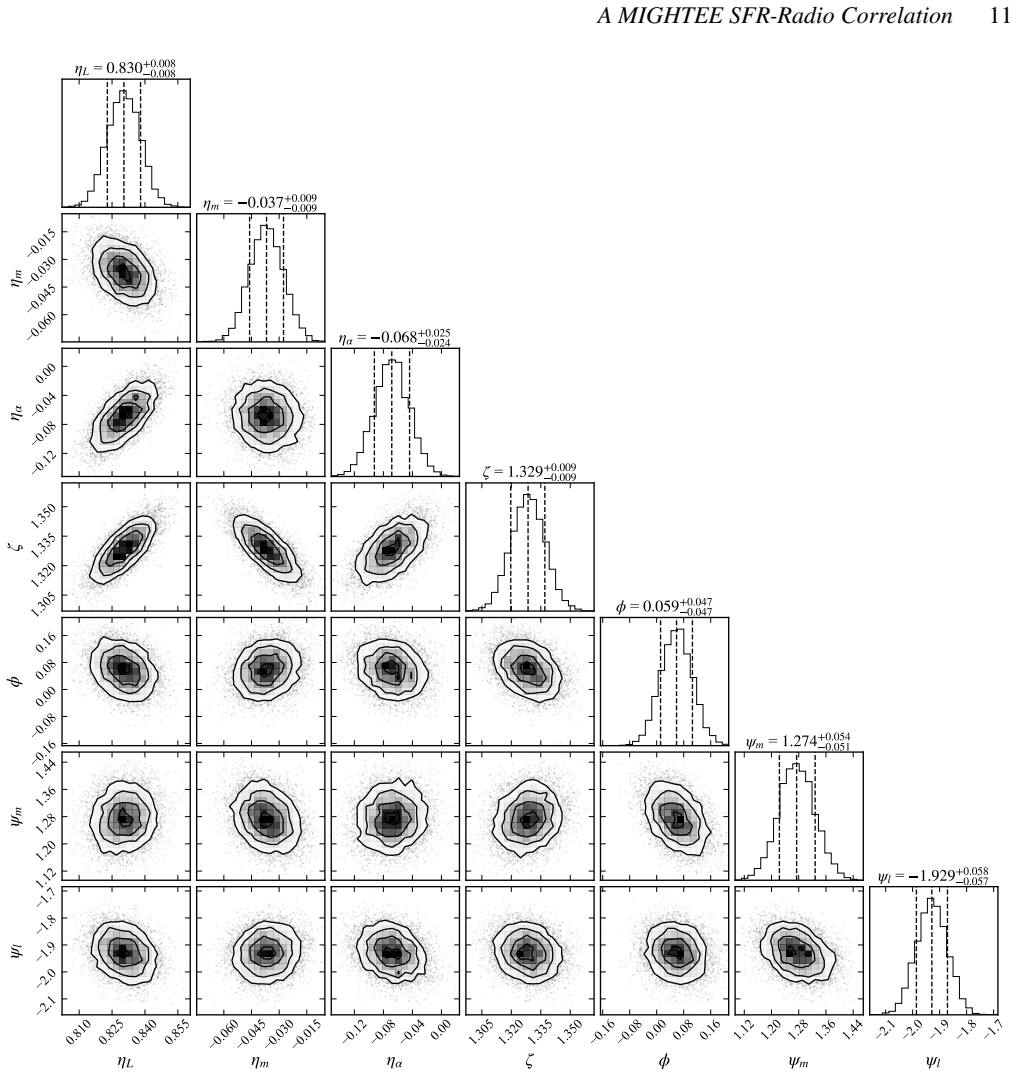
The mean star-formation-dominated SFR–radio correlation is log10(SFR/M⊙ yr−1) = 0.790 imes (log10(L1.4/W Hz−1) − 23) + 1.244 imes (1 + z)^0.122 − 0.033 imes (log10(M*/M⊙) − 10), with an intrinsic scatter of 0.178 dex. Redshift evolution is required at high significance; stellar-mass dependence is statistically present but practically negligible.
What carries the argument
A two-component hierarchical Bayesian mixture model whose SF mean is linear in log radio luminosity, additive in a power-law redshift term and a linear mass term, and whose SF fraction is a logistic function of luminosity and stellar mass; the model is sampled with the full per-source SFR posterior.
Load-bearing premise
The conversion from observed radio flux to rest-frame 1.4 GHz luminosity assumes a spectral index that is either fixed at −0.7 or allowed only a simple linear change with redshift; any real curvature or population dependence not captured by that form is absorbed into the reported redshift evolution.
What would settle it
Matched-resolution multi-frequency radio imaging of the same MIGHTEE fields that measures the true spectral-index distribution of SF-dominated galaxies as a function of redshift; if the measured indices show no systematic steepening of order Δα ≈ −0.07 per unit redshift, the physical explanation offered for the redshift term fails.
If this is right
- Future radio surveys can convert luminosity to SFR with a relation whose mass term can be dropped at little cost and whose redshift term is now quantified.
- Binary AGN/SFG cuts are no longer required for calibrating the relation; probabilistic membership is sufficient and less biased.
- Claims of strong stellar-mass dependence in the IRRC or SFR–radio plane should be re-examined under mixture modelling that keeps AGN in the sample.
- A mild spectral-index evolution of order α(z) = −0.7 − 0.068z is already enough to erase the need for an explicit redshift term in the SFR–radio plane.
Where Pith is reading between the lines
- If the same mixture approach is applied to other SFR tracers (Hα, UV, IR), residual mass or redshift trends currently attributed to dust or IMF variations may likewise shrink once AGN contamination is treated probabilistically.
- The logistic SF-fraction surface recovered here is itself a selection-function map; it can be used as a prior when stacking or luminosity-function modelling of the same field.
- Once S-band data arrive, the spectral-index explanation can be turned into a joint fit of α(z) and the SFR–radio plane rather than a post-hoc test.
Editorial analysis
A structured set of objections, weighed in public.
Referee Report
Summary. The paper derives a mean SFR–1.4 GHz radio luminosity relation for star-formation-dominated galaxies using a Bayesian hierarchical two-component mixture model applied to MIGHTEE COSMOS DR1 radio sources, with SFRs taken from full GRAHSP SED posteriors. Binary SFG/AGN cuts are avoided; instead an evolving logistic mixture fraction (in L1.4 and M*) jointly models the SF sequence and a radio-excess background. The preferred relation is log10(SFR) = 0.790 L' + 1.244 (1+z)^0.122 − 0.033 M' (L' = log10 L1.4 − 23, M' = log10 M* − 10) with intrinsic scatter 0.178 dex. Redshift evolution is required at high significance; stellar-mass dependence is weak. The redshift term can be re-absorbed into a mild spectral-index evolution α(z) = −0.7 − 0.068 z. Volume-limited bootstrap KS tests support that the relation is not driven by Malmquist bias.
Significance. If the result holds, the work supplies a practically usable, dust-agnostic SFR–radio calibration for deep radio surveys (MeerKAT, LOFAR, SKA pathfinders) that does not rely on the circular radio-excess cuts common in IRRC-based studies. The hierarchical mixture approach, full SFR-posterior marginalisation, and explicit model comparison via WAIC/PSIS-LOO-CV are methodological strengths that the community can reuse. The finding that mass dependence is much weaker than in recent IRRC work, while redshift evolution remains, is a concrete, falsifiable claim that can be tested with forthcoming multi-band MIGHTEE data. The paper is therefore of clear interest for galaxy evolution and radio continuum cosmology.
major comments (2)
- §2.1 and §3: photometric redshifts are adopted for a substantial fraction of the sample but their posteriors are not sampled (only SFR posteriors are). Because both L1.4 (Eq. 1) and the (1+z) term in μ_SF depend on z, residual photo-z scatter or catastrophic outliers can couple into the reported redshift evolution. A quantitative test—e.g. restricting to the spectroscopic/PAU subset, or Monte-Carlo sampling the photo-z PDFs for a representative subsample—should be shown so that the significance of γ_z = 0.122 ± 0.019 can be assessed under realistic redshift uncertainty.
- §4.4 / Eq. (1): the conversion from observed flux to rest-frame L1.4 assumes either fixed α = −0.7 or a simple linear α(z) = −0.7 − 0.068 z. The paper already demonstrates that the redshift term can be re-absorbed into α(z) and that the slope remains consistent, which is good. However, any spectral curvature or population-dependent spectral shape not captured by this one-parameter form will still be absorbed into the reported (1+z) term. Given that multi-frequency MIGHTEE S-band data are imminent, the manuscript should state more explicitly that the present redshift coefficient is degenerate with spectral-index assumptions and should be re-calibrated once measured α are available.
minor comments (5)
- Table numbering is inconsistent: the main posterior table is labelled Table 3 in the text but appears as Table 5 in the caption; the second/third-best models are Table 4. Please renumber for consistency.
- Fig. 2 right panel: the quantity log10(ΔSFR/SFR) is defined in the caption but the axis label is abbreviated; a short explicit definition in the figure itself would help.
- §3.1: the cut log10(ΔSFR/SFR) > 1 removes only 1.8 % of sources; a one-sentence statement that results are insensitive to the precise threshold would strengthen the claim of robustness.
- Eq. (4) and surrounding text: the decision to drop the constant intercept ζ when both mass and redshift terms are present is sensible, but a brief note that the intercept is absorbed into the normalisation of the (1+z) term would clarify the parameterisation for readers who wish to implement the relation.
- References: a few in-prep works (Hale et al. submitted; Stylianou et al.; Jackson et al.) are cited for catalogue construction; ensure that the public data products needed to reproduce the sample selection are clearly identified or will be released with the paper.
Circularity Check
No significant circularity: the hierarchical mixture model jointly fits free parameters for the SF mean relation and evolving background fraction; the reported coefficients are posterior results, not identities or pre-assumed cuts.
full rationale
The paper's central result is an empirical fit of a two-component hierarchical Bayesian mixture (SF-dominated Gaussian around a parametric mean µ_SF plus a background Gaussian) to the joint distribution of GRAHSP SFR posteriors and MIGHTEE L_1.4 values. All coefficients (η_L, η_z, γ_z, η_m, φ, ψ_L, ψ_m, σ_int, …) are free parameters sampled by NUTS after AIC/WAIC/LOO model selection among an exhaustive suite of functional forms (Table 1–2). The final relation (Eq. 14) is therefore the MAP/posterior mean of those free parameters, not a quantity forced by construction from an input definition or from a prior cut. The authors explicitly contrast this with the classic circular procedure of first excising radio-excess sources relative to an assumed IRRC and then re-fitting the same relation. Mild self-citations (MIGHTEE DR1 catalogues, GRAHSP SED code) supply data products and software; they do not supply a uniqueness theorem or ansatz that forces the slope, redshift exponent or mass coefficient. Spectral-index assumptions (fixed α = −0.7 or linear α(z)) are modelling choices that are tested and re-absorbed, not circular reductions. Volume-limited KS tests further confirm the relation is recovered inside complete sub-samples. Hence the derivation chain is self-contained and data-driven; circularity score is near zero.
Axiom & Free-Parameter Ledger
free parameters (7)
- η_L (slope of log SFR vs log L1.4) =
0.790 ± 0.010
- η_z and γ_z (redshift evolution amplitude and exponent) =
η_z=1.244±0.016, γ_z=0.122±0.019
- η_m (stellar-mass coefficient) =
−0.033 ± 0.009
- σ_int (intrinsic scatter of SF component) =
0.178 ± 0.004 dex
- ϕ, ψ_L, ψ_m (logistic mixture fraction parameters) =
ϕ≈0, ψ_L≈−1.97, ψ_m≈1.29
- μ_bkg, σ_bkg (background Gaussian) =
μ_bkg≈0.77, σ_bkg≈0.76
- η_α (optional spectral-index evolution) =
−0.068 ± 0.025
axioms (5)
- domain assumption Planck 2020 flat ΛCDM cosmology (Ωm=0.31, H0=67.66)
- domain assumption Radio spectrum Sν∝ν^α with fiducial α=−0.7 (or linear evolution)
- domain assumption GRAHSP SED models (delayed-τ SFH, Chabrier IMF, Bruzual-Charlot SSPs, flexible AGN torus) correctly recover SFR posteriors
- ad hoc to paper Two-component mixture (1-D Gaussian SF relation + 1-D Gaussian background) is an adequate description of the population
- domain assumption Photometric redshifts can be treated as delta functions (posteriors not sampled)
read the original abstract
Determining the relationship between star-formation rate (SFR) and the radio luminosity ($L_{1.4}$) is critical if we are to trace the star-formation history of the Universe dust-agnostically using current and future radio facilities. However, until now, such work has relied on potentially biased binary classifications of sources to remove contaminating active galactic nuclei (AGN). We present a new, statistically-driven methodology for deriving the SFR -- $L_{1.4}$ relation, removing the need for problematic cuts. We use a Bayesian hierarchical mixture model fit to the radio-detected sources in the deep MIGHTEE COSMOS DR1 catalogue, incorporating the full SFR posterior probability distributions generated by state-of-the-art spectral energy distribution fitting code \texttt{GRAHSP}. This allows us to probabilistically determine a mean SFR -- $L_{1.4}$ relation for the SF dominated galaxies, whilst accounting for changing fractions of SF dominated sources across redshift, radio luminosity and stellar mass ranges. We find that the SFR -- radio luminosity correlation exhibits a significant dependence on redshift, but a stellar mass dependence that is weaker than previous studies. Our resultant SFR-radio correlation is $\log_{10}(\text{SFR}/M_{\odot}\,\text{yr}^{-1}) = 0.790\times(\log _{10}(L_{1.4}/\text{W\,Hz}^{-1})-23) + 1.244 \times(1+z)^{0.122} -0.033 \times (\log_{10}(M_*/M_{\odot})-10)$, with an intrinsic scatter of 0.178 dex. We show that this redshift evolution could be explained by a moderate evolution in the radio spectral index of SF galaxies. We attribute the lack of observed strong dependence on stellar mass, compared to recent studies, to the novel statistical approach that does not rely on cuts to remove AGN.
Figures



Reference graph
Works this paper leans on
-
[1]
COSMOS2020: Cosmic evolution of the stellar-to-halo mass relation for central and satellite galaxies up to z 5. , keywords =. doi:10.1051/0004-6361/202243136 , archivePrefix =. 2203.10895 , primaryClass =
work page internal anchor Pith review Pith/arXiv arXiv doi:10.1051/0004-6361/202243136
-
[2]
The evolving relation between star-formation rate and stellar mass in the VIDEO Survey since $z=3$
The evolving relation between star formation rate and stellar mass in the VIDEO survey since z = 3. , keywords =. doi:10.1093/mnras/stv1715 , archivePrefix =. 1507.07503 , primaryClass =
work page internal anchor Pith review Pith/arXiv arXiv doi:10.1093/mnras/stv1715
-
[3]
Constraining the Low-mass Slope of the Star Formation Sequence at 0.5 < z < 2.5. , keywords =. doi:10.1088/0004-637X/795/2/104 , archivePrefix =. 1407.1843 , primaryClass =
-
[4]
Star Formation in AEGIS Field Galaxies since z=1.1: The Dominance of Gradually Declining Star Formation, and the Main Sequence of Star-forming Galaxies. , keywords =. doi:10.1086/517926 , archivePrefix =. astro-ph/0701924 , primaryClass =
-
[5]
Evidence that the AGN dominates the radio emission in z ~ 1 radio-quiet quasars
Evidence that the AGN dominates the radio emission in z 1 radio-quiet quasars. , keywords =. doi:10.1093/mnras/stx284 , archivePrefix =. 1702.00904 , primaryClass =
work page internal anchor Pith review Pith/arXiv arXiv doi:10.1093/mnras/stx284
-
[6]
Radio-Quiet Quasars in the VIDEO Survey: Evidence for AGN-powered radio emission at S_1.4GHz < 1 mJy
Radio-quiet quasars in the VIDEO survey: evidence for AGN-powered radio emission at S\_\ 1.4 GHz < 1\ mJy. , keywords =. doi:10.1093/mnras/stv134 , archivePrefix =. 1410.3892 , primaryClass =
work page internal anchor Pith review Pith/arXiv arXiv doi:10.1093/mnras/stv134
-
[7]
Quasar feedback and the origin of radio emission in radio-quiet quasars. , keywords =. doi:10.1093/mnras/stu842 , archivePrefix =. 1402.6736 , primaryClass =
-
[8]
Fundamental differences in the radio properties of red and blue quasars: enhanced compact AGN emission in red quasars. , keywords =. doi:10.1093/mnras/staa954 , archivePrefix =. 2004.01197 , primaryClass =
-
[9]
Exploring the quasar disc─wind─jet connection with LoTSS and SDSS. , keywords =. doi:10.1093/mnras/stag065 , archivePrefix =. 2510.25833 , primaryClass =
-
[10]
MIGHTEE: the nature of the radio-loud AGN population. , keywords =. doi:10.1093/mnras/stac2140 , archivePrefix =. 2207.12379 , primaryClass =
-
[11]
The LOFAR two metre sky survey data release 2: probabilistic spectral source classifications and faint radio source demographics. , keywords =. doi:10.1093/mnras/stae2117 , archivePrefix =. 2409.11465 , primaryClass =
-
[12]
The LOFAR Two-metre Sky Survey Deep Fields: new probabilistic spectroscopic classifications and the accretion rates of radio galaxies. , keywords =. doi:10.1093/mnras/staf1347 , archivePrefix =. 2508.18347 , primaryClass =
-
[13]
The faint radio sky: VLBA observations of the COSMOS field. , keywords =. doi:10.1051/0004-6361/201731163 , archivePrefix =. 1707.07512 , primaryClass =
-
[14]
The Chandra Deep Field-South: Optical Spectroscopy. I. , keywords =. doi:10.1086/424707 , archivePrefix =. astro-ph/0312324 , primaryClass =
work page internal anchor Pith review Pith/arXiv arXiv doi:10.1086/424707
-
[15]
Identifying Luminous Active Galactic Nuclei in Deep Surveys: Revised IRAC Selection Criteria. , keywords =. doi:10.1088/0004-637X/748/2/142 , archivePrefix =. 1201.3899 , primaryClass =
-
[16]
AGNfitter: A Bayesian MCMC Approach to Fitting Spectral Energy Distributions of AGNs. , keywords =. doi:10.3847/1538-4357/833/1/98 , archivePrefix =. 1606.05648 , primaryClass =
-
[17]
Radio spectral properties of star-forming galaxies in the MIGHTEE-COSMOS field and their impact on the far-infrared-radio correlation. , keywords =. doi:10.1093/mnras/stab2290 , archivePrefix =. 2108.02778 , primaryClass =
-
[18]
Far-infrared emission in luminous quasars accompanied by nuclear outflows
Far-infrared emission in luminous quasars accompanied by nuclear outflows. , keywords =. doi:10.1093/mnras/stx1416 , archivePrefix =. 1706.04789 , primaryClass =
work page internal anchor Pith review Pith/arXiv arXiv doi:10.1093/mnras/stx1416
-
[19]
UV-FIR SED modelling of AGNs in IR-luminous galaxies up to z 2.5: understanding the effects of torus models. , keywords =. doi:10.1093/mnras/stad589 , archivePrefix =. 2302.10374 , primaryClass =
work page internal anchor Pith review Pith/arXiv arXiv doi:10.1093/mnras/stad589
-
[20]
The incidence of X-ray AGN and non-AGN galaxies in the far-infrared: Insights into host galaxy properties and AGN obscuration. , keywords =. doi:10.1051/0004-6361/202555645 , archivePrefix =. 2507.08935 , primaryClass =
work page internal anchor Pith review Pith/arXiv arXiv doi:10.1051/0004-6361/202555645
-
[21]
AGN are cooler than you think: the intrinsic far-IR emission from QSOs. , keywords =. doi:10.1093/mnras/stw667 , archivePrefix =. 1603.05278 , primaryClass =
-
[22]
The star-formation rates of QSOs
The star formation rates of QSOs. , keywords =. doi:10.1093/mnras/stac1359 , archivePrefix =. 2205.11645 , primaryClass =
work page internal anchor Pith review Pith/arXiv arXiv doi:10.1093/mnras/stac1359
-
[23]
Herschel-ATLAS: the link between accretion luminosity and star formation in quasar host galaxies. , keywords =. doi:10.1111/j.1365-2966.2011.18826.x , archivePrefix =. 1103.3905 , primaryClass =
-
[24]
Galaxy populations and redshift dependence of the correlation between infrared and radio luminosity
Galaxy populations and redshift dependence of the correlation between infrared and radio luminosity. , keywords =. doi:10.1051/0004-6361/202449313 , archivePrefix =. 2407.04825 , primaryClass =
work page internal anchor Pith review Pith/arXiv arXiv doi:10.1051/0004-6361/202449313
-
[25]
Radio spectral properties of star-forming galaxies between 150 and 5000 MHz in the ELAIS-N1 field. , keywords =. doi:10.1093/mnras/stae364 , archivePrefix =. 2303.06941 , primaryClass =
-
[26]
Radio spectral energy distribution of low-z metal-poor extreme starburst galaxies: novel insights on the escape of ionizing photons. , keywords =. doi:10.1093/mnras/stag492 , archivePrefix =. 2503.17327 , primaryClass =
-
[27]
The Radio Spectral Energy Distribution and Star Formation Calibration in MIGHTEE-COSMOS Highly Star-forming Galaxies at 1.5 < z < 3.5. , keywords =. doi:10.3847/1538-4357/ade233 , archivePrefix =. 2506.16275 , primaryClass =
-
[28]
The star-formation rate-radio luminosity relation at low frequencies
The LOFAR Two-metre Sky Survey Deep Fields. The star-formation rate-radio luminosity relation at low frequencies. , keywords =. doi:10.1051/0004-6361/202039343 , archivePrefix =. 2011.08196 , primaryClass =
-
[29]
An ALMA Survey of the SCUBA-2 Cosmology Legacy Survey UKIDSS/UDS Field: The Far-infrared/Radio Correlation for High-redshift Dusty Star-forming Galaxies. , keywords =. doi:10.3847/1538-4357/abb77b , archivePrefix =. 2009.06647 , primaryClass =
work page internal anchor Pith review Pith/arXiv arXiv doi:10.3847/1538-4357/abb77b 2009
-
[30]
The far-infrared/radio correlation as probed by Herschel. , keywords =. doi:10.1051/0004-6361/201014552 , archivePrefix =. 1005.1072 , primaryClass =
-
[31]
Exploring the infrared/radio correlation at high redshift. , keywords =. doi:10.1111/j.1365-2966.2008.13077.x , archivePrefix =. 0802.2694 , primaryClass =
-
[32]
The Far- and Mid-Infrared/Radio Correlations in the Spitzer Extragalactic First Look Survey. , keywords =. doi:10.1086/422425 , archivePrefix =. astro-ph/0406030 , primaryClass =
-
[33]
Herschel-ATLAS: the far-infrared-radio correlation at z < 0.5. , keywords =. doi:10.1111/j.1365-2966.2010.17772.x , archivePrefix =. 1009.5390 , primaryClass =
-
[34]
, keywords =
Radio continuum and far-infrared emission from spiral galaxies : a close correlation. , keywords =
-
[35]
The LOFAR window on star-forming galaxies and AGNs - curved radio SEDs and IR-radio correlation at 0<z<2.5. , keywords =. doi:10.1093/mnras/stx1040 , archivePrefix =. 1704.06268 , primaryClass =
-
[37]
The Far-Infrared-Radio Correlation at High Redshifts: Physical Considerations and Prospects for the Square Kilometer Array. , keywords =. doi:10.1088/0004-637X/706/1/482 , archivePrefix =. 0910.0011 , primaryClass =
-
[38]
MeerKAT Science: On the Pathway to the SKA , year = 2016, month = jan, eid =
The MeerKAT International GHz Tiered Extragalactic Exploration (MIGHTEE) Survey. MeerKAT Science: On the Pathway to the SKA , year = 2016, month = jan, eid =. doi:10.22323/1.277.0006 , archivePrefix =. 1709.01901 , primaryClass =
-
[39]
, journal=
Jonas, Justin L. , journal=. MeerKAT—The South African Array With Composite Dishes and Wide-Band Single Pixel Feeds , year=
-
[40]
Jonas, Justin. The MeerKAT Radio Telescope. PoS. doi:10.22323/1.277.0001
-
[41]
MIGHTEE: the continuum survey Data Release 1. , keywords =. doi:10.1093/mnras/stae2528 , archivePrefix =. 2411.04958 , primaryClass =
-
[42]
The Messenger , year = 2013, month = dec, volume =
UltraVISTA: A VISTA Public Survey of the Distant Universe. The Messenger , year = 2013, month = dec, volume =
2013
-
[43]
Third data release of the Hyper Suprime-Cam Subaru Strategic Program. , keywords =. doi:10.1093/pasj/psab122 , archivePrefix =. 2108.13045 , primaryClass =
-
[44]
Hybrid photometric redshifts for sources in the COSMOS and XMM-LSS fields
Hybrid photometric redshifts for sources in the COSMOS and XMM-LSS fields. , keywords =. doi:10.1093/mnras/stac1042 , archivePrefix =. 2206.00748 , primaryClass =
work page internal anchor Pith review Pith/arXiv arXiv doi:10.1093/mnras/stac1042
-
[45]
Evolution of the galaxy stellar mass function: evidence for an increasing M* from z = 2 to the present day. , keywords =. doi:10.1093/mnras/stab1956 , archivePrefix =. 2101.07182 , primaryClass =
work page internal anchor Pith review Pith/arXiv arXiv doi:10.1093/mnras/stab1956
-
[46]
doi:10.5281/zenodo.15176245 , url =
Vaccari, Mattia , title =. doi:10.5281/zenodo.15176245 , url =
-
[47]
The Spitzer Data Fusion: Contents, Construction and Applications to Galaxy Evolution Studies
The Spitzer Data Fusion: Contents, Construction and Applications to Galaxy Evolution Studies. The Many Facets of Extragalactic Radio Surveys: Towards New Scientific Challenges , year = 2015, month = oct, eid =. doi:10.22323/1.267.0027 , archivePrefix =. 1604.02353 , primaryClass =
work page internal anchor Pith review Pith/arXiv arXiv doi:10.22323/1.267.0027 2015
-
[48]
HELP: the Herschel Extragalactic Legacy Project. , keywords =. doi:10.1093/mnras/stab1526 , archivePrefix =. 2105.05659 , primaryClass =
-
[49]
COSMOS2020: A Panchromatic View of the Universe to z 10 from Two Complementary Catalogs. , keywords =. doi:10.3847/1538-4365/ac3078 , archivePrefix =. 2110.13923 , primaryClass =
-
[50]
Genuine Retrieval of the AGN Host Stellar Population (GRAHSP). , keywords =. doi:10.1051/0004-6361/202449372 , archivePrefix =. 2405.19297 , primaryClass =
-
[51]
CIGALE: a python Code Investigating GALaxy Emission. , keywords =. doi:10.1051/0004-6361/201834156 , archivePrefix =. 1811.03094 , primaryClass =
-
[52]
Fitting AGN/galaxy X-ray-to-radio SEDs with CIGALE and improvement of the code
Fitting AGN/Galaxy X-Ray-to-radio SEDs with CIGALE and Improvement of the Code. , keywords =. doi:10.3847/1538-4357/ac4971 , archivePrefix =. 2201.03718 , primaryClass =
work page internal anchor Pith review Pith/arXiv arXiv doi:10.3847/1538-4357/ac4971
-
[53]
Evidence for inverse Compton scattering in high-redshift Lyman-break galaxies
Evidence for inverse Compton scattering in high-redshift Lyman-break galaxies. , keywords =. doi:10.1093/mnras/staf1505 , archivePrefix =. 2509.06677 , primaryClass =
work page internal anchor Pith review Pith/arXiv arXiv doi:10.1093/mnras/staf1505
-
[54]
The radio properties of radio-quiet quasars. , keywords =. doi:10.1046/j.1365-8711.1998.01481.x , archivePrefix =. astro-ph/9802148 , primaryClass =
-
[55]
, author=
The No-U-Turn sampler: adaptively setting path lengths in Hamiltonian Monte Carlo. , author=. J. Mach. Learn. Res. , volume=
-
[56]
The rate of star formation in normal disk galaxies. , keywords =. doi:10.1086/161261 , adsurl =
-
[57]
Determining Star Formation Rates for Infrared Galaxies
Determining Star Formation Rates for Infrared Galaxies. , keywords =. doi:10.1088/0004-637X/692/1/556 , archivePrefix =. 0810.4150 , primaryClass =
work page internal anchor Pith review Pith/arXiv arXiv doi:10.1088/0004-637x/692/1/556
-
[58]
PeerJ Computer Science , author =. 2023 , pages =. doi:10.7717/peerj-cs.1516 , abstract =
-
[59]
The infrared-radio correlation of star-forming galaxies is strongly M _ -dependent but nearly redshift-invariant since z 4. , keywords =. doi:10.1051/0004-6361/202039647 , archivePrefix =. 2010.05510 , primaryClass =
-
[60]
, month = jan, year =
Draine, Bruce T. , month = jan, year =. Physics of the
-
[61]
Saas-Fee Advanced Course , keywords =
Physical Processes in the Interstellar Medium. Saas-Fee Advanced Course , keywords =. doi:10.1007/978-3-662-47890-5_2 , archivePrefix =. 1412.5182 , primaryClass =
-
[62]
Radio emission from normal galaxies. , keywords =. doi:10.1146/annurev.aa.30.090192.003043 , adsurl =
-
[63]
Star Formation Rates in Faint Radio Galaxies
Star Formation Rates in Faint Radio Galaxies. , keywords =. doi:10.1086/306333 , archivePrefix =. astro-ph/9805327 , primaryClass =
work page internal anchor Pith review Pith/arXiv arXiv doi:10.1086/306333
-
[64]
Radio Detection of Radio-Quiet Galaxies. , keywords =. doi:10.1088/0004-6256/136/3/1097 , archivePrefix =. 0806.3986 , primaryClass =
-
[65]
Monthly Notices of the Royal Astronomical Society , author =. 2024 , pages =. doi:10.1093/mnras/stae1215 , abstract =
-
[66]
Nearby galaxies in the LOFAR Two-metre Sky Survey. I. Insights into the non-linearity of the radio-SFR relation. , keywords =. doi:10.1051/0004-6361/202142878 , archivePrefix =. 2204.00635 , primaryClass =
work page internal anchor Pith review Pith/arXiv arXiv doi:10.1051/0004-6361/202142878
-
[67]
Calibrating Extinction-free Star Formation Rate Diagnostics with 33 GHz Free-free Emission in NGC 6946. , keywords =. doi:10.1088/0004-637X/737/2/67 , archivePrefix =. 1105.4877 , primaryClass =
-
[68]
The MOSDEF Survey: calibrating the relationship between H star formation rate and radio continuum luminosity at 1.4 < z < 2.6. , keywords =. doi:10.1093/mnras/staa2561 , archivePrefix =. 2008.04329 , primaryClass =
work page internal anchor Pith review Pith/arXiv arXiv doi:10.1093/mnras/staa2561 2008
-
[69]
Measuring the kinetic power of active galactic nuclei in the radio mode. , keywords =. doi:10.1111/j.1365-2966.2007.12253.x , archivePrefix =. 0707.3356 , primaryClass =
-
[70]
Voelk, H. J. , month = jul, year =. The correlation between radio and far-infrared emission for disk galaxies : a calorimeter theory. , volume =. Astronomy and Astrophysics , publisher =
-
[71]
The Optical and Near-Infrared Properties of Galaxies. I. Luminosity and Stellar Mass Functions. , keywords =. doi:10.1086/378847 , archivePrefix =. astro-ph/0302543 , primaryClass =
-
[72]
Christopher and Seibert, Mark and Buat, Véronique and Iglesias-Páramo, Jorge and Barlow, Tom A
Martin, D. Christopher and Seibert, Mark and Buat, Véronique and Iglesias-Páramo, Jorge and Barlow, Tom A. and Bianchi, Luciana and Byun, Yong-Ik and Donas, José and Forster, Karl and Friedman, Peter G. and Heckman, Timothy M. and Jelinsky, Patrick N. and Lee, Young-Wook and Madore, Barry F. and Malina, Roger F. and Milliard, Bruno and Morrissey, Patrick ...
-
[73]
A simple model to interpret the ultraviolet, optical and infrared emission from galaxies , volume =
da Cunha, Elisabete and Charlot, Stéphane and Elbaz, David , month = aug, year =. A simple model to interpret the ultraviolet, optical and infrared emission from galaxies , volume =. Monthly Notices of the Royal Astronomical Society , publisher =. doi:10.1111/j.1365-2966.2008.13535.x , abstract =
-
[74]
Noll, S. and Burgarella, D. and Giovannoli, E. and Buat, V. and Marcillac, D. and Muñoz-Mateos, J. C. , month = dec, year =. Analysis of galaxy spectral energy distributions from far-. Astronomy and Astrophysics , publisher =. doi:10.1051/0004-6361/200912497 , abstract =
-
[75]
Pacifici, Camilla and Iyer, Kartheik G. and Mobasher, Bahram and da Cunha, Elisabete and Acquaviva, Viviana and Burgarella, Denis and Calistro Rivera, Gabriela and Carnall, Adam C. and Chang, Yu-Yen and Chartab, Nima and Cooke, Kevin C. and Fairhurst, Ciaran and Kartaltepe, Jeyhan and Leja, Joel and Małek, Katarzyna and Salmon, Brett and Torelli, Marianna...
-
[76]
Monthly Notices of the Royal Astronomical Society , author =
Applications of 1.4. Monthly Notices of the Royal Astronomical Society , author =. 2026 , pages =. doi:10.1093/mnras/stag832 , abstract =
-
[77]
Monthly Notices of the Royal Astronomical Society , author =
The dependence of the. Monthly Notices of the Royal Astronomical Society , author =. 2025 , pages =. doi:10.1093/mnras/staf1570 , abstract =
-
[78]
The Radio Spectral Energy Distribution and Star-formation Rate Calibration in Galaxies. , keywords =. doi:10.3847/1538-4357/836/2/185 , archivePrefix =. 1611.01705 , primaryClass =
-
[79]
Radio Properties of Infrared-selected Galaxies in the IRAS 2 Jy Sample. , keywords =. doi:10.1086/323145 , archivePrefix =. astro-ph/0102154 , primaryClass =
-
[80]
Thermal infrared and nonthermal radio : remarkable correlation in disks of galaxies. , keywords =. doi:10.1086/184556 , adsurl =
-
[81]
and Klein, U
de Jong, T. and Klein, U. and Wielebinski, R. and Wunderlich, E. , month = jun, year =. Radio continuum and far-infrared emission from spiral galaxies : a close correlation. , volume =. Astronomy and Astrophysics , publisher =
discussion (0)
Sign in with ORCID, Apple, or X to comment. Anyone can read and Pith papers without signing in.