REVIEW 3 major objections 114 references
Generative AI helps diabetes patients prepare for visits but fails at medication reasoning and emotional support.
Reviewed by Pith at T0; open to challenge. T0 means a machine referee read the full paper against a public rubric. the ladder, T0–T4 →
T0 review · grok-4.5
2026-07-12 00:24 UTC pith:ZPQ5QU2X
load-bearing objection Solid dual-perspective HCI evaluation of GenAI for T2DM; the non-matched "convergence" is a real soft spot but does not sink the empirical core. the 3 major comments →
Between Knowledge and Care: A Mixed-Methods Evaluation of Generative AI for T2DM Self-Management from Patient and Physician Perspectives
The pith
A machine-rendered reading of the paper's core claim, the machinery that carries it, and where it could break.
Core claim
Across patient-reported needs and physician ratings of four models, generative AI is reliable for standardized T2DM facts and lifestyle advice but consistently underperforms on medication guide/interpretation and emotional support; patients and physicians independently draw the same educator-versus-decision-maker boundary and flag the same emotional and personalization deficits, supporting AI as a pre-visit primer rather than clinical authority.
What carries the argument
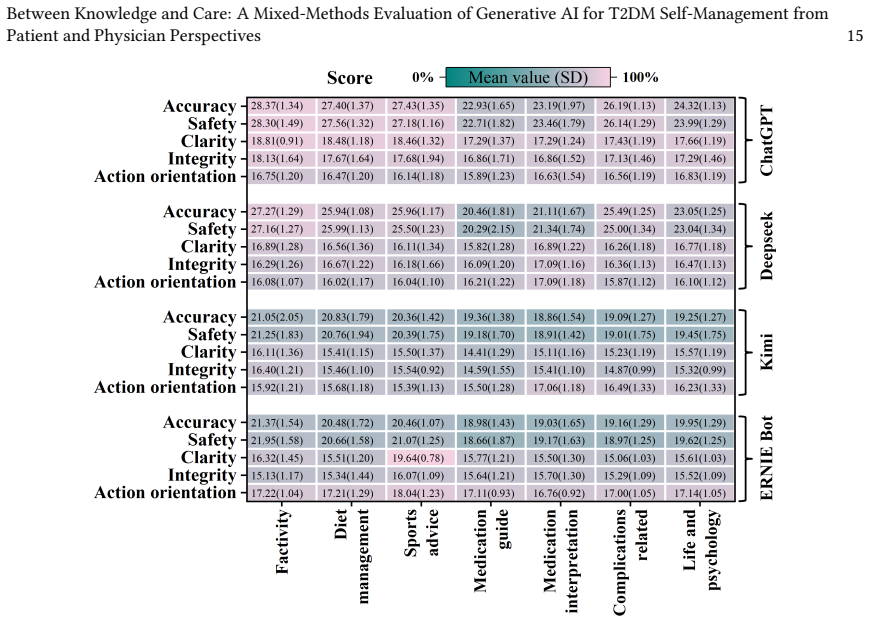
A physician-informed five-dimensional rubric (Accuracy, Safety, Clarity, Integrity, Action Orientation) applied to 66 curated patient questions across four models, triangulated with patient attitudes and post-scoring interviews, which surfaces the pre-visit primer role and the fluency illusion.
Load-bearing premise
That ratings from seven Chinese endocrinologists on static single-turn outputs, plus twenty-one self-selected patients’ recalled queries, are representative enough to ground general design directions for generative AI in chronic care.
What would settle it
Have patients and clinicians score the same AI answers to the same medication-adjustment and affect-laden questions: if shared deficits on emotional support and personalization disappear, or if high factual scores also yield safe, complete medication guidance without omitted contraindications, the claimed performance gradient and convergence pattern fail.
If this is right
- Interfaces should route medication, dose-change, and ambiguous-symptom queries into safety-constrained modes with prominent disclaimers and escalation to clinicians.
- Design should make the gap between linguistic fluency and clinical grounding visible so non-experts do not treat polished answers as authoritative.
- Chronic-care tools should prioritize pre-visit question scaffolding and uncertainty disclosure over definitive treatment advice.
- Emotional and personalization failures require structured validation plus paths to human support rather than template empathy.
- No single model is universally optimal; task-aware orchestration can exploit model strengths under risk gates.
Where Pith is reading between the lines
- The same facts-high / meds-and-emotion-low gradient is likely to recur in other long-horizon chronic conditions that mix protocol knowledge with situated clinical judgment.
- A same-stimulus dual-rating design (patients and clinicians scoring identical outputs) would test whether the reported convergences survive matched conditions.
- Once high-stakes domains are gated by risk-aware fallbacks, routing policy may matter more for safety than which base model is chosen.
Editorial analysis
A structured set of objections, weighed in public.
Referee Report
Summary. This mixed-methods HCI paper evaluates generative AI for T2DM self-management from patient and physician perspectives. Study 1 (N=21 patients) analyzes 784 participant-reported queries into seven informational-need categories and, with clinicians, develops a five-dimension weighted rubric (Accuracy, Safety, Clarity, Integrity, Action Orientation). Study 2 has seven endocrinologists score static single-turn responses from four commercial models (GPT-4-turbo, DeepSeek-R1, Kimi K2, ERNIE Bot 4.5) on a curated 66-question set, followed by interviews. Models score higher on factual and lifestyle categories than on medication reasoning and emotional support; ChatGPT leads overall. The authors induce two analytic concepts (pre-visit primer; fluency illusion), report three patient–physician convergences and two divergences, and propose four design directions.
Significance. The work addresses a timely HCI gap: dual-perspective evaluation of LLM health content in chronic care, grounded in naturalistic patient queries rather than only benchmark QA. Strengths include transparent methods (codebook thematic analysis, consensus curation criteria, explicit rubric weights, exploratory RM-ANOVA plus interviews), category-level performance gradients that align quantitative scores with physician quotes, and two useful named concepts (pre-visit primer; fluency illusion) that can travel beyond T2DM. If the triangulation and design claims hold under tighter framing, the paper offers empirically grounded design targets for safer GenAI chronic-care tools.
major comments (3)
- §6.5–6.6: The central warrant for the four design directions is that patients and physicians “independently converged” on role boundaries, emotional inadequacy, and personalization gaps, making those “most robustly evidenced.” The manuscript itself states this is not a same-stimulus evaluation: patients never rated the AI outputs physicians scored. Convergence therefore rests on thematic resonance between Study 1 attitudes/recalled needs and Study 2 rubric/interview critiques of different objects. Emotional inadequacy is the clearest case (patient Q7/Q8 means vs. physician “checkbox lines” quotes). Either reframe as complementary single-perspective findings plus thematic resonance, or add a same-stimulus patient rating arm; as written, the dual-perspective robustness claim overreaches.
- §4.2 Phase 2 / §5.1 / Limitations: All model evaluation is static single-turn. The paper’s safety, action-orientation, and fluency-illusion claims, and the risk-aware fallback design direction, are load-bearing for real multi-turn health use (clarification, correction, dose-change follow-ups). The Limitations note this but do not bound how far single-turn scores can support those claims. Explicitly scope conclusions to single-turn educational outputs, or add a multi-turn pilot on high-risk categories (Medication Guide/Interpretation).
- §5.1.1: With N=7 physicians the reported F-values (e.g., model effect F(3,18)=2315.46, η²_G=0.72; dimension F(4,24)=4823.12) are extreme relative to sample size and imply near-zero residual variance. Authors label tests exploratory, but the narrative still treats model rankings and category gaps as firmly established. Soften inferential language, report rater agreement (e.g., ICC) and score distributions more carefully, and lead with descriptive patterns rather than ANOVA as primary evidence.
Circularity Check
Empirical mixed-methods study; analytic concepts and design directions are induced from ratings and interviews, not forced by definition or fitted parameters.
full rationale
This is a qualitative/quantitative HCI evaluation paper, not a formal derivation. Study 1 induces seven query categories and a five-dimensional rubric from 784 participant-reported queries and clinician priorities; Study 2 applies that rubric to four models and interviews seven physicians. The pre-visit primer and fluency illusion are explicitly labeled analytic concepts that 'emerge from the data' (Abstract; §6.1, §6.3), not theorems deduced from axioms. The four design directions in §6.6 are design implications grounded in observed performance gaps (e.g., ~10-point drop from factual to medication categories; low personalization and psychological-support means), not predictions forced by construction. There are no equations, no fitted parameters renamed as predictions, and no uniqueness theorems. Self-citations (e.g., authors' prior arXiv notes) appear only as related work and do not load-bear the present claims. The skeptic's concern—that patient–physician 'convergence' is not same-stimulus—is a validity/triangulation limitation the paper itself flags in §6.5 ('This comparison is not a same stimulus evaluation'), not circularity: the paper does not claim the three shared limitations are mathematically entailed by the inputs; it reports thematic resonance across independently collected corpora. Score 1 reflects only minor self-positioning relative to the authors' own prior note, which is not load-bearing.
Axiom & Free-Parameter Ledger
free parameters (2)
- rubric dimension weights =
30/30/20/20/20 (max 120)
- curated evaluation set size =
66
axioms (3)
- domain assumption Physician expert judgment on the five dimensions is an appropriate gold-standard proxy for clinical appropriateness of patient-facing AI health information.
- domain assumption Participant-reported (partly paraphrased) queries adequately represent real informational needs of T2DM patients who use generative AI.
- ad hoc to paper Static single-turn model outputs are informative of the safety and quality issues that arise in real multi-turn health use.
invented entities (2)
-
pre-visit primer
no independent evidence
-
fluency illusion
no independent evidence
read the original abstract
Generative AI is increasingly used for everyday health guidance, yet its clinical appropriateness in chronic disease contexts remains poorly understood. This paper presents a two-part mixed-methods study on \revise{Type 2 Diabetes Mellitus (T2DM)}, examining how patients and physicians assess AI-generated health information. \revise{Study~1} analyzes 784 \revise{participant reported} patient queries to characterize seven informational need categories and \revise{develops a structured five dimensional physician rating rubric informed by patient query categories and clinician priorities} (\textit{Accuracy, Safety, Clarity, Integrity, Action Orientation}). \revise{Study~2} engages seven physicians scoring responses from four AI models and discussing evaluative reasoning through in-depth interviews. Models perform well on factual explanation and lifestyle guidance but consistently underperform on medication reasoning and emotional support. Two \revise{analytic concepts} emerge \revise{from the data}. The \textit{pre-visit primer} \revise{frames AI as preparation for clinical encounters rather than as a replacement for physicians}. The \textit{fluency illusion} \revise{describes how polished language may convey epistemic authority that the clinical content does not support}. Patients and physicians converged on three shared limitations (role boundaries, emotional inadequacy, personalization gaps) while diverging in evaluative emphasis, \revise{which informed} four design directions, task-aware orchestration, risk-aware fallback, dynamic personalization, and emotionally attuned interaction.
Figures


Reference graph
Works this paper leans on
-
[1]
Moustafa Abdelwanis, Hamdan Khalaf Alarafati, Maram Muhanad Saleh Tammam, and Mecit Can Emre Simsekler. 2024. Exploring the risks of automation bias in healthcare artificial intelligence applications: A Bowtie analysis.Journal of Safety Science and Resilience5, 4 (2024), 460–469
2024
-
[2]
Vibhor Agarwal, Yiqiao Jin, Mohit Chandra, Munmun De Choudhury, Srijan Kumar, and Nishanth Sastry. 2024. Medhalu: Hallucinations in responses to healthcare queries by large language models.arXiv preprint arXiv:2409.19492(2024)
arXiv 2024
-
[3]
2025.Kimi (June 2025 Version)
Moonshot AI. 2025.Kimi (June 2025 Version). https://www.kimi.com/ Kimi AI assistant developed by Moonshot AI, accessed June 2025
2025
-
[4]
Samir Akrimi, Leon Schwensfeier, Peter Düking, Thorsten Kreutz, and Christian Brinkmann. 2025. ChatGPT-4o-Generated Exercise Plans for Patients with Type 2 Diabetes Mellitus: Assessment of Their Safety and Other Quality Criteria by Coaching Experts.Sports13, 4 (2025), 92
2025
-
[5]
Ninel Iacobus Antonie, Gina Gheorghe, Vlad Alexandru Ionescu, Loredana-Crista Tiucă, and Camelia Cristina Diaconu. 2025. The role of ChatGPT and AI Chatbots in optimizing antibiotic therapy: a comprehensive narrative review.Antibiotics14, 1 (2025), 60. Manuscript submitted to ACM Between Knowledge and Care: A Mixed-Methods Evaluation of Generative AI for ...
2025
-
[6]
Elham Asgari, Nina Montaña-Brown, Magda Dubois, Saleh Khalil, Jasmine Balloch, Joshua Au Yeung, and Dominic Pimenta. 2025. A framework to assess clinical safety and hallucination rates of LLMs for medical text summarisation.npj Digital Medicine8, 1 (2025), 274
2025
-
[7]
Amid Ayobi, Jacob Hughes, Christopher J Duckworth, Jakub J Dylag, Sam Gordon James, Paul Marshall, Matthew Guy, Anitha Kumaran, Adriane Chapman, Michael Boniface, et al. 2023. Computational notebooks as co-design tools: engaging young adults living with diabetes, family carers, and clinicians with machine learning models. InProceedings of the 2023 CHI Con...
2023
-
[8]
Amid Ayobi, Katarzyna Stawarz, Dmitri Katz, Paul Marshall, Taku Yamagata, Raul Santos-Rodriguez, Peter Flach, and Aisling Ann O’Kane. 2021. Co-designing personal health? Multidisciplinary benefits and challenges in informing diabetes self-care technologies.Proceedings of the ACM on Human-Computer Interaction5, CSCW2 (2021), 1–26
2021
-
[9]
2025.ERNIE Bot (June 2025 Version)
Baidu. 2025.ERNIE Bot (June 2025 Version). https://yiyan.baidu.com/ ERNIE Bot (Wenxin Yiyan) developed by Baidu, accessed June 2025
2025
-
[10]
Kevin Bauer, Moritz von Zahn, and Oliver Hinz. 2023. Expl (AI) ned: The impact of explainable artificial intelligence on users’ information processing.Information systems research34, 4 (2023), 1582–1602
2023
-
[11]
Manas Satish Bedmutha, Anuujin Tsedenbal, Kelly Tobar, Sarah Borsotto, Kimberly R Sladek, Deepansha Singh, Reggie Casanova-Perez, Emily Bascom, Brian Wood, Janice Sabin, Wanda Pratt, Andrea Hartzler, and Nadir Weibel. 2024. ConverSense: An Automated Approach to Assess Patient-Provider Interactions using Social Signals. InProceedings of the 2024 CHI Confer...
-
[12]
Umang Bhatt, Javier Antorán, Yunfeng Zhang, Q Vera Liao, Prasanna Sattigeri, Riccardo Fogliato, Gabrielle Melançon, Ranganath Krishnan, Jason Stanley, Omesh Tickoo, et al. 2021. Uncertainty as a form of transparency: Measuring, communicating, and using uncertainty. InProceedings of the 2021 AAAI/ACM Conference on AI, Ethics, and Society. 401–413
2021
-
[13]
Aditya Bhattacharya, Jeroen Ooge, Gregor Stiglic, and Katrien Verbert. 2023. Directive Explanations for Monitoring the Risk of Diabetes Onset: Introducing Directive Data-Centric Explanations and Combinations to Support What-If Explorations. InProceedings of the 28th International Conference on Intelligent User Interfaces(Sydney, NSW, Australia)(IUI ’23). ...
-
[14]
Aditya Bhattacharya, Jeroen Ooge, Gregor Stiglic, and Katrien Verbert. 2023. Directive explanations for monitoring the risk of diabetes onset: introducing directive data-centric explanations and combinations to support what-if explorations. InProceedings of the 28th international conference on intelligent user interfaces. 204–219
2023
-
[15]
Aditya Bhattacharya, Simone Stumpf, Robin De Croon, and Katrien Verbert. 2025. Explanatory Debiasing: Involving Domain Experts in the Data Generation Process to Mitigate Representation Bias in AI Systems. InProceedings of the 2025 CHI Conference on Human Factors in Computing Systems (CHI ’25). Association for Computing Machinery, New York, NY, USA, Articl...
-
[16]
Lisa Biernatzki, Silke Kuske, Jutta Genz, Michaela Ritschel, Astrid Stephan, Christina Bächle, Sigrid Droste, Sandra Grobosch, Nicole Ernstmann, Nadja Chernyak, et al. 2018. Information needs in people with diabetes mellitus: a systematic review.Systematic reviews7, 1 (2018), 27
2018
-
[17]
Virginia Braun and Victoria Clarke. 2006. Using thematic analysis in psychology.Qualitative research in psychology3, 2 (2006), 77–101
2006
-
[18]
Burgess, Ivana Jankovic, Melissa Austin, Nancy Cai, Adela Kapuścińska, Suzanne Currie, J
Eleanor R. Burgess, Ivana Jankovic, Melissa Austin, Nancy Cai, Adela Kapuścińska, Suzanne Currie, J. Marc Overhage, Erika S Poole, and Jofish Kaye. 2023. Healthcare AI Treatment Decision Support: Design Principles to Enhance Clinician Adoption and Trust. InProceedings of the 2023 CHI Conference on Human Factors in Computing Systems(Hamburg, Germany)(CHI ’...
-
[19]
Renjie Cao, Zhuoxin Yan, Xinyan Su, and Zhiheng Zhang. 2026. Causal Influence Maximization with Steady-State Guarantees. arXiv:2603.11761 [stat.ME] https://arxiv.org/abs/2603.11761
arXiv 2026
-
[20]
Shuheng Cao et al . 2022. Multi-channel medical image segmentation method in Hessian domain. InMedical Imaging 2022: Computer-Aided Diagnosis, Vol. 12033. SPIE
2022
-
[21]
Shuheng Cao, Ruiqi Chen, Renjie Cao, Zhenhao Zhang, Siyu Zhang, and Tingting Dan. 2026. Beyond Agreement: Scoring Panel-Surfaced Biomedical Entity Candidates for Curator Triage.arXiv preprint arXiv:2605.30826(2026)
Pith/arXiv arXiv 2026
-
[22]
Jingruo Chen, Yibo Meng, and Kexin Nie. 2026. "Not Just Me and My To-Do List": Understanding Challenges of Task Management for Adults with ADHD and the Need for AI-Augmented Social Scaffolds.arXiv preprint arXiv:2603.17258(2026)
Pith/arXiv arXiv 2026
-
[23]
Ruiqi Chen, Qingyang He, Hanxi Bao, Jung Choi, and Xin Tong. 2025. GestoBrush: Facilitating Graffiti Artists’ Digital Creation Experiences through Embodied AR Interactions. InProceedings of the 18th International Symposium on Visual Information Communication and Interaction. 1–9
2025
-
[24]
Ruiqi Chen, Shuhe Wang, Xuhai Xu, Lan Wei, Yuling Sun, and Xin Tong. 2023. Design and Evaluation of a VR Therapy for Patients with Mild Cognitive Impairment and Dementia: Perspectives from Patients and Stakeholders. In2023 IEEE Conference on Virtual Reality and 3D User Interfaces Abstracts and Workshops (VRW). IEEE, 597–598
2023
-
[25]
Andrea Cuadra, Maria Wang, Lynn Andrea Stein, Malte F Jung, Nicola Dell, Deborah Estrin, and James A Landay. 2024. The illusion of empathy? notes on displays of emotion in human-computer interaction. InProceedings of the 2024 CHI Conference on Human Factors in Computing Systems. 1–18
2024
-
[26]
Yanjun Cui, Biratal Raj Wagle, Shriti Raj, Enzo Plaitano, Catherine Stanger, and Temiloluwa Prioleau. 2025. Empowering Self-Management of Diabetes through Long-Term Wearable Data and Seasonal Visualizations. InProceedings of the Extended Abstracts of the CHI Conference on Human Factors in Computing Systems. 1–8
2025
-
[27]
2025.DeepSeek (June 2025 Version)
DeepSeek. 2025.DeepSeek (June 2025 Version). https://www.deepseek.com/ DeepSeek large language model, accessed June 2025. Manuscript submitted to ACM 24 Chen et al
2025
-
[28]
Pooja M. Desai, Elliot G. Mitchell, Maria L. Hwang, Matthew E. Levine, David J. Albers, and Lena Mamykina. 2019. Personal Health Oracle: Explorations of Personalized Predictions in Diabetes Self-Management. InProceedings of the 2019 CHI Conference on Human Factors in Computing Systems(Glasgow, Scotland Uk)(CHI ’19). Association for Computing Machinery, Ne...
-
[29]
Sherize Merlin Dsouza, Julien Venne, Sahana Shetty, and Helmut Brand. 2024. Identification of challenges and leveraging mHealth technology, with need-based solutions to empower self-management in type 2 diabetes: a qualitative study.Diabetology & Metabolic Syndrome16, 1 (2024), 182
2024
-
[30]
Murielle Florins and Jean Vanderdonckt. 2004. Graceful degradation of user interfaces as a design method for multiplatform systems. InProceedings of the 9th international conference on Intelligent user interfaces. 140–147
2004
-
[31]
Farieda Gaber, Maqsood Shaik, Fabio Allega, Agnes Julia Bilecz, Felix Busch, Kelsey Goon, Vedran Franke, and Altuna Akalin. 2025. Evaluating large language model workflows in clinical decision support for triage and referral and diagnosis.npj Digital Medicine8, 1 (2025), 263
2025
-
[32]
Uğur Genç and Himanshu Verma. 2024. Situating Empathy in HCI/CSCW: A Scoping Review.Proceedings of the ACM on Human-Computer Interaction8, CSCW2 (2024), 1–37
2024
-
[33]
Rebecca Gerstenberg, Robin Neuhaus, Martin Vitt, and Marc Hassenzahl. 2025. Living Well with Diabetes: Rethinking Digital Diabetes Management Systems. InProceedings of the 2025 ACM Designing Interactive Systems Conference. 3153–3172
2025
-
[34]
1992.ANOV A: Repeated measures
Ellen R Girden. 1992.ANOV A: Repeated measures. Number 84. sage
1992
-
[35]
Enying Gong, Shaira Baptista, Anthony Russell, Paul Scuffham, Michaela Riddell, Jane Speight, Dominique Bird, Emily Williams, Mojtaba Lotfaliany, and Brian Oldenburg. 2020. My diabetes coach, a mobile app–based interactive conversational agent to support type 2 diabetes self-management: randomized effectiveness-implementation trial.Journal of medical Inte...
2020
-
[36]
Shuangyan Guo, Yang Song, Guanyun Chen, Hongxin Han, Hong Wu, and Jingdong Ma. 2025. Promoting trust and intention to adopt health information generated by ChatGPT among healthcare customers: An empirical study.Digital Health11 (2025), 20552076251374121
2025
-
[37]
Gaole He, Nilay Aishwarya, and Ujwal Gadiraju. 2025. Is conversational xai all you need? human-ai decision making with a conversational xai assistant. InProceedings of the 30th International Conference on Intelligent User Interfaces. 907–924
2025
-
[38]
Carlos A Hernandez, Andres E Vazquez Gonzalez, Anastasiia Polianovskaia, Rafael Amoro Sanchez, Veronica Muyolema Arce, Ahmed Mustafa, Ekaterina Vypritskaya, Oscar Perez Gutierrez, Muhammad Bashir, and Ashkan Eighaei Sedeh. 2023. The future of patient education: AI-driven guide for type 2 diabetes.Cureus15, 11 (2023)
2023
-
[39]
Allyson S Hughes, Sarah Beach, Spruhaa Vasistha, Nazanin Heydarian, and Osvaldo Morera. 2024. Development and Validation of a Measure for Seeking Health Information in the Diabetes Online Community: Mixed Methods Study.JMIR diabetes9 (2024), e55424
2024
-
[40]
Minhwa Hwang, Seonghyeon Lee, Ga Eun Park, and Yeon-Hwan Park. 2025. Effectiveness of a digital health coaching self-management program for older adults living alone with multiple chronic conditions: a randomized controlled trial.Geriatric Nursing65 (2025), 103509
2025
-
[41]
Maia Jacobs, Jeremy Johnson, and Elizabeth D Mynatt. 2018. MyPath: Investigating breast cancer patients’ use of personalized health information. Proceedings of the ACM on Human-Computer Interaction2, CSCW (2018), 1–21
2018
-
[42]
Israt Jahan, Md Tahmid Rahman Laskar, Chun Peng, and Jimmy Xiangji Huang. 2024. A comprehensive evaluation of large language models on benchmark biomedical text processing tasks.Computers in biology and medicine171 (2024), 108189
2024
-
[43]
Di Jin, Eileen Pan, Nassim Oufattole, Wei-Hung Weng, Hanyi Fang, and Peter Szolovits. 2021. What disease does this patient have? a large-scale open domain question answering dataset from medical exams.Applied Sciences11, 14 (2021), 6421
2021
-
[44]
Qiao Jin, Bhuwan Dhingra, Zhengping Liu, William W Cohen, and Xinghua Lu. 2019. Pubmedqa: A dataset for biomedical research question answering.arXiv preprint arXiv:1909.06146(2019)
Pith/arXiv arXiv 2019
-
[45]
Matthew Jörke, Shardul Sapkota, Lyndsea Warkenthien, Niklas Vainio, Paul Schmiedmayer, Emma Brunskill, and James A. Landay. 2025. GPTCoach: Towards LLM-Based Physical Activity Coaching. InProceedings of the 2025 CHI Conference on Human Factors in Computing Systems (CHI ’25). Association for Computing Machinery, New York, NY, USA, Article 993, 46 pages. do...
-
[46]
Jade Kandel, Jiayi Liu, Arran Zeyu Wang, Chin Tseng, and Danielle Szafir. 2025. Graphical Perception of Icon Arrays versus Bar Charts for Value Comparisons in Health Risk Communication.arXiv preprint arXiv:2509.16465(2025)
arXiv 2025
-
[47]
Jenia Kim, Henry Maathuis, and Danielle Sent. 2024. Human-centered evaluation of explainable AI applications: a systematic review.Frontiers in Artificial Intelligence7 (2024), 1456486
2024
-
[48]
Yubin Kim, Hyewon Jeong, Shan Chen, Shuyue Stella Li, Mingyu Lu, Kumail Alhamoud, Jimin Mun, Cristina Grau, Minseok Jung, Rodrigo Gameiro, et al. 2025. Medical hallucinations in foundation models and their impact on healthcare.arXiv preprint arXiv:2503.05777(2025)
arXiv 2025
-
[49]
Yunsoo Kim, Jinge Wu, Yusuf Abdulle, and Honghan Wu. 2024. MedExQA: Medical question answering benchmark with multiple explanations. arXiv preprint arXiv:2406.06331(2024)
Pith/arXiv arXiv 2024
-
[50]
Zhang Lanshan, Jingyi Yang, and Gege Fang. 2025. Factors influencing the acceptance of medical AI chat assistants among healthcare professionals and patients: a survey-based study in China.Frontiers in Public Health13 (2025), 1637270
2025
-
[51]
Christine P Lee, Jihye Choi, and Bilge Mutlu. 2025. MAP: Multi-user Personalization with Collaborative LLM-powered Agents. InProceedings of the Extended Abstracts of the CHI Conference on Human Factors in Computing Systems. 1–11
2025
-
[52]
Robert Lewis, Craig Ferguson, Chelsey Wilks, Noah Jones, and Rosalind W Picard. 2022. Can a recommender system support treatment personalisation in digital mental health therapy? A quantitative feasibility assessment using data from a behavioural activation therapy app. InCHI Conference on Human Factors in Computing Systems Extended Abstracts. 1–8
2022
-
[53]
Shu Liu, Soujanya Ponnapalli, Shreya Shankar, Sepanta Zeighami, Alan Zhu, Shubham Agarwal, Ruiqi Chen, Samion Suwito, Shuo Yuan, Ion Stoica, et al. 2025. Supporting our ai overlords: Redesigning data systems to be agent-first.arXiv preprint arXiv:2509.00997(2025). Manuscript submitted to ACM Between Knowledge and Care: A Mixed-Methods Evaluation of Genera...
arXiv 2025
-
[54]
What’s Happening
Xuewen Luo, Fan Ding, Rishikesh Panda, Ruiqi Chen, Junnyong Loo, and Shuyun Zhang. 2025. "What’s Happening" - A Human-centered Multimodal Interpreter Explaining the Actions of Autonomous Vehicles. InProceedings of the Winter Conference on Applications of Computer Vision. 1163–1170
2025
-
[55]
Ruiying Ma, Shreya Shankar, Ruiqi Chen, Yiming Lin, Sepanta Zeighami, Rajoshi Ghosh, Abhinav Gupta, Anushrut Gupta, Tanmai Gopal, and Aditya G Parameswaran. 2026. Can AI Agents Answer Your Data Questions? A Benchmark for Data Agents.arXiv preprint arXiv:2603.20576(2026)
arXiv 2026
-
[56]
Kelly Mack, Emma J McDonnell, Leah Findlater, and Heather D Evans. 2022. Chronically under-addressed: Considerations for HCI accessibility practice with chronically ill people. InProceedings of the 24th international ACM SIGACCESS conference on computers and accessibility. 1–15
2022
-
[57]
Lindsay Satterwhite Mayberry, Courtney R Lyles, Brian Oldenburg, Chandra Y Osborn, Makenzie Parks, and Monica E Peek. 2019. mHealth interventions for disadvantaged and vulnerable people with type 2 diabetes.Current diabetes reports19, 12 (2019), 148
2019
-
[58]
Yibo Meng, Jingruo Chen, Lyumanshan Ye, Bingyi Liu, and Zhicong Lu. 2026. Balancing Safety and Autonomy: Accessibility-Oriented Interventions in Generative AI for Cognitive Impairment. InACM SIGACCESS Conference on Computers and Accessibility
2026
-
[59]
Yibo Meng, Ruiqi Chen, Bingyi Liu, Yan Guan, and Xiaolan Ding. 2025. Between Knowledge and Care: Evaluating Generative AI-Based IUI in Type 2 Diabetes Management Through Patient and Physician Perspectives.arXiv preprint arXiv:2510.10048(2025)
arXiv 2025
-
[60]
Yibo Meng, Ruiqi Chen, Zhiming Liu, and Xiaolan Ding. 2026. TibetCPR: A Multimodal Tactile Feedback System to Enhance Cardiopulmonary Resuscitation Training in High-Altitude Regions of Tibet.arXiv preprint arXiv:2606.07765(2026)
Pith/arXiv arXiv 2026
-
[61]
Yibo Meng, Guangrui Fan, Bingyi Liu, Yingfangzhong Sun, Ruiqi Chen, and Haipeng Mi. 2026. Engagement Is Not Transfer: A Withdrawal Study of a Consumer Social Robot with Autistic Children at Home.arXiv preprint arXiv:2604.02642(2026)
Pith/arXiv arXiv 2026
-
[62]
Yibo Meng, Bingyi Liu, Ruiqi Chen, Xiaolan Ding, and Shuai Ma. 2026. Living Inside the Black Box: Behavioral Probing and Adaptation in Mandatory Wearable Sensing. InACM International Joint Conference on Pervasive and Ubiquitous Computing / International Symposium on Wearable Computers, ISWC Notes. Acceptance rate: 25.8%
2026
-
[63]
Yibo Meng, Bingyi Liu, Siyuan Li, and Xinran Huang. 2026. From Decoration to Co-Presence: Reconfiguring Human–Plant Relations in Urban Workplaces Through Aesthetic Bio-Feedback. (2026)
2026
-
[64]
Creating the World with Order!
Yibo Meng, Lyumanshan Ye, Yifan Feng, Rong Fu, Bingyi Liu, Linghao Li, Nan Gao, et al . 2026. "Creating the World with Order!": Designing Tangible Toolkit to Support Creative Expression and Wellbeing for Individuals with ASD. (2026)
2026
-
[65]
Focus on social experiences while alive, not who will see me after I die
Yibo Meng, Lyumanshan Ye, Yue Guan, and Haipeng Mi. 2026. "Focus on social experiences while alive, not who will see me after I die": A study on the tension between end-of-life loneliness and the mechanisms of digital legacy. InProc. EUSSET Conf. on Computer-Supported Cooperative Work. EUSSET
2026
-
[66]
Michael Merry, Pat Riddle, and Jim Warren. 2021. A mental models approach for defining explainable artificial intelligence.BMC Medical Informatics and Decision Making21, 1 (2021), 344
2021
-
[67]
Milad Mirbabaie, Julian Marx, Nicholas Möllmann, and Svenja Matt. 2025. Digital Assistants for Diabetes Treatment: Designing a User Interface to Support Chronic Disease Self-Management.ACM SIGMIS Database: the DATABASE for Advances in Information Systems56, 3 (2025), 55–79
2025
-
[68]
Elliot G Mitchell, Rosa Maimone, Andrea Cassells, Jonathan N Tobin, Patricia Davidson, Arlene M Smaldone, and Lena Mamykina. 2021. Automated vs. human health coaching: exploring participant and practitioner experiences.Proceedings of the ACM on human-computer interaction5, CSCW1 (2021), 1–37
2021
-
[69]
Yutao Mou, Shikun Zhang, and Wei Ye. 2024. Sg-bench: Evaluating llm safety generalization across diverse tasks and prompt types.Advances in Neural Information Processing Systems37 (2024), 123032–123054
2024
-
[70]
Suchismita Naik, Austin L Toombs, Amanda Snellinger, Scott Saponas, and Amanda K Hall. 2025. Designing with Multi-Agent Generative AI: Insights from Industry Early Adopters. InProceedings of the 2025 ACM Designing Interactive Systems Conference. 1961–1972
2025
-
[71]
Yunmin Oh, Kika Arias, Lisa Auster-Gussman, and Sarah Graham. 2023. Designing relational AI-powered digital health coaching for chronic disease prevention and management. InInternational Conference on Human-Computer Interaction. Springer, 88–103
2023
-
[72]
2025.ChatGPT (June 2025 Version)
OpenAI. 2025.ChatGPT (June 2025 Version). https://openai.com/ OpenAI ChatGPT large language model, accessed June 2025
2025
-
[73]
Shuyi Pan and Maartje MA De Graaf. 2025. Developing a Social Support Framework: Understanding the Reciprocity in Human-Chatbot Relationship. InProceedings of the 2025 CHI Conference on Human Factors in Computing Systems. 1–13
2025
-
[74]
Maryam Peimani, Anita L Stewart, Robabeh Ghodssi-Ghassemabadi, Ensieh Nasli-Esfahani, and Afshin Ostovar. 2024. The moderating role of e-health literacy and patient-physician communication in the relationship between online diabetes information-seeking behavior and self-care practices among individuals with type 2 diabetes.BMC Primary Care25, 1 (2024), 442
2024
-
[75]
Sarah Masud Preum, Kate Clark, Ashley Davis, Konstantine Khutsishvilli, and Rupa S Valdez. 2019. Information seeking and information processing behaviors among Type 2 diabetics.arXiv preprint arXiv:1910.12444(2019)
Pith/arXiv arXiv 2019
-
[76]
Shreya Rajagopal, Jae Ho Sohn, Hari Subramonyam, and Shiwali Mohan. 2025. Can Generative AI Support Patients’ and Caregivers’ Informational Needs? Towards Task-Centric Evaluation Of AI Systems. arXiv:2402.00234 [cs.HC] https://arxiv.org/abs/2402.00234
Pith/arXiv arXiv 2025
-
[77]
Felix G Rebitschek, Alessandra Carella, Silja Kohlrausch-Pazin, Michael Zitzmann, Anke Steckelberg, and Christoph Wilhelm. 2025. Evaluating evidence-based health information from generative AI using a cross-sectional study with laypeople seeking screening information.npj Digital Medicine8, 1 (2025), 343
2025
-
[78]
Sandeep Reddy. 2024. Generative AI in healthcare: an implementation science informed translational path on application, integration and governance.Implementation Science19, 1 (2024), 27. Manuscript submitted to ACM 26 Chen et al
2024
-
[79]
Moritz Reis, Florian Reis, and Wilfried Kunde. 2024. Influence of believed AI involvement on the perception of digital medical advice.Nature Medicine30, 11 (2024), 3098–3100
2024
-
[80]
Jonatan Reyes, Anil Ufuk Batmaz, and Marta Kersten-Oertel. 2025. Trusting AI: does uncertainty visualization affect decision-making?Frontiers in Computer Science7 (2025), 1464348
2025
discussion (0)
Sign in with ORCID, Apple, or X to comment. Anyone can read and Pith papers without signing in.