REVIEW 4 major objections 5 minor 37 references
ObjRetarget maps human videos to robot hands by optimizing arm planes and polyhedral finger–object contacts, raising real-robot success to 75.8%.
Reviewed by Pith at T0; open to challenge. T0 means a machine referee read the full paper against a public rubric. the ladder, T0–T4 →
T0 review · grok-4.5
2026-07-11 23:39 UTC pith:JXYJQSDY
load-bearing objection Solid systems pipeline with real dual-arm gains; the contact-threshold unit and pure-geometry bet are the only things that need cleaning before I trust the ablations fully. the 4 major comments →
ObjRetarget: An Object-Aware Motion Retargeting Framework with Anthropomorphic Arm Constraints and Polyhedral Hand Modeling
The pith
A machine-rendered reading of the paper's core claim, the machinery that carries it, and where it could break.
Core claim
ObjRetarget shows that decoupling arm and hand retargeting—refining video-initialized arm trajectories with a task-adaptive arm-plane loss while preserving multi-finger contact structure via polytope-cluster geometric invariants—produces stable, natural, and generalizable dexterous manipulation from human videos, lifting average success on six real dual-arm tasks to 75.8 % versus 61.6 % and 50.8 % for two prior video baselines.
What carries the argument
Polytope-cluster hand modeling: each contacting finger defines a local tetrahedron (palm center, fingertip, adjacent fingertip, object contact point); edge-length and relative-pose invariants on these tetrahedra keep grasp geometry and semantics intact while the arm is separately regularized by a soft, velocity-aware arm-plane normal.
Load-bearing premise
Once a fixed distance threshold says contact has started, simply keeping a few tetrahedron edge lengths and relative poses close to the human demo is enough to keep multi-finger grasps stable, without force sensing or closed-loop contact control.
What would settle it
Repeat the six real-robot tasks while deliberately varying object compliance, surface friction, or mass so that pure geometric matching produces visible slip or drop; if success collapses toward the baselines while geometric consistency scores stay high, the claim that invariants alone carry stability fails.
If this is right
- Video-to-robot pipelines can skip large-scale reinforcement learning for many tabletop dexterous tasks by adding explicit contact geometry and arm-plane priors.
- Success rates and slip metrics improve most on multi-stage and contact-sustained tasks (pouring, drawer close, bimanual place), so those become the natural next testbeds.
- Cross-demonstrator hand-size and style differences can be absorbed by the same fixed geometric constraints without per-person retraining.
- The same polytope representation supplies a compact, optimizable contact state that later modules could feed into force or whole-body controllers.
Where Pith is reading between the lines
- Because the method never uses tactile feedback, any future closed-loop force layer could treat the polytope residuals as a cheap geometric error signal for grasp correction.
- The fixed 0.05 cm contact threshold is brittle to depth noise; replacing it with a learned or uncertainty-aware detector would test how much of the reported gain is truly geometric versus threshold-tuned.
- If the tetrahedra continue to stabilize grasps under larger kinematic mismatch (e.g., non-anthropomorphic hands), the same idea could transfer beyond human-like platforms.
Editorial analysis
A structured set of objections, weighed in public.
Referee Report
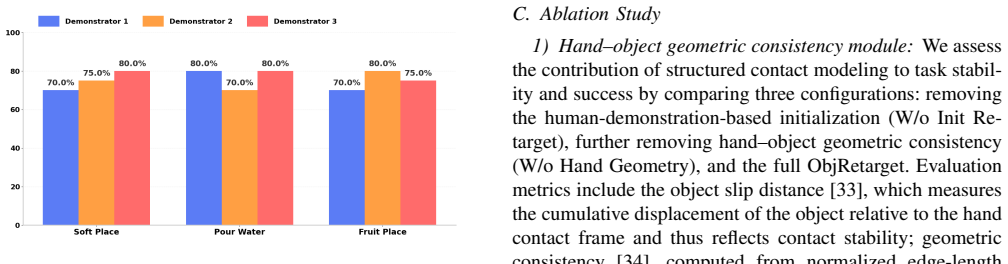
Summary. ObjRetarget is a human-to-robot motion retargeting framework for learning dexterous manipulation from RGB-D videos. It decouples arm and hand: arm trajectories are initialized from a learned retargeter and refined with task-adaptive arm-plane regularization plus end-effector tracking; hand motions follow free-space retargeting until contact, then switch to polytope-cluster optimization that preserves tetrahedral edge lengths and relative contact poses (Eqs. 10–15). On a RealMan dual-arm platform with Inspire hands, the method reports 75.8% average success over six everyday tasks (20 trials each, randomized object poses) versus 61.6% for OKAMI and 50.8% for adapted ORION, with ablations (Tables II–III) attributing gains to geometric hand consistency and anthropomorphic arm constraints, plus a cross-demonstrator check.
Significance. If the reported gains hold under clarified contact detection and fuller statistics, this is a solid systems contribution for object-aware video-to-robot retargeting without large-scale RL. Strengths include multi-task real-robot evaluation, two external baselines, cross-demonstrator tests, and structured ablations that separate hand geometry from arm initialization/plane terms. The polytope-cluster contact units and task-adaptive arm-plane normal (n_ref from wrist velocity) are concrete, interpretable design choices. A project page is linked; if code and hyperparameters are released, that would further strengthen the contribution for the community.
major comments (4)
- [§III-D, Table II] §III-D states the contact switch threshold as δ = 0.05 cm. For a RealSense D435i and tabletop objects this is two orders of magnitude below typical depth/tracking residual, so either the unit is a typographical error (likely 0.05 m) or contact is never reliably declared. Because this threshold gates activation of the polytope-cluster optimization (Eqs. 10–15), the ablation that attributes the jump from 53.3% to 75.8% success and the drop in object-slip distance (Table II) to “geometric consistency” is currently uninterpretable: we cannot know how often the polytope terms ran. Please correct the unit, report the empirical contact-detection rate per task, and (ideally) show a short sensitivity study on δ so that the central hand-module claim is cleanly tested.
- [Tables I–III, §IV-A] Table I reports success rates over 20 trials per task with no binomial confidence intervals, standard errors, or error bars; Tables II–III likewise give point estimates only for continuous metrics. With N=20 and success rates in the 40–85% range, sampling variability is non-negligible. Adding CIs (or bootstrap intervals) and, if possible, a brief note on trial independence would make the 75.8% vs 61.6%/50.8% comparison and the ablation deltas load-bearing rather than suggestive.
- [§IV-A, Table I] ORION was designed for parallel grippers; the paper adapts it by converting gripper trajectories to palm trajectories plus hand pose/joint constraints in IK. That adaptation is reasonable for fairness of workspace coverage, but it does not equip ORION with multi-finger contact modeling, so the large gap on contact-sensitive tasks (Pour Water, Drawer Close, Bimanual Place) partly reflects capability mismatch rather than pure retargeting quality. A short discussion of what the adapted baseline can and cannot represent, or an additional dexterous-hand baseline if available, would better support the claim that structured contact modeling is the decisive factor.
- [§III-B–D, [30]] The method depends on several free parameters (δ; arm weights λ_p, λ_s, λ_R and schedule w(t); hand weights w_f and λ in L_edge + λ L_pose; init retargeting λ_ori, λ_tip) and on an initialization retargeter cited as anonymous/to-appear [30]. Without reported numerical values, sensitivity ranges, or a public implementation of the init stage, independent reproduction of Tables I–III is difficult. Please list the operating values used for all reported experiments and clarify how much of the arm performance is inherited from [30] versus the new plane/task losses (Eqs. 6–8).
minor comments (5)
- [§V Conclusion] Conclusion refers to the “RMC-DA dual-arm robotic platform” while §IV-A and the rest of the paper use “RealMan dual-arm”; please unify the platform name.
- [§III-D] In §III-D, “0.05cm” should be spaced as “0.05 cm” (and corrected for unit as above). Similar unit/spacing consistency would help throughout.
- [Fig. 2] Fig. 2 is dense; a short caption note on which blocks are offline (video processing) vs online (execution) would aid readers implementing the pipeline.
- [§III-B] Eq. (1)–(3) describe the initialization retargeter; a one-sentence pointer to which components are new versus taken from [30] would reduce ambiguity for readers of the anonymous citation.
- [Abstract / intro] Project URL is given as https://github.io/ObjRetarget (missing user/org segment); please verify the live link before camera-ready.
Circularity Check
Empirical retargeting systems paper; success rates are hardware-measured against external baselines, not forced by definition. Only minor self-citation for arm initialization.
specific steps
-
self citation load bearing
[§III-B Motion Initialization; Ref. [30]]
"First, a reference trajectory is generated based on our previous retargeting work [30], providing a feasible and structured initial motion. Then, the trajectory is refined using an optimization framework guided by anthropomorphic motion constraints and task objectives… [30] Anonymous, “DexTele: A dual-arm dexterous teleoperation system based on motion retargeting and adaptive force control,” in Proc. IEEE Int. Conf. Robot. Autom. (ICRA), 2026, to appear."
Arm initialization is justified only by an overlapping-author, not-yet-public citation rather than a fully specified, independently verified procedure in this paper. This is pipeline-supporting, not central: ablations (Tables II–III, W/o Init Retarget) still report results, and the claimed gains are attributed to plane regularization and polytope geometry, which are defined here. Mild self-dependence only.
full rationale
ObjRetarget is a methods-plus-hardware paper: human video → retargeting pipeline → real-robot success rates (Table I: 75.8% vs OKAMI/ORION) and ablations (Tables II–III). The arm-plane loss (Eqs. 4–6, 8) and polytope edge/pose losses (Eqs. 10–15) are design objectives that match human geometry by construction of the optimizer; that is standard constrained retargeting, not a self-definitional “prediction.” Performance claims (success, object slip, MPJPE, Fréchet) are measured on a RealMan dual-arm platform with randomized object poses and external baselines, so they are not statistically forced by a fit. The only mild circularity-adjacent element is reliance on the authors’ prior retargeting work [30] (anonymous, ICRA 2026 to-appear) for the arm initialization trajectory; ablations still report non-zero success without it, and the central novelty (polytope clusters + task-adaptive arm-plane) is independently specified and tested. No uniqueness theorem, no fitted parameter renamed as prediction, no ansatz smuggled as external fact. Score 1 reflects that single non-load-bearing self-citation only.
Axiom & Free-Parameter Ledger
free parameters (4)
- Contact distance threshold δ =
0.05 cm (as written; likely unit error)
- Arm loss weights λ_p, λ_s, λ_R and plane weight schedule w(t)
- Hand geometry weights w_f and λ in L_edge + λ L_pose
- Init retargeting weights λ_ori, λ_tip
axioms (5)
- domain assumption Human RGB-D video yields sufficiently accurate body/hand poses (via SLAHMR) and object point-cloud trajectories for retargeting.
- ad hoc to paper Preserving local tetrahedral edge lengths and relative contact poses preserves manipulation semantics and improves grasp stability.
- domain assumption A soft arm-plane normal aligned with wrist motion direction yields more natural, executable redundant-arm configurations than end-effector tracking alone.
- domain assumption Robot joint limits and forward kinematics are known and position control is adequate for the demonstrated quasi-static tasks.
- standard math Standard SO(3)/Lie-algebra orientation error and Euclidean position losses are valid task metrics.
invented entities (2)
-
Polytope / tetrahedron contact clusters (palm, fingertip, adjacent fingertip, object contact centroid)
no independent evidence
-
Task-adaptive arm-plane reference normal n_ref_arm from (p_w − p_s) × ṗ_w
no independent evidence
read the original abstract
Learning robot dexterous manipulation from human manipulation videos requires reliably retargeting human intent to executable robot actions while maintaining stable hand-object contact, which remains a key challenge in embodied intelligence. Existing retargeting methods often ignore explicit contact modeling or rely on reinforcement learning, resulting in limited accuracy and generalization. To address this, we propose ObjRetarget, a human-to-robot motion retargeting framework for learning robot dexterous manipulation from human videos, which integrates anthropomorphic arm trajectory constraints with structured hand-object geometric modeling. For arm motion, reference trajectories extracted from human videos are used for initialization, followed by anthropomorphic constraints and redundancy-aware optimization to generate natural and accurate movements. For hand manipulation, ObjRetarget represents multi-finger contacts using polytope clusters and preserves contact structure through geometric invariants to improve stability. Experiments on real robots show that ObjRetarget improves manipulation success rates and contact stability across multiple dexterous tasks, and generalizes well to different demonstrations, object poses, and task settings.
Figures


Reference graph
Works this paper leans on
-
[1]
Learning by watching: Phys- ical imitation of manipulation skills from human videos,
H. Xiong, Q. Li, Y . C. Chen, et al., “Learning by watching: Phys- ical imitation of manipulation skills from human videos,” in Proc. IEEE/RSJ Int. Conf. Intell. Robot Syst. (IROS), 2021, pp. 7827–7834
2021
-
[2]
DexMV: Imitation learning for dexterous manipulation from human videos,
Y . Qin, Y . H. Wu, S. Liu, et al., “DexMV: Imitation learning for dexterous manipulation from human videos,” in Proc. Eur. Conf. Comput. Vis. (ECCV), 2022, pp. 570–587
2022
-
[3]
ImMimic: Cross-domain imitation from human videos via mapping and interpolation,
Y . Liu, W. C. Shin, Y . Han, et al., “ImMimic: Cross-domain imitation from human videos via mapping and interpolation,” arXiv preprint arXiv:2509.10952, 2025
Pith/arXiv arXiv 2025
-
[4]
A mobile robot hand-arm teleoperation system by vision and IMU,
L. S. Li, J. Jiang, P. Ruppel, et al., “A mobile robot hand-arm teleoperation system by vision and IMU,” in Proc. IEEE/RSJ Int. Conf. Intell. Robot Syst. (IROS), 2020, pp. 10900–10906
2020
-
[5]
A dexterous hand-arm teleoper- ation system based on hand pose estimation and active vision,
S. Li, N. Hendrich, H. Liang, et al., “A dexterous hand-arm teleoper- ation system based on hand pose estimation and active vision,” IEEE Trans. Cybern., vol. 54, no. 3, pp. 1417–1428, 2022
2022
-
[6]
Robotic telekinesis: Learning a robotic hand imitator by watching humans on YouTube,
A. Sivakumar, K. Shaw, and D. Pathak, “Robotic telekinesis: Learning a robotic hand imitator by watching humans on YouTube,” arXiv preprint arXiv:2202.10448, 2022
Pith/arXiv arXiv 2022
-
[7]
Task-oriented hand motion retargeting for dexterous manipulation imitation,
D. Antotsiou, G. Garcia-Hernando, and T.-K. Kim, “Task-oriented hand motion retargeting for dexterous manipulation imitation,” in Proc. Eur. Conf. Comput. Vis. Workshops (ECCVW), 2018
2018
-
[8]
HR-GCN: 2D–3D whole-body pose estimation with high-resolution graph convolutional network from a monocular camera,
M. Zhang, Q. Gao, Y . Lai, et al., “HR-GCN: 2D–3D whole-body pose estimation with high-resolution graph convolutional network from a monocular camera,” IEEE Sens. J., 2025
2025
-
[9]
L. Yang, X. Huang, Z. Wu, et al., “OmniRetarget: Interaction- preserving data generation for humanoid whole-body loco- manipulation and scene interaction,” arXiv preprint arXiv:2509.26633, 2025
Pith/arXiv arXiv 2025
-
[10]
HDMI: Learning interactive humanoid whole-body control from human videos,
H. Weng, Y . Li, N. Sobanbabu, et al., “HDMI: Learning interactive humanoid whole-body control from human videos,” arXiv preprint arXiv:2509.16757, 2025
arXiv 2025
-
[11]
Learning dexterous in-hand manipulation,
O. A. Andrychowicz, B. Baker, M. Chociej, et al., “Learning dexterous in-hand manipulation,” Int. J. Robot. Res., vol. 39, no. 1, pp. 3–20, 2020
2020
-
[12]
Learning dexterous manipu- lation for a soft robotic hand from human demonstrations,
A. Gupta, C. Eppner, S. Levine, et al., “Learning dexterous manipu- lation for a soft robotic hand from human demonstrations,” in Proc. IEEE/RSJ Int. Conf. Intell. Robot Syst. (IROS), 2016, pp. 3786–3793
2016
-
[13]
ContactSDF: Signed distance functions as multi- contact models for dexterous manipulation,
W. Yang and W. Jin, “ContactSDF: Signed distance functions as multi- contact models for dexterous manipulation,” IEEE Robot. Autom. Lett., 2025
2025
-
[14]
Towards generaliza- tion and simplicity in continuous control,
A. Rajeswaran, K. Lowrey, E. V . Todorov, et al., “Towards generaliza- tion and simplicity in continuous control,” in Proc. Adv. Neural Inf. Process. Syst. (NeurIPS), vol. 30, 2017
2017
-
[15]
A tutorial on task-parameterized movement learning and retrieval,
S. Calinon, “A tutorial on task-parameterized movement learning and retrieval,” Intell. Serv. Robot., vol. 9, no. 1, pp. 1–29, 2016
2016
-
[16]
Grasp stability prediction with sim-to-real transfer from tactile sensing,
Z. Si, Z. Zhu, A. Agarwal, S. Anderson and W. Yuan, “Grasp stability prediction with sim-to-real transfer from tactile sensing,” in Proc. IEEE/RSJ Int. Conf. Intell. Robot. Syst. (IROS), 2022, pp. 7809–7816
2022
-
[17]
Dynamic movement primitive based motion retar- geting for dual-arm sign language motions,
Y . Liang, et al., “Dynamic movement primitive based motion retar- geting for dual-arm sign language motions,” in Proc. IEEE Int. Conf. Robot. Autom. (ICRA), 2021, pp. 8195–8201
2021
-
[18]
Dynamic motion primitives- based trajectory learning for physical human–robot interaction force control,
X. Xing, K. Maqsood, C. Zeng, et al., “Dynamic motion primitives- based trajectory learning for physical human–robot interaction force control,” IEEE Trans. Ind. Inform., vol. 20, no. 2, pp. 1675–1686, 2023
2023
-
[19]
Learning human-to-humanoid real- time whole-body teleoperation,
T. He, Z. Luo, W. Xiao, et al., “Learning human-to-humanoid real- time whole-body teleoperation,” in Proc. IEEE/RSJ Int. Conf. Intell. Robot Syst. (IROS), 2024, pp. 8944–8951
2024
-
[20]
Learning agile robotic locomotion skills by imitating animals,
X. B. Peng, et al., “Learning agile robotic locomotion skills by imitating animals,” arXiv preprint arXiv:2004.00784, 2020
Pith/arXiv arXiv 2004
-
[21]
Vision-based teleoperation of Shadow dexterous hand using end-to-end deep neural network,
S. Li, et al., “Vision-based teleoperation of Shadow dexterous hand using end-to-end deep neural network,” in Proc. IEEE Int. Conf. Robot. Autom. (ICRA), 2019, pp. 416–422
2019
-
[22]
Zhang, et al., ”Kinematic motion retargeting via neural latent optimization for learning sign language,” IEEE Robot
H. Zhang, et al., ”Kinematic motion retargeting via neural latent optimization for learning sign language,” IEEE Robot. Autom. Lett., vol. 7, no. 2, pp. 4582–4589, Apr. 2022
2022
-
[23]
Frame-by-frame motion retargeting with self-collision avoidance from diverse human demon- strations,
B. Zheng, D. Liang, Q. Huang, et al., “Frame-by-frame motion retargeting with self-collision avoidance from diverse human demon- strations,” IEEE Robot. Autom. Lett., 2024
2024
-
[24]
Kinematic motion retargeting via neural latent optimization for learning sign language,
H. Zhang, et al., “Kinematic motion retargeting via neural latent optimization for learning sign language,” IEEE Robot. Autom. Lett., vol. 7, no. 2, pp. 4582–4589, Apr. 2022
2022
-
[25]
A reduction of imitation learning and structured prediction to no-regret online learning,
S. Ross, G. Gordon, and D. Bagnell, “A reduction of imitation learning and structured prediction to no-regret online learning,” in Proc. Int. Conf. Artif. Intell. Stat. (AISTATS), 2011, pp. 627–635
2011
-
[26]
One-shot visual imitation learning via meta-learning,
C. Finn, T. Yu, T. Zhang, et al., “One-shot visual imitation learning via meta-learning,” in Proc. Conf. Robot Learn. (CoRL), 2017, pp. 357–368
2017
-
[27]
CLIPort: What and where pathways for robotic manipulation,
M. Shridhar, L. Manuelli, and D. Fox, “CLIPort: What and where pathways for robotic manipulation,” in Proc. Conf. Robot Learn. (CoRL), 2022, pp. 894–906
2022
-
[28]
Imitation-guided multimodal policy generation from behaviourally diverse demonstrations,
S. Zhu, R. Kaushik, S. Kaski, et al., “Imitation-guided multimodal policy generation from behaviourally diverse demonstrations,” in Proc. IEEE/RSJ Int. Conf. Intell. Robot Syst. (IROS), 2023, pp. 1675–1682
2023
-
[29]
Decoupling human and camera motion from videos in the wild,
V . Ye, G. Pavlakos, J. Malik, and A. Kanazawa, “Decoupling human and camera motion from videos in the wild,” in Proc. IEEE/CVF Conf. Comput. Vis. Pattern Recognit. (CVPR), 2023
2023
-
[30]
DexTele: A dual-arm dexterous teleoperation system based on motion retargeting and adaptive force control,
Anonymous, “DexTele: A dual-arm dexterous teleoperation system based on motion retargeting and adaptive force control,” in Proc. IEEE Int. Conf. Robot. Autom. (ICRA), 2026, to appear
2026
-
[31]
OKAMI: Teaching humanoid robots manipulation skills through single video imitation,
J. Li, Y . Zhu, Y . Xie, et al., “OKAMI: Teaching humanoid robots manipulation skills through single video imitation,” arXiv preprint arXiv:2410.11792, 2024
Pith/arXiv arXiv 2024
-
[32]
Vision-based manipulation from single human video with open-world object graphs,
Y . Zhu, A. Lim, P. Stone, and Y . Zhu, “Vision-based manipulation from single human video with open-world object graphs,” arXiv preprint arXiv:2405.20321, 2024
Pith/arXiv arXiv 2024
-
[33]
First-person hand action benchmark with RGB-D videos and 3D hand pose annotations,
G. Garcia-Hernando, S. Yuan, S. Baek, et al., “First-person hand action benchmark with RGB-D videos and 3D hand pose annotations,” in Proc. IEEE Conf. Comput. Vis. Pattern Recognit. (CVPR), 2018, pp. 409–419
2018
-
[34]
Grasping in the wild: Learning 6-DoF closed-loop grasping from low-cost demonstrations,
S. Song, A. Zeng, J. Lee, et al., “Grasping in the wild: Learning 6-DoF closed-loop grasping from low-cost demonstrations,” IEEE Robot. Autom. Lett., vol. 5, no. 3, pp. 4978–4985, 2020
2020
-
[35]
Neural kinematic networks for unsupervised motion retargetting,
R. Villegas, J. Yang, D. Ceylan, et al., “Neural kinematic networks for unsupervised motion retargetting,” in Proc. IEEE Conf. Comput. Vis. Pattern Recognit. (CVPR), 2018, pp. 8639–8648
2018
-
[36]
Trajectory prediction in au- tonomous driving with a lane heading auxiliary loss,
R. Greer, N. Deo, and M. Trivedi, “Trajectory prediction in au- tonomous driving with a lane heading auxiliary loss,” IEEE Robot. Autom. Lett., vol. 6, no. 3, pp. 4907–4914, 2021
2021
-
[37]
Computing the Fr ´echet distance between two polygonal curves,
H. Alt and M. Godau, “Computing the Fr ´echet distance between two polygonal curves,” Int. J. Comput. Geom. Appl., vol. 5, no. 1–2, pp. 75–91, 1995
1995
discussion (0)
Sign in with ORCID, Apple, or X to comment. Anyone can read and Pith papers without signing in.