REVIEW 6 minor
The Reweighting Principle in Statistical Mechanics
T0 review · 0 major / 6 minor · reviewed 2026-07-11 · grok-4.5
Pith's one-line read Reweighting unifies soft and hard constraints so that microcanonical and canonical ensembles are two projections of one prior, and ensemble equivalence is concentration of measure.
desk verdict Clean, correct reorganization of min-relative-entropy and LDP ensemble equivalence under one reweighting language; useful pedagogy, no new theorem. read the letter →
The pith
A machine-rendered reading of the paper's core claim, the machinery that carries it, and where it could break.
The reading
What carries the argument
The enlarged-space structural prior ρ₀(x,A)∝δ(A−A(x)), reweighted by e^{-λA}. Its conditionals and marginals are the microcanonical and canonical ensembles; its intensive marginal obeys a large-deviation principle whose rate function is entropy–bias competition, so the soft ensemble concentrates onto the hard ensemble.
What would settle it
Find a concrete extensive system whose intensive-observable rate function has multiple competing minima so that the exponentially tilted ensemble does not concentrate onto a single microcanonical shell; if the soft and hard ensembles remain macroscopically inequivalent, the claimed emergence of conditioning fails.
Extended reading notes
Core claim
Exponential tilting and conditioning are the minimum-relative-entropy updates for soft and hard constraints; after the observable is promoted to an explicit variable, microcanonical and canonical ensembles are the conditional and marginal distributions of one structural prior that has been exponentially reweighted, and in the large-system limit concentration of measure makes the soft ensemble macroscopically equivalent to the hard one.
Load-bearing premise
The construction treats the unnormalized flat measure that only encodes the deterministic link between configurations and the observable as the correct structural prior, even when that measure cannot be normalized on non-compact spaces.
Editorial analysis
A structured set of objections, weighed in public.
Referee Report
Summary. The manuscript develops a unified probabilistic framework for equilibrium statistical mechanics based on reweighting of reference measures. It shows that exponential tilting and conditioning are the minimum-relative-entropy updates associated with soft (average) and hard (exact) constraints, respectively, and that their relative entropies recover the Legendre structure of the canonical ensemble and the surprisal/Boltzmann structure of the microcanonical ensemble (Secs. 2–3, App. B, Tables 1–2). By promoting observables to explicit variables on an enlarged space with structural prior ρ₀(x,A)∝δ(A−A(x)), microcanonical and canonical ensembles are obtained as the conditional and marginal distributions of a common exponentially reweighted joint measure (Sec. 4, Eqs. 18–25). In the thermodynamic limit, a large-deviation principle for the intensive observable shows that concentration of measure turns soft tilting into effective hard conditioning, so ensemble equivalence appears as entropy–bias competition (Sec. 5, Eqs. 26–35). An extension of the same language to path space is outlined but not developed.
Significance. The central derivations are standard and correctly executed: the variational characterizations of exponential tilting and conditioning (App. B) are textbook minimum-relative-entropy arguments, and the large-deviation concentration argument (Sec. 5) follows the usual rate-function analysis of ensemble equivalence. The contribution is organizational and conceptual rather than a new theorem: it places soft and hard constraints, Gibbs and Boltzmann entropy, and canonical/microcanonical constructions under a single reweighting language, with the enlarged-space joint prior (Sec. 4) as the cleanest original framing. Strengths include parameter-free identities, explicit parallel tables for soft/hard constraints, and honest acknowledgment that the structural prior may be improper on non-compact spaces. If the journal publishes perspective/framework papers in statistical mechanics, this is a useful and carefully written contribution that bridges information theory, inference, and ensemble theory without overclaiming new mathematics.
minor comments (6)
- [Section 4, Eq. (18)] Section 4, Eq. (18): The structural prior is unnormalized on non-compact spaces. A single clarifying sentence stating that all thermodynamic potentials, partition functions, and relative-entropy identities used later are formed only after exponential reweighting or finite-resolution conditioning has produced normalizable measures would remove any residual ambiguity about improper priors.
- [Section 1 and Conclusion] Section 1 / Conclusion: The introduction and conclusion could more sharply separate the paper’s organizational contribution (enlarged-space joint construction; parallel soft/hard relative-entropy table) from textbook ingredients (exponential families, LDP ensemble equivalence). A short paragraph locating the work relative to Jaynes, Kullback–Leibler, Ellis, and Touchette would help readers assess novelty without changing the technical content.
- [Section 2, Eq. (6)] Section 2 and Eq. (6): Conditioning via a Dirac delta is correctly flagged as formal/singular. A brief pointer to regular conditional distributions or the finite-shell construction already used in Sec. 3.2 would make the measure-theoretic status fully explicit for readers outside statistical mechanics.
- [Abstract and Conclusion] Conclusion (path-space paragraph): The abstract and conclusion suggest a unified description of equilibrium thermodynamics and conditioned stochastic dynamics, but the path-space material is only an outline with citations. Softening the abstract wording to match the body (“we outline… to be developed elsewhere”) would avoid overpromising relative to the delivered content.
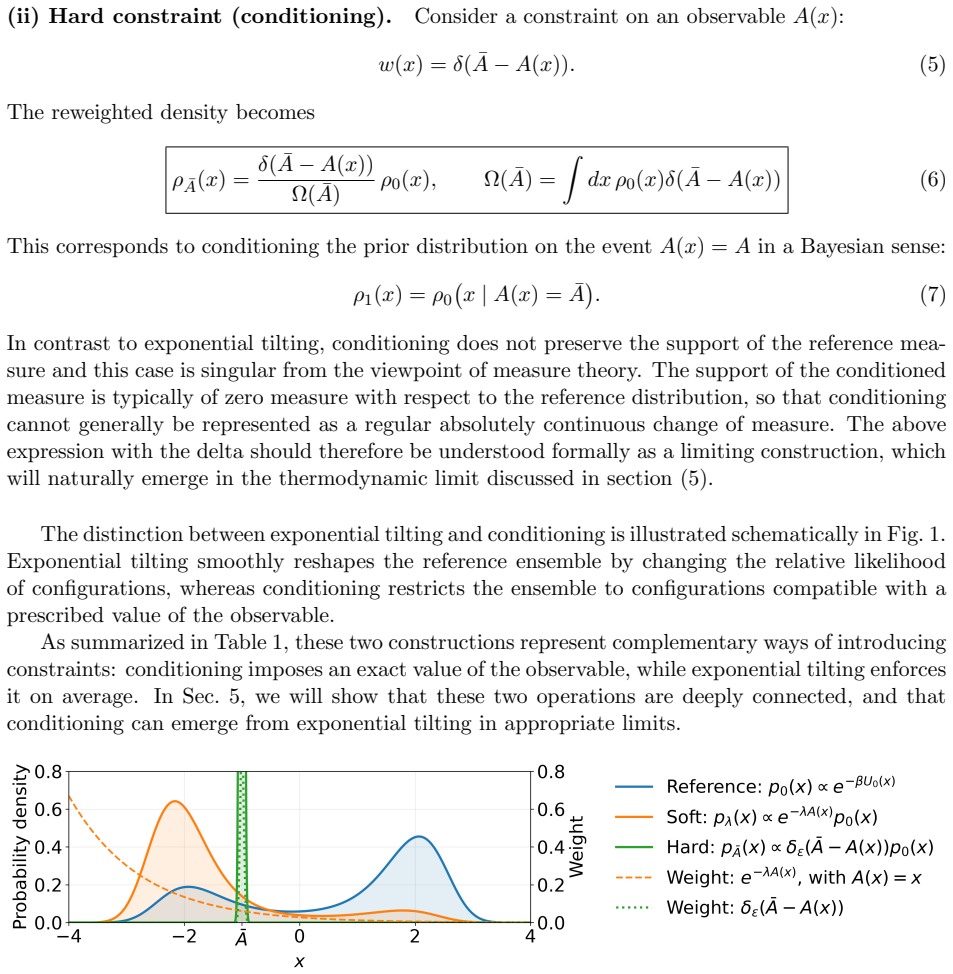
- [Figure 1, Table 1] Figure 1 caption and Table 1: The schematic is helpful; ensuring that the figure explicitly labels the soft (tilted) and hard (conditioned) supports relative to the reference measure would improve accessibility for non-specialists.
- [References / Section 5] References: A few standard ensemble-equivalence and large-deviation sources already cited (Ellis, Touchette, Dembo–Zeitouni) are appropriate; adding a pointer to modern discussions of ensemble inequivalence (e.g., systems with long-range interactions) would briefly indicate the scope of the concentration argument without expanding the paper.
Circularity Check
No significant circularity: standard min-relative-entropy and LDP arguments reorganized under a reweighting language; nothing is forced by fit, self-definition, or self-citation.
full rationale
The paper is a conceptual reorganization of classical results (minimum relative entropy yielding the exponential family and conditioned measures; large-deviation concentration yielding ensemble equivalence). Appendix B derives the exponential family and the conditioned shell by ordinary constrained variational calculus with respect to D(ρ∥ρ₀); those solutions are not assumed in the problem statements. The enlarged-space prior ρ₀(x,A)∝δ(A−A(x)) is introduced as a structural reference measure, after which the canonical ensemble is the A-marginal and the microcanonical ensemble is the conditional by direct computation (Eqs. 20–25)—a constructive representation, not a claim that something independent is predicted from an input that already contains it. The thermodynamic-limit argument (Eqs. 26–35) imports the standard LDP scaling Ω_N(a)≍e^{N s(a)}, Z_N≍e^{N φ(λ)} and obtains concentration of the intensive observable; the rate function I_λ(a)=λa−s(a)+φ(λ) is the usual Legendre structure, not a fitted or self-defined quantity. There are no empirical fits, no self-citations by the author, and no uniqueness theorems imported from prior work by the same author. Recovery of Gibbs/Boltzmann entropy under a uniform reference is an explicit specialization (Table 2), not a circular re-labeling. Score 0 is therefore appropriate.
Assumptions & free parameters
assumptions (4)
- domain assumption Kullback–Leibler divergence quantifies the least-biased update of a reference measure under constraints (principle of minimum relative entropy).
- domain assumption Extensive observables obey a large-deviation principle with rate function I_λ(a)=λa−s(a)+φ(λ) under exponential tilting.
- domain assumption The density of states scales as Ω_N(a)≍e^{N s(a)} and the partition function as Z_N(λ)≍e^{N φ(λ)}.
- standard math Functional differentiation of the relative-entropy Lagrangian yields the exponential family and the conditioned measure.
invented entities (1)
-
Structural prior ρ₀(x,A)∝δ(A−A(x)) on the enlarged space
Cite this review
Pith. "Pith review of The Reweighting Principle in Statistical Mechanics." pith.science (2026). https://pith.science/paper/AH2A7PHL
@misc{pith2026260703867,
  author       = {Pith},
  title        = {Pith review of: The Reweighting Principle in Statistical Mechanics},
  year         = {2026},
  howpublished = {\url{https://pith.science/paper/AH2A7PHL}},
  note         = {Machine review of arXiv:2607.03867}
}
read the original abstract
Reweighting of probability measures provides a unifying perspective on ensemble transformations in statistical mechanics. We distinguish two complementary classes of reweighting: soft constraints, which redistribute probability while preserving the support of the reference measure, and hard constraints, which impose support restrictions through conditioning. We show that exponential tilting and conditioning on an exact observable value arise as the minimum relative entropy updates associated with soft expectation constraints and hard exact-value constraints, respectively. Their relative entropies naturally inherit complementary thermodynamic structures: exponential tilting gives rise to the Legendre structure of the canonical ensemble and reduces, for a uniform reference measure, to Gibbs entropy, whereas conditioning reduces to Boltzmann entropy through the surprisal of the constrained macrostate. By introducing an enlarged probability space in which observables are treated as explicit random variables, we further show that canonical and microcanonical ensembles arise as marginal and conditional distributions of a common joint reference measure. In the thermodynamic limit, large-deviation concentration makes soft and hard constraints macroscopically equivalent, providing a probabilistic interpretation of canonical--microcanonical ensemble equivalence. Finally, we outline how the same information-theoretic framework naturally extends to path space, suggesting a unified probabilistic description of equilibrium statistical mechanics and conditioned stochastic dynamics.
Figures
Reviewed July 11, 2026 · model on record in the stance chip above.
Discussion (0). Continue with ORCID to comment.