REVIEW 2 major objections 4 minor 58 references
Stochastic control with signatures via Riccati equations on the tensor algebra
T0 review · 2 major / 4 minor · reviewed 2026-07-11 · grok-4.5
Pith's one-line read Path-dependent stochastic control reduces to Riccati equations on the tensor algebra of signatures, with an explicit feedback law recovered by dynamic recentering.
desk verdict Solid closed-loop signature control via Boué–Dupuis + tensor Riccati, with recentering that actually works for a nontrivial class beyond LQ. read the letter →
The pith
A machine-rendered reading of the paper's core claim, the machinery that carries it, and where it could break.
The reading
What carries the argument
The recentered Riccati equation (3.5) on the extended tensor algebra, whose solution ψ supplies the time-dependent coefficients of the local signature expansions of the value process and the optimal control.
What would settle it
Take a concrete reward in class B (for instance the quartic tracking functional used in Section 5), solve the truncated Riccati system with dynamic recentering, and compare the resulting closed-loop trajectories and value process against an independent Monte-Carlo evaluation of the Clark-Ocone formula; systematic discrepancy outside numerical truncation error would refute the claimed representation.
Extended reading notes
Core claim
For terminal rewards whose signature coefficients lie in the admissible class B, there exists a weak optimal control whose value process and feedback law admit local signature expansions whose coefficients solve a recentered Riccati equation on the extended tensor algebra; a dynamic recentering algorithm stitches these local expansions into a global representation over the whole horizon.
Load-bearing premise
The reward coefficient must belong to a special algebraic class that guarantees both existence of a Riccati solution and a positive radius of convergence for the signature series; if a natural path functional falls outside that class, the feedback representation fails.
Editorial analysis
A structured set of objections, weighed in public.
Referee Report
Summary. The paper solves a class of non-Markovian stochastic control problems with path-dependent rewards of the form F(X) = ⟨p, bX_T⟩, where p belongs to an admissible class B of signature coefficients. Using the Boué–Dupuis variational representation, the problem is reduced to conditional log-Laplace transforms of linear signature functionals. These transforms are expanded via an infinite-dimensional Riccati equation on the extended tensor algebra (imported from the authors’ concurrent analytic work). The main result (Theorem 4.3) constructs a weak optimal control α* whose value process and feedback map admit local signature expansions V*_t = ⟨ψ^{bX_σ}_t , bX_{σ,t}⟩ and α*_t = ⟨ψ^{bX_σ}_t |1 , bX_{σ,t}⟩ on stochastic intervals between recentering times, with coefficients solving the recentered Riccati system (3.5). A dynamic recentering algorithm restores a global representation. Applications include tracking of signature functionals and signature lifts of nonlinear Volterra control problems, with numerical illustrations against a Monte-Carlo Clark–Ocone benchmark.
Significance. If the result holds, the paper supplies the first rigorous closed-loop feedback representation of optimal controls for a nontrivial class of genuinely path-dependent, non-quadratic rewards, expressed as time-dependent linear functionals of the controlled signature. This goes beyond both classical LQ theory and existing signature-parametrization approaches that optimize only over restricted control classes. The reduction via Boué–Dupuis plus the recentering device cleanly separates the analytic existence theory (class B, radius of convergence) from the control-theoretic construction, and the numerical examples demonstrate that the method is implementable beyond the linear-quadratic regime. The work therefore opens a concrete route from signature algebra to non-Markovian stochastic control.
major comments (2)
- The load-bearing existence and radius statements (Theorem 3.2) and the preservation of class B under left shifts (Proposition 3.3) are imported wholesale from the concurrent arXiv 2606.29622. While the control derivation itself is self-contained once those results are granted, the present manuscript never states the precise hypotheses under which the imported theorems apply (e.g., the quantitative bounds on the shuffle exponential). A short self-contained appendix or a precise citation of the exact statements used would make the paper independently readable and would clarify the scope of Theorem 4.3.
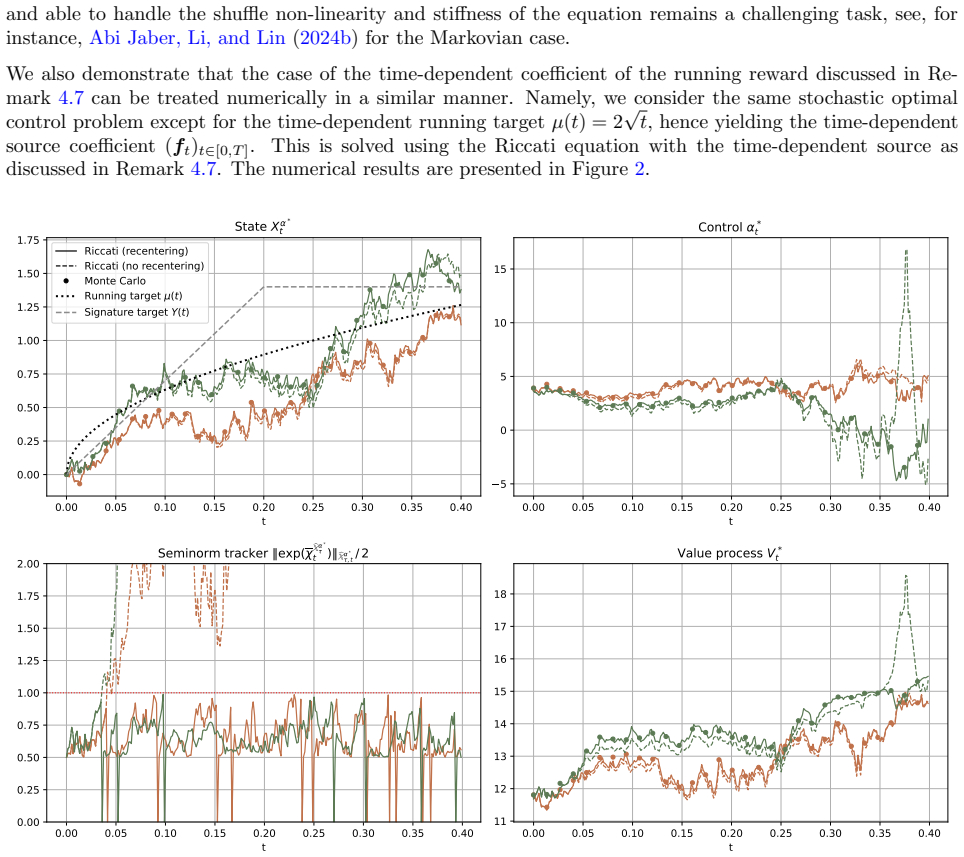
- Remark 4.7 and the numerical experiment of Figure 2 treat time-dependent running rewards ⟨f_t , bX_t⟩ as if the same Riccati theory applies, yet the authors explicitly note that the required extension of the log-Laplace results of Abi Jaber–Attal–Sotnikov (2026a) is only conjectural. Either the time-dependent case should be removed from the main claims or a precise statement of what is proved versus what is numerically observed should be added, so that the reader can distinguish the theorem from the conjecture.
minor comments (4)
- Definition 3.1 of class B is dense; a short paragraph explaining why the leading even-degree negative terms are necessary (and why lower-order terms can be absorbed) would help non-specialists.
- In the proof of Theorem 4.3 the application of Itô’s formula on the tensor algebra cites Theorem 3.5 of the companion paper; a one-line reminder of the precise integrability condition used would improve readability.
- Figures 1–2 would benefit from a clearer legend distinguishing the three methods (Riccati with recentering / without / Monte-Carlo) and from an explicit statement of the truncation level N_trunc = 10 and the number of Monte-Carlo paths.
- The a.s. finiteness of the number of recentering times is left open; a brief remark that the local representation remains valid pathwise even if infinitely many recenterings accumulate would remove any residual ambiguity.
Circularity Check
Modest load-bearing self-citation of concurrent log-Laplace/Riccati results; control derivation itself is independent and non-circular.
-
self citation load bearing
[Def. 3.1, Thm. 3.2, Prop. 3.3 (and their use in Thm. 4.3)]
"We now state our definition of the class B, which matches the one in Abi Jaber, Attal, and Sotnikov (2026a) ... We recall the existence result for (3.2) proved in (Abi Jaber, Attal, and Sotnikov, 2026a, Theorems 4.7 and Theorem 5.7). ... Proposition 3.3. If p∈B and X∈T((R^{2})) such that X∅=1, then X|p∈B."
Class B, the existence of a C^{1} solution to the signature Riccati equation, the local log-Laplace expansion, and the preservation of B under left shifts are imported wholesale from the authors' concurrent arXiv:2606.29622 and are the sole justification that the value process and optimal control admit the claimed signature expansions on each [σ,τ_σ]. Without those results the feedback representation of Theorem 4.3 does not hold. The citation is therefore load-bearing, yet the prior work supplies independent analytic estimates rather than a re-labeling of the control problem, so the circularity remains modest.
full rationale
The paper's central Theorem 4.3 is obtained by applying the Boué–Dupuis variational formula to reduce the control problem to a conditional log-Laplace transform of a linear signature functional, then invoking the authors' concurrent analytic results (class B, existence of the infinite-dimensional Riccati solution, and local radius of convergence of the expansion) as black-box inputs. Those inputs are independent mathematical statements about Brownian signatures (not re-statements of the control problem), and the subsequent steps—Chen identity + left-shift recentering to stay inside B, Itô formula on the tensor algebra to identify the feedback maps, and the dynamic-recentering algorithm—are self-contained derivations that do not reduce to the inputs by construction. No fitted parameters, no self-definitional loops, no uniqueness theorems imported as external facts, and no renaming of known empirical patterns appear. The self-citation is therefore real (if concurrent) support rather than circularity; a score of 2 reflects that the load-bearing analytic premise is internal to the author group while the control representation itself remains non-circular.
Assumptions & free parameters
assumptions (4)
- standard math Boué–Dupuis variational representation equates the control value to the log-Laplace transform of the uncontrolled functional.
- domain assumption Existence of a C1 solution to the infinite-dimensional Riccati equation (3.2) on the extended tensor algebra whenever the terminal condition lies in class B, together with the quantitative radius-of-convergence bound (3.3).
- domain assumption The left-shift of any element of B by a group-like element remains in B (Proposition 3.3).
- standard math Admissible weak controls are progressively measurable processes with finite energy under the controlled measure.
invented entities (2)
-
Class B of admissible signature coefficients (Definition 3.1)
-
Dynamic recentering algorithm (Subsection 5.1, stopping times τ_n)
Cite this review
Pith. "Pith review of Stochastic control with signatures via Riccati equations on the tensor algebra." pith.science (2026). https://pith.science/paper/3XQAN2XB
@misc{pith2026260703986,
  author       = {Pith},
  title        = {Pith review of: Stochastic control with signatures via Riccati equations on the tensor algebra},
  year         = {2026},
  howpublished = {\url{https://pith.science/paper/3XQAN2XB}},
  note         = {Machine review of arXiv:2607.03986}
}
read the original abstract
We solve in semi-explicit form a class of non-Markovian stochastic optimal control problems with path-dependent rewards, using path signatures. We reformulate the control problem as the computation of Laplace transforms of signature functionals thanks to the Bou\'e-Dupuis representation. Exploiting recent signature representations of such transforms on tensor algebras, we determine the value process and the optimal control through an infinite-dimensional system of Riccati equations on the extended tensor algebra. We establish an explicit feedback representation of the optimal control and the value process as an infinite linear combination of the time-extended signature of the controlled process, with time-dependent coefficients. The expansions being intrinsically local, we propose a dynamic recentering algorithm to ensure a global representation over the entire time horizon. We illustrate the approach on genuinely path-dependent, non-linear examples that go beyond the tractable linear-quadratic setting, including the tracking of linear functionals of the signature and signature lifts of Volterra control problems.
Figures

Reference graph
Works this paper leans on
-
[1]
Signature
Cuchiero, Christa and Svaluto-Ferro, Sara and Teichmann, Josef , journal=. Signature
-
[2]
Litterer, Christian and Oberhauser, Harald , journal=. On a. 2014 , publisher=
2014
-
[3]
arXiv preprint arXiv:2212.13628 , year=
Functional expansions , author=. arXiv preprint arXiv:2212.13628 , year=
-
[4]
Mathematical Finance , volume=
The Laplace transform of the integrated Volterra Wishart process , author=. Mathematical Finance , volume=. 2022 , publisher=
2022
-
[5]
2000 , publisher=
An introduction to superprocesses , author=. 2000 , publisher=
2000
-
[6]
2002 , institution=
Affine processes and application in finance , author=. 2002 , institution=
2002
-
[7]
Abi Jaber, Eduardo and Larsson, Martin and Pulido, Sergio , journal=. Affine. 2019 , publisher=
2019
-
[8]
Abi Jaber, Eduardo and Li, Shaun and Lin, Xuyang , journal=
Show all 58 references
-
[9]
arXiv preprint arXiv:2508.02759 , year=
Hedging with memory: shallow and deep learning with signatures , author=. arXiv preprint arXiv:2508.02759 , year=
-
[10]
Signature volatility models: pricing and hedging with
Abi Jaber, Eduardo and G. Signature volatility models: pricing and hedging with. SIAM Journal on Financial Mathematics , volume=. 2025 , publisher=
2025
-
[11]
arXiv preprint arXiv:2407.04956, to appear in Annals of Applied Probability , year=
Path-dependent processes from signatures , author=. arXiv preprint arXiv:2407.04956, to appear in Annals of Applied Probability , year=
-
[12]
Lyons, Terry and Ni, Hao and Tao, Jiajie , journal=. A
-
[13]
arXiv preprint arXiv:2511.23295 , year=
Signature approach for pricing and hedging path-dependent options with frictions , author=. arXiv preprint arXiv:2511.23295 , year=
-
[14]
The Annals of Probability , volume=
Forests, cumulants, martingales , author=. The Annals of Probability , volume=. 2022 , publisher=
2022
-
[15]
A variational representation for certain functionals of
Bou. A variational representation for certain functionals of. The Annals of Probability , volume=. 1998 , publisher=
1998
-
[16]
Bulletin of the American Mathematical Society , volume=
Iterated path integrals , author=. Bulletin of the American Mathematical Society , volume=
-
[17]
Flots et s
Ben Arous, G. Flots et s. Probability Theory and Related Fields , volume=. 1989 , publisher=
1989
-
[18]
Revista Matem
Differential equations driven by rough signals , author=. Revista Matem
-
[19]
Numerical Solution of Stochastic Differential Equations , pages=
Stochastic Differential Equations , author=. Numerical Solution of Stochastic Differential Equations , pages=
-
[20]
Integration of paths, geometric invariants and a generalized
Chen, Kuo-Tsai , journal=. Integration of paths, geometric invariants and a generalized. 1957 , publisher=
1957
-
[21]
Hariya, Yuu and Watanabe, Sou , journal=. The. 2022 , publisher=
2022
-
[22]
2026 , journal=
Martingale property and moment explosions in signature volatility models , author=. 2026 , journal=
2026
-
[23]
A Simple Option Formula for General Jump-Diffusion and Other Exponential
Lewis, Alan , year =. A Simple Option Formula for General Jump-Diffusion and Other Exponential
-
[24]
Note on Analytic Regularity of Heat Kernels on Nilpotent
Zienkiewicz, Jacek , year = 2003, journal =. Note on Analytic Regularity of Heat Kernels on Nilpotent
2003
-
[25]
Transactions of the American Mathematical Society , volume=
Integration of paths--A faithful representation of paths by noncommutative formal power series , author=. Transactions of the American Mathematical Society , volume=. 1958 , publisher=
1958
-
[26]
Journal of Algebra , year=
A natural ring basis for the shuffle algebra and an application to group schemes , author=. Journal of Algebra , year=
-
[27]
, journal =
Lyndon, Roger C. , journal =. On
-
[28]
Quantitative Finance , volume =
Bruno Dupire , title =. Quantitative Finance , volume =. 2019 , publisher =
2019
-
[29]
Advances in Mathematics , volume=
The signature of a rough path: uniqueness , author=. Advances in Mathematics , volume=. 2016 , publisher=
2016
-
[30]
Tychonoff, Andrei , journal=. Th
-
[31]
arXiv preprint arXiv:2602.23473 , year=
Solving Linear-Quadratic Stochastic Control Problems with Signatures , author=. arXiv preprint arXiv:2602.23473 , year=
-
[32]
The Annals of Probability , number =
Ilya Chevyrev and Terry Lyons , title =. The Annals of Probability , number =
-
[33]
arXiv preprint arXiv:2308.15135 , year=
Signature trading: a path-dependent extension of the mean-variance framework with exogenous signals , author=. arXiv preprint arXiv:2308.15135 , year=
-
[34]
SIAM Journal on Financial Mathematics , volume=
Optimal execution with rough path signatures , author=. SIAM Journal on Financial Mathematics , volume=. 2020 , publisher=
2020
-
[35]
arXiv preprint arXiv:2501.06758 , year=
Pricing American options under rough volatility using deep-signatures and signature-kernels , author=. arXiv preprint arXiv:2501.06758 , year=
-
[36]
SIAM Journal on Control and Optimization , volume=
Stochastic control with signatures , author=. SIAM Journal on Control and Optimization , volume=. 2025 , publisher=
2025
-
[37]
Finance and Stochastics , pages=
Primal and dual optimal stopping with signatures , author=. Finance and Stochastics , pages=. 2025 , publisher=
2025
-
[38]
The Annals of Applied Probability , volume=
Optimal stopping with signatures , author=. The Annals of Applied Probability , volume=. 2023 , publisher=
2023
-
[39]
Conference on Modern Topics in Stochastic Analysis and Applications (in honour of Terry Lyons’ 70th birthday) , pages=
Pricing American Options Under Rough Volatility Using Signatures , author=. Conference on Modern Topics in Stochastic Analysis and Applications (in honour of Terry Lyons’ 70th birthday) , pages=. 2024 , organization=
2024
-
[40]
arXiv preprint arXiv:2606.19772 , year=
Signature Methods for Optimal Market Making , author=. arXiv preprint arXiv:2606.19772 , year=
-
[41]
Advances in neural information processing systems , volume=
Deep signature transforms , author=. Advances in neural information processing systems , volume=
-
[42]
SIAM Journal on Financial Mathematics , volume=
Double-execution strategies using path signatures , author=. SIAM Journal on Financial Mathematics , volume=. 2022 , publisher=
2022
-
[43]
Applied Mathematical Finance , volume=
Non-parametric pricing and hedging of exotic derivatives , author=. Applied Mathematical Finance , volume=. 2020 , publisher=
2020
-
[44]
SIAM Journal on Financial Mathematics , volume=
Signature methods in stochastic portfolio theory , author=. SIAM Journal on Financial Mathematics , volume=. 2025 , publisher=
2025
-
[45]
Stochastic Differential Systems Filtering and Control , pages=
An entropy approach to the time reversal of diffusion processes , author=. Stochastic Differential Systems Filtering and Control , pages=. 1985 , publisher=
1985
-
[46]
Sur une classe d’
Fredholm, Ivar , year=. Sur une classe d’. Acta Mathematica , volume=
-
[47]
SIAM Journal on Control and Optimization , volume=
Integral operator Riccati equations arising in stochastic Volterra control problems , author=. SIAM Journal on Control and Optimization , volume=. 2021 , publisher=
2021
-
[48]
1999 , publisher=
Stochastic controls: Hamiltonian systems and HJB equations , author=. 1999 , publisher=
1999
-
[49]
Mathematical Finance , volume=
Optimal liquidation with signals: the general propagator case , author=. Mathematical Finance , volume=. 2025 , publisher=
2025
-
[50]
arXiv preprint arXiv:2306.05433 , year=
Equilibrium in functional stochastic games with mean-field interaction , author=. arXiv preprint arXiv:2306.05433 , year=
-
[51]
The Annals of Applied Probability , volume=
Linear-quadratic control for a class of stochastic Volterra equations: solvability and approximation , author=. The Annals of Applied Probability , volume=. 2021 , publisher=
2021
-
[52]
Stochastic control with signatures via
Abi Jaber, Eduardo and Elie Attal and Dimitri Sotnikov , journal =. Stochastic control with signatures via
-
[53]
Affine structure of the
Abi Jaber, Eduardo and Elie Attal and Dimitri Sotnikov , journal =. Affine structure of the
-
[54]
Concentration
Boucheron, St. Concentration
-
[55]
Hariya, Yuu and Watanabe, Sou , year =. The. Electronic Communications in Probability , volume =
-
[56]
Annales de l'Institut Henri Poincaré, Probabilités et Statistiques , number =
Joseph Lehec , title =. Annales de l'Institut Henri Poincaré, Probabilités et Statistiques , number =
-
[57]
2026 , journal=
Malliavin calculus for signatures with applications to finance , author=. 2026 , journal=
2026
-
[58]
arXiv preprint arXiv:1309.0260 , year=
Learning from the past, predicting the statistics for the future, learning an evolving system , author=. arXiv preprint arXiv:1309.0260 , year=
Reviewed July 11, 2026 · model on record in the stance chip above.
Discussion (0). Continue with ORCID to comment.