REVIEW 2 major objections 4 minor 1 cited by
There and back again: the quasi-interstellar objects
T0 review · 2 major / 4 minor · reviewed 2026-07-11 · grok-4.5
Pith's one-line read Solar System ejecta that return as quasi-interstellar objects are rare, slow, and easily told apart from true Galactic ISOs.
desk verdict Quasi-ISOs are a real, kinematically distinct foreground that is rare and slow; absolute rates are uncertain but the distinguishability claim holds. read the letter →
The pith
A machine-rendered reading of the paper's core claim, the machinery that carries it, and where it could break.
The reading
What carries the argument
Burst-ejection test-particle integrations of Solar System ISOs, evolved under white-noise, correlated, or no dynamical heating in a Galactic potential, then convolved with Oort-cloud loss-rate models (exponentials, flyby Monte Carlo, and N-body ejection timings) to obtain present-day re-encounter rates and v_∞ distributions.
What would settle it
A clear detection of an unbound small body with v_∞ of order 0.1 km s^{-1} arriving near the Galactic-plane intersections at Galactic longitudes ~−45° and +135°, or a measured rate of such objects that exceeds roughly one per decade within 5 au.
Extended reading notes
Core claim
Quasi-interstellar objects—Solar System planetesimals that leave through outer Oort-cloud erosion and later re-encounter the Sun—are intrinsically rare, carry hyperbolic excess velocities of order 0.1 km s^{-1}, and arrive from restricted sky patches near the Galactic plane. Early, high-volume ejections are too dispersed to contribute, so the observed interstellar-object sample will remain a clean Galactic population.
Load-bearing premise
The absolute number of returners scales directly with how many outer Oort-cloud objects were lost in the past half-billion years, a quantity that differs by factors of tens depending on whether one normalizes to today’s long-period comets or to the interstellar-object density per star.
Signed reviews
Editorial analysis
A structured set of objections, weighed in public.
Referee Report
Summary. The paper defines quasi-interstellar objects (quasi-ISOs) as planetesimals unbound from the Solar System (primarily via outer Oort-cloud erosion over the past few hundred Myr) that later re-encounter the inner Solar System after orbiting in the Galactic potential. Using suites of test-particle burst simulations in a smooth MilkyWay2014 potential plus white-noise, correlated (Ornstein–Uhlenbeck), or no dynamical heating, the authors compute re-encounter rates via an importance-sampled flux estimator restricted to incoming trajectories and gravitational focusing (Eqs. 6–11). Convolving with exponential, Nesvorný et al. (2023), and Monte-Carlo flyby erosion histories, they conclude that quasi-ISOs are rare (re-encounter probability ≲3×10^{-14} yr^{-1} per ISO), arrive with v_∞ of order 0.1 km s^{-1}, and occupy preferred radiants near the Galactic plane at ℓ≈−45°/+135°, rendering them kinematically distinct from true Galactic ISOs.
Significance. If the kinematic conclusions hold, the work cleanly removes a potential local foreground for the ISO samples expected from LSST and similar surveys, confirming that the observed population will be Galactic rather than Solar-System-derived. Strengths include a carefully constructed encounter-rate estimator that correctly excludes outgoing particles, systematic exploration of heating models and ejection geometries (isotropic vs. midplane-flattened), and falsifiable predictions for v_∞ distributions and on-sky radiants (Figs. 6–9). Absolute rates remain order-of-magnitude uncertain, but the distinguishability result is robust across the model suite and does not rely on the absolute normalization.
major comments (2)
- §3 and Fig. 5: Absolute quasi-ISO rates scale directly with the highly uncertain number of Oort-cloud objects lost in the past ~0.5 Gyr. The two normalizations (present-day long-period-comet rate vs. ISO number density per star) differ by factors of tens, and the Monte-Carlo flyby model requires an ad-hoc σ_H=1.1 dex scatter (Eq. 20) to match the other erosion histories. While this does not move objects into the kinematic domain of true ISOs, the paper’s claim that quasi-ISOs are “intrinsically rare” relative to the expected ISO detection rate should be accompanied by an explicit sensitivity table or shaded band spanning the full normalization range, rather than two discrete point sets.
- §2.1.2 and Eq. 4: The correlated-heating model enforces spatial correlation only between each ISO and the Sun (via β), neglecting correlations among nearby ISOs when they are far from the Sun. Because most returning particles never travel far (Fig. 2), the approximation may be adequate, but a short test with a fully pairwise correlated realization (or an analytic estimate of the neglected term) is needed to confirm that the v_∞ peak near 0.2 km s^{-1} and the re-encounter probability remain unchanged.
minor comments (4)
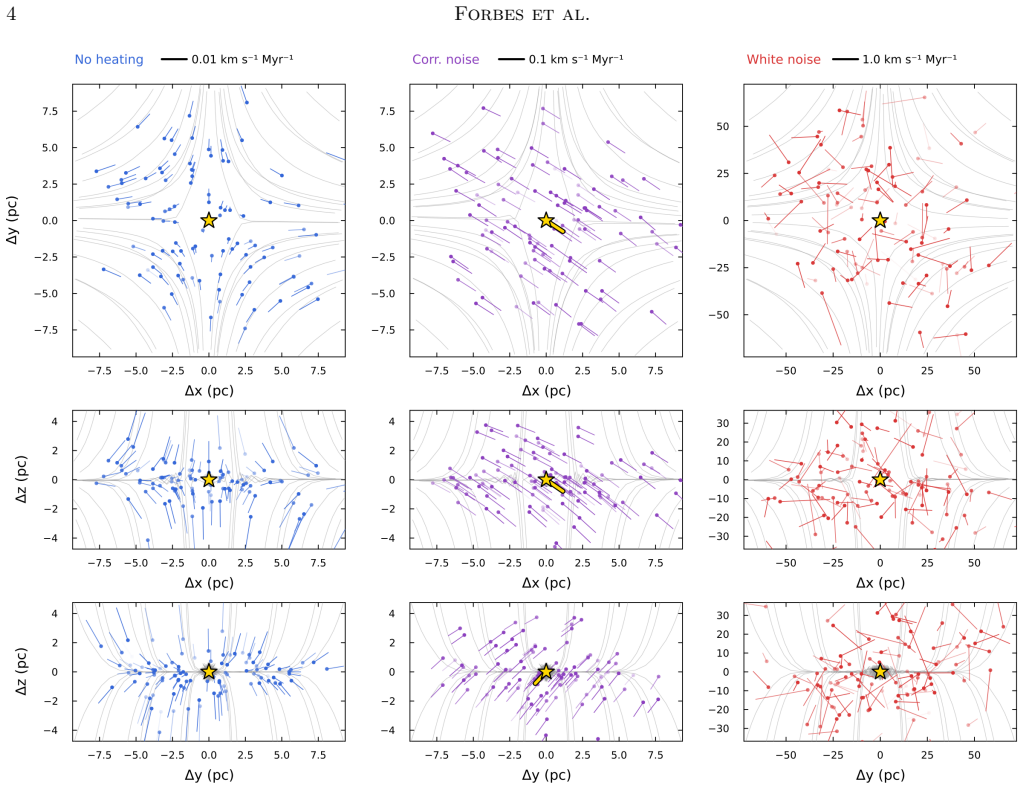
- Fig. 1 caption: the acceleration-line scales differ by column; a single colorbar or explicit scale factors would aid comparison.
- §2.2, Eq. 11: the expression for sin θ_c mixes v and v_∞; a brief intermediate step clarifying the hyperbolic angular-momentum identity would improve readability.
- Appendix sky maps (Figs. 8–9): the median lookback time ˜t is useful; adding the corresponding fractional contribution to the total rate would help the reader judge which panels dominate the stacked prediction.
- References: the Hanse et al. (2018) power-law fit is central; a short note on its domain of validity (mass, impact parameter, velocity) would be helpful given the extrapolation to rare slow encounters.
Circularity Check
No significant circularity: quasi-ISO rates, v_∞ and radiants are outputs of independent N-body integrations convolved with external erosion models; self-citations supply only methods/context.
full rationale
The derivation is self-contained simulation science. Burst ejections are integrated forward under three heating prescriptions (white-noise, correlated OU, none) whose parameters are fixed by the observed AVR or by GMC surface-density arguments, not by any quasi-ISO observable. Re-encounter rates are computed from the resulting phase-space density via importance sampling on a 0.1 pc sphere (Eqs. 6–11); the only free normalizations are the two literature Oort-cloud inventories (Boe et al. 2019 vs. ISO number density), which the paper displays separately rather than fitting. Convolution with dN_ej/dt uses external sources (Nesvorný et al. 2023 ejection times, Hanse et al. 2018 flyby-loss formula, exponential loss timescales). The kinematic claim (v_∞ ~ 0.1 km s^{-1}, polar/mid-plane radiants) follows directly from the low ejection speeds of outer-Oort objects and the epicyclic return geometry; it is recovered across all heating and geometry variants and is not forced by any fitted parameter of the present work. Self-citations (Forbes et al. 2025 stream density, KDE method; Hopkins et al. 2025a ISO velocity model) supply context or comparison distributions and are not load-bearing uniqueness theorems. Absolute-rate uncertainty is acknowledged and does not circularly produce the distinguishability result. Score 1 only for the minor, non-load-bearing self-citations of methods.
Assumptions & free parameters
free parameters (5)
- σ_ej (ejection velocity dispersion) =
0.1 or 1 km s^{-1}
- τ, r_corr (correlated-heating timescale and length) =
17 Myr, 170 pc
- σ_H (flyby-loss scatter) =
1.1 dex
- N_Oort normalizations (OC Norm vs ISO Norm) =
5e12 (present) vs ~5e14 (birth)
- t_loss (exponential Oort-cloud lifetime) =
3–13 Gyr
assumptions (4)
- domain assumption MilkyWay2014 smooth potential plus additive stochastic heating (white-noise or OU) adequately captures the relevant Galactic dynamics for ~Gyr streams near the Sun.
- domain assumption Oort-cloud losses can be treated as a time-dependent ejection rate that multiplies the single-burst return probability (Eq. 16).
- ad hoc to paper Ejections at 1.5 pc with purely radial initial velocity plus isotropic (or midplane-flattened) Gaussian kicks represent the unbound population that can return.
- domain assumption The Hanse et al. (2018) power-law loss fraction, after ad-hoc scatter, plus spectral-type encounter rates, gives a usable Monte-Carlo erosion history.
invented entities (1)
-
quasi-interstellar objects (quasi-ISOs)
Cite this review
Pith. "Pith review of There and back again: the quasi-interstellar objects." pith.science (2026). https://pith.science/paper/ABPGR2BF
@misc{pith2026260704216,
  author       = {Pith},
  title        = {Pith review of: There and back again: the quasi-interstellar objects},
  year         = {2026},
  howpublished = {\url{https://pith.science/paper/ABPGR2BF}},
  note         = {Machine review of arXiv:2607.04216}
}
abstract
A population of interstellar objects (ISOs) exist that originate from the Solar System, rather than from other stars. Such a foreground could challenge straightforward analysis of the ISO sample expected to be gathered by upcoming sky surveys. We assess whether small bodies unbound from the Solar System can experience dynamical evolution in the Galactic potential that places them on re-encounter trajectories. We find that these 'quasi-interstellar objects' (quasi-ISOs) primarily depart the Solar System through erosion of the outer Oort cloud in the past few hundred Myr, excluding the most recent ~10 Myr. After orbiting in the Milky Way potential nearby the Sun but beyond the tidal radius, those ejected on certain orbits can re-encounter the Solar System. Meanwhile, the larger population of ISOs produced by the Solar System early in its life will be too spread-out in the Galaxy to contribute significantly to the observed sample. We predict that quasi-ISOs will be intrinsically rare and have $v_\infty$ values of order 0.1 km s$^{-1}$, easily distinguishable from ISOs from other stars, meaning that the observed ISO sample will be truly Galactic. The detection of a quasi-ISO would imply larger-than-expected losses from the Oort cloud, or a particularly catastrophic erosion event 10-300 Myr ago that would not be detectable any other way.
Figures


Figures from the paper (6 more)


Forward citations
Cited by 1 Pith paper
-
Capture of interstellar objects during stellar encounters
Stellar flybys can capture interstellar objects into a star's outer Oort cloud, with the Sun likely catching a few tens of thousands of 'Oumuamua-sized ISOs this way.
Reference graph
Works this paper leans on
-
[1]
Albrow, L., Bannister, M. T., Forbes, J. C., & Nesvorn´ y, D. 2025, arXiv e-prints, arXiv:2512.04700, doi: 10.48550/arXiv.2512.04700 Astropy Collaboration, Robitaille, T. P., Tollerud, E. J., et al. 2013, A&A, 558, A33, doi: 10.1051/0004-6361/201322068 Astropy Collaboration, Price-Whelan, A. M., Sip˝ ocz, B. M., et al. 2018, AJ, 156, 123, doi: 10.3847/153...
-
[2]
Bailer-Jones, C. A. L. 2022, ApJL, 935, L9, doi: 10.3847/2041-8213/ac816a
-
[3]
2018, A&A, 616, A37, doi: 10.1051/0004-6361/201833456
Fouesneau, M. 2018, A&A, 616, A37, doi: 10.1051/0004-6361/201833456
-
[4]
Bailey, M. E., & Stagg, C. R. 1988, MNRAS, 235, 1, doi: 10.1093/mnras/235.1.1
-
[5]
Boe, B., Jedicke, R., Meech, K. J., et al. 2019, Icarus, 333, 252, doi: 10.1016/j.icarus.2019.05.034
-
[6]
Bournaud, F., Elmegreen, B. G., & Martig, M. 2009, ApJL, 707, L1, doi: 10.1088/0004-637X/707/1/L1
-
[7]
Bovy, J. 2015, ApJS, 216, 29, doi: 10.1088/0067-0049/216/2/29 de la Fuente Marcos, C., de la Fuente Marcos, R., &
-
[8]
Aarseth, S. J. 2018, MNRAS, 476, L1, doi: 10.1093/mnrasl/sly019
Show all 66 references
-
[9]
2018, MNRAS, 479, 4720, doi: 10.1093/mnras/sty1726
Dehnen, W., & Hasanuddin. 2018, MNRAS, 479, 4720, doi: 10.1093/mnras/sty1726
2018 doi
-
[10]
A., & Tonry, J
Do, A., Tucker, M. A., & Tonry, J. 2018, ApJL, 855, L10, doi: 10.3847/2041-8213/aaae67
2018 doi
-
[11]
R., Levison, H
Dones, L., Weissman, P. R., Levison, H. F., & Duncan, M. J. 2004, in Comets II, ed. M. C. Festou, H. U. Keller, & H. A. Weaver, 153
2004
-
[12]
C., Hopkins, M
Dorsey, R. C., Hopkins, M. J., Bannister, M. T., et al. 2025, PSJ, 6, 214, doi: 10.3847/PSJ/adf8ca
2025 doi
-
[13]
1987, AJ, 94, 1330, doi: 10.1086/114571
Duncan, M., Quinn, T., & Tremaine, S. 1987, AJ, 94, 1330, doi: 10.1086/114571
1987 doi
-
[14]
2017, AJ, 153, 133, doi: 10.3847/1538-3881/aa5c8a
Engelhardt, T., Jedicke, R., Vereˇ s, P., et al. 2017, AJ, 153, 133, doi: 10.3847/1538-3881/aa5c8a
2017 doi
-
[15]
Feng, F., & Jones, H. R. A. 2018, ApJL, 852, L27, doi: 10.3847/2041-8213/aaa404
2018 doi
-
[16]
C., Rickman, H., & West, R
Festou, M. C., Rickman, H., & West, R. M. 1993, A&A Rv, 5, 37, doi: 10.1007/BF00872923 Flammini Dotti, F., Kouwenhoven, M. B. N., Berczik, P.,
1993 doi
-
[17]
2025, A&A, 693, A166, doi: 10.1051/0004-6361/202452441
Shu, Q., & Spurzem, R. 2025, A&A, 693, A166, doi: 10.1051/0004-6361/202452441
2025 doi
-
[18]
2012, ApJ, 754, 48, doi: 10.1088/0004-637X/754/1/48
Forbes, J., Krumholz, M., & Burkert, A. 2012, ApJ, 754, 48, doi: 10.1088/0004-637X/754/1/48
2012 doi
-
[19]
2026, ApJ, 998, 187, doi: 10.3847/1538-4357/ae1a43
Patterson, J. 2026, ApJ, 998, 187, doi: 10.3847/1538-4357/ae1a43
2026 doi
-
[20]
C., Bannister, M
Forbes, J. C., Bannister, M. T., Lintott, C., et al. 2025, ApJ, 988, 121, doi: 10.3847/1538-4357/adc9ac
2025 doi
-
[21]
C., & Loeb, A
Forbes, J. C., & Loeb, A. 2019, ApJL, 875, L23, doi: 10.3847/2041-8213/ab158f
2019 doi
-
[22]
2016, The Journal of Open Source Software, 1, 24, doi: 10.21105/joss.00024 Garc´ ıa-S´ anchez, J., Weissman, P
Foreman-Mackey, D. 2016, The Journal of Open Source Software, 1, 24, doi: 10.21105/joss.00024 Garc´ ıa-S´ anchez, J., Weissman, P. R., Preston, R. A., et al. 2001, A&A, 379, 634, doi: 10.1051/0004-6361:20011330 G´ orski, K. M., Hivon, E., Banday, A. J., et al. 2005, ApJ, 622, ...
2016 doi
-
[23]
O., & Dehnen, W
Hands, T. O., & Dehnen, W. 2020, MNRAS, 493, L59, doi: 10.1093/mnrasl/slz186
2020 doi
-
[24]
F., & Pelupessy, F
Hanse, J., J´ ılkov´ a, L., Portegies Zwart, S. F., & Pelupessy, F. I. 2018, MNRAS, 473, 5432, doi: 10.1093/mnras/stx2721
2018 doi
-
[25]
R., Millman, K
Harris, C. R., Millman, K. J., van der Walt, S. J., et al. 2020, Nature, 585, 357, doi: 10.1038/s41586-020-2649-2
2020 doi
-
[26]
1986, Icarus, 65, 13, doi: 10.1016/0019-1035(86)90060-6
Heisler, J., & Tremaine, S. 1986, Icarus, 65, 13, doi: 10.1016/0019-1035(86)90060-6
1986 doi
-
[27]
Heyer, M., & Dame, T. M. 2015, ARA&A, 53, 583, doi: 10.1146/annurev-astro-082214-122324
2015 doi
-
[28]
2020, MNRAS, 492, 268, doi: 10.1093/mnras/stz3153
Higuchi, A., & Kokubo, E. 2020, MNRAS, 492, 268, doi: 10.1093/mnras/stz3153
2020 doi
-
[29]
Hills, J. G. 1981, AJ, 86, 1730, doi: 10.1086/113058
1981 doi
-
[30]
D., Schon, T
Hol, J. D., Schon, T. B., & Gustafsson, F. 2006, in 2006 IEEE Nonlinear Statistical Signal Processing Workshop (IEEE), 26, doi: 10.1109/NSSPW.2006.4378824
2006 doi
-
[31]
2009, A&A, 501, 941, doi: 10.1051/0004-6361/200811191
Holmberg, J., Nordstr¨ om, B., & Andersen, J. 2009, A&A, 501, 941, doi: 10.1051/0004-6361/200811191
2009 doi
-
[32]
J., Bannister, M
Hopkins, M. J., Bannister, M. T., & Lintott, C. 2025a, AJ, 169, 78, doi: 10.3847/1538-3881/ad9eb3
-
[33]
J., Dorsey, R
Hopkins, M. J., Dorsey, R. C., Forbes, J. C., et al. 2025b, ApJL, 990, L30, doi: 10.3847/2041-8213/adfbf4
-
[34]
2026, AJ, 171, 133, doi: 10.3847/1538-3881/ae3566
Huang, Y., Gladman, B., & Kokubo, E. 2026, AJ, 171, 133, doi: 10.3847/1538-3881/ae3566
2026 doi
-
[35]
Hunter, J. D. 2007, Computing in Science and Engineering, 9, 90, doi: 10.1109/MCSE.2007.55
2007 doi
-
[36]
2025, Icarus, 429, 116443, doi: 10.1016/j.icarus.2024.116443 Ivezi´ c,ˇZ., Kahn, S
Inno, L., Scuderi, M., Bertini, I., et al. 2025, Icarus, 429, 116443, doi: 10.1016/j.icarus.2024.116443 Ivezi´ c,ˇZ., Kahn, S. M., Tyson, J. A., et al. 2019, ApJ, 873, 111, doi: 10.3847/1538-4357/ab042c
2025 doi
-
[37]
2003, Earth Moon and Planets, 92, 465, doi: 10.1023/B:MOON.0000031961.88202.60
Jewitt, D. 2003, Earth Moon and Planets, 92, 465, doi: 10.1023/B:MOON.0000031961.88202.60
2003 doi
- [38]
-
[39]
A., Roˇ skar, R., & Quinn, T
Kaib, N. A., Roˇ skar, R., & Quinn, T. 2011, Icarus, 215, 491, doi: 10.1016/j.icarus.2011.07.037
2011 doi
-
[40]
2021, arXiv e-prints, arXiv:2106.02050, doi: 10.48550/arXiv.2106.02050 Kr´ olikowska, M
Kamdar, H., Conroy, C., & Ting, Y.-S. 2021, arXiv e-prints, arXiv:2106.02050, doi: 10.48550/arXiv.2106.02050 Kr´ olikowska, M. 2014, A&A, 567, A126, doi: 10.1051/0004-6361/201323263 Kr´ olikowska, M. 2020, A&A, 633, A80, doi: 10.1051/0004-6361/201936316
-
[41]
T., & Mackereth, J
Lintott, C., Bannister, M. T., & Mackereth, J. T. 2022, ApJL, 924, L1, doi: 10.3847/2041-8213/ac41d5
2022 doi
-
[42]
2025, A&A, 694, A167, doi: 10.1051/0004-6361/202452061
Maconi, E., Alves, J., Swiggum, C., et al. 2025, A&A, 694, A167, doi: 10.1051/0004-6361/202452061
2025 doi
-
[43]
A., & Chapman, R
McGlynn, T. A., & Chapman, R. D. 1989, ApJL, 346, L105, doi: 10.1086/185590
1989 doi
-
[44]
J., Weryk, R., Micheli, M., et al
Meech, K. J., Weryk, R., Micheli, M., et al. 2017, Nature, 552, 378, doi: 10.1038/nature25020
2017 doi
-
[45]
C., Hamilton, C., & Tremaine, S
Modak, S., Ostriker, E. C., Hamilton, C., & Tremaine, S. 2026, ApJ, 999, 136, doi: 10.3847/1538-4357/ae3bd4
2026 doi
-
[46]
Monk, H., & Seligman, D. Z. 2026, MNRAS, 547, stag345, doi: 10.1093/mnras/stag345
2026 doi
-
[47]
Morbidelli, A., Batygin, K., Brasser, R., & Raymond, S. N. 2020, MNRAS, 497, L46, doi: 10.1093/mnrasl/slaa111 Moro-Mart´ ın, A. 2018, ApJ, 866, 131, doi: 10.3847/1538-4357/aadf34 Moro-Mart´ ın, A. 2019, AJ, 157, 86, doi: 10.3847/1538-3881/aafda6
2020 doi
-
[48]
J., Adams, F
Napier, K. J., Adams, F. C., & Batygin, K. 2021a, PSJ, 2, 53, doi: 10.3847/PSJ/abe76e/53
-
[49]
J., Adams, F
Napier, K. J., Adams, F. C., & Batygin, K. 2021b, PSJ, 2, 217, doi: 10.3847/PSJ/ac29bb Nesvorn´ y, D., Bernardinelli, P., Vokrouhlick´ y, D., &
-
[50]
2023, Icarus, 406, 115738, doi: 10.1016/j.icarus.2023.115738
Batygin, K. 2023, Icarus, 406, 115738, doi: 10.1016/j.icarus.2023.115738
2023 doi
-
[51]
2026, arXiv e-prints, arXiv:2603.07187, doi: 10.48550/arXiv.2603.07187 ’Oumuamua ISSI Team, Bannister, M
Opitom, C., Manfroid, J., Hutsem´ ekers, D., et al. 2026, arXiv e-prints, arXiv:2603.07187, doi: 10.48550/arXiv.2603.07187 ’Oumuamua ISSI Team, Bannister, M. T., Bhandare, A., et al. 2019, Nature Astronomy, 3, 594, doi: 10.1038/s41550-019-0816-x
2026 doi
-
[52]
L., Bhandare, A., & Veras, D
Pfalzner, S., Aizpuru Vargas, L. L., Bhandare, A., & Veras, D. 2021, A&A, 651, A38, doi: 10.1051/0004-6361/202140587 Portegies Zwart, S. 2021, A&A, 647, A136, doi: 10.1051/0004-6361/202038888 Portegies Zwart, S., & Huang, S. 2025, A&A, 698, L27, doi: 10.1051/0004-6361/202554855
2021 doi
-
[53]
2020, in 2020 IEEE High Performance Extreme Computing Conference (HPEC), IEEE, 1–8
Rackauckas, C., & Nie, Q. 2020, in 2020 IEEE High Performance Extreme Computing Conference (HPEC), IEEE, 1–8
2020
-
[54]
N., Armitage, P
Raymond, S. N., Armitage, P. J., Veras, D., Quintana, E. V., & Barclay, T. 2018, MNRAS, 476, 3031, doi: 10.1093/mnras/sty468
2018 doi
-
[55]
Rickman, H., Fouchard, M., Froeschl´ e, C., & Valsecchi, G. B. 2008, Celestial Mechanics and Dynamical Astronomy, 102, 111, doi: 10.1007/s10569-008-9140-y
2008 doi
-
[56]
1976a, Icarus, 27, 123, doi: 10.1016/0019-1035(76)90189-5
Sekanina, Z. 1976a, Icarus, 27, 123, doi: 10.1016/0019-1035(76)90189-5
-
[57]
Speagle, J. S. 2020, MNRAS, 493, 3132, doi: 10.1093/mnras/staa278
2020 doi
-
[58]
Stern, S. A. 1990, PASP, 102, 793, doi: 10.1086/132704
1990 doi
-
[59]
2026, A&A, 708, A301, doi: 10.1051/0004-6361/202554978
Torres, S. 2026, A&A, 708, A301, doi: 10.1051/0004-6361/202554978
2026 doi
-
[60]
X., Brown, A
Torres, S., Cai, M. X., Brown, A. G. A., & Portegies Zwart, S. 2019, A&A, 629, A139, doi: 10.1051/0004-6361/201935330
2019 doi
-
[61]
E., & Ornstein, L
Uhlenbeck, G. E., & Ornstein, L. S. 1930, Physical Review, 36, 823, doi: 10.1103/PhysRev.36.823
1930 doi
-
[62]
1999, Icarus, 137, 84, doi: 10.1006/icar.1998.6040
Wiegert, P., & Tremaine, S. 1999, Icarus, 137, 84, doi: 10.1006/icar.1998.6040
1999 doi
-
[63]
2024, MNRAS, 533, 4485, doi: 10.1093/mnras/stae2067
Spurzem, R. 2024, MNRAS, 533, 4485, doi: 10.1093/mnras/stae2067
2024 doi
-
[64]
Wu, K., Kouwenhoven, M. B. N., Spurzem, R., & Pang, X. 2023, MNRAS, 523, 4801, doi: 10.1093/mnras/stad1673
2023 doi
-
[65]
2026, Nature Communications, doi: https://doi.org/10.1038/s41467-026-72646-8
Zhao, S., Shi, X., Lei, H., Hui, M.-T., & Shi, J. 2026, Nature Communications, doi: https://doi.org/10.1038/s41467-026-72646-8
2026 doi
-
[66]
2019, Journal of Open Source Software, 4, 1298, doi: 10.21105/joss.01298
Zonca, A., Singer, L., Lenz, D., et al. 2019, Journal of Open Source Software, 4, 1298, doi: 10.21105/joss.01298
2019 doi
Reviewed July 11, 2026 · model on record in the stance chip above.
Discussion (0). Continue with ORCID to comment.